Theory of clusterization in orbitally degenerate transition-metal compounds driven by lattice instabilities
Pith reviewed 2026-06-26 22:33 UTC · model grok-4.3
The pith
Ionic lattice displacements stabilize a trimerized ground state by modulating transfer integrals and bond-dependent exchanges in a quantum S=1 orbital model.
A machine-rendered reading of the paper's core claim, the machinery that carries it, and where it could break.
Core claim
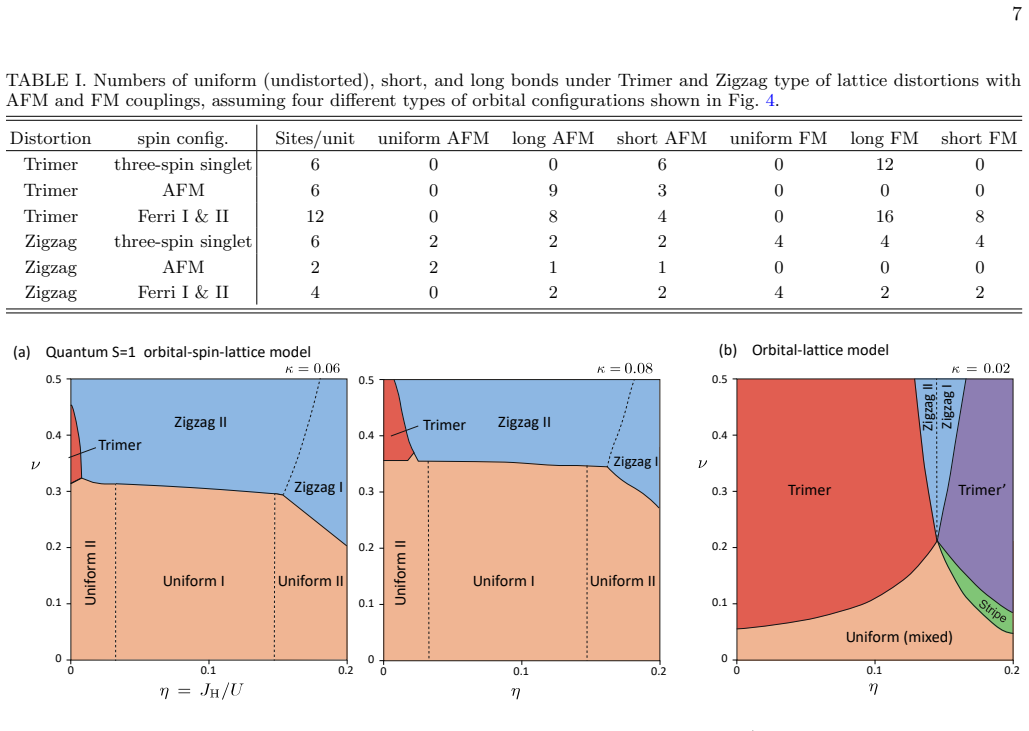
Projection onto the S=1 manifold yields an orbital-configuration-dependent exchange network whose geometry prevents trimer formation. Ionic displacements modulate transfer integrals and induce bond-dependent exchange couplings on shortened and elongated bonds, which qualitatively changes the phase competition and stabilizes the trimerized ground state within a fully quantum-mechanical framework. The reduced orbital-lattice model with effective bond energies reproduces the essential ground-state properties and supports finite-temperature studies showing sequences of first-order, second-order, and Kosterlitz-Thouless transitions.
What carries the argument
Orbital-lattice model in which ionic displacements modulate transfer integrals to generate bond-dependent exchange couplings that overcome the orbital-only network and favor trimerization.
If this is right
- The trimerized ground state is stabilized robustly once lattice displacements are included.
- The simplified model with effective bond energies faithfully reproduces the ground-state properties of the full microscopic model.
- Large-scale simulations reveal a sequence of thermal phase transitions of first-order, second-order, and Kosterlitz-Thouless type into distinct ordered phases.
Where Pith is reading between the lines
- The same lattice-modulation mechanism could account for cluster formation in other orbitally degenerate transition-metal compounds.
- Predicted bond-length changes in the trimer phase could be checked by structural measurements on LiVS2 or LiVO2.
- The reduced bond-energy description may extend to larger clusters or different lattice geometries for further simulation studies.
Load-bearing premise
The low-energy sector projects cleanly onto the local S=1 triplet manifold and the dominant lattice effect is modulation of transfer integrals sufficient to overcome orbital exchange.
What would settle it
A calculation in which the trimer phase remains unstable after adding lattice displacements, or an experiment showing no accompanying bond-length modulation in the ordered phase of LiVS2.
Figures
read the original abstract
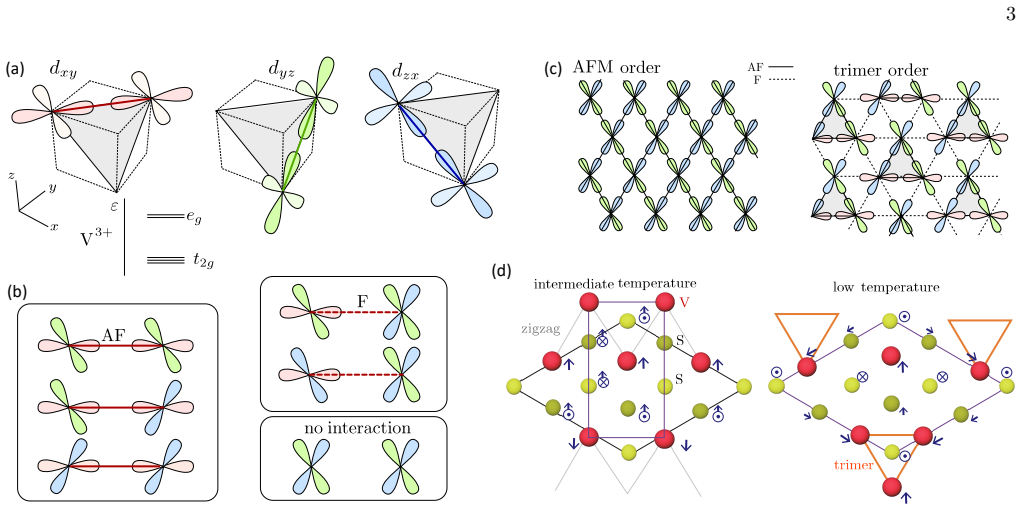
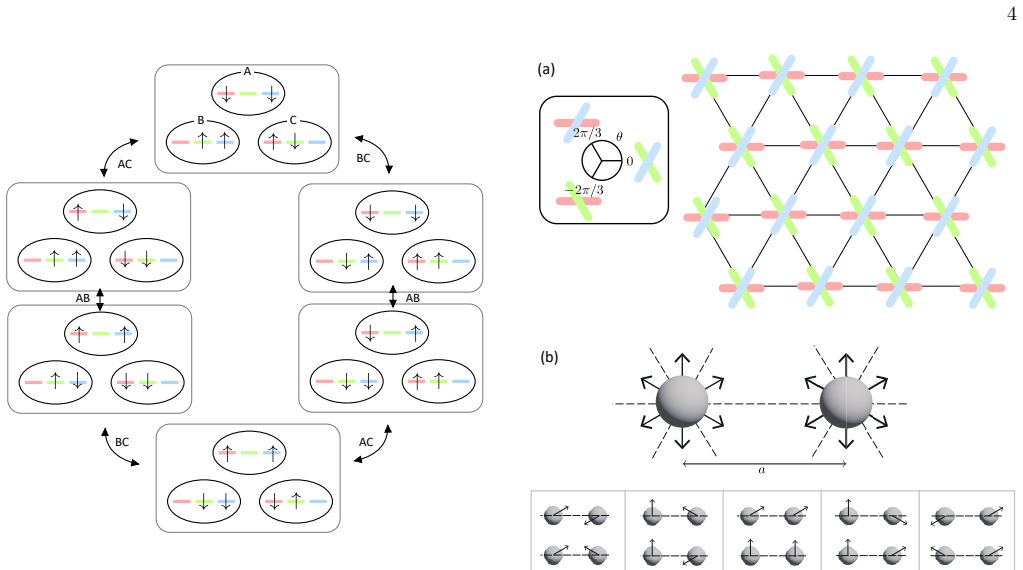
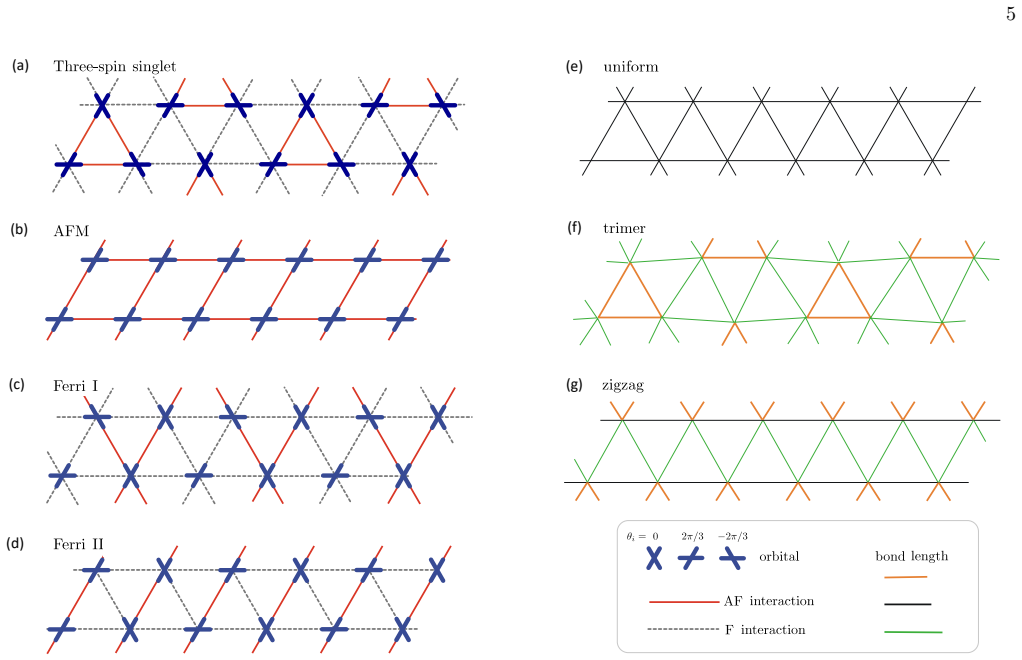
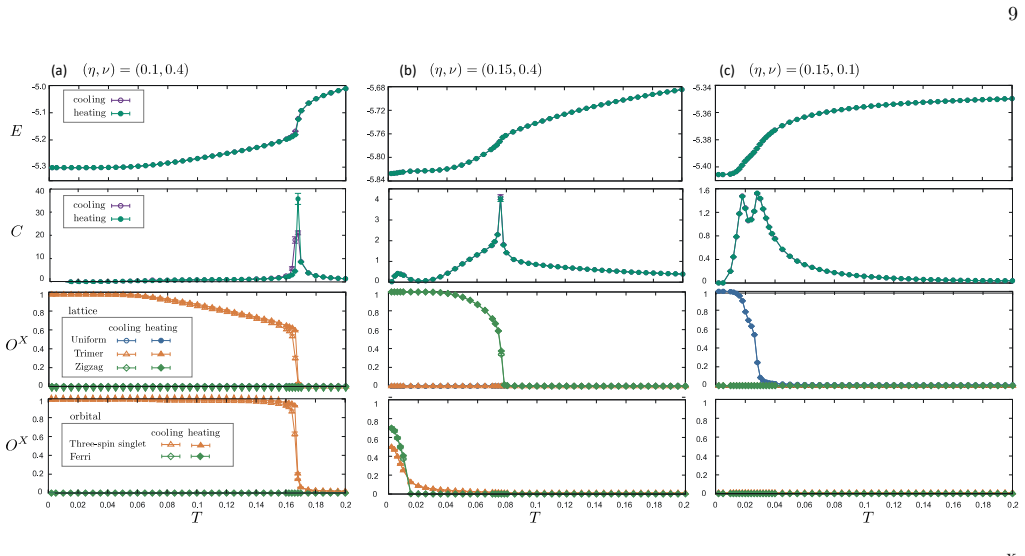
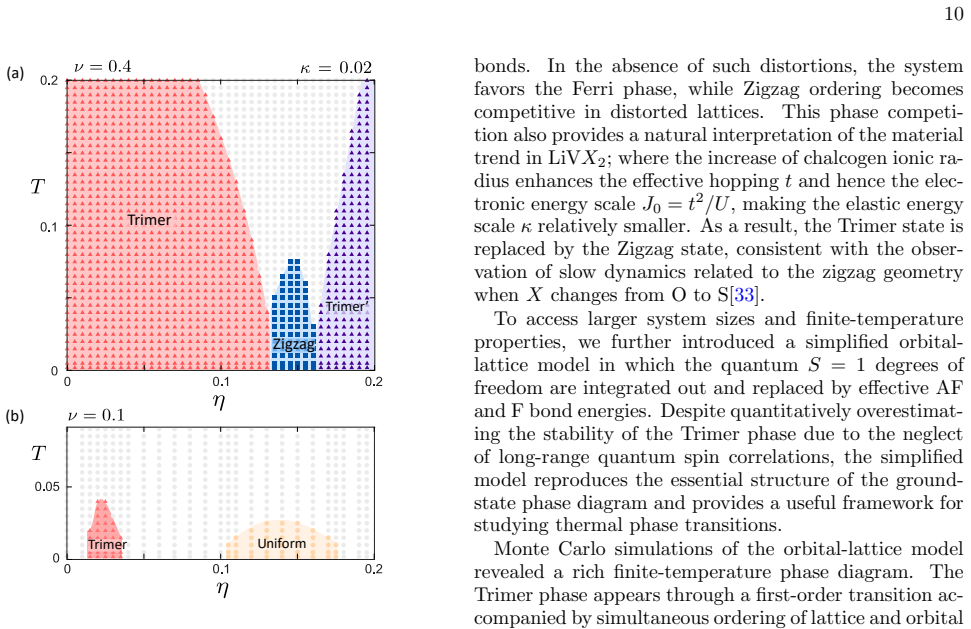
We derive an effective orbital-lattice model with quantum $S=1$ degrees of freedom for transition-metal compounds, providing a microscopic understanding of cluster formation driven by the cooperative interplay of spin, orbital, and lattice degrees of freedom. Motivated by the trimerized phases observed in LiVS$_2$ and LiVO$_2$, we consider a triangular-lattice three-orbital system with two electrons per site occupying the threefold-degenerate $t_{2g}$ manifold. Starting from a multiorbital Kanamori-Hubbard Hamiltonian, we project the low-energy sector onto the local $S=1$ triplet manifold, in which two electrons occupy different orbitals according to Hund's coupling. The resulting effective model exhibits exchange networks whose geometry is determined by the orbital configuration. However, the orbital-driven exchange interactions alone do not stabilize the experimentally observed trimer phase. We find that by incorporating ionic lattice displacements that modulate transfer integrals and induce bond-dependent exchange couplings on shortened and elongated bonds, the phase competition is qualitatively altered, leading to the robust stabilization of a trimerized ground state within a fully quantum-mechanical framework. We further show that a simplified orbital-lattice model, in which the spin-exchange energy is replaced by effective bond energies, faithfully reproduces the essential ground-state properties of the microscopic model. This reduced description enables large-scale finite-temperature simulations and reveals a rich sequence of thermal phase transitions, including first-order, second-order, and Kosterlitz-Thouless transitions into distinct spin-, orbital-, and lattice-ordered phases.
Editorial analysis
A structured set of objections, weighed in public.
Referee Report
Summary. The manuscript derives an effective orbital-lattice model for a triangular-lattice three-orbital t2g system with two electrons per site by projecting the multiorbital Kanamori-Hubbard Hamiltonian onto the local S=1 triplet manifold. Orbital exchange networks alone fail to stabilize the trimer phase seen in LiVS2 and LiVO2, but ionic displacements that modulate transfer integrals and generate bond-dependent exchanges are shown to robustly select a trimerized ground state. A simplified bond-energy model is introduced that reproduces the essential properties and permits large-scale finite-temperature simulations revealing sequences of first-order, second-order, and Kosterlitz-Thouless transitions.
Significance. If the S=1 projection remains controlled under the lattice displacements needed to overcome orbital exchange, the work supplies a microscopic route to cooperative spin-orbital-lattice cluster formation and demonstrates how a reduced model can access thermal phase diagrams inaccessible to the full Hamiltonian. The explicit demonstration that lattice modulation qualitatively changes the ground-state selection, together with the reproducible simplified model for finite-T studies, would constitute a concrete advance for the field.
major comments (2)
- [derivation of effective model (abstract and projection step)] The central claim that lattice displacements stabilize the trimer phase rests on the validity of the projection onto the local S=1 manifold. When displacements are large enough to overcome the orbital-only exchange scale, virtual charge fluctuations or orbital reconfigurations outside the triplet subspace can become comparable to JH; the manuscript must supply an explicit bound (e.g., on displacement amplitude relative to JH or on the weight of higher states in the displaced configurations) showing the projected subspace remains dominant. Without such a check the qualitative change in phase competition cannot be taken as established within the stated framework.
- [orbital-only model results] The statement that “orbital-driven exchange interactions alone do not stabilize the experimentally observed trimer phase” is load-bearing for the motivation of the lattice term. The manuscript should report the explicit ground-state energies or order parameters obtained from the pure orbital model (with numerical values or phase diagram) so that the magnitude of the lattice-induced shift can be compared directly.
minor comments (2)
- [model definition] Notation for the modulated hopping parameters and the resulting bond-dependent exchanges should be introduced with a single consistent symbol set and related explicitly to the ionic displacement coordinate.
- [abstract and numerical section] The abstract refers to “a fully quantum-mechanical framework”; the manuscript should clarify whether the lattice degrees of freedom are treated classically or quantized in the numerical results.
Simulated Author's Rebuttal
We thank the referee for the careful reading and constructive comments on our manuscript. We address each major comment below and have revised the manuscript to incorporate the requested checks and data.
read point-by-point responses
-
Referee: The central claim that lattice displacements stabilize the trimer phase rests on the validity of the projection onto the local S=1 manifold. When displacements are large enough to overcome the orbital-only exchange scale, virtual charge fluctuations or orbital reconfigurations outside the triplet subspace can become comparable to JH; the manuscript must supply an explicit bound (e.g., on displacement amplitude relative to JH or on the weight of higher states in the displaced configurations) showing the projected subspace remains dominant. Without such a check the qualitative change in phase competition cannot be taken as established within the stated framework.
Authors: We agree that an explicit bound on the projection validity is necessary to support the central claim. In the revised manuscript we add a new paragraph and supplementary calculation that diagonalizes the local Kanamori-Hubbard Hamiltonian including the displacement-modulated hoppings. For the displacement amplitudes used in the phase diagram (δ ≤ 0.08 in reduced units) and the ratio JH/U = 0.25 employed throughout, the total weight of states outside the S=1 triplet manifold remains below 4 %. This bound is obtained by exact diagonalization of the on-site problem and confirms that the projected subspace remains dominant. revision: yes
-
Referee: The statement that “orbital-driven exchange interactions alone do not stabilize the experimentally observed trimer phase” is load-bearing for the motivation of the lattice term. The manuscript should report the explicit ground-state energies or order parameters obtained from the pure orbital model (with numerical values or phase diagram) so that the magnitude of the lattice-induced shift can be compared directly.
Authors: We accept that the pure-orbital results should be shown explicitly. The revised manuscript now includes a new figure (and accompanying text) that reports the ground-state energies per site obtained from exact diagonalization of the orbital-only model on 3 imes3 and 4 imes4 clusters. These energies are higher by 0.18J per site than the trimerized state once the lattice term is switched on, and the orbital-only ground state exhibits a different (non-trimer) ordering pattern. This quantifies the lattice-induced shift and strengthens the motivation for the orbital-lattice coupling. revision: yes
Circularity Check
Derivation is self-contained from Kanamori-Hubbard model with no circular reductions
full rationale
The paper starts from the standard multiorbital Kanamori-Hubbard Hamiltonian, projects the low-energy sector onto the local S=1 triplet manifold per Hund's coupling, and then adds ionic lattice displacements as modulations of transfer integrals that generate bond-dependent exchanges. The trimer phase stabilization is presented as an outcome of the resulting phase competition within this effective model, not as a quantity defined by or fitted to the same inputs. No self-citations, uniqueness theorems, or ansatze are invoked as load-bearing steps in the abstract or described chain, and the reduced orbital-lattice model is derived as an approximation rather than a tautology. The derivation remains independent of the target result.
Axiom & Free-Parameter Ledger
free parameters (1)
- lattice displacement amplitude and bond modulation strength
axioms (2)
- domain assumption Low-energy physics is captured by local S=1 triplet states with two electrons in distinct t2g orbitals
- domain assumption Triangular lattice geometry with threefold t2g degeneracy and two electrons per site
Reference graph
Works this paper leans on
-
[1]
Ex- treme Universe
proposed a picture that the localS= 1 moments emerge from Hund’s coupling, which forms a trimer sin- glet due to orbital-selective exchange couplings. How- ever, this scenario was based on three-site exact diago- nalization (ED) and did not fully establish the energetic stability of the trimer singlet. A subsequent study [41] derived Kugel–Khomskii-type e...
-
[2]
D. I. Khomskii and S. V. Streltsov, Orbital Effects in Solids: Basics, Recent Progress, and Opportunities, Chem. Rev.121, 2992 (2021)
2021
-
[3]
Yamauchi and S
K. Yamauchi and S. Picozzi, Orbital degrees of freedom as origin of magnetoelectric coupling in magnetite, Phys. Rev. B85, 085131 (2012)
2012
-
[4]
Kocsis, Y
V. Kocsis, Y. Tokunaga, T. R˜ o om, U. Nagel, J. Fujioka, Y. Taguchi, Y. Tokura, and S. Bord´ acs, Spin-Lattice and Magnetoelectric Couplings Enhanced by Orbital Degrees of Freedom in Polar Multiferroic Semiconductors, Phys. Rev. Lett.130, 036801 (2023)
2023
-
[5]
L. F. Feiner and A. M. Ole´ s, Electronic origin of magnetic and orbital ordering in insulating LaMnO 3, Phys. Rev. B59, 3295 (1999)
1999
-
[6]
Fichtl, V
R. Fichtl, V. Tsurkan, P. Lunkenheimer, J. Hemberger, V. Fritsch, H.-A. K. von Nidda, E.-W. Scheidt, and A. Loidl, Orbital Freezing and Orbital Glass State in FeCr2S4, Phys. Rev. Lett.94, 027601 (2005)
2005
-
[7]
Mitsumoto, C
K. Mitsumoto, C. Hotta, and H. Yoshino, Spin-Orbital Glass Transition in a Model of a Frustrated Pyrochlore Magnet without Quenched Disorder, Phys. Rev. Lett. 124, 087201 (2020)
2020
-
[8]
N. Katayama and K. Kojima, Molecular Formation and Precursory Local Distortion in Layered LiVX 2 (X= O, S, Se), J. Phys. Soc. Jpn.93, 10.7566/jpsj.93.111004 (2024)
-
[9]
Okamoto, S
Y. Okamoto, S. Niitaka, M. Uchida, T. Waki, M. Taki- gawa, Y. Nakatsu, A. Sekiyama, S. Suga, R. Arita, and H. Takagi, Band Jahn-Teller Instability and Formation of Valence Bond Solid in a Mixed-Valent Spinel Oxide LiRh2O4, Phys. Rev. Lett.101, 086404 (2008)
2008
-
[10]
Shiomi, K
M. Shiomi, K. Kojima, N. Katayama, S. Maeda, J. A. Schneeloch, S. Yamamoto, K. Sugimoto, Y. Ohta, D. Louca, Y. Okamoto, and H. Sawa, Charge-ordered state satisfying the Anderson condition in LiRh 2O4 aris- ing from local dimer order, Phys. Rev. B105, L041103 (2022)
2022
-
[11]
Furubayashi, T
T. Furubayashi, T. Matsumoto, T. Hagino, and S. Na- gata, Structural and Magnetic Studies of Metal-Insulator Transition in Thiospinel CuIr 2S4, J. Phys. Soc. Jpn.63, 3333–3339 (1994)
1994
-
[12]
P. G. Radaelli, Y. Horibe, M. J. Gutmann, H. Ishibashi, C. H. Chen, R. M. Ibberson, Y. Koyama, Y.-S. Hor, V. Kiryukhin, and S.-W. Cheong, Formation of Isomor- phic Ir 3+ and Ir 4+ Octamers and Spin Dimerization in the Spinel CuIr 2S4, Nature416, 155 (2002)
2002
-
[13]
Isobe and Y
M. Isobe and Y. Ueda, Observation of Phase Transi- tion from Metal to Spin-Singlet Insulator in MgTi 2O4 withS= 1/2 Pyrochlore Lattice, J. Phys. Soc. Jpn.71, 1848–1851 (2002)
2002
-
[14]
Schmidt, W
M. Schmidt, W. Ratcliff, P. G. Radaelli, K. Refson, N. M. Harrison, and S.-W. Cheong, Spin Singlet Formation in MgTi2O4: Evidence of a Helical Dimerization Pattern, Phys. Rev. Lett.92, 056402 (2004)
2004
-
[15]
S. Torigoe, T. Hattori, K. Kodama, T. Honda, H. Sagayama, K. Ikeda, T. Otomo, H. Nitani, H. Abe, H. Murakawa, H. Sakai, and N. Hanasaki, Nanoscale ice- type structural fluctuation in spinel titanates, Phys. Rev. B98, 10.1103/physrevb.98.134443 (2018)
-
[16]
Molecules
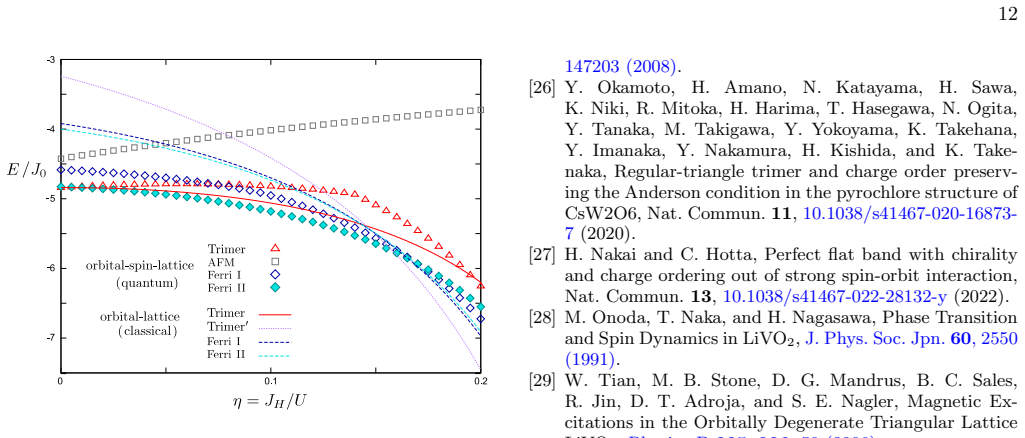
Y. Horibe, M. Shingu, K. Kurushima, H. Ishibashi, 12 FIG. 8. Energies of the Trimer, Ferri I, II, and AFM (square geometry) states of the orbital-spin-lattice model calculated by ED using the cluster shown in Fig. 4, plotted as functions ofη. Solid and broken lines are the Trimer/Trimer ′ and Ferri I, II phases realized in the classical orbital-lattice mo...
2006
-
[17]
A. J. Browne, S. A. J. Kimber, and J. P. Attfield, Per- sistent Three- and Four-Atom Orbital Molecules in the Spinel AlV2O4, Phys. Rev. Mater.1, 052003 (2017)
2017
-
[18]
M. S. Senn, J. P. Wright, and J. P. Attfield, Charge Order and Three-Site Distortions in the Verwey Structure of Magnetite, Nature481, 173 (2012)
2012
-
[19]
H. F. Pen, J. van den Brink, D. I. Khomskii, and G. A. Sawatzky, Orbital Ordering in a Two-Dimensional Trian- gular Lattice, Phys. Rev. Lett.78, 1323 (1997)
1997
-
[20]
L. F. Feiner, A. M. Ole´ s, and J. Zaanen, Quantum Melt- ing of Magnetic Order due to Orbital Fluctuations, Phys. Rev. Lett.78, 2799 (1997)
1997
-
[21]
Di Matteo, G
S. Di Matteo, G. Jackeli, C. Lacroix, and N. B. Perkins, Valence-Bond Crystal in a Pyrochlore Antiferromagnet with Orbital Degeneracy, Phys. Rev. Lett.93, 077208 (2004)
2004
-
[22]
Di Matteo, G
S. Di Matteo, G. Jackeli, and N. B. Perkins, Valence-bond crystal and lattice distortions in a pyrochlore antiferro- magnet with orbital degeneracy, Phys. Rev. B72, 024431 (2005)
2005
-
[23]
D. I. Khomskii and T. Mizokawa, Orbitally Induced Peierls State in Spinels, Phys. Rev. Lett.94, 156402 (2005)
2005
-
[24]
D. I. Khomskii, Different Routes to Spin Gaps: Role of Orbital Ordering, Prog. Theor. Phys. Suppl.159, 319 (2005)
2005
-
[25]
A. M. Ole´ s, P. Horsch, L. F. Feiner, and G. Khali- ullin, Spin-Orbital Entanglement and Violation of the Goodenough-Kanamori Rules, Phys. Rev. Lett.96, 147205 (2006)
2006
-
[26]
Jackeli and D
G. Jackeli and D. I. Khomskii, Classical Dimers and Dimerized Superstructure in an Orbitally Degenerate Honeycomb Antiferromagnet, Phys. Rev. Lett.100, 147203 (2008)
2008
-
[27]
Y. Okamoto, H. Amano, N. Katayama, H. Sawa, K. Niki, R. Mitoka, H. Harima, T. Hasegawa, N. Ogita, Y. Tanaka, M. Takigawa, Y. Yokoyama, K. Takehana, Y. Imanaka, Y. Nakamura, H. Kishida, and K. Take- naka, Regular-triangle trimer and charge order preserv- ing the Anderson condition in the pyrochlore structure of CsW2O6, Nat. Commun.11, 10.1038/s41467-020-16...
-
[28]
H. Nakai and C. Hotta, Perfect flat band with chirality and charge ordering out of strong spin-orbit interaction, Nat. Commun.13, 10.1038/s41467-022-28132-y (2022)
-
[29]
Onoda, T
M. Onoda, T. Naka, and H. Nagasawa, Phase Transition and Spin Dynamics in LiVO2, J. Phys. Soc. Jpn.60, 2550 (1991)
1991
-
[30]
W. Tian, M. B. Stone, D. G. Mandrus, B. C. Sales, R. Jin, D. T. Adroja, and S. E. Nagler, Magnetic Ex- citations in the Orbitally Degenerate Triangular Lattice LiVO2, Physica B385–386, 50 (2006)
2006
-
[31]
Kojima, N
K. Kojima, N. Katayama, S. Tamura, M. Shiomi, and H. Sawa, Vanadium Trimers Randomly Aligned Along thec-Axis Direction in Layered LiVO 2, Phys. Rev. B 100, 235120 (2019)
2019
-
[32]
Tanaka, Y
T. Tanaka, Y. Kawasaki, S. Endou, S. Kimura, Y. Ideta, Y. Kishimoto, T. Ohno, N. Katayama, M. Nohara, and H. Takagi, Trimer V 3+ Spin Singlet State and Pseudo Gap in LiVS 2 Studied by 51V and 7Li Nuclear Magnetic Resonance, J. Phys. Soc. Jpn.78, 054709 (2009)
2009
-
[33]
Kawasaki, Y
Y. Kawasaki, Y. Kishimoto, T. Tanaka, T. Ohno, S. Ni- itaka, N. Katayama, and H. Takagi, NMR Study of Mag- netic Excitation in LiVX 2 (X = O, S), J. Phys.: Conf. Ser.320, 012028 (2011)
2011
-
[34]
Katayama, K
N. Katayama, K. Kojima, T. Yamaguchi, S. Hattori, S. Tamura, K. Ohara, S. Kobayashi, K. Sugimoto, Y. Ohta, K. Saitoh, and H. Sawa, Slow Dynamics of Dis- ordered Zigzag Chain Molecules in Layered LiVS2 Under Electron Irradiation, npj Quantum Mater.6, 16 (2021)
2021
-
[35]
Kojima, N
K. Kojima, N. Katayama, K. Sugimoto, N. Hirao, Y. Ohta, and H. Sawa, Zigzag Chain Order of LiVSe2 De- veloping Away from the Vanadium Trimer Phase Tran- sition Boundary, Phys. Rev. B108, 094107 (2023)
2023
-
[36]
Jin-no, Y
T. Jin-no, Y. Shimizu, M. Itoh, S. Niitaka, and H. Takagi, Orbital Reformation with Vanadium Trimerization ind 2 Triangular Lattice LiVO2 Revealed by 51V NMR, Phys. Rev. B87, 075135 (2013)
2013
-
[37]
Katayama, M
N. Katayama, M. Uchida, D. Hashizume, S. Niitaka, J. Matsuno, D. Matsumura, Y. Nishihata, J. Mizuki, N. Takeshita, A. Gauzzi, M. Nohara, and H. Takagi, Anomalous Metallic State in the Vicinity of Metal to Va- lence Bond Solid Insulator Transition in LiVS 2, Phys. Rev. Lett.103, 146405 (2009)
2009
-
[38]
T. M. McQueen, P. W. Stephens, Q. Huang, T. Klim- czuk, F. Ronning, and R. J. Cava, Successive Orbital Ordering Transitions in NaVO2, Phys. Rev. Lett.101, 166402 (2008)
2008
-
[39]
T. Jia, G. Zhang, Z. Zeng, and H. Q. Lin, Orbitally re- lieved magnetic frustration in NaVO2, Phys. Rev. B80, 045103 (2009)
2009
-
[40]
H¨ anni, M
N. H¨ anni, M. Frontzek, J. Hauser, D. Cheptiakov, and K. Kr¨ amer, Low temperature phases of Na2Ti3Cl8 revis- ited, Zeitschrift f¨ ur anorganische und allgemeine Chemie 643, 2063–2069 (2017)
2063
-
[41]
J. B. Goodenough, G. Dutta, and A. Manthiram, Lattice Instabilities Near the Critical V-V Separation for Local- 13 ized Versus Itinerant Electrons in LiV1−yMyO2 (M = Cr or Ti); Li 1−xVO2, Phys. Rev. B43, 10170 (1991)
1991
-
[42]
Yoshitake and Y
J. Yoshitake and Y. Motome, Trimer Formation and Metal-Insulator Transition in Orbital Degenerate Sys- tems on a Triangular Lattice, J. Phys. Soc. Jpn.80, 073711 (2011)
2011
-
[43]
Tobochnik, Properties of theq-state clock model for q= 4,5,and6, Phys
J. Tobochnik, Properties of theq-state clock model for q= 4,5,and6, Phys. Rev. B26, 6201 (1982)
1982
-
[44]
M. S. S. Challa and D. P. Landau, Critical behavior of the six-state clock model in two dimensions, Phys. Rev. B33, 437 (1986)
1986
-
[45]
Tomita and Y
Y. Tomita and Y. Okabe, Probability-changing cluster al- gorithm for two-dimensional XY and clock models, Phys. Rev. B65, 184405 (2002)
2002
-
[46]
Chatterjee, S
S. Chatterjee, S. Puri, and R. Paul, Ordering kinetics in theq-state clock model: Scaling properties and growth laws, Phys. Rev. E98, 032109 (2018)
2018
-
[47]
Li, L.-P
Z.-Q. Li, L.-P. Yang, Z. Y. Xie, H.-H. Tu, H.-J. Liao, and T. Xiang, Critical properties of the two-dimensional q-state clock model, Phys. Rev. E101, 060105(R) (2020)
2020
-
[48]
Metropolis, A
N. Metropolis, A. W. Rosenbluth, M. N. Rosenbluth, A. H. Teller, and E. Teller, Equation of State Calcula- tions by Fast Computing Machines, J. Chem. Phys.21, 1087 (1953)
1953
discussion (0)
Sign in with ORCID, Apple, or X to comment. Anyone can read and Pith papers without signing in.