INI-VPINN: A Variational Physics-Informed Neural Network with Implicit Neumann and Interface Handling for Multi-Material Domains with Geometric Singularities
Pith reviewed 2026-06-26 23:53 UTC · model grok-4.3
The pith
INI-VPINN incorporates Neumann boundary and interface conditions directly into the variational formulation for multi-material domains.
A machine-rendered reading of the paper's core claim, the machinery that carries it, and where it could break.
Core claim
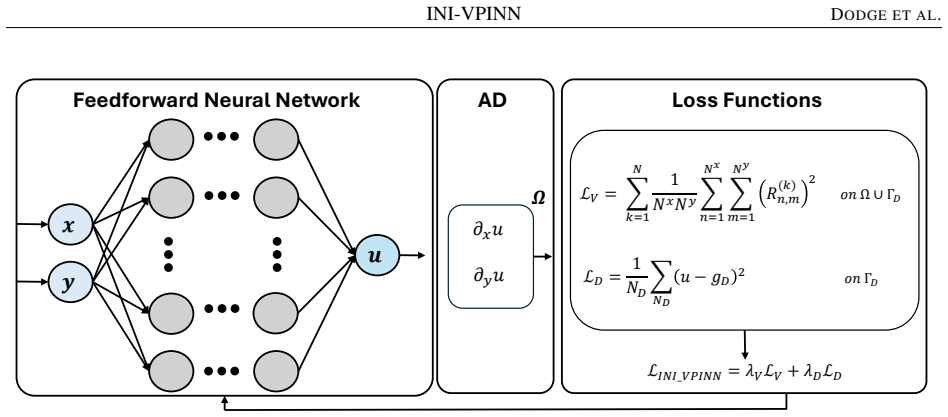
INI-VPINN naturally incorporates Neumann boundary and interface conditions into the variational formulation. It removes the need for additional loss terms or multiple subdomain networks. This framework employs compact support weighting functions and integration by parts to implicitly impose flux and continuity constraints, ensuring physical consistency across material boundaries without explicit enforcement.
What carries the argument
Compact support weighting functions combined with integration by parts, which transfer Neumann flux and interface continuity terms into the variational loss.
If this is right
- A single network suffices for mixed Neumann-Dirichlet multi-material problems without subdomain splitting.
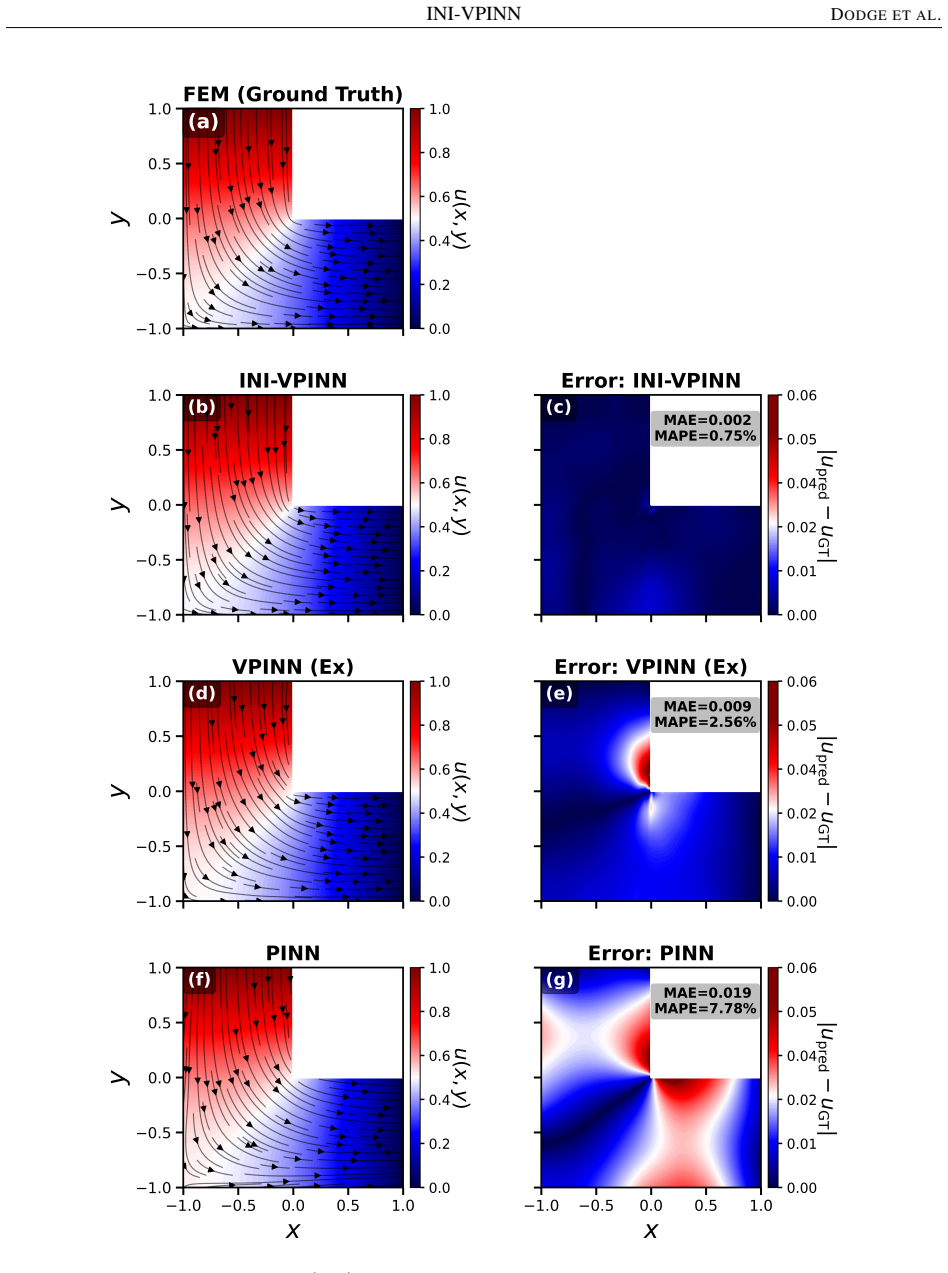
- Higher pointwise accuracy is obtained on Poisson and Laplace equations with sharp interfaces compared with other PINN formulations.
- Convergence becomes smoother and requires fewer iterations because interface penalties are absent.
- The same weak-form construction extends immediately to any linear elliptic operator whose weak form admits integration by parts.
Where Pith is reading between the lines
- The method could be applied to linear elasticity or Stokes flow by replacing the scalar test functions with appropriate vector or tensor versions.
- Because no interface-specific loss weights are tuned, the approach may reduce the hyperparameter search space in practical deployments.
- The compact-support construction might allow automatic differentiation libraries to evaluate the loss on unstructured meshes without additional coding for jump conditions.
Load-bearing premise
The weighting functions possess compact support so that integration by parts moves all boundary and interface contributions into the loss without leaving residual explicit terms that must still be enforced separately.
What would settle it
A manufactured multi-material Poisson problem with an exact analytic solution where the network output violates continuity of the normal derivative across the interface by more than the observed discretization error.
Figures
read the original abstract
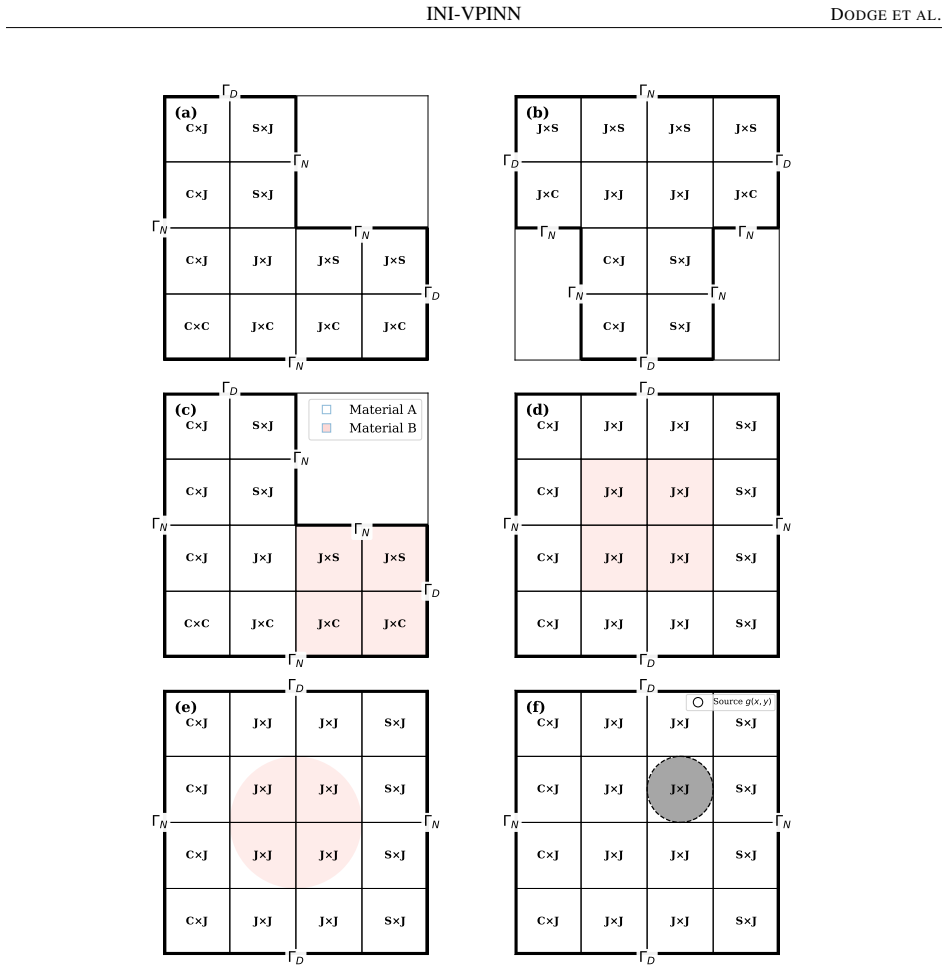
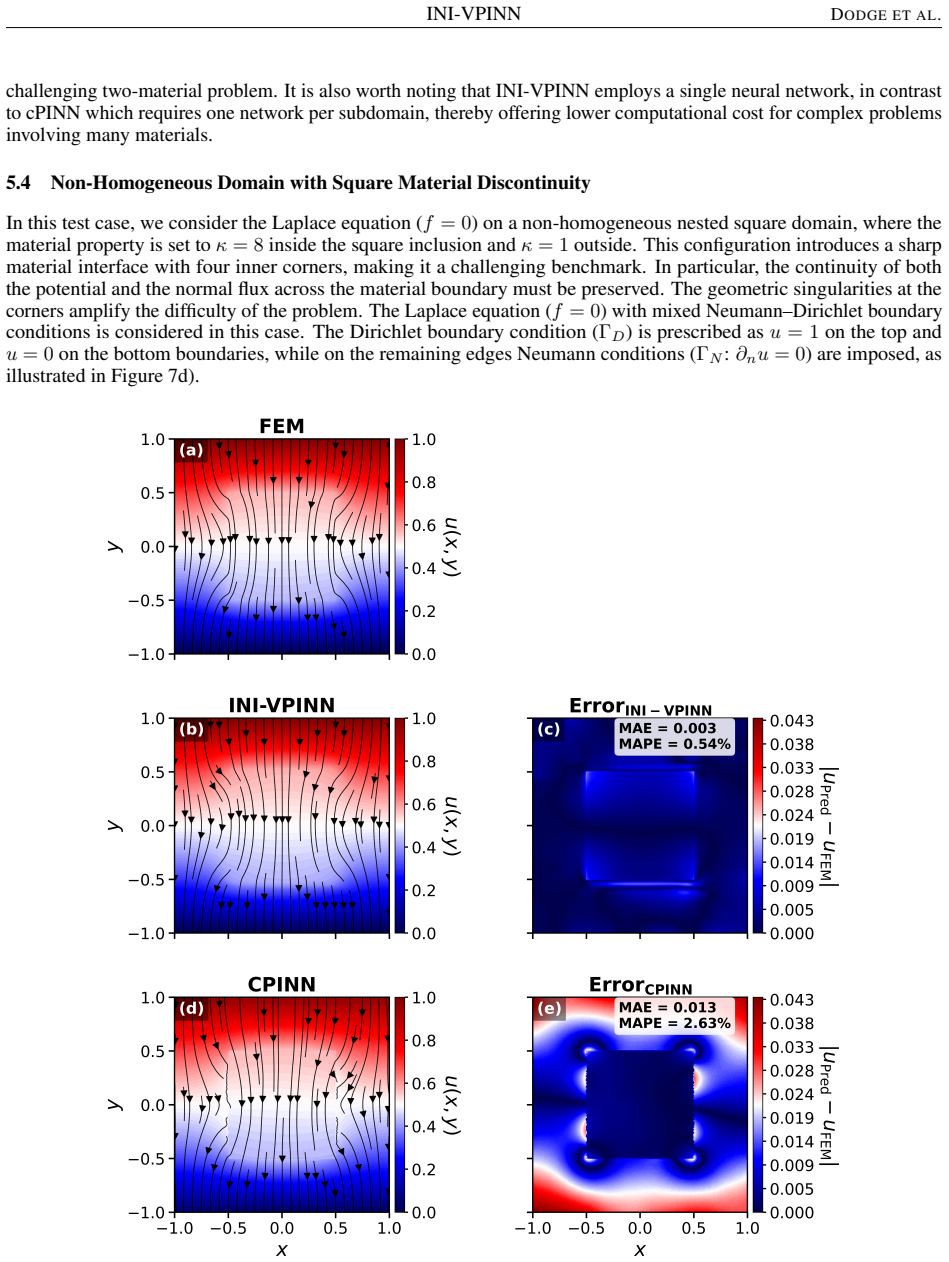
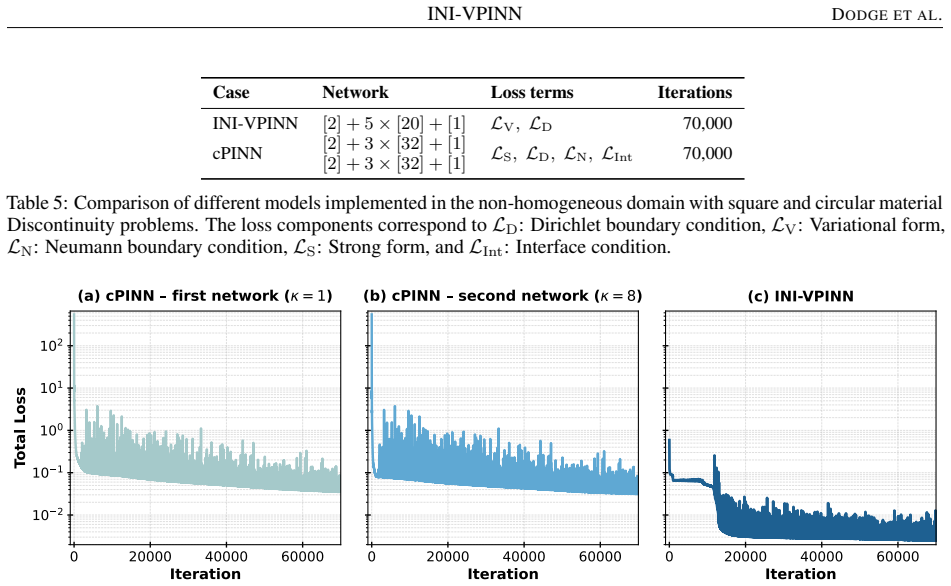
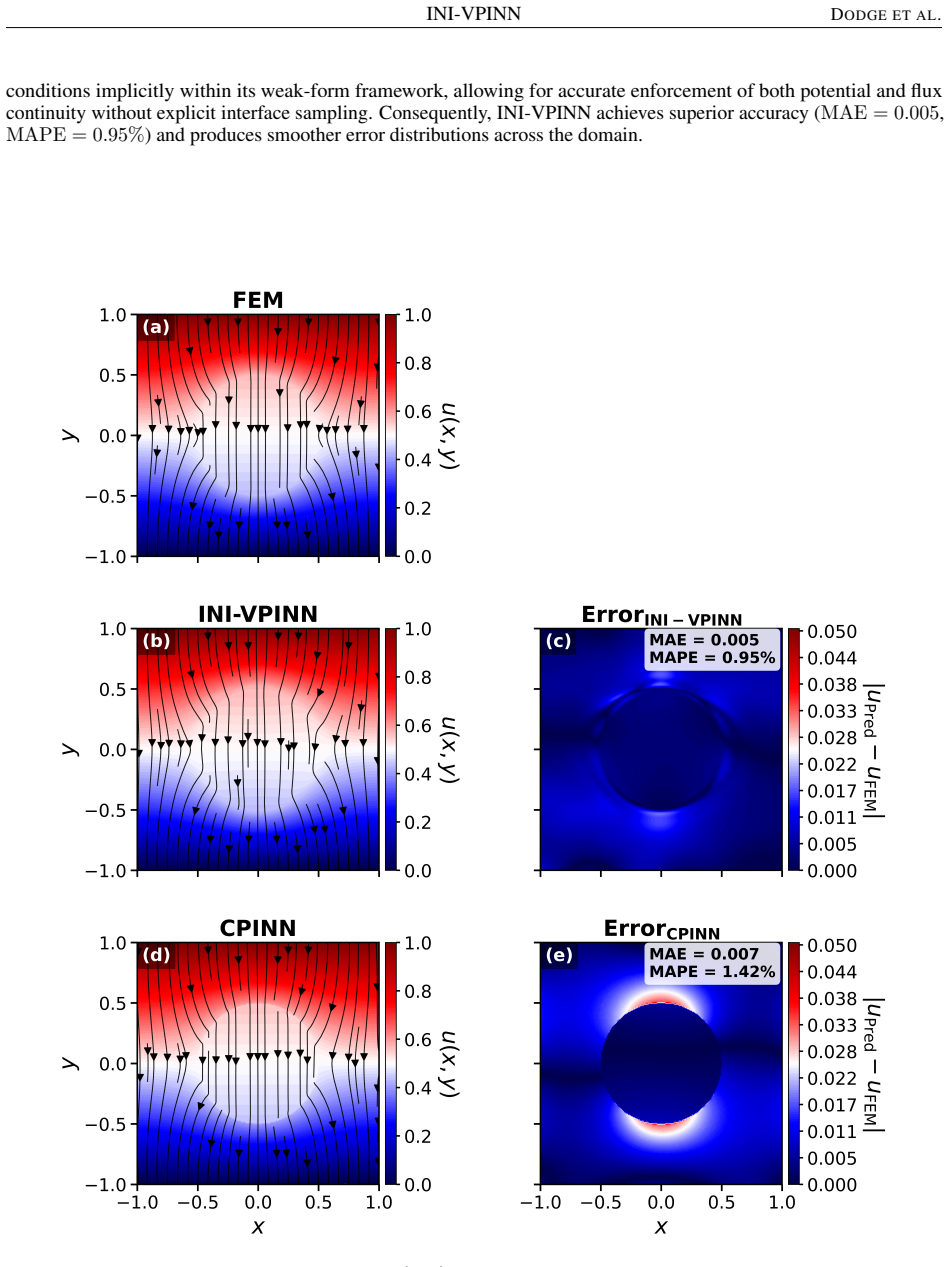
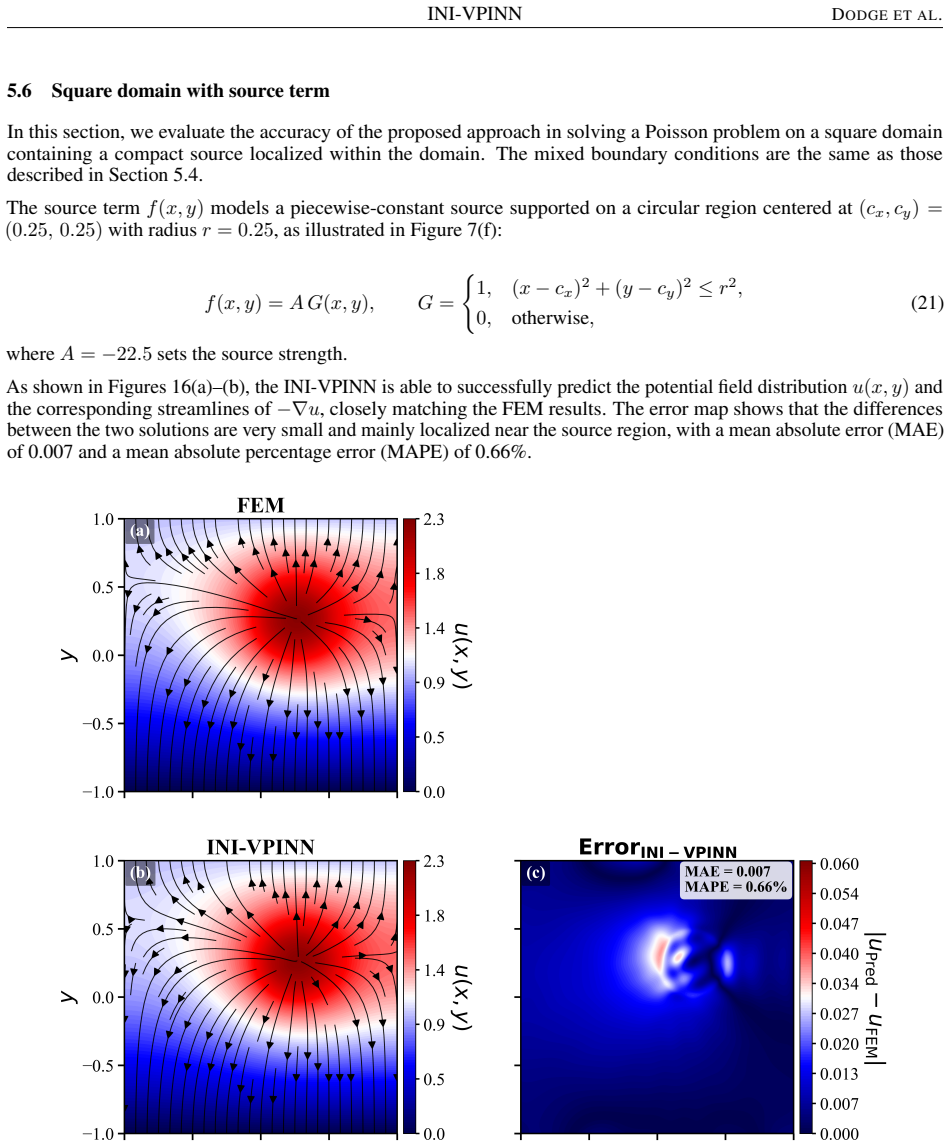
We propose a new weak-form Physics-Informed Neural Network approach (named INI-VPINN). INI-VPINN naturally incorporates Neumann boundary and interface conditions into the variational formulation. It removes the need for additional loss terms or multiple subdomain networks. This framework employs compact support weighting functions and integration by parts to implicitly impose flux and continuity constraints. In this way, it implicitly ensures physical consistency across material boundaries. The proposed method is tested on Poisson and Laplace problems with sharp interfaces and complex geometries. Results show that, compared with several other Physics Informed Neural Networks-based formulations, the INI-VPINN consistently achieves higher accuracy, smoother and faster convergence. The proposed framework provides a general approach for solving multimaterial problems with complex geometries and mixed Neumann-Dirichlet boundary conditions using neural networks. The implementation is publicly available in a GitHub repository.
Editorial analysis
A structured set of objections, weighed in public.
Referee Report
Summary. The manuscript proposes INI-VPINN, a variational physics-informed neural network that implicitly incorporates Neumann boundary conditions and interface continuity constraints for multi-material domains with geometric singularities. It achieves this via compact-support weighting functions and integration by parts in the weak form, eliminating explicit loss terms for fluxes or the need for multiple subdomain networks. The approach is demonstrated on Poisson and Laplace problems with sharp interfaces, claiming higher accuracy and smoother/faster convergence relative to other PINN formulations, with public code availability.
Significance. If the variational construction and numerical results hold, the method offers a streamlined, parameter-light framework for interface problems that aligns with standard weak-form treatments of flux continuity. This could reduce architectural complexity in PINN applications to multi-physics and multi-material settings while maintaining physical consistency, with the open implementation supporting reproducibility.
minor comments (2)
- [Abstract] Abstract: the claim of 'consistently achieves higher accuracy, smoother and faster convergence' is stated without any quantitative metrics, error tables, or convergence plots; these should be added or referenced to a specific results section/figure for substantiation.
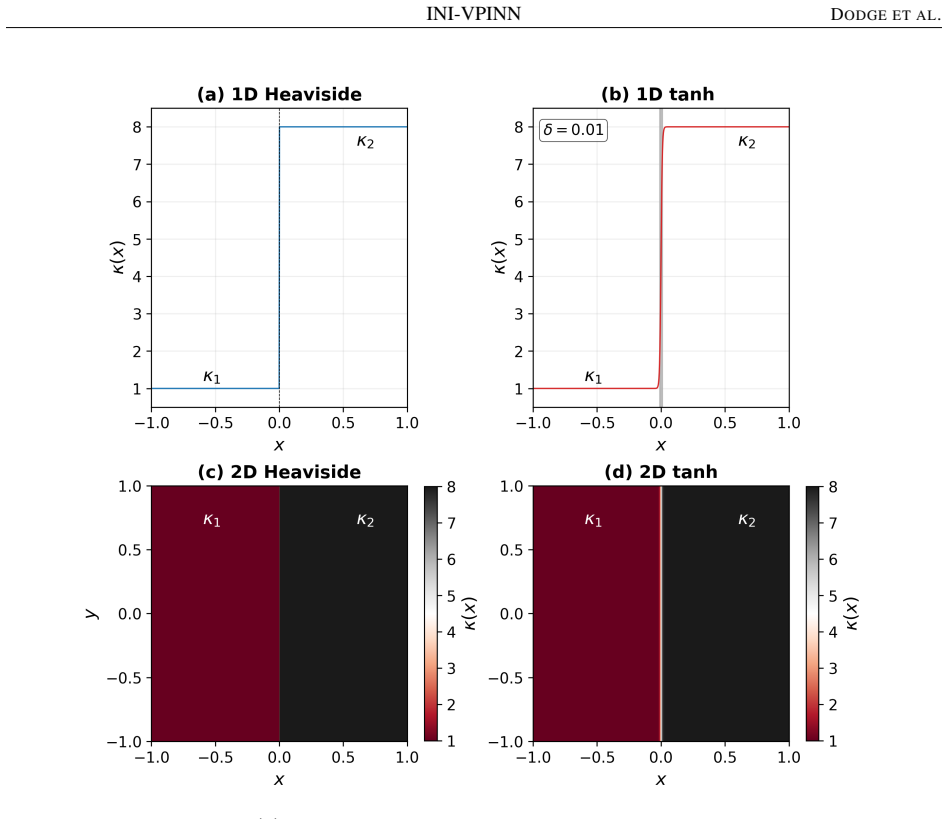
- [Methods] The description of 'compact support weighting functions' would benefit from an explicit definition or example in the methods section to clarify how support is chosen relative to interface geometry.
Simulated Author's Rebuttal
We thank the referee for their positive assessment of the INI-VPINN manuscript and the recommendation for minor revision. No specific major comments were provided in the report.
Circularity Check
No significant circularity
full rationale
The paper's central contribution is a reformulation of the variational loss for PINNs that uses compact-support test functions and integration by parts to embed Neumann and interface conditions directly. This is a standard weak-form construction and does not reduce any claimed prediction or uniqueness result to a fitted parameter or to a self-citation chain. No equations are shown to be equivalent by definition to their inputs, and the abstract and supplied context contain no load-bearing self-citations or ansatz smuggling. The derivation is therefore self-contained against external benchmarks.
Axiom & Free-Parameter Ledger
Reference graph
Works this paper leans on
-
[1]
Shayan Dodge, Sami Barmada, and Alessandro Formisano
doi:10.1109/TMAG.2025.3626152. Shayan Dodge, Sami Barmada, and Alessandro Formisano. A stacked adaptive residual pinn (star-pinn) approach to 2d time-domain magnetic diffusion in nonlinear materials. IEEE Access, 13:141380 – 141394,
-
[2]
doi:10.1109/ACCESS.2025.3597869
ISSN 2169-3536. doi:10.1109/ACCESS.2025.3597869. S Barmada, S Dodge, M Tucci, A Formisano, P Di Barba, and ME Mognaschi. A novel hybrid boundary element–physics informed neural network method for numerical solutions in electromagnetics. IEEE Access, 12:171444–171457,
-
[3]
doi:10.1109/ACCESS.2024.3500039. Y Chen and L Dal Negro. Physics-informed neural networks for imaging and parameter retrieval of photonic nanostructures from near-field data. APL Photonics, 7(1):010802,
-
[4]
Physics informed neural network for option pricing
A Dhiman and Y Hu. Physics informed neural network for option pricing. arXiv preprint arXiv:2312.06711,
-
[5]
Extended physics-informed neural networks (xpinns): A generalized space-time domain decomposition based deep learning framework for nonlinear partial differential equations
AD Jagtap and GE Karniadakis. Extended physics-informed neural networks (xpinns): A generalized space-time domain decomposition based deep learning framework for nonlinear partial differential equations. Communications in Computational Physics, 28(5):2002–2041,
2002
-
[6]
doi:10.1016/j.jcp.2021.110768. LD McClenny and UM Braga-Neto. Self-adaptive physics-informed neural networks. Journal of Computational Physics, 474:111722,
-
[7]
Ehsan Kharazmi, Zhongqiang Zhang, and George E
doi:10.1016/j.cma.2019.112790. Ehsan Kharazmi, Zhongqiang Zhang, and George E. Karniadakis. Variational physics-informed neural networks for solving partial differential equations. arXiv preprint arXiv:1912.00873,
-
[8]
Reza Khodayi-Mehr and Michael M
URL https://arxiv.org/abs/ 1912.00873. Reza Khodayi-Mehr and Michael M. Zavlanos. Varnet: Variational neural networks for the solution of partial differential equations. In Proceedings of the 2nd Conference on Learning for Dynamics and Control, volume 120 ofProceedings of Machine Learning Research, pages 298–307,
arXiv 1912
-
[9]
Yaohua Zang, Gang Bao, Xiaojing Ye, and Haomin Zhou
URLhttps://arxiv.org/abs/1912.07443. Yaohua Zang, Gang Bao, Xiaojing Ye, and Haomin Zhou. Weak adversarial networks for high-dimensional partial differential equations. Journal of Computational Physics, 411:109409,
arXiv 1912
-
[10]
doi:10.1016/j.jcp.2020.109409. 24 INI-VPINNDODGE ET AL. Rui Xu, Dongxiao Zhang, Miao Rong, and Nanzhe Wang. Weak form theory-guided neural network (tgnn-wf) for deep learning of subsurface single- and two-phase flow. Journal of Computational Physics, 436:110318,
-
[11]
doi:10.1016/j.jcp.2021.110318. Chuang Liu and HengAn Wu. cv-pinn: Efficient learning of variational physics-informed neural network with domain decomposition. Extreme Mechanics Letters, 63:102051,
-
[12]
Stefano Berrone, Claudio Canuto, Moreno Pintore, and N
doi:10.1016/j.eml.2023.102051. Stefano Berrone, Claudio Canuto, Moreno Pintore, and N. Sukumar. Enforcing dirichlet boundary conditions in physics-informed neural networks and variational physics-informed neural networks. Heliyon, 9(8):e18820,
-
[13]
Stefano Berrone and Moreno Pintore
doi:10.1016/j.heliyon.2023.e18820. Stefano Berrone and Moreno Pintore. Meshfree variational-physics-informed neural networks (mf-vpinn): An adaptive training strategy. Algorithms, 17(9):415,
-
[14]
Sergio Rojas, Paweł Maczuga, Judit Muñoz-Matute, David Pardo, and Maciej Paszy ´nski
doi:10.3390/a17090415. Sergio Rojas, Paweł Maczuga, Judit Muñoz-Matute, David Pardo, and Maciej Paszy ´nski. Robust variational physics-informed neural networks. Computer Methods in Applied Mechanics and Engineering, 425:116904,
-
[15]
doi:10.1016/j.cma.2024.116904. Vivek G. Patel and Nikunj V . Rachchh. Meshless method–review on recent developments.Materials Today: Proceedings, 26:1598–1603,
-
[16]
Ben-Yu Guo, Jie Shen, and Li-Lian Wang
doi:10.1016/j.matpr.2019.12.333. Ben-Yu Guo, Jie Shen, and Li-Lian Wang. Optimal spectral-galerkin methods using generalized jacobi polynomials. Journal of Scientific Computing, 27(1):305–322,
-
[17]
arXiv:1412.6980. Eid H. Doha, Ali H. Bhrawy, Mohamed A. Abdelkawy, and Robert A. Van Gorder. Jacobi–gauss–lobatto collocation method for the numerical solution of 1+1 nonlinear schrödinger equations. Journal of Computational Physics, 261: 244–255,
-
[18]
doi:10.1016/j.jcp.2014.01.003. 25
discussion (0)
Sign in with ORCID, Apple, or X to comment. Anyone can read and Pith papers without signing in.