High-temperature ferromagnetism and antiferromagnetism in monolayer ce{CrTe2}: Roles of strong spin-lattice coupling and charge doping
Pith reviewed 2026-06-26 22:30 UTC · model grok-4.3
The pith
Lattice strain and charge doping enable room-temperature ferromagnetism and antiferromagnetism in monolayer CrTe2.
A machine-rendered reading of the paper's core claim, the machinery that carries it, and where it could break.
Core claim
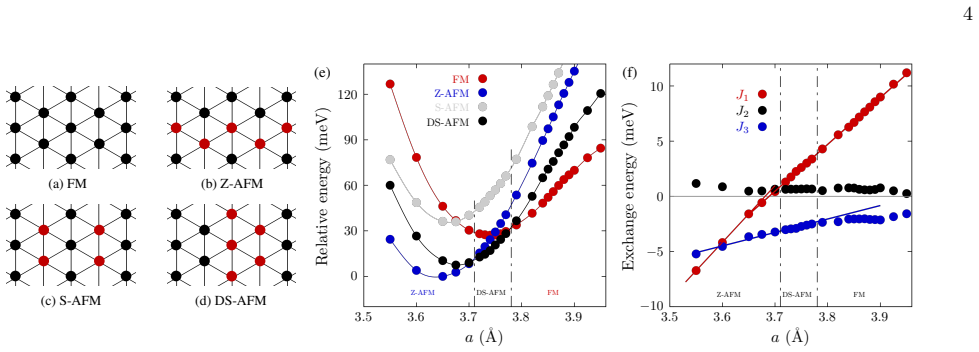
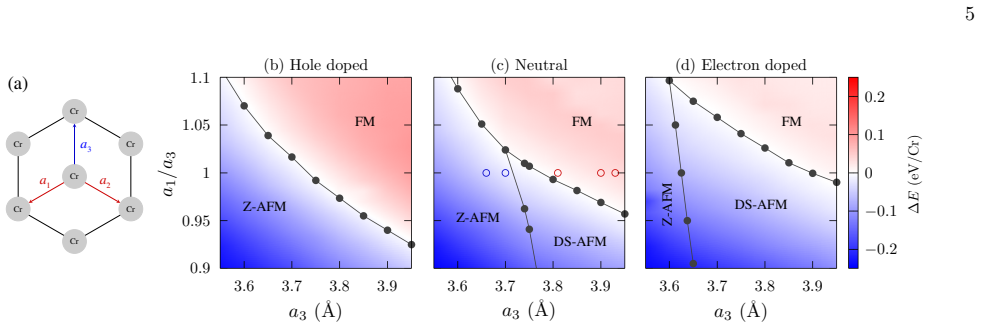
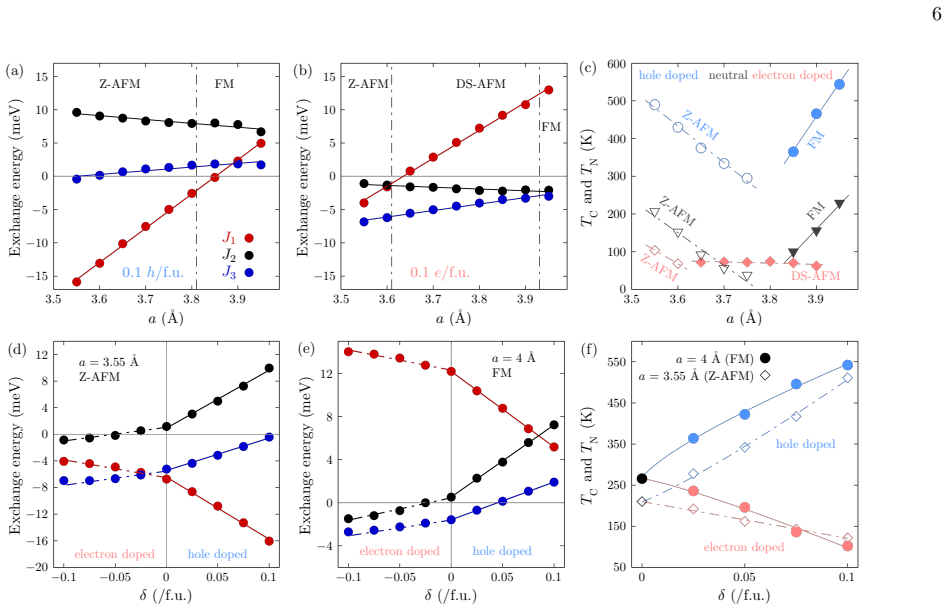
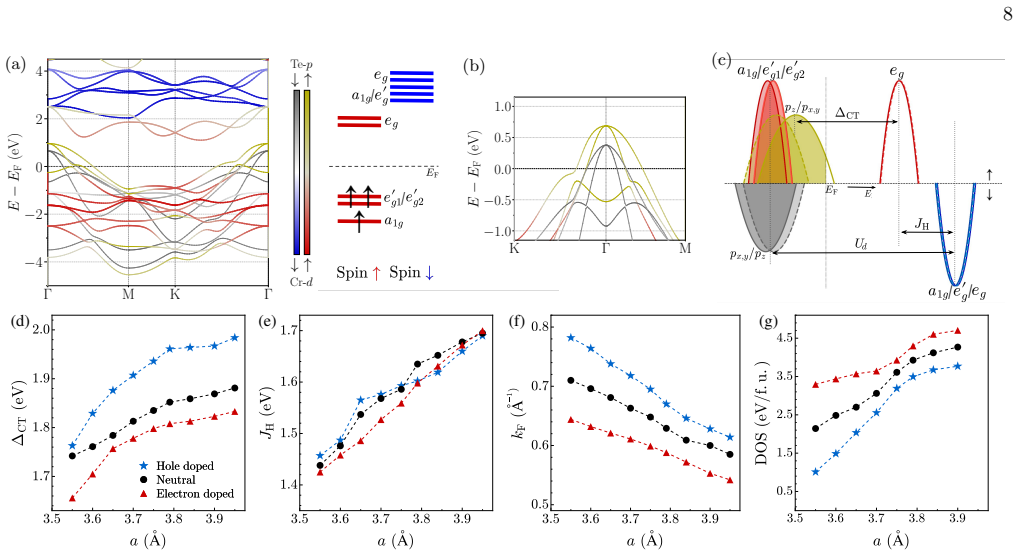
Structural and electronic perturbations enable room-temperature ferromagnetism and antiferromagnetism in monolayer CrTe2. This magnetic evolution arises from competing, highly tunable direct and ligand-mediated exchange interactions in the presence of Ruderman-Kittel-Kasuya-Yosida coupling, with a novel double-stripe antiferromagnetic phase further stabilized by electron doping.
What carries the argument
Competing direct and ligand-mediated exchange interactions tuned by lattice strain and carrier density in the presence of Ruderman-Kittel-Kasuya-Yosida coupling.
If this is right
- A rich magnetic phase diagram is governed by the interplay of lattice strain and carrier density.
- Electron doping stabilizes a novel double-stripe antiferromagnetic phase.
- Structural and electronic perturbations produce room-temperature ferromagnetism and antiferromagnetism.
- A colossal magnetoelastic response occurs under the relevant perturbations.
- Zone-folded Raman modes act as fingerprints for identifying the magnetic phases.
Where Pith is reading between the lines
- Electrical gating of carrier density could switch between ferromagnetic and antiferromagnetic states in a device setting.
- Raman spectroscopy on strained or doped samples could test the predicted phase diagram and Raman fingerprints.
- The same strain-plus-doping approach may extend to other monolayer transition-metal dichalcogenides with similar exchange competition.
- Device architectures could exploit the magnetoelastic coupling for strain-tunable spintronic elements.
Load-bearing premise
Exchange parameters extracted from zero-temperature calculations remain accurate when fed into classical Heisenberg Monte Carlo simulations to predict finite-temperature magnetic order.
What would settle it
Experimental measurements showing magnetic transition temperatures well below room temperature in strained or doped monolayer CrTe2 samples would falsify the room-temperature order predictions.
Figures
read the original abstract
The interplay of structural, electronic, and magnetic degrees of freedom governs phase stability and critical temperatures in two-dimensional magnets. Controlling this coupling is essential for advancing fundamental understanding and spintronic applications. Combining first-principles calculations with Heisenberg Monte Carlo simulations, we reveal a rich magnetic phase diagram governed by the interplay of lattice strain and carrier density. These results provide a unified framework that reconciles diverse experimental reports on epitaxial layers and predicts a novel double-stripe antiferromagnetic phase, further stabilized by electron doping. Moreover, structural and electronic perturbations enable room-temperature ferromagnetism and antiferromagnetism. This magnetic evolution arises from competing, highly tunable direct and ligand-mediated exchange interactions in the presence of Ruderman-Kittel-Kasuya-Yosida coupling. By disentangling their individual contributions, we elucidate the underlying microscopic mechanisms, which transcends the conventional conduction electron picture. Finally, we quantify the colossal magnetoelastic response and identify zone-folded Raman modes that serve as unique experimental fingerprints for phase identification. Together, these results establish \ce{CrTe2} as a versatile platform for two-dimensional spintronics, where magnetic order and transition temperatures are tailorable via structural and electrical engineering.
Editorial analysis
A structured set of objections, weighed in public.
Referee Report
Summary. The manuscript combines DFT calculations with classical Heisenberg Monte Carlo simulations to map the magnetic phase diagram of monolayer CrTe2 as a function of biaxial strain and carrier doping. It reports a novel double-stripe antiferromagnetic ground state stabilized by electron doping, competing direct, ligand-mediated, and RKKY exchange channels, and the emergence of room-temperature ferromagnetism and antiferromagnetism under structural and electronic perturbations. Strong spin-lattice coupling is invoked to explain a colossal magnetoelastic response and zone-folded Raman modes proposed as experimental fingerprints.
Significance. If the central results hold, the work supplies a unified microscopic picture that reconciles disparate experimental reports on epitaxial CrTe2 and identifies concrete routes (strain plus doping) to room-temperature order in a 2D magnet. The disentanglement of exchange mechanisms and the identification of Raman signatures constitute concrete, testable predictions that could guide spintronic device design.
major comments (1)
- [Computational Methods and Results sections] The workflow extracts J_ij from zero-temperature DFT and inserts them unchanged into classical Heisenberg Monte Carlo to obtain finite-temperature critical temperatures and phase boundaries (abstract and computational-methods section). The manuscript repeatedly stresses strong spin-lattice coupling and a colossal magnetoelastic response, which implies that the exchange parameters themselves should renormalize with temperature and lattice expansion. No test of this assumption (e.g., temperature-dependent J_ij or self-consistent magnetoelastic feedback) is reported, yet the room-temperature claims rest directly on the static-J approximation.
minor comments (2)
- [Abstract and Methods] The abstract and methods description supply no information on DFT convergence parameters (k-mesh, energy cutoff, Hubbard-U sensitivity), Monte Carlo system-size scaling, or error bars on the reported critical temperatures.
- [Results] Notation for the distinct exchange channels (direct, ligand-mediated, RKKY) should be defined once with explicit equations or a table before being used in the discussion of their competition.
Simulated Author's Rebuttal
We thank the referee for the careful and constructive review of our manuscript. We address the single major comment below regarding the static-J approximation in our computational workflow.
read point-by-point responses
-
Referee: [Computational Methods and Results sections] The workflow extracts J_ij from zero-temperature DFT and inserts them unchanged into classical Heisenberg Monte Carlo to obtain finite-temperature critical temperatures and phase boundaries (abstract and computational-methods section). The manuscript repeatedly stresses strong spin-lattice coupling and a colossal magnetoelastic response, which implies that the exchange parameters themselves should renormalize with temperature and lattice expansion. No test of this assumption (e.g., temperature-dependent J_ij or self-consistent magnetoelastic feedback) is reported, yet the room-temperature claims rest directly on the static-J approximation.
Authors: We agree that the emphasis on strong spin-lattice coupling raises a legitimate question about the temperature dependence of the extracted J_ij parameters. The colossal magnetoelastic response and strain-tuned exchange are computed at T=0 to demonstrate the extreme sensitivity of the magnetic interactions to lattice changes. However, a fully self-consistent treatment incorporating temperature-renormalized J_ij or dynamic magnetoelastic feedback would require computationally demanding methods (e.g., spin-lattice dynamics or finite-temperature constrained DFT) that are currently prohibitive for the dense strain-doping grid presented. The static-J Heisenberg Monte Carlo approach remains the standard methodology in the 2D-magnet literature for estimating Tc values and phase boundaries. We will add an explicit paragraph in the Computational Methods and Results sections acknowledging this approximation, its limitations, and its consistency with prior works on similar materials. This will be a partial revision that clarifies rather than alters the numerical results. revision: partial
Circularity Check
No circularity; derivation uses independent DFT + MC workflow
full rationale
The paper extracts exchange parameters J_ij from zero-temperature first-principles calculations and feeds them into classical Heisenberg Monte Carlo to obtain finite-temperature phases and Tc values. This is a standard forward workflow with no reduction of the target critical temperatures or phase boundaries back to parameters fitted from those same quantities. No self-citation load-bearing steps, uniqueness theorems, or ansatz smuggling are present in the described chain. The approach remains self-contained against external computational benchmarks.
Axiom & Free-Parameter Ledger
free parameters (1)
- Hubbard U for Cr 3d states
axioms (1)
- domain assumption Magnetic interactions are adequately captured by a classical Heisenberg Hamiltonian whose parameters are obtained from zero-temperature DFT calculations.
Reference graph
Works this paper leans on
-
[1]
Further quan- titative understanding can be obtained by directly exam- ining how the magnetic exchange interactions respond to lattice distortions
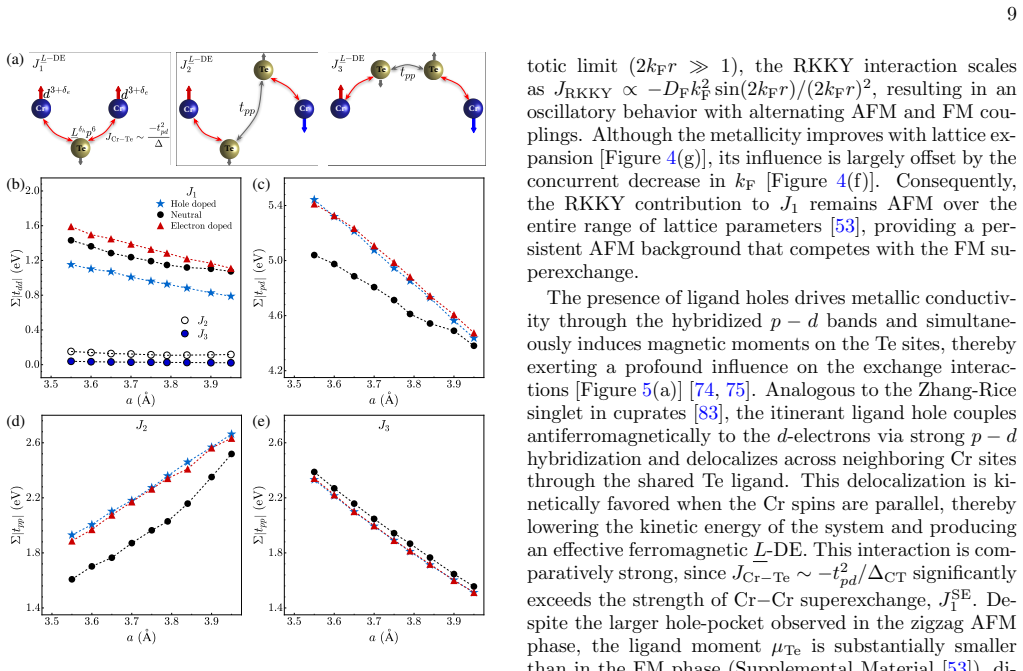
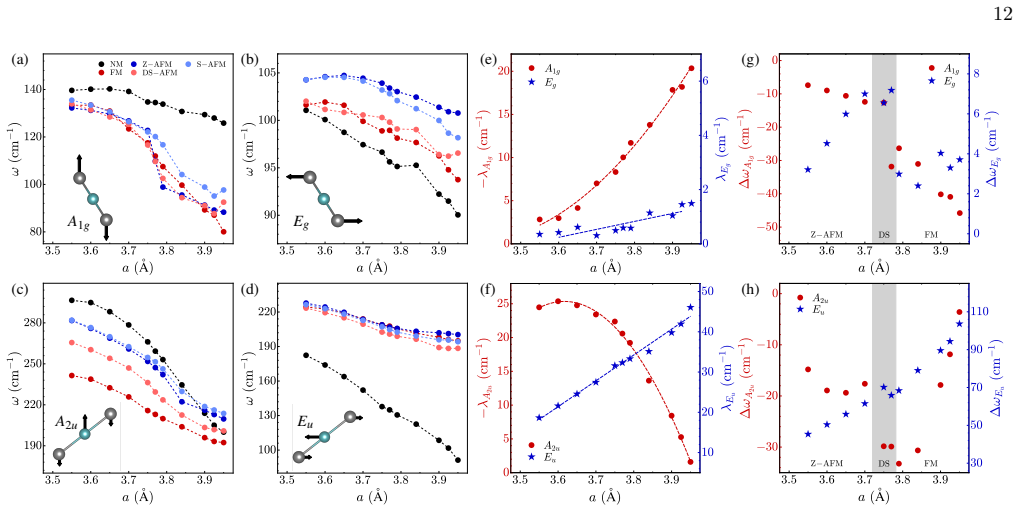
Spin-lattice coupling While the phonon frequency renormalization and the associated spin-phonon coupling constantλ ν provide clear signatures of spin-lattice coupling, they offer only an indirect view of its microscopic origin. Further quan- titative understanding can be obtained by directly exam- ining how the magnetic exchange interactions respond to la...
-
[2]
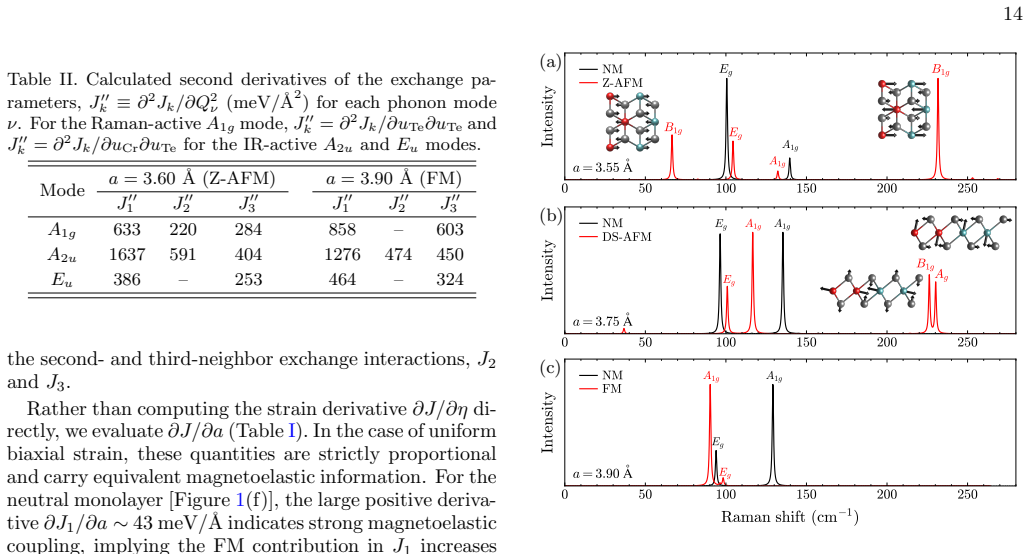
Zone-folded phonon modes and magnetic ordering The emergence of zone-folded Raman-active modes provides a unique, symmetry-sensitive fingerprint of the underlying magnetic order, offering resolving capabilities beyond those of phonon renormalization alone (Figure 7). A similar approach has been successfully employed to identify interlayer AFM order in CrI...
-
[3]
P. C. Hohenberg, Existence of long-range order in one and two dimensions, Phys. Rev.158, 383 (1967)
1967
-
[4]
N. D. Mermin and H. Wagner, Absence of ferro- magnetism or antiferromagnetism in one- or two- dimensional isotropic Heisenberg models, Phys. Rev. Lett.17, 1133 (1966)
1966
-
[5]
J.-U. Lee, S. Lee, J. H. Ryoo, S. Kang, T. Y. Kim, P. Kim, C.-H. Park, J.-G. Park, and H. Cheong, Ising- type magnetic ordering in atomically thin FePS 3, Nano Lett.16, 7433 (2016)
2016
-
[6]
C. Gong, L. Li, Z. Li, H. Ji, A. Stern, Y. Xia, T. Cao, W. Bao, C. e. Wang, Y. Wang, Z. Q. Qiu, R. J. Cava, S. G. Louie, J. Xia, and X. Zhang, Discovery of intrin- sic ferromagnetism in two-dimensional van der Waals crystals, Nature546, 265 (2017)
2017
-
[7]
Huang, G
B. Huang, G. Clark, E. Navarro-Moratalla, D. R. Klein, R. Cheng, K. L. Seyler, D. Zhong, E. Schmidgall, M. A. McGuire, D. H. Cobden, W. Yao, D. Xiao, P. Jarillo- Herrero, and X. Xu, Layer-dependent ferromagnetism in a van der Waals crystal down to the monolayer limit, Nature546, 270 (2017)
2017
-
[8]
Gibertini, M
M. Gibertini, M. Koperski, A. F. Morpurgo, and K. S. Novoselov, Magnetic 2D materials and heterostructures, Nat. Nanotechnol.14, 408 (2019)
2019
-
[9]
Q. H. Wang, A. Bedoya-Pinto, M. Blei, A. H. Dismukes, A. Hamo, S. Jenkins, M. Koperski, Y. Liu, Q.-C. Sun, E. J. Telford, H. H. Kim, M. Augustin, U. Vool, J.- X. Yin, L. H. Li, A. Falin, C. R. Dean, F. Casanova, R. F. L. Evans, M. Chshiev, A. Mishchenko, C. Petro- vic, R. He, L. Zhao, A. W. Tsen, B. D. Gerardot, M. Brotons-Gisbert, Z. Guguchia, X. Roy, S....
2022
-
[10]
Huang, G
B. Huang, G. Clark, D. R. Klein, D. MacNeill, E. Navarro-Moratalla, K. L. Seyler, N. Wilson, M. A. McGuire, D. H. Cobden, D. Xiao, W. Yao, P. Jarillo- Herrero, and X. Xu, Electrical control of 2D magnetism in bilayer CrI3, Nat. Nanotechnol.13, 544 (2018)
2018
-
[11]
Jiang, L
S. Jiang, L. Li, Z. Wang, K. F. Mak, and J. Shan, Con- trolling magnetism in 2D CrI 3 by electrostatic doping, Nat. Nanotechnol.13, 549 (2018)
2018
-
[12]
Q. Li, M. Yang, C. Gong, R. V. Chopdekar, A. T. N’Diaye, J. Turner, G. Chen, A. Scholl, P. Shafer, E. Arenholz, A. K. Schmid, S. Wang, K. Liu, N. Gao, A. S. Admasu, S.-W. Cheong, C. Hwang, J. Li, F. Wang, X. Zhang, and Z. Qiu, Patterning-induced ferromag- netism of Fe 3GeTe2 van der Waals materials beyond room temperature, Nano Lett.18, 5974 (2018)
2018
-
[13]
Jiang, J
S. Jiang, J. Shan, and K. F. Mak, Electric-field switch- ing of two-dimensional van der Waals magnets, Nat. Mater.17, 406 (2018)
2018
-
[14]
Y. Deng, Y. Yu, Y. Song, J. Zhang, N. Z. Wang, Z. Sun, Y. Yi, Y. Z. Wu, S. Wu, J. Zhu, J. Wang, X. H. Chen, and Y. Zhang, Gate-tunable room-temperature ferro- magnetism in two-dimensional Fe 3GeTe2, Nature563, 94 (2018)
2018
-
[15]
S. Y. Park, D. S. Kim, Y. Liu, J. Hwang, Y. Kim, W. Kim, J.-Y. Kim, C. Petrovic, C. Hwang, S.-K. Mo, H.-j. Kim, B.-C. Min, H. C. Koo, J. Chang, C. Jang, J. W. Choi, and H. Ryu, Controlling the magnetic anisotropy of the van der Waals ferromagnet Fe 3GeTe2 through hole doping, Nano Lett.20, 95 (2020)
2020
-
[16]
C. K. Singh and M. Kabir, Long-range anisotropic Heisenberg ferromagnets and electrically tunable order- ing, Phys. Rev. B103, 214411 (2021)
2021
-
[17]
C. K. Singh and M. Kabir, Room-temperature fer- romagnetism in two-dimensional CrBr 3, Phys. Rev. Mater.6, 084407 (2022)
2022
-
[18]
Bedoya-Pinto, J.-R
A. Bedoya-Pinto, J.-R. Ji, A. K. Pandeya, P. Gar- giani, M. Valvidares, P. Sessi, J. M. Taylor, F. Radu, K. Chang, and S. S. P. Parkin, Intrinsic 2D-XY ferro- magnetism in a van der Waals monolayer, Science374, 616 (2021)
2021
-
[19]
H. H. Kim, B. Yang, S. Li, S. Jiang, C. Jin, Z. Tao, G. Nichols, F. Sfigakis, S. Zhong, C. Li, S. Tian, D. G. Cory, G.-X. Miao, J. Shan, K. F. Mak, H. Lei, K. Sun, L. Zhao, and A. W. Tsen, Evolution of inter- layer and intralayer magnetism in three atomically thin chromium trihalides, Proc. Natl. Acad. Sci. USA116, 11131 (2019)
2019
-
[20]
Zhang, J
Z. Zhang, J. Shang, C. Jiang, A. Rasmita, W. Gao, and T. Yu, Direct photoluminescence probing of ferromag- netism in monolayer two-dimensional CrBr3, Nano Lett. 19, 3138 (2019)
2019
-
[21]
Z. Wang, M. Gibertini, D. Dumcenco, T. Taniguchi, K. Watanabe, E. Giannini, and A. F. Morpurgo, De- termining the phase diagram of atomically thin lay- ered antiferromagnet CrCl3, Nat. Nanotechnol.14, 1116 (2019)
2019
-
[22]
D. R. Klein, D. MacNeill, Q. Song, D. T. Larson, S. Fang, M. Xu, R. A. Ribeiro, P. C. Canfield, E. Kaxi- ras, R. Comin, and P. Jarillo-Herrero, Enhancement of interlayer exchange in an ultrathin two-dimensional magnet, Nat. Phys.15, 1255 (2019)
2019
-
[23]
Zhang, Q
X. Zhang, Q. Lu, W. Liu, W. Niu, J. Sun, J. Cook, M. Vaninger, P. F. Miceli, D. J. Singh, S.-W. Lian, T.- R. Chang, X. He, J. Du, L. He, R. Zhang, G. Bian, and 17 Y. Xu, Room-temperature intrinsic ferromagnetism in epitaxial CrTe2 ultrathin films, Nat. Commun.12, 2492 (2021)
2021
-
[24]
Y. Ou, W. Yanez, R. Xiao, M. Stanley, S. Ghosh, B. Zheng, W. Jiang, Y.-S. Huang, T. Pillsbury, A. Richardella, C. Liu, T. Low, V. H. Crespi, K. A. Mkhoyan, and N. Samarth, ZrTe 2/CrTe2: an epitaxial van der Waals platform for spintronics, Nat. Commun. 13, 2972 (2022)
2022
-
[25]
D. C. Freitas, R. Weht, A. Sulpice, G. Remenyi, P. Stro- bel, F. Gay, J. Marcus, and M. Nunez-Regueiro, Ferro- magnetism in layered metastable 1T-CrTe 2, J. Phys.: Condens. Matter27, 176002 (2015)
2015
-
[26]
X. Sun, W. Li, X. Wang, Q. Sui, T. Zhang, Z. Wang, L. Liu, D. Li, S. Feng, S. Zhong, H. Wang, V. Bouch- iat, M. Nunez Regueiro, N. Rougemaille, J. Coraux, A. Purbawati, A. Hadj-Azzem, Z. Wang, B. Dong, X. Wu, T. Yang, G. Yu, B. Wang, Z. Han, X. Han, and Z. Zhang, Room temperature ferromagnetism in ultra- thin van der Waals crystals of 1T-CrTe2, Nano Res.1...
2020
-
[27]
Fabre, A
F. Fabre, A. Finco, A. Purbawati, A. Hadj-Azzem, N. Rougemaille, J. Coraux, I. Philip, and V. Jacques, Characterization of room-temperature in-plane magne- tization in thin flakes of CrTe 2 with a single-spin mag- netometer, Phys. Rev. Mater.5, 034008 (2021)
2021
-
[28]
Kushwaha, O
N. Kushwaha, O. Armitage, B. Edwards, L. Trzaska, J. Rigden, P. Bencok, D. Biswas, T.-L. Lee, C. Sanders, G. van der Laan, P. Wahl, P. D. C. King, and A. Ra- jan, From ferromagnetic semiconductor to antiferromag- netic metal in epitaxial Cr xTey monolayers, npj Quan- tum Mater.10, 50 (2025)
2025
-
[29]
G. Miao, M. Gu, H. Sun, P. Chen, J. Li, S. Xue, N. Su, Z. Su, W. Zhong, Z. Zhang, X. Zhu, J. Zhang, Y. Yao, W. Jiang, M. Meng, W. Wang, and J. Guo, Tuning the magnetism in ultrathin Cr xTey films by lattice dimen- sionality, Adv. Electron. Mater.11, 2400720 (2025)
2025
-
[30]
D. Tian, S. Zhong, J. Dong, S. Zhou, Z. Liu, K. Chen, W. Zhang, L. Cao, X. He, X. Li, T. Guo, K. Du, H. Feng, Y. Wang, P. Cheng, Y. Zhang, B. Feng, K. Wu, S. Wei, Y. Du, Y. Lu, and L. Chen, Room-temperature two- dimensional multiferroic metal with voltage-controllable magnetic order, Nat. Mater. (2026)
2026
-
[31]
J.-J. Xian, C. Wang, J.-H. Nie, R. Li, M. Han, J. Lin, W.-H. Zhang, Z.-Y. Liu, Z.-M. Zhang, M.-P. Miao, Y. Yi, S. Wu, X. Chen, J. Han, Z. Xia, W. Ji, and Y.- S. Fu, Spin mapping of intralayer antiferromagnetism and field-induced spin reorientation in monolayer CrTe2, Nat. Commun.13, 257 (2022)
2022
-
[32]
Armitage, N
O. Armitage, N. Kushwaha, A. Rajan, L. C. Rhodes, S. Buchberger, B. K. Saika, S. Mo, M. D. Wat- son, P. D. C. King, and P. Wahl, Electronic struc- ture of monolayer CrTe 2: An antiferromagnetic two- dimensional van der Waals material, Phys. Rev. B112, 245416 (2025)
2025
-
[33]
Purbawati, J
A. Purbawati, J. Coraux, J. Vogel, A. Hadj-Azzem, N. Wu, N. Bendiab, D. Jegouso, J. Renard, L. Marty, V. Bouchiat, A. Sulpice, L. Aballe, M. Foerster, F. Genuzio, A. Locatelli, T. O. Mente¸ s, Z. V. Han, X. Sun, M. N´ u˜ nez-Regueiro, and N. Rougemaille, In- plane magnetic domains and N´ eel-like domain walls in thin flakes of the room temperature CrTe 2 ...
2020
-
[34]
Leˇ zai´ c, P
M. Leˇ zai´ c, P. Mavropoulos, and S. Bl¨ ugel, First- principles prediction of high Curie temperature for fer- romagnetic bcc-Co and bcc-FeCo alloys and its rele- vance to tunneling magnetoresistance, Appl. Phys. Lett. 90, 082504 (2007)
2007
-
[35]
J.-W. Li, Z. Zhang, J.-Y. You, B. Gu, and G. Su, Two- dimensional Heisenberg model with material-dependent superexchange interactions, Phys. Rev. B107, 224411 (2023)
2023
-
[36]
Li, S.-S
S. Li, S.-S. Wang, B. Tai, W. Wu, B. Xiang, X.-L. Sheng, and S. A. Yang, Tunable anomalous Hall trans- port in bulk and two-dimensional 1T-CrTe 2: A first- principles study, Phys. Rev. B103, 045114 (2021)
2021
-
[37]
X. Xu, Y. W. Li, S. R. Duan, S. L. Zhang, Y. J. Chen, L. Kang, A. J. Liang, C. Chen, W. Xia, Y. Xu, P. Ma- linowski, X. D. Xu, J.-H. Chu, G. Li, Y. F. Guo, Z. K. Liu, L. X. Yang, and Y. L. Chen, Signature for non- Stoner ferromagnetism in the van der Waals ferromag- net Fe3GeTe2, Phys. Rev. B101, 201104 (2020)
2020
-
[38]
H. Wu, C. Hu, Y. Xie, B. G. Jang, J. Huang, Y. Guo, S. Wu, C. Hu, Z. Yue, Y. Shi, R. Basak, Z. Ren, T. Yil- maz, E. Vescovo, C. Jozwiak, A. Bostwick, E. Roten- berg, A. Fedorov, J. D. Denlinger, C. Klewe, P. Shafer, D. Lu, M. Hashimoto, J. Kono, A. Frano, R. J. Birge- neau, X. Xu, J.-X. Zhu, P. Dai, J.-H. Chu, and M. Yi, Spectral evidence for local-moment...
2024
-
[39]
Zhong, C
Y. Zhong, C. Peng, H. Huang, D. Guan, J. Hwang, K. H. Hsu, Y. Hu, C. Jia, B. Moritz, D. Lu, J.-S. Lee, J.-F. Jia, T. P. Devereaux, S.-K. Mo, and Z.-X. Shen, From Stoner to local moment magnetism in atomically thin Cr2Te3, Nat. Commun.14, 5340 (2023)
2023
-
[40]
A. A. Katanin and E. M. Agapov, Magnetic properties of monolayer, multilayer, and bulk crte 2, Phys. Rev. B 111, 035118 (2025)
2025
-
[41]
Hohenberg and W
P. Hohenberg and W. Kohn, Inhomogeneous electron gas, Phys. Rev.136, B864 (1964)
1964
-
[42]
Kohn and L
W. Kohn and L. J. Sham, Self-consistent equations in- cluding exchange and correlation effects, Phys. Rev. 140, A1133 (1965)
1965
-
[43]
Kresse and J
G. Kresse and J. Hafner, Ab initio molecular dynamics for liquid metals, Phys. Rev. B47, 558 (1993)
1993
-
[44]
Kresse and J
G. Kresse and J. Furthm¨ uller, Efficient iterative schemes for ab initio total-energy calculations using a plane-wave basis set, Phys. Rev. B54, 11169 (1996)
1996
-
[45]
P. E. Bl¨ ochl, Projector augmented-wave method, Phys. Rev. B50, 17953 (1994)
1994
-
[46]
J. P. Perdew, K. Burke, and M. Ernzerhof, Generalized gradient approximation made simple, Phys. Rev. Lett. 77, 3865 (1996)
1996
-
[47]
S. L. Dudarev, G. A. Botton, S. Y. Savrasov, C. J. Humphreys, and A. P. Sutton, Electron-energy-loss spectra and the structural stability of nickel oxide: An LSDA+U study, Phys. Rev. B57, 1505 (1998)
1998
-
[48]
Grimme, J
S. Grimme, J. Antony, S. Ehrlich, and H. Krieg, A con- sistent and accurate ab initio parametrization of density functional dispersion correction (DFT-D) for the 94 el- ements H−Pu, J. Chem. Phys.132, 154104 (2010)
2010
-
[49]
H. J. Monkhorst and J. D. Pack, Special points for brillouin-zone integrations, Phys. Rev. B13, 5188 (1976)
1976
-
[50]
Marzari and D
N. Marzari and D. Vanderbilt, Maximally localized gen- eralized Wannier functions for composite energy bands, 18 Phys. Rev. B56, 12847 (1997)
1997
-
[51]
Pizzi, V
G. Pizzi, V. Vitale, R. Arita, S. Bl¨ ugel, F. Freimuth, G. G´ eranton, M. Gibertini, D. Gresch, C. John- son, T. Koretsune, J. Iba˜ nez-Azpiroz, H. Lee, J.- M. Lihm, D. Marchand, A. Marrazzo, Y. Mokrousov, J. I. Mustafa, Y. Nohara, Y. Nomura, L. Paulatto, S. Ponc´ e, T. Ponweiser, J. Qiao, F. Th¨ ole, S. S. Tsirkin, M. Wierzbowska, N. Marzari, D. Vanderb...
2020
-
[52]
Metropolis, A
N. Metropolis, A. W. Rosenbluth, M. N. Rosenbluth, A. H. Teller, and E. Teller, Equation of state calcula- tions by fast computing machines, J. Chem. Phys.21, 1087 (1953)
1953
-
[53]
Marsaglia, Choosing a point from the surface of a sphere, Ann
G. Marsaglia, Choosing a point from the surface of a sphere, Ann. Math. Statist.43, 645 (1972)
1972
-
[54]
R. F. L. Evans, W. J. Fan, P. Chureemart, T. A. Ostler, M. O. A. Ellis, and R. W. Chantrell, Atomistic spin model simulations of magnetic nanomaterials, J. Phys.: Condens. Matter26, 103202 (2014)
2014
-
[55]
Supplemental Material
-
[56]
Otero Fumega, J
A. Otero Fumega, J. Phillips, and V. Pardo, Controlled two-dimensional ferromagnetism in 1T-CrTe 2: The role of charge density wave and strain, J. Phys. Chem. C 124, 21047 (2020)
2020
-
[57]
L. Meng, Z. Zhou, M. Xu, S. Yang, K. Si, L. Liu, X. Wang, H. Jiang, B. Li, P. Qin, P. Zhang, J. Wang, Z. Liu, P. Tang, Y. Ye, W. Zhou, L. Bao, H.-J. Gao, and Y. Gong, Anomalous thickness dependence of Curie temperature in air-stable two-dimensional fer- romagnetic 1T-CrTe 2 grown by chemical vapor deposi- tion, Nat. Commun.12, 809 (2021)
2021
-
[58]
Y. Wang, J. Yan, J. Li, S. Wang, M. Song, J. Song, Z. Li, K. Chen, Y. Qin, L. Ling, H. Du, L. Cao, X. Luo, Y. Xiong, and Y. Sun, Magnetic anisotropy and topo- logical Hall effect in the trigonal chromium tellurides Cr5Te8, Phys. Rev. B100, 024434 (2019)
2019
-
[59]
Rubin, A
P. Rubin, A. Sherman, and M. Schreiber, Magnetic phase diagram of the spin-1 two-dimensionalJ 1−J2 Heisenberg model on a triangular lattice, Phys. Lett. A376, 1062 (2012)
2012
-
[60]
Glittum and O
C. Glittum and O. F. Sylju˚ asen, Arc-shaped structure factor in theJ 1−J2−J3 classical Heisenberg model on the triangular lattice, Phys. Rev. B104, 184427 (2021)
2021
-
[61]
Zhu and S
Z. Zhu and S. R. White, Spin liquid phase of theS= 1 2 J1 −J 2 Heisenberg model on the triangular lattice, Phys. Rev. B92, 041105 (2015)
2015
-
[62]
A. O. Scheie, E. A. Ghioldi, J. Xing, J. A. M. Paddison, N. E. Sherman, M. Dupont, L. D. Sanjeewa, S. Lee, A. J. Woods, D. Abernathy, D. M. Pajerowski, T. J. Williams, S.-S. Zhang, L. O. Manuel, A. E. Trumper, C. D. Pemmaraju, A. S. Sefat, D. S. Parker, T. P. Dev- ereaux, R. Movshovich, J. E. Moore, C. D. Batista, and D. A. Tennant, Proximate spin liquid ...
2024
-
[63]
J. Y. Ni, X. Y. Li, D. Amoroso, X. He, J. S. Feng, E. J. Kan, S. Picozzi, and H. J. Xiang, Giant biquadratic ex- change in 2D magnets and its role in stabilizing ferro- magnetism of NiCl 2 monolayers, Phys. Rev. Lett.127, 247204 (2021)
2021
-
[64]
Kabir and T
M. Kabir and T. Saha-Dasgupta, Manipulation of edge magnetism in hexagonal graphene nanoflakes, Phys. Rev. B90, 035403 (2014)
2014
-
[65]
Ganguly, M
S. Ganguly, M. Kabir, and T. Saha-Dasgupta, Magnetic and electronic crossovers in graphene nanoflakes, Phys. Rev. B95, 174419 (2017)
2017
-
[66]
B. Liu, S. Liu, L. Yang, Z. Chen, E. Zhang, Z. Li, J. Wu, X. Ruan, F. Xiu, W. Liu, L. He, R. Zhang, and Y. Xu, Light-tunable ferromagnetism in atomically thin Fe3GeTe2 driven by femtosecond laser pulse, Phys. Rev. Lett.125, 267205 (2020)
2020
-
[67]
Enayat, Z
M. Enayat, Z. Sun, U. R. Singh, R. Aluru, S. Schmaus, A. Yaresko, Y. Liu, C. Lin, V. Tsurkan, A. Loidl, J. Deisenhofer, and P. Wahl, Real-space imaging of the atomic-scale magnetic structure of FeTe, Science345, 653 (2014)
2014
-
[68]
Y. Li, X. Du, J. Wang, R. Xu, W. Zhao, K. Zhai, J. Liu, H. Chen, Y. Yang, N. C. Plumb, S. Ju, M. Shi, Z. Liu, J.-g. Guo, X. Chen, Y. Chen, and L. Yang, Quantum- confined tunable ferromagnetism on the surface of a van der Waals antiferromagnet NaCrTe 2, Nano Lett.24, 9832 (2024)
2024
-
[69]
J. Wang, J. Deng, X. Liang, G. Gao, T. Ying, S. Tian, H. Lei, Y. Song, X. Chen, J.-g. Guo, and X. Chen, Spin- flip-driven giant magnetotransport in A-type antiferro- magnet NaCrTe2, Phys. Rev. Mater.5, L091401 (2021)
2021
-
[70]
P. W. Anderson, Antiferromagnetism. Theory of su- perexchange interaction, Phys. Rev.79, 350 (1950)
1950
-
[71]
J. B. Goodenough, An interpretation of the mag- netic properties of the perovskite-type mixed crystals La(1-x)SrxCoO3-λ, J. Phys. Chem. Solids6, 287 (1958)
1958
-
[72]
Kanamori, Superexchange interaction and symmetry properties of electron orbitals, J
J. Kanamori, Superexchange interaction and symmetry properties of electron orbitals, J. Phys. Chem. Solids 10, 87 (1959)
1959
-
[73]
M. A. Ruderman and C. Kittel, Indirect exchange cou- pling of nuclear magnetic moments by conduction elec- trons, Phys. Rev.96, 99 (1954)
1954
-
[74]
Kasuya, A theory of metallic ferro- and antiferro- magnetism on Zener’s model, Prog
T. Kasuya, A theory of metallic ferro- and antiferro- magnetism on Zener’s model, Prog. Theor. Phys.16, 45 (1956)
1956
-
[75]
Yosida, Magnetic properties of Cu−Mn alloys, Phys
K. Yosida, Magnetic properties of Cu−Mn alloys, Phys. Rev.106, 893 (1957)
1957
-
[76]
Sakurai, Magnetic and electronic properties of Ca1-xNaxCr2O4: Double-exchange interactions and lig- and holes, Phys
H. Sakurai, Magnetic and electronic properties of Ca1-xNaxCr2O4: Double-exchange interactions and lig- and holes, Phys. Rev. B89, 024416 (2014)
2014
-
[77]
Pradhan, D
K. Pradhan, D. Sen, P. Sanyal, and T. Saha-Dasgupta, Two-sublattice double exchange driven magnetism in Cr-based two-dimensional magnets, Phys. Rev. B111, L180404 (2025)
2025
-
[78]
Y. Zhu, Y. F. Pan, L. Ge, J. Y. Fan, D. N. Shi, C. L. Ma, J. Hu, and R. Q. Wu, Separating RKKY interaction from other exchange mechanisms in two-dimensional magnetic materials, Phys. Rev. B108, L041401 (2023)
2023
-
[79]
J. Wang, Y. Xu, S. Wang, X. Dai, P. Yan, J. Zhou, R. Wang, Y. Xu, and L. He, Hole-mediated RKKY in- teraction in 2D ferromagnetic CrTe 2 ultra-thin films, Adv. Electron. Mater.10, 2300646 (2024)
2024
-
[80]
D. I. Khomskii, Transition metal compounds (Cam- bridge University Press, 2014)
2014
discussion (0)
Sign in with ORCID, Apple, or X to comment. Anyone can read and Pith papers without signing in.