REVIEW 1 major objections 1 minor 29 references
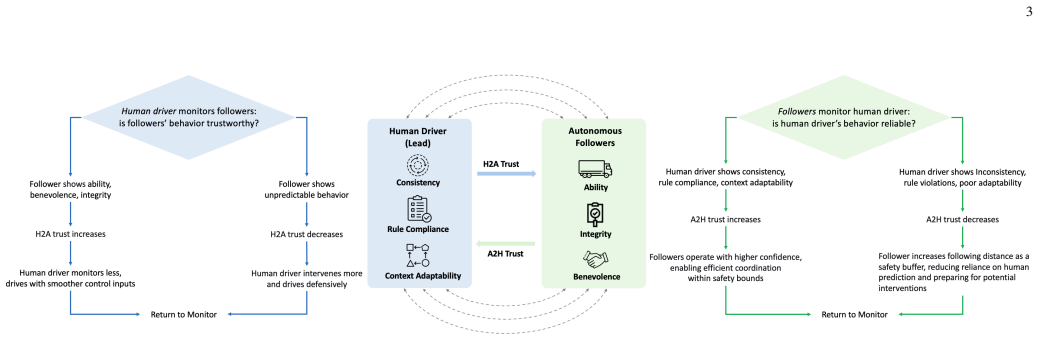
Bidirectional trust between human truck drivers and autonomous followers can be modeled with following distance as the variable driving co-evolving feedback loops.
Reviewed by Pith at T0; open to challenge. T0 means a machine referee read the full paper against a public rubric. the ladder, T0–T4 →
T0 review · grok-4.3
2026-06-30 23:48 UTC pith:EQY6MQNL
load-bearing objection The paper sketches a bidirectional trust framework for human-led truck platooning but the quantitative model stays too high-level to assess. the 1 major comments →
Human-Machine Bidirectional Trust-Aware Analysis and Design for Human-Led Truck Platooning
The pith
A machine-rendered reading of the paper's core claim, the machinery that carries it, and where it could break.
Core claim
The paper claims that bidirectional trust in human-led platooning can be conceptualized with distinct dimensions drawn from established theories and driver psychology, then operationalized in a quantitative model where following distance acts as the key variable that closes a feedback loop between human behavior and automation response, producing either positive reinforcement or negative spiral effects as shown in simulation examples, and that this model yields concrete design guidelines for autonomous followers to improve trust calibration, safety, and acceptance.
What carries the argument
The bidirectional trust framework instantiated as a quantitative feedback-loop model whose central interaction variable is following distance.
Load-bearing premise
Established trust theories combined with general truck driver psychology can be mapped directly onto distinct, operationalizable dimensions for both directions of trust without new empirical data collected from professional drivers in platooning conditions.
What would settle it
An empirical study with instrumented professional truck drivers in real or simulated platooning that measures trust ratings and following distances over time and finds no evidence of the predicted feedback loop or the proposed dimension mappings.
If this is right
- Design guidelines for autonomous followers can be derived to maintain appropriate following distances that support positive trust reinforcement rather than negative spirals.
- Human-led platooning systems can incorporate real-time monitoring of following distance to adjust automation responses and sustain calibrated trust.
- The framework supplies a theoretical basis for improving safety and user acceptance in mixed human-automation truck convoys.
- Future modeling work can extend the quantitative instantiation to predict when trust dynamics shift from positive to negative regimes.
Where Pith is reading between the lines
- The same following-distance feedback structure might apply to other human-led autonomous systems such as drone formations or ship convoys where one operator oversees multiple machines.
- If the model holds, initial trust calibration protocols at the start of a platoon run could reduce the chance of early negative spirals.
- Real-world data collection on professional drivers could test whether the mapped trust dimensions require adjustment for fatigue or route-specific factors the current framework leaves implicit.
Editorial analysis
A structured set of objections, weighed in public.
Referee Report
Summary. The paper develops a conceptual framework for bidirectional trust in human-led truck platooning systems. It maps established ABI trust dimensions (ability, benevolence, integrity) plus truck-driver psychology insights to distinct human-to-automation and automation-to-human trust dimensions. It introduces a quantitative model that uses following distance as the interaction variable to illustrate trust co-evolution via a feedback loop, presents simulation examples of positive reinforcement and negative spirals, and derives design guidelines for autonomous followers to support appropriate trust calibration.
Significance. If the framework and model hold, this work offers a useful integration of human-factors perspectives with engineering design for platooning, explicitly positioned as a preliminary foundation rather than a validated result. The focus on professional truck drivers and the bidirectional framing address an underexplored aspect of trust in mixed human-automation teams. The cautious framing and call for future empirical work are appropriate strengths.
major comments (1)
- [Quantitative model] Quantitative model section: The manuscript states that a quantitative model operationalizes the bidirectional dynamics with following distance as the key variable and demonstrates feedback via simulations, but no equations, derivation steps, parameter definitions, or model structure are provided. This absence is load-bearing because it prevents evaluation of whether the loop is independently derived or whether trust levels are effectively defined in terms of the interaction variable itself.
minor comments (1)
- [Abstract and introduction] The distinction between the conceptual framework (which draws on prior theories) and the illustrative simulations could be stated more explicitly in the abstract and introduction to prevent any implication of empirical validation.
Simulated Author's Rebuttal
We thank the referee for the positive evaluation of the paper's contribution and for the constructive major comment. We agree that the quantitative model requires explicit formalization and will revise the manuscript to include the missing mathematical details.
read point-by-point responses
-
Referee: [Quantitative model] Quantitative model section: The manuscript states that a quantitative model operationalizes the bidirectional dynamics with following distance as the key variable and demonstrates feedback via simulations, but no equations, derivation steps, parameter definitions, or model structure are provided. This absence is load-bearing because it prevents evaluation of whether the loop is independently derived or whether trust levels are effectively defined in terms of the interaction variable itself.
Authors: We acknowledge the validity of this observation. While the manuscript describes the model at a conceptual level and reports simulation outcomes, it does not supply the explicit equations, parameter definitions, or derivation steps. In the revised version we will add a new subsection that (1) presents the full model structure as a system of coupled difference equations linking human-to-automation and automation-to-human trust to following distance, (2) defines all parameters (trust-update gains, decay rates, distance thresholds) with their grounding in the ABI dimensions and driver-psychology literature, and (3) shows the step-by-step derivation from the bidirectional framework. This addition will make clear that the trust dynamics are independently specified rather than circularly defined by the interaction variable. revision: yes
Circularity Check
No significant circularity identified
full rationale
The paper develops a conceptual framework drawing on established ABI trust theories and truck-driver psychology insights, then introduces a quantitative model framed explicitly as a preliminary operationalization and illustrative simulation using following distance in a feedback loop. No equations, fitted parameters, self-citations as load-bearing premises, or derivations are visible in the provided text that reduce any claimed result to its inputs by construction. The work positions itself as a foundation for future empirical research rather than asserting predictive derivations or uniqueness theorems. This is the most common honest finding for conceptual/preliminary modeling papers.
Axiom & Free-Parameter Ledger
axioms (1)
- domain assumption Trust in automation can be decomposed into ability, benevolence, and integrity dimensions that apply separately to human-to-automation and automation-to-human directions in platooning.
Cite this review
Pith. "Pith review of Human-Machine Bidirectional Trust-Aware Analysis and Design for Human-Led Truck Platooning." pith.science (2026). https://pith.science/paper/EQY6MQNL
@misc{pith2026260618255,
  author       = {Pith},
  title        = {Pith review of: Human-Machine Bidirectional Trust-Aware Analysis and Design for Human-Led Truck Platooning},
  year         = {2026},
  howpublished = {\url{https://pith.science/paper/EQY6MQNL}},
  note         = {Machine review of arXiv:2606.18255}
}
read the original abstract
Human-led truck platooning, where a human-driven truck leads one or more autonomous followers, offers significant benefits in fuel efficiency, safety, and traffic flow. However, its successful deployment hinges on trust between the human driver and the automated systems. Unlike conventional automation, trust in this context is inherently bidirectional: the human must trust the autonomous followers, and the followers must reliably interpret and respond to the human's behavior. While prior research has extensively studied human trust in automation, the reciprocal nature of trust, especially considering the expertise of professional truck drivers, remains underexplored. This paper develops a conceptual framework of bidirectional trust for human-led platooning systems. Drawing on established trust theories (ability, benevolence, integrity) and insights from truck driver psychology, we propose distinct dimensions for human-to-automation trust and automation-to-human trust. To move beyond conceptualization, we introduce a quantitative model that operationalizes the bidirectional dynamics, using the following distance as the key interaction variable to illustrate how trust co-evolves through a feedback loop. Simulation examples demonstrate both positive reinforcement and negative spiral effects. Based on this framework and its quantitative instantiation, we derive design guidelines for autonomous followers to foster appropriate trust calibration, improve safety, and enhance user acceptance. The framework bridges human factors and engineering perspectives, providing a theoretical and preliminary quantitative foundation for future empirical and modeling research.
Figures


Reference graph
Works this paper leans on
-
[1]
Recent trends in the public acceptance of autonomous vehicles: A review,
T. Alqahtani, “Recent trends in the public acceptance of autonomous vehicles: A review,”Vehicles, vol. 7, no. 2, p. 45, 2025
work page 2025
-
[2]
Rationale behind human-led autonomous truck platooning,
Y . Lu, C. Li, X. Jiang, and Q. Zhang, “Rationale behind human-led autonomous truck platooning,”arXiv preprint arXiv:2603.13296, 2026
-
[3]
Trust in partially automated driving systems for trucks: A quantitative empirical study,
L. Wendel, P. Planing, and H. Br ¨auchle, “Trust in partially automated driving systems for trucks: A quantitative empirical study,” inInnova- tions for Metropolitan Areas: Intelligent Solutions for Mobility, Logistics and Infrastructure designed for Citizens. Springer, 2020, pp. 133–143
work page 2020
-
[4]
Trust in automation: Designing for appropriate reliance,
J. D. Lee and K. A. See, “Trust in automation: Designing for appropriate reliance,”Human Factors, vol. 46, no. 1, pp. 50–80, 2004
work page 2004
-
[5]
Trust in automation: Integrating empirical evidence on factors that influence trust,
K. A. Hoff and M. Bashir, “Trust in automation: Integrating empirical evidence on factors that influence trust,”Human Factors, vol. 57, no. 3, pp. 407–434, 2015
work page 2015
-
[6]
Trip: Misbehav- ior detection for dynamic platoons using trust,
K. Garlichs, A. Willecke, M. Wegner, and L. C. Wolf, “Trip: Misbehav- ior detection for dynamic platoons using trust,” in2019 IEEE Intelligent Transportation Systems Conference (ITSC). IEEE, 2019, pp. 455–460
work page 2019
-
[7]
An integrative model of organizational trust,
R. C. Mayer, J. H. Davis, and F. D. Schoorman, “An integrative model of organizational trust,”Academy of Management Review, vol. 20, no. 3, pp. 709–734, 1995
work page 1995
-
[8]
Age-related safety in professional heavy vehicle drivers: A literature review,
J. Duke, M. Guest, and M. Boggess, “Age-related safety in professional heavy vehicle drivers: A literature review,”Accident Analysis & Preven- tion, vol. 42, no. 2, pp. 364–371, 2010
work page 2010
-
[9]
S.-M. Castritius, C. J. Dietz, P. Schubert, J. Moeller, S. Morvilius, S. Hammer, C. A. Tran, and C. T. Haas, “Truck platooning under real traffic conditions: first insights on behavioral adaptations and gap preference of professional drivers,”Human factors, vol. 63, no. 6, pp. 1033–1045, 2021
work page 2021
-
[10]
V . Lourenc ¸o, S. P. Duarte, A. Lobo, S. Ferreira, and L. Cunha, “Rep- resentations of truck platooning acceptance of truck drivers, decision- makers, and general public: A systematic review,”Transportation Re- search Part F: Traffic Psychology and Behaviour, vol. 104, pp. 359–373, 2024
work page 2024
-
[11]
Do you want your autonomous car to drive like you?
C. Basu, Q. Yang, D. Hungerman, M. Singhal, and A. D. Dragan, “Do you want your autonomous car to drive like you?” inProceedings of the 2017 ACM/IEEE International Conference on Human-Robot Interaction, 2017, pp. 417–425
work page 2017
-
[12]
Maveric: A data-driven approach to personalized autonomous driving,
M. L. Schrum, E. Sumner, M. C. Gombolay, and A. Best, “Maveric: A data-driven approach to personalized autonomous driving,”IEEE Transactions on Robotics, vol. 40, pp. 1952–1965, 2024
work page 1952
-
[13]
S. Nordhoff, J. Stapel, X. He, A. Gentner, and R. Happee, “Do driver’s characteristics, system performance, perceived safety, and trust influence how drivers use partial automation? a structural equation modelling analysis,”Frontiers in Psychology, vol. 14, p. 1125031, 2023
work page 2023
-
[14]
K. Shu, Y . Lu, and A. Khajepour,Game Theory in Autonomous Driving. Springer, 2026
work page 2026
-
[15]
The mind in the machine: Anthropomorphism increases trust in an autonomous vehicle,
A. Waytz, J. Heafner, and N. Epley, “The mind in the machine: Anthropomorphism increases trust in an autonomous vehicle,”Journal of experimental social psychology, vol. 52, pp. 113–117, 2014
work page 2014
-
[16]
From here to autonomy: lessons learned from human– automation research,
M. R. Endsley, “From here to autonomy: lessons learned from human– automation research,”Human factors, vol. 59, no. 1, pp. 5–27, 2017
work page 2017
-
[17]
Trust dynamics in multiagent systems: A review of formal models,
N. Razin, M. Lahijanian, S. Nikolaidis, G. Klein, and G. A. Kaminka, “Trust dynamics in multiagent systems: A review of formal models,” ACM Transactions on Human-Robot Interaction, vol. 10, no. 4, pp. 1– 35, 2021
work page 2021
-
[18]
The mind in the machine: Anthro- pomorphism increases trust in an autonomous vehicle,
A. Waytz, J. Heafner, and N. Epley, “The mind in the machine: Anthro- pomorphism increases trust in an autonomous vehicle,” inProceedings of the 2014 CHI Conference on Human Factors in Computing Systems, 2014, pp. 157–166
work page 2014
-
[19]
R. Axelrod and W. D. Hamilton, “The evolution of cooperation,”science, vol. 211, no. 4489, pp. 1390–1396, 1981
work page 1981
-
[20]
The evolution of reciprocal altruism,
R. L. Trivers, “The evolution of reciprocal altruism,”The Quarterly review of biology, vol. 46, no. 1, pp. 35–57, 1971
work page 1971
-
[21]
Should self-driving cars mimic human driving behaviors?
J. Craig and M. Nojoumian, “Should self-driving cars mimic human driving behaviors?” inInternational Conference on Human-Computer Interaction. Springer, 2021, pp. 213–225
work page 2021
-
[22]
Naturalistic study of truck following behavior,
E. Nodine, A. Lam, M. Yanagisawa, and W. Najm, “Naturalistic study of truck following behavior,”Transportation research record, vol. 2615, no. 1, pp. 35–42, 2017
work page 2017
-
[23]
A. Rouchitsas and H. Alm, “External human–machine interfaces for autonomous vehicle-to-pedestrian communication: A review of empirical work,”Frontiers in psychology, vol. 10, p. 2757, 2019
work page 2019
-
[24]
J. Kraus, D. Scholz, D. Stiegemeier, and M. Baumann, “The more you know: trust dynamics and calibration in highly automated driving and the effects of take-overs, system malfunction, and system transparency,” Human factors, vol. 62, no. 5, pp. 718–736, 2020
work page 2020
-
[25]
The influence of system transparency on trust: Evaluating interfaces in a highly automated vehicle,
L. Oliveira, C. Burns, J. Luton, S. Iyer, and S. Birrell, “The influence of system transparency on trust: Evaluating interfaces in a highly automated vehicle,”Transportation research part F: traffic psychology and behaviour, vol. 72, pp. 280–296, 2020
work page 2020
-
[26]
P. Madhavan and D. A. Wiegmann, “Effects of information source, pedigree, and reliability on operator interaction with decision support systems,”Human factors, vol. 49, no. 5, pp. 773–785, 2007
work page 2007
-
[27]
M. Hj ¨almdahl, S. Krupenia, and B. Thorslund, “Driver behaviour and driver experience of partial and fully automated truck platooning–a simulator study,”European transport research review, vol. 9, no. 1, p. 8, 2017
work page 2017
-
[28]
Simulator and on-road testing of truck platooning: a systematic review,
T. C. Botelho, S. P. Duarte, M. C. Ferreira, S. Ferreira, and A. Lobo, “Simulator and on-road testing of truck platooning: a systematic review,” European Transport Research Review, vol. 17, no. 1, p. 4, 2025
work page 2025
-
[29]
Scenario-based decision-making using game theory for interactive autonomous driving: A survey,
Z. Lin and Z. Tian, “Scenario-based decision-making using game theory for interactive autonomous driving: A survey,”arXiv preprint arXiv:2509.05777, 2025
discussion (0)
Sign in with ORCID, Apple, or X to comment. Anyone can read and Pith papers without signing in.