First Measurement of the K^- Escape Cross Section in the {}¹²{rm C}(K⁻,p) Reaction
Pith reviewed 2026-06-26 21:31 UTC · model grok-4.3
The pith
The K^- escape cross section in carbon-12 is measured at 436 μb/sr, giving an imaginary optical potential of -100 MeV stronger than one-nucleon models predict.
A machine-rendered reading of the paper's core claim, the machinery that carries it, and where it could break.
Core claim
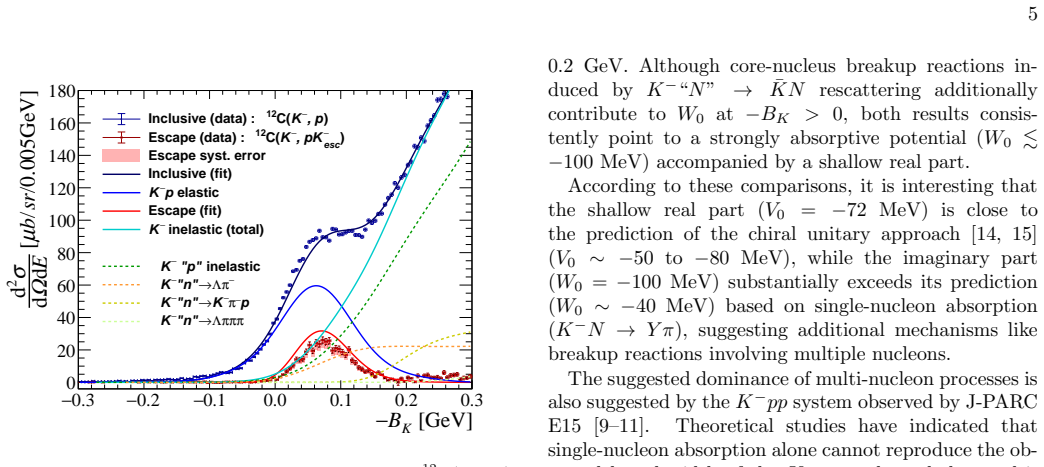
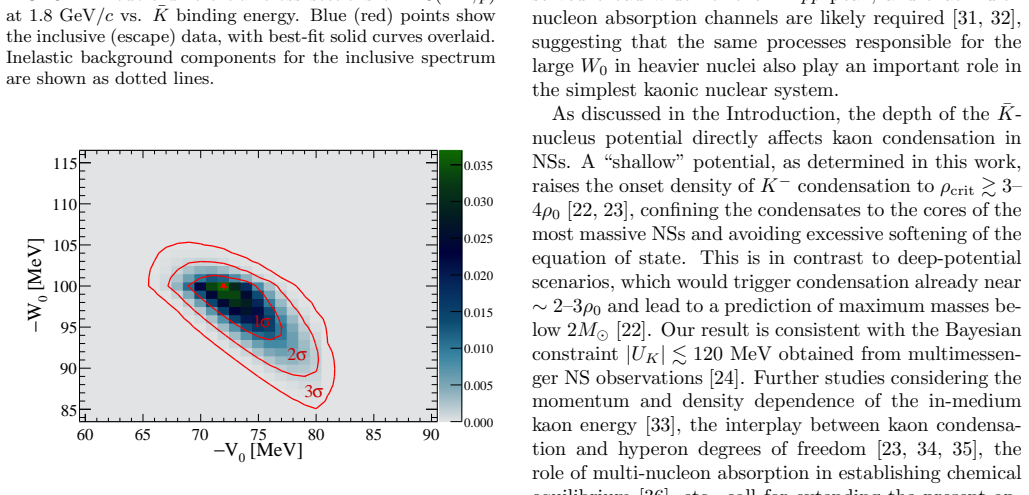
The differential cross section for the K^-escape reaction was determined to be 436 ± 6 (stat.) ± 44 (syst.) μb/sr. A simultaneous likelihood fit yielded real and imaginary potential strengths of V0 = -72^{+3}_{-5} (stat.) ^{+0}_{-8} (syst.) MeV and W0 = -100^{+7}_{-1} (stat.) ^{+0}_{-16} (syst.) MeV at the nuclear center, respectively. The derived W0 is significantly stronger than that predicted by theoretical models based on one-nucleon processes, suggesting possible contribution of multi-nucleon involving processes.
What carries the argument
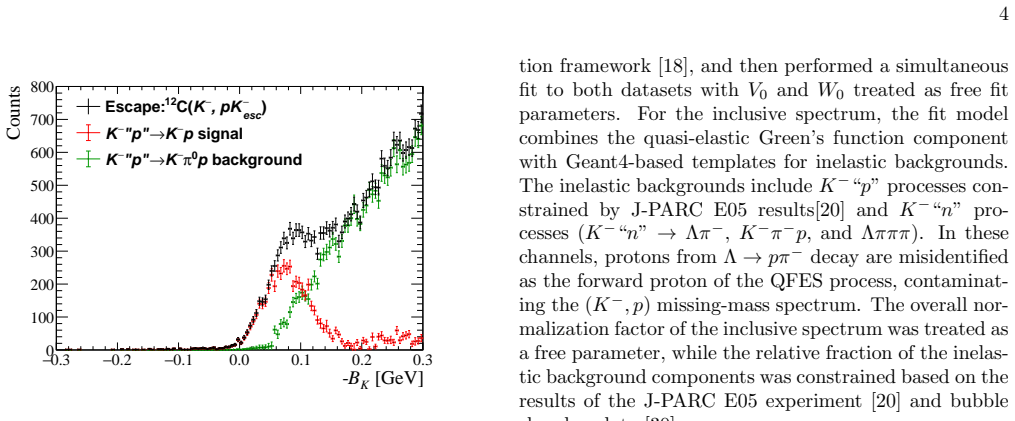
The K^- escape reaction identified by detecting both the outgoing proton and the escaped K^-, which separates the imaginary part of the optical potential in a simultaneous likelihood fit to inclusive and exclusive data.
If this is right
- The imaginary part of the K^- optical potential receives substantial contributions from multi-nucleon absorption processes.
- One-nucleon absorption models underestimate the strength of the imaginary potential by a large margin.
- The real part of the potential at the nuclear center is -72 MeV.
- Models of K^- nucleus interactions must incorporate multi-nucleon processes to match the data.
Where Pith is reading between the lines
- If multi-nucleon absorption is the dominant source, it would alter expected formation probabilities for deeply bound kaonic states or hypernuclei in similar reactions.
- Applying the same simultaneous-fit method to heavier or lighter targets could reveal how the relative strength of multi-nucleon contributions changes with nuclear size.
Load-bearing premise
The chosen optical potential form and reaction model correctly isolate the imaginary part without significant contamination from unmodeled multi-nucleon absorption channels or detector acceptance effects.
What would settle it
An independent experiment or calculation that reproduces the measured escape cross section of 436 μb/sr using only one-nucleon absorption models without extra imaginary strength.
Figures
read the original abstract
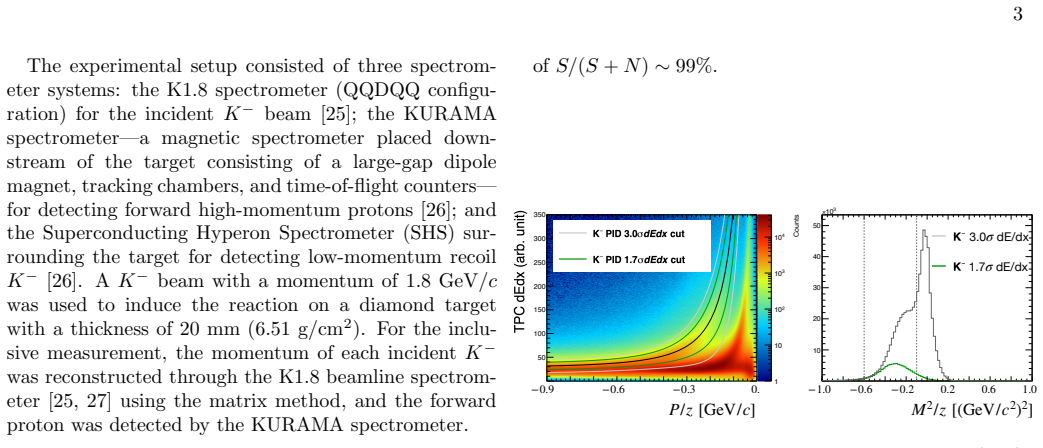
We investigated the $\bar{K}$-nucleus interaction through the simultaneous measurement of the inclusive $^{12}{\rm C}(K^-, p)$ and exclusive $K^-$-escape $^{12}{\rm C}(K^-, p K^-_{esc})$ reactions at $1.8$ GeV/$c$ at J-PARC. The present measurement explicitly focuses on the $K^-$ escape process for the first time, successfully accomplishing a direct experimental determination of the imaginary part of the $K^-$ optical potential. The differential cross section for the $K^-$-escape reaction was determined to be $436 \pm 6\:(\text{stat.}) \pm 44\:(\text{syst.})~\mu\text{b/sr}$. A simultaneous likelihood fit yielded real and imaginary potential strengths of $V_0 = -72\:^{+3}_{-5}\:(\text{stat.})\:^{+0}_{-8}\:(\text{syst.})~\text{MeV}$ and $W_0 = -100\:^{+7}_{-1}\:(\text{stat.})\:^{+0}_{-16}\:(\text{syst.})~\text{MeV}$ at the nuclear center, respectively. The derived $W_0$ is significantly stronger than that predicted by theoretical models based on one-nucleon processes, suggesting possible contribution of multi-nucleon involving processes.
Editorial analysis
A structured set of objections, weighed in public.
Referee Report
Summary. The manuscript reports the first measurement of the K^- escape cross section in the ^{12}C(K^-, p) reaction at 1.8 GeV/c, determining the differential cross section to be 436 ± 6 (stat.) ± 44 (syst.) μb/sr. A simultaneous likelihood fit to inclusive and exclusive data extracts central optical potential strengths V0 = -72^{+3}_{-5} (stat.)^{+0}_{-8} (syst.) MeV and W0 = -100^{+7}_{-1} (stat.)^{+0}_{-16} (syst.) MeV, with the latter significantly exceeding one-nucleon absorption model predictions and interpreted as evidence for multi-nucleon processes.
Significance. If the extraction holds, the direct escape-channel measurement supplies a new experimental handle on the imaginary part of the K^- optical potential, which is otherwise difficult to isolate. The reported W0 value, if robust against model assumptions, would indicate that multi-nucleon absorption contributes substantially beyond current one-nucleon calculations, with potential consequences for kaonic-atom analyses and K^- propagation in nuclei.
major comments (1)
- [results section on the likelihood fit] The simultaneous likelihood fit (described in the results section) extracts W0 = -100 MeV by assuming the chosen optical-potential form (parameterized by V0, W0 at r=0) plus the reaction model fully accounts for the observed K^- escape yield. Because the paper concludes that multi-nucleon processes are likely present to explain the discrepancy with theory, any unmodeled leakage of those channels into the escape signature would systematically bias W0 upward; no explicit test (model-space variation or microscopic comparison) is reported that bounds this contamination below the quoted ±16 MeV systematic uncertainty.
Simulated Author's Rebuttal
We thank the referee for the careful review and the insightful comment concerning the likelihood fit and possible systematic effects from multi-nucleon processes. We respond to the major comment below.
read point-by-point responses
-
Referee: [results section on the likelihood fit] The simultaneous likelihood fit (described in the results section) extracts W0 = -100 MeV by assuming the chosen optical-potential form (parameterized by V0, W0 at r=0) plus the reaction model fully accounts for the observed K^- escape yield. Because the paper concludes that multi-nucleon processes are likely present to explain the discrepancy with theory, any unmodeled leakage of those channels into the escape signature would systematically bias W0 upward; no explicit test (model-space variation or microscopic comparison) is reported that bounds this contamination below the quoted ±16 MeV systematic uncertainty.
Authors: The optical potential in our analysis is an effective phenomenological potential whose imaginary part W0 is intended to encompass the net effect of all absorption mechanisms, including multi-nucleon processes. The fact that the fitted |W0| exceeds one-nucleon predictions is itself the quantitative signature of those additional contributions. The systematic uncertainty of 16 MeV was obtained by varying the potential shape, nuclear density, and distortion parameters within the reaction model. Although we did not carry out an explicit microscopic multi-nucleon calculation or additional model-space scan beyond those variations, the simultaneous likelihood fit to both the inclusive and exclusive data sets supplies internal consistency checks that constrain possible unaccounted leakage. In the revised manuscript we will add a short paragraph in the results section that explicitly discusses this point and states that the quoted systematic uncertainty is intended to cover residual model dependence of this type. revision: partial
Circularity Check
No significant circularity; direct measurement and data-driven fit
full rationale
The paper reports a new experimental measurement of the K^- escape differential cross section (436 ±6 stat ±44 syst μb/sr) from J-PARC data on the exclusive ^{12}C(K^-, p K^-_{esc}) reaction. The optical potential parameters V0 and W0 are extracted via a simultaneous likelihood fit to the measured inclusive and exclusive spectra. This is standard parameter estimation from fresh data against an external reaction model, not a derivation that reduces to its own inputs by construction. No self-citations, ansatze smuggled via prior work, or uniqueness theorems are invoked in the provided text to justify the central result. The comparison of fitted W0 to one-nucleon theoretical models is an external benchmark, not internal redefinition.
Axiom & Free-Parameter Ledger
free parameters (2)
- V0 =
-72 MeV
- W0 =
-100 MeV
axioms (1)
- domain assumption The K- nucleus interaction can be described by a local optical potential whose imaginary part directly governs the escape probability in the (K-,p) reaction.
Reference graph
Works this paper leans on
-
[1]
A. D. Martin, Kaon-nucleon parameters, Nuclear Physics B179, 33 (1981)
1981
-
[2]
Hyodo, Antikaon-nucleon dynamics and its applica- tion to few-body systems, Nuclear Physics A914, 260 (2013)
T. Hyodo, Antikaon-nucleon dynamics and its applica- tion to few-body systems, Nuclear Physics A914, 260 (2013)
2013
-
[3]
Iwasakiet al., Observation of kaonic hydrogenK α X Rays, Phys
M. Iwasakiet al., Observation of kaonic hydrogenK α X Rays, Phys. Rev. Lett.78, 3067 (1997)
1997
-
[4]
Bazziet al., A new measurement of kaonic hydrogen X-rays, Physics Letters B704, 113 (2011)
M. Bazziet al., A new measurement of kaonic hydrogen X-rays, Physics Letters B704, 113 (2011)
2011
-
[5]
Beeret al.(DEAR Collaboration), Measurement of the Kaonic Hydrogen X-Ray Spectrum, Phys
G. Beeret al.(DEAR Collaboration), Measurement of the Kaonic Hydrogen X-Ray Spectrum, Phys. Rev. Lett. 94, 212302 (2005)
2005
-
[6]
Ikeda, T
Y. Ikeda, T. Hyodo, and W. Weise, Chiral SU(3) theory of antikaon-nucleon interactions with improved threshold constraints, Nuclear Physics A881, 98 (2012)
2012
-
[7]
D. Jido, J. A. Oller, E. Oset, A. Ramos, and U. G. Meiss- ner, Chiral dynamics of the two Λ(1405) states, Nucl. Phys. A725, 181 (2003)
2003
-
[8]
Akaishi and T
Y. Akaishi and T. Yamazaki, Nuclear ¯Kbound states in light nuclei, Physical Review C65, 044005 (2002)
2002
-
[9]
Ajimuraet al.(J-PARC E15), TheK −ppbound state observed in the 3He(K −, Λp)nreaction, Phys
S. Ajimuraet al.(J-PARC E15), TheK −ppbound state observed in the 3He(K −, Λp)nreaction, Phys. Lett. B 743, 305 (2015), arXiv:1408.5768 [nucl-ex]
Pith/arXiv arXiv 2015
-
[10]
Hashimotoet al.(J-PARC E15), Search for the “K −pp”-like structure in the 3He(K −, n) reaction at 1.0 GeV/c, Prog
T. Hashimotoet al.(J-PARC E15), Search for the “K −pp”-like structure in the 3He(K −, n) reaction at 1.0 GeV/c, Prog. Theor. Exp. Phys.2015, 061D01 (2015)
2015
-
[11]
Yamagaet al.(J-PARC E15), Observation of a ¯KN N bound state in the 3He(K −, n) reaction, Phys
T. Yamagaet al.(J-PARC E15), Observation of a ¯KN N bound state in the 3He(K −, n) reaction, Phys. Rev. C 102, 044002 (2020)
2020
-
[12]
Batty, E
C. Batty, E. Friedman, and A. Gal, Strong interaction physics from hadronic atoms, Physics Reports287, 385 (1997)
1997
-
[13]
Friedman and A
E. Friedman and A. Gal, In-medium nuclear interactions of low-energy hadrons, Physics Reports452, 89 (2007)
2007
-
[14]
Kaiser, P
N. Kaiser, P. B. Siegel, and W. Weise, Chiral dynam- ics and the low-energy kaon-nucleon interaction, Nuclear Physics A594, 325 (1995)
1995
-
[15]
Waas and W
T. Waas and W. Weise, S-wave interactions of ¯Kandη mesons in nuclear matter, Nuclear Physics A625, 287 (1997)
1997
-
[16]
Hashimotoet al.(J-PARC E62 Collaboration), Mea- surements of Strong-Interaction Effects in Kaonic-Helium Isotopes at Sub-eV Precision with X-Ray Microcalorime- ters, Phys
T. Hashimotoet al.(J-PARC E62 Collaboration), Mea- surements of Strong-Interaction Effects in Kaonic-Helium Isotopes at Sub-eV Precision with X-Ray Microcalorime- ters, Phys. Rev. Lett.128, 112503 (2022)
2022
-
[17]
Yamagata-Sekihara, Y
J. Yamagata-Sekihara, Y. Iizawa, D. Jido, N. Ikeno, T. Hashimoto, S. Okada, and S. Hirenzaki, Investigation of Kaonic Atom Optical Potential by the High-Precision Data of Kaonic 3He and 4He Atoms, Progress of Theo- retical and Experimental Physics2025, 013D02 (2024)
2024
-
[18]
Yamagata, H
J. Yamagata, H. Nagahiro, and S. Hirenzaki, In-flight (K −, p) reactions for the formation of kaonic atoms and kaonic nuclei using the green function method, Phys. Rev. C74, 014604 (2006)
2006
-
[19]
Kishimotoet al., Search for deeply bound kaonic nu- clear states by in-flightk − reactions, Prog
T. Kishimotoet al., Search for deeply bound kaonic nu- clear states by in-flightk − reactions, Prog. Theor. Phys. 118, 181 (2007)
2007
-
[20]
Y. Ichikawaet al.(J-PARC E05 collaboration), An event excess observed in the deeply bound region of the 12C(K −, p) missing-mass spectrum, Progress of Theoret- ical and Experimental Physics2020, 123D01 (2020)
2020
-
[21]
Y. Iizawa, D. Jido, N. Ikeno, J. Yamagata-Sekihara, and S. Hirenzaki, Origin of energy shift in kaonic atom and kaon-nucleus interaction, arXiv preprint arXiv:1907.05626 (2019), arXiv:1907.05626 [nucl-th]
Pith/arXiv arXiv 1907
-
[22]
Hong and Z
B. Hong and Z. Ren, Probing kaon meson condensations through gravitational waves during neutron star inspiral phases, Physics Letters B858, 139076 (2024)
2024
-
[23]
T. Muto, T. Maruyama, and T. Tatsumi, Effects of three- baryon forces on kaon condensation in hyperon-mixed matter, Phys. Lett. B821, 136587 (2021)
2021
-
[24]
Guha Roy and S
D. Guha Roy and S. Banik, Signatures ofK − condensa- tion on neutron star structure andf-mode frequencies, Physics Letters B871, 139990 (2025)
2025
-
[25]
Takahashiet al., Beam and sks spectrometers at the k1.8 beam line, Progress of Theoretical and Experimental Physics2012, 02B012 (2012)
T. Takahashiet al., Beam and sks spectrometers at the k1.8 beam line, Progress of Theoretical and Experimental Physics2012, 02B012 (2012)
2012
-
[26]
W. S. Junget al.(J-PARC E42 Collaboration), Cross Section Measurements for 12C(K −, K+Ξ−) and 12C(K −, K+ΛΛ) Reactions at 1.8 GeV/c, Progress of Theoretical and Experimental Physics2025, 091D01 (2025)
2025
-
[27]
K. Agariet al., Secondary charged beam lines at the j- parc hadron experimental hall, Progress of Theoretical and Experimental Physics2012, 10.1093/ptep/pts038 (2012)
-
[28]
J. Ahn, S. Choi, S. Hasegawa, S. Hayakawa, J. Hong, Y. Ichikawa, K. Imai, S. Kim, Y. Makida, H. Ohhata, H. Sako, K. Sasaki, S. Sato, T. Takahashi, K. Tanida, and J. Yoshida, Superconducting dipole magnet for hy- peron spectrometer, Nuclear Instruments and Methods in Physics Research Section A: Accelerators, Spectrome- ters, Detectors and Associated Equipm...
2023
-
[29]
S. Kim, Y. Ichikawa, H. Sako, J. Ahn, T. Akaishi, S. Ashikaga, S. Choi, H. Ekawa, S. Hasegawa, S. Hayakawa, W. Jung, B. Kang, J. Lee, T. Nanamura, S. Sato, K. Shirotori, K. Suzuki, K. Tanida, S. Yang, and J. Yoshida, High-rate performance of a time projection chamber for an h-dibaryon search experiment at j-parc, Nuclear Instruments and Methods in Physics...
2019
-
[30]
C. V. Velde-Wilquet, J. Sacton, J. H. Wickens, D. N. Tovee, and D. H. Davis, Determination of the branch- ing fractions forK − meson absorption at rest in carbon nuclei, Nuovo Cimento A39, 538 (1977)
1977
-
[31]
Sekihara, E
T. Sekihara, E. Oset, and A. Ramos, On the structure of theK −ppresonance in the 3He(K −,Λp)n reaction, Prog. Theor. Exp. Phys.2016, 123D03 (2016)
2016
-
[32]
Dot´ e, T
A. Dot´ e, T. Inoue, and T. Myo, Investigation of the K −ppbound state with a coupled-channel complex scal- ing method, Phys. Lett. B784, 197 (2018). 7
2018
-
[33]
Muto, Kaonic modes in hyperonic matter and p-wave kaon condensation, Nuclear Physics A697, 225 (2002)
T. Muto, Kaonic modes in hyperonic matter and p-wave kaon condensation, Nuclear Physics A697, 225 (2002)
2002
-
[34]
T. Muto, T. Maruyama, and T. Tatsumi, Kaon-baryon coupling schemes and kaon condensation in hyperon- mixed matter, Prog. Theor. Exp. Phys.2022, 093D03 (2022)
2022
-
[35]
Tolos and L
L. Tolos and L. Fabbietti, Strangeness in nuclei and neu- tron stars, Prog. Part. Nucl. Phys.112, 103770 (2020)
2020
-
[36]
Ramos and E
A. Ramos and E. Oset, The properties of antikaons in the nuclear medium, Nuclear Physics A671, 481 (2000)
2000
discussion (0)
Sign in with ORCID, Apple, or X to comment. Anyone can read and Pith papers without signing in.