Bayesian Anytime Pareto Set Identification for Multi-Objective Multi-Armed Bandits
Pith reviewed 2026-06-26 21:53 UTC · model grok-4.3
The pith
The first anytime Bayesian algorithm identifies Pareto sets in multi-objective multi-armed bandits.
A machine-rendered reading of the paper's core claim, the machinery that carries it, and where it could break.
Core claim
TTPFTS is the first anytime algorithm for the Pareto Set Identification problem in Multi-Objective Multi-Armed Bandits, relying on Bayesian Thompson sampling with a top-two selection rule. Empirical tests show it competes with fixed-budget methods on synthetic data and succeeds in molecular discovery, while a new uncertainty metric tracks confidence, and theory confirms asymptotic correctness.
What carries the argument
Top-Two Pareto Front Thompson Sampling (TTPFTS), a Bayesian sampling rule that selects arms to identify the Pareto front in an anytime manner.
If this is right
- The algorithm allows identification of Pareto optimal solutions without committing to a fixed number of samples in advance.
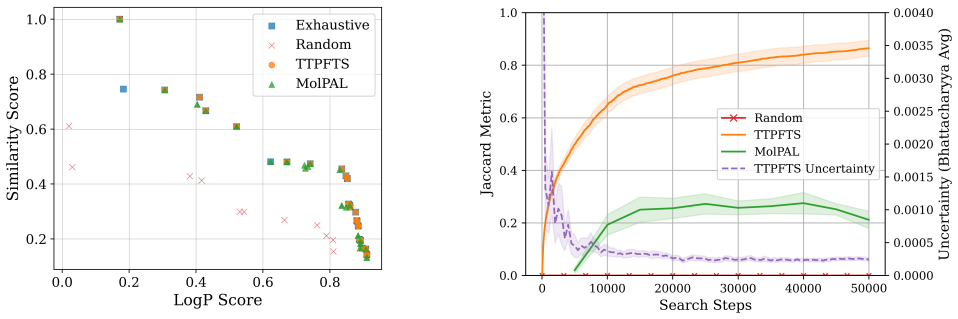
- It provides practical value in applications like molecular discovery by efficiently exploring large libraries.
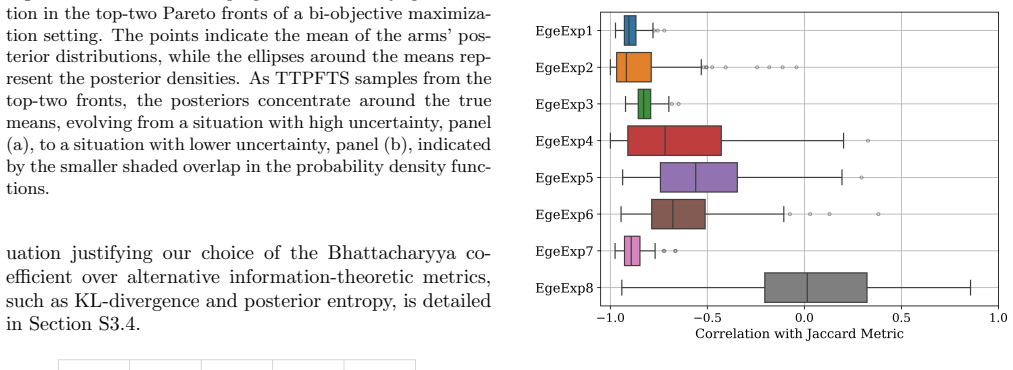
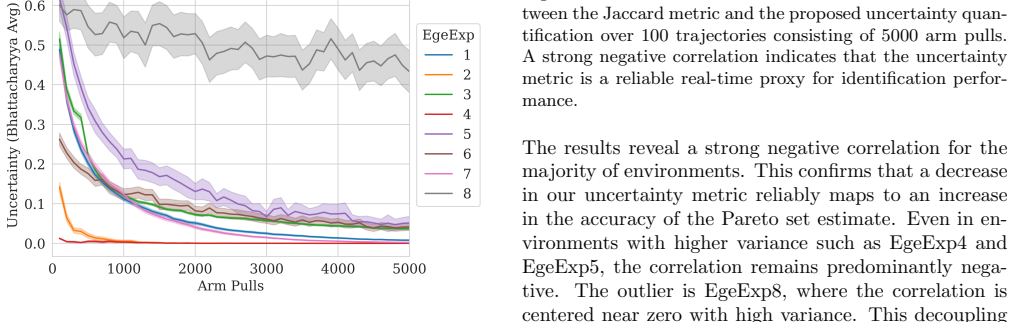
- The uncertainty quantification metric serves as a proxy for performance monitoring during learning.
- Asymptotic correctness ensures the predicted Pareto set matches the true one in the limit.
Where Pith is reading between the lines
- This method may generalize to other sequential decision problems involving multiple objectives.
- Incorporating domain-specific priors through the Bayesian model could improve performance in applied settings.
- Further experiments in non-stationary environments could test the robustness of the asymptotic guarantee.
Load-bearing premise
The reward distributions can be modeled Bayesianly such that the posterior concentrates to allow correct identification of the Pareto set over time.
What would settle it
Running the algorithm on a simple multi-objective bandit with known rewards where it does not converge to the true Pareto set after millions of pulls would disprove the asymptotic claim.
Figures
read the original abstract
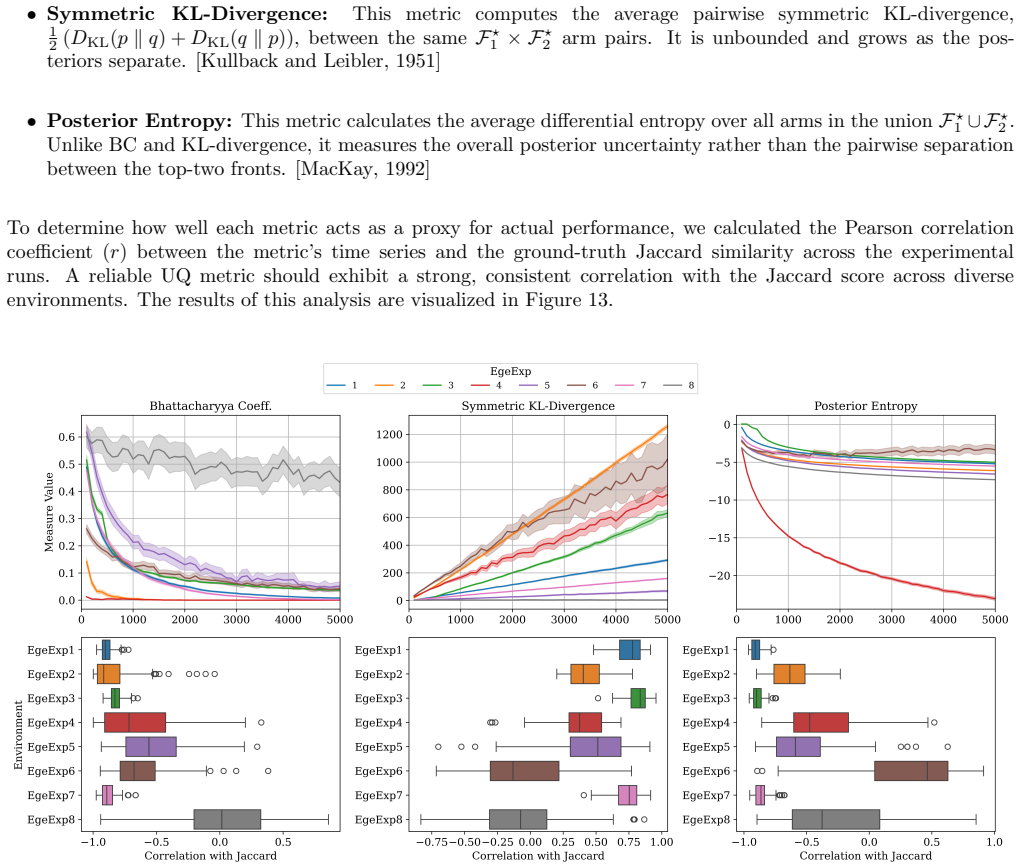
Identifying Pareto optimal solutions is critical to support multi-objective decision-making. We introduce the first anytime Multi-Objective Multi-Armed Bandit algorithm for the Pareto Set Identification problem, taking a Bayesian approach: Top-Two Pareto Front Thompson Sampling (TTPFTS). We benchmark TTPFTS against state-of-the-art fixed-budget Pareto Set Identification algorithms on synthetic environments. Next, we demonstrate its practical utility in a challenging multi-objective molecular discovery setting by efficiently exploring an ultra-large synthesis-on-demand molecular library. Furthermore, we introduce a novel uncertainty quantification metric that estimates our algorithm's confidence in the predicted Pareto set. We demonstrate that this metric effectively proxies true performance, yielding a robust methodology for monitoring learning progress in complex settings. Finally, we complement these empirical findings with a theoretical proof of the algorithm's asymptotic correctness.
Editorial analysis
A structured set of objections, weighed in public.
Referee Report
Summary. The paper introduces Top-Two Pareto Front Thompson Sampling (TTPFTS) as the first anytime Bayesian algorithm for Pareto Set Identification in multi-objective multi-armed bandits. It reports benchmarks against fixed-budget baselines on synthetic environments, applies the method to molecular discovery over an ultra-large synthesis-on-demand library, proposes a novel uncertainty quantification metric shown to proxy true performance, and states a theoretical proof of asymptotic correctness.
Significance. If the asymptotic result holds under the stated Bayesian model and the molecular experiment protocol is reproducible, the work would constitute a meaningful advance by supplying the first anytime PSI algorithm together with a practical UQ diagnostic. The combination of synthetic benchmarks, real-world molecular application, and the explicit claim of a proof is stronger than purely empirical contributions in the area.
major comments (2)
- [Abstract, §4] Abstract and §4 (Theoretical Analysis): the claim of asymptotic correctness for TTPFTS requires uniform posterior concentration over the entire Pareto front under the chosen vector-valued Bayesian model. No derivation or citation of a multi-objective concentration inequality that accounts for objective dependence and the combinatorial structure of the front is supplied; marginal concentration alone does not guarantee that the Top-Two rule stops sampling suboptimal arms with probability 1.
- [§5.2] §5.2 (Molecular Discovery Experiment): the reported efficiency gains are presented without an ablation on the choice of prior or likelihood for the vector-valued rewards, nor a sensitivity analysis on the number of objectives. Because the central practical claim rests on these results, the absence of such controls leaves open whether performance is driven by the algorithm or by favorable modeling assumptions.
minor comments (2)
- Notation for the Pareto front and the Top-Two sampling rule should be introduced with a single consistent definition rather than re-stated in each section.
- Figure captions for the synthetic benchmarks should explicitly state the number of independent runs and whether error bars represent standard error or standard deviation.
Simulated Author's Rebuttal
We thank the referee for their constructive comments, which highlight important aspects of the theoretical analysis and experimental validation. We address each major comment below and outline the revisions we will make to strengthen the manuscript.
read point-by-point responses
-
Referee: [Abstract, §4] Abstract and §4 (Theoretical Analysis): the claim of asymptotic correctness for TTPFTS requires uniform posterior concentration over the entire Pareto front under the chosen vector-valued Bayesian model. No derivation or citation of a multi-objective concentration inequality that accounts for objective dependence and the combinatorial structure of the front is supplied; marginal concentration alone does not guarantee that the Top-Two rule stops sampling suboptimal arms with probability 1.
Authors: We agree that the current presentation of the asymptotic correctness result would benefit from greater detail on the concentration properties. The proof in §4 establishes asymptotic correctness under the stated Bayesian model by leveraging posterior concentration for the vector-valued rewards, but the main text and appendix do not explicitly derive or cite a uniform concentration inequality that fully accounts for objective dependence and the combinatorial nature of the Pareto front. In the revised manuscript we will expand the appendix to include this derivation (building on standard multi-objective extensions of posterior concentration results) and clarify how it ensures the Top-Two sampling rule eliminates suboptimal arms with probability 1. This addresses the gap identified by the referee. revision: yes
-
Referee: [§5.2] §5.2 (Molecular Discovery Experiment): the reported efficiency gains are presented without an ablation on the choice of prior or likelihood for the vector-valued rewards, nor a sensitivity analysis on the number of objectives. Because the central practical claim rests on these results, the absence of such controls leaves open whether performance is driven by the algorithm or by favorable modeling assumptions.
Authors: We concur that additional controls would make the molecular discovery results more robust. The current experiments use a fixed Gaussian process prior and likelihood for the vector-valued molecular properties, and the number of objectives is held constant at the values relevant to the discovery task. In the revision we will add an ablation study varying the prior hyperparameters and likelihood assumptions, together with a sensitivity analysis across different numbers of objectives (while keeping the molecular library and evaluation protocol fixed). These results will be reported in an expanded §5.2 and will demonstrate that the observed efficiency gains are primarily attributable to TTPFTS rather than to specific modeling choices. revision: yes
Circularity Check
No significant circularity detected; derivation chain is self-contained.
full rationale
The paper introduces the TTPFTS algorithm, reports empirical benchmarks on synthetic environments and a molecular discovery task, introduces an uncertainty metric, and states a theoretical proof of asymptotic correctness. No equations, definitions, or claims in the provided text reduce any prediction or result to a fitted input, self-definition, or load-bearing self-citation by construction. The proof is presented as independent theoretical support, and results rely on external benchmarks, satisfying the condition for a self-contained analysis.
Axiom & Free-Parameter Ledger
Reference graph
Works this paper leans on
-
[1]
Structure and Interpretation of Computer Programs
Harold Abelson and Gerald Jay Sussman and Julie Sussman. Structure and Interpretation of Computer Programs. 1985
1985
-
[2]
Visual Information Extraction with Lixto
Robert Baumgartner and Georg Gottlob and Sergio Flesca. Visual Information Extraction with Lixto. Proceedings of the 27th International Conference on Very Large Databases. 2001
2001
-
[3]
Brachman and James G
Ronald J. Brachman and James G. Schmolze. An overview of the KL-ONE knowledge representation system. Cognitive Science. 1985
1985
-
[4]
Complexity results for nonmonotonic logics
Georg Gottlob. Complexity results for nonmonotonic logics. Journal of Logic and Computation. 1992
1992
-
[5]
Hypertree Decompositions and Tractable Queries
Georg Gottlob and Nicola Leone and Francesco Scarcello. Hypertree Decompositions and Tractable Queries. Journal of Computer and System Sciences. 2002
2002
-
[6]
Levesque
Hector J. Levesque. Foundations of a functional approach to knowledge representation. Artificial Intelligence. 1984
1984
-
[7]
Levesque
Hector J. Levesque. A logic of implicit and explicit belief. Proceedings of the Fourth National Conference on Artificial Intelligence. 1984
1984
-
[8]
On the compilability and expressive power of propositional planning formalisms
Bernhard Nebel. On the compilability and expressive power of propositional planning formalisms. Journal of Artificial Intelligence Research. 2000
2000
-
[9]
International Conference on Artificial Intelligence and Statistics , year=
Bandit Pareto Set Identification: the Fixed Budget Setting , author=. International Conference on Artificial Intelligence and Statistics , year=
-
[10]
Best Arm Identification: A Unified Approach to Fixed Budget and Fixed Confidence , url =
Gabillon, Victor and Ghavamzadeh, Mohammad and Lazaric, Alessandro , booktitle =. Best Arm Identification: A Unified Approach to Fixed Budget and Fixed Confidence , url =
-
[11]
Proceedings of The 33rd International Conference on Machine Learning , pages =
Anytime Exploration for Multi-armed Bandits using Confidence Information , author =. Proceedings of The 33rd International Conference on Machine Learning , pages =. 2016 , editor =
2016
-
[12]
International Conference on Algorithmic Learning Theory , year=
Pure Exploration in Multi-armed Bandits Problems , author=. International Conference on Algorithmic Learning Theory , year=
-
[13]
29th Annual Conference on Learning Theory , pages =
Simple Bayesian Algorithms for Best Arm Identification , author =. 29th Annual Conference on Learning Theory , pages =. 2016 , editor =
2016
-
[14]
ArXiv , year=
Adaptive Algorithms for Relaxed Pareto Set Identification , author=. ArXiv , year=
-
[15]
International Conference on Artificial Intelligence and Statistics , year=
Pareto Set Identification With Posterior Sampling , author=. International Conference on Artificial Intelligence and Statistics , year=
-
[16]
Proceedings of The 27th International Conference on Artificial Intelligence and Statistics , pages =
Sequential learning of the. Proceedings of The 27th International Conference on Artificial Intelligence and Statistics , pages =. 2024 , editor =
2024
-
[17]
2020 , publisher =
Bandit Algorithms , author =. 2020 , publisher =
2020
-
[18]
Annual Conference Computational Learning Theory , year=
Best Arm Identification in Multi-Armed Bandits , author=. Annual Conference Computational Learning Theory , year=
-
[19]
Machine Learning , year=
Finite-time Analysis of the Multiarmed Bandit Problem , author=. Machine Learning , year=
-
[20]
The 2013 International Joint Conference on Neural Networks (IJCNN) , year=
Designing multi-objective multi-armed bandits algorithms: A study , author=. The 2013 International Joint Conference on Neural Networks (IJCNN) , year=
2013
-
[21]
International Conference on Artificial Intelligence and Statistics , year=
Pareto Front Identification from Stochastic Bandit Feedback , author=. International Conference on Artificial Intelligence and Statistics , year=
-
[22]
The European Symposium on Artificial Neural Networks , year=
Thompson Sampling for Multi-Objective Multi-Armed Bandits Problem , author=. The European Symposium on Artificial Neural Networks , year=
-
[23]
AAAI Conference on Artificial Intelligence , year=
Hierarchize Pareto Dominance in Multi-Objective Stochastic Linear Bandits , author=. AAAI Conference on Artificial Intelligence , year=
-
[24]
International Conference on Machine Learning , year=
Active Learning for Multi-Objective Optimization , author=. International Conference on Machine Learning , year=
-
[25]
Gopakumar, Abhijith M. and Balachandran, Prasanna V. and Xue, Dezhen and Gubernatis, James E. and Lookman, Turab , title =. Scientific Reports , year =. doi:10.1038/s41598-018-21936-3 , url =
-
[26]
Liu, Yifei and Zhu, Yiheng and Wang, Jike and Hu, Renling and Shen, Chao and Qu, Wanglin and Wang, Gaoang and Su, Qun and Zhu, Yuchen and Kang, Yu and Pan, Peichen and Hsieh, Chang-Yu and Hou, Tingjun , title =. Advanced Science , volume =. doi:https://doi.org/10.1002/advs.202410640 , url =. https://advanced.onlinelibrary.wiley.com/doi/pdf/10.1002/advs.20...
-
[27]
Fromer, Jenna C. and Graff, David E. and Coley, Connor W. Pareto optimization to accelerate multi-objective virtual screening. Digital Discovery. 2024. doi:10.1039/D3DD00227F
-
[28]
Pareto Front Approximation for Multi-Objective Session-Based Recommender Systems , url=
Wilm, Timo and Normann, Philipp and Stepprath, Felix , year=. Pareto Front Approximation for Multi-Objective Session-Based Recommender Systems , url=. doi:10.1145/3640457.3688048 , booktitle=
-
[29]
IISE Transactions51(5), 437–455 (2019) https://doi
Hui Zhao and Kan Wu and Edward Huang , title =. IISE Transactions , volume =. 2018 , publisher =. doi:10.1080/24725854.2017.1395978 , URL =
-
[30]
Hayes and Lander Willem and Roxana Rădulescu and Steven Abrams and Diederik M
Mathieu Reymond and Conor F. Hayes and Lander Willem and Roxana Rădulescu and Steven Abrams and Diederik M. Roijers and Enda Howley and Patrick Mannion and Niel Hens and Ann Nowé and Pieter Libin , keywords =. Exploring the Pareto front of multi-objective COVID-19 mitigation policies using reinforcement learning , journal =. 2024 , issn =. doi:https://doi...
-
[31]
e-PAL: An Active Learning Approach to the Multi-Objective Optimization Problem
Zuluaga, Marcela and Krause, Andreas and P. e-PAL: An Active Learning Approach to the Multi-Objective Optimization Problem. Journal of Machine Learning Research , volume =
-
[32]
ArXiv , year=
Constrained Pareto Set Identification with Bandit Feedback , author=. ArXiv , year=
-
[33]
International Conference on Artificial Intelligence and Statistics , year=
Vector Optimization with Stochastic Bandit Feedback , author=. International Conference on Artificial Intelligence and Statistics , year=
-
[34]
International Conference on Machine Learning , year=
Feasible Arm Identification , author=. International Conference on Machine Learning , year=
-
[35]
International Conference on Artificial Intelligence and Statistics , year=
Top Feasible Arm Identification , author=. International Conference on Artificial Intelligence and Statistics , year=
-
[36]
Proceedings of the Thirty-Second International Joint Conference on Artificial Intelligence (IJCAI-23) , year =
What Lies beyond the Pareto Front? A Survey on Decision-Support Methods for Multi-Objective Optimization , author =. Proceedings of the Thirty-Second International Joint Conference on Artificial Intelligence (IJCAI-23) , year =
-
[37]
International Conference on Artificial Intelligence and Statistics , year=
Fixed-Confidence Guarantees for Bayesian Best-Arm Identification , author=. International Conference on Artificial Intelligence and Statistics , year=
-
[38]
Patrick , title =
Klarich, Kathryn and Goldman, Brian and Kramer, Trevor and Riley, Patrick and Walters, W. Patrick , title =. Journal of Chemical Information and Modeling , volume =. 2024 , doi =
2024
-
[39]
Mills and Ian Collins and Alan M
Albertus Wijnand Hensbergen and Vanessa R. Mills and Ian Collins and Alan M. Jones , keywords =. An expedient synthesis of oxazepino and oxazocino quinazolines , journal =. 2015 , issn =. doi:https://doi.org/10.1016/j.tetlet.2015.10.008 , url =
-
[40]
Nargund and Mahalakshmi Suresha Biradar , keywords =
Sharmila Gote and Shankar Thapa and Sonal Dubey and Shachindra L. Nargund and Mahalakshmi Suresha Biradar , keywords =. Computational investigation of quinazoline derivatives as Keap1 inhibitors for Alzheimer's disease , journal =. 2023 , issn =. doi:https://doi.org/10.1016/j.imu.2023.101334 , url =
-
[41]
Van Molle, Pieter and Verbelen, Tim and Vankeirsbilck, Bert and De Vylder, Jonas and Diricx, Bart and Kimpe, Tom and Simoens, Pieter and Dhoedt, Bart , title =. Neural Comput. Appl. , month = aug, pages =. 2021 , issue_date =. doi:10.1007/s00521-021-05789-y , abstract =
-
[42]
International Conference on Artificial Intelligence and Statistics , year=
Optimality of Thompson Sampling for Gaussian Bandits Depends on Priors , author=. International Conference on Artificial Intelligence and Statistics , year=
-
[43]
International Joint Conference on Artificial Intelligence , year=
Multi-Objective Generalized Linear Bandits , author=. International Joint Conference on Artificial Intelligence , year=
-
[44]
Bulletin of the Calcutta Mathematical Society , year =
Bhattacharyya, Anil Kumar , title =. Bulletin of the Calcutta Mathematical Society , year =
-
[45]
Autonomous Agents and Multi-Agent Systems , year=
A practical guide to multi-objective reinforcement learning and planning , author=. Autonomous Agents and Multi-Agent Systems , year=
-
[46]
Nature , volume=
Ultra-large library docking for discovering new chemotypes , author=. Nature , volume=. 2019 , doi=
2019
-
[47]
Bayesian Anytime m-top Exploration
Pieter Libin and Timothy Verstraeten and Roijers, Diederik M and Wenjia Wang and Kristof Theys and Ann Nowe. Bayesian Anytime m-top Exploration. 2019 IEEE 31st International Conference on Tools with Artificial Intelligence (ICTAI). 2019. doi:10.1109/ICTAI.2019.00201
-
[48]
Lipinski and Franco Lombardo and Beryl W
Christopher A. Lipinski and Franco Lombardo and Beryl W. Dominy and Paul J. Feeney , keywords =. Experimental and computational approaches to estimate solubility and permeability in drug discovery and development settings , journal =. 1997 , note =. doi:https://doi.org/10.1016/S0169-409X(96)00423-1 , url =
-
[49]
Expert Opinion on Drug Discovery , volume=
Lipophilicity in drug discovery , author=. Expert Opinion on Drug Discovery , volume=. 2010 , month=
2010
-
[50]
Oleksandr O. Grygorenko and Dmytro S. Radchenko and Igor Dziuba and Alexander Chuprina and Kateryna E. Gubina and Yurii S. Moroz , keywords =. Generating Multibillion Chemical Space of Readily Accessible Screening Compounds , journal =. 2020 , issn =. doi:https://doi.org/10.1016/j.isci.2020.101681 , url =
-
[51]
1990 , edition =
Keinosuke Fukunaga , title =. 1990 , edition =
1990
-
[52]
Journal of Chemical Information and Modeling , year =
Rogers, David and Hahn, Mathew , title =. Journal of Chemical Information and Modeling , year =
-
[53]
Journal of Chemical Information and Modeling , year =
Zhang, Jian and Mucs, Damian and Norinder, Ulf and Svensson, Filip , title =. Journal of Chemical Information and Modeling , year =
-
[54]
Leibler , title =
Solomon Kullback and Richard A. Leibler , title =. The Annals of Mathematical Statistics , year =
-
[55]
David J. C. MacKay , title =. Neural Computation , year =
-
[56]
, title =
Thompson, William R. , title =. Biometrika , volume =. 1933 , month =
1933
-
[57]
Proceedings of the Sixteenth International Conference on Artificial Intelligence and Statistics , series =
Agrawal, Shipra and Goyal, Navin , title =. Proceedings of the Sixteenth International Conference on Artificial Intelligence and Statistics , series =. 2013 , editor =
2013
discussion (0)
Sign in with ORCID, Apple, or X to comment. Anyone can read and Pith papers without signing in.