Polarized neutron scattering as a probe for vortex-type spin correlations in iron oxide multicore assemblies
Pith reviewed 2026-06-26 20:08 UTC · model grok-4.3
The pith
Polarized neutron scattering reveals signatures of vortex-type magnetization in iron oxide multicore assemblies at low fields.
A machine-rendered reading of the paper's core claim, the machinery that carries it, and where it could break.
Core claim
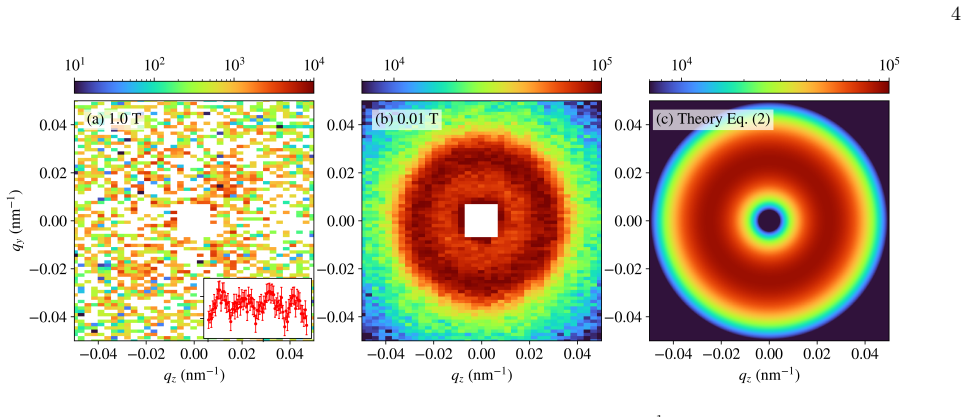
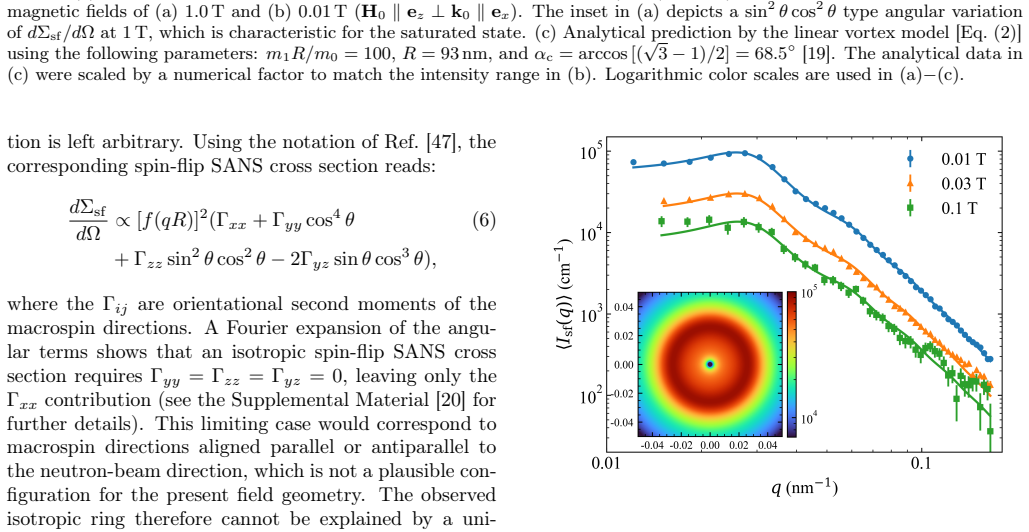
The field evolution and the characteristic isotropic ring-type feature of the spin-flip scattering intensity at intermediate momentum transfers are in line with the formation of flux-closure states. The latter are stabilized by the interplay of exchange, Zeeman, and magnetostatic energies, as described by the analytical theory for vortex-state magnetic nanoparticles. This provides a quantitative match between measured and calculated polarized SANS cross sections for the studied multicore iron oxide assemblies.
What carries the argument
Polarized SANS spin-flip channel cross sections compared against the analytical theory for vortex-state nanoparticles, which isolates the isotropic ring signature of flux-closure magnetization patterns.
If this is right
- Vortex-type configurations appear at low applied magnetic fields in these densely packed assemblies.
- The isotropic ring in spin-flip scattering serves as a direct indicator of flux-closure states.
- The method enables statistically averaged characterization across many particles at once.
- It complements surface-limited techniques by accessing bulk magnetic microstructure in nanoparticle systems.
Where Pith is reading between the lines
- The same scattering signatures could be tracked in other multicore magnetic materials to test whether flux closure is a general response to dense packing.
- Temperature or particle-size variations could be added to map the stability range of these states under the same neutron probe.
- If vortex states dominate stray-field minimization, assembly design rules for biomedical or sensor uses might prioritize core clustering over single-particle alignment.
- Extension to time-resolved measurements could reveal how quickly these configurations respond to changing external fields.
Load-bearing premise
The analytical theory for vortex-state nanoparticles correctly predicts the polarized SANS cross sections for these multicore iron oxide assemblies without dominant contributions from other magnetic configurations.
What would settle it
A quantitative mismatch between measured spin-flip intensities and vortex-theory predictions, or absence of the isotropic ring feature at intermediate momentum transfers under low applied fields.
Figures
read the original abstract
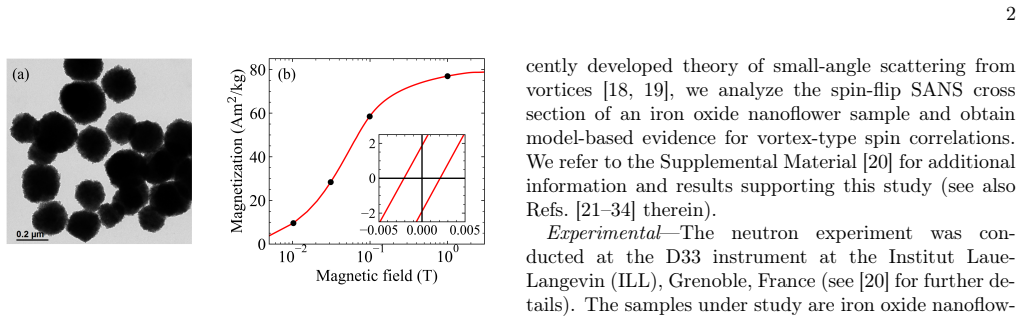
We report an experimental investigation of the magnetic microstructure of iron oxide multicore assemblies by means of polarized small-angle neutron scattering (SANS). Guided by a recently developed analytical theory for vortex-state magnetic nanoparticles, we provide a quantitative comparison between the measured and calculated cross sections, revealing signatures that are consistent with vortex-type magnetization configurations at low applied magnetic fields. In particular, the field evolution and the characteristic isotropic ring-type feature of the spin-flip scattering intensity at intermediate momentum transfers are in line with the formation of flux-closure states. The latter are stabilized by the interplay of exchange, Zeeman, and magnetostatic energies. The methodology allows for a statistically significant characterization of vortex states in densely packed nanoparticle systems, thereby complementing surface-sensitive techniques that are commonly limited to the observation of spin structures in individual particles.
Editorial analysis
A structured set of objections, weighed in public.
Referee Report
Summary. The manuscript reports polarized SANS experiments on iron oxide multicore nanoparticle assemblies. Using a recently developed analytical theory for vortex-state magnetic nanoparticles, the authors perform a quantitative comparison of measured and calculated polarized cross sections. They identify signatures consistent with vortex-type (flux-closure) magnetization configurations at low applied fields, notably the field evolution and an isotropic ring feature in the spin-flip scattering intensity at intermediate momentum transfers. The work positions polarized SANS as a bulk-sensitive method for statistically significant characterization of such states in densely packed systems.
Significance. If the quantitative match holds after addressing inter-core effects, the result would provide a useful complement to surface-sensitive techniques for probing vortex states in nanoparticle assemblies. The combination of polarized SANS with an analytical forward model is a methodological strength that could enable falsifiable tests of magnetization textures in multicore systems.
major comments (2)
- The central claim rests on the applicability of the single-nanoparticle vortex theory to multicore assemblies. The manuscript does not demonstrate that inter-core magnetostatic (dipolar) contributions are negligible or explicitly incorporated into the forward calculation for the reported particle packing fractions and size distributions; without this, the quantitative comparison cannot be considered load-bearing for the vortex interpretation.
- The abstract states that a 'quantitative comparison' was performed and that the data are 'consistent with the theory' with 'statistically significant characterization,' yet the provided text supplies no details on data reduction steps, fitting procedures, error propagation, goodness-of-fit metrics, or tests against alternative magnetic configurations.
minor comments (1)
- Notation for the polarized cross sections (e.g., spin-flip vs. non-spin-flip channels) should be defined explicitly at first use to aid readers unfamiliar with polarized SANS conventions.
Simulated Author's Rebuttal
We thank the referee for their detailed and constructive report. We address each of the major comments below and have revised the manuscript to incorporate additional analysis and methodological details as suggested.
read point-by-point responses
-
Referee: The central claim rests on the applicability of the single-nanoparticle vortex theory to multicore assemblies. The manuscript does not demonstrate that inter-core magnetostatic (dipolar) contributions are negligible or explicitly incorporated into the forward calculation for the reported particle packing fractions and size distributions; without this, the quantitative comparison cannot be considered load-bearing for the vortex interpretation.
Authors: We acknowledge this as a valid concern. The original analysis assumed that inter-core interactions are secondary for the length scales probed by SANS. To address this, we have added an appendix with calculations of the dipolar field strength using the known volume fractions and particle size distributions from TEM. These estimates indicate that the inter-core dipolar energy is at least an order of magnitude smaller than the intra-particle exchange energy, justifying the single-particle approximation. We have also updated the discussion section to include this justification. revision: yes
-
Referee: The abstract states that a 'quantitative comparison' was performed and that the data are 'consistent with the theory' with 'statistically significant characterization,' yet the provided text supplies no details on data reduction steps, fitting procedures, error propagation, goodness-of-fit metrics, or tests against alternative magnetic configurations.
Authors: We agree that these details were insufficiently described. In the revised manuscript, we have substantially expanded the 'Data analysis' and 'Methods' sections to include: a description of the polarized SANS data reduction pipeline, the specific fitting procedure and software used for comparing to the analytical vortex model, propagation of statistical errors, the resulting chi-squared values, and explicit comparisons to alternative models (e.g., collinear and flower-state configurations) showing poorer agreement. This makes the quantitative nature of the comparison fully transparent. revision: yes
Circularity Check
No significant circularity detected
full rationale
The paper presents polarized SANS data on multicore iron oxide assemblies and performs a quantitative comparison to an externally cited analytical theory for vortex states in nanoparticles. The central claim (field evolution and isotropic ring feature consistent with flux-closure) is an interpretation of measured intensities against model cross sections; it does not reduce by construction to a fitted parameter, self-defined quantity, or load-bearing self-citation chain within the paper's own equations. The theory is invoked as guidance for interpretation rather than as an unverified premise whose assumptions already embed the target result. No self-definitional, fitted-input, or ansatz-smuggling steps are exhibited in the abstract or described methodology.
Axiom & Free-Parameter Ledger
axioms (1)
- domain assumption The analytical theory for vortex-state magnetic nanoparticles accurately models the polarized SANS cross sections of the iron oxide multicore assemblies.
Reference graph
Works this paper leans on
-
[1]
E. C. Stoner and E. P. Wohlfarth, A mechanism of mag- netic hysteresis in heterogeneous alloys, Phil. Trans. Roy. Soc. LondonA240, 599 (1948)
1948
-
[2]
W. F. Brown Jr.,Micromagnetics(Interscience Publish- ers, New York, 1963)
1963
-
[3]
Aharoni,Introduction to the Theory of Ferromag- netism, 2nd ed
A. Aharoni,Introduction to the Theory of Ferromag- netism, 2nd ed. (Oxford University Press, Oxford, 2000)
2000
-
[4]
Gavilán, A
H. Gavilán, A. Gallo-Cordova, M. Rábade-Chediak, A. Páez-Rodríguez, M. del Puerto Morales, and L. Gutiérrez, Magnetic hyperthermia in focus: emerg- ing non-cancer applications of magnetic nanoparticles, Nanoscale17, 27734 (2025)
2025
-
[5]
Lappas, G
A. Lappas, G. Antonaropoulos, K. Brintakis, M. Vasi- lakaki, K. N. Trohidou, V. Iannotti, G. Ausanio, A. Kostopoulou, M. Abeykoon, I. K. Robinson, and E. S. Bozin, Vacancy-driven noncubic local structure and mag- netic anisotropy tailoring in FexO-Fe3−δO4 nanocrystals, Phys. Rev. X9, 041044 (2019)
2019
-
[6]
E. M. Jefremovas, L. Calus, and J. Leliaert, Coercivity- size map of magnetic nanoflowers: Spin disorder tunes the vortex reversal mechanism and tailors the hyperther- mia sweet spot, Small Sci.6, e202500490 (2026)
2026
-
[7]
N. A. Usov, M. S. Nesmeyanov, and V. P. Tarasov, Magnetic vortices as efficient nano heaters in magnetic nanoparticle hyperthermia, Sci. Rep.8, 1224 (2018)
2018
-
[8]
E. M. Jefremovas, P. Rooms, A. Gallo-Córdova, M. P. Morales, F. Wiekhorst, A. Michels, and J. Leliaert, Nanoscale mapping of internal magnetization dynamics reveals how disorder shapes heat generation in magnetic particle hyperthermia (2026), arXiv:2603.14566 [cond- mat.mes-hall]
arXiv 2026
-
[9]
M. L. Etheridge, K. R. Hurley, J. Zhang, S. Jeon, H. L. Ring, C. Hogan, C. L. Haynes, M. Garwood, and J. C. Bischof, Accounting for biological aggregation in heating and imaging of magnetic nanoparticles, Technology2, 214 (2014)
2014
-
[10]
Nowak, O
U. Nowak, O. N. Mryasov, R. Wieser, K. Guslienko, and R. W. Chantrell, Spin dynamics of magnetic nanoparti- cles: Beyond Brown’s theory, Phys. Rev. B72, 172410 (2005)
2005
-
[11]
Gatel, F
C. Gatel, F. J. Bonilla, A. Meffre, E. Snoeck, B. Warot- Fonrose, B. Chaudret, L.-M. Lacroix, and T. Blon, Size- specific spin configurations in single iron nanomagnet: From flower to exotic vortices, Nano Lett.15, 6952 (2015)
2015
-
[12]
A. S. Samardak, A. V. Davydenko, A. V. Ognev, Y. S. Jeon, Y. S. Choi, and Y. K. Kim, Size-dependent changeover in magnetization reversal mode of self- assembled one-dimensional chains of spherical Fe 3O4 nanoparticles, Jap. J. Appl. Phys.55, 100303 (2016)
2016
-
[13]
H. Gao, T. Zhang, Y. Zhang, Y. Chen, B. Liu, J. Wu, X. Liu, Y. Li, M. Peng, Y. Zhang, G. Xie, F. Zhao, and H. M. Fan, Ellipsoidal magnetite nanoparticles: a new member of the magnetic-vortex nanoparticles family for efficient magnetic hyperthermia, J. Mater. Chem. B8, 515 (2020)
2020
-
[14]
Niraula, D
G. Niraula, D. Toneto, G. F. Goya, G. Zoppellaro, J. A. H. Coaquira, D. Muraca, J. C. Denardin, T. P. 6 Almeida, M. Knobel, A. I. Ayesh, and S. K. Sharma, Observation of magnetic vortex configuration in non- stoichiometric Fe3O4 nanospheres, Nanoscale Adv.5, 5015 (2023)
2023
-
[15]
C. Moya, M. Escoda-Torroella, J. Rodríguez-Álvarez, A. I. Figueroa, Í. García, I. B. Ferrer-Vidal, A. Gallo- Cordova, M. Puerto Morales, L. Aballe, A. Fraile Ro- dríguez, A. Labarta, and X. Batlle, Unveiling the crys- tal and magnetic texture of iron oxide nanoflowers, Nanoscale16, 1942 (2024)
1942
-
[16]
Mühlbauer, D
S. Mühlbauer, D. Honecker, E. A. Périgo, F. Bergner, S. Disch, A. Heinemann, S. Erokhin, D. Berkov, C. Leighton, M. R. Eskildsen, and A. Michels, Mag- netic small-angle neutron scattering, Rev. Mod. Phys. 91, 015004 (2019)
2019
-
[17]
Michels,Magnetic Small-Angle Neutron Scattering: A Probe for Mesoscale Magnetism Analysis(Oxford Uni- versity Press, Oxford, 2021)
A. Michels,Magnetic Small-Angle Neutron Scattering: A Probe for Mesoscale Magnetism Analysis(Oxford Uni- versity Press, Oxford, 2021)
2021
-
[18]
M. P. Adams, E. P. Sinaga, Š. Liščák, and A. Michels, Framework for polarized magnetic neutron scattering from nanoparticle assemblies with vortex-type spin tex- tures, Phys. Rev. B110, 014420 (2024)
2024
-
[19]
M. P. Adams, E. M. Jefremovas, and A. Michels, An- gular anisotropy landscape of vortex ensembles in polar- ized small-angle neutron scattering, Phys. Rev. Res.8, in press (2026)
2026
-
[20]
See the Supplemental Material [URL] for additional in- formation and results supporting this study
-
[21]
Honecker, A
D. Honecker, A. Ferdinand, F. Döbrich, C. D. De- whurst, A. Wiedenmann, C. Gómez-Polo, K. Suzuki, and A. Michels, Longitudinal polarization analysis in small- angle neutron scattering, Eur. Phys. J. B76, 209 (2010)
2010
-
[22]
K. L. Krycka, J. A. Borchers, R. A. Booth, Y. Ijiri, K. Hasz, J. J. Rhyne, and S. A. Majetich, Origin of sur- face canting withinFe3O4 nanoparticles, Phys. Rev. Lett. 113, 147203 (2014)
2014
-
[23]
Zákutná, D
D. Zákutná, D. Niˇ zˇ nanský, L. C. Barnsley, E. Babcock, Z. Salhi, A. Feoktystov, D. Honecker, and S. Disch, Field dependence of magnetic disorder in nanoparticles, Phys. Rev. X10, 031019 (2020)
2020
-
[24]
Ukleev, F
V. Ukleev, F. Ajejas, A. Devishvili, A. Vorobiev, N.-J. Steinke, R. Cubitt, C. Luo, R.-M. Abrudan, F. Radu, V. Cros, N. Reyren, and J. S. White, Observation by SANS and PNR of pure Néel-type domain wall pro- files and skyrmion suppression below room temperature in magnetic [Pt/CoFeB/Ru]10 multilayers, Science and Technology of Advanced Materials25, 2315015 (2024)
2024
-
[25]
G. L. Squires,Introduction to the Theory of Thermal Neutron Scattering(Cambridge University Press, Cam- bridge, 2012)
2012
-
[26]
C. D. Dewhurst, I. Grillo, D. Honecker, M. Bonnaud, M. Jacques, C. Amrouni, A. Perillo-Marcone, G. Manzin, andR.Cubitt,Thesmall-angleneutronscatteringinstru- ment D33 at the Institut Laue-Langevin, J. Appl. Cryst. 49, 1 (2016)
2016
-
[27]
E. M. Jefremovas, M. Dembski-Villalta, A. Gallo Cor- dova, D. Honecker, J. Leliaert, S. Liscak, A. Michels, M. P. Morales, S. Mühlbauer, V. Rai, N.-J. Steinke, and I. Titov, Resolving the inhomogeneous spin structure of magnetic nanoflowers, Proposal number: 5-61-51, In- stitut Laue-Langevin (2025),https://dx.doi.org/10. 5291/ILL-DATA.5-61-51
2025
-
[28]
A. R. Wildes, Scientific Reviews: Neutron polarization analysis corrections made easy, Neutron News17, 17 (2006)
2006
-
[29]
C. D. Dewhurst, Graphical reduction and analysis small- angle neutron scattering program:GRASP, J. Appl. Cryst.56, 1595 (2023)
2023
-
[30]
D. J. Kinning and E. L. Thomas, Hard-sphere interac- tions between spherical domains in diblock copolymers, Macromolecules17, 1712 (1984)
1984
-
[31]
Vansteenkiste, J
A. Vansteenkiste, J. Leliaert, M. Dvornik, M. Helsen, F. Garcia-Sanchez, and B. Van Waeyenberge, The design and verification of MuMax3, AIP Advances4, 107133 (2014)
2014
-
[32]
L. G. Vivas, R. Yanes, D. Berkov, S. Erokhin, M. Ber- sweiler, D. Honecker, P. Bender, and A. Michels, To- ward understanding complex spin textures in nanopar- ticles by magnetic neutron scattering, Phys. Rev. Lett. 125, 117201 (2020)
2020
-
[33]
P.Sinaga, M.P.Adams, E.H
E. P.Sinaga, M.P.Adams, E.H. Hasdeo,andA.Michels, Neutron scattering signature of the Dzyaloshinskii- Moriya interaction in nanoparticles, Phys. Rev. B110, 054404 (2024)
2024
-
[34]
M. P. Adams and A. Michels,NuMagSANS: a GPU- accelerated open-source software package for the generic computation of nuclear and magnetic small-angle neu- tron scattering observables of complex systems, J. Appl. Cryst.59, 943 (2026)
2026
-
[35]
Sharma, H
J.Borchers, K.Krycka, B.Bosch-Santos, E.deLimaCor- rea, A. Sharma, H. Carlton, Y. Dang, M. Donahue, C. Grüttner, R. Ivkov, and C. L. Dennis, Magnetic anisotropy dominates over physical and magnetic struc- ture in performance of magnetic nanoflowers, Small Structures6, 2400410 (2025)
2025
-
[36]
Hansen and I
J.-P. Hansen and I. R. McDonald,Theory of Simple Liq- uids, 3rd ed. (Elsevier, Amsterdam, 2006)
2006
-
[37]
Chen and P
S.-H. Chen and P. Tartaglia,Scattering Methods in Com- plex Fluids(Cambridge University Press, Cambridge, 2015)
2015
-
[38]
C. E. Krill and R. Birringer, Estimating grain-size distri- butions in nanocrystalline materials from X-ray diffrac- tion profile analysis, Philos. Mag. A77, 621 (1998)
1998
-
[39]
Kotlarchyk and S.-H
M. Kotlarchyk and S.-H. Chen, Analysis of small angle neutron scattering spectra from polydisperse interacting colloids, J. Chem. Phys.79, 2461 (1983)
1983
-
[40]
J. S. Pedersen, Determination of size distribution from small-angle scattering data for systems with effective hard-sphere interactions, J. Appl. Cryst.27, 595 (1994)
1994
-
[41]
J. S. Pedersen, Analysis of small-angle scattering data from colloids and polymer solutions: modeling and least- squares fitting, Adv. Colloid Interface Sci.70, 171 (1997)
1997
-
[42]
Hugounenq, M
P. Hugounenq, M. Levy, D. Alloyeau, L. Lartigue, E. Dubois, V. Cabuil, C. Ricolleau, S. Roux, C. Wil- helm, F. Gazeau, and R. Bazzi, Iron oxide monocrys- talline nanoflowers for highly efficient magnetic hyper- thermia, J. Phys. Chem. C116, 15702 (2012)
2012
-
[43]
Bender, J
P. Bender, J. Fock, C. Frandsen, M. F. Hansen, C. Bal- ceris, F. Ludwig, O. Posth, E. Wetterskog, L. K. Bogart, P. Southern, W. Szczerba, L. Zeng, K. Witte, C. Grüt- tner, F. Westphal, D. Honecker, D. González-Alonso, L. Fernández Barquín, and C. Johansson, Relating mag- netic properties and high hyperthermia performance of iron oxide nanoflowers, J. Phys...
2018
-
[44]
Gavilán, E
H. Gavilán, E. H. Sánchez, M. E. F. Brollo, L. Asín, K. K. Moerner, C. Frandsen, F. J. Lázaro, C. J. Serna, S. Veintemillas-Verdaguer, M. Puerto Morales, 7 and L. Gutiérrez, Formation mechanism of maghemite nanoflowers synthesized by a polyol-mediated process, ACS Omega2, 7172 (2017)
2017
-
[45]
Gallo-Cordova, J
A. Gallo-Cordova, J. G. Ovejero, A. M. Pablo-Sainz- Ezquerra, J. Cuya, B. Jeyadevan, S. Veintemillas- Verdaguer, P. Tartaj, and M. del Puerto Morales, Un- ravelling an amine-regulated crystallization crossover to prove single/multicore effects on the biomedical and en- vironmental catalytic activity of magnetic iron oxide col- loids, J. Colloid Interface ...
2022
-
[46]
Nanoporosity, which is conjectured to be present in this system [49], is likely not at the origin of the observed magnetic scattering in Figs. 2 and 3. If nanosized pores with a certain size were present, say∼10 nm, this would give rise to a spin-flip signal that is centered at around 2π 10 nm ∼= 0.6 nm−1, which lies outside of the recorded momentum-trans...
-
[47]
M. P. Adams, E. P. Sinaga, and A. Michels, On the an- gular anisotropy of the randomly averaged magnetic neu- tron scattering cross section of nanoparticles, IUCrJ10, 261 (2023)
2023
-
[48]
The particular settingαc = 68.5◦ results from the theo- retical analysis [19] of the 2D spin-flip SANS cross section [Eq. (2)]. Due to the mathematical structure of the cor- responding azimuthally averaged 1D expression [Eq. (3)], αc andm 0 cannot be independently determined from 1D spin-flip data alone, since the fit is sensitive only to their multiplica...
-
[49]
Batlle and A
X. Batlle and A. Fraile Rodríguez, private communica- tion (2026)
2026
discussion (0)
Sign in with ORCID, Apple, or X to comment. Anyone can read and Pith papers without signing in.