A Theory-Guided Advanced Regulatory Control Synthesis for Cooling-Limited Exothermic Semi-Batch Reactors
Pith reviewed 2026-06-26 19:47 UTC · model grok-4.3
The pith
A theory-guided workflow translates minimum-time optimality into valve-position control for safer semi-batch reactor operation.
A machine-rendered reading of the paper's core claim, the machinery that carries it, and where it could break.
Core claim
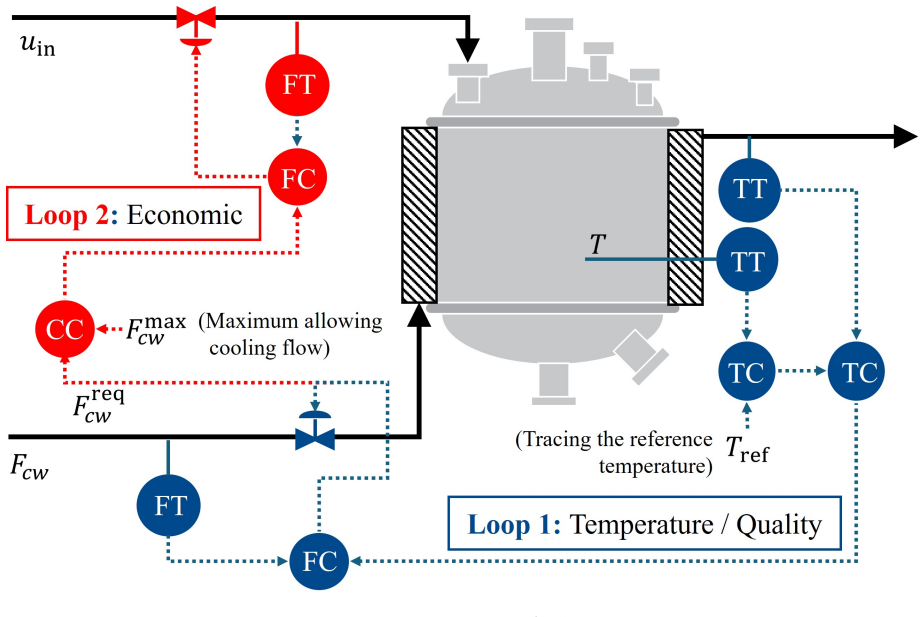
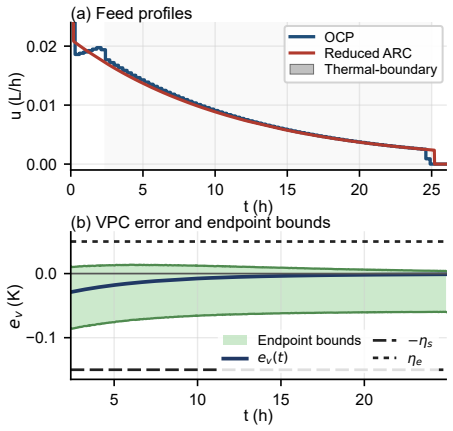
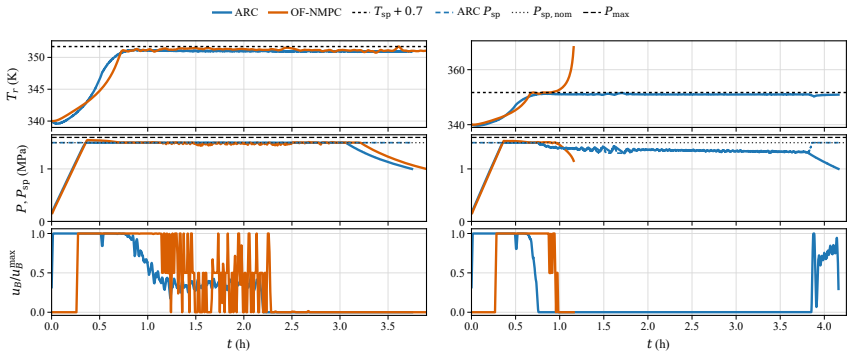
Under stated assumptions, the workflow translates boundary-seeking optimality into a cooling-demand valve-position-control (VPC) architecture and translates local safety requirements into near-boundary tuning rules. On a reduced benchmark and an industrial-scale polymerization, ARC is nominally competitive with an implemented nominal-model output-feedback nonlinear model predictive control (OF-NMPC) benchmark using extended Kalman filter (EKF) state estimation. In the studied adverse parameter mismatch and unmodeled fault scenarios, ARC keeps temperature-limit violation at 0%, whereas OF-NMPC either violates the limit or fails to complete the batch.
What carries the argument
The finite-horizon minimum-time optimality condition combined with local safety analysis, which maps directly to a VPC architecture and near-boundary tuning rules.
If this is right
- ARC performs competitively with OF-NMPC in nominal operation.
- ARC maintains zero temperature-limit violations in adverse mismatch and fault scenarios.
- The synthesis workflow provides a systematic way to design ARC from optimality and safety analysis.
- Signal selection, pairing, interconnection, and tuning in ARC can be derived rather than chosen heuristically.
Where Pith is reading between the lines
- Such ARC designs could be implemented using standard industrial control hardware without needing online optimization.
- The method may apply to other processes where constraints become active sequentially.
- Further validation could involve hardware-in-the-loop testing on physical reactor setups.
Load-bearing premise
The finite-horizon minimum-time optimality condition combined with local safety analysis can be directly mapped into a VPC architecture and tuning rules that remain valid for the actual reactor dynamics and constraint structure.
What would settle it
A simulation or experiment in which the ARC system derived from the workflow violates the temperature limit under the studied parameter mismatch conditions.
Figures
read the original abstract
This paper studies theory-guided advanced regulatory control (ARC) synthesis for cooling-limited exothermic semi-batch reactors, whose productivity and thermal safety are governed by changing active constraints. Industrial ARC uses feedback loops, cascades, selectors, feedforward/override logic, and valve-position elements, but signal selection, pairing, interconnection, and tuning remain heuristic. Nonlinear model predictive control (NMPC) gives a systematic constrained-operation workflow, but requires a maintained nonlinear model, state estimator, and online optimizer. We combine finite-horizon minimum-time optimality with local safety analysis to develop a systematic analysis-to-architecture ARC synthesis workflow for cooling-limited semi-batch reactors. Under stated assumptions, the workflow translates boundary-seeking optimality into a cooling-demand valve-position-control (VPC) architecture and translates local safety requirements into near-boundary tuning rules. On a reduced benchmark and an industrial-scale polymerization, ARC is nominally competitive with an implemented nominal-model output-feedback nonlinear model predictive control (OF-NMPC) benchmark using extended Kalman filter (EKF) state estimation. In the studied adverse parameter mismatch and unmodeled fault scenarios, ARC keeps temperature-limit violation at 0%, whereas OF-NMPC either violates the limit or fails to complete the batch.
Editorial analysis
A structured set of objections, weighed in public.
Referee Report
Summary. The manuscript develops a theory-guided workflow that combines finite-horizon minimum-time optimality with local safety analysis to synthesize an advanced regulatory control (ARC) architecture for cooling-limited exothermic semi-batch reactors. Under stated assumptions, the workflow maps boundary-seeking optimality to a cooling-demand valve-position-control (VPC) structure and local safety requirements to near-boundary tuning rules. On a reduced benchmark and an industrial polymerization example, the resulting ARC is nominally competitive with output-feedback NMPC (OF-NMPC) using EKF estimation; under the studied adverse parameter mismatch and unmodeled fault scenarios, ARC reports 0 % temperature-limit violations while OF-NMPC either violates the limit or fails to complete the batch.
Significance. If the central mapping holds analytically, the work supplies a systematic, non-optimization-based route from optimality and safety analysis to implementable ARC that avoids the model-maintenance and computational overhead of NMPC. The reported robustness to mismatch would be a concrete contribution to constrained control synthesis for semi-batch processes where active constraints change during operation.
major comments (2)
- [Abstract] Abstract: the central claim that finite-horizon min-time optimality plus local safety analysis directly translates into a VPC architecture whose closed-loop safety properties survive the same model mismatch and faults used in the benchmark is load-bearing, yet the abstract provides no theorem, invariance argument, or explicit assumption list (e.g., on relative degree, constraint activity ordering, or Lipschitz constants) showing that the derived structure inherits the original safety margins once plant parameters deviate from the nominal reduced-order model.
- [Abstract] The empirical 0 % violation result for ARC (versus OF-NMPC violations) is presented for two specific adverse scenarios; without an intermediate analytical step confirming that the VPC remains boundary-seeking under the reported mismatches, the robustness conclusion rests on the untested premise that the architecture preserves the finite-horizon safety properties outside the nominal model used for derivation.
minor comments (1)
- The abstract states competitiveness under nominal conditions and zero violations under mismatch but supplies no equations, explicit assumptions list, data tables, or error-bar/statistical detail; these elements should be added in the main text to allow verification of the derivation and empirical claims.
Simulated Author's Rebuttal
We thank the referee for the constructive feedback on our manuscript. We respond point-by-point to the major comments, clarifying the role of assumptions and derivations in the full text while agreeing that the abstract can be strengthened for clarity.
read point-by-point responses
-
Referee: [Abstract] Abstract: the central claim that finite-horizon min-time optimality plus local safety analysis directly translates into a VPC architecture whose closed-loop safety properties survive the same model mismatch and faults used in the benchmark is load-bearing, yet the abstract provides no theorem, invariance argument, or explicit assumption list (e.g., on relative degree, constraint activity ordering, or Lipschitz constants) showing that the derived structure inherits the original safety margins once plant parameters deviate from the nominal reduced-order model.
Authors: The abstract references 'stated assumptions' that are formalized in Section II (including relative degree one for the temperature dynamics and cooling-limited operation with ordered constraint activity). Sections III and IV derive the VPC mapping from finite-horizon optimality and the near-boundary tuning from local safety analysis using gain-sign consistency. No single invariance theorem for arbitrary mismatches appears in the abstract because the safety inheritance under deviation is supported by the boundary-seeking property (preserved when the cooling gain sign remains positive) rather than a global invariance result. We will revise the abstract to list the key assumptions explicitly and note that robustness is validated numerically. revision: partial
-
Referee: [Abstract] The empirical 0 % violation result for ARC (versus OF-NMPC violations) is presented for two specific adverse scenarios; without an intermediate analytical step confirming that the VPC remains boundary-seeking under the reported mismatches, the robustness conclusion rests on the untested premise that the architecture preserves the finite-horizon safety properties outside the nominal model used for derivation.
Authors: The 0 % violation result is reported specifically for the two adverse mismatch and fault scenarios in Section V. The VPC architecture is constructed to remain boundary-seeking by design under the assumption that cooling demand stays active, which is preserved in the studied cases via the override logic and tuning. No general analytical step confirming preservation for all mismatches is provided; the robustness is positioned as an empirical demonstration. We will update the abstract to distinguish the nominal theoretical mapping from the numerical robustness validation. revision: partial
Circularity Check
No circularity: derivation maps optimality and safety analysis to architecture without reduction to inputs by construction
full rationale
The paper presents a workflow that starts from finite-horizon minimum-time optimality combined with local safety analysis and produces a VPC architecture plus tuning rules. This mapping is offered under explicitly stated assumptions and is then validated by simulation against an OF-NMPC benchmark; the resulting performance numbers (0 % violation rate) are empirical outcomes, not quantities that are definitionally identical to the optimality condition or safety margins used as inputs. No equations, fitted parameters, or self-citations are shown that would make any claimed prediction equivalent to its own premise by construction. The derivation therefore remains self-contained against external benchmarks.
Axiom & Free-Parameter Ledger
axioms (2)
- domain assumption The reactor is cooling-limited exothermic semi-batch with productivity and thermal safety governed by changing active constraints.
- domain assumption Finite-horizon minimum-time optimality combined with local safety analysis can be translated into a VPC architecture and near-boundary tuning rules under the paper's stated assumptions.
Reference graph
Works this paper leans on
-
[1]
Joel A. E. Andersson, Joris Gillis, Greg Horn, James B. Rawlings, and Moritz Diehl. CasADi: A software framework for nonlinear optimization and optimal control.Mathematical Programming Computation, 11(1):1–36, March 2019. ISSN 1867-2957. doi: 10.1007/s12532-018-0139-4
-
[2]
Giuseppe Andriani, Gianmaria Pio, Ernesto Salzano, Chiara Vianello, and Paolo Mocellin. Evaluating the thermal stability of chemicals and systems: A review.The Canadian Journal of Chemical Engineering, 103(1):42–62, 2025. ISSN 1939-019X. doi: 10.1002/cjce.25422
-
[3]
L. T. Biegler and V. M. Zavala. Large-scale nonlinear programming using IPOPT: An integrating framework for enterprise-wide dynamic optimization.Computers & Chemical Engineering, 33 (3):575–582, March 2009. ISSN 0098-1354. doi: 10.1016/j.compchemeng.2008.08.006
-
[4]
Dominique Bonvin. Optimal operation of batch reactors: A personal view.Journal of Process Control, 8(5-6):355–368, 1998. doi: 10.1016/S0959-1524(98)00010-9
-
[5]
Advanced regulatory control techniques for improved averaging level control performance
Gustaf Zacharias Gous, Andries Johannes Wiid, Johan Derik le Roux, and Ian Keith Craig. Advanced regulatory control techniques for improved averaging level control performance. Industrial & Engineering Chemistry Research, 62(38):15578–15587, 2023. doi: 10.1021/acs.iecr. 3c01506
-
[6]
Boucher, Cecilia Pereira, Thomas Roiss, and Martin Scheringer
Konrad Hungerb¨ uhler, Justin M. Boucher, Cecilia Pereira, Thomas Roiss, and Martin Scheringer. Thermal Process Safety. In Konrad Hungerb¨ uhler, Justin M. Boucher, Cecilia Pereira, Thomas Roiss, and Martin Scheringer, editors,Chemical Products and Processes: Foundations of Environmentally Oriented Design, pages 199–217. Springer International Publishing, Cham,
-
[7]
doi: 10.1007/978-3-030-62422-4 8
ISBN 978-3-030-62422-4. doi: 10.1007/978-3-030-62422-4 8
-
[8]
Alex Kummer and Tam´ as Varga. What do we know already about reactor runaway? – a review.Process Safety and Environmental Protection, 147:460–476, 2021. ISSN 0957-5820. doi: 10.1016/j.psep.2020.09.059
-
[9]
Alex Kummer, Lajos Nagy, and Tam´ as Varga. NMPC-based control scheme for a semi-batch reactor under parameter uncertainty.Computers & Chemical Engineering, 141:106998, 2020. ISSN 00981354. doi: 10.1016/j.compchemeng.2020.106998
-
[10]
Simin Li, Shuang-hua Yang, Yi Cao, Xiaoping Jiang, and Chenchen Zhou. A benchmark of industrial polymerization process for thermal runaway process monitoring.Process Safety and Environmental Protection, 193:353–363, 2025. doi: 10.1016/j.psep.2024.11.057
-
[11]
Batch process control–overview and outlook.Acta Automatica Sinica, 43(6):933–943, 2017
Jingyi Lu, Zhixing Cao, and Furong Gao. Batch process control–overview and outlook.Acta Automatica Sinica, 43(6):933–943, 2017
2017
-
[12]
Sergio Lucia, Tiago Finkler, and Sebastian Engell. Multi-stage nonlinear model predictive control applied to a semi-batch polymerization reactor under uncertainty.Journal of Process Control, 23(9):1306–1319, 2013. doi: 10.1016/j.jprocont.2013.08.008
-
[13]
Harmonic maps with prescribed singularities and applications in general relativity
Zolt´ an K. Nagy, Bernd Mahn, R¨ udiger Franke, and Frank Allg¨ ower. Nonlinear model predictive control of batch processes: An industrial case study. InIFAC Proceedings Volumes, volume 38, pages 1–6, Prague, Czech Republic, 2005. doi: 10.3182/20050703-6-CZ-1902.01576. 22
work page internal anchor Pith review Pith/arXiv arXiv doi:10.3182/20050703-6-cz-1902.01576 2005
-
[14]
Lei Ni, Ahmed Mebarki, Juncheng Jiang, Mingguang Zhang, and Zhan Dou. Semi-batch reactors: Thermal runaway risk.Journal of Loss Prevention in the Process Industries, 43: 559–566, 2016. ISSN 0950-4230. doi: 10.1016/j.jlp.2016.07.024
-
[15]
Michael Nikolaou. Model predictive controllers: A critical synthesis of theory and industrial needs.Advances in Chemical Engineering, 26:131–204, 2001. doi: 10.1016/S0065-2377(01) 26003-7
-
[16]
Rawlings, David Q
James B. Rawlings, David Q. Mayne, and Moritz M. Diehl.Model Predictive Control: Theory, Computation, and Design. Nob Hill Publishing, Madison, WI, 2 edition, 2017
2017
-
[17]
D. Rodrigues, S. Srinivasan, J. Billeter, and D. Bonvin. Variant and invariant states for chemical reaction systems.Computers & Chemical Engineering, 73:23–33, 2015. ISSN 0098-1354. doi: 10.1016/j.compchemeng.2014.10.009
-
[18]
Ferm´ ın S´ aez-Pardo, Juan Jos´ e Giner-Sanz, Montserrat Garc´ ıa-Gabald´ on, and Valent´ ın P´ erez- Herranz. Modeling of a solution polymerization reactor operating in semi-batch mode for polymethyl methacrylate production.Chemical Engineering Research and Design, 210:230–246, October 2024. ISSN 0263-8762. doi: 10.1016/j.cherd.2024.08.024
-
[19]
Tariq Samad, Margret Bauer, Scott Bortoff, Stefano Di Cairano, Lorenzo Fagiano, Peter Fogh Odgaard, R. Russell Rhinehart, Ricardo S´ anchez-Pe˜ na, Atanas Serbezov, Finn Ankersen, Philippe Goupil, Benyamin Grosman, Marcel Heertjes, Iven Mareels, and Raye Sosseh. Industry engagement with control research: Perspective and messages.Annual Reviews in Control,...
-
[20]
Plantwide control: The search for the self-optimizing control structure
Sigurd Skogestad. Plantwide control: The search for the self-optimizing control structure. Journal of Process Control, 10(5–6):487–507, 2000. doi: 10.1016/S0959-1524(00)00023-8
-
[21]
Sigurd Skogestad. Control structure design for complete chemical plants.Computers & Chemical Engineering, 28(1–2):219–234, 2004. doi: 10.1016/j.compchemeng.2003.08.002
-
[22]
Annual Reviews in Control , author =
Sigurd Skogestad. Advanced control using decomposition and simple elements.Annual Reviews in Control, 56:100903, 2023. doi: 10.1016/j.arcontrol.2023.100903
-
[23]
Ian W. M. Smith. The temperature-dependence of elementary reaction rates: Beyond Arrhenius. Chemical Society Reviews, 37(4):812–826, March 2008. ISSN 1460-4744. doi: 10.1039/B704257B
-
[24]
T. J. Snee, C. Barcons, H. Hern´ andez, and J. M. Zald´ ıvar. Characterisation of an exothermic reaction using adiabatic and isothermal calorimetry.Journal of Thermal Analysis, 38(12): 2729–2747, December 1992. ISSN 1572-8943. doi: 10.1007/BF01979748
-
[25]
Masoud Soroush and Costas Kravaris. Nonlinear control of a batch polymerization reactor: An experimental study.AIChE Journal, 38(9):1429–1448, 1992. ISSN 1547-5905. doi: 10.1002/aic. 690380914
work page doi:10.1002/aic 1992
-
[26]
B. Srinivasan, D. Bonvin, E. Visser, and S. Palanki. Dynamic optimization of batch processes: II. Role of measurements in handling uncertainty.Computers & Chemical Engineering, 27(1): 27–44, January 2003. ISSN 0098-1354. doi: 10.1016/S0098-1354(02)00117-5
-
[27]
B. Srinivasan, S. Palanki, and Dominique Bonvin. Dynamic optimization of batch processes: I. Characterization of the nominal solution.Computers & Chemical Engineering, 27(1):1–26, January 2003. ISSN 0098-1354. doi: 10.1016/S0098-1354(02)00116-3. 23
-
[28]
John Wiley & Sons, 2021
Francis Stoessel.Thermal Safety of Chemical Processes: Risk Assessment and Process Design. John Wiley & Sons, 2021. ISBN 978-3-527-33921-1
2021
-
[29]
Wade.Basic and Advanced Regulatory Control: System Design and Application
Hugh L. Wade.Basic and Advanced Regulatory Control: System Design and Application. ISA, Research Triangle Park, NC, 2004
2004
-
[30]
Chenchen Zhou, Zuzhen Ji, and Jose Matias. Real-time nonlinear model predictive control framework for event-triggered switching in industrial batch polymerization process.Journal of Process Control, 163:103738, 2026. doi: 10.1016/j.jprocont.2026.103738. 24 Supplementary Material S1 How to Read This Supplement The main paper is intended to be self-containe...
discussion (0)
Sign in with ORCID, Apple, or X to comment. Anyone can read and Pith papers without signing in.