Projected altermagnetism by symmetry reduction at surfaces and in thin films
Pith reviewed 2026-06-26 20:09 UTC · model grok-4.3
The pith
Surfaces of g-wave altermagnets can project d-wave spin splitting in thin films.
A machine-rendered reading of the paper's core claim, the machinery that carries it, and where it could break.
Core claim
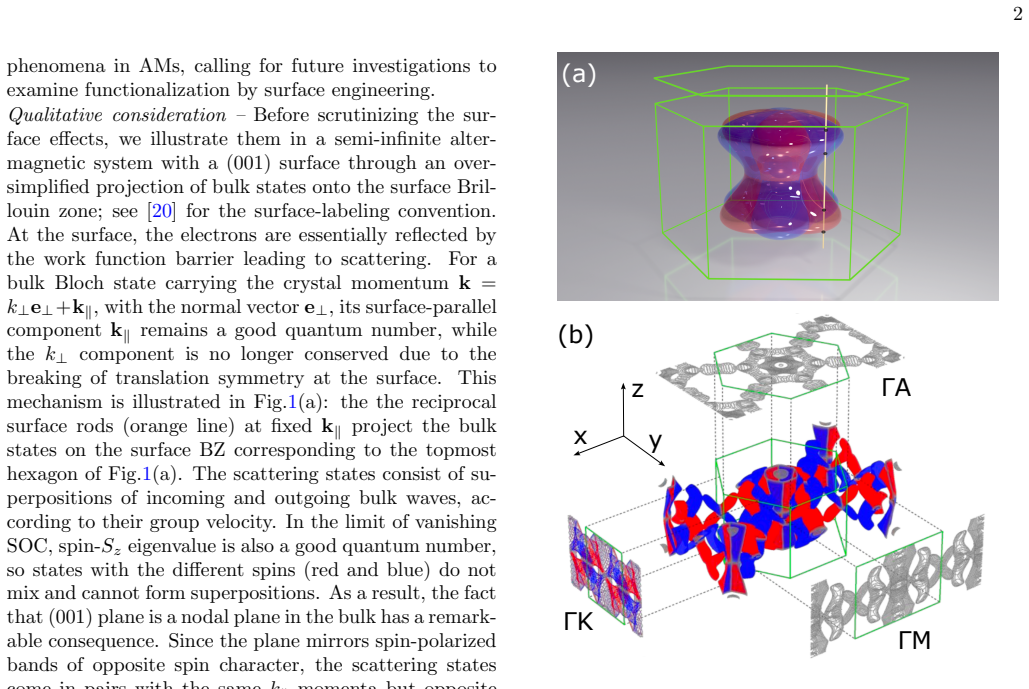
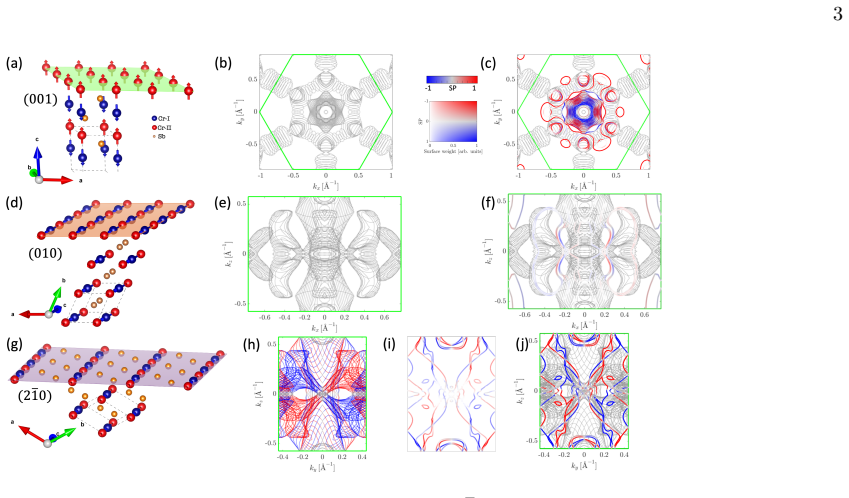
When the surface coincides with a symmetry plane of the bulk altermagnetic order, the resulting two-dimensional Brillouin zone exhibits spin-degenerate bands, corresponding to conventional antiferromagnetic behavior. In all other cases, the symmetry of the altermagnetic order is reduced, leading to modified spin splitting. A thin-film geometry of a g-wave altermagnet with a particular surface orientation enables a d-wave spin splitting, which is commonly accompanied by the spin-splitter effect.
What carries the argument
Symmetry reduction at surfaces that projects the bulk altermagnetic spin-splitting wave symmetry onto a lower-order form such as g-wave to d-wave.
If this is right
- Surfaces coinciding with a symmetry plane produce spin-degenerate bands identical to conventional antiferromagnets.
- All other surface orientations reduce the altermagnetic symmetry and modify the spin splitting.
- Non-d-wave altermagnets can be functionalized by surfaces to exhibit d-wave splitting and the associated spin-splitter effect.
- Surfaces and thin films supply a tunable platform for spin-dependent electronic phenomena.
Where Pith is reading between the lines
- Device designers could select film orientation rather than bulk crystal symmetry to access desired spin textures in a broader set of altermagnetic compounds.
- The same projection principle may apply at interfaces in heterostructures, allowing engineered spin splitting without bulk symmetry constraints.
- Systematic mapping of surface orientations for known altermagnets could identify additional cases where higher-order bulk order projects to lower-order 2D splitting.
Load-bearing premise
Bulk altermagnetic order symmetries remain intact sufficiently close to the surface except for the explicit breaking by the surface termination.
What would settle it
Angle-resolved photoemission or spin-resolved spectroscopy on a thin film of a known g-wave altermagnet with the identified surface orientation, checking whether the measured spin texture in the 2D Brillouin zone shows d-wave character.
Figures
read the original abstract
Altermagnets are a newly identified class of magnetic materials that combine vanishing net magnetization within the unit cell with spin-split electronic states. Their theoretical description relies on symmetry properties of the bulk band structure. Surfaces and thin films, however, inherently break these symmetries. Here, we investigate the consequences of such symmetry reduction for the electronic structure of bulk altermagnets near the surface and of thin films. When the surface coincides with a symmetry plane of the bulk altermagnetic order, the resulting two-dimensional Brillouin zone exhibits spin-degenerate bands, corresponding to conventional antiferromagnetic behavior. In all other cases, the symmetry of the altermagnetic order is reduced, leading to modified spin splitting. Remarkably, we discover a thin-film geometry of a $g$-wave altermagnet with a particular surface orientation that enables a $d$-wave spin splitting, which is commonly accompanied by the spin-splitter effect, suggesting the functionalization of non-$d$-wave altermagnets by surfaces. Our findings demonstrate that symmetry breaking at surfaces and in thin films fundamentally reshapes altermagnetic spin textures, providing a tunable platform for controlling spin-dependent electronic phenomena.
Editorial analysis
A structured set of objections, weighed in public.
Referee Report
Summary. The manuscript examines how surfaces and thin films break the symmetries of bulk altermagnets, leading to modified spin splitting in the electronic structure. When the surface aligns with a bulk symmetry plane, the 2D Brillouin zone shows spin-degenerate bands akin to conventional antiferromagnets; otherwise, the altermagnetic order symmetry is reduced. The central result is the identification of a thin-film geometry for a g-wave altermagnet with a specific surface orientation that projects to d-wave spin splitting, accompanied by the spin-splitter effect.
Significance. If the central symmetry-projection result holds, the work offers a geometry-based route to functionalize non-d-wave altermagnets for spin-dependent transport, providing a tunable platform without introducing free parameters. The analysis relies on standard bulk symmetry arguments applied to reduced dimensionality, which is a strength for reproducibility.
major comments (2)
- [thin-film geometry section] The projection of g-wave bulk order to d-wave spin splitting in the thin-film geometry (abstract and the section on thin-film results) assumes that the bulk altermagnetic order parameter and its symmetry planes remain unchanged in the near-surface region. No calculation or discussion addresses possible surface relaxation, moment rotation, or additional spin-orbit terms that could alter or suppress the projected d-wave character and spin-splitter effect.
- [surface symmetry reduction analysis] The claim that symmetry reduction leads to modified spin splitting in all non-symmetry-plane cases lacks explicit checks against possible surface-induced reconstructions that might restore or eliminate mirror/rotation elements not captured by the bulk termination analysis alone.
minor comments (2)
- [abstract] The abstract would benefit from naming the specific surface orientation or example material to make the g-to-d conversion claim immediately verifiable.
- [methods or symmetry tables] Notation for the 2D Brillouin zone folding and spin textures could be clarified with an additional figure or table summarizing the symmetry elements before and after surface termination.
Simulated Author's Rebuttal
We are grateful to the referee for the careful reading of our manuscript and the constructive feedback. Below we provide point-by-point responses to the major comments.
read point-by-point responses
-
Referee: [thin-film geometry section] The projection of g-wave bulk order to d-wave spin splitting in the thin-film geometry (abstract and the section on thin-film results) assumes that the bulk altermagnetic order parameter and its symmetry planes remain unchanged in the near-surface region. No calculation or discussion addresses possible surface relaxation, moment rotation, or additional spin-orbit terms that could alter or suppress the projected d-wave character and spin-splitter effect.
Authors: The manuscript employs symmetry arguments based on the bulk altermagnetic order to analyze the effects of surface termination. We acknowledge that this approach assumes the order parameter and symmetry planes are preserved near the surface. No explicit calculations of surface effects are included, as the focus is on the geometric projection of symmetries. We will add a discussion paragraph in the thin-film results section to clarify this assumption and note that surface relaxation, moment rotation, or spin-orbit terms could modify the projected spin splitting in actual materials. This revision will address the scope of our ideal symmetry-based analysis. revision: yes
-
Referee: [surface symmetry reduction analysis] The claim that symmetry reduction leads to modified spin splitting in all non-symmetry-plane cases lacks explicit checks against possible surface-induced reconstructions that might restore or eliminate mirror/rotation elements not captured by the bulk termination analysis alone.
Authors: Our analysis of surface symmetry reduction is derived from the symmetries of the bulk termination. We recognize that surface-induced reconstructions could in principle alter the symmetry elements. The manuscript does not include explicit checks for such reconstructions. We will revise the surface symmetry reduction analysis section to include a statement acknowledging this possibility and emphasizing that our results pertain to the symmetry breaking from the ideal surface cut. This will provide a more complete context for the claims. revision: yes
Circularity Check
No circularity: symmetry reduction is independent group-theoretic argument
full rationale
The derivation proceeds by applying standard symmetry operations of the bulk altermagnetic order (g-wave) to the reduced symmetry at a surface termination, followed by explicit 2D Brillouin-zone folding. No fitted parameters, no self-referential definitions, and no load-bearing self-citations appear in the symmetry tables or projection arguments. The central result (g-wave bulk projects to d-wave surface splitting for a specific orientation) follows directly from the listed symmetry planes and the explicit breaking of translation by the surface; it is not equivalent to any input by construction. The assumption that bulk order persists near the surface is an external physical premise, not a definitional loop.
Axiom & Free-Parameter Ledger
axioms (1)
- domain assumption Bulk altermagnetic order possesses well-defined symmetry planes that dictate spin splitting in the three-dimensional Brillouin zone.
Reference graph
Works this paper leans on
-
[1]
ˇSmejkal, J
L. ˇSmejkal, J. Sinova, and T. Jungwirth, Beyond Con- ventional Ferromagnetism and Antiferromagnetism: A Phase with Nonrelativistic Spin and Crystal Rotation Symmetry, Phys. Rev. X12, 031042 (2022)
2022
-
[2]
ˇSmejkal, J
L. ˇSmejkal, J. Sinova, and T. Jungwirth, Emerging Re- search Landscape of Altermagnetism, Phys. Rev. X12, 040501 (2022)
2022
-
[3]
Takahashi, C
K. Takahashi, C. R. W. Steward, M. Ogata, R. M. Fer- nandes, and J. Schmalian, Elasto-Hall conductivity and the anomalous Hall effect in altermagnets, Phys. Rev. B 111, 184408 (2025)
2025
-
[4]
L. ˇSmejkal, R. Gonz´ alez-Hern´ andez, T. Jungwirth, and J. Sinova, Crystal time-reversal symmetry breaking and spontaneous hall effect in collinear antiferromagnets, Science Advances6, eaaz8809 (2020), https://www.science.org/doi/pdf/10.1126/sciadv.aaz8809
-
[5]
Attias, A
L. Attias, A. Levchenko, and M. Khodas, Intrinsic anomalous Hall effect in altermagnets, Phys. Rev. B110, 094425 (2024)
2024
-
[6]
Hoyer, R
R. Hoyer, R. Jaeschke-Ubiergo, K.-H. Ahn, L. ˇSmejkal, and A. Mook, Spontaneous crystal thermal Hall effect in insulating altermagnets, Phys. Rev. B111, L020412 (2025)
2025
-
[7]
Reichlova, R
H. Reichlova, R. Lopes Seeger, R. Gonz´ alez-Hern´ andez, I. Kounta, R. Schlitz, D. Kriegner, P. Ritzinger, M. Lammel, M. Leivisk¨ a, A. Birk Hellenes, K. Olejn´ ık, V. Petˇ riˇ cek, P. Doleˇ zal, L. Horak, E. Schmoranzerova, A. Badura, S. Bertaina, A. Thomas, V. Baltz, L. Michez, J. Sinova, S. T. B. Goennenwein, T. Jungwirth, and L. ˇSmejkal, Observation...
2024
-
[8]
L. Bai, W. Feng, S. Liu, L. ˇSmejkal, Y. Mokrousov, and Y. Yao, Altermagnetism: Exploring New Frontiers in Magnetism and Spintronics, Advanced Functional Ma- terials34, 2409327 (2024)
2024
-
[9]
Y. Fang, J. Cano, and S. A. A. Ghorashi, Quantum Ge- ometry Induced Nonlinear Transport in Altermagnets, Physical Review Letters133, 106701 (2024)
2024
-
[10]
D. S. Antonenko, R. M. Fernandes, and J. W. F. Vender- bos, Mirror Chern Bands and Weyl Nodal Loops in Al- termagnets, Physical Review Letters134, 096703 (2025)
2025
-
[11]
Q. Cui, B. Zeng, P. Cui, T. Yu, and H. Yang, Efficient spin Seebeck and spin Nernst effects of magnons in alter- magnets, Phys. Rev. B108, L180401 (2023)
2023
-
[12]
M. Naka, S. Hayami, H. Kusunose, Y. Yanagi, Y. Mo- tome, and H. Seo, Spin current generation in organic an- tiferromagnets, Nature Communications10, 4305 (2019)
2019
-
[13]
Gonz´ alez-Hern´ andez, L.ˇSmejkal, K
R. Gonz´ alez-Hern´ andez, L.ˇSmejkal, K. V´ yborn´ y, Y. Ya- 6 hagi, J. Sinova, T. c. v. Jungwirth, and J. ˇZelezn´ y, Ef- ficient Electrical Spin Splitter Based on Nonrelativis- tic Collinear Antiferromagnetism, Phys. Rev. Lett.126, 127701 (2021)
2021
-
[14]
Shao, S.-H
D.-F. Shao, S.-H. Zhang, M. Li, C.-B. Eom, and E. Y. Tsymbal, Spin-neutral currents for spintronics, Nature Communications12, 7061 (2021)
2021
-
[15]
Reimers, L
S. Reimers, L. Odenbreit, L. ˇSmejkal, V. N. Strocov, P. Constantinou, A. B. Hellenes, R. Jaeschke Ubiergo, W. H. Campos, V. K. Bharadwaj, A. Chakraborty, T. Denneulin, W. Shi, R. E. Dunin-Borkowski, S. Das, M. Kl¨ aui, J. Sinova, and M. Jourdan, Direct observation of altermagnetic band splitting in CrSb thin films, Nature Communications15, 2116 (2024)
2024
-
[16]
J. Ding, Z. Jiang, X. Chen, Z. Tao, Z. Liu, T. Li, J. Liu, J. Sun, J. Cheng, J. Liu, Y. Yang, R. Zhang, L. Deng, W. Jing, Y. Huang, Y. Shi, M. Ye, S. Qiao, Y. Wang, Y. Guo, D. Feng, and D. Shen, Large Band Splitting in g-Wave Altermagnet CrSb, Phys. Rev. Lett.133, 206401 (2024)
2024
-
[17]
Zeng, M.-Y
M. Zeng, M.-Y. Zhu, Y.-P. Zhu, X.-R. Liu, X.-M. Ma, Y.- J. Hao, P. Liu, G. Qu, Y. Yang, Z. Jiang, K. Yamagami, M. Arita, X. Zhang, T.-H. Shao, Y. Dai, K. Shimada, Z. Liu, M. Ye, Y. Huang, Q. Liu, and C. Liu, Observation of Spin Splitting in Room-Temperature Metallic Antifer- romagnet CrSb, Advanced Science11, 2406529 (2024)
2024
-
[18]
C. Li, M. Hu, Z. Li, Y. Wang, W. Chen, B. Thiagara- jan, M. Leandersson, C. Polley, T. Kim, H. Liu, C. Fulga, M. G. Vergniory, O. Janson, O. Tjernberg, and J. van den Brink, Topological Weyl altermagnetism in CrSb, Com- munications Physics8, 311 (2025)
2025
-
[19]
G. Yang, Z. Li, S. Yang, J. Li, H. Zheng, W. Zhu, Z. Pan, Y. Xu, S. Cao, W. Zhao, A. Jana, J. Zhang, M. Ye, Y. Song, L.-H. Hu, L. Yang, J. Fujii, I. Vobornik, M. Shi, H. Yuan, Y. Zhang, Y. Xu, and Y. Liu, Three- dimensional mapping of the altermagnetic spin splitting in CrSb, Nature Communications16, 1442 (2025)
2025
-
[20]
This implies that the [100] and the [110] direction form an angle of 60 ◦ and are equiva- lent
Note that we follow the standard definition of the hexag- onal unit cell with the basis vectors in the basal plane having an angle of 120 ◦. This implies that the [100] and the [110] direction form an angle of 60 ◦ and are equiva- lent. We place the cartesianx-axis along [100], they-axis along [120] and thez-axis along [001] and use Miller in- dexes of cr...
-
[21]
R. M. Geilhufe and W. Hergert, GTPack: A Mathemat- ica Group Theory Package for Application in Solid-State Physics and Photonics, Frontiers in Physics6, 86 (2018)
2018
-
[22]
Hergert and R
W. Hergert and R. M. Geilhufe,Group Theory in Solid State Physics and Photonics: Problem Solving with Mathematica(Wiley-VCH, 2018)isbn:978-3-527-41133- 7
2018
-
[23]
C. R. W. Steward, R. M. Fernandes, and J. Schmalian, Dynamic paramagnon-polarons in altermagnets, Phys. Rev. B108, 144418 (2023)
2023
-
[24]
Bhowal and N
S. Bhowal and N. A. Spaldin, Ferroically Ordered Mag- netic Octupoles ind-Wave Altermagnets, Phys. Rev. X 14, 011019 (2024)
2024
-
[25]
P. A. McClarty and J. G. Rau, Landau Theory of Alter- magnetism, Phys. Rev. Lett.132, 176702 (2024)
2024
- [26]
-
[27]
D. Jo, D. Go, Y. Mokrousov, P. M. Oppeneer, S.-W. Cheong, and H.-W. Lee, Weak Ferromagnetism in Al- termagnets from Alternatingg-Tensor Anisotropy, Phys. Rev. Lett.134, 196703 (2025)
2025
-
[28]
Autieri, R
C. Autieri, R. M. Sattigeri, G. Cuono, and A. Fakhre- dine, Staggered Dzyaloshinskii-Moriya interaction induc- ing weak ferromagnetism in centrosymmetric altermag- nets and weak ferrimagnetism in noncentrosymmetric al- termagnets, Physical Review B111, 054442 (2025)
2025
-
[29]
R. M. Fernandes, V. S. de Carvalho, T. Birol, and R. G. Pereira, Topological transition from nodal to nodeless Zeeman splitting in altermagnets, Phys. Rev. B109, 024404 (2024)
2024
-
[31]
Krempask´ y, L
J. Krempask´ y, L. ˇSmejkal, S. W. D’Souza, M. Ha- jlaoui, G. Springholz, K. Uhl´ ıˇ rov´ a, F. Alarab, P. C. Constantinou, V. Strocov, D. Usanov, W. R. Pudelko, R. Gonz´ alez-Hern´ andez, A. Birk Hellenes, Z. Jansa, H. Reichlov´ a, Z. ˇSob´ aˇ n, R. D. Gonzalez Betancourt, P. Wadley, J. Sinova, D. Kriegner, J. Min´ ar, J. H. Dil, and T. Jungwirth, Alterm...
2024
-
[32]
Osumi, S
T. Osumi, S. Souma, T. Aoyama, K. Yamauchi, A. Honma, K. Nakayama, T. Takahashi, K. Ohgushi, and T. Sato, Observation of a giant band splitting in alter- magnetic MnTe, Phys. Rev. B109, 115102 (2024)
2024
-
[34]
A. Korshunov, M. Alkorta, C.-Y. Lim, F. Ballester, C. Li, Z. Li, D. Chernyshov, A. Bosak, M. G. Vergniory, I. Errea, and S. Blanco-Canosa, Flat band driven competing charge and spin instabilities in the altermagnet CrSb, arXiv preprint arXiv: 2603.25317 10.48550/arXiv.2603.25317 (2026)
-
[35]
Sorn, Funtionalization ofg-wave altermagnets: spin- splitter effect enabled by surfaces (2026), in preparation
S. Sorn, Funtionalization ofg-wave altermagnets: spin- splitter effect enabled by surfaces (2026), in preparation. Supplementary Material: Projected altermagnetism by symmetry reduction at surfaces and in thin films Sopheak Sorn, 1, 2 Charanpreet Singh, 3 Lukasz Plucinski, 4 Gustav Bihlmayer,5 Yuriy Mokrousov,5, 6 and Wulf Wulfhekel1, 3 1Institute for Qua...
2026
-
[36]
Therefore, the symmetry analysis proceeds analogously to that for CrSb, and the results are summarized in Table SII
axis, i.e., y-axis [4]. Therefore, the symmetry analysis proceeds analogously to that for CrSb, and the results are summarized in Table SII. For the cases involving the (010) and the (210) plane, the altermagnetic OPφ=O (3x2−y2)yz,y forms a one-dimensional irreducible rep- 6 TABLE SII. Summary of symmetry analysis for thin fims and surfaces of MnTe (N´ ee...
-
[37]
N. W. Ashcroft, N. D. Mermin,et al., Solid state physics (1976)
1976
-
[38]
ˇSmejkal, J
L. ˇSmejkal, J. Sinova, and T. Jungwirth, Emerging Research Landscape of Altermagnetism, Phys. Rev. X12, 040501 (2022)
2022
-
[39]
Sorn, Funtionalization ofg-wave altermagnets: spin-splitter effect enabled by surfaces (2026), in preparation
S. Sorn, Funtionalization ofg-wave altermagnets: spin-splitter effect enabled by surfaces (2026), in preparation
2026
-
[40]
S. Lee, S. Lee, S. Jung, J. Jung, D. Kim, Y. Lee, B. Seok, J. Kim, B. G. Park, L. ˇSmejkal, C.-J. Kang, and C. Kim, Broken Kramers Degeneracy in Altermagnetic MnTe, Phys. Rev. Lett.132, 036702 (2024)
2024
-
[41]
M. Roig, A. Kreisel, Y. Yu, B. M. Andersen, and D. F. Agterberg, Minimal models for altermagnetism, Phys. Rev. B110, 144412 (2024)
2024
-
[42]
T. Cole, S. Coh, and D. Vanderbilt, Python Tight Binding (PythTB) (2025)
2025
-
[43]
P. Blaha, K. Schwarz, F. Tran, R. Laskowski, G. K. H. Madsen, and L. D. Marks, WIEN2k: An APW+lo program for calculating the properties of solids, The Journal of Chemical Physics152, 074101 (2020), https://pubs.aip.org/aip/jcp/article- pdf/doi/10.1063/1.5143061/16727313/074101 1 online.pdf
-
[44]
C. Li, M. Hu, Z. Li, Y. Wang, W. Chen, B. Thiagarajan, M. Leandersson, C. Polley, T. Kim, H. Liu, C. Fulga, M. G. Vergniory, O. Janson, O. Tjernberg, and J. van den Brink, Topological Weyl altermagnetism in CrSb, Communications Physics8, 311 (2025)
2025
-
[45]
J. Ding, Z. Jiang, X. Chen, Z. Tao, Z. Liu, T. Li, J. Liu, J. Sun, J. Cheng, J. Liu, Y. Yang, 11 R. Zhang, L. Deng, W. Jing, Y. Huang, Y. Shi, M. Ye, S. Qiao, Y. Wang, Y. Guo, D. Feng, and D. Shen, Large Band Splitting ing-Wave Altermagnet CrSb, Phys. Rev. Lett.133, 206401 (2024)
2024
-
[46]
Reimers, L
S. Reimers, L. Odenbreit, L. ˇSmejkal, V. N. Strocov, P. Constantinou, A. B. Hellenes, R. Jaeschke Ubiergo, W. H. Campos, V. K. Bharadwaj, A. Chakraborty, T. Denneulin, W. Shi, R. E. Dunin-Borkowski, S. Das, M. Kl¨ aui, J. Sinova, and M. Jourdan, Direct observation of altermagnetic band splitting in CrSb thin films, Nature Communications15, 2116 (2024). 12
2024
discussion (0)
Sign in with ORCID, Apple, or X to comment. Anyone can read and Pith papers without signing in.