Nonequilibrium steady states induced by stochastic mid-circuit measurements and resets on a quantum computer
Pith reviewed 2026-06-26 21:00 UTC · model grok-4.3
The pith
Stochastic mid-circuit measurements and conditional resets drive a Floquet Ising model on a quantum processor to a nonequilibrium steady state that matches noisy theory and shows crossover tied to the equilibrium phase transition.
A machine-rendered reading of the paper's core claim, the machinery that carries it, and where it could break.
Core claim
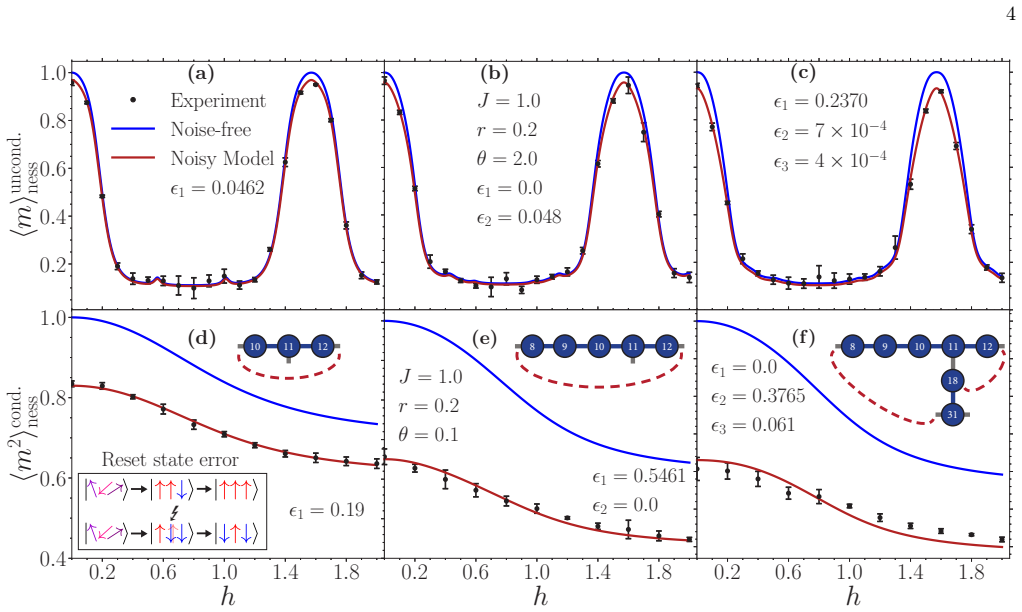
The stationary state of the noisy conditional resetting agrees quantitatively with the experiments on the superconducting quantum processor, and it shows crossover behavior related to the equilibrium quantum phase transition of the interacting Floquet transverse-field Ising model.
What carries the argument
Noisy discrete-time theory in which unitary gates alternate with noisy mid-circuit projective measurements and conditional resets; it predicts the stationary states reached under stochastic resetting.
If this is right
- Nonequilibrium steady states can be reached on noisy quantum processors by interleaving unitary evolution with stochastic mid-circuit measurements and resets.
- The stationary states display crossover signatures connected to the equilibrium quantum phase transition of the underlying Floquet model.
- The protocol offers a route to preparing collective stationary states on current hardware without requiring error correction.
- Mid-circuit measurement capabilities can be incorporated into quantum algorithms that target nonequilibrium physics.
Where Pith is reading between the lines
- The same resetting protocol could be tested on other Floquet or non-Floquet many-body models to check whether the crossover remains tied to equilibrium critical points.
- Quantitative agreement on seven qubits suggests that similar noisy discrete-time models might be used to predict behavior on larger processors once mid-circuit reset fidelity improves.
- Extending the number of qubits or the duration of the stochastic protocol would test whether the steady-state crossover sharpens or broadens with system size.
Load-bearing premise
The noisy discrete-time theory accurately captures the combined effects of the unitary gates, mid-circuit measurements, and conditional resets on the specific superconducting hardware.
What would settle it
A significant quantitative mismatch between the measured stationary-state observables on the seven-qubit processor and the predictions of the noisy conditional resetting theory for the same Floquet Ising parameters would falsify the claim.
Figures
read the original abstract
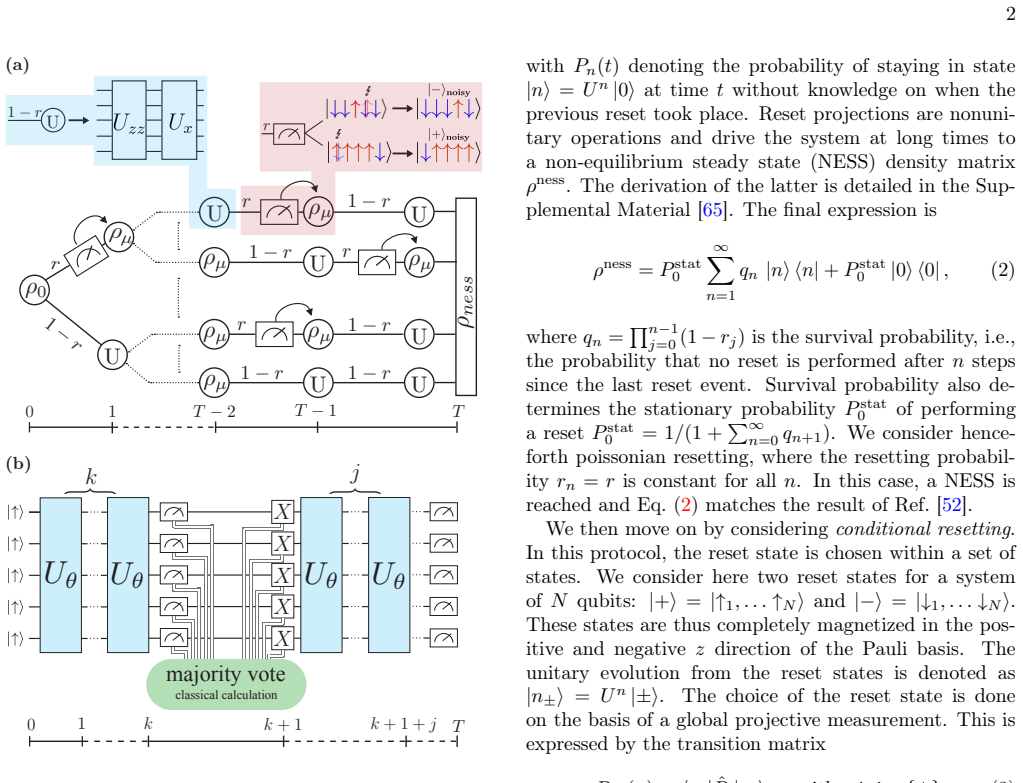
Stochastic resetting has emerged as a versatile protocol to drive quantum many-body systems to non-equilibrium steady states by interspersing unitary dynamics with measurements and resets at random times. In spite of this, a quantum hardware validation of such non-equilibrium steady states is still missing. Here, we achieve this goal by first formulating a noisy discrete-time theory where unitary gates alternate with noisy mid-circuit projective measurements and conditional resets. This noisy conditional resetting theory is then demonstrated on a superconducting quantum processor for up to $N=7$ qubits. We consider, as a paradigmatic case, the unitary dynamics of the interacting Floquet transverse-field Ising model. The stationary state of the noisy conditional resetting agrees quantitatively with the experiments, and it shows crossover behavior related to the equilibrium quantum phase transition of the model. Our results might thus pave the way for the preparation of collective stationary states on noisy quantum devices and for further developments of quantum algorithms involving mid-circuit measurements.
Editorial analysis
A structured set of objections, weighed in public.
Referee Report
Summary. The manuscript formulates a noisy discrete-time theory in which unitary gates on the interacting Floquet transverse-field Ising model alternate with noisy mid-circuit projective measurements and conditional resets. The theory is implemented and tested on a superconducting quantum processor for system sizes up to N=7. The authors report that the predicted non-equilibrium stationary states agree quantitatively with the experimental observations and display crossover signatures connected to the equilibrium quantum phase transition of the underlying model.
Significance. If the noise model accurately reproduces the combined effects of gates, measurements, and resets on the hardware, the work supplies the first explicit hardware validation of stochastic-resetting protocols for generating non-equilibrium steady states on quantum processors. The link between the driven stationary state and the equilibrium QPT provides additional theoretical value. The demonstration could support future preparation of collective states on NISQ devices and the design of mid-circuit-measurement algorithms.
minor comments (2)
- [Abstract] Abstract: the claim of quantitative agreement is stated without reference to the error metric, number of experimental shots, or how noise parameters were extracted from calibration data; adding these details would strengthen the abstract.
- The manuscript should include a dedicated section or appendix that explicitly derives the form of the noisy measurement/reset channel from the hardware calibration data rather than stating it as given.
Simulated Author's Rebuttal
We thank the referee for the positive summary, significance assessment, and recommendation of minor revision. No specific major comments were provided in the report.
Circularity Check
No significant circularity; theory formulated independently then validated experimentally
full rationale
The provided abstract and context describe a noisy discrete-time theory formulated first (unitary gates alternating with noisy mid-circuit measurements and conditional resets), followed by experimental demonstration on superconducting hardware for the Floquet transverse-field Ising model. The stationary-state agreement with experiments and crossover behavior tied to the equilibrium QPT are presented as empirical validation outcomes, not as quantities derived by construction from fitted parameters or prior self-citations. No load-bearing steps reduce to self-definition, fitted-input predictions, or self-citation chains within the given material. The derivation chain remains self-contained against external benchmarks.
Axiom & Free-Parameter Ledger
Reference graph
Works this paper leans on
-
[1]
This analysis could eventually enable a systematic scaling to larger system sizes of quantum simulation of resetting-induced collective stationary states
into the conditional feedback loops. This analysis could eventually enable a systematic scaling to larger system sizes of quantum simulation of resetting-induced collective stationary states. Data availability statementThe data supporting the findings of this article can be accessed on Zenodo [89]. Acknowledgements.—We acknowledge the use of IBM Quantum s...
-
[2]
M.R.EvansandS.N.Majumdar,Diffusionwithstochas- tic resetting, Phys. Rev. Lett.106, 160601 (2011)
2011
-
[3]
M. R. Evans and S. N. Majumdar, Diffusion with optimal resetting, J. Phys. A: Math. Theor.44, 435001 (2011)
2011
-
[4]
H. Tong, C. Faloutsos, and J.-Y. Pan, Random walk with restart: fast solutions and applications, Knowl. Inf. Syst. 14, 327 (2008)
2008
-
[5]
Lorenz, Runtime distributions and criteria for restarts, inSOFSEM 2018: Theory and Practice of Com- puter Science(Springer, 2017) pp
J.-H. Lorenz, Runtime distributions and criteria for restarts, inSOFSEM 2018: Theory and Practice of Com- puter Science(Springer, 2017) pp. 493–507
2018
-
[6]
Blumer, S
O. Blumer, S. Reuveni, and B. Hirshberg, Combin- ing stochastic resetting with metadynamics to speed-up molecular dynamics simulations, Nat. Commun.15, 240 (2024)
2024
-
[7]
J. R. Church, O. Blumer, T. D. Keidar, L. Ploutno, S. Reuveni, and B. Hirshberg, Accelerating molecular dynamics through informed resetting, J. Chem. Theory Comput.21, 605 (2025)
2025
-
[8]
A. Pal, A. Kundu, and M. R. Evans, Diffusion under time-dependent resetting, J. Phys. A: Math. Theor.49, 225001 (2016)
2016
-
[9]
Pal and S
A. Pal and S. Reuveni, First passage under restart, Phys. Rev. Lett.118, 030603 (2017)
2017
-
[10]
Chechkin and I
A. Chechkin and I. M. Sokolov, Random search with re- setting: A unified renewal approach, Phys. Rev. Lett. 121, 050601 (2018)
2018
-
[11]
Campos and V
D. Campos and V. m. c. Méndez, Phase transitions in optimal search times: How random walkers should com- bine resetting and flight scales, Phys. Rev. E92, 062115 (2015)
2015
-
[12]
Masoliver and M
J. Masoliver and M. Montero, Anomalous diffusion under stochastic resettings: A general approach, Phys. Rev. E 100, 042103 (2019)
2019
-
[13]
Sandev, R
T. Sandev, R. K. Singh, V. Méndez, and L. Kocarev, First-passage times for generalized heterogeneous teleg- rapher’s processes, Phys. Rev. E111, 044105 (2025). 6
2025
-
[14]
A. Pal, V. Stojkoski, and T. Sandev, Random resetting in search problems, inTarget Search Problems(Springer,
-
[15]
M. R. Evans and S. N. Majumdar, Diffusion with reset- ting in arbitrary spatial dimension, J. Phys. A: Math. Theor.47, 285001 (2014)
2014
-
[16]
S. N. Majumdar, S. Sabhapandit, and G. Schehr, Dy- namical transition in the temporal relaxation of stochas- tic processes under resetting, Phys. Rev. E91, 052131 (2015)
2015
-
[17]
Eule and J
S. Eule and J. J. Metzger, Non-equilibrium steady states of stochastic processes with intermittent resetting, New J. Phys.18, 033006 (2016)
2016
-
[18]
Nagar and S
A. Nagar and S. Gupta, Diffusion with stochastic reset- ting at power-law times, Phys. Rev. E93, 060102 (2016)
2016
-
[19]
V. m. c. Méndez and D. Campos, Characterization of sta- tionary states in random walks with stochastic resetting, Phys. Rev. E93, 022106 (2016)
2016
-
[20]
Magoni, S
M. Magoni, S. N. Majumdar, and G. Schehr, Ising model with stochastic resetting, Phys. Rev. Research2, 033182 (2020)
2020
-
[21]
Vinod, A
D. Vinod, A. G. Cherstvy, W. Wang, R. Metzler, and I. M. Sokolov, Nonergodicity of reset geometric brownian motion, Phys. Rev. E105, L012106 (2022)
2022
-
[22]
Vatash and Y
R. Vatash and Y. Roichman, Many-body colloidal dy- namics under stochastic resetting: Competing effects of particle interactions on the steady-state distribution, Phys. Rev. Res.7, L032020 (2025)
2025
- [23]
-
[24]
Hartmann, W
L. Hartmann, W. Dür, and H.-J. Briegel, Steady-state entanglement in open and noisy quantum systems, Phys. Rev. A74, 052304 (2006)
2006
-
[25]
N.Linden, S.Popescu,andP.Skrzypczyk,Howsmallcan thermal machines be? the smallest possible refrigerator, Phys. Rev. Lett.105, 130401 (2010)
2010
-
[26]
D. C. Rose, H. Touchette, I. Lesanovsky, and J. P. Garra- han, Spectral properties of simple classical and quantum reset processes, Phys. Rev. E98, 022129 (2018)
2018
-
[27]
Mukherjee, K
B. Mukherjee, K. Sengupta, and S. N. Majumdar, Quan- tum dynamics with stochastic reset, Phys. Rev. B98, 104309 (2018)
2018
-
[28]
Carollo, R
F. Carollo, R. L. Jack, and J. P. Garrahan, Unraveling the large deviation statistics of markovian open quantum systems, Phys. Rev. Lett.122, 130605 (2019)
2019
-
[29]
Tavakoli, G
A. Tavakoli, G. Haack, N. Brunner, and J. B. Brask, Au- tonomous multipartite entanglement engines, Phys. Rev. A101, 012315 (2020)
2020
-
[30]
A. Riera-Campeny, J. Ollé, and A. Masó-Puigdellosas, Measurement-induced resetting in open quantum sys- tems, arXiv:2011.04403
-
[31]
Perfetto, F
G. Perfetto, F. Carollo, and I. Lesanovsky, Thermody- namics of quantum-jump trajectories of open quantum systems subject to stochastic resetting, SciPost Phys.13, 079 (2022)
2022
-
[32]
S. Dhar, S. Dasgupta, and A. Dhar, Quantum time of arrival distribution in a simple lattice model, J. Phys. A: Math. Theor.48, 115304 (2015)
2015
-
[33]
S. Dhar, S. Dasgupta, A. Dhar, and D. Sen, Detection of a quantum particle on a lattice under repeated projective measurements, Phys. Rev. A91, 062115 (2015)
2015
-
[34]
F. A. Grünbaum, L. Velázquez, A. H. Werner, and R. F. Werner, Recurrence for discrete time unitary evolutions, Commun. Math. Phys.320, 543 (2013)
2013
-
[35]
Friedman, D
H. Friedman, D. Kessler, and E. Barkai, Quantum re- newal equation for the first detection time of a quantum walk, J. Phys. A: Math. Theor.50, 04LT01 (2016)
2016
-
[36]
Friedman, D
H. Friedman, D. A. Kessler, and E. Barkai, Quantum walks: The first detected passage time problem, Phys. Rev. E95, 032141 (2017)
2017
-
[37]
Thiel, E
F. Thiel, E. Barkai, and D. A. Kessler, First detected arrival of a quantum walker on an infinite line, Phys. Rev. Lett.120, 040502 (2018)
2018
-
[38]
Tornow and K
S. Tornow and K. Ziegler, Measurement-induced quan- tum walks on an ibm quantum computer, Phys. Rev. Res.5, 033089 (2023)
2023
-
[39]
R. Yin, Q. Wang, S. Tornow, and E. Barkai, Resonances of recurrence time of monitored quantum walks, J. Chem. Phys.162, https://doi.org/10.1063/5.0265944 (2025)
-
[40]
Walter, G
B. Walter, G. Perfetto, and A. Gambassi, Thermody- namic phases in first detected return times of quantum many-body systems, Phys. Rev. A111, L040202 (2025)
2025
-
[41]
Kulkarni and S
M. Kulkarni and S. N. Majumdar, First detection prob- ability in quantum resetting via random projective mea- surements, J. Phys. A: Math. Theor.56, 385003 (2023)
2023
-
[42]
Yin and E
R. Yin and E. Barkai, Restart expedites quantum walk hitting times, Phys. Rev. Lett.130, 050802 (2023)
2023
-
[43]
Chatterjee, S
P. Chatterjee, S. Aravinda, and R. Modak, Quest for optimal quantum resetting: Protocols for a particle on a chain, Phys. Rev. E110, 034132 (2024)
2024
-
[44]
S. Roy, S. Gupta, and G. Morigi, Causality, localization, and universality of monitored quantum walks with long- range hopping, Phys. Rev. E112, 044146 (2025)
2025
-
[45]
Bao and Z
R. Bao and Z. Hou, Accelerating quantum relaxation via temporary reset: A Mpemba-inspired approach, Phys. Rev. Lett.135, 150403 (2025)
2025
-
[46]
P. Solanki, I. Lesanovsky, and G. Perfetto, Uni- versal relaxation speedup in open quantum systems through transient conditional and unconditional reset- ting, arXiv:2512.10005 (2025)
-
[47]
Perfetto, F
G. Perfetto, F. Carollo, M. Magoni, and I. Lesanovsky, Designing nonequilibrium states of quantum matter through stochastic resetting, Phys. Rev. B104, L180302 (2021)
2021
-
[48]
Turkeshi, M
X. Turkeshi, M. Dalmonte, R. Fazio, and M. Schirò, En- tanglement transitions from stochastic resetting of non- hermitian quasiparticles, Phys. Rev. B105, L241114 (2022)
2022
-
[49]
Magoni, F
M. Magoni, F. Carollo, G. Perfetto, and I. Lesanovsky, Emergent quantum correlations and collective behavior in noninteracting quantum systems subject to stochastic resetting, Phys. Rev. A106, 052210 (2022)
2022
-
[50]
Dattagupta, D
S. Dattagupta, D. Das, and S. Gupta, Stochastic resets in the context of a tight-binding chain driven by an os- cillating field, J. Stat. Mech.: Theory Exp.2022(10), 103210
2022
-
[51]
F. J. Sevilla and A. Valdés-Hernández, Dynamics of closed quantum systems under stochastic resetting, J. Phys. A: Math. Theor.56, 034001 (2023)
2023
-
[52]
Acharya and S
A. Acharya and S. Gupta, Tight-binding model subject to conditional resets at random times, Phys. Rev. E108, 064125 (2023)
2023
-
[53]
S. Wald, L. H. Yao, T. Platini, C. Hooley, and F. Car- ollo, Stochastic resetting in discrete-time quantum dy- namics: steady states and correlations in few-qubit sys- 7 tems, Quantum9, 1742 (2025)
2025
-
[54]
Kulkarni, S
M. Kulkarni, S. N. Majumdar, and S. Sabhapandit, Dy- namically emergent correlations in bosons via quantum resetting, J. Phys. A: Math. Theor.58, 105003 (2025)
2025
-
[55]
C. G. Wade, M. Marcuzzi, E. Levi, J. M. Kondo, I. Lesanovsky, C. S. Adams, and K. J. Weatherill, A terahertz-driven non-equilibrium phase transition in a room temperature atomic vapour, Nature communica- tions9, 3567 (2018)
2018
-
[56]
Raghunandan, J
M. Raghunandan, J. Wrachtrup, and H. Weimer, High- density quantum sensing with dissipative first order tran- sitions, Phys. Rev. Lett.120, 150501 (2018)
2018
-
[57]
Fernández-Lorenzo and D
S. Fernández-Lorenzo and D. Porras, Quantum sensing close to a dissipative phase transition: Symmetry break- ing and criticality as metrological resources, Phys. Rev. A96, 013817 (2017)
2017
-
[58]
Garbe, M
L. Garbe, M. Bina, A. Keller, M. G. A. Paris, and S. Felicetti, Critical quantum metrology with a finite- component quantum phase transition, Phys. Rev. Lett. 124, 120504 (2020)
2020
-
[59]
Montenegro, C
V. Montenegro, C. Mukhopadhyay, R. Yousefjani, S. Sarkar, U. Mishra, M. G. Paris, and A. Bayat, Quan- tum metrology and sensing with many-body systems, Phys. Rep.1134, 1 (2025)
2025
-
[60]
A. D. Córcoles, M. Takita, K. Inoue, S. Lekuch, Z. K. Minev, J. M. Chow, and J. M. Gambetta, Exploiting dynamic quantum circuits in a quantum algorithm with superconducting qubits, Phys. Rev. Lett.127, 100501 (2021)
2021
-
[61]
G. P. Gehér, M. Jastrzebski, E. T. Campbell, and O. Crawford, To reset, or not to reset—that is the ques- tion, npj Quantum Inf.11, 39 (2025)
2025
-
[62]
Bäumer, V
E. Bäumer, V. Tripathi, D. S. Wang, P. Rall, E. H. Chen, S. Majumder, A. Seif, and Z. K. Minev, Efficient long- range entanglement using dynamic circuits, PRX Quan- tum5, 030339 (2024)
2024
-
[63]
M. R. Evans, S. N. Majumdar, and G. Schehr, Stochastic resetting and applications, J. Phys. A: Math. Theor.53, 193001 (2020)
2020
-
[64]
Nagar and S
A. Nagar and S. Gupta, Stochastic resetting in interact- ing particle systems: A review, J. Phys. A: Math. Theor. 56, 283001 (2023)
2023
-
[65]
Feller,An introduction to probability theory and its applications(Wiley, 1968)
W. Feller,An introduction to probability theory and its applications(Wiley, 1968)
1968
-
[66]
See Supplemental Material at [URL will be inserted by publisher] for the details on the experimental implemen- tation and the theoretical calculations
-
[67]
D. Soldner, I. Lesanovsky, and G. Perfetto, Nonanalitici- tiesandergodicitybreakinginnoninteractingmany-body dynamics via stochastic resetting and global measure- ments, arXiv:2510.11450 (2025)
-
[68]
Janssen and R
J. Janssen and R. Manca,Applied semi-Markov processes (Springer Science & Business Media, 2006)
2006
-
[69]
Prosen, Chaos and complexity of quantum motion, J
T. Prosen, Chaos and complexity of quantum motion, J. Phys. A: Math. Theor.40, 7881 (2007)
2007
-
[70]
Prosen, Exact time-correlation functions of quantum ising chain in a kicking transversal magnetic field: Spec- tral analysis of the adjoint propagator in heisenberg pic- ture, Prog
T. Prosen, Exact time-correlation functions of quantum ising chain in a kicking transversal magnetic field: Spec- tral analysis of the adjoint propagator in heisenberg pic- ture, Prog. Theor. Phys. Suppl.139, 191 (2000)
2000
-
[71]
Bertini, P
B. Bertini, P. Kos, and T. c. v. Prosen, Entanglement spreading in a minimal model of maximal many-body quantum chaos, Phys. Rev. X9, 021033 (2019)
2019
-
[72]
L. Su, A. Clerk, and I. Martin, Dynamics and phases of nonunitary floquet transverse-field ising model, Phys. Rev. Res.6, 013131 (2024)
2024
-
[73]
T.-C.LuandT.Grover,Spacetimedualitybetweenlocal- ization transitions and measurement-induced transitions, PRX Quantum2, 040319 (2021)
2021
-
[74]
Ulčakar and Z
I. Ulčakar and Z. Lenarčič, Generalized Gibbs ensem- bles in weakly interacting dissipative systems and digital quantum computers, SciPost Phys.19, 068 (2025)
2025
-
[75]
A. Javadi-Abhari, M. Treinish, K. Krsulich, C. J. Wood, J. Lishman, J. Gacon, S. Martiel, P. D. Na- tion, L. S. Bishop, A. W. Cross, B. R. Johnson, and J. M. Gambetta, Quantum computing with qiskit (2024), arXiv:2405.08810 [quant-ph]
work page internal anchor Pith review Pith/arXiv arXiv 2024
-
[76]
M. A. Nielsen and I. L. Chuang,Quantum computation and quantum information(Cambridge university press, 2010)
2010
-
[77]
Viola and S
L. Viola and S. Lloyd, Dynamical suppression of deco- herence in two-state quantum systems, Phys. Rev. A58, 2733 (1998)
1998
-
[78]
Ezzell, B
N. Ezzell, B. Pokharel, L. Tewala, G. Quiroz, and D. A. Lidar, Dynamical decoupling for superconducting qubits: A performance survey, Phys. Rev. Appl.20, 064027 (2023)
2023
-
[79]
M.U.Khan, M.A.Kamran, W.R.Khan, M.M.Ibrahim, M. U. Ali, and S. W. Lee, Error mitigation in the nisq era: Applying measurement error mitigation techniques to enhance quantum circuit performance, Mathematics 12, 10.3390/math12142235 (2024)
-
[80]
Pomarico, M
D. Pomarico, M. Pandey, R. Cioli, F. Dell’Anna, S. Pas- cazio, F. V. Pepe, P. Facchi, and E. Ercolessi, Quantum error mitigation in optimized circuits for particle-density correlations in real-time dynamics of the schwinger model, Entropy27, 427 (2025)
2025
discussion (0)
Sign in with ORCID, Apple, or X to comment. Anyone can read and Pith papers without signing in.