QCD studies and precision physics at the LHeC
Pith reviewed 2026-06-26 18:49 UTC · model grok-4.3
The pith
The LHeC would enable a coherent determination of all proton PDFs in a single experiment.
A machine-rendered reading of the paper's core claim, the machinery that carries it, and where it could break.
Core claim
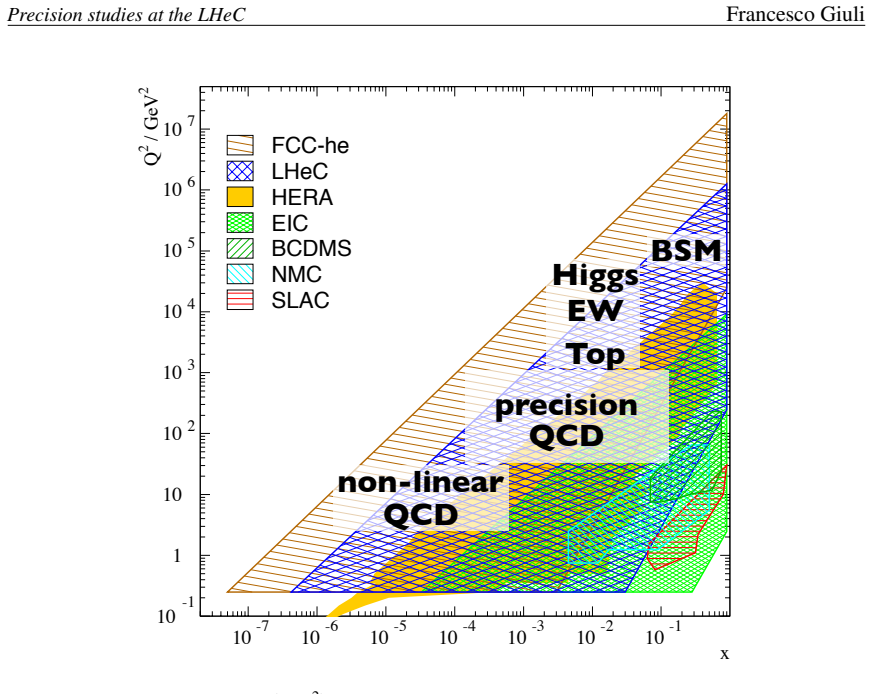
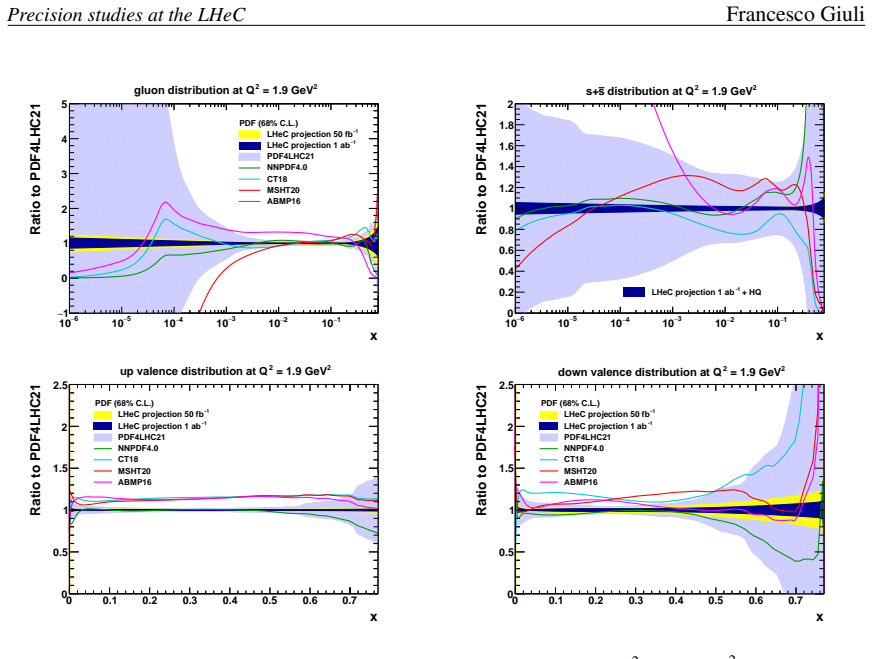
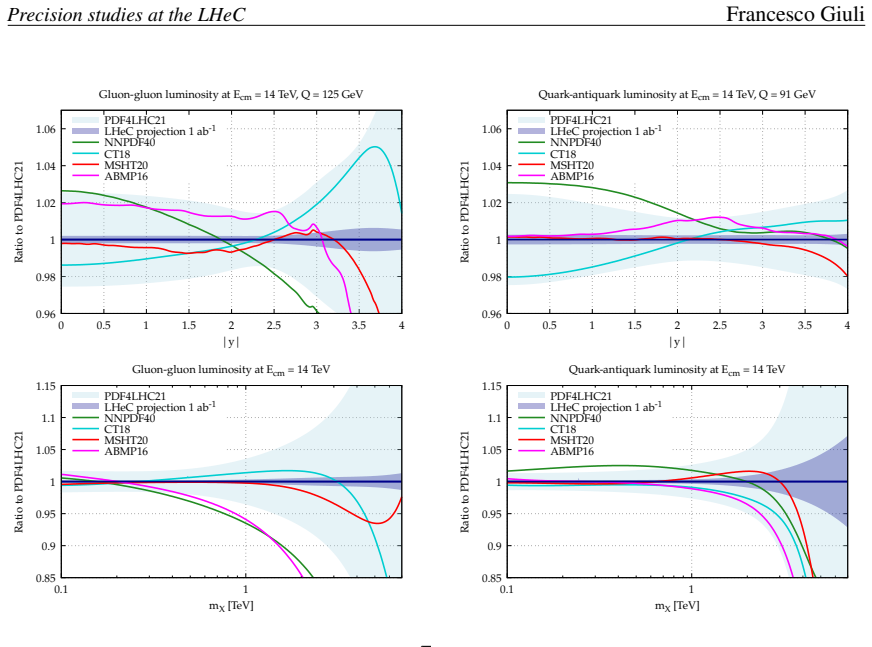
The LHeC adds a high-current Energy Recovery Linac to the HL-LHC, delivering electron-proton collisions at centre-of-mass energies around the TeV scale. The combination of high luminosity, a very large lever arm in Bjorken x and Q², and clean neutral- and charged-current deep-inelastic scattering measurements would enable a coherent determination of all proton PDFs in a single experiment. The resulting constraints would substantially reduce uncertainties in the gluon, valence, strange and heavy-flavour distributions, provide stringent tests of perturbative and small-x QCD, and improve the parton luminosities that enter precision and discovery measurements at the HL-LHC and at future hadron c
What carries the argument
Coherent extraction of all proton PDFs from combined neutral-current and charged-current deep-inelastic scattering over a wide range in Bjorken x and Q² at high luminosity.
If this is right
- Substantially reduce uncertainties in the gluon, valence, strange and heavy-flavour distributions
- Provide stringent tests of perturbative and small-x QCD
- Improve the parton luminosities that enter precision and discovery measurements at the HL-LHC and future hadron colliders
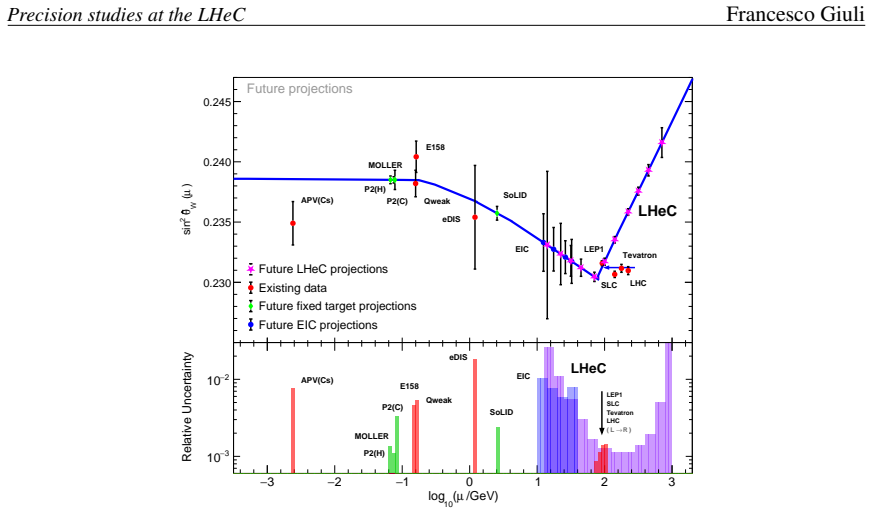
- Deliver competitive determinations of the strong coupling and weak mixing angle including its running over a wide range of scales
Where Pith is reading between the lines
- A single-experiment PDF set could reduce tensions that appear when data from multiple facilities are combined.
- Tighter PDFs would increase the reach of new-physics searches that rely on accurate background predictions at hadron colliders.
- Direct access to the running of the weak mixing angle over many orders of magnitude in scale would provide an independent electroweak test.
- The programme could set performance benchmarks that future electron-hadron facilities would need to meet or exceed.
Load-bearing premise
The LHeC will be built and will deliver the high luminosity, energy-recovery performance, and detector capabilities assumed in the bridge-project study.
What would settle it
Operation of the LHeC that fails to produce the projected reduction in PDF uncertainties or yields results inconsistent with the expected clean DIS measurements would falsify the central claim.
Figures

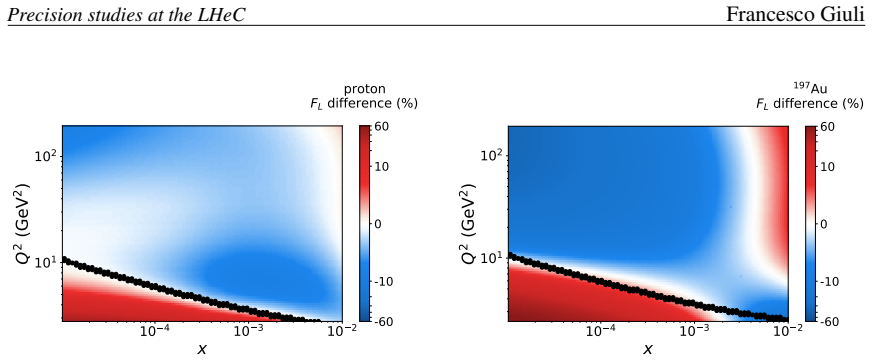
read the original abstract
The Large Hadron electron Collider (LHeC) would add a high-current Energy Recovery Linac to the HL-LHC, delivering electron-proton collisions at centre-of-mass energies around the TeV scale. This contribution summarises the QCD and parton-distribution-function (PDF) aspects of the recent LHeC bridge-project study. The combination of high luminosity, a very large lever arm in Bjorken $x$ and $Q^2$, and clean neutral- and charged-current deep-inelastic scattering measurements would enable a coherent determination of all proton PDFs in a single experiment. The resulting constraints would substantially reduce uncertainties in the gluon, valence, strange and heavy-flavour distributions, provide stringent tests of perturbative and small-$x$ QCD, and improve the parton luminosities that enter precision and discovery measurements at the HL-LHC and at future hadron colliders. The same programme gives competitive and complementary determinations of the strong coupling and weak mixing angle, including measurements of its running over a wide range of scales.
Editorial analysis
A structured set of objections, weighed in public.
Referee Report
Summary. The manuscript summarizes the QCD and PDF aspects of the recent LHeC bridge-project study. It claims that adding a high-current Energy Recovery Linac to the HL-LHC would deliver ep collisions at TeV-scale centre-of-mass energies with high luminosity and a large lever arm in Bjorken x and Q². Combined with clean neutral- and charged-current DIS measurements, this setup would enable a coherent determination of all proton PDFs in a single experiment, substantially reducing uncertainties on the gluon, valence, strange and heavy-flavour distributions, providing stringent tests of perturbative and small-x QCD, and improving parton luminosities relevant to HL-LHC and future hadron colliders. The same programme is stated to yield competitive determinations of α_s and the weak mixing angle, including its running over a wide range of scales.
Significance. If the projected LHeC performance is realized, the programme would provide a unique, self-consistent set of ep constraints on proton structure that complement pp data, with direct impact on precision LHC measurements and searches. The emphasis on simultaneous NC+CC coverage and the extended kinematic reach is a clear strength of the ep mode.
major comments (2)
- [Introduction / PDF section] The central claims rest entirely on performance projections taken from the bridge-project study. The manuscript should add an explicit subsection (e.g., near the introduction or in the PDF section) that lists the key input assumptions (luminosity, energy-recovery efficiency, detector acceptance and resolution) and states how they were propagated into the quoted PDF uncertainty reductions; without this, readers cannot assess the robustness of the quoted gains.
- [Abstract] The abstract and summary state that the LHeC would 'enable a coherent determination of all proton PDFs in a single experiment.' This phrasing should be qualified to make clear that the coherence is conditional on the assumed machine and detector parameters; the current wording risks being read as an unconditional claim.
minor comments (2)
- [Abstract] The manuscript refers to 'the recent LHeC bridge-project study' without a specific citation or arXiv number in the provided text; adding the reference would allow readers to trace the input projections.
- [Figures] Figure captions (if present in the full text) should explicitly state whether the shown uncertainty bands include only statistical or also systematic and PDF-parameterisation uncertainties.
Simulated Author's Rebuttal
We thank the referee for the positive assessment and the recommendation for minor revision. The two major comments are addressed point by point below.
read point-by-point responses
-
Referee: [Introduction / PDF section] The central claims rest entirely on performance projections taken from the bridge-project study. The manuscript should add an explicit subsection (e.g., near the introduction or in the PDF section) that lists the key input assumptions (luminosity, energy-recovery efficiency, detector acceptance and resolution) and states how they were propagated into the quoted PDF uncertainty reductions; without this, readers cannot assess the robustness of the quoted gains.
Authors: We agree that an explicit listing of the key assumptions would improve transparency. The PDF results quoted in the manuscript are taken directly from the bridge-project study, whose performance projections (luminosity, energy-recovery efficiency, detector acceptance and resolution) are documented in that reference. We will add a dedicated subsection (placed after the introduction and before the main PDF discussion) that enumerates these assumptions and briefly describes their propagation into the uncertainty reductions, with explicit cross-references to the relevant sections of the bridge-project study. revision: yes
-
Referee: [Abstract] The abstract and summary state that the LHeC would 'enable a coherent determination of all proton PDFs in a single experiment.' This phrasing should be qualified to make clear that the coherence is conditional on the assumed machine and detector parameters; the current wording risks being read as an unconditional claim.
Authors: We accept the referee's observation. The phrasing in the abstract (and the parallel statement in the summary) can be read as unconditional. We will revise both locations to qualify the claim explicitly, for example by inserting 'subject to the assumed machine and detector parameters' immediately after 'enable a coherent determination of all proton PDFs in a single experiment'. revision: yes
Circularity Check
No circularity; forward-looking projections independent of fitted inputs
full rationale
The manuscript summarises projected PDF constraints and QCD tests from the LHeC bridge-project study. No derivation chain, equation, or 'prediction' is shown that reduces by construction to fitted parameters, self-citations, or ansatzes internal to the paper. The central claim is a conditional expectation based on assumed machine performance and is not a closed-loop calculation equivalent to its inputs.
Axiom & Free-Parameter Ledger
axioms (2)
- domain assumption The LHeC will achieve the centre-of-mass energies, luminosities and detector performance stated in the bridge-project study.
- domain assumption Perturbative QCD and the parton model remain valid across the extended x and Q² range accessed by LHeC.
Reference graph
Works this paper leans on
-
[1]
The Large Hadron electron Collider as a bridge project for CERN,
F. Ahmadova et al., “The Large Hadron electron Collider as a bridge project for CERN,” arXiv:2503.17727 [hep-ex]
-
[2]
The Large Hadron–Electron Collider at the HL-LHC,
P. Agostini et al. [LHeC and FCC-he Study Group], “The Large Hadron–Electron Collider at the HL-LHC,” J. Phys. G 48(2021) 110501, arXiv:2007.14491 [hep-ex]
-
[3]
J. L. Abelleira Fernandez et al. [LHeC Study Group], “A Large Hadron Electron Collider at CERN,” J. Phys. G39 (2012) 075001, arXiv:1206.2913 [physics.acc-ph]
work page internal anchor Pith review Pith/arXiv arXiv 2012
-
[4]
Future Deep Inelastic Scattering with the LHeC
M. Klein, “Future Deep Inelastic Scattering with the LHeC,” arXiv:1802.04317 [hep-ph]
work page internal anchor Pith review Pith/arXiv arXiv
-
[5]
The PDF4LHC21 combination of global PDF fits for the LHC Run III,
R. D. Ball et al. [PDF4LHC Working Group], “The PDF4LHC21 combination of global PDF fits for the LHC Run III,” J. Phys. G49(2022) 080501, arXiv:2203.05506 [hep-ph]
-
[6]
Thepathtoprotonstructureat1% accuracy,
R.D.Balletal.[NNPDF],“Thepathtoprotonstructureat1% accuracy,” Eur. Phys. J. C82(2022) 428, arXiv:2109.02653 [hep-ph]
-
[7]
H. Abramowicz et al. [H1 and ZEUS], “Combination of mea- surements of inclusive deep inelastic𝑒± 𝑝 scattering cross sections and QCD analysis of HERA data,” Eur. Phys. J. C 75(2015) 580, arXiv:1506.06042 [hep-ex]
work page internal anchor Pith review Pith/arXiv arXiv 2015
-
[8]
New CTEQ global analysis of quantum chromodynamics with high-precision data from the LHC
T. J. Hou et al., “New CTEQ global analysis of quantum chromodynamics with high-precision data from the LHC,” Phys.Rev.D103(2021)014013,arXiv:1912.10053[hep-ph]
work page internal anchor Pith review Pith/arXiv arXiv 2021
- [9]
-
[10]
Parton Distribution Functions, $\alpha_s$ and Heavy-Quark Masses for LHC Run II
S. Alekhin, J. Blümlein, S. Moch and R. Placakyte, “Parton distribution functions,𝛼𝑠, and heavy-quark masses for LHC Run II,” Phys. Rev. D96(2017) 014011, arXiv:1701.05838 [hep-ph]
work page internal anchor Pith review Pith/arXiv arXiv 2017
-
[11]
V.Andreevetal.[H1],“Determinationofthestrongcoupling constant 𝛼𝑠 (𝑚 𝑍 ) in next-to-next-to-leading order QCD us- ing H1 jet cross section measurements,” Eur. Phys. J. C77 (2017) 791, arXiv:1709.07251 [hep-ex]
-
[12]
Electroweak Physics in Inclusive Deep Inelastic Scattering at the LHeC,
D. Britzger, M. Klein and H. Spiesberger, “Electroweak Physics in Inclusive Deep Inelastic Scattering at the LHeC,” arXiv:2007.11799 [hep-ph]
-
[13]
Precision elec- troweakphysicsattheLHeCandFCC-eh,
D. Britzger, M. Klein and H. Spiesberger, “Precision elec- troweakphysicsattheLHeCandFCC-eh,”arXiv:2203.06237 [hep-ph]
-
[14]
Review of Particle Physics,
S. Navas et al. [Particle Data Group], “Review of Particle Physics,” Phys. Rev. D110(2024) 030001
2024
-
[15]
Science Requirements and Detector Concepts for the Electron-Ion Collider: EIC Yellow Report
R. Abdul Khalek et al., “Science Requirements and Detector Concepts for the Electron-Ion Collider: EIC Yellow Re- port,” Nucl. Phys. A1026(2022) 122447, arXiv:2103.05419 [physics.ins-det]. 7
work page internal anchor Pith review Pith/arXiv arXiv 2022
discussion (0)
Sign in with ORCID, Apple, or X to comment. Anyone can read and Pith papers without signing in.