IllustrisTNG50 angular momentum maps: tracing the morpho-kinematic evolution of galaxies
Pith reviewed 2026-06-26 20:29 UTC · model grok-4.3
The pith
TNG50 galaxy discs redistribute stellar angular momentum through four evolving j-substructures driven by gas fraction and rotational support.
A machine-rendered reading of the paper's core claim, the machinery that carries it, and where it could break.
Core claim
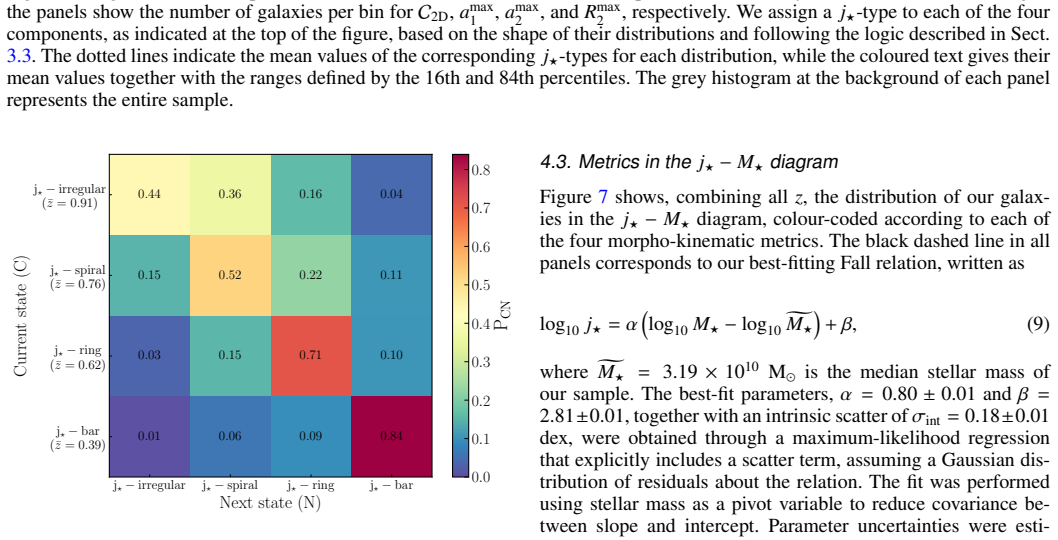
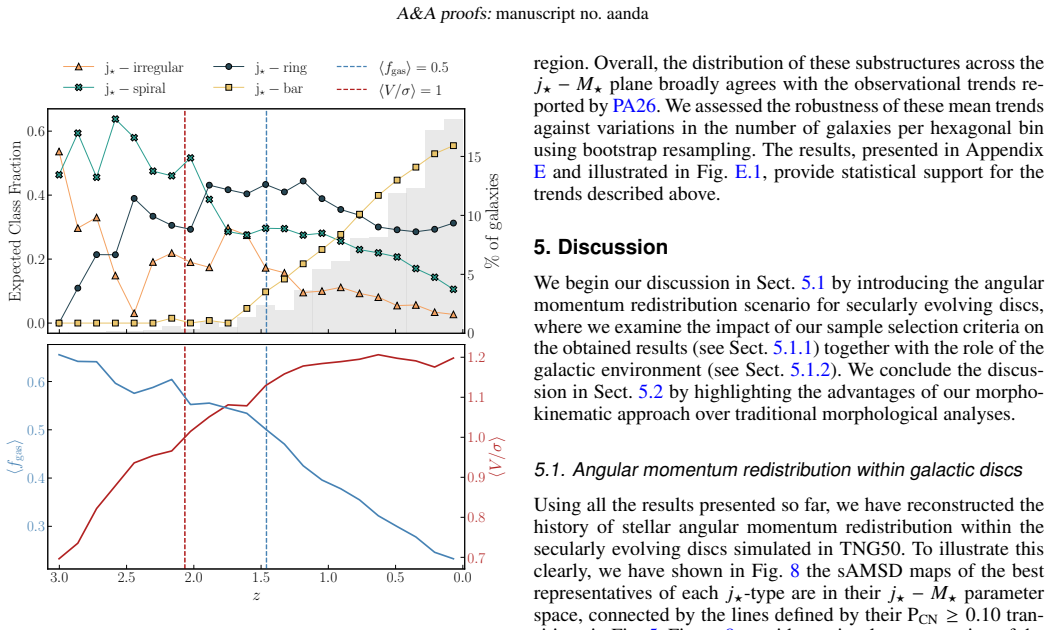
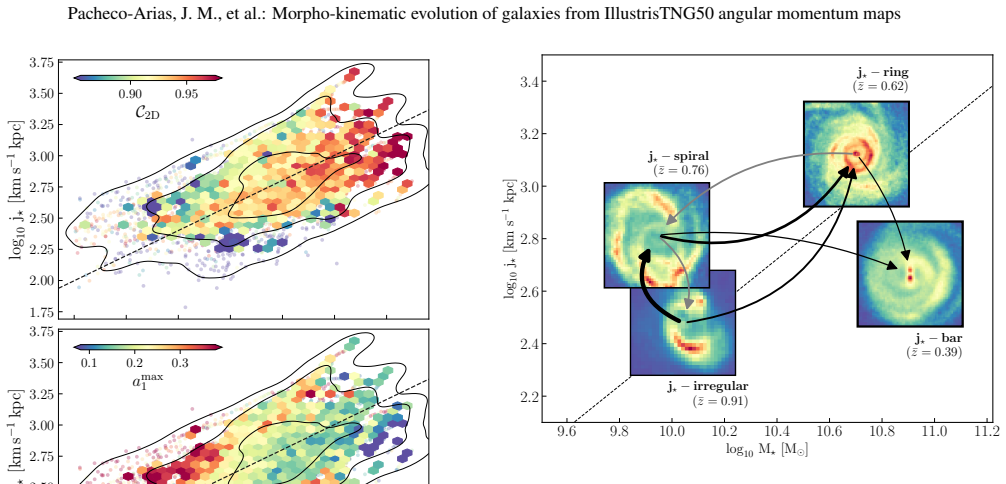
TNG50 discs exhibit a morpho-kinematic diversity consistent with observations, redistributing stellar angular momentum through four dominant j-substructures that evolve with redshift as follows: j-irregulars (mean z=0.91), j-spirals (0.76), j-rings (0.62), and j-bars (0.39). The gas fraction and stellar rotational support (V/σ) drive this evolution, enabling reconstruction of galactic evolutionary histories through sAMSD analysis.
What carries the argument
Gaussian mixture model with four fully covariant components that classifies galaxies into j-types using morpho-kinematic metrics from stellar specific angular momentum surface density maps and Fourier decomposition.
If this is right
- Gas-rich galaxies preferentially host j-irregulars and j-spirals.
- Gas-poor systems favour j-rings and j-bars.
- At fixed gas fraction, higher V/σ favours j-spirals and j-rings respectively.
- The sAMSD analysis links variations in stellar dynamics to mass redistribution consequences.
Where Pith is reading between the lines
- The evolutionary sequence implies that angular momentum maps could be used to infer the stage of secular evolution in observed galaxies.
- Connecting these j-types to mass redistribution may allow reconstruction of full galactic histories beyond what morphology alone provides.
- Similar classification applied to other simulations could test if the four-type pathway is universal.
Load-bearing premise
That partitioning the galaxies into exactly four j-types via the Gaussian mixture model reflects genuine physical substructures rather than an imposed categorization.
What would settle it
Observational data from surveys showing no correlation between the j-type fractions and redshift or gas fraction in the predicted manner would challenge the evolutionary pathway.
Figures
read the original abstract
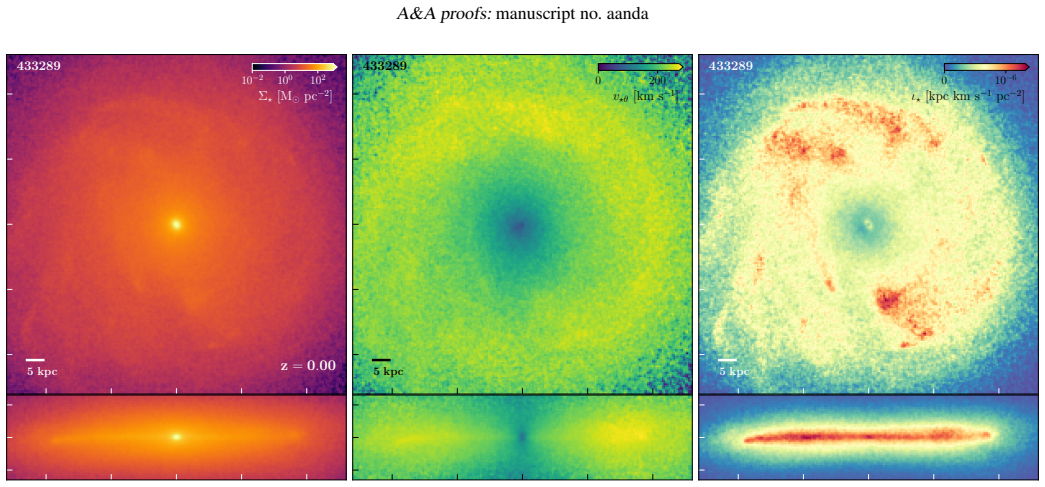
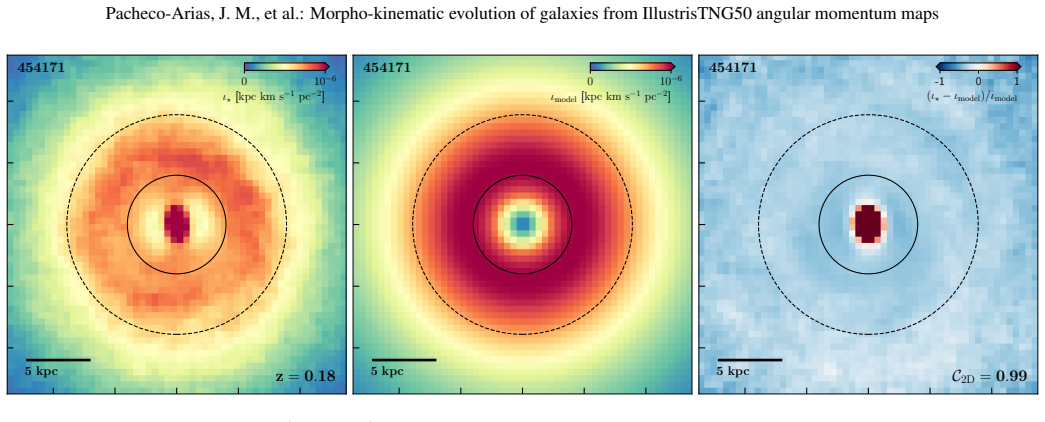
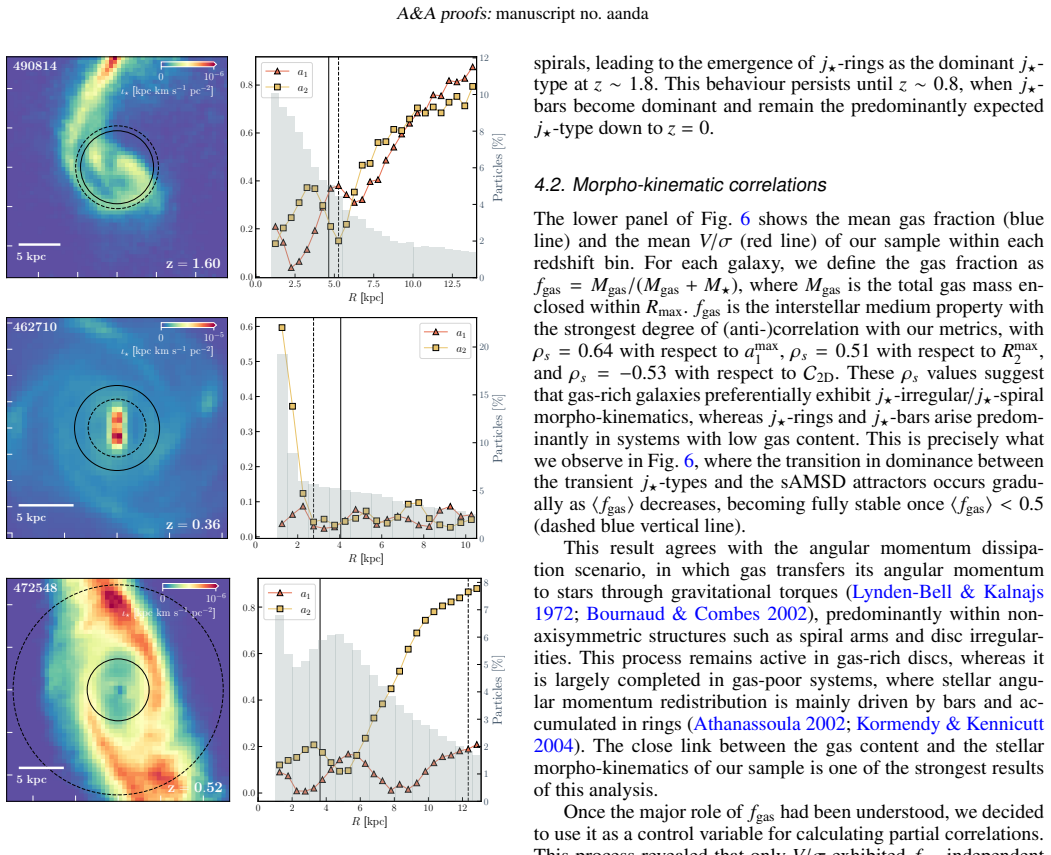
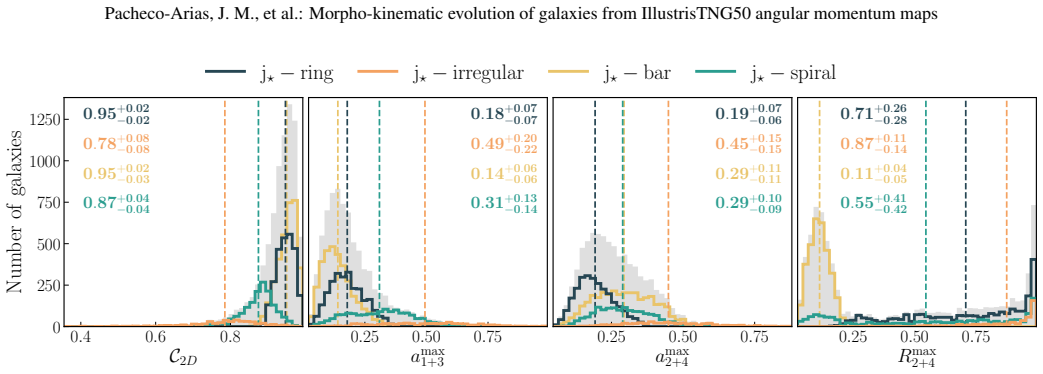
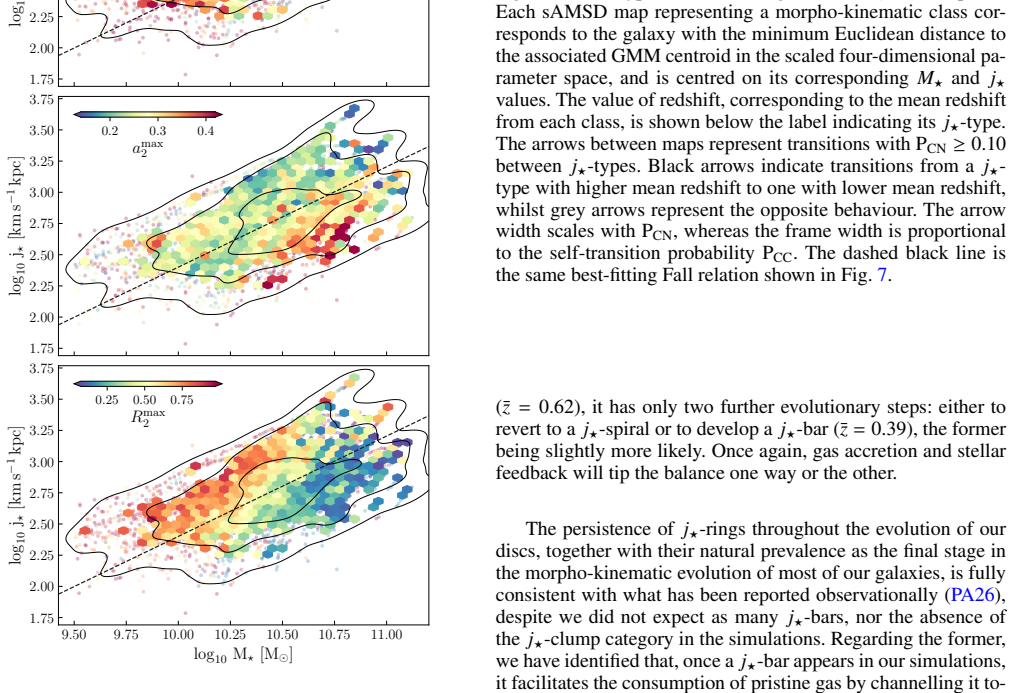
Following the first observational study of the two-dimensional spatial distribution of stellar specific angular momentum (sAM) in late-type galaxies, we quantify the morpho-kinematic diversity of galaxy simulations using the newly proposed j-types classification. We analyse the stellar sAM surface density (sAMSD) of $\sim$8000 TNG50 stellar discs spanning $0 \leq z \leq 3.5$ and $9.5 \leq \log(M_\star/\mathrm{M}_\odot) \leq 11.2$, selected from the TNG50 MW/M31 parent sample. We characterize their j-substructures using four morpho-kinematic metrics derived from comparisons with the Freeman sAMSD distribution and the Fourier decomposition of the galaxies in the sAMSD space. A Gaussian mixture model with four fully covariant components assigns each galaxy a probability of belonging to one of four j-types. We find that TNG50 discs exhibit a morpho-kinematic diversity consistent with observations, redistributing stellar angular momentum through four dominant j-substructures that evolve with redshift as follows: j-irregulars ($\bar{z}=0.91$), j-spirals ($\bar{z}=0.76$), j-rings ($\bar{z}=0.62$), and j-bars ($\bar{z}=0.39$). The gas fraction and stellar rotational support ($V/\sigma$) drive this evolution: gas-rich galaxies preferentially host j-irregulars and j-spirals, whereas gas-poor systems favour j-rings and j-bars. At fixed gas fraction, higher $V/\sigma$ favours j-spirals and j-rings, respectively. We conclude that there is a canonical pathway for the redistribution of angular momentum within galactic discs undergoing secular evolution in TNG50, accessible only through their morpho-kinematic description. The sAMSD analysis links variations in stellar dynamics to their consequences for mass redistribution, enabling the reconstruction of comprehensive galactic evolutionary histories.
Editorial analysis
A structured set of objections, weighed in public.
Referee Report
Summary. The manuscript analyzes the stellar specific angular momentum surface density (sAMSD) of ~8000 TNG50 disc galaxies (0 ≤ z ≤ 3.5, 9.5 ≤ log(M*/M⊙) ≤ 11.2) selected from the MW/M31 parent sample. Four morpho-kinematic metrics are derived from comparisons to the Freeman sAMSD profile and Fourier decomposition in sAMSD space; a Gaussian mixture model with four fully covariant components then assigns each galaxy a probability of belonging to one of four j-types (j-irregulars, j-spirals, j-rings, j-bars). The central result is an evolutionary sequence with mean redshifts j-irregulars (0.91) → j-spirals (0.76) → j-rings (0.62) → j-bars (0.39), driven by gas fraction and V/σ, claimed to be consistent with observations and to reveal a canonical secular pathway for angular-momentum redistribution.
Significance. If the four-component classification is shown to be robust rather than an imposed partition, the work supplies a concrete morpho-kinematic bridge between simulated sAMSD maps and observational j-type studies, linking variations in stellar dynamics to mass redistribution and offering falsifiable predictions for how gas content and rotational support shape disc evolution across cosmic time.
major comments (1)
- [Methods (GMM classification)] The Gaussian mixture model is applied with exactly four fully covariant components (abstract and Methods section describing the GMM). No model-selection statistic (BIC, AIC, or integrated completed likelihood), stability test under bootstrap or feature perturbation, or explicit comparison to n=3 or n=5 components is reported. Because this single modeling decision defines the four j-types and directly produces the reported mean redshifts and ordering, the central evolutionary-sequence claim inherits any arbitrariness in the component count.
minor comments (2)
- [Sample selection] Sample selection criteria are stated only at the level of the parent MW/M31 sample and broad mass/redshift cuts; explicit cuts on disc identification, resolution requirements, or exclusion of mergers should be listed with numbers of galaxies removed at each step.
- [Results (redshift statistics)] The abstract and results do not describe how galaxies with comparable probabilities across multiple components are treated when computing mean redshifts or when constructing the evolutionary sequence.
Simulated Author's Rebuttal
We thank the referee for their constructive feedback on our analysis of TNG50 stellar discs using sAM surface density maps. We address the single major comment below.
read point-by-point responses
-
Referee: The Gaussian mixture model is applied with exactly four fully covariant components (abstract and Methods section describing the GMM). No model-selection statistic (BIC, AIC, or integrated completed likelihood), stability test under bootstrap or feature perturbation, or explicit comparison to n=3 or n=5 components is reported. Because this single modeling decision defines the four j-types and directly produces the reported mean redshifts and ordering, the central evolutionary-sequence claim inherits any arbitrariness in the component count.
Authors: The choice of four components follows directly from the observational j-type framework (four distinct morpho-kinematic classes) that the manuscript explicitly extends to simulations for comparability. This is not a purely statistical partition but an observationally anchored classification. We agree that reporting model-selection criteria would strengthen the presentation. In the revised manuscript we will add BIC/AIC comparisons across n=3–6 components (showing n=4 as preferred) together with a brief bootstrap stability check on the component assignments. revision: yes
Circularity Check
No significant circularity in derivation chain
full rationale
The paper derives four metrics from sAMSD and Fourier analysis of TNG50 discs, fits a GMM with four components to assign j-type membership probabilities, then computes empirical statistics (mean redshift per type, correlations with gas fraction and V/σ). These statistics are direct outputs of the clustering applied to the simulation sample; no independent prediction is generated and then shown to equal a fitted quantity by construction. No load-bearing self-citation, uniqueness theorem, or ansatz is invoked. The fixed component count is a modeling decision whose justification is not addressed in the provided text, but this does not render the reported trends equivalent to the inputs. The chain is self-contained descriptive analysis of the dataset.
Axiom & Free-Parameter Ledger
free parameters (1)
- Number of GMM components
axioms (2)
- domain assumption The Freeman sAMSD distribution is an appropriate reference for defining morpho-kinematic metrics
- domain assumption TNG50 stellar disks faithfully represent the angular-momentum distributions of real late-type galaxies
invented entities (1)
-
j-irregulars, j-spirals, j-rings, j-bars
no independent evidence
Reference graph
Works this paper leans on
-
[1]
New morpho-kinematic classification: The two-dimensional spatial distribution of stellar specific angular momentum in late-type galaxies. , keywords =. doi:10.1051/0004-6361/202557280 , archivePrefix =. 2603.02942 , primaryClass =
-
[2]
Milky Way and Andromeda analogues from the TNG50 simulation. , keywords =. doi:10.1093/mnras/stae2165 , archivePrefix =. 2303.16217 , primaryClass =
-
[3]
First results from the TNG50 simulation: the evolution of stellar and gaseous discs across cosmic time. , keywords =. doi:10.1093/mnras/stz2338 , archivePrefix =. 1902.05553 , primaryClass =
-
[4]
2019a, MNRAS, 490, 3234, doi: 10.1093/mnras/stz2306
First results from the TNG50 simulation: galactic outflows driven by supernovae and black hole feedback. , keywords =. doi:10.1093/mnras/stz2306 , archivePrefix =. 1902.05554 , primaryClass =
work page internal anchor Pith review Pith/arXiv arXiv doi:10.1093/mnras/stz2306 1902
-
[5]
Y., V¨ ais¨ anen, P., Whitelock, P
E pur si muove: Galilean-invariant cosmological hydrodynamical simulations on a moving mesh. , keywords =. doi:10.1111/j.1365-2966.2009.15715.x , archivePrefix =. 0901.4107 , primaryClass =
-
[6]
Moving mesh cosmology: numerical techniques and global statistics. , keywords =. doi:10.1111/j.1365-2966.2012.21590.x , archivePrefix =. 1109.1281 , primaryClass =
-
[7]
The AREPO Public Code Release. , keywords =. doi:10.3847/1538-4365/ab908c , archivePrefix =. 1909.04667 , primaryClass =
-
[8]
Simulating galaxy formation with black hole driven thermal and kinetic feedback. , keywords =. doi:10.1093/mnras/stw2944 , archivePrefix =. 1607.03486 , primaryClass =
work page internal anchor Pith review Pith/arXiv arXiv doi:10.1093/mnras/stw2944
-
[9]
2018, MNRAS, 473, 4077, doi: 10.1093/mnras/stx2656
Simulating galaxy formation with the IllustrisTNG model. , keywords =. doi:10.1093/mnras/stx2656 , archivePrefix =. 1703.02970 , primaryClass =
work page internal anchor Pith review Pith/arXiv arXiv doi:10.1093/mnras/stx2656
-
[10]
The abundance of satellites around Milky Way- and M31-like galaxies with the TNG50 simulation: a matter of diversity. , keywords =. doi:10.1093/mnras/stab2437 , archivePrefix =. 2101.12215 , primaryClass =
-
[11]
Satellites of Milky Way- and M31-like galaxies with TNG50: quenched fractions, gas content, and star formation histories. , keywords =. doi:10.1093/mnras/stad1357 , archivePrefix =. 2211.00010 , primaryClass =
-
[12]
The MUSE Hubble Ultra Deep Field Survey. XVI. The angular momentum of low-mass star-forming galaxies: A cautionary tale and insights from TNG50. , keywords =. doi:10.1051/0004-6361/202040225 , archivePrefix =. 2101.12250 , primaryClass =
-
[13]
The Origin of the Relation Between Stellar Angular Momentum and Stellar Mass in Nearby Disk-dominated Galaxies. , keywords =. doi:10.3847/2041-8213/ac911e , archivePrefix =. 2201.08579 , primaryClass =
-
[14]
Connection to morphology, halo spin, and black hole mass
Galactic angular momentum in the IllustrisTNG simulation - I. Connection to morphology, halo spin, and black hole mass. , keywords =. doi:10.1093/mnras/stac806 , archivePrefix =. 2203.10098 , primaryClass =
-
[15]
Mass-morphology relation of TNG50 galaxies. , keywords =. doi:10.1051/0004-6361/202554847 , archivePrefix =. 2505.01620 , primaryClass =
-
[16]
Formation of Galactic Disks. II. The Physical Drivers of Disk Spin-up. , keywords =. doi:10.3847/1538-4357/ad57ba , archivePrefix =. 2306.13125 , primaryClass =
-
[17]
2022, MNRAS, 515, 1524, doi: 10.1093/mnras/stac1708
Morphological decomposition of TNG50 galaxies: methodology and catalogue. , keywords =. doi:10.1093/mnras/stac1708 , archivePrefix =. 2206.04693 , primaryClass =
-
[18]
2022, MNRAS, 512, 5339, doi: 10.1093/mnras/stac816
The evolution of the barred galaxy population in the TNG50 simulation. , keywords =. doi:10.1093/mnras/stac816 , archivePrefix =. 2110.04537 , primaryClass =
-
[19]
2024, @doi [A&A] 10.1051/0004-6361/202451521 , 692, A159
Pattern speed evolution of barred galaxies in TNG50. , keywords =. doi:10.1051/0004-6361/202451521 , archivePrefix =. 2407.11154 , primaryClass =
-
[20]
The complex relationship between black hole feedback, star formation, and stellar bars in TNG50. , keywords =. doi:10.1093/mnras/staf255 , archivePrefix =. 2409.06783 , primaryClass =
-
[21]
Galactic Dynamics: Second Edition
-
[22]
And yet it flips: connecting galactic spin and the cosmic web. , keywords =. doi:10.1093/mnras/staa250 , archivePrefix =. 1906.01623 , primaryClass =
-
[23]
The persistent cosmic web and its filamentary structure - II. Illustrations. , keywords =. doi:10.1111/j.1365-2966.2011.18395.x , archivePrefix =. 1009.4014 , primaryClass =
-
[24]
The persistent cosmic web and its filamentary structure - I. Theory and implementation. , keywords =. doi:10.1111/j.1365-2966.2011.18394.x , archivePrefix =. 1009.4015 , primaryClass =
-
[25]
A User's Guide To Discrete Morse Theory , volume =
Forman, Robin , year =. A User's Guide To Discrete Morse Theory , volume =
-
[26]
Continuous Fields and Discrete Samples: Reconstruction through Delaunay Tessellations
Continuous fields and discrete samples: reconstruction through Delaunay tessellations. , keywords =. doi:10.48550/arXiv.astro-ph/0011007 , archivePrefix =. astro-ph/0011007 , primaryClass =
work page internal anchor Pith review Pith/arXiv arXiv doi:10.48550/arxiv.astro-ph/0011007
-
[27]
Connecting the cosmic web to the spin of dark haloes: implications for galaxy formation. , keywords =. doi:10.1111/j.1365-2966.2012.21636.x , archivePrefix =. 1201.5794 , primaryClass =
-
[28]
Spin alignments within the cosmic web: a theory of constrained tidal torques near filaments
Spin alignments within the cosmic web: a theory of constrained tidal torques near filaments. , keywords =. doi:10.1093/mnras/stv1570 , archivePrefix =. 1504.06073 , primaryClass =
work page internal anchor Pith review Pith/arXiv arXiv doi:10.1093/mnras/stv1570
-
[29]
Galaxy orientation with the cosmic web across cosmic time
Galaxy orientation with the cosmic web across cosmic time. , keywords =. doi:10.1093/mnras/sty2567 , archivePrefix =. 1809.06212 , primaryClass =
work page internal anchor Pith review Pith/arXiv arXiv doi:10.1093/mnras/sty2567
-
[30]
Swirling around filaments: are large-scale structure vortices spinning up dark halos?
Swirling around filaments: are large-scale structure vortices spinning up dark haloes?. , keywords =. doi:10.1093/mnras/stu2289 , archivePrefix =. 1310.3801 , primaryClass =
work page internal anchor Pith review Pith/arXiv arXiv doi:10.1093/mnras/stu2289
-
[31]
Galaxy spin alignment in filaments and sheets: observational evidence
Galaxy Spin Alignment in Filaments and Sheets: Observational Evidence. , keywords =. doi:10.1088/2041-8205/775/2/L42 , archivePrefix =. 1308.2816 , primaryClass =
work page internal anchor Pith review Pith/arXiv arXiv doi:10.1088/2041-8205/775/2/l42 2041
-
[32]
A Study of Environmental Effects on Galaxy Spin Using MaNGA Data
A study of environmental effects on galaxy spin using MaNGA data. , keywords =. doi:10.1093/mnras/sty729 , archivePrefix =. 1802.10265 , primaryClass =
work page internal anchor Pith review Pith/arXiv arXiv doi:10.1093/mnras/sty729
-
[33]
, year = 1967, month = jan, volume =
Statistical mechanics of violent relaxation in stellar systems. , year = 1967, month = jan, volume =. doi:10.1093/mnras/136.1.101 , adsurl =
-
[34]
Dynamics of secular evolution. Secular Evolution of Galaxies , year = 2013, editor =. doi:10.48550/arXiv.1202.3403 , adsurl =
work page internal anchor Pith review Pith/arXiv arXiv doi:10.48550/arxiv.1202.3403 2013
-
[35]
On the generating mechanism of spiral structure. , year = 1972, month = jan, volume =. doi:10.1093/mnras/157.1.1 , adsurl =
-
[36]
A dynamically young and perturbed Milky Way disk
A dynamically young and perturbed Milky Way disk. , keywords =. doi:10.1038/s41586-018-0510-7 , archivePrefix =. 1804.10196 , primaryClass =
work page internal anchor Pith review Pith/arXiv arXiv doi:10.1038/s41586-018-0510-7
-
[37]
On the Spiral Structure of Disk Galaxies. , year = 1964, month = aug, volume =. doi:10.1086/147955 , adsurl =
-
[38]
Outline of a Theory of Density Waves
On the Spiral Structure of Disk Galaxies, II. Outline of a Theory of Density Waves. Proceedings of the National Academy of Science , year = 1966, month = feb, volume =. doi:10.1073/pnas.55.2.229 , adsurl =
-
[39]
Gas accretion on spiral galaxies: bar formation and renewal
Gas accretion on spiral galaxies: Bar formation and renewal. , keywords =. doi:10.1051/0004-6361:20020920 , archivePrefix =. astro-ph/0206273 , primaryClass =
work page internal anchor Pith review Pith/arXiv arXiv doi:10.1051/0004-6361:20020920
-
[40]
Bar-Halo Interaction and Bar Growth
Bar-Halo Interaction and Bar Growth. , keywords =. doi:10.1086/340784 , archivePrefix =. astro-ph/0203368 , primaryClass =
work page internal anchor Pith review Pith/arXiv arXiv doi:10.1086/340784
-
[41]
Secular Evolution and the Formation of Pseudobulges in Disk Galaxies. , keywords =. doi:10.1146/annurev.astro.42.053102.134024 , archivePrefix =. astro-ph/0407343 , primaryClass =
-
[42]
of a Symp
Problems of Cosmical Aerodynamics, Proc. of a Symp. Problems of Cosmical Aerodynamics, Proc. of a Symp , year = 1949, editor =
1949
-
[43]
, year = 1969, month = feb, volume =
Origin of the Angular Momentum of Galaxies. , year = 1969, month = feb, volume =. doi:10.1086/149876 , adsurl =
-
[44]
Astrofizika , year = 1970, month = jan, volume =
The space structure of perturbations and the origin of rotation of galaxies in the theory of fluctuation. Astrofizika , year = 1970, month = jan, volume =
1970
-
[45]
Angular momentum growth in protogalaxies. , keywords =. doi:10.1086/162573 , adsurl =
-
[46]
Formation and rotation of disc galaxies with haloes. , keywords =. doi:10.1093/mnras/193.2.189 , adsurl =
-
[47]
The formation of galactic discs. , keywords =. doi:10.1046/j.1365-8711.1998.01227.x , archivePrefix =. astro-ph/9707093 , primaryClass =
-
[48]
Galactic Angular Momentum in the Illustris Simulation: Feedback and the Hubble Sequence
Galactic Angular Momentum in the Illustris Simulation: Feedback and the Hubble Sequence. , keywords =. doi:10.1088/2041-8205/804/2/L40 , archivePrefix =. 1503.01117 , primaryClass =
work page internal anchor Pith review Pith/arXiv arXiv doi:10.1088/2041-8205/804/2/l40 2041
-
[49]
Angular momentum evolution of galaxies in EAGLE
Angular momentum evolution of galaxies in EAGLE. , keywords =. doi:10.1093/mnras/stw2610 , archivePrefix =. 1609.01739 , primaryClass =
work page internal anchor Pith review Pith/arXiv arXiv doi:10.1093/mnras/stw2610
-
[50]
Physical Models of Galaxy Formation in a Cosmological Framework. , keywords =. doi:10.1146/annurev-astro-082812-140951 , archivePrefix =. 1412.2712 , primaryClass =
work page internal anchor Pith review Pith/arXiv arXiv doi:10.1146/annurev-astro-082812-140951
-
[51]
Theoretical Challenges in Galaxy Formation
Theoretical Challenges in Galaxy Formation. , keywords =. doi:10.1146/annurev-astro-081913-040019 , archivePrefix =. 1612.06891 , primaryClass =
work page internal anchor Pith review Pith/arXiv arXiv doi:10.1146/annurev-astro-081913-040019
-
[52]
Nature Reviews Physics , keywords =
Cosmological simulations of galaxy formation. Nature Reviews Physics , keywords =. doi:10.1038/s42254-019-0127-2 , archivePrefix =. 1909.07976 , primaryClass =
-
[53]
Angular Momentum from Tidal Torques. , keywords =. doi:10.1086/165480 , adsurl =
-
[54]
Angular momentum properties of haloes and their baryon content in the Illustris simulation
Angular momentum properties of haloes and their baryon content in the Illustris simulation. , keywords =. doi:10.1093/mnras/stw2945 , archivePrefix =. 1608.01323 , primaryClass =
work page internal anchor Pith review Pith/arXiv arXiv doi:10.1093/mnras/stw2945
-
[55]
Quantifying the impact of mergers on the angular momentum of simulated galaxies
Quantifying the impact of mergers on the angular momentum of simulated galaxies. , keywords =. doi:10.1093/mnras/stx2667 , archivePrefix =. 1701.04407 , primaryClass =
work page internal anchor Pith review Pith/arXiv arXiv doi:10.1093/mnras/stx2667
-
[56]
The EAGLE project: Simulating the evolution and assembly of galaxies and their environments
The EAGLE project: simulating the evolution and assembly of galaxies and their environments. , keywords =. doi:10.1093/mnras/stu2058 , archivePrefix =. 1407.7040 , primaryClass =
work page internal anchor Pith review Pith/arXiv arXiv doi:10.1093/mnras/stu2058
-
[57]
First results from the IllustrisTNG simulations: matter and galaxy clustering
First results from the IllustrisTNG simulations: matter and galaxy clustering. , keywords =. doi:10.1093/mnras/stx3304 , archivePrefix =. 1707.03397 , primaryClass =
work page internal anchor Pith review Pith/arXiv arXiv doi:10.1093/mnras/stx3304
-
[58]
Angular momentum and galaxy formation revisited
Angular Momentum and Galaxy Formation Revisited. , keywords =. doi:10.1088/0067-0049/203/2/17 , archivePrefix =. 1207.4189 , primaryClass =
work page internal anchor Pith review Pith/arXiv arXiv doi:10.1088/0067-0049/203/2/17
-
[59]
Internal Kinematics and Dynamics of Galaxies , year = 1983, editor =
Galaxy formation - Some comparisons between theory and observation. Internal Kinematics and Dynamics of Galaxies , year = 1983, editor =
1983
-
[60]
Angular Momentum and Galaxy Formation Revisited: Effects of Variable Mass-to-light Ratios
Angular Momentum and Galaxy Formation Revisited: Effects of Variable Mass-to-light Ratios. , keywords =. doi:10.1088/2041-8205/769/2/L26 , archivePrefix =. 1305.1626 , primaryClass =
work page internal anchor Pith review Pith/arXiv arXiv doi:10.1088/2041-8205/769/2/l26 2041
-
[61]
The angular momentum-mass relation: a fundamental law from dwarf irregulars to massive spirals
The angular momentum-mass relation: a fundamental law from dwarf irregulars to massive spirals. , keywords =. doi:10.1051/0004-6361/201833091 , archivePrefix =. 1804.04663 , primaryClass =
work page internal anchor Pith review Pith/arXiv arXiv doi:10.1051/0004-6361/201833091
-
[62]
Fundamental Mass-Spin-Morphology Relation of Spiral Galaxies
Fundamental Mass-Spin-Morphology Relation Of Spiral Galaxies. , keywords =. doi:10.1088/0004-637X/784/1/26 , archivePrefix =. 1312.4543 , primaryClass =
work page internal anchor Pith review Pith/arXiv arXiv doi:10.1088/0004-637x/784/1/26
-
[63]
xGASS: characterizing the slope and scatter of the stellar mass-angular momentum relation for nearby galaxies. , keywords =. doi:10.1093/mnras/stab3261 , archivePrefix =. 2111.15048 , primaryClass =
-
[64]
GHASP: an H kinematic survey of spiral and irregular galaxies - VI. New H data cubes for 108 galaxies. , keywords =. doi:10.1111/j.1365-2966.2008.13422.x , archivePrefix =. 0805.0976 , primaryClass =
-
[65]
GHASP: an H kinematic survey of 203 spiral and irregular galaxies - VII. Revisiting the analysis of H data cubes for 97 galaxies. , keywords =. doi:10.1111/j.1365-2966.2008.13796.x , archivePrefix =. 0808.0132 , primaryClass =
-
[66]
GHASP: an H kinematical survey of spiral galaxies - XIII. Distribution of luminous and dark matter in spiral and irregular nearby galaxies using H and H I rotation curves and WISE photometry. , keywords =. doi:10.1093/mnras/stz2678 , archivePrefix =. 1909.08408 , primaryClass =
-
[67]
Scikit-learn: Machine Learning in Python
Scikit-learn: Machine Learning in Python. Journal of Machine Learning Research , keywords =. doi:10.48550/arXiv.1201.0490 , archivePrefix =. 1201.0490 , primaryClass =
work page internal anchor Pith review Pith/arXiv arXiv doi:10.48550/arxiv.1201.0490
-
[68]
Dempster, A. P. and Laird, N. M. and Rubin, D. B. , title =. Journal of the Royal Statistical Society: Series B (Methodological) , volume =. 1977 , month =. doi:10.1111/j.2517-6161.1977.tb01600.x , url =
-
[69]
Astropy: A Community Python Package for Astronomy
Astropy: A community Python package for astronomy. , keywords =. doi:10.1051/0004-6361/201322068 , archivePrefix =. 1307.6212 , primaryClass =
work page internal anchor Pith review Pith/arXiv arXiv doi:10.1051/0004-6361/201322068
-
[70]
The Astropy Project: Building an inclusive, open-science project and status of the v2.0 core package
The Astropy Project: Building an Open-science Project and Status of the v2.0 Core Package. , keywords =. doi:10.3847/1538-3881/aabc4f , archivePrefix =. 1801.02634 , primaryClass =
work page internal anchor Pith review Pith/arXiv arXiv doi:10.3847/1538-3881/aabc4f
-
[71]
and Haberland, Matt and Reddy, Tyler and Cournapeau, David and Burovski, Evgeni and Peterson, Pearu and Weckesser, Warren and Bright, Jonathan and
Virtanen, Pauli and Gommers, Ralf and Oliphant, Travis E. and Haberland, Matt and Reddy, Tyler and Cournapeau, David and Burovski, Evgeni and Peterson, Pearu and Weckesser, Warren and Bright, Jonathan and. Nature Methods , year =
-
[72]
Hunter, J. D. , Title =. Computing in Science & Engineering , Volume =
-
[73]
Array programming with NumPy. , keywords =. doi:10.1038/s41586-020-2649-2 , archivePrefix =. 2006.10256 , primaryClass =
work page internal anchor Pith review Pith/arXiv arXiv doi:10.1038/s41586-020-2649-2 2006
-
[74]
Introducing the NEWHORIZON simulation: Galaxy properties with resolved internal dynamics across cosmic time. , keywords =. doi:10.1051/0004-6361/202039429 , archivePrefix =. 2009.10578 , primaryClass =
-
[75]
Mergers drive spin swings along the cosmic web
Mergers drive spin swings along the cosmic web. , keywords =. doi:10.1093/mnrasl/slu106 , archivePrefix =. 1403.2728 , primaryClass =
work page internal anchor Pith review Pith/arXiv arXiv doi:10.1093/mnrasl/slu106
-
[76]
The Accretion of Dark Matter Subhalos within the Cosmic Web: Primordial Anisotropic Distribution and its Universality. , keywords =. doi:10.1088/0004-637X/813/1/6 , archivePrefix =. 1509.06804 , primaryClass =
work page internal anchor Pith review Pith/arXiv arXiv doi:10.1088/0004-637x/813/1/6
-
[77]
Gravitational torques dominate the dynamics of accreted gas at z > 2. , keywords =. doi:10.1093/mnras/stac1663 , archivePrefix =. 2110.05384 , primaryClass =
-
[78]
FIREbox: simulating galaxies at high dynamic range in a cosmological volume. , keywords =. doi:10.1093/mnras/stad1205 , archivePrefix =. 2205.15325 , primaryClass =
-
[79]
Simba: Cosmological Simulations with Black Hole Growth and Feedback
SIMBA: Cosmological simulations with black hole growth and feedback. , keywords =. doi:10.1093/mnras/stz937 , archivePrefix =. 1901.10203 , primaryClass =
work page internal anchor Pith review Pith/arXiv arXiv doi:10.1093/mnras/stz937 1901
-
[80]
A simple and accurate approximation for the Q stability parameter in multicomponent and realistically thick discs. , keywords =. doi:10.1093/mnras/stt809 , archivePrefix =. 1302.4291 , primaryClass =
work page internal anchor Pith review Pith/arXiv arXiv doi:10.1093/mnras/stt809
discussion (0)
Sign in with ORCID, Apple, or X to comment. Anyone can read and Pith papers without signing in.