Giskard : Byzantine Robust and Confidential Aggregation for Large-Scale Decentralized Learning
Pith reviewed 2026-06-26 20:22 UTC · model grok-4.3
The pith
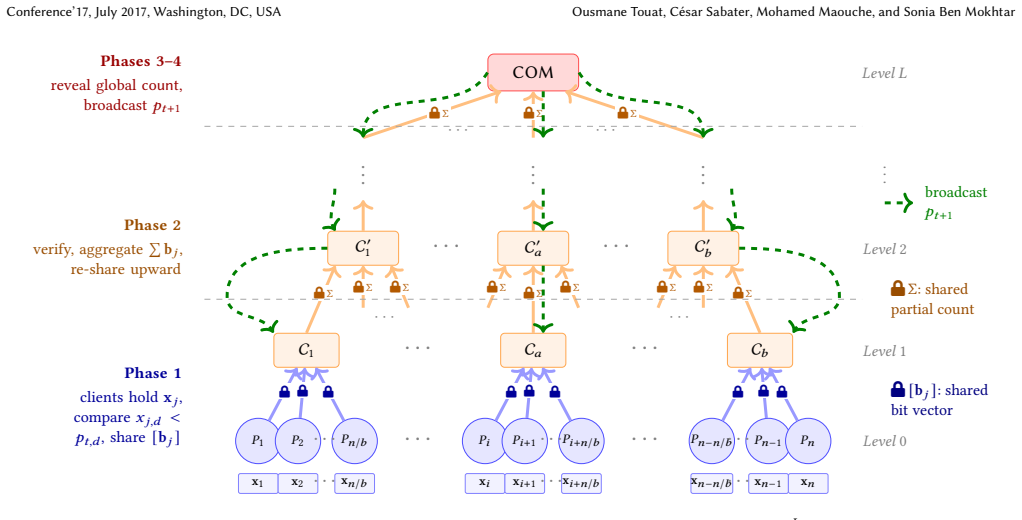
Giskard organizes parties into a tree of log-sized committees to compute a confidential approximate median via intra-committee MPC.
A machine-rendered reading of the paper's core claim, the machinery that carries it, and where it could break.
Core claim
By organizing participants into a tree of O(log n)-sized committees and evaluating a coordinate-wise approximate median via committee-adapted distributed binary search with BGW-style MPC inside each committee, Giskard achieves both confidentiality of updates and resilience to n/4 Byzantine parties with asymptotically lower per-party communication than all-to-all or small-subset baselines.
What carries the argument
Tree of O(log n)-sized committees running BGW-style MPC for distributed binary search to compute coordinate-wise approximate median.
If this is right
- Per-party communication complexity drops asymptotically compared with all-to-all MPC or small-subset delegation.
- Model utility stays comparable to non-robust baselines even when up to one quarter of parties are Byzantine.
- Formal proofs establish both security against malicious parties and confidentiality of individual updates.
- The protocol supports networks of at least one million participants in experiments.
Where Pith is reading between the lines
- The tree structure might extend to other robust aggregation statistics if suitable MPC subroutines exist for them.
- Dynamic committee formation over time could reduce the impact of static topology attacks that the current design does not explicitly address.
- The approach leaves open whether the same committee MPC pattern can be composed with differential privacy mechanisms without destroying the median guarantee.
Load-bearing premise
That structuring the network as a tree of small committees and running BGW MPC inside them is enough to deliver both confidentiality and Byzantine robustness at scale without creating new weaknesses or large overhead.
What would settle it
An experiment in which n/4 colluding parties either reveal hidden updates or shift the computed median far from the honest value in a Giskard run with a million participants.
Figures

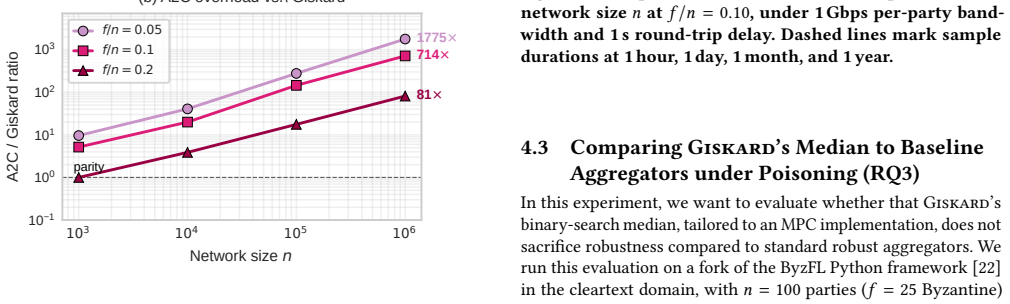
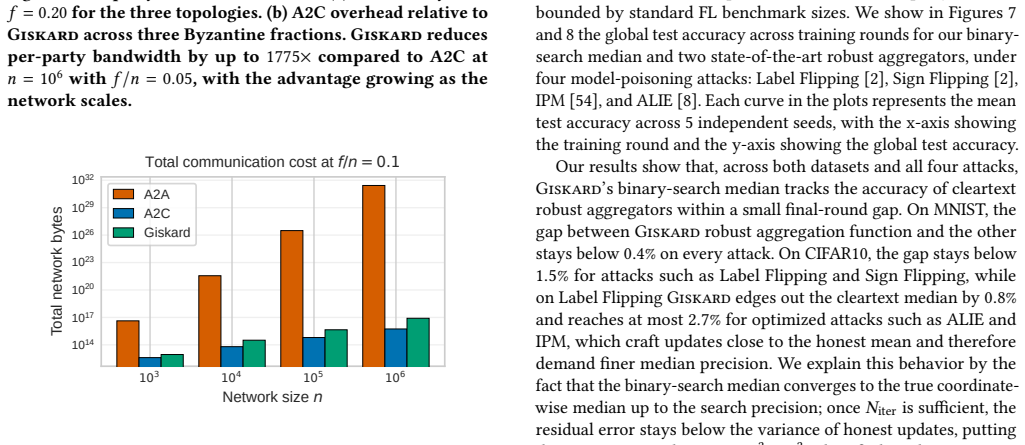
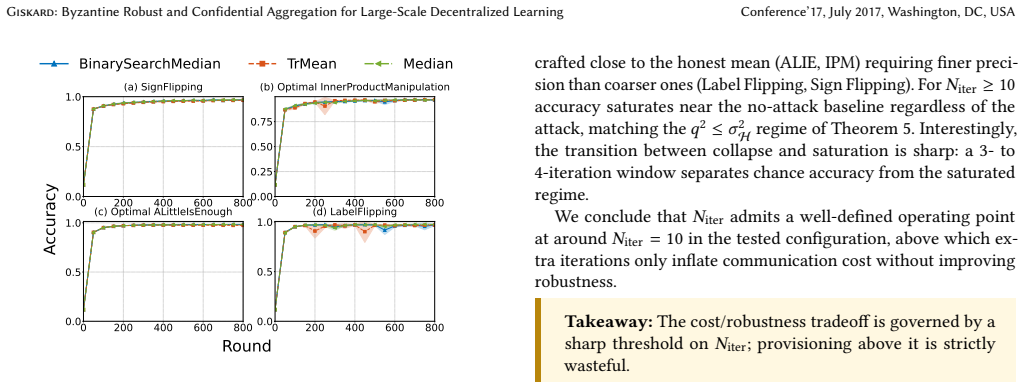
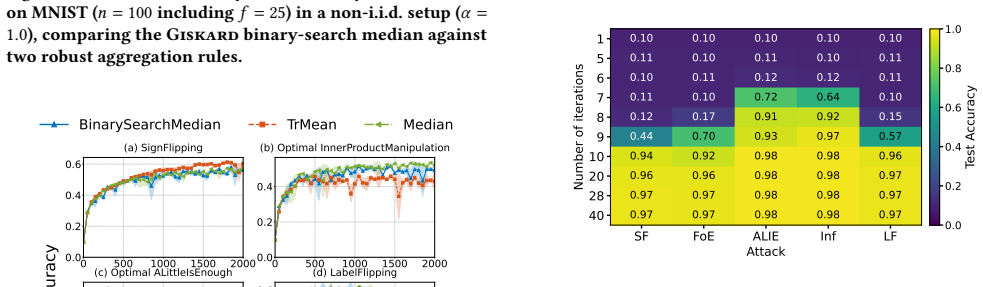
read the original abstract
Dealing simultaneously with confidentiality and Byzantine behaviors in decentralized learning is a challenging problem. Indeed, in decentralized learning, clients train a machine learning model while keeping their data locally and share their model parameters or gradients with a set of neighbors. While enforcing confidentiality calls for hiding the exchanged model parameters/gradients (e.g., by using cryptographic techniques), dealing with Byzantine contributions often requires inspecting the latter. Hence, most research works address these objectives separately. A recent line of work proposes to employ secure multi-party computation (MPC) to implement robust aggregators against model poisoning, thereby enforcing both confidentiality and Byzantine resilience. However, these solutions scale badly: they either require all-to-all communication between participants or delegate the entire computation to a small subset, whose computational and communication load grows proportionally with the size of the network. In this paper, we present Giskard, a protocol for confidential and Byzantine-robust decentralized aggregation. Giskard organizes $n$ parties into a tree of committees of size $O(\log n)$ and evaluates a coordinate-wise approximate median via a committee-adapted distributed binary search over the value domain, using BGW-style MPC within each committee. We assess Giskard both theoretically by proving its security and confidentiality properties and experimentally through extensive experiments involving up to one million participants. Compared to its closest competitors, Giskard reduces per-party communication complexity asymptotically while exhibiting comparable model utility under up to $n/4$ Byzantine parties.
Editorial analysis
A structured set of objections, weighed in public.
Referee Report
Summary. The paper presents Giskard, a protocol for confidential and Byzantine-robust decentralized aggregation in large-scale learning. It organizes n parties into a tree of O(log n)-sized committees and computes a coordinate-wise approximate median via distributed binary search using BGW-style MPC inside each committee. The authors claim asymptotic reduction in per-party communication complexity relative to prior MPC-based aggregators, security and confidentiality proofs, and experimental validation with up to 1M participants showing comparable model utility under up to n/4 Byzantine parties.
Significance. If the security reduction and honest-majority guarantees hold, the result would be significant: it offers a scalable alternative to all-to-all or small-subset MPC approaches for simultaneously achieving confidentiality and Byzantine resilience in decentralized ML, with concrete communication savings and large-scale empirical support.
major comments (2)
- [Protocol description / Abstract] Protocol description (committee formation and assignment): the n/4 Byzantine tolerance claim requires that every O(log n)-sized committee maintains an honest majority (for BGW MPC and the median step). The manuscript must supply the explicit assignment protocol together with a concentration analysis (Chernoff bounds plus union bound over Θ(n/log n) committees, plus handling of tree propagation and any adversarial influence on assignment). The abstract states the construction but does not indicate that this analysis is present; without it the central resilience claim is not yet load-bearing.
- [Security proof] Security proof section: the reduction to BGW security inside committees must explicitly address the case where a committee fails the honest-majority condition (even with small probability) and how tree-level propagation is handled; the current high-level claim does not yet demonstrate that a single bad committee cannot compromise the global median or confidentiality.
minor comments (2)
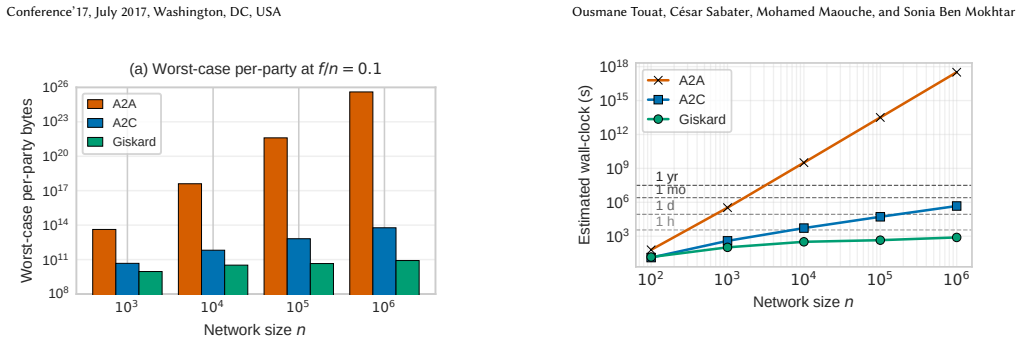
- [Experiments] The experimental section should report per-party communication volume as a function of n (not only wall-clock time) to substantiate the asymptotic claim.
- [Notation / Protocol] Notation for committee size c = O(log n) and the precise median approximation error should be defined once and used consistently.
Simulated Author's Rebuttal
We thank the referee for the constructive comments on the committee assignment and security reduction. We agree that these aspects require more explicit treatment to fully support the n/4 tolerance claim and will revise the manuscript accordingly.
read point-by-point responses
-
Referee: [Protocol description / Abstract] Protocol description (committee formation and assignment): the n/4 Byzantine tolerance claim requires that every O(log n)-sized committee maintains an honest majority (for BGW MPC and the median step). The manuscript must supply the explicit assignment protocol together with a concentration analysis (Chernoff bounds plus union bound over Θ(n/log n) committees, plus handling of tree propagation and any adversarial influence on assignment). The abstract states the construction but does not indicate that this analysis is present; without it the central resilience claim is not yet load-bearing.
Authors: We agree that the manuscript's high-level description of the tree of O(log n) committees does not yet include an explicit assignment protocol or the required concentration analysis. In the revision we will add a concrete assignment mechanism (random sampling via a public randomness source or VRF to limit adversarial control) together with a Chernoff-bound plus union-bound argument showing that every committee has honest majority except with negligible probability. We will also analyze tree propagation to show that a local violation cannot affect the global approximate median. These additions will appear in Section 3 (Protocol) and the security analysis. revision: yes
-
Referee: [Security proof] Security proof section: the reduction to BGW security inside committees must explicitly address the case where a committee fails the honest-majority condition (even with small probability) and how tree-level propagation is handled; the current high-level claim does not yet demonstrate that a single bad committee cannot compromise the global median or confidentiality.
Authors: We acknowledge that the current security argument assumes the honest-majority condition holds in all committees and does not yet spell out the consequences or mitigation for the negligible-probability failure case. In the revision we will extend the proof to bound the effect of a single faulty committee on the coordinate-wise approximate median and on confidentiality, leveraging the tree structure and the fact that parent committees can cross-check results. If needed we will also describe a lightweight consistency check that aborts or excludes a suspect committee. This will be added to the security section. revision: yes
Circularity Check
No circularity; protocol and proofs rely on external MPC primitives without self-referential reduction
full rationale
The paper constructs Giskard by organizing parties into O(log n) committees and applying BGW-style MPC for median aggregation, then states it proves security and confidentiality properties. No equations or claims reduce a result to its own inputs by definition, rename a fitted parameter as a prediction, or rest the central theorem on a self-citation chain. The n/4 Byzantine tolerance and committee honest-majority requirement are design assumptions justified by concentration arguments and external MPC guarantees rather than circular redefinition. The derivation is therefore self-contained against the stated primitives.
Axiom & Free-Parameter Ledger
axioms (1)
- standard math Security and confidentiality properties of BGW-style secure multi-party computation hold within each committee
Reference graph
Works this paper leans on
-
[1]
Sulaiman A Alghunaim and Kun Yuan. 2022. A unified and refined convergence analysis for non-convex decentralized learning.IEEE Transactions on Signal Processing70 (2022), 3264–3279
2022
-
[2]
Zeyuan Allen-Zhu, Faeze Ebrahimianghazani, Jerry Li, and Dan Alistarh. 2021. Byzantine-Resilient Non-Convex Stochastic Gradient Descent. InInternational Conference on Learning Representations
2021
-
[3]
Youssef Allouah, Sadegh Farhadkhani, Rachid Guerraoui, Nirupam Gupta, Rafaël Pinot, and John Stephan. 2023. Fixing by mixing: A recipe for optimal byzantine ml under heterogeneity. InInternational Conference on Artificial Intelligence and Statistics. PMLR, 1232–1300
2023
-
[4]
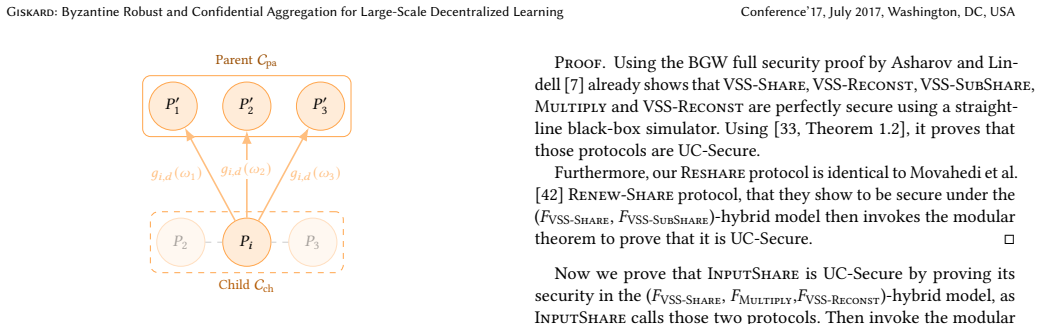
Youssef Allouah, Rachid Guerraoui, Nirupam Gupta, Rafaël Pinot, and John Stephan. 2023. On the privacy-robustness-utility trilemma in distributed learning. InInternational Conference on Machine Learning. PMLR, 569–626
2023
-
[5]
Youssef Allouah, Rachid Guerraoui, and John Stephan. 2025. Towards Trustwor- thy Federated Learning with Untrusted Participants. InProceedings of the 42nd International Conference on Machine Learning (Proceedings of Machine Learning Research, Vol. 267), Aarti Singh, Maryam Fazel, Daniel Hsu, Simon Lacoste-Julien, Felix Berkenkamp, Tegan Maharaj, Kiri Wags...
2025
-
[6]
arkworks contributors. 2022. arkworks zkSNARK ecosystem. https://arkworks.rs
2022
-
[7]
Gilad Asharov and Yehuda Lindell. 2011. A Full Proof of the BGW Protocol for Perfectly-Secure Multiparty Computation.IACR Cryptology ePrint Archive2011 (01 2011), 136
2011
-
[8]
Gilad Baruch, Moran Baruch, and Yoav Goldberg. 2019. A little is enough: Circumventing defenses for distributed learning.Advances in Neural Information Processing Systems32 (2019)
2019
-
[9]
James Bell, Adrià Gascón, Tancrède Lepoint, Baiyu Li, Sarah Meiklejohn, Mariana Raykova, and Cathie Yun. 2023. ACORN: input validation for secure aggregation. InProceedings of the 32nd USENIX Conference on Security Symposium(Anaheim, CA, USA)(SEC ’23). USENIX Association, USA, Article 269, 18 pages
2023
-
[10]
Analyzing Information Leakage of Updates to Natural Language Models , booktitle =
James Henry Bell, Kallista A. Bonawitz, Adrià Gascón, Tancrède Lepoint, and Mar- iana Raykova. 2020. Secure Single-Server Aggregation with (Poly)Logarithmic Overhead. InProceedings of the 2020 ACM SIGSAC Conference on Computer and Communications Security(Virtual Event, USA)(CCS ’20). Association for Com- puting Machinery, New York, NY, USA, 1253–1269. doi...
-
[11]
2017.Fast and differentially private algorithms for decentralized collaborative machine learn- ing
Aurélien Bellet, Rachid Guerraoui, Mahsa Taziki, and Marc Tommasi. 2017.Fast and differentially private algorithms for decentralized collaborative machine learn- ing. Research Report. INRIA Lille. https://inria.hal.science/hal-01665410
2017
-
[12]
Michael Ben-Or, Shafi Goldwasser, and Avi Wigderson. 1988. Completeness theo- rems for non-cryptographic fault-tolerant distributed computation. InProceedings of the Twentieth Annual ACM Symposium on Theory of Computing(Chicago, Illi- nois, USA)(STOC ’88). Association for Computing Machinery, New York, NY, USA, 1–10. doi:10.1145/62212.62213
-
[13]
Practical secure aggregation for privacy-preserving machine learning,
Keith Bonawitz, Vladimir Ivanov, Ben Kreuter, Antonio Marcedone, H. Brendan McMahan, Sarvar Patel, Daniel Ramage, Aaron Segal, and Karn Seth. 2017. Practi- cal Secure Aggregation for Privacy-Preserving Machine Learning. InProceedings of the 2017 ACM SIGSAC Conference on Computer and Communications Security (Dallas, Texas, USA)(CCS ’17). Association for Co...
-
[14]
Nicolas Braud-Santoni, Rachid Guerraoui, and Florian Huc. 2013. Fast byzantine agreement. InProceedings of the 2013 ACM Symposium on Principles of Distributed Computing(Montréal, Québec, Canada)(PODC ’13). Association for Computing Machinery, New York, NY, USA, 57–64. doi:10.1145/2484239.2484243
-
[15]
Ran Canetti. 2000. Universally Composable Security: A New Paradigm for Cryptographic Protocols. Cryptology ePrint Archive, Paper 2000/067. https: //eprint.iacr.org/2000/067
2000
-
[16]
Xiaoyu Cao, Minghong Fang, Jia Liu, and Neil Zhenqiang Gong. 2021. FLTrust: Byzantine-robust Federated Learning via Trust Bootstrapping. InProceedings 2021 Network and Distributed System Security Symposium(Virtual). Internet Society. doi:10.14722/ndss.2021.24434
-
[17]
Antoine Choffrut, Rachid Guerraoui, Rafael Pinot, Renaud Sirdey, John Stephan, and Martin Zuber. 2024. Towards Practical Homomorphic Aggregation in Byzantine-Resilient Distributed Learning. InProceedings of the 25th International Middleware Conference(Hong Kong, Hong Kong)(Middleware ’24). Association for Computing Machinery, New York, NY, USA, 431–444. d...
-
[18]
Ivan Damgård, Valerio Pastro, {Nigel P.} Smart, and Sarah Zakarias. 2012. Mul- tiparty Computation from Somewhat Homomorphic Encryption. InAdvances in Cryptology - CRYPTO 2012, Reihaneh Safavi-Naini and Ran Canetti (Eds.), Vol. 7417. Springer Berlin Heidelberg, Germany, 643–662
2012
-
[19]
Minghong Fang, Zifan Zhang, Hairi, Prashant Khanduri, Jia Liu, Songtao Lu, Yuchen Liu, and Neil Gong. 2024. Byzantine-robust decentralized federated learning. InProceedings of the 2024 on ACM SIGSAC Conference on Computer and Communications Security. 2874–2888
2024
-
[20]
Choquette-Choo, Mark R Thomas, Muhammad Ahmad Kaleem, Stephan Rabanser, Congyu Fang, Somesh Jha, Nicolas Papernot, and Xiao Wang
Nicholas Franzese, Adam Dziedzic, Christopher A. Choquette-Choo, Mark R Thomas, Muhammad Ahmad Kaleem, Stephan Rabanser, Congyu Fang, Somesh Jha, Nicolas Papernot, and Xiao Wang. 2023. Robust and Actively Secure Server- less Collaborative Learning. InAdvances in Neural Information Processing Systems, A. Oh, T. Naumann, A. Globerson, K. Saenko, M. Hardt, a...
2023
-
[21]
Ali Reza Ghavamipour, Benjamin Zi Hao Zhao, Oguzhan Ersoy, and Fatih Turk- men. 2024. Privacy-Preserving Aggregation for Decentralized Learning with Byzantine-Robustness. doi:10.48550/arXiv.2404.17970 arXiv:2404.17970 [cs]
-
[22]
Marc González, Rachid Guerraoui, Rafael Pinot, Geovani Rizk, John Stephan, and François Taïani. 2025. ByzFL: Research Framework for Robust Federated Learning. arXiv:2505.24802 [cs.LG] https://arxiv.org/abs/2505.24802
arXiv 2025
-
[23]
István Hegedűs, Gábor Danner, and Márk Jelasity. 2019. Gossip learning as a decentralized alternative to federated learning. InDistributed Applications and Interoperable Systems: 19th IFIP WG 6.1 International Conference, DAIS 2019, Held as Part of the 14th International Federated Conference on Distributed Computing Techniques, DisCoTec 2019. Springer, Sp...
2019
-
[24]
Wassily Hoeffding. 1963. Probability inequalities for sums of bounded random variables.Journal of the American statistical association58, 301 (1963), 13–30
1963
-
[25]
Yangsibo Huang, Samyak Gupta, Zhao Song, Kai Li, and Sanjeev Arora. 2021. Eval- uating gradient inversion attacks and defenses in federated learning.Advances in neural information processing systems34 (2021), 7232–7241
2021
-
[26]
Yufan Jiang, Maryam Zarezadeh, Tianxiang Dai, and Stefan Köpsell. 2025. AlphaFL: Secure Aggregation with Malicious 2 Security for Federated Learn- ing against Dishonest Majority. Cryptology ePrint Archive, Paper 2025/1289. https://eprint.iacr.org/2025/1289
2025
-
[27]
Sai Praneeth Karimireddy, Lie He, and Martin Jaggi. 2020. Byzantine-Robust Learning on Heterogeneous Datasets via Bucketing
2020
-
[28]
Sai Praneeth Karimireddy, Lie He, and Martin Jaggi. 2021. Learning from History for Byzantine Robust Optimization. InProceedings of the 38th Inter- national Conference on Machine Learning (Proceedings of Machine Learning Research, Vol. 139), Marina Meila and Tong Zhang (Eds.). PMLR, 5311–5319. https://proceedings.mlr.press/v139/karimireddy21a.html
2021
-
[29]
Sai Praneeth Karimireddy, Lie He, and Martin Jaggi. 2022. Byzantine-Robust Learning on Heterogeneous Datasets via Bucketing. InInternational Conference on Learning Representations
2022
-
[30]
Marcel Keller, Emmanuela Orsini, and Peter Scholl. 2016. MASCOT: Faster Malicious Arithmetic Secure Computation with Oblivious Transfer. Cryptology ePrint Archive, Paper 2016/505. doi:10.1145/2976749.2978357
-
[31]
Valerie King, Steven Lonargan, Jared Saia, and Amitabh Trehan. 2011. Load balanced scalable Byzantine agreement through quorum building, with full in- formation. InProceedings of the 12th International Conference on Distributed Com- puting and Networking(Bangalore, India)(ICDCN’11). Springer-Verlag, Berlin, Heidelberg, 203–214
2011
-
[32]
Valerie King, Jared Saia, Vishal Sanwalani, and Erik Vee. 2006. Towards Secure and Scalable Computation in Peer-to-Peer Networks. InProceedings of the 47th Annual IEEE Symposium on Foundations of Computer Science (FOCS ’06). IEEE Computer Society, USA, 87–98. doi:10.1109/FOCS.2006.77
-
[33]
Eyal Kushilevitz, Yehuda Lindell, and Tal Rabin. 2010. Information-Theoretically Secure Protocols and Security under Composition.SIAM J. Comput.39, 5 (March 2010), 2090–2112
2010
-
[34]
Liping Li, Wei Xu, Tianyi Chen, Georgios B. Giannakis, and Qing Ling. 2019. RSA: Byzantine-robust stochastic aggregation methods for distributed learning from heterogeneous datasets. InProceedings of the Thirty-Third AAAI Confer- ence on Artificial Intelligence and Thirty-First Innovative Applications of Artificial Intelligence Conference and Ninth AAAI S...
-
[35]
Xiangru Lian, Ce Zhang, Huan Zhang, Cho-Jui Hsieh, Wei Zhang, and Ji Liu
-
[36]
InProceedings of the 31st International Conference on Neural Information Processing Systems(Long Beach, California, USA)(NIPS’17)
Can decentralized algorithms outperform centralized algorithms? a case study for decentralized parallel stochastic gradient descent. InProceedings of the 31st International Conference on Neural Information Processing Systems(Long Beach, California, USA)(NIPS’17). Curran Associates Inc., Red Hook, NY, USA, 5336–5346
-
[37]
Yizhong Liu, Zixiao Jia, Zian Jin, Xiao Chen, Song Bian, Runhua Xu, Dawei Li, Jianwei Liu, and Yuan Lu. 2025. Aion: robust and efficient multi-round single- mask secure aggregation against malicious participants. InProceedings of the 34th USENIX Conference on Security Symposium(Seattle, WA, USA)(SEC ’25). USENIX Association, USA, Article 156, 20 pages
2025
-
[38]
Hidde Lycklama, Lukas Burkhalter, Alexander Viand, Nicolas Kuchler, and Anwar Hithnawi. 2023. RoFL: Robustness of Secure Federated Learning. In2023 IEEE Symposium on Security and Privacy (SP). IEEE, Article 33, 33 pages. doi:10.1109/ SP46215.2023.10179400
arXiv 2023
-
[39]
Mohamad Mansouri, Melek Önen, Wafa Ben Jaballah, and Mauro Conti. 2023. Sok: Secure aggregation based on cryptographic schemes for federated learning. Proceedings on Privacy Enhancing Technologies(2023)
2023
-
[40]
Brendan McMahan, Eider Moore, Daniel Ramage, Seth Hampson, and Blaise Aguera Y. Arcas. 2017. Communication-Efficient Learning of Deep Networks Conference’17, July 2017, Washington, DC, USA Ousmane Touat, César Sabater, Mohamed Maouche, and Sonia Ben Mokhtar from Decentralized Data. InProceedings of the 20th International Conference on Artificial Intellige...
2017
-
[41]
Luca Melis, Congzheng Song, Emiliano De Cristofaro, and Vitaly Shmatikov
-
[42]
In2019 IEEE symposium on security and privacy (SP)
Exploiting unintended feature leakage in collaborative learning. In2019 IEEE symposium on security and privacy (SP). IEEE, IEEE, San Francisco, CA, USA, 691–706
-
[43]
Viraaji Mothukuri, Reza M Parizi, Seyedamin Pouriyeh, Yan Huang, Ali De- hghantanha, and Gautam Srivastava. 2021. A survey on security and privacy of federated learning.Future Generation Computer Systems115 (2021), 619–640
2021
-
[44]
Mahnush Movahedi, Jared Saia, and Mahdi Zamani. 2015. Secure Multi-party Shuffling. InPost-Proceedings of the 22nd International Colloquium on Structural Information and Communication Complexity - Volume 9439(Montserrat, Spain) (SIROCCO 2015). Springer-Verlag, Berlin, Heidelberg, 459–473. doi:10.1007/978- 3-319-25258-2_32
-
[45]
Milad Nasr, Reza Shokri, and Amir Houmansadr. 2019. Comprehensive privacy analysis of deep learning: Passive and active white-box inference attacks against centralized and federated learning. In2019 IEEE symposium on security and privacy (SP). IEEE, IEEE, San Francisco, CA, USA, 739–753
2019
-
[46]
Blanchard Peva, El Mhamdi El Mahdi, Guerraoui Rachid, and Stainer Julien. 2017. Machine Learning with Adversaries: Byzantine Tolerant Gradient Descent. In Advances in Neural Information Processing Systems 30: Annual Conference on Neural Information Processing Systems 2017, Guyon Isabelle, von Luxburg Ulrike, Bengio Samy, Wallach Hanna M., Fergus Rob, Vish...
2017
-
[47]
Krishna Pillutla, Sham M Kakade, and Zaid Harchaoui. 2022. Robust aggregation for federated learning.IEEE Transactions on Signal Processing70 (2022), 1142– 1154
2022
-
[48]
Mayank Rathee, Conghao Shen, Sameer Wagh, and Raluca Ada Popa. 2023. ELSA: Secure Aggregation for Federated Learning with Malicious Actors . In2023 IEEE Symposium on Security and Privacy (SP). IEEE Computer Society, Los Alamitos, CA, USA, 1961–1979. doi:10.1109/SP46215.2023.10179468
-
[49]
Amrita Roy Chowdhury, Chuan Guo, Somesh Jha, and Laurens van der Maaten
-
[50]
EIFFeL: Ensuring Integrity for Federated Learning. InProceedings of the 2022 ACM SIGSAC Conference on Computer and Communications Security(Los Angeles, CA, USA)(CCS ’22). Association for Computing Machinery, New York, NY, USA, 2535–2549. doi:10.1145/3548606.3560611
-
[51]
Adi Shamir. 1979. How to share a secret.Commun. ACM22, 11 (Nov. 1979), 612–613. doi:10.1145/359168.359176
-
[52]
Muhammad Shayan, Clement Fung, Chris J. M. Yoon, and Ivan Beschastnikh
-
[53]
IEEE Transactions on Parallel and Distributed Systems32, 7 (July 2021), 1513–1525
Biscotti: A Blockchain System for Private and Secure Federated Learning. IEEE Transactions on Parallel and Distributed Systems32, 7 (July 2021), 1513–1525. doi:10.1109/TPDS.2020.3044223
-
[54]
Jinhyun So, Başak Güler, and A Salman Avestimehr. 2020. Byzantine-resilient secure federated learning.IEEE Journal on Selected Areas in Communications39, 7 (2020), 2168–2181
2020
-
[55]
Jinhyun So, Chaoyang He, Chien-Sheng Yang, Songze Li, Qian Yu, Ramy E Ali, Basak Guler, and Salman Avestimehr. 2022. Lightsecagg: a lightweight and versatile design for secure aggregation in federated learning.Proceedings of Machine Learning and Systems4 (2022), 694–720
2022
-
[56]
Raj Kiriti Velicheti, Derek Xia, and Sanmi Koyejo. 2021. Secure Byzantine-Robust Distributed Learning via Clustering. InNeurIPS Workshop New Frontiers in Feder- ated Learning: Privacy, Fairness, Robustness, Personalization and Data Ownership
2021
-
[57]
Kang Wei, Jun Li, Ming Ding, Chuan Ma, Howard H Yang, Farhad Farokhi, Shi Jin, Tony QS Quek, and H Vincent Poor. 2020. Federated learning with differential privacy: Algorithms and performance analysis.IEEE transactions on information forensics and security15 (2020), 3454–3469
2020
-
[58]
Cong Xie, Oluwasanmi Koyejo, and Indranil Gupta. 2020. Fall of empires: Breaking byzantine-tolerant sgd by inner product manipulation. InUncertainty in artificial intelligence. PMLR, 261–270
2020
-
[59]
Andrew C. Yao. 1982. Protocols for secure computations . In23rd Annual Symposium on Foundations of Computer Science. IEEE Computer Society, Los Alamitos, CA, USA, 160–164. doi:10.1109/SFCS.1982.38
-
[60]
Andrew Chi Chih Yao. 1986. HOW TO GENERATE AND EXCHANGE SECRETS.. InAnnual Symposium on Foundations of Computer Science (Proceedings) (Annual Symposium on Foundations of Computer Science (Proceedings)). IEEE, 162–167. doi:10.1109/sfcs.1986.25
-
[61]
Dong Yin, Yudong Chen, Ramchandran Kannan, and Peter Bartlett. 2018. Byzantine-Robust Distributed Learning: Towards Optimal Statistical Rates. In Proceedings of the 35th International Conference on Machine Learning (Proceedings of Machine Learning Research, Vol. 80), Jennifer Dy and Andreas Krause (Eds.). PMLR, Stockholm, Sweden, 5650–5659
2018
-
[62]
Mahdi Zamani, Mahnush Movahedi, and Jared Saia. 2014. Millions of Millionaires: Multiparty Computation in Large Networks. Cryptology ePrint Archive, Paper 2014/149. https://eprint.iacr.org/2014/149
2014
-
[63]
Chengliang Zhang, Suyi Li, Junzhe Xia, Wei Wang, Feng Yan, and Yang Liu. 2020. {BatchCrypt}: Efficient homomorphic encryption for {Cross-Silo} federated learning. In2020 USENIX annual technical conference (USENIX ATC 20). 493–506
2020
-
[64]
Jingwen Zhang, Jiale Zhang, Junjun Chen, and Shui Yu. 2020. GAN Enhanced Membership Inference: A Passive Local Attack in Federated Learning. InICC 2020 - 2020 IEEE International Conference on Communications (ICC). IEEE, Dublin, Ireland, 1–6. doi:10.1109/ICC40277.2020.9148790 A Open Science We provide an artifact available in the following anonymized code ...
-
[65]
Leaf-side sharing.For each 𝑑∈ [𝐷] , leaf 𝑗 computes 𝑏 𝑗,𝑑 = 1[𝑥 𝑗,𝑑 <𝑝 𝑡,𝑑 ] and invokes VSS-Share(𝑏 𝑗,𝑑 ) toward C𝑗
-
[66]
If verification rejects,[𝑏 𝑗,𝑑 ] ← [0]
VSS verification.The committee completes VSS verifi- cation for each[𝑏 𝑗,𝑑 ]. If verification rejects,[𝑏 𝑗,𝑑 ] ← [0]
-
[67]
If the opened value is nonzero,[𝑏 𝑗,𝑑 ] ← [ 0]
Bit-domain check.The committee jointly runs Multiply( [𝑏𝑗,𝑑 ],[ 1 −𝑏 𝑗,𝑑 ]) and opens the result via VSS-Reconst. If the opened value is nonzero,[𝑏 𝑗,𝑑 ] ← [ 0]
-
[68]
Protocol 2:Reshare Input.Each 𝑃𝑖 ∈ Cch holds 𝜎𝑖 =𝑓(𝛼 𝑖 ), where 𝑓 is a degree- 𝜏 polynomial
Local aggregation.Each𝑃 𝑖 ∈ C 𝑗 locally computes [𝜎𝑑 ]𝑖 ← ∑︁ 𝑗:𝑃 𝑖 ∈ C𝑗 [𝑏 𝑗,𝑑 ]𝑖 for every𝑑∈ [𝐷]. Protocol 2:Reshare Input.Each 𝑃𝑖 ∈ Cch holds 𝜎𝑖 =𝑓(𝛼 𝑖 ), where 𝑓 is a degree- 𝜏 polynomial. Both committees have size 𝑚 with threshold 𝜏<𝑚/ 4; {𝛼𝑖 } and {𝜔𝑟 } are the public evaluation points of Cch andC pa. Output.Each 𝑃 ′ 𝑟 ∈ C pa holds 𝜎 ′ 𝑟 =𝑓 ′ (𝜔𝑟 ), ...
-
[69]
Each 𝑃 ′ 𝑟 ∈ C pa receives 𝑔𝑖 (𝜔𝑟 ), where 𝑔𝑖 is a degree-𝜏polynomial with𝑔 𝑖 (0)=𝜎 𝑖
Sub-sharing.Each 𝑃𝑖 ∈ Cch invokes VSS-SubShare(𝜎𝑖 ) toward Cpa. Each 𝑃 ′ 𝑟 ∈ C pa receives 𝑔𝑖 (𝜔𝑟 ), where 𝑔𝑖 is a degree-𝜏polynomial with𝑔 𝑖 (0)=𝜎 𝑖
-
[70]
Each 𝑃 ′ 𝑟 ∈ Cpa locally computes 𝜎 ′ 𝑟 ← ∑︁ 𝑖∈ Cch 𝜆𝑖 ·𝑔𝑖 (𝜔𝑟 )
Local recombination.Let {𝜆𝑖 }𝑖∈ Cch be the Lagrange coefficients interpolating 𝑓( 0) from {𝑓(𝛼 𝑖 )}. Each 𝑃 ′ 𝑟 ∈ Cpa locally computes 𝜎 ′ 𝑟 ← ∑︁ 𝑖∈ Cch 𝜆𝑖 ·𝑔𝑖 (𝜔𝑟 ). Protocol 3:Broadcast Down (in the Tree) Input.Each 𝑃 ′ 𝑟 ∈ C pa holds the same public value 𝑣∈R (e.g., a reconstructed pivot coordinate). Both committees have size 𝑚 with threshold 𝜏<𝑚/ 4.Ou...
-
[71]
Majority vote.Each 𝑃𝑖 ∈ Cch collects the received values{𝑣𝑟 }𝑟∈ Cpa and outputs the value with multiplicity>𝑚/2
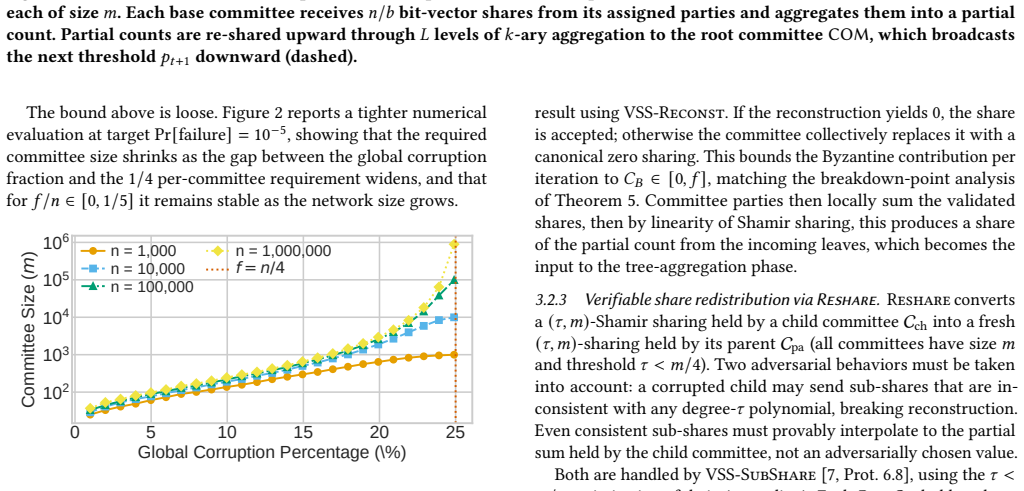
Send.Each 𝑃 ′ 𝑟 ∈ C pa sends 𝑣 to every 𝑃𝑖 ∈ C ch over authenticated channels.2. Majority vote.Each 𝑃𝑖 ∈ Cch collects the received values{𝑣𝑟 }𝑟∈ Cpa and outputs the value with multiplicity>𝑚/2. Substituting𝑓/𝑛=1/4−𝜖, Pr[𝑋≥𝑚/4] ≤exp − 16𝜖2 (3+4𝜖) 2 · 𝑚(3/4+𝜖) 2 =exp − 2𝜖2𝑚 3+4𝜖 . Conference’17, July 2017, Washington, DC, USA Ousmane Touat, César Sabater, M...
2017
discussion (0)
Sign in with ORCID, Apple, or X to comment. Anyone can read and Pith papers without signing in.