ChronoSurv: A Clinical Pathway-Guided Graph Framework for Multimodal Survival Analysis
Pith reviewed 2026-06-26 21:00 UTC · model grok-4.3
The pith
ChronoSurv models patient care as directed graphs aligned to diagnostic steps for multimodal survival prediction.
A machine-rendered reading of the paper's core claim, the machinery that carries it, and where it could break.
Core claim
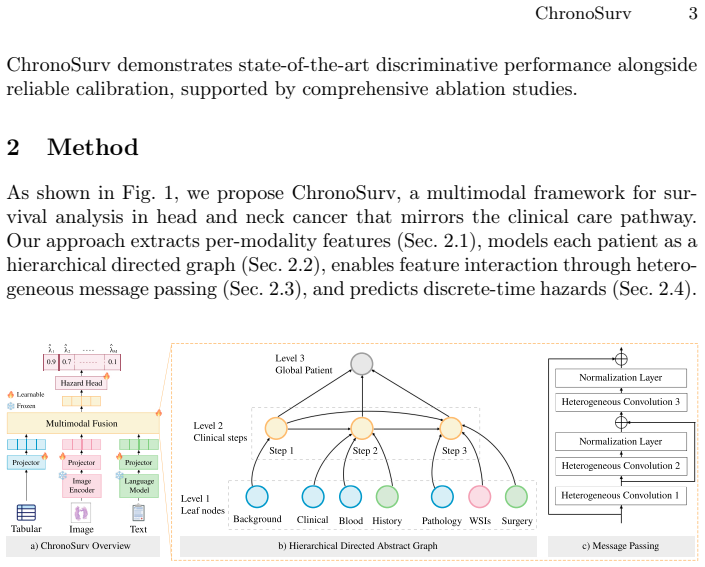
ChronoSurv is a heterogeneous hierarchical directed graph framework for multimodal survival analysis that represents patient care as a progression-aware clinical trajectory using directed graphs aligned with key diagnostic steps. A hierarchical topology supports fine-grained, coarse, and global representations while enabling adaptation to missing modalities, and heterogeneous message passing captures complex asymmetric relationships across modalities and clinical steps. On two public datasets it reaches state-of-the-art discriminative performance together with statistically reliable calibration.
What carries the argument
heterogeneous hierarchical directed graph that encodes a progression-aware clinical trajectory aligned with diagnostic steps, using hierarchical topology and heterogeneous message passing
If this is right
- Trajectory-aware graph modeling yields higher discriminative accuracy than prior fusion approaches.
- Hierarchical representations and heterogeneous message passing enable handling of missing modalities without retraining.
- Alignment with diagnostic steps produces statistically reliable calibration suitable for clinical use.
- Ablation results isolate the contribution of the directed-graph structure and the hierarchy.
- The same architecture supports flexible adaptation across different multimodal cancer datasets.
Where Pith is reading between the lines
- The same directed-graph alignment could be tested on sequential care pathways in other cancers or chronic diseases.
- Real-time updates to the graph from electronic health records might allow dynamic re-prediction as new diagnostic steps occur.
- Combining the calibrated outputs with downstream optimization models could directly suggest treatment sequences.
- Larger multi-center validation would test whether the performance gains hold when clinical workflows vary across institutions.
Load-bearing premise
That modeling patient care as a progression-aware clinical trajectory using directed graphs aligned with key diagnostic steps will better capture structured clinical workflows than static fusion strategies or temporally agnostic modeling.
What would settle it
On a held-out dataset a static-fusion or temporally-agnostic baseline achieves both higher concordance and equal or better calibration than ChronoSurv.
Figures
read the original abstract
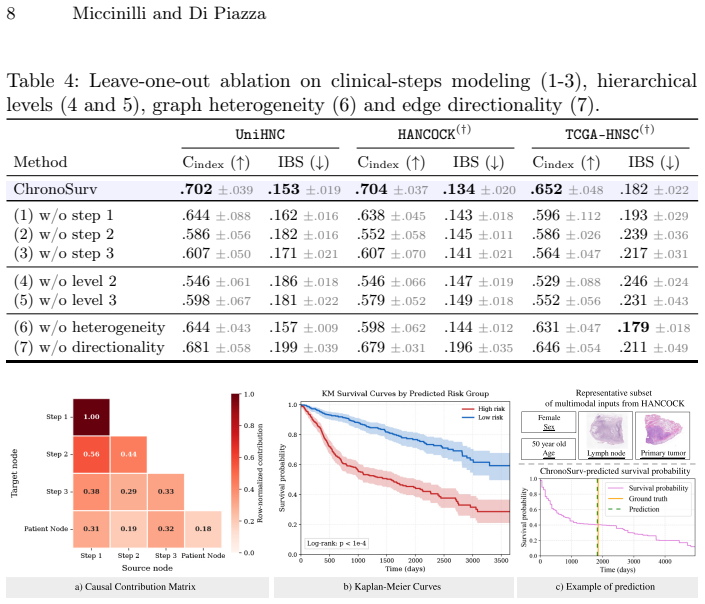
Accurate survival prediction is essential for personalized treatment planning in head and neck cancer, yet remains challenging due to the heterogeneous and high-dimensional nature of multimodal clinical data. While deep survival models have improved predictive performance over classical statistical approaches, existing methods typically rely on static fusion strategies or temporally agnostic modeling, limiting their ability to capture structured clinical workflows. In this work, we propose ChronoSurv, a heterogeneous hierarchical directed graph framework for multimodal survival analysis. ChronoSurv represents patient care as a progression-aware clinical trajectory using directed graphs aligned with key diagnostic steps. A hierarchical topology incorporates fine-grained, coarse, and global representations, further supporting flexible adaptation to missing modalities, while heterogeneous message passing models complex and asymmetric relationships across modalities and clinical steps. Experimental results on two public datasets demonstrate that ChronoSurv achieves state-of-the-art discriminative performance while maintaining statistically reliable calibration. Comprehensive ablation studies further confirm the contribution of each architectural component, highlighting the potential of trajectory-aware graph modeling for multimodal survival prediction.
Editorial analysis
A structured set of objections, weighed in public.
Referee Report
Summary. The paper proposes ChronoSurv, a heterogeneous hierarchical directed graph framework for multimodal survival analysis in head and neck cancer. It models patient care as progression-aware clinical trajectories via directed graphs aligned with diagnostic steps, using a hierarchical topology (fine-grained, coarse, global) for missing-modality adaptation and heterogeneous message passing for asymmetric cross-modal relationships. The central claim is that this yields state-of-the-art discriminative performance and statistically reliable calibration on two public datasets, with ablations confirming each component's contribution.
Significance. If the empirical results hold with proper controls, the trajectory-aware graph modeling could meaningfully advance multimodal survival methods by explicitly incorporating structured clinical workflows, addressing limitations of static fusion or temporally agnostic approaches. The emphasis on hierarchical representations and heterogeneous passing is a coherent extension of graph-based survival models.
major comments (2)
- [Abstract] Abstract: The claim of 'state-of-the-art discriminative performance' and 'statistically reliable calibration' is asserted without any reported metrics (e.g., C-index, IBS, AUC), baseline comparisons, dataset sizes, or statistical significance tests. This absence makes the central empirical claim impossible to evaluate from the provided text.
- [Abstract] Abstract: No details are given on the two public datasets (names, sizes, censoring rates) or the exact experimental protocol (train/test splits, hyperparameter search, multiple runs). These omissions are load-bearing for assessing whether the reported SOTA is robust or reproducible.
Simulated Author's Rebuttal
We thank the referee for the careful reading and constructive comments on the abstract. We agree that the abstract would benefit from greater specificity to allow readers to evaluate the central claims directly. We will revise the abstract in the resubmission to incorporate key quantitative results, dataset identifiers, and protocol details while respecting length constraints.
read point-by-point responses
-
Referee: [Abstract] Abstract: The claim of 'state-of-the-art discriminative performance' and 'statistically reliable calibration' is asserted without any reported metrics (e.g., C-index, IBS, AUC), baseline comparisons, dataset sizes, or statistical significance tests. This absence makes the central empirical claim impossible to evaluate from the provided text.
Authors: We acknowledge the validity of this point. The current abstract summarizes outcomes at a high level. The full manuscript reports C-index, IBS, and AUC values with baseline comparisons and significance tests in the experimental results. In revision we will add concise numerical highlights (e.g., C-index deltas and p-values) to the abstract to make the SOTA and calibration claims directly evaluable. revision: yes
-
Referee: [Abstract] Abstract: No details are given on the two public datasets (names, sizes, censoring rates) or the exact experimental protocol (train/test splits, hyperparameter search, multiple runs). These omissions are load-bearing for assessing whether the reported SOTA is robust or reproducible.
Authors: We agree that dataset and protocol specifics strengthen reproducibility. The full paper identifies the datasets, reports sizes and censoring rates, and details the 5-fold cross-validation protocol with hyperparameter search in Sections 3 and 4. We will incorporate the dataset names, approximate sizes, and a brief protocol statement into the revised abstract. revision: yes
Circularity Check
No significant circularity detected
full rationale
The provided manuscript text consists solely of the abstract, which describes an empirical graph-based modeling approach for survival analysis without any equations, derivations, fitted parameters presented as predictions, or self-citation chains. The central claim of SOTA performance rests on experimental results on public datasets rather than any first-principles reduction or self-definitional construction. No load-bearing steps reduce to inputs by construction, satisfying the default expectation that most papers are not circular.
Axiom & Free-Parameter Ledger
Reference graph
Works this paper leans on
-
[1]
Alsentzer, E., Murphy, J.R., Boag, W., Weng, W.H., Jin, D., Naumann, T., Mc- Dermott, M.B.A.: Publicly Available Clinical BERT Embeddings (Jun 2019)
2019
-
[2]
Andrearczyk, V., Oreiller, V., Abobakr, M., Hatt, M., Depeursinge, A., et al.: Overview of the HECKTOR Challenge at MICCAI 2022: Automatic Head and Neck Tumor Segmentation and Outcome Prediction in PET/CT (2023)
2022
-
[3]
In: MICCAI (2024)
Bae, J., et al.: HoG-Net: Hierarchical Multi-Organ Graph Network for Head and Neck Cancer Recurrence Prediction from CT Images . In: MICCAI (2024)
2024
-
[4]
CA: a cancer journal for clinicians74, 229–263 (2024)
Bray, F., Laversanne, M., Sung, H., Ferlay, J., Siegel, R.L., Soerjomataram, I., Jemal, A.: GLOBOCAN estimates of incidence and mortality worldwide for 36 cancers in 185 countries. CA: a cancer journal for clinicians74, 229–263 (2024)
2024
-
[5]
Brody, S., et al.: How Attentive are Graph Attention Networks? (2022)
2022
-
[6]
Biometrics31(4), 863–872 (Dec 1975)
Brown, C.C.: On the use of indicator variables for studying the time-dependence of parameters in a response-time model. Biometrics31(4), 863–872 (Dec 1975)
1975
-
[7]
The Lancet
Budach, V., Tinhofer, I.: Novel prognostic clinical factors and biomarkers for out- come prediction in head and neck cancer. The Lancet. Oncology (2019)
2019
-
[8]
Nature Medicine (2024)
Chen, R.J., Ding, T., Lu, M.Y., Williamson, D.F.K., Jaume, G., Song, A.H., Chen, B.,Zhang,A.,Shao,D.,Shaban,M.,Williams,M.,Oldenburg,L.,Weishaupt,L.L., Wang, J.J., Vaidya, A., Williams, W., Mahmood, F., et al.: Towards a general- purpose foundation model for computational pathology. Nature Medicine (2024)
2024
-
[9]
In: MICCAI (2021)
Chen, R.J., Lu, M.Y., Shaban, M., Chen, C., Chen, T.Y., Williamson, D.F.K., Mahmood, F.: Whole slide images are 2d point clouds: Context-aware survival prediction using patch-based graph convolutional networks. In: MICCAI (2021)
2021
-
[10]
In: ICCV (2021)
Chen, R.J., Lu, M.Y., Weng, W.H., Chen, T.Y., Williamson, D.F., Manz, T., Shady, M., Mahmood, F.: Multimodal co-attention transformer for survival pre- diction in gigapixel whole slide images. In: ICCV (2021)
2021
-
[11]
Cancer Cell (2022)
Chen, R.J., Lu, M.Y., Williamson, D.F., Chen, T.Y., Lipkova, J., Shaban, M., Shady, M., Williams, M., Joo, B., Noor, Z., et al.: Pan-cancer integrative histology- genomic analysis via multimodal deep learning. Cancer Cell (2022)
2022
-
[12]
XGBoost: A Scalable Tree Boosting System
Chen, T., Guestrin, C.: XGBoost: A Scalable Tree Boosting System. In: Proceed- ings of the 22nd ACM SIGKDD International Conference on Knowledge Discovery and Data Mining. pp. 785–794 (Aug 2016), arXiv:1603.02754 [cs]
work page internal anchor Pith review Pith/arXiv arXiv 2016
-
[13]
Journal of the Royal Statistical Society
Cox, D.R.: Regression Models and Life-Tables. Journal of the Royal Statistical Society. Series B (Methodological)34(2), 187–220 (1972) 10 Miccinilli and Di Piazza
1972
- [14]
-
[15]
Dörrich, M., Balk, M., Heusinger, T., Beyer, S., Kanso, H., Matek, C., Hartmann, A., Iro, H., Eckstein, M., Gostian, A.O., Kist, A.M.: A multimodal dataset for precisiononcologyinheadandneckcancer(May2024),pages:2024.05.29.24308141
2024
-
[16]
In: Advances in Neural Information Processing Systems
Goldstein, M., Han, X., Puli, A., Perotte, A., Ranganath, R.: X-CAL: Explicit Calibration for Survival Analysis. In: Advances in Neural Information Processing Systems. vol. 33, pp. 18296–18307. Curran Associates, Inc. (2020)
2020
-
[17]
Statistics in Medicine (1999)
Graf, E., Schmoor, C., Sauerbrei, W., Schumacher, M.: Assessment and comparison of prognostic classification schemes for survival data. Statistics in Medicine (1999)
1999
- [18]
-
[19]
npj Digital Medicine9(1), 76 (Dec 2025)
Hou, J., Zhang, R., Xie, Y., Li, C., Qin, W.: Multimodal deep learning for can- cer prognosis prediction with clinical information prompts integration. npj Digital Medicine9(1), 76 (Dec 2025)
2025
-
[20]
In: Proceedings of AAAI Spring Symposium on Survival Prediction - Algorithms, Challenges, and Applications 2021
Hu, S., Fridgeirsson, E., Wingen, G.v., Welling, M.: Transformer-Based Deep Sur- vival Analysis. In: Proceedings of AAAI Spring Symposium on Survival Prediction - Algorithms, Challenges, and Applications 2021. pp. 132–148. PMLR (May 2021)
2021
-
[21]
Ishwaran, H., Kogalur, U.B., Blackstone, E.H., Lauer, M.S.: Random survival forests. The Annals of Applied Statistics2(3) (Sep 2008), arXiv:0811.1645 [stat]
work page internal anchor Pith review Pith/arXiv arXiv 2008
- [22]
-
[23]
BMC Medical Research Methodology18(2018)
Katzman,J.,Shaham,U.,Bates,J.,Cloninger,A.,Jiang,T.,Kluger,Y.:DeepSurv: Personalized Treatment Recommender System Using A Cox Proportional Hazards Deep Neural Network. BMC Medical Research Methodology18(2018)
2018
-
[24]
Bioengineering10(9), 1046 (Sep 2023)
Kim, S.Y.: GNN-surv: Discrete-Time Survival Prediction Using Graph Neural Net- works. Bioengineering10(9), 1046 (Sep 2023)
2023
-
[25]
Nature517(7536), 576–582 (Jan 2015)
Lawrence, M.S., Sougnez, C., Lichtenstein, L., Cibulskis, K., Lander, E., Burnett, K., et al.: Comprehensive genomic characterization of head and neck squamous cell carcinomas. Nature517(7536), 576–582 (Jan 2015)
2015
-
[26]
Proceedings of the AAAI Conference on Artificial Intelligence32(1) (Apr 2018)
Lee, C., Zame, W., Yoon, J., Van Der Schaar, M.: DeepHit: A Deep Learning Approach to Survival Analysis With Competing Risks. Proceedings of the AAAI Conference on Artificial Intelligence32(1) (Apr 2018)
2018
-
[27]
Bioinformatics (2022)
Li, R., Wu, X., Li, A., Wang, M.: HFBSurv: hierarchical multimodal fusion with factorized bilinear models for cancer survival prediction. Bioinformatics (2022)
2022
-
[28]
Lu, W., Toss, M., Rakha, E., Rajpoot, N., Minhas, F.: Slidegraph+: Whole slide image level graphs to predict her2status in breast cancer (2021)
2021
-
[29]
In: MICCAI (2023)
Meng, M., Bi, L., Kim, J., et al.: Merging-Diverging Hybrid Transformer Networks for Survival Prediction in Head and Neck Cancer. In: MICCAI (2023)
2023
-
[30]
In: IJCAI (2025)
Qu,M.,Yang,G.,Di,D.,Su,T.,Fan,L.,etal.:Multimodalcancersurvivalanalysis via hypergraph learning with cross-modality rebalance. In: IJCAI (2025)
2025
-
[31]
Saeed, N., Ridzuan, M., Maani, F.A., Yaqub, M., et al.: SurvRNC: Learning Or- dered Representations for Survival Prediction using Rank-N-Contrast (2024)
2024
-
[32]
Shan, X., Ge, R., Liu, J., Wu, L., Zhang, C., Liu, S., Qin, W., Min, W., Elazab, A., Wang, C.: GraphMMP: A Graph Neural Network Model with Mutual Information and Global Fusion for Multimodal Medical Prognosis (Aug 2025)
2025
-
[33]
Statistics in Medicine30(10), 1105–1117 (May 2011) ChronoSurv 11
Uno, H., Cai, T., Pencina, M.J., D’Agostino, R.B., Wei, L.J.: On the C-statistics for evaluating overall adequacy of risk prediction procedures with censored survival data. Statistics in Medicine30(10), 1105–1117 (May 2011) ChronoSurv 11
2011
-
[34]
Scientific Reports11(1), 13505 (Jun 2021)
Vale-Silva, L.A., Rohr, K.: Long-term cancer survival prediction using multimodal deep learning. Scientific Reports11(1), 13505 (Jun 2021)
2021
-
[35]
Wang, C.W., Khalil, M.A., Puspita Firdi, N.: A Survey on Deep Learning for Precision Oncology (Jun 2022)
2022
-
[36]
Journal of Applied Mechanics pp
Weibull, W.: A Statistical Distribution Function of Wide Applicability. Journal of Applied Mechanics pp. 293–297 (1951)
1951
-
[37]
Xiong, C., Chen, H., Zheng, H., Wei, D., Zheng, Y., Sung, J.J., King, I.: Mome: Mixture of multimodal experts for cancer survival prediction (2024)
2024
-
[38]
In: ML4H (2025)
Zhang, H., Liu, Y., Sun, Y., Shen, L., Wei, L.: Improving Survival Prediction of Head-and-Neck Cancer with Medical Image, Foundation Models and Multi-modal Fusion. In: ML4H (2025)
2025
-
[39]
In: ICCV (2019)
Zhou, Y., Graham, S., Koohbanani, N.A., Shaban, M., Heng, P.A., Rajpoot, N.: Cgc-net: Cell graph convolutional network for grading of colorectal cancer histology images. In: ICCV (2019)
2019
discussion (0)
Sign in with ORCID, Apple, or X to comment. Anyone can read and Pith papers without signing in.