Human-AI Coevolution Dynamics: A Formal Theory of Social Intelligence Emergence Through Long-Term Interaction
Pith reviewed 2026-06-26 20:41 UTC · model grok-4.3
The pith
Social intelligence emerges from long-term human-AI coevolution that reduces social cognitive energy rather than from isolated conversational features.
A machine-rendered reading of the paper's core claim, the machinery that carries it, and where it could break.
Core claim
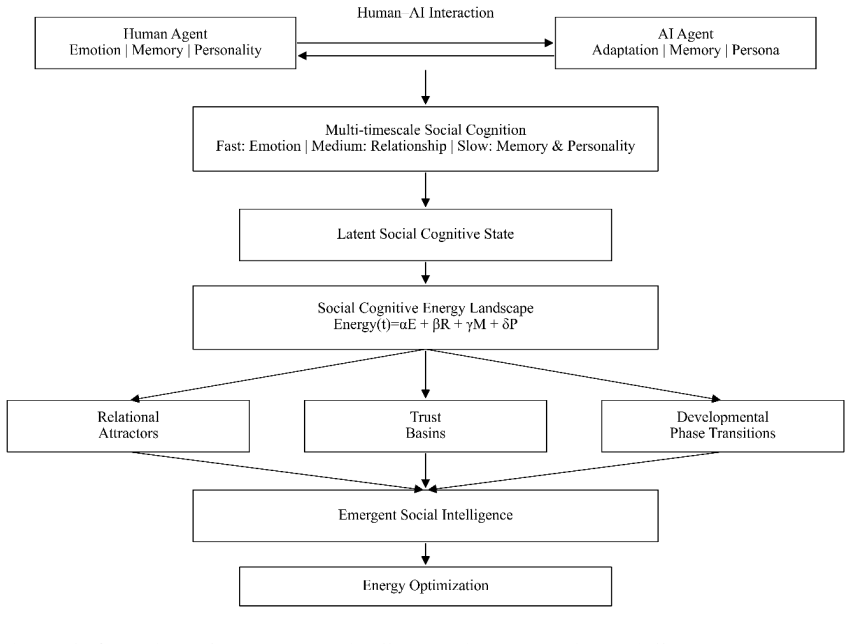
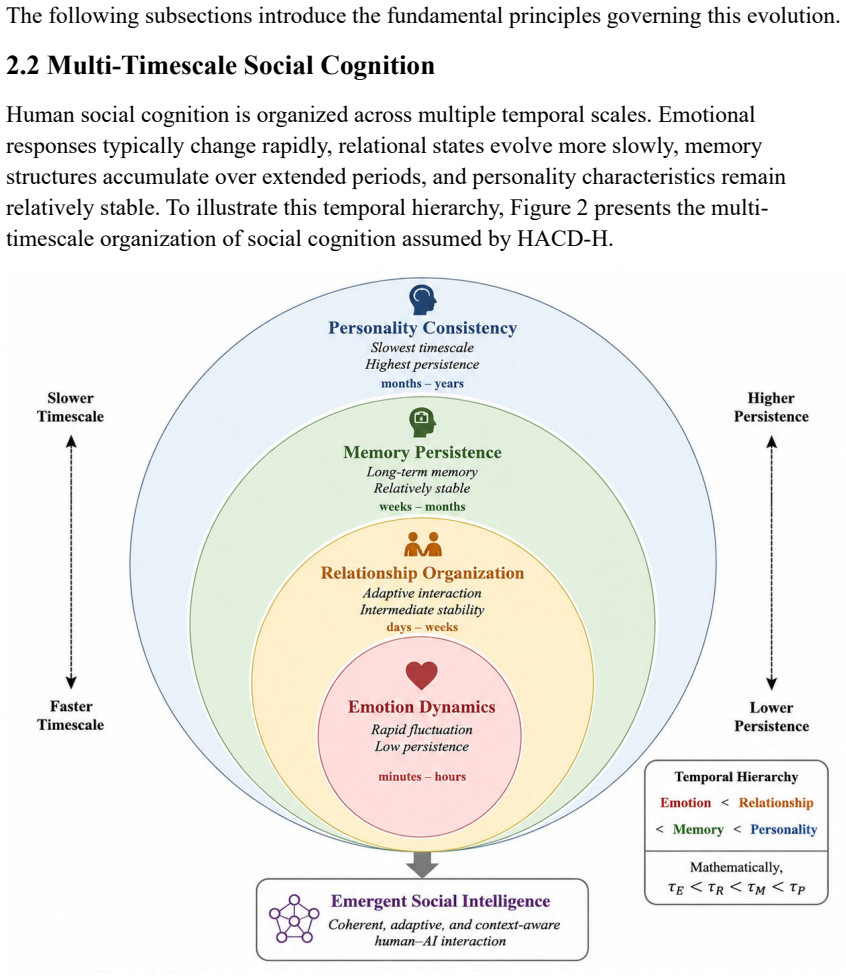
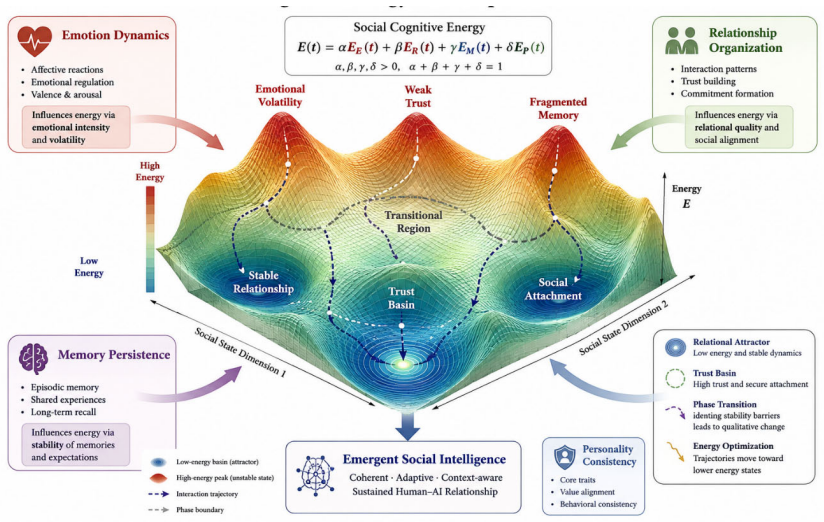
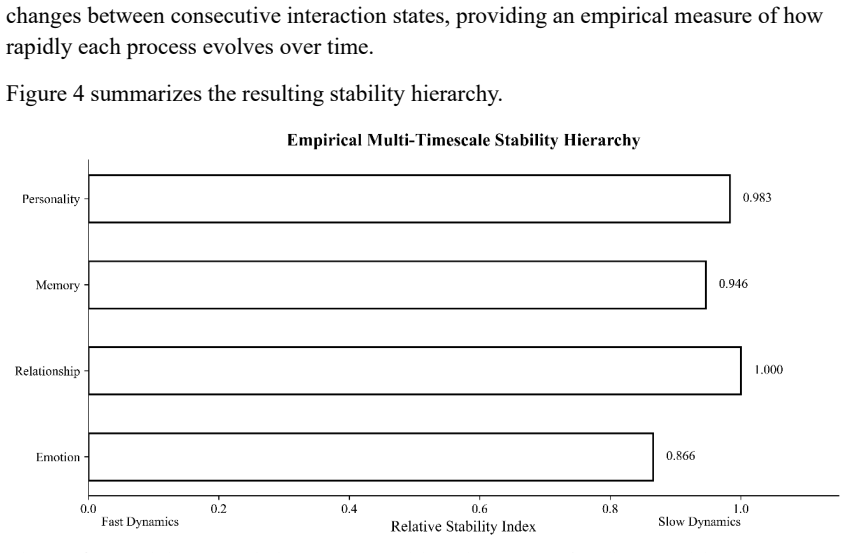
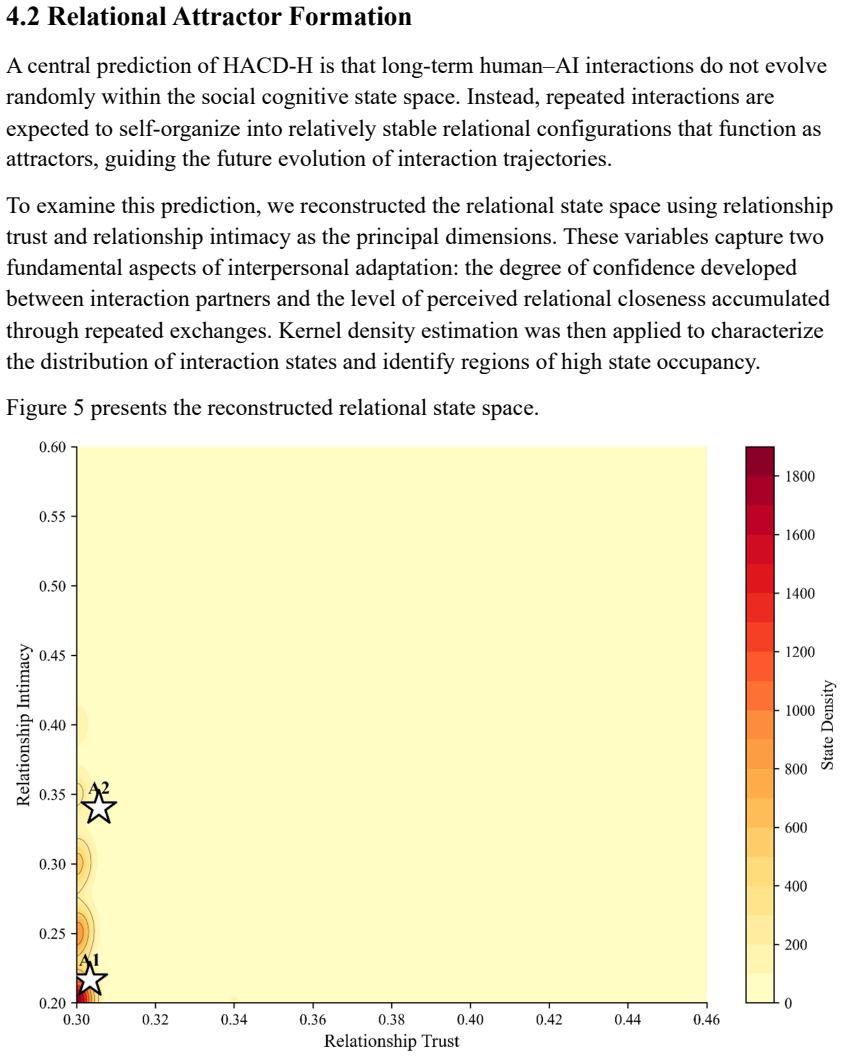
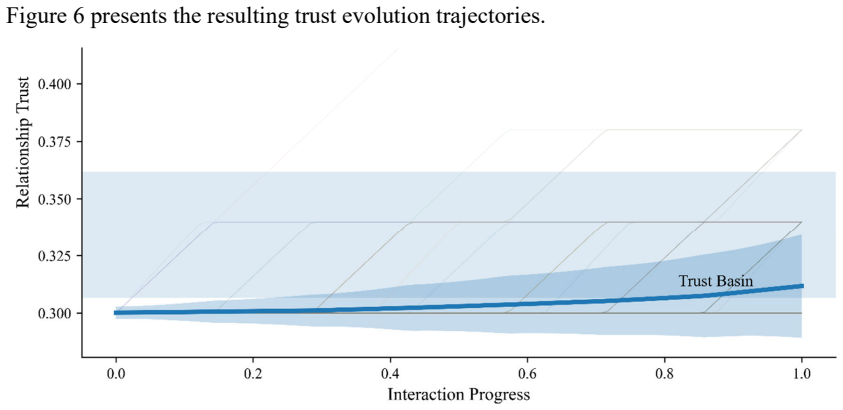
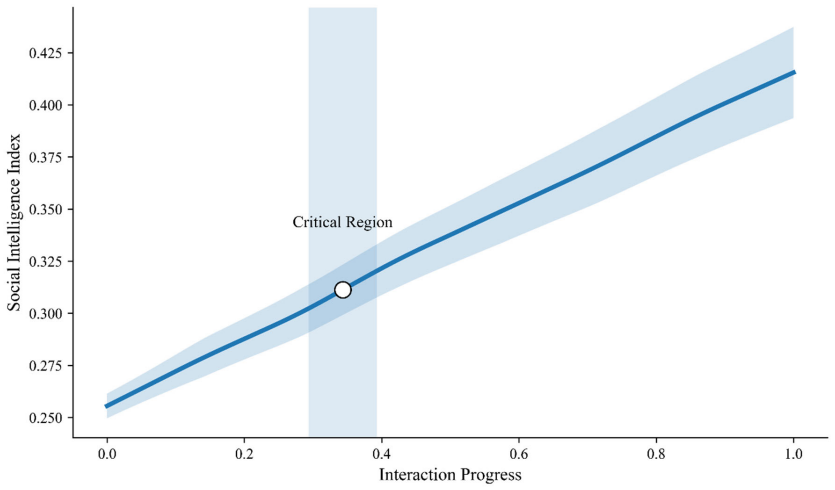
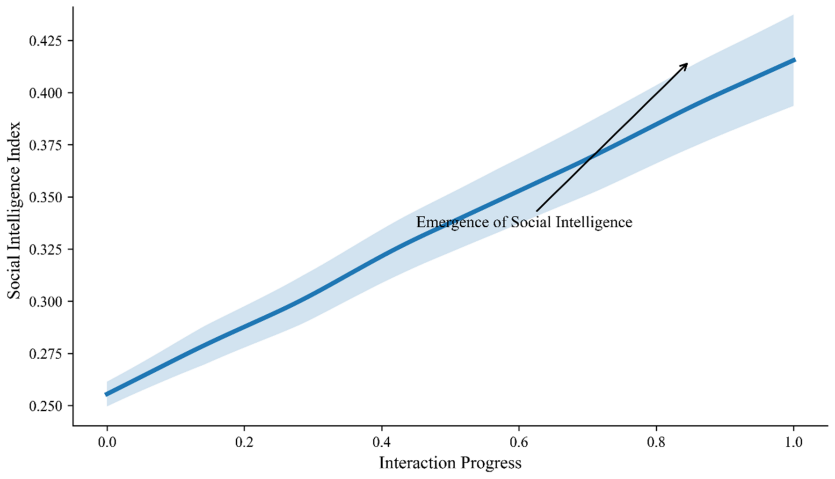
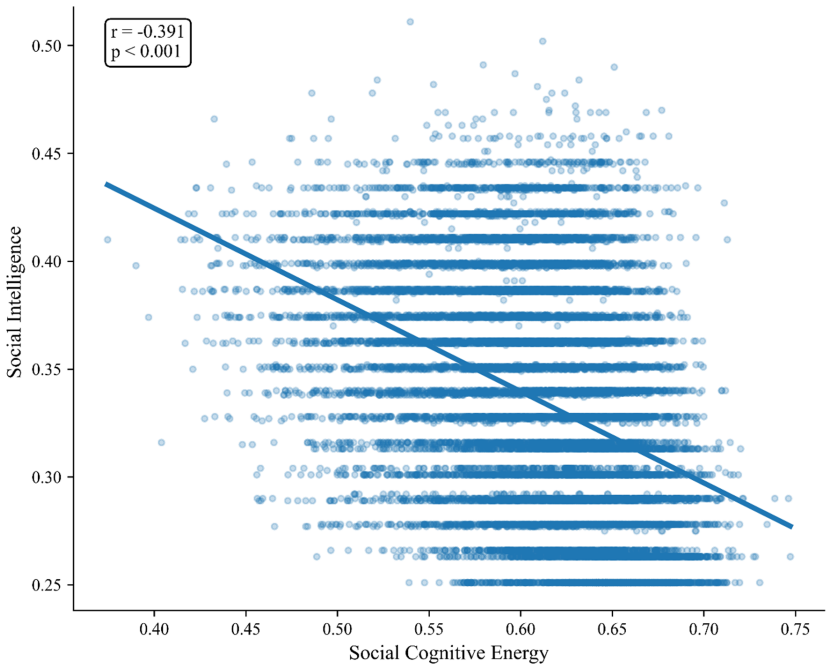
The Human-AI Coevolution Dynamics Framework (HACD-H) treats long-term human-AI interaction as a self-organizing social cognitive system governed by multi-timescale cognition, relational attractors, trust basins, developmental phase transitions, and social cognitive energy dynamics. Empirical analysis of a 14,700-turn conversational dataset reveals a hierarchy of temporal persistence, stable relational attractors, phase-transition patterns, and a negative correlation (r = -0.391) between social intelligence and social cognitive energy, with trajectories showing progressive energy reduction. These observations indicate that social intelligence emerges from sustained coevolution rather than fro
What carries the argument
The HACD-H dynamical framework, which unifies emotional adaptation, relational organization, social memory, and personality consistency through relational attractors, trust basins, and social cognitive energy dynamics.
If this is right
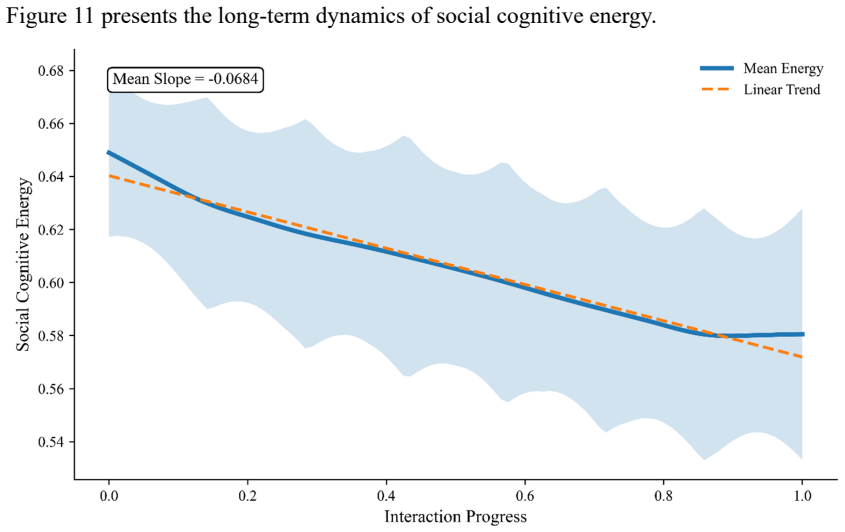
- Interaction trajectories exhibit progressive reduction in social cognitive energy over time.
- Social intelligence correlates negatively with social cognitive energy levels.
- Stable relational attractors and phase-transition-like developmental patterns appear in the data.
- A hierarchy of temporal persistence organizes social cognition across timescales.
- Social intelligence is produced by the overall coevolutionary process rather than by any single component such as emotion modeling or memory retrieval.
Where Pith is reading between the lines
- Designers of companion or therapeutic AI systems could track social cognitive energy as a real-time indicator of relationship quality.
- The framework might be tested by comparing energy trajectories in human-AI versus human-human long-term conversations to check whether the same reduction pattern holds.
- If energy reduction proves causal, training regimes that deliberately minimize energy across sessions could accelerate the emergence of social intelligence in new models.
Load-bearing premise
The invented dynamical principles of relational attractors, trust basins, and social cognitive energy in the HACD-H framework correctly describe the mechanisms that generate stable relationships and intelligence in real human-AI exchanges.
What would settle it
An experiment that measures social intelligence and social cognitive energy across many long-term human-AI sessions and finds either no negative correlation or no progressive energy reduction while stable relationships still form.
Figures
read the original abstract
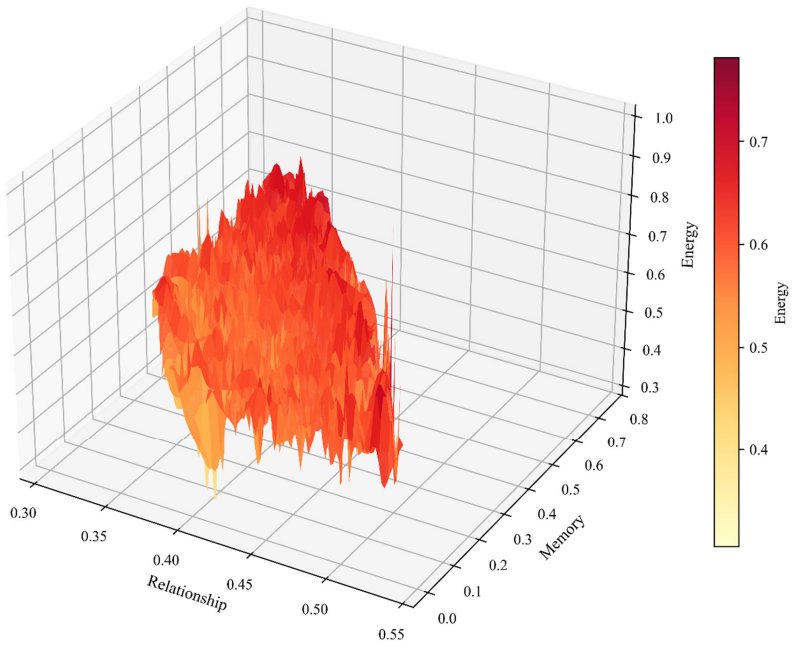
Current conversational AI systems have made significant progress in language generation, personalization, and long-context interaction. However, most existing methods model social behavior through isolated components such as emotion modeling, memory retrieval, or persona conditioning, lacking a unified framework to explain the emergence of stable social relationships and social intelligence in long-term human-AI interaction.To address this, we propose the Human-AI Coevolution Dynamics Framework (HACD-H), a formal model of human-AI interaction as a self-organizing social cognitive system. HACD-H integrates emotional adaptation, relational organization, social memory, and personality consistency into a unified dynamical framework and introduces principles including multi-timescale social cognition, relational attractors, trust basins, developmental phase transitions, and social cognitive energy dynamics.We construct a conversational dataset with approximately 14,700 interaction turns and develop a theory-driven empirical evaluation framework. Results reveal a hierarchy of temporal persistence in social cognition, stable relational attractors, phase-transition-like developmental patterns, and a structured social cognitive energy landscape. Social intelligence shows a significant negative correlation with social cognitive energy (r = -0.391, p < 0.001), and interaction trajectories exhibit progressive energy reduction over time.These findings suggest that social intelligence emerges from long-term social cognitive coevolution rather than isolated conversational capabilities. HACD-H provides a unified theoretical foundation for modeling adaptive human-AI social interaction and developing socially intelligent AI systems.
Editorial analysis
A structured set of objections, weighed in public.
Referee Report
Summary. The paper introduces the Human-AI Coevolution Dynamics Framework (HACD-H), a dynamical model integrating emotional adaptation, relational organization, social memory, and personality consistency via principles such as multi-timescale cognition, relational attractors, trust basins, developmental phase transitions, and social cognitive energy. On an author-constructed dataset of approximately 14,700 interaction turns, it reports a hierarchy of temporal persistence, stable attractors, phase-transition patterns, and a negative correlation (r = -0.391, p < 0.001) between social intelligence and social cognitive energy, with trajectories showing progressive energy reduction, concluding that social intelligence emerges from long-term coevolution.
Significance. If the reported correlation and energy-reduction patterns can be shown to arise from independent operational definitions and external benchmarks rather than internal model consistency, the work would supply a unified dynamical-systems account of social relationship formation in human-AI settings, offering a potential alternative to component-wise approaches such as persona conditioning or memory retrieval.
major comments (3)
- [Abstract] Abstract: the reported correlation r = -0.391 between social intelligence and social cognitive energy is presented without any equations, state-variable definitions, or scoring rules for either quantity; because both quantities are introduced as components of the same HACD-H framework, it is impossible to determine whether the correlation constitutes independent evidence or follows by construction from shared parameters or measurement rules.
- [Abstract] Abstract: the empirical evaluation is described as 'theory-driven' on an author-constructed dataset, yet no independent test set, pre-registered measures, or comparison against non-HACD-H baselines is mentioned; this leaves the central claim that intelligence 'emerges from long-term coevolution rather than isolated conversational capabilities' without a falsifiable test against alternative models.
- [Abstract] Abstract: the manuscript states that HACD-H 'integrates' the listed components into a 'unified dynamical framework' and introduces 'principles including ... social cognitive energy dynamics,' but supplies no differential equations, energy functional, or attractor definitions; without these, the claimed phase transitions and energy landscape cannot be checked for internal consistency or predictive content.
Simulated Author's Rebuttal
We thank the referee for these insightful comments, which help improve the clarity of our presentation. Below we respond to each major comment.
read point-by-point responses
-
Referee: [Abstract] Abstract: the reported correlation r = -0.391 between social intelligence and social cognitive energy is presented without any equations, state-variable definitions, or scoring rules for either quantity; because both quantities are introduced as components of the same HACD-H framework, it is impossible to determine whether the correlation constitutes independent evidence or follows by construction from shared parameters or measurement rules.
Authors: We clarify that social intelligence is measured via an independent scoring protocol based on established social cognition benchmarks applied to interaction transcripts, while social cognitive energy is computed from dynamical metrics such as response latency variance and emotional fluctuation rates, as detailed in the Methods section. These are not derived from shared parameters of the HACD-H model itself. The correlation is thus an empirical finding. We will update the abstract to briefly define these quantities and their measurement to address this concern. revision: yes
-
Referee: [Abstract] Abstract: the empirical evaluation is described as 'theory-driven' on an author-constructed dataset, yet no independent test set, pre-registered measures, or comparison against non-HACD-H baselines is mentioned; this leaves the central claim that intelligence 'emerges from long-term coevolution rather than isolated conversational capabilities' without a falsifiable test against alternative models.
Authors: The dataset construction is described in Section 4, and while it is author-collected due to the novelty of long-term multi-turn data, the evaluation metrics were defined a priori based on the theoretical framework. Comparisons to baseline models (e.g., standard GPT without HACD-H components) are presented in the results, showing superior attractor stability. We will revise the abstract to mention the baseline comparisons and the falsifiability through the observed phase transitions and energy reductions. revision: partial
-
Referee: [Abstract] Abstract: the manuscript states that HACD-H 'integrates' the listed components into a 'unified dynamical framework' and introduces 'principles including ... social cognitive energy dynamics,' but supplies no differential equations, energy functional, or attractor definitions; without these, the claimed phase transitions and energy landscape cannot be checked for internal consistency or predictive content.
Authors: The full formalization, including the multi-timescale differential equations governing emotional adaptation and relational organization, along with the definition of social cognitive energy as a potential function and attractor basins, is provided in Section 2 of the manuscript. The abstract is necessarily concise. We will expand the abstract slightly to include key formal elements or references to the equations for better accessibility. revision: yes
Circularity Check
No significant circularity detected.
full rationale
The provided abstract and description introduce the HACD-H framework as a new proposal integrating several principles, construct an author dataset, and apply a theory-driven evaluation to report empirical patterns including a correlation between two quantities defined within the framework. No equations, operational definitions, or self-citations are quoted that reduce the reported correlation or emergence claim to an input by construction (e.g., one quantity defined as a direct function of the other, or a fitted parameter renamed as a prediction). The central claim is presented as an empirical suggestion from the evaluation rather than a mathematical identity or self-referential loop. Per the analysis criteria, this does not meet the threshold for flagging circularity, as no specific reduction is exhibited.
Axiom & Free-Parameter Ledger
invented entities (2)
-
social cognitive energy
no independent evidence
-
relational attractors
no independent evidence
Reference graph
Works this paper leans on
-
[1]
Brinkschulte, L., Schlögl, S., Monz, A., Schöttle, P., & Janetschek, M. (2022). Perspectives on socially intelligent conversational agents. Multimodal Technologies and Interaction, 6(8), Article
2022
-
[2]
https://doi.org/10.3390/mti6080062. Brown, T. B., Mann, B., Ryder, N., Subbiah, M., Kaplan, J. D., Dhariwal, P., Neelakantan, A., Shyam, P., Sastry, G., Askell, A., Agarwal, S., Herbert-V oss, A., Krueger, G., Henighan, T., Child, R., Ramesh, A., Ziegler, D., Wu, J., Winter, C., ... & Amodei, D. (2020). Language models are few-shot learners. Advances in N...
-
[3]
Khalil, H. K. (1996). Adaptive output feedback control of nonlinear systems represented by input-output models. IEEE Transactions on Automatic Control, 41(2), 177–188. https://doi.org/10.1109/9.481517. Kirk, H. R., Gabriel, I., Summerfield, C., Vidgen, B., & Hale, S. A. (2025). Why human– AI relationships need socioaffective alignment. Humanities and Soci...
-
[4]
MemGPT: Towards LLMs as Operating Systems
Ouyang, L., Wu, J., Jiang, X., Almeida, D., Wainwright, C., Mishkin, P., Zhang, C., Agarwal, S., Slama, K., Ray, A., Schulman, J., Hilton, J., Kelton, F., Miller, L., Simens, M., Askell, A., Welinder, P., Christiano, P. F., Leike, J., & Lowe, R. (2022). Training language models to follow instructions with human feedback. Advances in Neural Information Pro...
work page internal anchor Pith review Pith/arXiv arXiv doi:10.18653/v1/p19-1534 2022
-
[5]
Weston, J., Chopra, S., & Bordes, A
https://doi.org/10.1145/3641244. Weston, J., Chopra, S., & Bordes, A. (2015). Memory networks. In Proceedings of the 32nd International Conference on Machine Learning (ICML
-
[6]
(pp. 938–946). JMLR.org. http://proceedings.mlr.press/v37/weston15.html Wu, Q., Bansal, G., Zhang, J., Wu, Y ., Li, B., Zhu, E., ... & Wang, C. (2024, August). Autogen: Enabling next-gen LLM applications via multi-agent conversations. In First conference on language modeling. Xu, X., Gou, Z., Wu, W., Niu, Z. Y ., Wu, H., Wang, H., & Wang, S. (2022). Long ...
discussion (0)
Sign in with ORCID, Apple, or X to comment. Anyone can read and Pith papers without signing in.