Bubble wall velocity and nucleation rates in inverse holographic phase transitions
Pith reviewed 2026-06-26 19:53 UTC · model grok-4.3
The pith
Euclidean bounce solutions yield nucleation rates and wall velocity estimates for inverse holographic QCD transitions.
A machine-rendered reading of the paper's core claim, the machinery that carries it, and where it could break.
Core claim
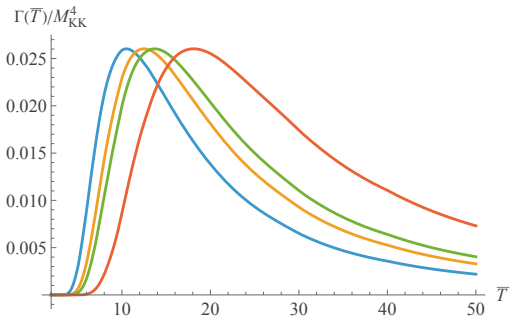
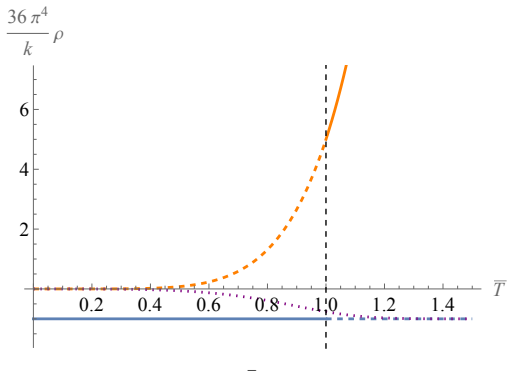
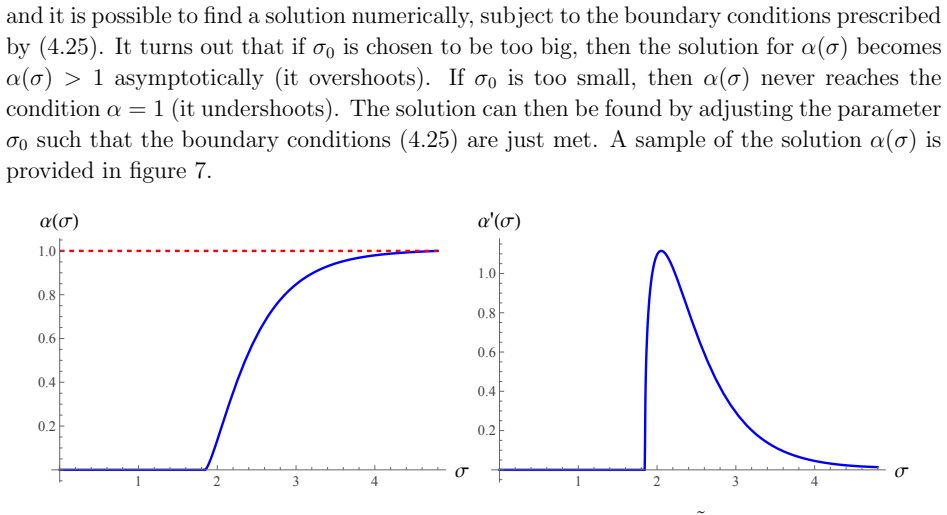
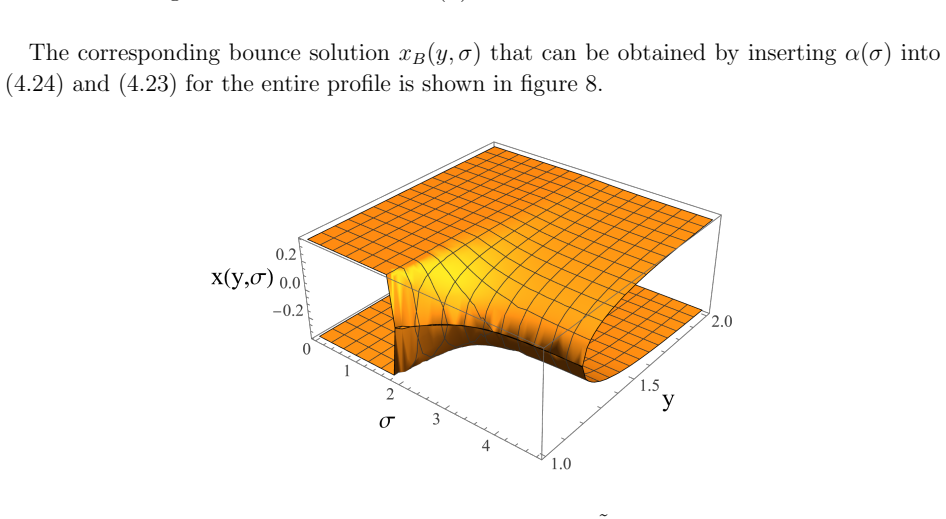
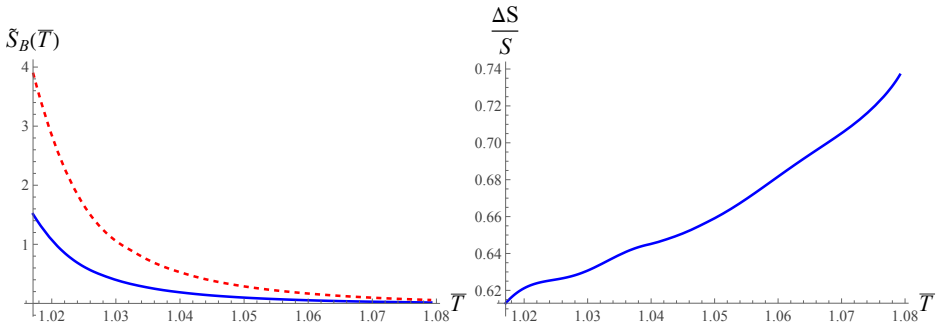
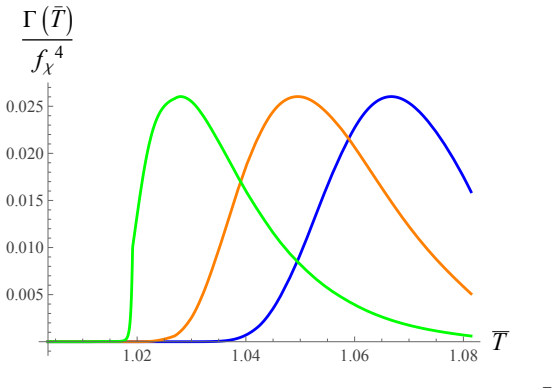
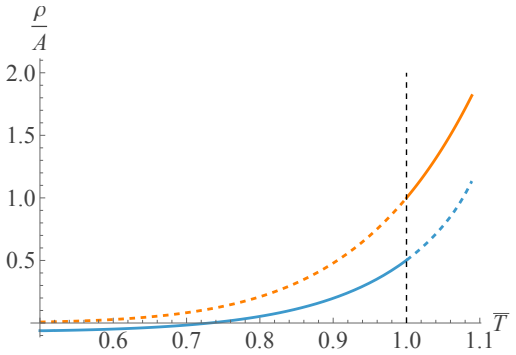
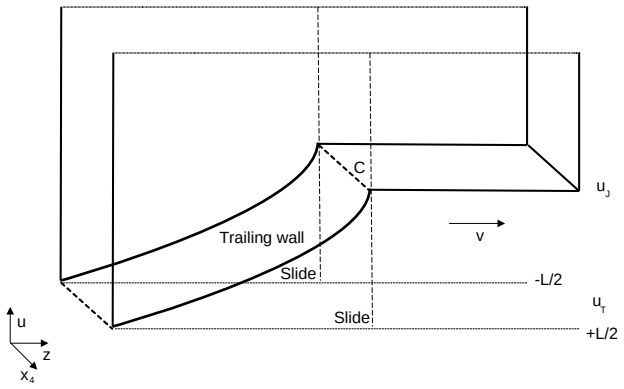
For both the deconfinement transition in the unflavored version of the model and a chiral symmetry-restoring transition occurring in the deconfined phase of the full theory, the corresponding Euclidean bounce solutions are found and the bubble nucleation rates and the relevant transition parameters are computed. For the deconfinement transition, the large jump in the number of degrees of freedom between the two phases suggests that the bubble wall velocity is parametrically small; a rough estimate of it near the critical temperature is provided. In the case of the chiral transition, the bubble wall velocity and the friction force exerted on the bubbles are computed employing motivated ansatz
What carries the argument
Euclidean bounce solutions in the five-dimensional holographic geometry, which encode the tunneling rate from the metastable superheated phase to the stable phase.
If this is right
- Nucleation rates follow directly from the Euclidean bounce action for both transitions.
- The deconfinement bubble wall velocity is parametrically small near the critical temperature.
- The friction force on the bubble is obtained for the chiral transition.
- Transition parameters such as the strength parameter can be extracted from the computed quantities.
Where Pith is reading between the lines
- Small wall velocities may imply extended metastable lifetimes in cosmological applications of these models.
- The chiral-transition ansatze could be checked by direct numerical evolution of the bubble profile.
- The same bounce and velocity methods could be applied to other top-down holographic models of strong-coupling transitions.
Load-bearing premise
Motivated ansatze and approximations for the steady-state configurations are adequate to compute the bubble wall velocity and friction force for the chiral transition.
What would settle it
A full numerical solution of the steady-state bubble equations without the ansatze that produces a wall velocity differing by more than order one from the reported value.
Figures
read the original abstract
We study the dynamics of first-order inverse phase transitions (driven by superheating) at strong coupling, focusing on the top-down Witten-Sakai-Sugimoto model for holographic QCD. Two cases are considered: the deconfinement transition in the unflavored version of the model and a chiral symmetry-restoring transition occurring in the deconfined phase of the full theory. In both cases, we imagine driving the system into a metastable phase at high temperature, inducing the nucleation of bubbles of the stable phase. For both classes of transitions, we find the corresponding Euclidean bounce solutions and compute the bubble nucleation rates and the relevant transition parameters. For the deconfinement transition, the large jump in the number of degrees of freedom between the two phases suggests that the bubble wall velocity is parametrically small; we provide a rough estimate of it near the critical temperature. In the case of the chiral transition, instead, we compute the bubble wall velocity and the friction force exerted on the bubbles employing motivated ansatze and approximations for the steady-state configurations.
Editorial analysis
A structured set of objections, weighed in public.
Referee Report
Summary. The paper examines inverse (superheating-driven) first-order phase transitions in the Witten-Sakai-Sugimoto holographic QCD model. It constructs Euclidean bounce solutions and computes nucleation rates and transition parameters for both the deconfinement transition (unflavored model) and the chiral symmetry-restoring transition (flavored model in the deconfined phase). For deconfinement it argues the wall velocity is parametrically small due to the large jump in degrees of freedom and supplies a rough estimate near T_c; for the chiral case it reports wall velocity and friction using motivated ansatze and approximations for steady-state bubble profiles.
Significance. If the numerical solutions and ansatze are reliable, the work supplies concrete, top-down holographic results for nucleation rates and wall dynamics in strongly coupled inverse transitions, which are relevant for cosmological and heavy-ion applications. The explicit construction of bounces in an established model is a positive feature; however, the absence of error control on the chiral results limits the immediate utility of the velocity and friction numbers.
major comments (2)
- [Abstract] Abstract and the chiral-transition section: the computation of bubble wall velocity and friction force rests on 'motivated ansatze and approximations for the steady-state configurations' with no reported error estimates, convergence tests, comparison to exact solutions, or sensitivity analysis. Because these quantities are the central output for the chiral case, the lack of validation makes the reported numbers load-bearing and unquantified.
- [Abstract] Abstract and nucleation-rate section: the statement that 'Euclidean bounce solutions were found and rates computed' supplies no error estimates, convergence checks, or validation against known limits (e.g., thin-wall or high-T regimes), weakening in the numerical values for both transitions.
minor comments (1)
- Notation for the steady-state profiles and friction force should be defined explicitly with reference to the underlying holographic equations.
Simulated Author's Rebuttal
We thank the referee for their careful reading of the manuscript and for the constructive comments. We address each major point below, indicating where revisions will be made.
read point-by-point responses
-
Referee: [Abstract] Abstract and the chiral-transition section: the computation of bubble wall velocity and friction force rests on 'motivated ansatze and approximations for the steady-state configurations' with no reported error estimates, convergence tests, comparison to exact solutions, or sensitivity analysis. Because these quantities are the central output for the chiral case, the lack of validation makes the reported numbers load-bearing and unquantified.
Authors: We agree that the chiral-transition results rely on motivated ansatze for the steady-state bubble profiles, as obtaining fully numerical solutions to the coupled equations for the wall is numerically demanding in this top-down model. The ansatze are constructed to respect the asymptotic behavior and the dominant degrees of freedom in the Witten-Sakai-Sugimoto background, following standard practice in holographic bubble dynamics. Nevertheless, the absence of quantitative error bars or sensitivity scans does limit the precision that can be claimed. In the revised manuscript we will add an expanded discussion of the ansatz limitations, include a parameter-sensitivity study, and qualify the abstract to indicate that the velocity and friction values are approximate. revision: partial
-
Referee: [Abstract] Abstract and nucleation-rate section: the statement that 'Euclidean bounce solutions were found and rates computed' supplies no error estimates, convergence checks, or validation against known limits (e.g., thin-wall or high-T regimes), weakening in the numerical values for both transitions.
Authors: The Euclidean bounce solutions were obtained by numerically minimizing the on-shell action subject to the appropriate boundary conditions in the holographic geometry. We will strengthen the revised version by adding explicit convergence tests with respect to the radial discretization and by comparing the computed nucleation rates to the thin-wall limit near T_c and to the high-temperature regime where analytic approximations are available. These additions will be included for both the deconfinement and chiral cases. revision: yes
Circularity Check
No significant circularity; derivations rely on explicit solutions and model ansatze without reduction to inputs by construction
full rationale
The paper computes Euclidean bounce solutions for nucleation rates and transition parameters directly from the Witten-Sakai-Sugimoto holographic model. For the deconfinement case, the velocity estimate follows from the degrees-of-freedom jump, a model property. For the chiral case, velocity and friction are obtained via motivated ansatze for steady-state profiles. No quoted equations or steps show a fitted parameter renamed as prediction, self-definitional loop, or load-bearing self-citation chain; the central results remain independent computations within the established framework.
Axiom & Free-Parameter Ledger
axioms (1)
- domain assumption The Witten-Sakai-Sugimoto model provides a valid holographic dual for the relevant QCD-like phase transitions at strong coupling.
Reference graph
Works this paper leans on
-
[1]
C. Caprini, M. Hindmarsh, S. Huber, T. Konstandin, J. Kozaczuk, G. Nardini, J. M. No, A. Petiteau, P. Schwaller and G. Servant,et al.“Science with the space-based interferome- ter eLISA. II: Gravitational waves from cosmological phase transitions,” JCAP04(2016), 001 [arXiv:1512.06239 [astro-ph.CO]]
Pith/arXiv arXiv 2016
-
[2]
Detecting gravitational waves from cosmological phase transitions with LISA: an update,
C. Caprini, M. Chala, G. C. Dorsch, M. Hindmarsh, S. J. Huber, T. Konstandin, J. Kozaczuk, G. Nardini, J. M. No and K. Rummukainen,et al.“Detecting gravitational waves from cosmological phase transitions with LISA: an update,” JCAP03(2020), 024 [arXiv:1910.13125 [astro-ph.CO]]
Pith/arXiv arXiv 2020
-
[3]
Phase transitions in the early universe,
M. B. Hindmarsh, M. L¨ uben, J. Lumma and M. Pauly, “Phase transitions in the early universe,” SciPost Phys. Lect. Notes24, 1 (2021) [arXiv:2008.09136 [astro-ph.CO]]
arXiv 2021
-
[4]
Fate of false vacua in holographic first-order phase transitions,
F. Bigazzi, A. Caddeo, A. L. Cotrone and A. Paredes, “Fate of false vacua in holographic first-order phase transitions,” JHEP12, 200 (2020) [arXiv:2008.02579 [hep-th]]
arXiv 2020
-
[5]
Dark Holograms and Gravitational Waves,
F. Bigazzi, A. Caddeo, A. L. Cotrone and A. Paredes, “Dark Holograms and Gravitational Waves,” JHEP04, 094 (2021) [arXiv:2011.08757 [hep-ph]]
arXiv 2021
-
[6]
Gravitational waves from a holo- graphic phase transition,
F. R. Ares, M. Hindmarsh, C. Hoyos and N. Jokela, “Gravitational waves from a holo- graphic phase transition,” JHEP21, 100 (2020) [arXiv:2011.12878 [hep-th]]. 46
arXiv 2020
-
[7]
Bubble wall velocity from holography,
Y. Bea, J. Casalderrey-Solana, T. Giannakopoulos, D. Mateos, M. Sanchez- Garitaonandia and M. Zilh˜ ao, “Bubble wall velocity from holography,” Phys. Rev. D 104, no.12, L121903 (2021) [arXiv:2104.05708 [hep-th]]
arXiv 2021
-
[8]
Bubble wall velocity at strong coupling,
F. Bigazzi, A. Caddeo, T. Canneti and A. L. Cotrone, “Bubble wall velocity at strong coupling,” JHEP08, 090 (2021) [arXiv:2104.12817 [hep-ph]]
arXiv 2021
-
[9]
Effective ac- tions and bubble nucleation from holography,
F. R. Ares, O. Henriksson, M. Hindmarsh, C. Hoyos and N. Jokela, “Effective ac- tions and bubble nucleation from holography,” Phys. Rev. D105, no.6, 066020 (2022) [arXiv:2109.13784 [hep-th]]
arXiv 2022
-
[10]
Holographic bubbles with Jecco: expanding, collapsing and critical,
Y. Bea, J. Casalderrey-Solana, T. Giannakopoulos, A. Jansen, D. Mateos, M. Sanchez- Garitaonandia and M. Zilh˜ ao, “Holographic bubbles with Jecco: expanding, collapsing and critical,” JHEP09, 008 (2022) [erratum: JHEP03, 225 (2023)] [arXiv:2202.10503 [hep-th]]
arXiv 2022
-
[11]
The hydrodynamics of inverse phase transi- tions,
G. Barni, S. Blasi and M. Vanvlasselaer, “The hydrodynamics of inverse phase transi- tions,” JCAP10, 042 (2024) [arXiv:2406.01596 [hep-ph]]
arXiv 2024
-
[12]
Hydrody- namics of relativistic superheated bubbles,
Y. Bea, J. Casalderrey-Solana, D. Mateos and M. Sanchez-Garitaonandia, “Hydrody- namics of relativistic superheated bubbles,” Phys. Rev. D112, no.11, 114041 (2025) [arXiv:2406.14450 [hep-th]]
arXiv 2025
-
[13]
S. Borsanyi and P. Parotto, “The QCD phase diagram,” [arXiv:2512.08843 [nucl-th]]
-
[14]
Signatures of quark-hadron phase transitions in general-relativistic neutron- star mergers,
E. R. Most, L. J. Papenfort, V. Dexheimer, M. Hanauske, S. Schramm, H. St¨ ocker and L. Rezzolla, “Signatures of quark-hadron phase transitions in general-relativistic neutron- star mergers,” Phys. Rev. Lett.122(2019) no.6, 061101 [arXiv:1807.03684 [astro-ph.HE]]
Pith/arXiv arXiv 2019
-
[15]
Megahertz Gravitational Waves from Neutron Star Mergers,
D. Blas, J. Casalderrey-Solana, D. Mateos and M. Sanchez-Garitaonandia, “Megahertz Gravitational Waves from Neutron Star Mergers,” Phys. Rev. Lett.136, no.10, 101401 (2026) [arXiv:2210.03171 [hep-th]]
arXiv 2026
-
[16]
Bubble dynamics in a QCD-like phase diagram,
Y. Bea, M. Giliberti, D. Mateos, M. Sanchez-Garitaonandia, A. Serantes and M. Zilh˜ ao, “Bubble dynamics in a QCD-like phase diagram,” JHEP04, 013 (2026) [arXiv:2412.09588 [hep-th]]
arXiv 2026
-
[17]
Inverse bubbles from broken supersymmetry,
G. Barni, S. Blasi and M. Vanvlasselaer, “Inverse bubbles from broken supersymmetry,” Phys. Rev. D112no.9, 9 (2025) [arXiv:2503.01951 [hep-ph]]
arXiv 2025
-
[18]
Super-heated first order phase transitions,
G. Barni and A. Tesi, “Super-heated first order phase transitions,” JHEP03, 188 (2026) [arXiv:2508.08362 [hep-ph]]. 47
arXiv 2026
-
[19]
High-Frequency Gravitational Waves from Phase Transitions in Nascent Neutron Stars,
K. Bleau, J. Kopp, J. Lee and J. van de Vis, “High-Frequency Gravitational Waves from Phase Transitions in Nascent Neutron Stars,” [arXiv:2603.18153 [hep-ph]]
-
[20]
G. Barni, S. Blasi, E. Madge and M. Vanvlasselaer, “Gravitational waves from the sound shell model: direct and inverse phase transitions in the early Universe,” JCAP03, 066 (2026) [arXiv:2510.21439 [hep-ph]]
arXiv 2026
-
[21]
Anti-de Sitter space, thermal phase transition, and confinement in gauge theories,
E. Witten, “Anti-de Sitter space, thermal phase transition, and confinement in gauge theories,” Adv. Theor. Math. Phys.2, 505-532 (1998) [arXiv:hep-th/9803131 [hep-th]]
Pith/arXiv arXiv 1998
-
[22]
Low energy hadron physics in holographic QCD,
T. Sakai and S. Sugimoto, “Low energy hadron physics in holographic QCD,” Prog. Theor. Phys.113, 843-882 (2005) [arXiv:hep-th/0412141 [hep-th]]
Pith/arXiv arXiv 2005
-
[23]
A Holographic model of deconfine- ment and chiral symmetry restoration,
O. Aharony, J. Sonnenschein and S. Yankielowicz, “A Holographic model of deconfine- ment and chiral symmetry restoration,” Annals Phys.322, 1420-1443 (2007) [arXiv:hep- th/0604161 [hep-th]]
arXiv 2007
-
[24]
The Fate of the False Vacuum. 1. Semiclassical Theory,
S. R. Coleman, “The Fate of the False Vacuum. 1. Semiclassical Theory,” Phys. Rev. D 15, 2929-2936 (1977)
1977
-
[25]
Fate of the False Vacuum at Finite Temperature: Theory and Applica- tions,
A. D. Linde, “Fate of the False Vacuum at Finite Temperature: Theory and Applica- tions,” Phys. Lett. B100, 37-40 (1981)
1981
-
[26]
Prediction of the bubble wall veloc- ity for a large jump in degrees of freedom,
M. Sanchez-Garitaonandia and J. van de Vis, “Prediction of the bubble wall veloc- ity for a large jump in degrees of freedom,” Phys. Rev. D110no.2, 023509 (2024) [arXiv:2312.09964 [hep-ph]]
arXiv 2024
-
[27]
Holography and the electroweak phase tran- sition,
P. Creminelli, A. Nicolis and R. Rattazzi, “Holography and the electroweak phase tran- sition,” JHEP03, 051 (2002) [arXiv:hep-th/0107141 [hep-th]]
Pith/arXiv arXiv 2002
-
[28]
Baryons from instantons in holographic QCD,
H. Hata, T. Sakai, S. Sugimoto and S. Yamato, “Baryons from instantons in holographic QCD,” Prog. Theor. Phys.117, 1157 (2007) [arXiv:hep-th/0701280 [hep-th]]
Pith/arXiv arXiv 2007
-
[29]
Theta dependence in Holographic QCD,
L. Bartolini, F. Bigazzi, S. Bolognesi, A. L. Cotrone and A. Manenti, “Theta dependence in Holographic QCD,” JHEP02, 029 (2017) [arXiv:1611.00048 [hep-th]]
Pith/arXiv arXiv 2017
-
[30]
Notes on Theta Dependence in Holographic Yang-Mills,
F. Bigazzi, A. L. Cotrone and R. Sisca, “Notes on Theta Dependence in Holographic Yang-Mills,” JHEP08, 090 (2015) [arXiv:1506.03826 [hep-th]]
Pith/arXiv arXiv 2015
-
[31]
C. Bonanno, “The large-N limit of the topological susceptibility of SU(N) Yang- Mills theories via Parallel Tempering on Boundary Conditions,” JHEP01, 039 (2026) [arXiv:2510.08006 [hep-lat]]
arXiv 2026
-
[32]
Confinement and chiral symmetry breaking in holography: a smooth switch-off,
M. Berenguer, J. Erdmenger, N. Evans, W. Fan and F. Vasel, “Confinement and chiral symmetry breaking in holography: a smooth switch-off,” [arXiv:2601.11136 [hep-th]]. 48
-
[33]
Energy loss of a heavy quark moving through N=4 supersymmetric Yang-Mills plasma,
C. P. Herzog, A. Karch, P. Kovtun, C. Kozcaz and L. G. Yaffe, “Energy loss of a heavy quark moving through N=4 supersymmetric Yang-Mills plasma,” JHEP07, 013 (2006) [arXiv:hep-th/0605158 [hep-th]]
Pith/arXiv arXiv 2006
-
[34]
S. S. Gubser, “Drag force in AdS/CFT,” Phys. Rev. D74, 126005 (2006) [arXiv:hep- th/0605182 [hep-th]]. 49
arXiv 2006
discussion (0)
Sign in with ORCID, Apple, or X to comment. Anyone can read and Pith papers without signing in.