Distinct Near-Horizon Trend of Synchrotron Polarization in Kerr Spacetime
Pith reviewed 2026-06-26 20:09 UTC · model grok-4.3
The pith
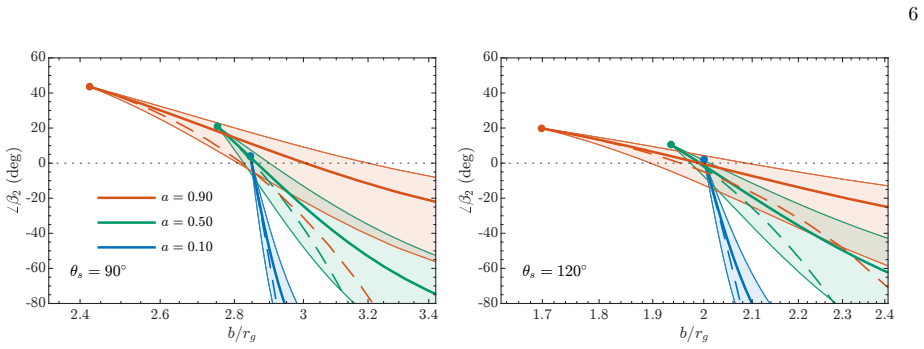
Near-horizon synchrotron polarization in Kerr spacetime takes a distinct analytic form where the leading term depends only on spin and source polar angle for stationary axisymmetric degenerate fields.
A machine-rendered reading of the paper's core claim, the machinery that carries it, and where it could break.
Core claim
The near-horizon expansion of the linear polarization vector for synchrotron emission in a Kerr background admits a distinct analytic form. For emission from a stationary, axisymmetric, degenerate electromagnetic field, the leading-order polarization pattern depends only on the Kerr spin and the source polar angle, while the next-to-leading-order correction further encodes the geometric and rotational structure of the electromagnetic field.
What carries the argument
Near-horizon expansion of the linear polarization vector for synchrotron emission.
If this is right
- Leading polarization pattern isolates black-hole spin from field structure.
- Next-to-leading terms encode electromagnetic-field geometry and rotation.
- Result applies off the equator and recovers prior equatorial limits.
- Near-horizon polarization measurements could probe gravito-electromagnetic coupling.
Where Pith is reading between the lines
- If confirmed, the separation may let observers extract spin independently of uncertain plasma details.
- Similar expansions could be derived for other emission processes sharing the same field symmetries.
- The pattern supplies a concrete template for interpreting Event Horizon Telescope or future polarimetric data.
Load-bearing premise
The electromagnetic field is stationary, axisymmetric, and degenerate.
What would settle it
A near-horizon polarization measurement whose leading angular dependence fails to match the predicted spin-and-polar-angle form for any choice of stationary axisymmetric degenerate field.
Figures
read the original abstract
We show that the near-horizon expansion of the linear polarization vector for synchrotron emission in a Kerr background admits a distinct analytic form. For emission from a stationary, axisymmetric, degenerate electromagnetic field, the leading-order polarization pattern depends only on the Kerr spin and the source polar angle, while the next-to-leading-order correction further encodes the geometric and rotational structure of the electromagnetic field. Our result extends the equatorial analysis of [Hou et al. (2024)] and the off-equatorial leading-order result of [Chael et al. (2026)]. Near-horizon polarization thus offers a potential probe of the fundamental properties of rotating black holes and of gravito-electromagnetic interactions.
Editorial analysis
A structured set of objections, weighed in public.
Referee Report
Summary. The manuscript shows that the near-horizon expansion of the linear polarization vector for synchrotron emission in a Kerr background admits a distinct analytic form. For emission from a stationary, axisymmetric, degenerate electromagnetic field, the leading-order polarization pattern depends only on the Kerr spin and the source polar angle, while the next-to-leading-order correction further encodes the geometric and rotational structure of the electromagnetic field. The result extends the equatorial analysis of Hou et al. (2024) and the off-equatorial leading-order result of Chael et al. (2026).
Significance. If the derivation holds, this provides a parameter-free leading-order result that isolates the effects of black hole spin and source location from the details of the electromagnetic field, which is a strength for theoretical modeling in general relativity and astrophysics. It could serve as a probe of fundamental properties of rotating black holes.
minor comments (2)
- [Abstract] Abstract: the modeling assumption that the electromagnetic field is stationary, axisymmetric, and degenerate is central to the separation of leading-order and NLO terms; a short parenthetical reminder of this scope would reduce risk of over-generalization by readers.
- The extension relative to Hou et al. (2024) and Chael et al. (2026) is stated clearly, but a dedicated comparison paragraph or table summarizing what is new versus recovered would improve readability.
Simulated Author's Rebuttal
We thank the referee for the positive summary, significance assessment, and recommendation of minor revision. No specific major comments were provided in the report.
Circularity Check
Minor self-citation present but derivation is independent and self-contained
full rationale
The paper derives an analytic near-horizon expansion of the linear polarization vector from the Kerr geometry and the explicit modeling assumptions of a stationary, axisymmetric, degenerate electromagnetic field. These inputs are stated directly in the abstract and are not obtained by fitting or by redefinition from the output polarization pattern. The reference to Hou et al. (2024) is used only to note an equatorial extension; the central leading-order and next-to-leading-order expressions are obtained from the spacetime and field structure within the present work. No load-bearing step reduces to a self-citation chain, a fitted parameter renamed as a prediction, or an ansatz smuggled via prior work. The result remains falsifiable against the stated assumptions and standard Kerr electrodynamics.
Axiom & Free-Parameter Ledger
axioms (2)
- standard math Kerr metric is the exact spacetime geometry for a rotating black hole
- domain assumption Synchrotron radiation polarization can be computed from the electromagnetic field and particle motion in curved spacetime
Reference graph
Works this paper leans on
-
[1]
Im{G}, Im{G}= Im pm 1 pm 0 + Φ(1) 0 Φ(0) 0 + 2 pm 0 pℓ −1 Φ(0) 1 Φ(0) 0 . (10) By explicitly evaluating the coefficients in this expansion for a given spacetime geometry, one can, in prin- ciple, extract all information relevant to near-horizon polarized emission, although the procedure may be algebraically cumbersome. III. EXPANSIONS IN KERR ...
-
[2]
Z1 − acosθ s (r+ −r −)Σ+ .(44) UsingZ 1 =−(1 +Z 2
-
[3]
Im{G}together with the relation betweenZ 0 andz 0, this is equivalently χ1 =−Im{G} − acosθ s (r+ −r −)Σ+ .(45) Substituting Eq. (41), this becomes χ1 = βs(1−aΩ + sin2 θs) +q ψΣ+(1−λΩ +) 2 sinθs(H+ −aλ)(H +Ω+ −a) − acosθ s (r+ −r −)Σ+ .(46) We see that the next-to-leading-order correction depends explicitly onq ψ and Ω F , which characterize the near-horiz...
-
[4]
The components of the photon momentum are given by pℓ =ϵ −2Lℓ(ϵ), p n =ϵ 2Ln(ϵ), p m = E(βs −iν s)√ 2(1 +ϵ−i cosθ s) , whereL ℓ andL n are real-analytic functions withL ℓ(0)̸= 0
Factorization of leading-order terms Given thatR(r) =P(r) 2 −ϵ 2Kand that √ Ris related to the outgoing photon branch, it follows that for P+ ̸= 0, √ Ris real-analytic inϵ. The components of the photon momentum are given by pℓ =ϵ −2Lℓ(ϵ), p n =ϵ 2Ln(ϵ), p m = E(βs −iν s)√ 2(1 +ϵ−i cosθ s) , whereL ℓ andL n are real-analytic functions withL ℓ(0)̸= 0. For s...
-
[5]
Let us expandH(ϵ) as H(ϵ) =H 0 +H 1ϵ+H 2ϵ2 +· · ·
Absence of theO( √ ∆)term and expansion structure The real-valued functionρ(ϵ) strictly modulates the amplitude ofA−iB, leaving its phase invariant. Let us expandH(ϵ) as H(ϵ) =H 0 +H 1ϵ+H 2ϵ2 +· · ·. Substituting this into Eq. (A 1) yields the bracketed term 1 +ϵ 2H(ϵ) = 1 +ϵ 2H0 +ϵ 3H1 +O(ϵ 4). Because ϵ2 = ∆ andϵ 3 = ∆3/2, this explicitly demonstrates t...
-
[6]
Im{H0}, Z ext 3/2 =−(1 +Z 2
-
[7]
While a generic, regular field is mathematically analytic in the radial parameterϵ=r−1, this property does not physically necessitate thatH(ϵ) be an even function
Im{H1}. While a generic, regular field is mathematically analytic in the radial parameterϵ=r−1, this property does not physically necessitate thatH(ϵ) be an even function. If the field smoothly extended across the horizon satisfies the parity conditionH(ϵ) =H(−ϵ), thenHshould be a function ofϵ 2 (i.e., bH(∆)), restrictingZto integer powers ∆n. However, su...
-
[8]
Expansion coefficients atO(∆) The imaginary part ofH 0 receives two distinct contributions. From Eq. (A 1), the first contribution is (ImH 0)Φ0 =− qψ 2 Dext + , D ext + = 1−Ω + sin2 θs sinθ s(2Ω+ −1) . The mixed term involving Φ1 yields a contribution identical to that in the non-extremal case, (ImH 0)Φ1 = νsqψ −β sDext + 2(2−λ) . Summing these gives ImH ...
-
[9]
(42) when evaluated using extremal horizon data
Im{H0}exactly matches the non-extremal result in Eq. (42) when evaluated using extremal horizon data. However, this cannot be recovered simply by taking the limitd H →0. Instead, treating the expansion inϵ= √ ∆ independently is physically essential due to the non-commutativity of the near-horizon expansion and the extremal limit
-
[10]
Near-horizon Polarization as a Diagnostic of Black Hole Spacetime,
Y. Hou, J. Huang, M. Guo, Y. Mizuno, and B. Chen, “Near-horizon Polarization as a Diagnostic of Black Hole Spacetime,”Astrophys. J. Lett.988no. 2, (2025) L51,arXiv:2409.07248 [gr-qc]
arXiv 2025
-
[11]
Black Hole Polarimetry III: Universal Polarization of Synchrotron Radiation at the Horizon,
A. Chael, A. Lupsasca, G. N. Wong, Z. Gelles, and E. Quataert, “Black Hole Polarimetry III: Universal Polarization of Synchrotron Radiation at the Horizon,”arXiv:2606.12518 [astro-ph.HE]
-
[12]
Gravitational field of a spinning mass as an example of algebraically special metrics,
R. P. Kerr, “Gravitational field of a spinning mass as an example of algebraically special metrics,”Physical review letters11no. 5, (1963) 237. 10
1963
-
[13]
C. W. Misner, K. S. Thorne, and J. A. Wheeler,Gravitation. Macmillan, 1973
1973
-
[14]
Ueber den Einfluss der Eigenrotation der Zentralkoerper auf die Bewegung der Planeten und Monde nach der Einsteinschen Gravitationstheorie,
J. Lense and H. Thirring, “Ueber den Einfluss der Eigenrotation der Zentralkoerper auf die Bewegung der Planeten und Monde nach der Einsteinschen Gravitationstheorie,”Phys. Z.19(1918) 156–163
1918
-
[15]
A confirmation of the general relativistic prediction of the Lense-Thirring effect,
I. Ciufolini and E. C. Pavlis, “A confirmation of the general relativistic prediction of the Lense-Thirring effect,” Nature431(2004) 958–960
2004
-
[16]
Electromagnetic extractions of energy from Kerr black holes,
R. D. Blandford and R. L. Znajek, “Electromagnetic extractions of energy from Kerr black holes,”Mon. Not. Roy. Astron. Soc.179(1977) 433–456
1977
-
[17]
Electrodynamics of black hole magnetospheres,
S. S. Komissarov, “Electrodynamics of black hole magnetospheres,”Mon. Not. Roy. Astron. Soc.350(2004) 407,arXiv:astro-ph/0402403
Pith/arXiv arXiv 2004
-
[18]
Polarized image of equatorial emission in the Kerr geometry,
Z. Gelles, E. Himwich, D. C. M. Palumbo, and M. D. Johnson, “Polarized image of equatorial emission in the Kerr geometry,”Phys. Rev. D104no. 4, (2021) 044060,arXiv:2105.09440 [gr-qc]
arXiv 2021
-
[19]
How Spatially Resolved Polarimetry Informs Black Hole Accretion Flow Models,
A. Ricarte, M. D. Johnson, Y. Y. Kovalev, D. C. M. Palumbo, and R. Emami, “How Spatially Resolved Polarimetry Informs Black Hole Accretion Flow Models,”Galaxies11no. 1, (2023) 5,arXiv:2211.03907 [astro-ph.HE]
arXiv 2023
-
[20]
Observational Signatures of Frame Dragging in Strong Gravity,
A. Ricarte, D. C. M. Palumbo, R. Narayan, F. Roelofs, and R. Emami, “Observational Signatures of Frame Dragging in Strong Gravity,”Astrophys. J. Lett.941no. 1, (2022) L12,arXiv:2211.01810 [gr-qc]
arXiv 2022
-
[21]
Black Hole Polarimetry I. A Signature of Electromagnetic Energy Extraction,
A. Chael, A. Lupsasca, G. N. Wong, and E. Quataert, “Black Hole Polarimetry I. A Signature of Electromagnetic Energy Extraction,”Astrophys. J.958no. 1, (2023) 65,arXiv:2307.06372 [astro-ph.HE]
arXiv 2023
-
[22]
Semianalytical study on polarized images of a black hole due to frame dragging,
X. Wang, S. Chen, M. Guo, and B. Chen, “Semianalytical study on polarized images of a black hole due to frame dragging,”Phys. Rev. D113no. 2, (2026) 024033,arXiv:2508.15178 [gr-qc]
arXiv 2026
-
[23]
Polarization patterns of the hot spots plunging into a Kerr black hole,
B. Chen, Y. Hou, Y. Song, and Z. Zhang, “Polarization patterns of the hot spots plunging into a Kerr black hole,”Phys. Rev. D111no. 8, (2025) 083045,arXiv:2407.14897 [astro-ph.HE]
arXiv 2025
-
[24]
Polarization signatures of inspiraling hotspots around Kerr black holes,
P. Ruales, D. E. A. Gates, and A. C´ ardenas-Avenda˜ no, “Polarization signatures of inspiraling hotspots around Kerr black holes,”Phys. Rev. D113no. 10, (2026) 103030,arXiv:2602.09102 [astro-ph.HE]. [16]Event Horizon TelescopeCollaboration, K. Akiyamaet al., “First M87 Event Horizon Telescope Results. VIII. Magnetic Field Structure near The Event Horizon...
Pith/arXiv arXiv 2026
-
[25]
Orbital motion near Sagittarius A* - Constraints from polarimetric ALMA observations,
M. Wielgus, M. Moscibrodzka, J. Vos, Z. Gelles, I. Marti-Vidal, J. Farah, N. Marchili, C. Goddi, and H. Messias, “Orbital motion near Sagittarius A* - Constraints from polarimetric ALMA observations,”Astron. Astrophys.665(2022) L6,arXiv:2209.09926 [astro-ph.HE]. [18]Event Horizon TelescopeCollaboration, K. Akiyamaet al., “First Sagittarius A* Event Horizo...
arXiv 2022
-
[26]
Near-horizon polarized images of a rotating hairy Horndeski black hole,
C. Chen, Q. Pan, and J. Jing, “Near-horizon polarized images of a rotating hairy Horndeski black hole,”JCAP 04(2026) 024,arXiv:2509.12526 [gr-qc]
arXiv 2026
-
[27]
G. B. Rybicki and A. P. Lightman,Lightman Radiative Processes in Astrophysics. Lightman Radiative Processes in Astrophysics, 1979
1979
-
[28]
An Approach to gravitational radiation by a method of spin coefficients,
E. Newman and R. Penrose, “An Approach to gravitational radiation by a method of spin coefficients,”J. Math. Phys.3(1962) 566–578
1962
-
[29]
On quadratic first integrals of the geodesic equations for type [22] spacetimes,
M. Walker and R. Penrose, “On quadratic first integrals of the geodesic equations for type [22] spacetimes,” Commun. Math. Phys.18(1970) 265–274
1970
-
[30]
Universal polarimetric signatures of the black hole photon ring,
E. Himwich, M. D. Johnson, A. Lupsasca, and A. Strominger, “Universal polarimetric signatures of the black hole photon ring,”Phys. Rev. D101no. 8, (2020) 084020,arXiv:2001.08750 [gr-qc]
arXiv 2020
-
[31]
Chandrasekhar,The mathematical theory of black holes, vol
S. Chandrasekhar,The mathematical theory of black holes, vol. 69. Oxford university press, 1998
1998
-
[32]
Global structure of the Kerr family of gravitational fields,
B. Carter, “Global structure of the Kerr family of gravitational fields,”Phys. Rev.174(1968) 1559–1571
1968
-
[33]
K. S. Thorne, K. S. Thorne, R. H. Price, and D. A. MacDonald,Black holes: the membrane paradigm. Yale university press, 1986
1986
-
[34]
Spacetime approach to force-free magnetospheres,
S. E. Gralla and T. Jacobson, “Spacetime approach to force-free magnetospheres,”Mon. Not. Roy. Astron. Soc.445no. 3, (2014) 2500–2534,arXiv:1401.6159 [astro-ph.HE]. [Erratum: Mon.Not.Roy.Astron.Soc. 534, 1541 (2024)]
arXiv 2014
-
[35]
Hydromagnetic flows from rapidly rotating compact objects. i-cold relativistic flows from rapid rotators,
M. Camenzind, “Hydromagnetic flows from rapidly rotating compact objects. i-cold relativistic flows from rapid rotators,”Astronomy and Astrophysics (ISSN 0004-6361), vol. 162, no. 1-2, July 1986, p. 32-44. SNSF-supported research.162(1986) 32–44
1986
-
[36]
Magnetohydrodynamic flows in kerr geometry-energy extraction from black holes,
M. Takahashi, S. Nitta, Y. Tatematsu, and A. Tomimatsu, “Magnetohydrodynamic flows in kerr geometry-energy extraction from black holes,”Astrophysical Journal, Part 1 (ISSN 0004-637X), vol. 363, Nov. 1, 1990, p. 206-217.363(1990) 206–217
1990
-
[37]
Toward a Full MHD Jet Model of Spinning Black Holes–II: Kinematics and Application to the M87 Jet,
L. Huang, Z. Pan, and C. Yu, “Toward a Full MHD Jet Model of Spinning Black Holes–II: Kinematics and Application to the M87 Jet,”Astrophys. J.894no. 1, (2020) 45,arXiv:2004.01827 [astro-ph.HE]
arXiv 2020
-
[38]
General Grad-Shafranov equation,
Y. Shen, “General Grad-Shafranov equation,”Phys. Rev. D113no. 10, (2026) 104077,arXiv:2605.08597 [gr-qc]
Pith/arXiv arXiv 2026
-
[39]
V. S. Beskin,MHD flows in compact astrophysical objects: accretion, winds and jets. Springer Science & Business Media, 2009
2009
-
[40]
Relativistic fluids and magneto-fluids,
A. M. Anile, “Relativistic fluids and magneto-fluids,”Relativistic Fluids and Magneto-fluids(2005)
2005
-
[41]
Black hole electrodynamics and the carter tetrad,
R. L. Znajek, “Black hole electrodynamics and the carter tetrad,”Monthly Notices of the Royal Astronomical Society179no. 3, (1977) 457–472
1977
-
[42]
Discriminating Accretion States via Rotational Symmetry in Simulated Polarimetric Images of M87,
D. C. M. Palumbo, G. N. Wong, and B. S. Prather, “Discriminating Accretion States via Rotational Symmetry in Simulated Polarimetric Images of M87,”Astrophys. J.894no. 2, (2020) 156,arXiv:2004.01751 [astro-ph.HE]. 11
arXiv 2020
-
[43]
S. S. Komissarov, “Observations of the Blandford-Znajek and the MHD Penrose processes in computer simulations of black hole magnetospheres,”Mon. Not. Roy. Astron. Soc.359(2005) 801–808, arXiv:astro-ph/0501599
Pith/arXiv arXiv 2005
-
[44]
Black Hole Polarimetry. II. The Connection between Spin and Polarization,
G. N. Wong, A. Chael, A. Lupsasca, and E. Quataert, “Black Hole Polarimetry. II. The Connection between Spin and Polarization,”Astrophys. J.997no. 1, (2026) 113,arXiv:2509.22639 [astro-ph.HE]
arXiv 2026
-
[45]
Nonthermal Synchrotron Emission and Polarization Signatures during Black Hole Flux Eruptions,
F. Zhou, J. Huang, Y. Li, Z. Zhang, Y. Hou, M. Guo, and B. Chen, “Nonthermal Synchrotron Emission and Polarization Signatures during Black Hole Flux Eruptions,”Astrophys. J.1002no. 2, (2026) 152, arXiv:2512.06803 [astro-ph.HE]
Pith/arXiv arXiv 2026
-
[46]
J. S. Long, A. Uniyal, M. Zhang, Y. Mizuno, Z. Younsi, C. M. Fromm, and K. Wu, “From Morphology to Variability: Radiative Cooling Effects on Horizon-Scale Polarization in Two-Temperature GRMHD Simulations,”arXiv:2606.16818 [astro-ph.HE]
-
[47]
Hybrid black hole- and disk-driven jets: Steady axisymmetric ideal MHD modeling,
Y. Song, Y. Hou, L. Huang, and B. Chen, “Hybrid black hole- and disk-driven jets: Steady axisymmetric ideal MHD modeling,”Phys. Rev. D113no. 4, (2026) 043054,arXiv:2507.23281 [astro-ph.HE]
arXiv 2026
-
[48]
Signatures of Black Hole Spin and Plasma Acceleration in Jet Polarimetry. II. Off-axis Jets,
Z. Gelles, A. Chael, and E. Quataert, “Signatures of Black Hole Spin and Plasma Acceleration in Jet Polarimetry. II. Off-axis Jets,”Astrophys. J.1001no. 2, (2026) 206,arXiv:2601.13307 [astro-ph.HE]
arXiv 2026
-
[49]
Image of Bonnor black dihole with a thin accretion disk and its polarization information,
Z. Zhang, S. Chen, and J. Jing, “Image of Bonnor black dihole with a thin accretion disk and its polarization information,”Eur. Phys. J. C82no. 9, (2022) 835,arXiv:2205.13696 [gr-qc]
arXiv 2022
-
[50]
Influence of quantum correction on the Schwarzschild black hole polarized image,
S. Guo, Y.-X. Huang, K. Liu, E.-W. Liang, and K. Lin, “Influence of quantum correction on the Schwarzschild black hole polarized image,”Eur. Phys. J. C84no. 6, (2024) 601,arXiv:2405.12808 [gr-qc]
arXiv 2024
-
[51]
Polarized image of a synchrotron-emitting ring in an Einstein-Maxwell-scalar theory,
Y. Chen, L. Cheng, P. Wang, and H. Yang, “Polarized image of a synchrotron-emitting ring in an Einstein-Maxwell-scalar theory,”Phys. Rev. D112no. 2, (2025) 024044,arXiv:2409.05304 [gr-qc]
arXiv 2025
-
[52]
Polarized image of a synchrotron emitting ring around a static hairy black hole in Horndeski theory,
H.-Y. Shi and T. Zhu, “Polarized image of a synchrotron emitting ring around a static hairy black hole in Horndeski theory,”Eur. Phys. J. C84no. 8, (2024) 814
2024
-
[53]
Astrometric and polarimetric imprints of hot-spots orbiting parametrized black holes,
J. L. Rosa, N. Aimar, and D. Rubiera-Garcia, “Astrometric and polarimetric imprints of hot-spots orbiting parametrized black holes,”JCAP01(2026) 005,arXiv:2508.19874 [gr-qc]
arXiv 2026
-
[54]
Polarized equatorial emission and hot spots around black holes with a dark matter halo,
T. Angelov, R. Bekir, G. Gyulchev, P. Nedkova, and S. Yazadjiev, “Polarized equatorial emission and hot spots around black holes with a dark matter halo,”Eur. Phys. J. C85no. 9, (2025) 1075,arXiv:2503.21395 [gr-qc]
arXiv 2025
-
[55]
Imaging and polarization patterns of various thick disks around Kerr-MOG black holes,
X. Wang, H. Ye, and X.-X. Zeng, “Imaging and polarization patterns of various thick disks around Kerr-MOG black holes,”JCAP05(2026) 057,arXiv:2511.09379 [gr-qc]
arXiv 2026
-
[56]
C.-Y. Yang, K.-J. He, X.-X. Zeng, and L.-F. Li, “Observational signatures and polarized images of rotating charged black holes in Kalb–Ramond gravity,”Eur. Phys. J. C86no. 5, (2026) 520,arXiv:2508.07393 [gr-qc]
arXiv 2026
-
[57]
Unveiling Inner Shadows and Polarization Signatures of Rotating Einstein-Gauss-Bonnet Black Holes,
B.-B. Chen, C.-Y. Yang, D. Chen, and K.-J. He, “Unveiling Inner Shadows and Polarization Signatures of Rotating Einstein-Gauss-Bonnet Black Holes,”arXiv:2604.07726 [gr-qc]
discussion (0)
Sign in with ORCID, Apple, or X to comment. Anyone can read and Pith papers without signing in.