Universal Closed Form for Dynamical Love Numbers of Black Holes
Pith reviewed 2026-06-26 19:47 UTC · model grok-4.3
The pith
Dynamical Love numbers of Schwarzschild black holes admit an exact closed-form expression valid to all orders.
A machine-rendered reading of the paper's core claim, the machinery that carries it, and where it could break.
Core claim
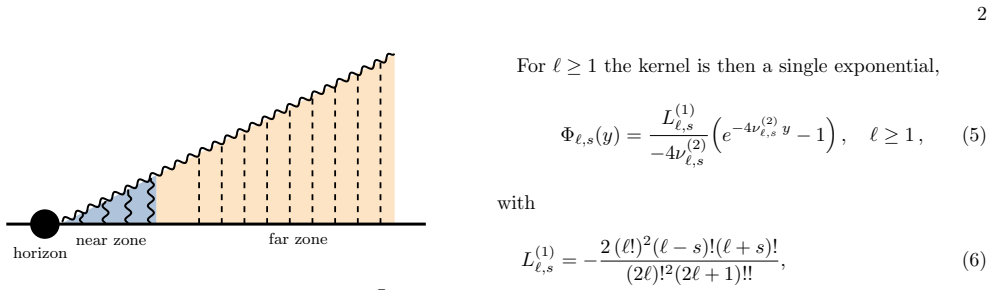
The scheme-independent dynamical response of a Schwarzschild black hole is given exactly by bar F_ell,s over 4 pi R_S to the 2 ell plus 1 equals Phi_ell,s of bar y minus one half eta times Phi prime, with bar y equal to minus one half eta squared tau and tau containing the zeta tower that resums all orders. Phi_ell,s is the leading-log solution to the renormalization group equation, but the running logarithm is lifted to tau equals log(R_S/R) minus 2 times the sum over k greater than or equal to 2 of zeta_k eta to the k minus 1. This tower is universal across multipole and spin because it descends from the same far-zone Gamma(1 minus eta) factor that governs long-range scattering. The result
What carries the argument
The lifted running logarithm tau that resums the leading-log RG solution Phi_ell,s by incorporating the far-zone zeta series from Gamma(1-eta).
If this is right
- Dynamical Love numbers for any multipole and spin are now given by a single analytic expression rather than by successive perturbative calculations.
- The same zeta tower links the Love numbers directly to the Newtonian phase in long-range scattering.
- The factorization into horizon matching, near-zone anomalous dimension, and far-zone dressed log holds for scalar, electromagnetic, and gravitational perturbations alike.
- Shell effective field theory supplies an independent verification of the formula through order G^15.
Where Pith is reading between the lines
- Similar resummation of zeta series from far-zone factors could apply to Love numbers of other black hole spacetimes or to other observables involving long-range gravitational interactions.
- The closed form may simplify post-Newtonian calculations for binary inspirals by providing exact tidal responses at arbitrary frequencies.
- Comparison against high-precision numerical solutions of the wave equation for specific frequencies would provide a direct test beyond the EFT verification order.
Load-bearing premise
Lifting the running logarithm in the leading-log RG solution with the specific zeta series from the far-zone Gamma(1-eta) factor produces the correct all-order result without residual scheme dependence or missing contributions from other zones.
What would settle it
An explicit computation of the dynamical Love number for any ell, s, and frequency at an order higher than G^15 that disagrees with the closed-form prediction would falsify the claim.
Figures
read the original abstract
Black hole static Love numbers vanish, but their dynamical counterparts do not. We present the scheme-independent dynamical response $\bar{F}_{\ell,s}$ of a Schwarzschild black hole in closed form, to all orders, and for every spin $s$ and multipole $\ell$. The result is $\bar{F}_{\ell,s}/4\pi R_S^{2\ell+1}=\Phi_{\ell,s}(\bar{y})-\tfrac12\eta\,\Phi_{\ell,s}'(\bar{y})$ with $\bar{y}=-\tfrac12\eta^2\tau$ and $\eta=i\omega R_S$. Here $\Phi_{\ell,s}$ is simply the leading-log solution to the renormalization group equation, but lifting the running logarithm to $\tau=\log(R_S/R)-2\sum_{k\ge2}\zeta_k\,\eta^{k-1}$ resums it to all orders. This tower of Riemann zeta values is the Newtonian phase in disguise: it originates from the same far-zone $\Gamma(1-\eta)$ that governs long-range scattering, and is universal across multipole and spin. Our result exhibits a factorization pinned to three ingredients: the hard matching coefficient at the horizon, the anomalous dimension in the near zone, and the dressed log in the far zone. Using shell effective field theory, we independently verify our formula for scalar, electromagnetic, and gravitational perturbations, reaching $\mathcal O(G^{15})$.
Editorial analysis
A structured set of objections, weighed in public.
Referee Report
Summary. The manuscript claims a scheme-independent closed-form expression for the dynamical response (Love numbers) of Schwarzschild black holes valid to all orders in G for arbitrary multipole ℓ and spin s: bar F_{ℓ,s}/(4π R_S^{2ℓ+1}) = Φ_{ℓ,s}(bar y) − (1/2)η Φ'_{ℓ,s}(bar y), with bar y = −(1/2)η² τ and τ the far-zone dressed logarithm containing the zeta tower extracted from Γ(1−η). The derivation factorizes the response into a hard horizon matching coefficient, near-zone anomalous dimension, and far-zone contribution; the leading-log RG solution is lifted by substituting the zeta series for the running logarithm. Independent verification via shell EFT is reported to O(G^{15}) for scalar, electromagnetic, and gravitational perturbations.
Significance. If the central formula holds, the work supplies an exact all-order result for dynamical black-hole responses together with an explicit three-zone factorization and a universal far-zone zeta tower. The O(G^{15}) shell-EFT checks constitute a non-trivial, independent test of the resummation. The result would streamline calculations in black-hole perturbation theory and EFT matching, with potential applications to gravitational-wave observables and scattering amplitudes.
major comments (1)
- [Derivation of the closed form (RG flow, far-zone Γ(1−η) matching, and lifting of the logarithm)] The lifting step that replaces the running logarithm by τ = log(R_S/R) − 2 ∑_{k≥2} ζ_k η^{k−1} is presented as yielding the exact all-order, scheme-independent result. This assumption—that no additional logarithms or power-law terms arise from the near-zone or horizon sectors that would require further dressing—is load-bearing for the claim of an exact closed form. The O(G^{15}) shell-EFT verification confirms agreement through that order but does not test whether the resummation continues to hold or whether other zones contribute at higher orders; an explicit argument addressing possible residual scheme dependence beyond the checked order is needed.
minor comments (2)
- [Abstract] The abstract states verification for 'three perturbation types' without naming them; the text should explicitly list scalar, electromagnetic, and gravitational perturbations for immediate clarity.
- [Main text (RG section)] The definition of Φ_{ℓ,s} as 'the leading-log solution to the renormalization group equation' would benefit from an explicit equation reference or functional form in the main text to aid readers tracing the lifting procedure.
Simulated Author's Rebuttal
We thank the referee for their careful review and for highlighting the central assumptions underlying our all-order claim. We address the major comment below.
read point-by-point responses
-
Referee: The lifting step that replaces the running logarithm by τ = log(R_S/R) − 2 ∑_{k≥2} ζ_k η^{k−1} is presented as yielding the exact all-order, scheme-independent result. This assumption—that no additional logarithms or power-law terms arise from the near-zone or horizon sectors that would require further dressing—is load-bearing for the claim of an exact closed form. The O(G^{15}) shell-EFT verification confirms agreement through that order but does not test whether the resummation continues to hold or whether other zones contribute at higher orders; an explicit argument addressing possible residual scheme dependence beyond the checked order is needed.
Authors: The three-zone factorization isolates the contributions exactly: the horizon supplies a scheme-independent hard matching coefficient with no additional running; the near zone contributes only through the anomalous dimension, which is fully captured by the RG equation whose leading-log solution is Φ; and the far zone supplies the universal dressed logarithm τ via the exact Γ(1−η) factor of Newtonian scattering. Because the zeta tower originates solely from this far-zone Gamma function and is independent of ℓ and s, no further logarithms or power-law corrections are generated by the other sectors. The shell-EFT verification to O(G^{15}) confirms that the pattern persists order by order, consistent with the factorization. We will add a dedicated paragraph in the revised manuscript that spells out this argument and explicitly rules out residual scheme dependence beyond the checked orders. revision: yes
Circularity Check
No significant circularity; derivation grounded by independent EFT verification
full rationale
The paper presents the closed-form dynamical response by starting from the leading-log RG solution for Phi_ell,s and lifting its running logarithm via the specific tau containing the zeta tower extracted from the far-zone Gamma(1-eta) factor. This step is justified in the text as originating from the Newtonian phase in long-range scattering and is presented as producing a scheme-independent all-order result via factorization into horizon matching, near-zone anomalous dimension, and far-zone dressed log. The central claim is then subjected to independent verification via shell EFT computations for scalar, electromagnetic, and gravitational cases up to O(G^15), which serves as external grounding rather than a self-referential fit or self-citation chain. No load-bearing equation reduces by construction to its own inputs, and the result is not equivalent to the leading-log input by definition. This is the normal case of a self-contained derivation against external benchmarks.
Axiom & Free-Parameter Ledger
axioms (2)
- domain assumption The response function obeys a renormalization group equation whose leading-log solution is Phi
- domain assumption The far-zone scattering phase is governed by Gamma(1-eta) and supplies the universal zeta tower
Forward citations
Cited by 1 Pith paper
-
Fermionic Love number of higher-dimensional Reissner-Nordstr\"om black holes
Fermionic tidal Love numbers for D-dimensional RN black holes remain nonzero for all angular momentum l (except extremal cases) and lose their l-dependence as D grows to infinity.
Reference graph
Works this paper leans on
-
[1]
A. E. H. Love, Proc. R. Soc. A82, 73 (1909)
1909
-
[2]
Damour, A
T. Damour, A. Nagar, Phys. Rev. D80, 084035 (2009). 5
2009
-
[3]
Binnington, E
T. Binnington, E. Poisson, Phys. Rev. D80, 084018 (2009)
2009
-
[4]
´E. ´E. Flanagan, T. Hinderer, Phys. Rev. D77, 021502 (2008)
2008
-
[5]
T. Hinderer, Astrophys. J.677, 1216 (2008), arXiv:0711.2420
Pith/arXiv arXiv 2008
-
[6]
T. Hindereret al., Phys. Rev. Lett.116, 181101 (2016), arXiv:1602.00599
Pith/arXiv arXiv 2016
-
[7]
S. De, D. Finstad, J. M. Lattimer, D. A. Brown, E. Berger, C. M. Biwer, Phys. Rev. Lett.121, 091102 (2018), arXiv:1804.08583
Pith/arXiv arXiv 2018
- [8]
-
[9]
B. Kol, M. Smolkin, JHEP02, 010 (2012)
2012
-
[10]
L. Hui, A. Joyce, R. Penco, L. Santoni, A. R. Solomon, JCAP04, 052 (2021), arXiv:2010.00593
arXiv 2021
-
[11]
H. S. Chia, Phys. Rev. D104, 024013 (2021), arXiv:2010.07300
arXiv 2021
-
[12]
P. Charalambous, S. Dubovsky, M. M. Ivanov, JHEP05, 038 (2021), arXiv:2102.08917
arXiv 2021
-
[13]
R. A. Porto, Fortsch. Phys.64, 723 (2016), arXiv:1606.08895
Pith/arXiv arXiv 2016
-
[14]
P. Charalambous, S. Dubovsky, M. M. Ivanov, Phys. Rev. Lett.127, 101101 (2021), arXiv:2103.01234
arXiv 2021
-
[15]
L. Hui, A. Joyce, R. Penco, L. Santoni, A. R. Solomon, JCAP01, 032 (2022), arXiv:2105.01069
arXiv 2022
-
[16]
P. Charalambous, S. Dubovsky, M. M. Ivanov, JHEP10, 175 (2022), arXiv:2209.02091
arXiv 2022
-
[17]
L. Hui, A. Joyce, R. Penco, L. Santoni, A. R. Solomon, JHEP09, 049 (2022), arXiv:2203.08832
arXiv 2022
-
[18]
M. M. Ivanov, Z. Zhou, Phys. Rev. Lett.130, 091403 (2023), arXiv:2209.14324
arXiv 2023
-
[19]
J. Ben Achour, E. R. Livine, S. Mukohyama, J.-P. Uzan, JHEP07, 112 (2022), arXiv:2202.12828
arXiv 2022
-
[20]
M. Rai, L. Santoni, JHEP07, 098 (2024), arXiv:2404.06544
arXiv 2024
- [21]
- [22]
- [23]
- [24]
-
[25]
P. Charalambous, S. Dubovsky, M. M. Ivanov, JHEP06, 180 (2025), arXiv:2502.02694
arXiv 2025
- [26]
-
[27]
V. Cardoso, E. Franzin, A. Maselli, P. Pani, G. Raposo, Phys. Rev. D95, 084014 (2017), arXiv:1701.01116
Pith/arXiv arXiv 2017
- [28]
-
[29]
D. Bini, A. Geralico, C. Kavanagh, A. Pound, D. Usseglio, Phys. Rev. D110, 064050 (2024), arXiv:2406.15878
arXiv 2024
-
[30]
M. M. Ivanov, Y.-Z. Li, J. Parra-Martinez, Z. Zhou, Phys. Rev. Lett.132, 131401 (2024), arXiv:2401.08752
arXiv 2024
-
[31]
M. M. Ivanov, Z. Zhou, Phys. Rev. D107, 084030 (2023), arXiv:2208.08459
arXiv 2023
-
[32]
M. V. S. Saketh, Z. Zhou, M. M. Ivanov, Phys. Rev. D 109, 064058 (2024), arXiv:2307.10391
arXiv 2024
-
[33]
S. Akhtar, Y. F. Bautista, C. Iossa, Z. Zhou, Phys. Rev. D112, 085018 (2025), arXiv:2505.21489
Pith/arXiv arXiv 2025
-
[34]
Y. F. Bautista, A. Guevara, C. Kavanagh, J. Vines, JHEP03, 136 (2023), arXiv:2107.10179
arXiv 2023
-
[35]
G. Bonelli, C. Iossa, D. P. Lichtig, A. Tanzini, Phys. Rev. D105, 044047 (2022), arXiv:2105.04483
arXiv 2022
-
[36]
D. Consoli, F. Fucito, J. F. Morales, R. Poghossian, JHEP12, 115 (2022), arXiv:2206.09437
arXiv 2022
- [37]
-
[38]
Y. F. Bautista, A. Guevara, C. Kavanagh, J. Vines, JHEP05, 211 (2023), arXiv:2212.07965
arXiv 2023
-
[39]
Y. F. Bautista, G. Bonelli, C. Iossa, A. Tanzini, Z. Zhou, Phys. Rev. D109, 084071 (2024), arXiv:2312.05965
arXiv 2024
-
[40]
H. Kobayashi, S. Mukohyama, N. Oshita, K. Takahashi, V. Yingcharoenrat, arXiv:2511.12580
-
[41]
S. Chakraborty, V. De Luca, L. Gualtieri, P. Pani, Phys. Rev. D112, 104015 (2025), arXiv:2507.22994
arXiv 2025
-
[42]
S. Caron-Huot, M. Correia, G. Isabella, M. Solon, Phys. Rev. Lett.135, 191601 (2025), arXiv:2503.13593
arXiv 2025
-
[43]
M. M. Ivanov, Y.-Z. Li, J. Parra-Martinez, Z. Zhou, Phys. Rev. Lett.135, 141401 (2025), arXiv:2504.07862
Pith/arXiv arXiv 2025
- [44]
-
[45]
M. M. Ivanov, Y.-Z. Li, J. Parra-Martinez, Z. Zhou, arXiv:2602.06951
-
[46]
O. Combaluzier–Szteinsznaider, D. Glazer, A. Joyce, M. J. Rodriguez, L. Santoni, arXiv:2511.02372
-
[47]
D. Kosmopoulos, D. Perrone, M. P. Solon, Phys. Rev. Lett.136, 211401 (2026), arXiv:2512.04002
Pith/arXiv arXiv 2026
-
[48]
W. D. Goldberger, I. Z. Rothstein, Phys. Rev. D73, 104029 (2006), arXiv:hep-th/0409156
Pith/arXiv arXiv 2006
-
[49]
W. D. Goldberger, I. Z. Rothstein, Phys. Rev. D73, 104030 (2006), arXiv:hep-th/0511133
Pith/arXiv arXiv 2006
-
[50]
W. D. Goldberger, I. Z. Rothstein, Gen. Rel. Grav.38, 1537 (2006), arXiv:hep-th/0605238
Pith/arXiv arXiv 2006
-
[51]
G. K¨ alin, Z. Liu, R. A. Porto, Phys. Rev. D102, 124025 (2020), arXiv:2008.06047
arXiv 2020
- [52]
-
[53]
J. Steinhoff, T. Hinderer, T. Dietrich, F. Foucart, Phys. Rev. Res.3, 033129 (2021), arXiv:2103.06100
arXiv 2021
- [54]
-
[55]
M. K. Mandal, P. Mastrolia, H. O. Silva, R. Patil, J. Steinhoff, JHEP02, 188 (2024), arXiv:2308.01865
arXiv 2024
-
[56]
M. K. Mandal, P. Mastrolia, H. O. Silva, R. Patil, J. Steinhoff, JHEP11, 067 (2023), arXiv:2304.02030
arXiv 2023
- [57]
-
[58]
M. K. Mandal, P. Mastrolia, R. Patil, J. Steinhoff, JHEP 05, 008 (2025), arXiv:2412.01706
arXiv 2025
-
[59]
M. V. S. Saketh, Z. Zhou, S. Ghosh, J. Steinhoff, D. Chatterjee, Phys. Rev. D110, 103001 (2024), arXiv:2407.08327
arXiv 2024
-
[60]
A. Bhattacharyya, S. Ghosh, N. Kumar, S. Kumar, S. Pal, JHEP11, 155 (2025), arXiv:2508.02785
arXiv 2025
- [61]
- [62]
-
[63]
M. Accettulli Huber, A. Brandhuber, S. De Ange- lis, G. Travaglini, Phys. Rev. D103, 045015 (2021), arXiv:2012.06548
arXiv 2021
- [64]
- [65]
-
[66]
Z. Bern, J. Parra-Martinez, R. Roiban, E. Sawyer, C.- H. Shen, JHEP05, 188 (2021), arXiv:2010.08559. 6
arXiv 2021
-
[67]
X. Kong, F. Ravndal, Phys. Lett. B450, 320 (1999), arXiv:nucl-th/9811076
Pith/arXiv arXiv 1999
-
[68]
X. Kong, F. Ravndal, Nucl. Phys. A665, 137 (2000), arXiv:hep-ph/9903523
Pith/arXiv arXiv 2000
-
[69]
T. Barford, M. C. Birse, Phys. Rev. C67, 064006 (2003), arXiv:hep-ph/0206146
Pith/arXiv arXiv 2003
-
[70]
A. H. Hoang, A. V. Manohar, I. W. Stewart, Phys. Rev. D64, 014033 (2001), arXiv:hep-ph/0102257
Pith/arXiv arXiv 2001
-
[71]
A. A. Penin, A. A. Pivovarov, Phys. Atom. Nucl.64, 275 (2001), arXiv:hep-ph/9904278
Pith/arXiv arXiv 2001
-
[72]
R. J. Hill and R. Plestid, Phys. Rev. D109, 056006 (2024), arXiv:2309.15929
arXiv 2024
- [73]
-
[74]
S. G. Avery, B. U. W. Schwab, JHEP04, 053 (2017), arXiv:1609.04397
Pith/arXiv arXiv 2017
-
[75]
S. Mano, H. Suzuki, E. Takasugi, Prog. Theor. Phys.95, 1079 (1996)
1996
-
[76]
A. A. Starobinsky, Zh. Eksp. Teor. Fiz.64, 48 (1973) [Sov. Phys. JETP37, 28 (1973)]
1973
-
[77]
A. A. Starobinsky, S. M. Churilov, Zh. Eksp. Teor. Fiz. 65, 3 (1973) [Sov. Phys. JETP38, 1 (1974)]
1973
-
[78]
D. N. Page, Phys. Rev. D13, 198 (1976)
1976
discussion (0)
Sign in with ORCID, Apple, or X to comment. Anyone can read and Pith papers without signing in.