Protein Representation Learning with Secondary-Structure and Energy-Filtered Hydrogen-Bond Graphs
Pith reviewed 2026-06-27 04:58 UTC · model grok-4.3
The pith
Incorporating secondary structure assignments and energy-filtered hydrogen-bond edges improves protein graph representations.
A machine-rendered reading of the paper's core claim, the machinery that carries it, and where it could break.
Core claim
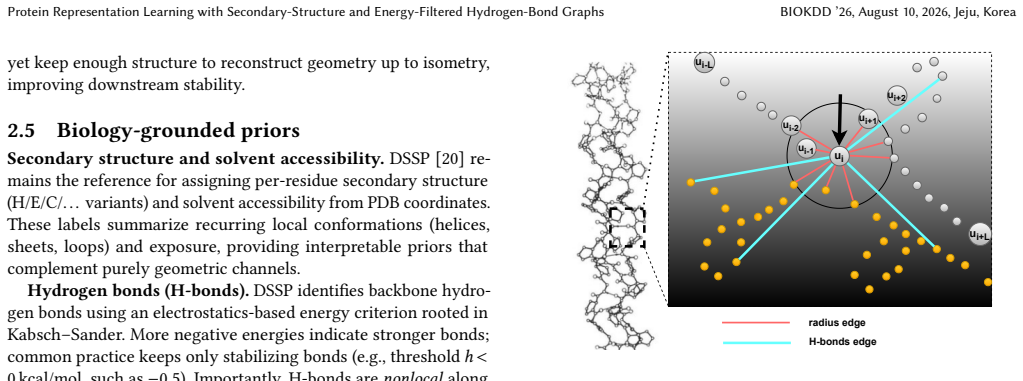
By augmenting residue-level node features with secondary structure assignments and constructing graph edges exclusively from energy-filtered hydrogen-bond interactions, the model captures both recurring local motifs and long-range stabilizing couplings that govern protein stability and function, leading to improved performance on protein benchmarks and greater alignment with biological motifs.
What carries the argument
Secondary-structure-augmented graph neural network with edges defined by energy-filtered hydrogen-bond interactions
If this is right
- Consistent improvements over existing graph-based methods on protein benchmarks
- Enhanced biological interpretability of the learned graph representations
- Learned connectivity aligns with established structural motifs
Where Pith is reading between the lines
- Removing the energy filter on hydrogen bonds should reduce performance toward levels seen with proximity-based graphs
- The same node and edge construction could be tested on related tasks such as mutation stability prediction
- The topology may transfer to modeling interactions between proteins and small molecules
Load-bearing premise
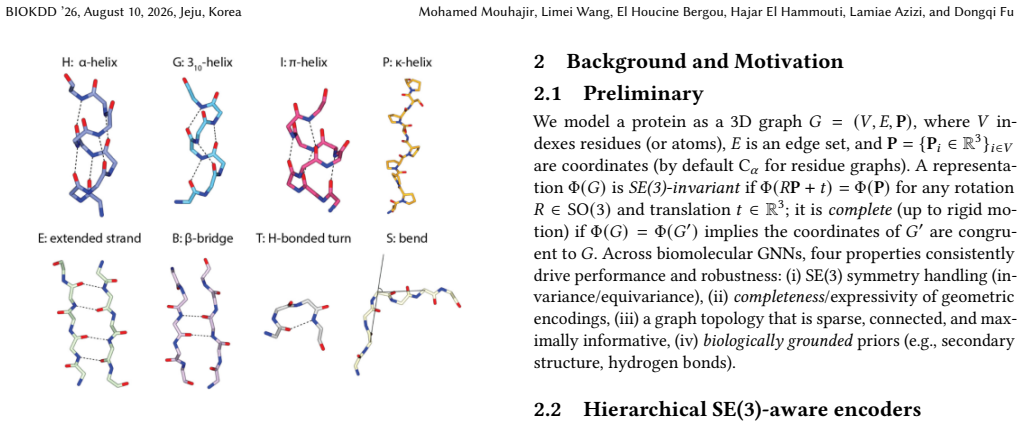
Secondary-structure assignments and energy-filtered hydrogen-bond interactions supply a graph topology that is meaningfully more informative for stability and function than sequence adjacency or geometric proximity alone.
What would settle it
Train the same GNN architecture on identical protein data but with three different edge sets (sequence adjacency, geometric proximity, and the proposed energy-filtered hydrogen bonds), then measure whether the hydrogen-bond version produces statistically significant gains on a held-out stability or function prediction benchmark.
Figures
read the original abstract
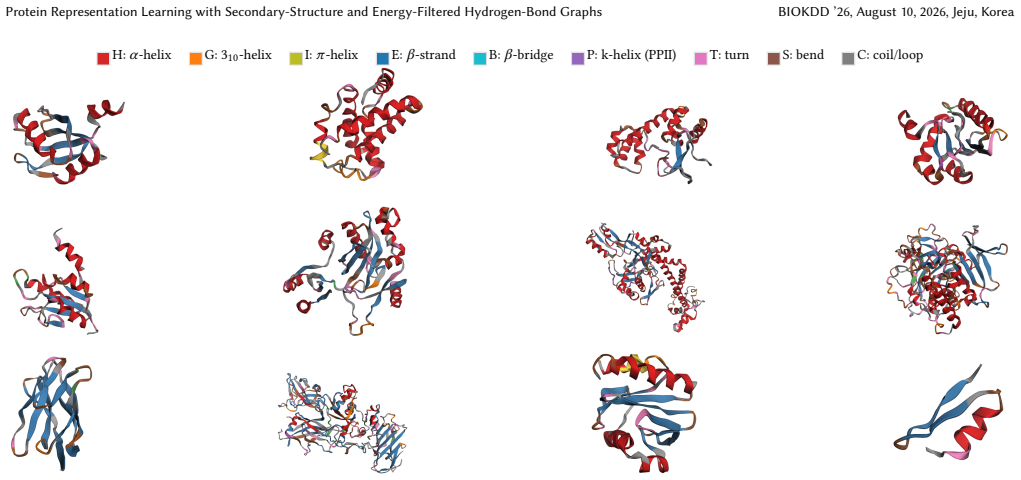
Graph-based representations are widely used in protein modeling, yet many existing approaches rely primarily on sequence adjacency or geometric proximity, which only partially reflect the principles governing protein folding. Proteins instead adopt complex three-dimensional conformations organized around secondary structure elements, such as $\alpha$-helices and $\beta$-sheets, which encode recurring local motifs and stabilizing hydrogen-bond interactions. In this work, we introduce a secondary-structure-aware graph neural network for protein representation learning. Residue-level node representations are augmented with secondary structure assignments, and graph edges are constructed from hydrogen-bond interactions filtered by their energetic strength. This design enables the model to capture both local structural context and long-range couplings that are central to protein stability and function. We evaluate the proposed approach on commonly used protein benchmarks and observe consistent improvements over existing graph-based methods. In addition, the resulting graph representations offer enhanced biological interpretability, as the learned connectivity aligns with established structural motifs. These findings suggest that incorporating secondary structure and energy-filtered hydrogen-bond topology provides an effective inductive bias for protein representation learning. The code is released at https://github.com/mohamedmohamed2021/SSProNet
Editorial analysis
A structured set of objections, weighed in public.
Referee Report
Summary. The manuscript introduces SSProNet, a graph neural network for protein representation learning. Residue nodes are augmented with secondary-structure assignments, and edges are defined via energetically filtered hydrogen-bond interactions rather than sequence adjacency or geometric proximity alone. The model is evaluated on standard protein benchmarks, where it reports consistent gains over prior graph-based methods and improved alignment with known structural motifs. Code is released publicly.
Significance. If the empirical gains hold under rigorous controls, the work supplies a biologically motivated inductive bias that directly encodes secondary-structure elements and stabilizing hydrogen bonds, which are central to folding and function. Public code release strengthens reproducibility.
minor comments (2)
- [Abstract] Abstract: the claim of 'consistent improvements' should be accompanied in the results section by explicit baseline comparisons, dataset sizes, and statistical significance tests so that the magnitude of gains can be assessed directly.
- Methods: the precise energy threshold and filtering procedure for hydrogen-bond edges should be stated with a reference to the underlying energy function or software used.
Simulated Author's Rebuttal
We thank the referee for the positive assessment of our work on SSProNet and the recommendation for minor revision. The report does not list any specific major comments, so we have no points to address point-by-point. We are happy to incorporate any minor suggestions that may arise during the revision process.
Circularity Check
No significant circularity detected
full rationale
The paper proposes a graph construction for protein representation learning that augments nodes with secondary-structure assignments and defines edges via energy-filtered hydrogen-bond interactions. This is presented as an inductive bias choice and is evaluated empirically on external protein benchmarks with reported gains over sequence-adjacency and geometric baselines. No equations, parameter fits, or self-citations are described that reduce any claimed result to an input by construction. The central claim rests on benchmark comparisons that are independent of the method definition itself.
Axiom & Free-Parameter Ledger
axioms (2)
- domain assumption Secondary structure assignments accurately capture recurring local motifs that influence folding.
- domain assumption Hydrogen-bond energy calculations reliably identify stabilizing long-range interactions.
Reference graph
Works this paper leans on
-
[1]
Functional evolution of two subtly different (similar) folds.BMC structural biology, 1(1):5, 2001
Vishal Agrawal and Radha KV Kishan. Functional evolution of two subtly different (similar) folds.BMC structural biology, 1(1):5, 2001
2001
-
[2]
A minimal sequence code for switching protein structure and function.Proceedings of the National Academy of Sciences, 106(50):21149–21154, 2009
Patrick A Alexander, Yanan He, Yihong Chen, John Orban, and Philip N Bryan. A minimal sequence code for switching protein structure and function.Proceedings of the National Academy of Sciences, 106(50):21149–21154, 2009
2009
-
[3]
Learning to represent programs with graphs.arXiv preprint arXiv:1711.00740, 2017
Miltiadis Allamanis, Marc Brockschmidt, and Mahmoud Khademi. Learning to represent programs with graphs.arXiv preprint arXiv:1711.00740, 2017
Pith/arXiv arXiv 2017
-
[4]
Graphqa: protein model quality assessment using graph convolutional networks.Bioinformatics, 37(3):360–366, 2021
Federico Baldassarre, David Menéndez Hurtado, Arne Elofsson, and Hossein Azizpour. Graphqa: protein model quality assessment using graph convolutional networks.Bioinformatics, 37(3):360–366, 2021
2021
-
[5]
Network biology: understanding the cell’s functional organization.Nature reviews genetics, 5(2):101–113, 2004
Albert-Laszlo Barabasi and Zoltan N Oltvai. Network biology: understanding the cell’s functional organization.Nature reviews genetics, 5(2):101–113, 2004
2004
-
[6]
Mace: Higher order equivariant message passing neural networks for fast and accurate force fields
Ilyes Batatia, David P Kovacs, Gregor Simm, Christoph Ortner, and Gabor Csanyi. Mace: Higher order equivariant message passing neural networks for fast and accurate force fields. In S. Koyejo, S. Mohamed, A. Agarwal, D. Belgrave, K. Cho, and A. Oh, editors,Advances in Neural Information Processing Systems, volume 35, pages 11423–11436. Curran Associates, ...
2022
-
[7]
Berman, John Westbrook, Zukang Feng, Gary Gilliland, T
Helen M. Berman, John Westbrook, Zukang Feng, Gary Gilliland, T. N. Bhat, Helge Weissig, Ilya N. Shindyalov, and Philip E. Bourne. The protein data bank. Nucleic Acids Research, 28(1):235–242, January 2000. doi: 10.1093/nar/28.1.235
-
[8]
Johannes Brandstetter, Rob Hesselink, Elise van der Pol, Erik J. Bekkers, and Max Welling. Geometric and physical quantities improve E(3) equivariant message passing.CoRR, abs/2110.02905, 2021
arXiv 2021
-
[9]
Geometric deep learning: going beyond euclidean data.IEEE Signal Processing Magazine, 34(4):18–42, 2017
Michael M Bronstein, Joan Bruna, Yann LeCun, Arthur Szlam, and Pierre Van- dergheynst. Geometric deep learning: going beyond euclidean data.IEEE Signal Processing Magazine, 34(4):18–42, 2017
2017
-
[10]
Jose M. Dana, Aleksandras Gutmanas, Nidhi Tyagi, Guoying Qi, Claire O’Donovan, Maria Martin, and Sameer Velankar. Sifts: updated structure inte- gration with function, taxonomy and sequences resource allows 40-fold increase in coverage of structure-based annotations for proteins.Nucleic Acids Research, 47(D1):D482–D489, January 2019. doi: 10.1093/nar/gky1114
-
[11]
Networks, crowds, and markets.Econ
David Easley and Jon Kleinberg. Networks, crowds, and markets.Econ. Theory, 26:1–28, 2010
2010
-
[12]
Continuous- discrete convolution for geometry-sequence modeling in proteins
Hehe Fan, Zhangyang Wang, Yi Yang, and Mohan Kankanhalli. Continuous- discrete convolution for geometry-sequence modeling in proteins. InThe Eleventh International Conference on Learning Representations, 2022
2022
-
[13]
Matthias Fey and Jan E. Lenssen. Fast graph representation learning with PyTorch geometric. InICLR Workshop on Representation Learning on Graphs and Manifolds, 2019
2019
-
[14]
Protein interface prediction using graph convolutional networks.Advances in neural information processing systems, 30, 2017
Alex Fout, Jonathon Byrd, Basir Shariat, and Asa Ben-Hur. Protein interface prediction using graph convolutional networks.Advances in neural information processing systems, 30, 2017
2017
-
[15]
DPPIN: A biological repository of dynamic protein- protein interaction network data
Dongqi Fu and Jingrui He. DPPIN: A biological repository of dynamic protein- protein interaction network data. InIEEE International Conference on Big Data, Big Data 2022, Osaka, Japan, December 17-20, 2022, pages 5269–5277. IEEE,
2022
-
[16]
URL https://doi.org/10.1109/ BigData55660.2022.10020904
doi: 10.1109/BIGDATA55660.2022.10020904. URL https://doi.org/10.1109/ BigData55660.2022.10020904
-
[17]
Dongqi Fu, Liri Fang, Ross Maciejewski, Vetle I. Torvik, and Jingrui He. Meta- learned metrics over multi-evolution temporal graphs. InKDD ’22: The 28th ACM SIGKDD Conference on Knowledge Discovery and Data Mining, Washington, DC, USA, August 14 - 18, 2022, pages 367–377. ACM, 2022. doi: 10.1145/3534678. 3539313. URL https://doi.org/10.1145/3534678.3539313
-
[18]
Graph u-nets
Hongyang Gao and Shuiwang Ji. Graph u-nets. Ininternational conference on machine learning, pages 2083–2092. PMLR, 2019
2083
-
[19]
Topology-aware graph pooling networks
Hongyang Gao, Yi Liu, and Shuiwang Ji. Topology-aware graph pooling networks. IEEE Transactions on Pattern Analysis and Machine Intelligence, 43(12):4512–4518, 2021
2021
-
[20]
Good: A graph out-of- distribution benchmark.Advances in Neural Information Processing Systems, 35: 2059–2073, 2022
Shurui Gui, Xiner Li, Limei Wang, and Shuiwang Ji. Good: A graph out-of- distribution benchmark.Advances in Neural Information Processing Systems, 35: 2059–2073, 2022
2059
-
[21]
Dssp 4: Fair annotation of protein secondary structure.Protein Science, 2025
Maarten L Hekkelman, Daniel Álvarez Salmoral, Anastassis Perrakis, and Rob- bie P Joosten. Dssp 4: Fair annotation of protein secondary structure.Protein Science, 2025
2025
-
[22]
Contrastive representation learning for 3d protein structures.arXiv preprint arXiv:2205.15675, 2022
Pedro Hermosilla and Timo Ropinski. Contrastive representation learning for 3d protein structures.arXiv preprint arXiv:2205.15675, 2022
arXiv 2022
-
[23]
Intrinsic-extrinsic convolution and pooling for learning on 3d protein structures
Pedro Hermosilla, Marco Schäfer, Matěj Lang, Gloria Fackelmann, Pere Pau Vázquez, Barbora Kozlíková, Michael Krone, Tobias Ritschel, and Timo Ropinski. Intrinsic-extrinsic convolution and pooling for learning on 3d protein structures. arXiv preprint arXiv:2007.06252, 2020
arXiv 2007
-
[24]
Jie Hou, Badri Adhikari, and Jianlin Cheng. Deepsf: deep convolutional neural network for mapping protein sequences to folds.Bioinformatics, 34(8):1295–1303, Protein Representation Learning with Secondary-Structure and Energy-Filtered Hydrogen-Bond Graphs BIOKDD ’26, August 10, 2026, Jeju, Korea 2018
2026
-
[25]
Learning complete protein representation by dynamically coupling of sequence and structure.Advances in Neural Information Processing Systems, 37:137673–137697, 2024
Bozhen Hu, Cheng Tan, Jun Xia, Yue Liu, Lirong Wu, Jiangbin Zheng, Yongjie Xu, Yufei Huang, and Stan Z Li. Learning complete protein representation by dynamically coupling of sequence and structure.Advances in Neural Information Processing Systems, 37:137673–137697, 2024
2024
-
[26]
Open graph benchmark: Datasets for machine learning on graphs.Advances in neural information processing systems, 33:22118–22133, 2020
Weihua Hu, Matthias Fey, Marinka Zitnik, Yuxiao Dong, Hongyu Ren, Bowen Liu, Michele Catasta, and Jure Leskovec. Open graph benchmark: Datasets for machine learning on graphs.Advances in neural information processing systems, 33:22118–22133, 2020
2020
-
[27]
Bowen Jing, Stephan Eismann, Patricia Suriana, Raphael JL Townshend, and Ron Dror. Learning from protein structure with geometric vector perceptrons.arXiv preprint arXiv:2009.01411, 2020
arXiv 2009
-
[28]
Highly accurate protein structure prediction with alphafold
John Jumper, Richard Evans, Alexander Pritzel, Tim Green, Michael Figurnov, Olaf Ronneberger, Kathryn Tunyasuvunakool, Russ Bates, Augustin Žídek, Anna Potapenko, et al. Highly accurate protein structure prediction with alphafold. nature, 596(7873):583–589, 2021
2021
-
[29]
Kingma and Jimmy Ba
Diederik P. Kingma and Jimmy Ba. Adam: A method for stochastic optimization. InInternational Conference on Learning Representations (ICLR), 2015
2015
-
[30]
Kipf and Max Welling
Thomas N. Kipf and Max Welling. Semi-supervised classification with graph convolutional networks.ICLR, 2017
2017
-
[31]
Structural patterns in globular proteins
Michael Levitt and Cyrus Chothia. Structural patterns in globular proteins. Nature, 261(5561):552–558, 1976
1976
-
[32]
Jiahan Li. Directed weight neural networks for protein structure representation learning.arXiv preprint arXiv:2201.13299, 2022
arXiv 2022
-
[33]
Spherical message passing for 3d molecular graphs
Yi Liu, Limei Wang, Meng Liu, Yuchao Lin, Xuan Zhang, Bora Oztekin, and Shuiwang Ji. Spherical message passing for 3d molecular graphs. InInternational Conference on Learning Representations (ICLR), 2022
2022
-
[34]
Pdb-wide collection of binding data: current status of the pdbbind database.Bioinformatics, 31(3):405–412, February 2015
Zhihai Liu, Yan Li, Li Han, Jie Li, Jie Liu, Zhixiong Zhao, Wei Nie, Yuchen Liu, and Renxiao Wang. Pdb-wide collection of binding data: current status of the pdbbind database.Bioinformatics, 31(3):405–412, February 2015. doi: 10.1093/ bioinformatics/btu626
2015
-
[35]
One transformer can understand both 2d & 3d molecular data.arXiv preprint arXiv:2210.01765, 2022
Shengjie Luo, Tianlang Chen, Yixian Xu, Shuxin Zheng, Tie-Yan Liu, Liwei Wang, and Di He. One transformer can understand both 2d & 3d molecular data.arXiv preprint arXiv:2210.01765, 2022
arXiv 2022
-
[36]
Weisfeiler and leman go neural: Higher-order graph neural networks
Christopher Morris, Martin Ritzert, Matthias Fey, William L Hamilton, Jan Eric Lenssen, Gaurav Rattan, and Martin Grohe. Weisfeiler and leman go neural: Higher-order graph neural networks. InProceedings of the AAAI conference on artificial intelligence, volume 33, pages 4602–4609, 2019
2019
-
[37]
Mikhail V. Omelchenko, Michael Y. Galperin, Yuri I. Wolf, et al. Non-homologous isofunctional enzymes: A systematic analysis of alternative solutions in enzyme evolution.Biology Direct, 5:31, 2010. doi: 10.1186/1745-6150-5-31
-
[38]
Pytorch: An imperative style, high-performance deep learning library
Adam Paszke, Sam Gross, Francisco Massa, Adam Lerer, James Bradbury, Gregory Chanan, Trevor Killeen, Zeming Lin, Natalia Gimelshein, Luca Antiga, Alban Des- maison, Andreas Kopf, Edward Yang, Zachary DeVito, Martin Raison, Alykhan Tejani, Sasank Chilamkurthy, Benoit Steiner, Lu Fang, Junjie Bai, and Soumith Chintala. Pytorch: An imperative style, high-per...
2019
-
[39]
Springer Science & Business Media, 2013
Georg E Schulz and R Heiner Schirmer.Principles of protein structure. Springer Science & Business Media, 2013
2013
-
[40]
Dynamic edge-conditioned filters in convolutional neural networks on graphs
Martin Simonovsky and Nikos Komodakis. Dynamic edge-conditioned filters in convolutional neural networks on graphs. InProceedings of the IEEE conference on computer vision and pattern recognition, pages 3693–3702, 2017
2017
-
[41]
Multi-scale representation learning on proteins.Advances in Neural Information Processing Systems, 34, 2021
Vignesh Ram Somnath, Charlotte Bunne, and Andreas Krause. Multi-scale representation learning on proteins.Advances in Neural Information Processing Systems, 34, 2021
2021
-
[42]
Anderson, Stephan Eismann, Risi Kondor, Russ Alt- man, and Ron O
Raphael John Lamarre Townshend, Martin Vögele, Patricia Adriana Suriana, Alexander Derry, Alexander Powers, Yianni Laloudakis, Sidhika Balachandar, Bowen Jing, Brandon M. Anderson, Stephan Eismann, Risi Kondor, Russ Alt- man, and Ron O. Dror. ATOM3D: Tasks on molecules in three dimensions. In Thirty-fifth Conference on Neural Information Processing System...
2021
-
[43]
Learning hierar- chical protein representations via complete 3d graph networks.ICLR, 2022
Limei Wang, Haoran Liu, Yi Liu, Jerry Kurtin, and Shuiwang Ji. Learning hierar- chical protein representations via complete 3d graph networks.ICLR, 2022
2022
-
[44]
Renxiao Wang, Xueliang Fang, Yipin Lu, and Shaomeng Wang. The pdbbind database: Collection of binding affinities for protein–ligand complexes with known three-dimensional structures.Journal of Medicinal Chemistry, 47(12): 2977–2980, 2004. doi: 10.1021/jm030580l
-
[45]
A theoretically-principled sparse, connected, and rigid graph repre- sentation of molecules
Shih-Hsin Wang, Yuhao Huang, Justin M Baker, Yuan-En Sun, Qi Tang, and Bao Wang. A theoretically-principled sparse, connected, and rigid graph repre- sentation of molecules. InThe Thirteenth International Conference on Learning Representations, 2025
2025
-
[46]
Advanced graph and se- quence neural networks for molecular property prediction and drug discovery
Zhengyang Wang, Meng Liu, Youzhi Luo, Zhao Xu, Yaochen Xie, Limei Wang, Lei Cai, Qi Qi, Zhuoning Yuan, Tianbao Yang, et al. Advanced graph and se- quence neural networks for molecular property prediction and drug discovery. Bioinformatics, 38(9):2579–2586, 2022
2022
-
[47]
Moleculenet: a bench- mark for molecular machine learning.Chemical science, 9(2):513–530, 2018
Zhenqin Wu, Bharath Ramsundar, Evan N Feinberg, Joseph Gomes, Caleb Ge- niesse, Aneesh S Pappu, Karl Leswing, and Vijay Pande. Moleculenet: a bench- mark for molecular machine learning.Chemical science, 9(2):513–530, 2018
2018
-
[48]
Task-agnostic graph explanations.Advances in neural information processing systems, 35:12027–12039, 2022
Yaochen Xie, Sumeet Katariya, Xianfeng Tang, Edward Huang, Nikhil Rao, Karthik Subbian, and Shuiwang Ji. Task-agnostic graph explanations.Advances in neural information processing systems, 35:12027–12039, 2022
2022
-
[49]
Periodic graph transformers for crystal material property prediction.Advances in Neural Information Processing Systems, 35:15066–15080, 2022
Keqiang Yan, Yi Liu, Yuchao Lin, and Shuiwang Ji. Periodic graph transformers for crystal material property prediction.Advances in Neural Information Processing Systems, 35:15066–15080, 2022
2022
-
[50]
Graphfm: Improving large-scale gnn training via feature momentum
Haiyang Yu, Limei Wang, Bokun Wang, Meng Liu, Tianbao Yang, and Shuiwang Ji. Graphfm: Improving large-scale gnn training via feature momentum. In International conference on machine learning, pages 25684–25701. PMLR, 2022
2022
-
[51]
Protein representation learning by geometric structure pretraining.ICLR, 2023
Zuobai Zhang, Minghao Xu, Arian Jamasb, Vijil Chenthamarakshan, Aurelie Lozano, Payel Das, and Jian Tang. Protein representation learning by geometric structure pretraining.ICLR, 2023
2023
discussion (0)
Sign in with ORCID, Apple, or X to comment. Anyone can read and Pith papers without signing in.