On the later evolution of observationally selected protocluster candidates at z\,{gtrsim}\,5
Pith reviewed 2026-06-26 20:02 UTC · model grok-4.3
The pith
Observationally selected protocluster candidates at z ≳ 5 include both genuine cluster progenitors and many interlopers that will not reach cluster mass by z=0.
A machine-rendered reading of the paper's core claim, the machinery that carries it, and where it could break.
Core claim
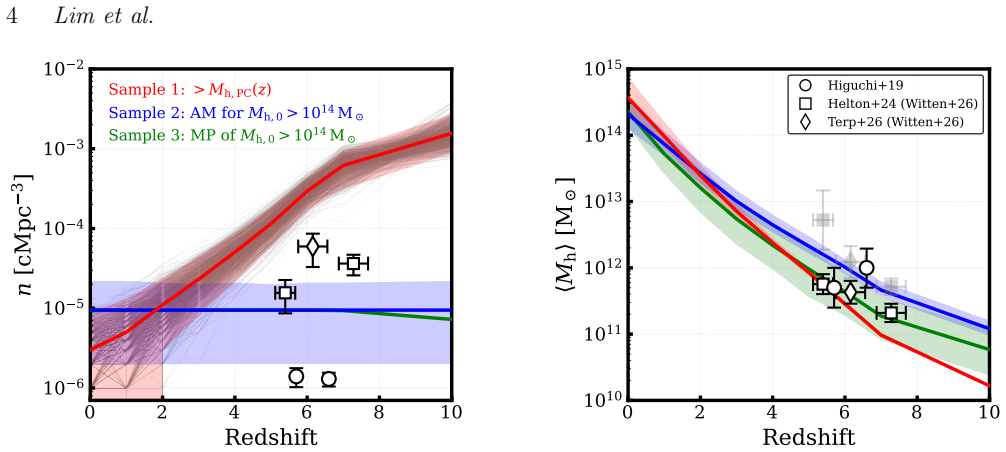
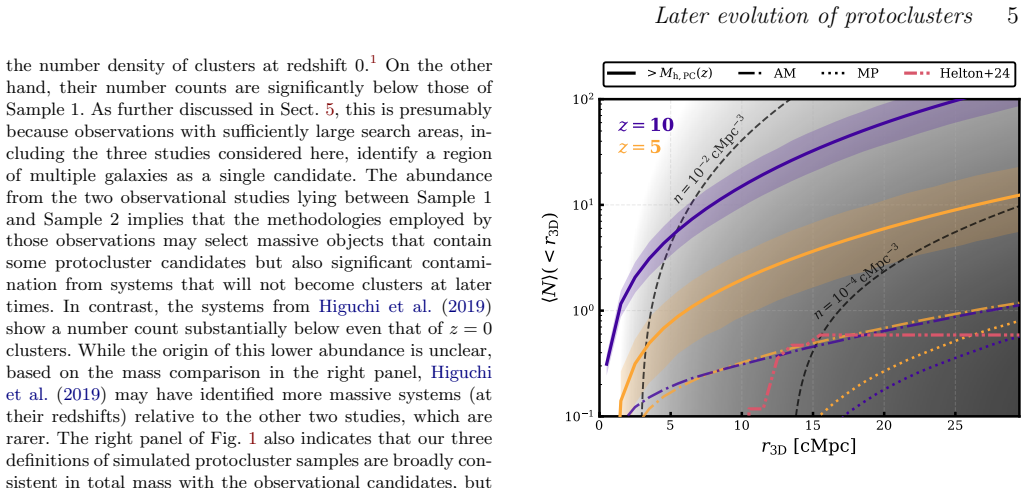
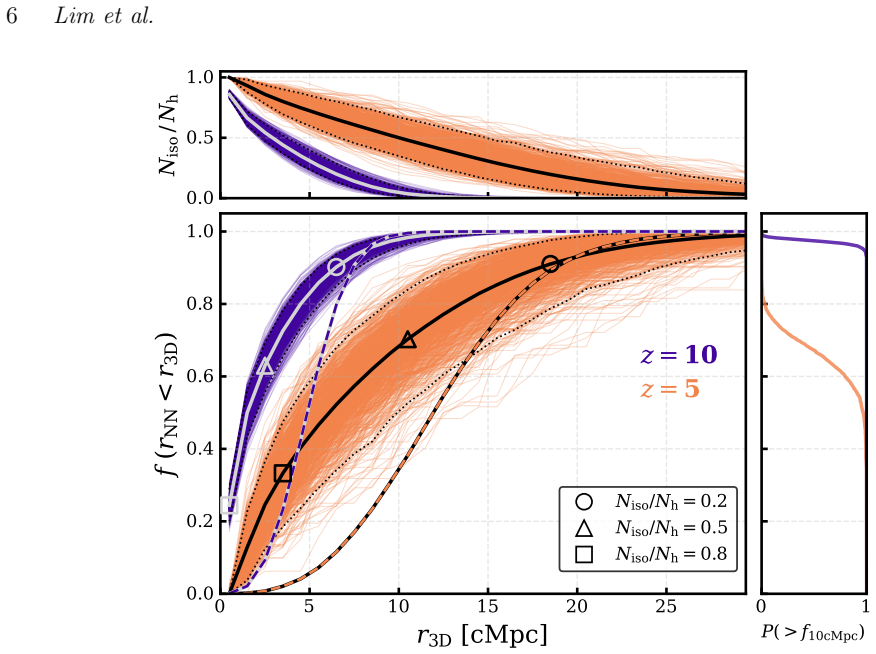
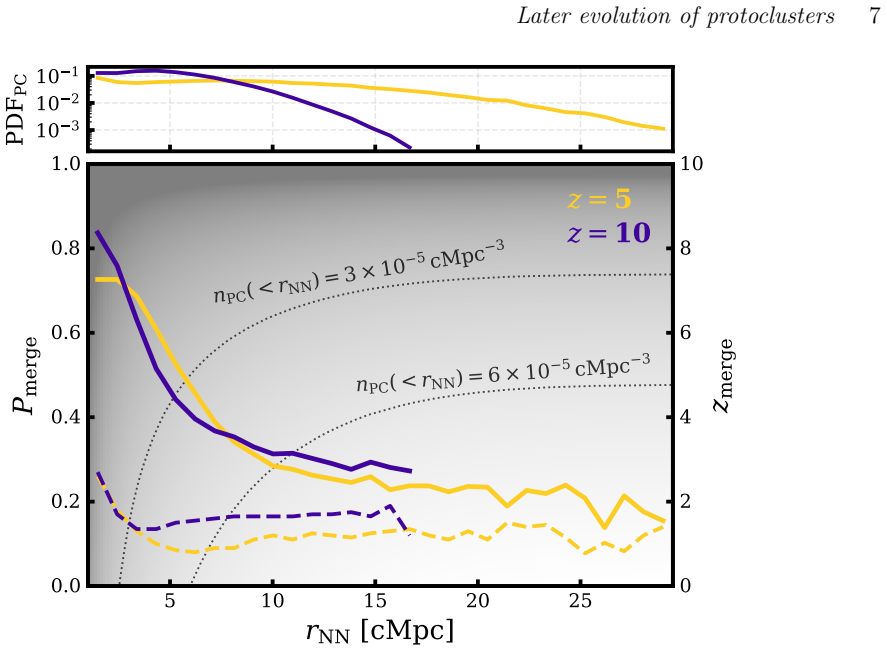
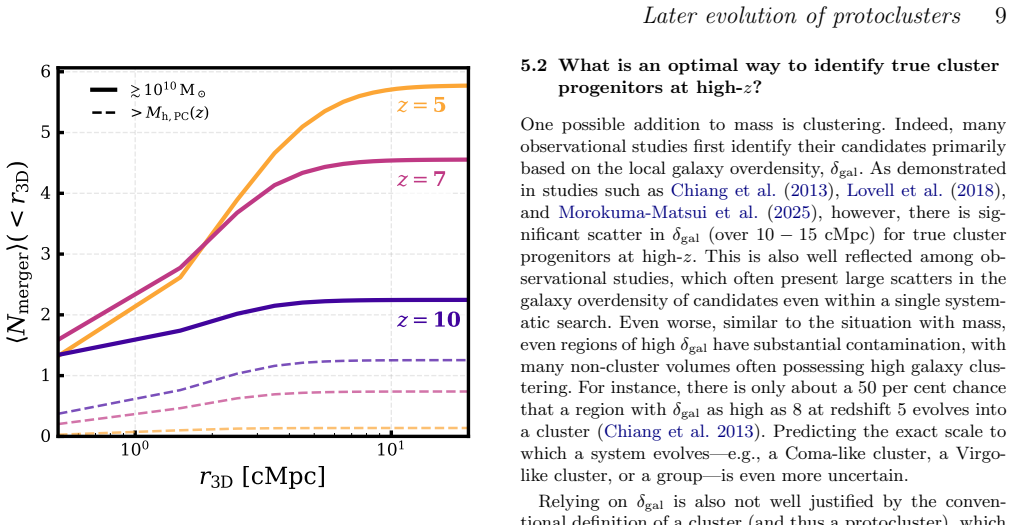
Using the FLAMINGO simulations, observationally selected protocluster candidates at z ≳ 5 have a number density that falls between the mass-selected and abundance-matched samples, indicating that searches recover both genuine cluster progenitors and significant interlopers that will not reach cluster masses by z=0. These candidates are heavily clustered, with 2-10 neighbors within 10 cMpc, and a neighbor at 5 cMpc (10 cMpc) implies ≳50% (≳30%) probability of later merging into a larger system, mostly at z ≲ 2. Each candidate experiences 2-6 later major mergers, mostly with systems too small to be identified as massive at the selection epoch, while observations exhibit weaker clustering than
What carries the argument
Comparison of three selection methods (mass-selected, abundance-matched, and observational) within the FLAMINGO simulations to track later evolution and merger histories from z ≳ 5 to z=0.
If this is right
- A candidate with a neighbor at 5 cMpc faces ≳50% chance of merging into a larger system, mostly at z ≲ 2.
- Merger counts converge beyond ~10 cMpc, marking a characteristic scale in structure formation.
- Relying only on high-z mass and galaxy overdensity produces severe scatter and systematic error in predicting final fate.
- Robust identification requires summing total galaxy mass down to faint limits inside a 10 cMpc radius.
Where Pith is reading between the lines
- Clustering strength around candidates could serve as an additional diagnostic to separate true progenitors from interlopers.
- Upcoming wide and deep surveys can test the prediction by measuring total enclosed mass rather than just bright galaxy counts.
- The mismatch between observed and simulated clustering may point to either selection biases in real data or missing processes in the models.
Load-bearing premise
The simulations correctly capture the clustering, merger rates, and mass growth of these systems from high redshift down to the present.
What would settle it
Direct measurement of how many observed z ≳ 5 protocluster candidates actually end up as z=0 clusters of the expected mass, compared against the simulated fractions.
Figures
read the original abstract
Recent observations have revealed numerous protocluster candidates at $z\,{\gtrsim}\,5$, yet whether these systems will eventually evolve into today's galaxy clusters remains an open question. Using the FLAMINGO simulations -- resolving protocluster cores up to $z\,{\simeq}\,10$ -- we track the later evolution of observationally selected protocluster candidates, comparing three selection methods against observational samples. The observed number density falls between our mass-selected and abundance-matched samples, implying that current searches pick up both genuine cluster progenitors and significant interlopers that will not reach cluster masses by $z\,{=}\,0$. We find that candidates at $z\gtrsim5$ are heavily clustered, hosting 2$-$10 neighbors within 10\,cMpc. Consequently, a candidate with a neighbor at 5\,cMpc (10\,cMpc) faces a $\gtrsim50\%$ ($\gtrsim30\%$) probability of later merging into a larger system, mostly at $z\,{\lesssim}\,2$. The merger count converges beyond ${\sim}10$\,cMpc, pointing to a fundamental scale in structure formation. Observations show markedly weaker clustering than our simulations predict, suggesting clustering offers a currently overlooked diagnostic. Each candidate undergoes roughly 2$-$6 later major mergers, mostly with systems too small to be recognized as massive at the selection epoch. Hence, relying solely on high-$z$ mass and galaxy overdensity to forecast a candidate's fate is prone to severe scatter and systematic error. A robust identification of true cluster progenitors demands a total mass sum of galaxies down to the faintest levels within a 10\,cMpc radius. Upcoming surveys with both depth and area will be key to reliably linking high-$z$ protocluster candidates to their ultimate destiny.
Editorial analysis
A structured set of objections, weighed in public.
Referee Report
Summary. The paper uses the FLAMINGO simulations to follow the z=0 descendants of protocluster candidates at z≳5. Three selection methods are compared: mass-selected, abundance-matched, and observationally selected. The observed number density is reported to lie between the mass-selected and abundance-matched samples, implying a mixture of genuine progenitors and interlopers. The simulations show strong clustering (2–10 neighbors within 10 cMpc), yielding merger probabilities of ≳50% (≳30%) for a neighbor at 5 cMpc (10 cMpc), mostly at z≲2. Observations exhibit weaker clustering than the simulations; each candidate experiences 2–6 later major mergers, mostly with systems too small to be identified at selection. The paper concludes that mass and overdensity alone are insufficient and that a total mass sum within 10 cMpc is required for robust identification.
Significance. If the simulation-based merger statistics and selection comparisons hold, the work supplies quantitative guidance on the reliability of current high-z protocluster searches and identifies clustering amplitude as a potentially useful diagnostic. The large-volume simulation approach that tracks individual systems across cosmic time is a clear methodological strength.
major comments (2)
- [Abstract] Abstract: The inference that the observed number density lying between the mass-selected and abundance-matched samples implies a substantial interloper fraction rests on the assumption that FLAMINGO correctly predicts merger probabilities from the measured clustering (e.g., neighbor at 5 cMpc → ≳50% merger probability). The same abstract states that observations show markedly weaker clustering than the simulations, creating an internal tension: if the simulated clustering (and therefore the derived merger dynamics) does not match reality, the positioning of the observed density does not reliably constrain the interloper fraction or later evolution.
- [Abstract] Abstract: No numerical values, error bars, or tables are provided for the number densities of the three samples or for the observed sample, nor are the precise definitions of the mass-selected and abundance-matched selections given. Without these, the claim that the observed density 'falls between' the two simulated samples cannot be evaluated for statistical significance or sensitivity to parameter choices.
Simulated Author's Rebuttal
We thank the referee for their constructive comments, which help clarify the presentation of our results. We address each major comment below.
read point-by-point responses
-
Referee: [Abstract] Abstract: The inference that the observed number density lying between the mass-selected and abundance-matched samples implies a substantial interloper fraction rests on the assumption that FLAMINGO correctly predicts merger probabilities from the measured clustering (e.g., neighbor at 5 cMpc → ≳50% merger probability). The same abstract states that observations show markedly weaker clustering than the simulations, creating an internal tension: if the simulated clustering (and therefore the derived merger dynamics) does not match reality, the positioning of the observed density does not reliably constrain the interloper fraction or later evolution.
Authors: The number density comparison and resulting implication for interlopers is based on the high-redshift selection statistics in the simulations versus observations, not directly on the merger probabilities. The merger probabilities are derived separately from the clustering properties within the simulations. We do note the discrepancy in clustering strength between simulations and observations, which we interpret as suggesting that clustering amplitude could serve as an additional diagnostic. However, we agree that this discrepancy introduces some uncertainty when applying the simulated merger rates to observed systems. We will revise the abstract to explicitly separate these points and add a caveat regarding the applicability of the merger statistics to observations given the clustering difference. revision: partial
-
Referee: [Abstract] Abstract: No numerical values, error bars, or tables are provided for the number densities of the three samples or for the observed sample, nor are the precise definitions of the mass-selected and abundance-matched selections given. Without these, the claim that the observed density 'falls between' the two simulated samples cannot be evaluated for statistical significance or sensitivity to parameter choices.
Authors: We agree that including specific numerical values and clearer definitions in the abstract would improve the accessibility of the key result. The full paper provides the definitions of the mass-selected and abundance-matched samples, along with the number densities in the relevant sections. We will update the abstract to include approximate number density values (with uncertainties where applicable) and brief definitions of the selection methods. revision: yes
Circularity Check
No circularity: external simulation outputs compared to independent observations without reduction to fitted inputs or self-citations.
full rationale
The paper defines mass-selected and abundance-matched samples within the FLAMINGO simulations and tracks their z=0 descendants, then positions the externally measured observed number density between those two simulated distributions to infer a mix of progenitors and interlopers. Clustering statistics, neighbor counts, and merger probabilities are computed directly from the simulation particle data without any fitting or tuning to the target observational number density or clustering measurements. The noted mismatch between simulated and observed clustering is reported as an output rather than an input. No self-citations, ansatzes, or uniqueness theorems are invoked to justify the central claims, and the derivation remains self-contained against external benchmarks.
Axiom & Free-Parameter Ledger
axioms (1)
- domain assumption FLAMINGO simulations correctly capture the physics and statistics of protocluster evolution and mergers at z ≳ 5.
Reference graph
Works this paper leans on
-
[1]
Too many protoclusters? Reconciling the overabundance of cluster progenitors within the first billion years of the Universe. arXiv e-prints , keywords =. doi:10.48550/arXiv.2605.28930 , archivePrefix =. 2605.28930 , primaryClass =
work page internal anchor Pith review Pith/arXiv arXiv doi:10.48550/arxiv.2605.28930
-
[2]
EPOCHS paper ─ X. Environmental effects on Galaxy formation and protocluster Galaxy candidates at 4.5 < z < 10 from JWST observations. , keywords =. doi:10.1093/mnras/staf543 , archivePrefix =. 2405.17359 , primaryClass =
-
[3]
A Quasar-anchored Protocluster at z = 6.6 in the ASPIRE Survey. I. Properties of [O III] Emitters in a 10 Mpc Overdensity Structure. , keywords =. doi:10.3847/1538-4357/adb1bd , archivePrefix =. 2410.03826 , primaryClass =
-
[4]
JADES: A Prominent Galaxy Overdensity Candidate within the First 500 Myr
JADES: A Prominent Galaxy Overdensity Candidate within the First 500 Myr. arXiv e-prints , keywords =. doi:10.48550/arXiv.2601.15960 , archivePrefix =. 2601.15960 , primaryClass =
work page internal anchor Pith review Pith/arXiv arXiv doi:10.48550/arxiv.2601.15960
-
[5]
Photometrically selected protocluster candidates at in the JWST COSMOS-Web field. , keywords =. doi:10.1017/pasa.2025.10096 , archivePrefix =. 2510.20172 , primaryClass =
-
[6]
Quantifying the Impact of Incompleteness on Identifying and Interpreting Galaxy Protocluster Populations with the TNG-Cluster Simulation. , keywords =. doi:10.3847/1538-4357/adf644 , archivePrefix =. 2504.03836 , primaryClass =
-
[7]
What are Protoclusters? -- Defining High Redshift Galaxy Clusters and Protoclusters
What are protoclusters? - Defining high-redshift galaxy clusters and protoclusters. , keywords =. doi:10.1093/mnras/stv1449 , archivePrefix =. 1506.08835 , primaryClass =
work page internal anchor Pith review Pith/arXiv arXiv doi:10.1093/mnras/stv1449
-
[8]
Galaxy evolution in protoclusters
Galaxy evolution in protoclusters. , keywords =. doi:10.1093/mnras/stx2454 , archivePrefix =. 1709.07009 , primaryClass =
work page internal anchor Pith review Pith/arXiv arXiv doi:10.1093/mnras/stx2454
-
[9]
All the Massive Galaxy Overdensities during Reionization: JWST Rest-Frame Optical Selection Reveals Young, Chemically Evolved Galaxies Embedded in Dense, Neutral Gas at z > 5. arXiv e-prints , keywords =. doi:10.48550/arXiv.2602.09091 , archivePrefix =. 2602.09091 , primaryClass =
work page internal anchor Pith review Pith/arXiv arXiv doi:10.48550/arxiv.2602.09091
-
[10]
The FLAMINGO simulations data release
The FLAMINGO simulations data release. arXiv e-prints , keywords =. doi:10.48550/arXiv.2604.24324 , archivePrefix =. 2604.24324 , primaryClass =
work page internal anchor Pith review Pith/arXiv arXiv doi:10.48550/arxiv.2604.24324
-
[11]
HBT+: an improved code for finding subhalos and building merger trees in cosmological simulations
HBT+: an improved code for finding subhaloes and building merger trees in cosmological simulations. , keywords =. doi:10.1093/mnras/stx2792 , archivePrefix =. 1708.03646 , primaryClass =
work page internal anchor Pith review Pith/arXiv arXiv doi:10.1093/mnras/stx2792
-
[12]
Assessing subhalo finders in cosmological hydrodynamical simulations. , keywords =. doi:10.1093/mnras/staf1478 , archivePrefix =. 2502.06932 , primaryClass =
-
[13]
Galaxy Formation and Evolution
-
[14]
, year = 2005, month = apr, volume =
The effects of reionization on Ly galaxy surveys. , keywords =. doi:10.1111/j.1365-2966.2005.09785.x , archivePrefix =. astro-ph/0507266 , primaryClass =
-
[15]
Identification of the brightest Ly emitters at z = 6.6: implications for the evolution of the luminosity function in the reionization era. , keywords =. doi:10.1093/mnras/stv947 , archivePrefix =. 1502.07355 , primaryClass =
work page internal anchor Pith review Pith/arXiv arXiv doi:10.1093/mnras/stv947
-
[16]
A Very Compact Dense Galaxy Overdensity with ≃ 130 Identified at z 8: Implications for Early Protocluster and Cluster Core Formation. , keywords =. doi:10.3847/0004-637X/822/1/5 , archivePrefix =. 1509.01751 , primaryClass =
work page internal anchor Pith review Pith/arXiv arXiv doi:10.3847/0004-637x/822/1/5
-
[17]
The realm of the galaxy protoclusters
The realm of the galaxy protoclusters. A review. , keywords =. doi:10.1007/s00159-016-0100-3 , archivePrefix =. 1610.05201 , primaryClass =
work page internal anchor Pith review Pith/arXiv arXiv doi:10.1007/s00159-016-0100-3
-
[18]
A massive, distant proto-cluster at z=2.47 caught in a phase of rapid formation?
A Massive, Distant Proto-cluster at z = 2.47 Caught in a Phase of Rapid Formation?. , keywords =. doi:10.1088/2041-8205/808/2/L33 , archivePrefix =. 1506.01715 , primaryClass =
work page internal anchor Pith review Pith/arXiv arXiv doi:10.1088/2041-8205/808/2/l33 2041
-
[19]
ALMA Deep Field in SSA22: A concentration of dusty starbursts in a z=3.09 protocluster core
ALMA Deep Field in SSA22: A Concentration of Dusty Starbursts in a z = 3.09 Protocluster Core. , keywords =. doi:10.1088/2041-8205/815/1/L8 , archivePrefix =. 1510.08861 , primaryClass =
work page internal anchor Pith review Pith/arXiv arXiv doi:10.1088/2041-8205/815/1/l8 2041
-
[20]
Galaxy Protoclusters as Drivers of Cosmic Star-Formation History in the First 2 Gyr
Galaxy Protoclusters as Drivers of Cosmic Star Formation History in the First 2 Gyr. , keywords =. doi:10.3847/2041-8213/aa7e7b , archivePrefix =. 1705.01634 , primaryClass =
work page internal anchor Pith review Pith/arXiv arXiv doi:10.3847/2041-8213/aa7e7b 2041
-
[21]
A Detailed Study of Massive Galaxies in a Protocluster at z = 3.13. , keywords =. doi:10.3847/1538-4357/aba626 , archivePrefix =. 2007.07055 , primaryClass =
-
[22]
Is there enough star formation in simulated protoclusters?. , keywords =. doi:10.1093/mnras/staa3693 , archivePrefix =. 2010.02259 , primaryClass =
-
[23]
Ancient Light from Young Cosmic Cities: Physical and Observational Signatures of Galaxy Proto-clusters. , keywords =. doi:10.1088/0004-637X/779/2/127 , archivePrefix =. 1310.2938 , primaryClass =
work page internal anchor Pith review Pith/arXiv arXiv doi:10.1088/0004-637x/779/2/127
-
[24]
From Clusters to Proto-Clusters: The Infrared Perspective on Environmental Galaxy Evolution. Universe , keywords =. doi:10.3390/universe8110554 , archivePrefix =. 2209.02781 , primaryClass =
-
[25]
Discovery of a protocluster at z~6
Discovery of a Protocluster at z -0.5ex 6. , keywords =. doi:10.1088/0004-637X/750/2/137 , archivePrefix =. 1203.1326 , primaryClass =
work page internal anchor Pith review Pith/arXiv arXiv doi:10.1088/0004-637x/750/2/137
-
[26]
A First Site of Galaxy Cluster Formation: Complete Spectroscopy of a Protocluster at $z=6.01$
A First Site of Galaxy Cluster Formation: Complete Spectroscopy of a Protocluster at z = 6.01. , keywords =. doi:10.1088/0004-637X/792/1/15 , archivePrefix =. 1407.1851 , primaryClass =
work page internal anchor Pith review Pith/arXiv arXiv doi:10.1088/0004-637x/792/1/15
-
[27]
A Systematic Survey of Protoclusters at $z\sim3\mathrm{-}6$ in the CFHTLS Deep Fields
A Systematic Survey of Protoclusters at z -0.5ex 3-6 in the CFHTLS Deep Fields. , keywords =. doi:10.3847/0004-637X/826/2/114 , archivePrefix =. 1605.01439 , primaryClass =
work page internal anchor Pith review Pith/arXiv arXiv doi:10.3847/0004-637x/826/2/114
-
[28]
GOLDRUSH. III. A systematic search for protoclusters at z 4 based on the >100 deg ^ 2 area. , keywords =. doi:10.1093/pasj/psx102 , archivePrefix =. 1708.09421 , primaryClass =
work page internal anchor Pith review Pith/arXiv arXiv doi:10.1093/pasj/psx102
-
[29]
Spectroscopic Confirmation of a Coma Cluster Progenitor at z 2.2. , keywords =. doi:10.3847/1538-4357/ab75c3 , archivePrefix =. 2002.06207 , primaryClass =
-
[30]
The JWST Advanced Deep Extragalactic Survey: Discovery of an Extreme Galaxy Overdensity at z = 5.4 with JWST/NIRCam in GOODS-S. , keywords =. doi:10.3847/1538-4357/ad0da7 , archivePrefix =. 2302.10217 , primaryClass =
-
[31]
Identification of High-redshift Galaxy Overdensities in GOODS-N and GOODS-S. , keywords =. doi:10.3847/1538-4357/ad6867 , archivePrefix =. 2311.04270 , primaryClass =
-
[32]
The Discovery of Primeval Large-Scale Structures with Forming Clusters at Redshift 6
The Discovery of Primeval Large-Scale Structures with Forming Clusters at Redshift 6. , keywords =. doi:10.1086/428499 , archivePrefix =. astro-ph/0412648 , primaryClass =
work page internal anchor Pith review Pith/arXiv arXiv doi:10.1086/428499
-
[33]
The discovery of the first luminous z -0.5ex 6 quasar in the UKIDSS Large Area Survey. , keywords =. doi:10.1111/j.1745-3933.2007.00290.x , archivePrefix =. astro-ph/0612162 , primaryClass =
-
[34]
Discovery of a Very Large Structure at Z=3.78
Discovery of a Very Large Structure at z = 3.78. , keywords =. doi:10.1088/0004-637X/796/2/126 , archivePrefix =. 1405.2620 , primaryClass =
work page internal anchor Pith review Pith/arXiv arXiv doi:10.1088/0004-637x/796/2/126
-
[35]
Spectroscopic Confirmation of a Protocluster at z=3.786
Spectroscopic Confirmation of a Protocluster at z 3.786. , keywords =. doi:10.3847/0004-637X/823/1/11 , archivePrefix =. 1604.08627 , primaryClass =
work page internal anchor Pith review Pith/arXiv arXiv doi:10.3847/0004-637x/823/1/11
-
[36]
Physical Properties of a Coma-analog Protocluster at z = 6.5. , keywords =. doi:10.3847/1538-4357/ab1a34 , adsurl =
-
[37]
GTC Observations of an Overdense Region of LAEs at z=6.5
Gran Telescopio Canarias observations of an overdense region of Lyman emitters at z = 6.5. , keywords =. doi:10.1093/mnras/stx782 , archivePrefix =. 1703.10043 , primaryClass =
work page internal anchor Pith review Pith/arXiv arXiv doi:10.1093/mnras/stx782
-
[38]
A Giant Protocluster of Galaxies at Redshift 5.7
A giant protocluster of galaxies at redshift 5.7. Nature Astronomy , keywords =. doi:10.1038/s41550-018-0587-9 , archivePrefix =. 1810.05765 , primaryClass =
work page internal anchor Pith review Pith/arXiv arXiv doi:10.1038/s41550-018-0587-9
-
[39]
SILVERRUSH. VIII. Spectroscopic Identifications of Early Large-scale Structures with Protoclusters over 200 Mpc at z 6-7: Strong Associations of Dusty Star-forming Galaxies. , keywords =. doi:10.3847/1538-4357/ab2cd5 , archivePrefix =. 1902.09555 , primaryClass =
-
[40]
SILVERRUSH. VII. Subaru/HSC Identifications of Protocluster Candidates at z 6-7: Implications for Cosmic Reionization. , keywords =. doi:10.3847/1538-4357/ab2192 , archivePrefix =. 1801.00531 , primaryClass =
work page internal anchor Pith review Pith/arXiv arXiv doi:10.3847/1538-4357/ab2192
-
[41]
An extreme proto-cluster of luminous dusty starbursts in the early Universe
An Extreme Protocluster of Luminous Dusty Starbursts in the Early Universe. , keywords =. doi:10.3847/1538-4357/aaa1f1 , archivePrefix =. 1709.02809 , primaryClass =
work page internal anchor Pith review Pith/arXiv arXiv doi:10.3847/1538-4357/aaa1f1
-
[42]
Do Submillimeter Galaxies Really Trace the Most Massive Dark-Matter Halos? Discovery of a High-z Cluster in a Highly Active Phase of Evolution. , keywords =. doi:10.1088/0004-637X/691/1/560 , archivePrefix =. 0809.1159 , primaryClass =
work page internal anchor Pith review Pith/arXiv arXiv doi:10.1088/0004-637x/691/1/560
-
[43]
A massive core for a cluster of galaxies at a redshift of 4.3
A massive core for a cluster of galaxies at a redshift of 4.3. , keywords =. doi:10.1038/s41586-018-0025-2 , archivePrefix =. 1804.09231 , primaryClass =
work page internal anchor Pith review Pith/arXiv arXiv doi:10.1038/s41586-018-0025-2
-
[44]
Megaparsec-scale structure around the protocluster core SPT2349-56 at z = 4.3. , keywords =. doi:10.1093/mnras/staa1275 , archivePrefix =. 2002.11600 , primaryClass =
-
[45]
Overdensities of submillimetre-bright sources around candidate protocluster cores selected from the South Pole Telescope survey. , keywords =. doi:10.1093/mnras/stab2800 , archivePrefix =. 2010.02909 , primaryClass =
-
[46]
The Habitat Segregation between Lyman Break Galaxies and Lyman alpha Emitters around a QSO at z~5
The Habitat Segregation between Lyman Break Galaxies and Ly Emitters around a QSO at z -0.5ex 5. , keywords =. doi:10.1086/518410 , archivePrefix =. 0704.2238 , primaryClass =
work page internal anchor Pith review Pith/arXiv arXiv doi:10.1086/518410
-
[47]
EIGER. I. A Large Sample of [O III]-emitting Galaxies at 5.3 < z < 6.9 and Direct Evidence for Local Reionization by Galaxies. , keywords =. doi:10.3847/1538-4357/acc588 , archivePrefix =. 2211.08254 , primaryClass =
-
[48]
The Serendipitous Discovery of a Group or Cluster of Young Galaxies at z2.40 in Deep Hubble Space Telescope WFPC2 Images. , keywords =. doi:10.1086/309852 , archivePrefix =. astro-ph/9512033 , primaryClass =
work page internal anchor Pith review Pith/arXiv arXiv doi:10.1086/309852
-
[49]
Discovery of six Ly alpha emitters near a radio galaxy at z ~ 5.2
Discovery of six Ly emitters near a radio galaxy at z 5.2. , keywords =. doi:10.1051/0004-6361:200400041 , archivePrefix =. astro-ph/0408520 , primaryClass =
work page internal anchor Pith review Pith/arXiv arXiv doi:10.1051/0004-6361:200400041
-
[50]
Properties of Ly-alpha emitters around the radio galaxy MRC 0316-257
Properties of Ly emitters around the radio galaxy MRC 0316 257 ^ ,. , keywords =. doi:10.1051/0004-6361:20042038 , archivePrefix =. astro-ph/0501259 , primaryClass =
work page internal anchor Pith review Pith/arXiv arXiv doi:10.1051/0004-6361:20042038
-
[51]
ODIN: Where Do Ly Blobs Live? Contextualizing Blob Environments within Large-scale Structure. , keywords =. doi:10.3847/1538-4357/acd341 , archivePrefix =. 2302.07860 , primaryClass =
-
[52]
A lensed protocluster candidate at z = 7.66 identified in JWST observations of the galaxy cluster SMACS0723 - 7327. , keywords =. doi:10.1051/0004-6361/202244719 , archivePrefix =. 2208.04930 , primaryClass =
-
[53]
Early Results from GLASS-JWST. XIV. A Spectroscopically Confirmed Protocluster 650 Million Years after the Big Bang. , keywords =. doi:10.3847/2041-8213/acb99e , archivePrefix =. 2211.09097 , primaryClass =
-
[54]
New insights into the most distant Ly detection
GN-z11: The environment of an active galactic nucleus at z = 10.603. New insights into the most distant Ly detection. , keywords =. doi:10.1051/0004-6361/202347187 , archivePrefix =. 2306.09142 , primaryClass =
-
[55]
JADES Imaging of GN-z11: Revealing the Morphology and Environment of a Luminous Galaxy 430 Myr after the Big Bang. , keywords =. doi:10.3847/1538-4357/acdbc6 , archivePrefix =. 2302.07234 , primaryClass =
-
[56]
A SPectroscopic Survey of Biased Halos in the Reionization Era (ASPIRE): JWST Reveals a Filamentary Structure around a z = 6.61 Quasar. , keywords =. doi:10.3847/2041-8213/accd6f , archivePrefix =. 2304.09894 , primaryClass =
-
[57]
Systematic Identification of LAEs for Visible Exploration and Reionization Research Using Subaru HSC (SILVERRUSH). I. Program strategy and clustering properties of 2000 Ly emitters at z = 6-7 over the 0.3-0.5 Gpc ^ 2 survey area. , keywords =. doi:10.1093/pasj/psx074 , archivePrefix =. 1704.07455 , primaryClass =
work page internal anchor Pith review Pith/arXiv arXiv doi:10.1093/pasj/psx074 2000
-
[58]
The FLAMINGO project: cosmological hydrodynamical simulations for large-scale structure and galaxy cluster surveys. , keywords =. doi:10.1093/mnras/stad2419 , archivePrefix =. 2306.04024 , primaryClass =
-
[59]
FLAMINGO: calibrating large cosmological hydrodynamical simulations with machine learning. , keywords =. doi:10.1093/mnras/stad2540 , archivePrefix =. 2306.05492 , primaryClass =
-
[60]
The BAHAMAS project: Calibrated hydrodynamical simulations for large-scale structure cosmology
The BAHAMAS project: calibrated hydrodynamical simulations for large-scale structure cosmology. , keywords =. doi:10.1093/mnras/stw2792 , archivePrefix =. 1603.02702 , primaryClass =
work page internal anchor Pith review Pith/arXiv arXiv doi:10.1093/mnras/stw2792
-
[61]
The BAHAMAS project: the CMB-large-scale structure tension and the roles of massive neutrinos and galaxy formation. , keywords =. doi:10.1093/mnras/sty377 , archivePrefix =. 1712.02411 , primaryClass =
work page internal anchor Pith review Pith/arXiv arXiv doi:10.1093/mnras/sty377
-
[62]
Dark Energy Survey Year 3 Results: Cosmological Constraints from Galaxy Clustering and Weak Lensing
Dark Energy Survey Year 3 results: Cosmological constraints from galaxy clustering and weak lensing. , keywords =. doi:10.1103/PhysRevD.105.023520 , archivePrefix =. 2105.13549 , primaryClass =
work page internal anchor Pith review Pith/arXiv arXiv doi:10.1103/physrevd.105.023520
-
[63]
Planck 2018 results. VI. Cosmological parameters. , keywords =. doi:10.1051/0004-6361/201833910 , archivePrefix =. 1807.06209 , primaryClass =
work page internal anchor Pith review Pith/arXiv arXiv doi:10.1051/0004-6361/201833910 2018
-
[64]
Consistent lensing and clustering in a low-S _ 8 Universe with BOSS, DES Year 3, HSC Year 1, and KiDS-1000. , keywords =. doi:10.1093/mnras/stac2938 , archivePrefix =. 2202.07440 , primaryClass =
-
[65]
SWIFT: A modern highly-parallel gravity and smoothed particle hydrodynamics solver for astrophysical and cosmological applications. , keywords =. doi:10.1093/mnras/stae922 , archivePrefix =. 2305.13380 , primaryClass =
-
[66]
The physics driving the cosmic star formation history. , keywords =. doi:10.1111/j.1365-2966.2009.16029.x , archivePrefix =. 0909.5196 , primaryClass =
-
[67]
The EAGLE project: Simulating the evolution and assembly of galaxies and their environments
The EAGLE project: simulating the evolution and assembly of galaxies and their environments. , keywords =. doi:10.1093/mnras/stu2058 , archivePrefix =. 1407.7040 , primaryClass =
work page internal anchor Pith review Pith/arXiv arXiv doi:10.1093/mnras/stu2058
-
[68]
Towards a realistic population of simulated galaxy groups and clusters
Towards a realistic population of simulated galaxy groups and clusters. , keywords =. doi:10.1093/mnras/stu608 , archivePrefix =. 1312.5462 , primaryClass =
work page internal anchor Pith review Pith/arXiv arXiv doi:10.1093/mnras/stu608
-
[69]
Radiative cooling rates, ion fractions, molecule abundances, and line emissivities including self-shielding and both local and metagalactic radiation fields. , keywords =. doi:10.1093/mnras/staa2172 , archivePrefix =. 2006.14322 , primaryClass =
-
[70]
2007, MNRAS, 376, 1145, doi: 10.1111/j.1365-2966.2007.11495.x
On the relation between the Schmidt and Kennicutt-Schmidt star formation laws and its implications for numerical simulations. , keywords =. doi:10.1111/j.1365-2966.2007.12639.x , archivePrefix =. 0709.0292 , primaryClass =
-
[71]
Galactic Stellar and Substellar Initial Mass Function
Galactic Stellar and Substellar Initial Mass Function. , keywords =. doi:10.1086/376392 , archivePrefix =. astro-ph/0304382 , primaryClass =
work page internal anchor Pith review Pith/arXiv arXiv doi:10.1086/376392
-
[72]
Chemical enrichment in cosmological, smoothed particle hydrodynamics simulations. , keywords =. doi:10.1111/j.1365-2966.2009.15331.x , archivePrefix =. 0902.1535 , primaryClass =
-
[73]
Simulating galactic outflows with kinetic supernova feedback. , keywords =. doi:10.1111/j.1365-2966.2008.13322.x , archivePrefix =. 0801.2770 , primaryClass =
-
[74]
Direct cosmological simulations of the growth of black holes and galaxies
Direct Cosmological Simulations of the Growth of Black Holes and Galaxies. , keywords =. doi:10.1086/524921 , archivePrefix =. 0705.2269 , primaryClass =
work page internal anchor Pith review Pith/arXiv arXiv doi:10.1086/524921
-
[75]
Cosmological simulations of the growth of supermassive black holes and feedback from active galactic nuclei: method and tests. , keywords =. doi:10.1111/j.1365-2966.2009.15043.x , archivePrefix =. 0904.2572 , primaryClass =
-
[76]
, year = 2005, month = apr, volume =
Modelling feedback from stars and black holes in galaxy mergers. , keywords =. doi:10.1111/j.1365-2966.2005.09238.x , archivePrefix =. astro-ph/0411108 , primaryClass =
-
[77]
The EAGLE simulations of galaxy formation: calibration of subgrid physics and model variations
The EAGLE simulations of galaxy formation: calibration of subgrid physics and model variations. , keywords =. doi:10.1093/mnras/stv725 , archivePrefix =. 1501.01311 , primaryClass =
work page internal anchor Pith review Pith/arXiv arXiv doi:10.1093/mnras/stv725
-
[78]
The importance of black hole repositioning for galaxy formation simulations. , keywords =. doi:10.1093/mnras/stac1339 , archivePrefix =. 2109.01489 , primaryClass =
-
[79]
Simulating Galaxy Formation with the IllustrisTNG Model
Simulating galaxy formation with the IllustrisTNG model. , keywords =. doi:10.1093/mnras/stx2656 , archivePrefix =. 1703.02970 , primaryClass =
work page internal anchor Pith review Pith/arXiv arXiv doi:10.1093/mnras/stx2656
-
[80]
Hunting for Galaxies and Halos in simulations with VELOCIraptor
Hunting for galaxies and halos in simulations with VELOCIraptor. , keywords =. doi:10.1017/pasa.2019.12 , archivePrefix =. 1902.01010 , primaryClass =
work page internal anchor Pith review Pith/arXiv arXiv doi:10.1017/pasa.2019.12 2019
discussion (0)
Sign in with ORCID, Apple, or X to comment. Anyone can read and Pith papers without signing in.