Methodological guidelines for circadian modeling of Daylight Saving Time: application to the United States
Pith reviewed 2026-06-26 18:35 UTC · model grok-4.3
The pith
A sign reversal in longitude offset inverted the US east-west axis in a prior circadian health study.
A machine-rendered reading of the paper's core claim, the machinery that carries it, and where it could break.
Core claim
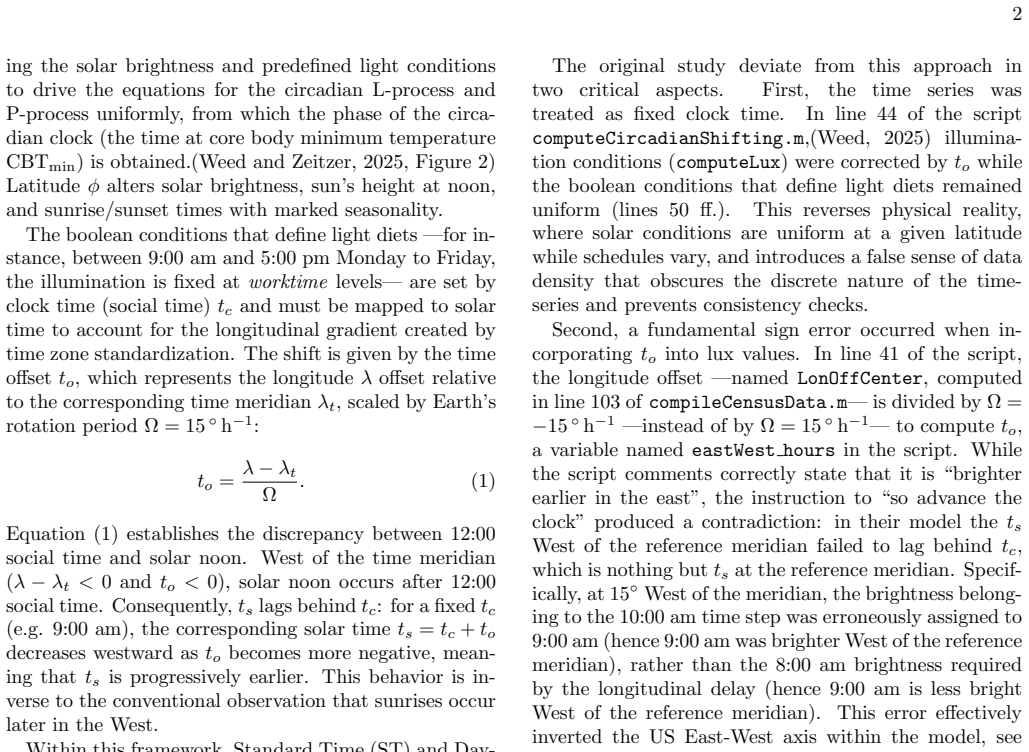
The prior study contained a fundamental computational error in which a sign reversal of the longitudinal offset effectively inverted the US East-West axis, cross-correlating local health data with the circadian burden of hypothetical locations on the opposite side of a time zone. The report outlines the methodology for a correct modelization of the circadian process in the context of US geography, emphasizing precise synchronization between solar and social time.
What carries the argument
The longitudinal offset calculation that aligns local solar time with social clock time for each US location during daylight saving transitions.
If this is right
- Any re-analysis of US health data against seasonal clock exposure must use the corrected longitudinal offset to avoid mapping data to the wrong side of each time zone.
- Models of circadian burden from daylight saving time must synchronize solar noon with social time on a location-by-location basis within each time zone.
- Future studies associating clock changes with health outcomes in the United States require explicit verification that east-west geography is preserved in the offset term.
Where Pith is reading between the lines
- The same sign error could appear in other national-scale studies that combine health records with geographic time-zone adjustments.
- Correcting the offset would allow direct comparison of circadian load between eastern and western edges of a single time zone rather than across the country in reverse.
- The guidelines could be applied to other countries with large east-west spans and daylight saving rules to test similar associations.
Load-bearing premise
The description in the prior study is sufficient to diagnose the sign reversal without needing its code or raw data.
What would settle it
Recomputing the original disease correlations after flipping the sign of the longitude offset back to the correct direction and checking whether the reported associations persist or change.
Figures
read the original abstract
Modeling the circadian impact of seasonal clock changing requires precise synchronization between solar and social time. This report critiques a recent study that associated disease prevalence in the United States with seasonal clock exposure. We identify a fundamental computational error in which a sign reversal of the longitudinal offset effectively inverted the US East-West axis, cross-correlating local health data with the circadian burden of hypothetical locations on the opposite side of a time zone. We outline the methodology for a correct modelization of the circadian process in the context of US geography.
Editorial analysis
A structured set of objections, weighed in public.
Referee Report
Summary. The manuscript critiques a recent study linking US disease prevalence to seasonal clock exposure under Daylight Saving Time, asserting a fundamental computational error in which a sign reversal of the longitudinal offset inverts the East-West axis and cross-correlates health data with circadian burdens from hypothetical opposite-side locations. It outlines methodological guidelines for correct circadian modeling that precisely synchronizes solar and social time with US geography.
Significance. If the error identification is substantiated with explicit verification, the work would usefully flag a methodological pitfall in chronobiology and public-health modeling of DST effects. The provision of corrective guidelines could improve future studies by emphasizing accurate longitudinal handling, though the manuscript's impact depends on demonstrating that the identified error materially alters the prior study's conclusions.
major comments (2)
- [Section identifying the computational error in the prior study] The central claim of a sign reversal inverting the US East-West axis is diagnosed solely from textual interpretation of the prior study's published description. Without re-deriving the offset calculation from raw inputs, code, or data (as required to rule out alternative conventions for reference meridian or time-zone boundary handling), the inversion conclusion is not uniquely established and remains open to ambiguity.
- [Methodology guidelines for correct modelization] No quantitative demonstration is provided showing how the corrected longitudinal offset changes the cross-correlation results or disease-prevalence associations relative to the claimed erroneous version. This leaves the practical significance of the error unverified and weakens the case that the prior findings are invalidated.
minor comments (2)
- The abstract and introduction should explicitly cite the full reference (including arXiv or DOI) of the critiqued study rather than referring only to 'a recent study'.
- Figure or table comparing the erroneous versus corrected longitudinal offsets across sample US locations would improve clarity of the methodological correction.
Simulated Author's Rebuttal
We thank the referee for their careful review and constructive comments on our manuscript. We address each major comment below.
read point-by-point responses
-
Referee: [Section identifying the computational error in the prior study] The central claim of a sign reversal inverting the US East-West axis is diagnosed solely from textual interpretation of the prior study's published description. Without re-deriving the offset calculation from raw inputs, code, or data (as required to rule out alternative conventions for reference meridian or time-zone boundary handling), the inversion conclusion is not uniquely established and remains open to ambiguity.
Authors: Our identification of the sign reversal rests on the prior study's explicit published description of the longitudinal offset formula and its application to US locations. This description specifies the computational steps in sufficient detail to reconstruct the sign error and resulting East-West inversion without ambiguity. While we agree that access to the original raw data or code would allow independent numerical verification, such materials are not available, and the published text constitutes the definitive record of the method used. Alternative conventions for reference meridians or time-zone boundaries are not indicated in the prior description and would not alter the sign-reversal outcome as stated. revision: no
-
Referee: [Methodology guidelines for correct modelization] No quantitative demonstration is provided showing how the corrected longitudinal offset changes the cross-correlation results or disease-prevalence associations relative to the claimed erroneous version. This leaves the practical significance of the error unverified and weakens the case that the prior findings are invalidated.
Authors: We acknowledge that the current manuscript does not include a side-by-side quantitative comparison of results under the erroneous versus corrected offset. The primary aim is to identify the methodological pitfall and provide guidelines for accurate circadian modeling. In the revised manuscript we will add a quantitative illustration, using a simplified cross-correlation example with representative US longitude data, to demonstrate the directional change in associations that results from correcting the sign error. revision: yes
- Without access to the prior study's raw inputs, code, or data, we cannot perform an independent numerical re-derivation of the offset calculation to exclude every conceivable alternative convention.
Circularity Check
No circularity: critique of external study relies on textual interpretation, not self-referential derivation
full rationale
The paper's central claim is an identification of a sign-reversal error in a prior external study's longitudinal offset calculation, diagnosed from the published description alone. No equations, predictions, or first-principles results in the present work reduce to its own inputs by construction. No self-citations are load-bearing for any derivation, and the methodology outlined is presented as corrective guidelines rather than a fitted or renamed result. This is a standard external critique with no internal circular steps.
Axiom & Free-Parameter Ledger
Reference graph
Works this paper leans on
-
[1]
author author Annonymous , ( year 2026 ),\ title title Correction for weed and zeitzer, circadian-informed modeling predicts regional variation in obesity and stroke outcomes under different permanent us time policies , \ https://doi.org/10.1073/PNAS.2612351123 journal journal Proceedings of the National Academy of Sciences \ volume 123 ,\ pages e26123511...
-
[2]
author author Crameri , Fabio ( year 2023 ),\ https://doi.org/10.5281/zenodo.1243862 title Scientific colour maps , \ NoStop
-
[3]
author author Erren , Thomas C , author Philip \ Lewis , and\ author Peter \ Morfeld ( year 2026 ),\ title title Challenges of county-level circadian modeling for time-policy debates , \ https://doi.org/10.1073/PNAS.2527389123 journal journal Proceedings of the National Academy of Sciences \ volume 123 ,\ pages e2527389123 NoStop
-
[4]
author author Hudson , George Vernon ( year 1895 ),\ title title On seasonal time-adjustment in countries south of lat. 30 degrees , \ https://paperspast.natlib.govt.nz/periodicals/TPRSNZ1895-28.2.7.1.5 journal journal Transactions and Proceedings of the Royal Society of New Zealand \ volume 28 ,\ pages 734 NoStop
-
[5]
author author Martín-Olalla , José María ( year 2018 ),\ title title Latitudinal trends in human primary activities: characterizing the winter day as a synchronizer , \ https://doi.org/10.1038/s41598-018-23546-5 journal journal Scientific Reports \ volume 8 ,\ pages 5350 NoStop
-
[6]
author author Martín-Olalla , José María ( year 2019 ),\ title title Seasonal synchronization of sleep timing in industrial and pre-industrial societies , \ https://doi.org/10.1038/s41598-019-43220-8 journal journal Scientific Reports \ volume 9 ,\ pages 6772 NoStop
-
[7]
author author Martín-Olalla , José María , and\ author Jorge \ Mira ( year 2025 ),\ title title Assessing the best hour to start the day: an appraisal of seasonal daylight saving time , \ https://doi.org/10.1098/rsos.240727 journal journal The Royal Society Open Science \ volume 12 ,\ pages 240727 NoStop
-
[8]
author author Martín-Olalla , José María , and\ author Jorge \ Mira ( year 2026 ),\ title title The sum of absolute circadian shifts: questioning the metric linking daylight saving time policy to health issues. \ https://doi.org/10.1073/PNAS.2532075123 journal journal Proceedings of the National Academy of Sciences \ volume 123 ,\ pages e2532075123 NoStop
-
[9]
author author Rubin , Rita ( year 2023 ),\ title title Groundswell grows for permanent daylight saving time, but medical societies overwhelmingly support year-round standard time , \ https://doi.org/10.1001/JAMA.2023.0159 journal journal JAMA \ 10.1001/JAMA.2023.0159 NoStop
-
[10]
author author Weed , Lara ( year 2025 ),\ https://github.com/Lara-Weed/CircadianTimePolicy title Circadian Time Policy ,\ type Tech. Rep. \ ( institution GitHub ) NoStop
2025
-
[11]
author author Weed , Lara , and\ author Jamie M. \ Zeitzer ( year 2025 ),\ title title Circadian-informed modeling predicts regional variation in obesity and stroke outcomes under different permanent us time policies , \ https://doi.org/10.1073/PNAS.2508293122 journal journal Proceedings of the National Academy of Sciences of the United States of America ...
-
[12]
\ Zeitzer ( year 2026 ),\ title title Reply to erren et al
author author Weed , Lara , and\ author Jamie M. \ Zeitzer ( year 2026 ),\ title title Reply to erren et al. and martin-olalla and mira: What constitutes circadian burden? an empirically grounded approach to long-term summary metrics , \ https://doi.org/10.1073/PNAS.2533444123 journal journal Proceedings of the National Academy of Sciences \ volume 123 ,\...
discussion (0)
Sign in with ORCID, Apple, or X to comment. Anyone can read and Pith papers without signing in.