Optical spin injection in graphane and fluorographene
Pith reviewed 2026-06-26 19:24 UTC · model grok-4.3
The pith
The fluorographene zigzag configuration produces 98% spin-polarized electrons via optical injection across a broad range of photon energies.
A machine-rendered reading of the paper's core claim, the machinery that carries it, and where it could break.
Core claim
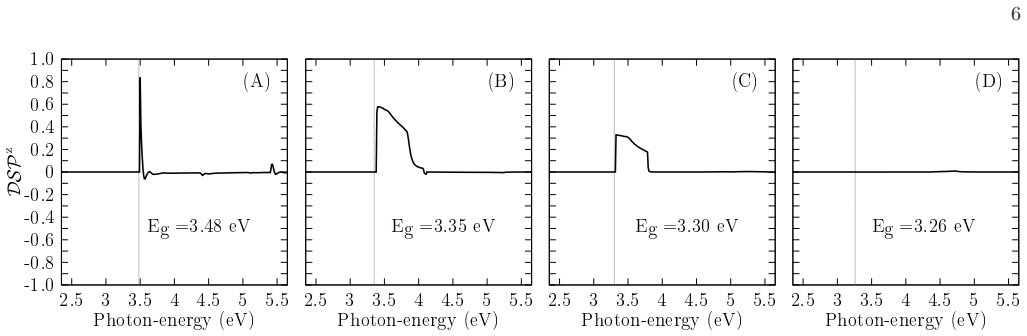
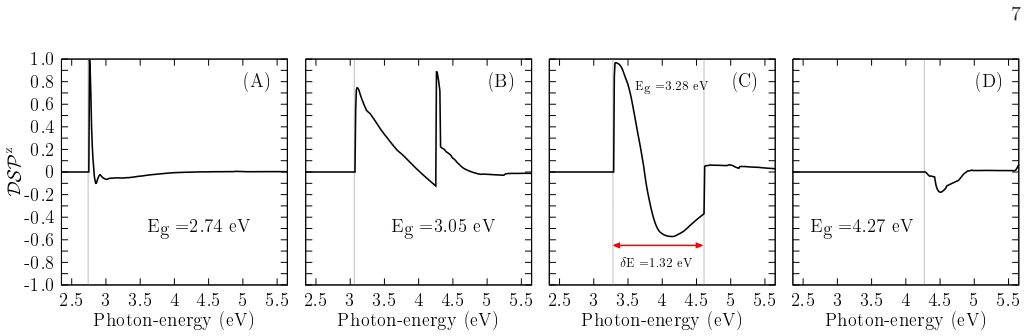
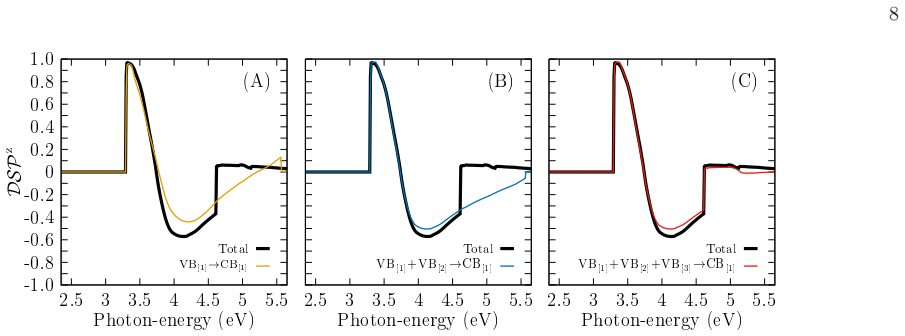
Using density functional theory, the authors calculate the degree of spin polarization response (DSP^z) for different stoichiometric configurations of graphane and fluorographene. The fluorographene zigzag configuration yields the best DSP^z, with 98% spin polarized electrons at the band edge and over a wide range of excitation photon energies. In contrast, other configurations achieve roughly 83-100% but only within limited photon-excitation energy ranges. Band-resolved analysis shows that almost the entire DSP^z spectrum in the zigzag fluorographene comes from transitions involving only the top valence band, a mixture of C-p and F-p states.
What carries the argument
The degree of spin polarization response (DSP^z), calculated from optical transition matrix elements and spin-orbit coupling in DFT band structures, which quantifies the spin selectivity of photoexcited electrons.
If this is right
- Fluorographene zigzag offers a material platform for optical spin injection with high efficiency over broad energies.
- Structures with low spin-orbit coupling can achieve near-100% polarization over wide photon ranges.
- Band contributions can be isolated to top valence bands in high-performing configurations.
- Higher spin-orbit coupling restricts strong polarization to narrow energy regions.
Where Pith is reading between the lines
- Such materials could enable energy-efficient spintronic devices using light to inject spin currents without magnetic fields.
- Testing these predictions would require fabricating zigzag fluorographene structures and measuring spin polarization via optical pumping experiments.
- Similar analysis might apply to other hydrogenated or fluorinated 2D materials for spin selectivity.
Load-bearing premise
Density functional theory calculations with standard approximations accurately capture the spin-orbit coupling strengths, band structures, and optical transition matrix elements needed to predict the reported DSP^z values.
What would settle it
An experimental measurement showing spin polarization significantly below 98% at the band edge in fluorographene zigzag under optical excitation would falsify the claim.
Figures
read the original abstract
We theoretically investigate the optical spin-injection response in different stoichiometric configurations of graphane and fluorographene using density functional theory. Our goal is to determine which configuration yields the strongest degree of spin polarization. The results show that the fluorographene zigzag configuration yields the best degree of spin polarization response (${\cal DSP}^{\mathrm{z}}$), with 98\% spin polarized electrons at the band edge and over a wide range of excitation photon energies. In contrast, other graphane and fluorographene configurations achieve a ${\cal DSP}^{\mathrm{z}}$ of roughly 83--100\%, but only within a limited photon-excitation energy range. In structures with low spin-orbit coupling, the degree of spin polarization is close to 100\% over a wide range of photon energies. For higher spin-orbit coupling, this strong response appears, but only in a narrow photon energy region. Additionally, under the band-resolved decomposition scheme, the contributions of different band-to-band transitions to the ${\cal DSP}^{\mathrm{z}}$ spectrum are identified by summing only the selected valence and conduction bands. Our findings show that almost the entire ${\cal DSP}^{\mathrm{z}}$ spectrum of the fluorographene zigzag configuration comes from transitions that involve only the top valence band, which is a mixture of C--p and F--p states.
Editorial analysis
A structured set of objections, weighed in public.
Referee Report
Summary. The manuscript uses density functional theory to compute optical spin-injection responses in multiple stoichiometric configurations of graphane and fluorographene. It claims that the fluorographene zigzag configuration produces the highest degree of spin polarization (DSP^z), reaching 98% at the band edge and remaining high across a broad photon-energy window, while other configurations reach 83–100% only in narrow ranges. A band-resolved decomposition is used to show that nearly the entire DSP^z spectrum in the best case arises from transitions involving only the top valence band (a C-p/F-p mixture). The work contrasts low-SOC (broadband near-100% polarization) and high-SOC (narrowband) regimes.
Significance. If the underlying DFT results are reliable, the identification of a specific fluorographene configuration that delivers near-100% optical spin polarization over a wide energy range would be useful for guiding experimental searches in 2D spintronics. The configuration dependence and the band-decomposition analysis supply concrete design rules linking SOC strength to the energy width of the high-polarization window.
major comments (2)
- [Abstract and Methods] Abstract and Methods: the central quantitative claims (98% DSP^z at the band edge for fluorographene zigzag, 83–100% ranges for other structures) are reported without any statement of the exchange-correlation functional, k-point mesh, plane-wave cutoff, or convergence tests for the optical matrix elements and SOC splittings. Because standard semilocal functionals systematically underestimate gaps and can misrepresent weak p-state SOC, these omissions are load-bearing for the numerical values.
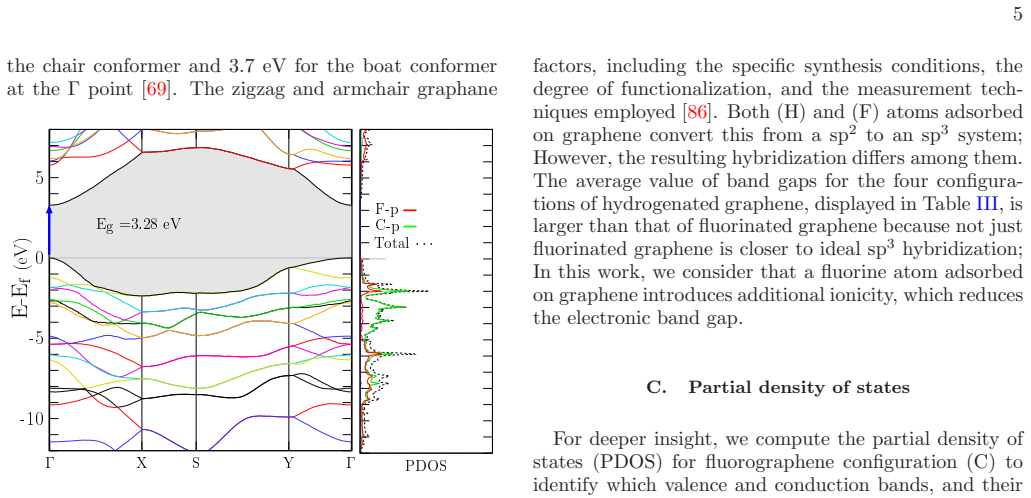
- [Results] Results section on band-resolved decomposition: the assertion that the entire DSP^z spectrum originates from the top valence band alone is presented without accompanying band-structure plots, SOC splitting values, or projected density-of-states data that would allow independent verification of the C-p/F-p character and the resulting transition matrix elements.
minor comments (2)
- The symbol ${\cal DSP}^{\mathrm{z}}$ is introduced in the abstract without an explicit definition; a clear equation or sentence defining the degree of spin polarization should appear at first use in the main text.
- Figure captions and axis labels should explicitly state the photon-energy range shown and whether the plotted DSP^z includes spin-orbit coupling or is computed in a scalar-relativistic approximation.
Simulated Author's Rebuttal
We thank the referee for the positive evaluation of the potential significance of our work for 2D spintronics and for the constructive comments. We address each major comment below and will revise the manuscript to incorporate the requested information.
read point-by-point responses
-
Referee: [Abstract and Methods] Abstract and Methods: the central quantitative claims (98% DSP^z at the band edge for fluorographene zigzag, 83–100% ranges for other structures) are reported without any statement of the exchange-correlation functional, k-point mesh, plane-wave cutoff, or convergence tests for the optical matrix elements and SOC splittings. Because standard semilocal functionals systematically underestimate gaps and can misrepresent weak p-state SOC, these omissions are load-bearing for the numerical values.
Authors: We agree that explicit documentation of the computational parameters is necessary for assessing the reliability of the reported DSP^z values. In the revised manuscript we will add a dedicated Methods section that states the exchange-correlation functional, k-point mesh, plane-wave cutoff, and the results of convergence tests performed for the optical matrix elements and SOC splittings. We will also note the known limitations of semilocal functionals for absolute gap values while emphasizing that the study focuses on comparative trends across the different stoichiometric configurations. revision: yes
-
Referee: [Results] Results section on band-resolved decomposition: the assertion that the entire DSP^z spectrum originates from the top valence band alone is presented without accompanying band-structure plots, SOC splitting values, or projected density-of-states data that would allow independent verification of the C-p/F-p character and the resulting transition matrix elements.
Authors: We acknowledge that the band-resolved analysis would be strengthened by additional supporting figures. In the revised manuscript we will include band-structure plots that display the SOC splittings near the band edges, projected density-of-states data confirming the C-p/F-p orbital character of the top valence band, and a supplementary figure showing the individual band-to-band contributions to the DSP^z spectrum for the fluorographene zigzag configuration and the other structures. revision: yes
Circularity Check
No circularity detected in reported results
full rationale
The paper computes DSP^z values directly from density functional theory band structures and optical matrix elements for various graphane and fluorographene configurations. No equations, fitted parameters, or self-citations are shown that would reduce the reported 98% spin polarization (or the band-resolved contributions) to a definition or prior fit by construction. The results are presented as outputs of external DFT implementations applied to the structures, with the band decomposition serving as an analysis step rather than a self-referential derivation. This is a standard computational workflow without load-bearing circular steps.
Axiom & Free-Parameter Ledger
axioms (1)
- domain assumption Density functional theory with typical approximations yields reliable band structures and optical matrix elements for graphane and fluorographene.
Reference graph
Works this paper leans on
-
[1]
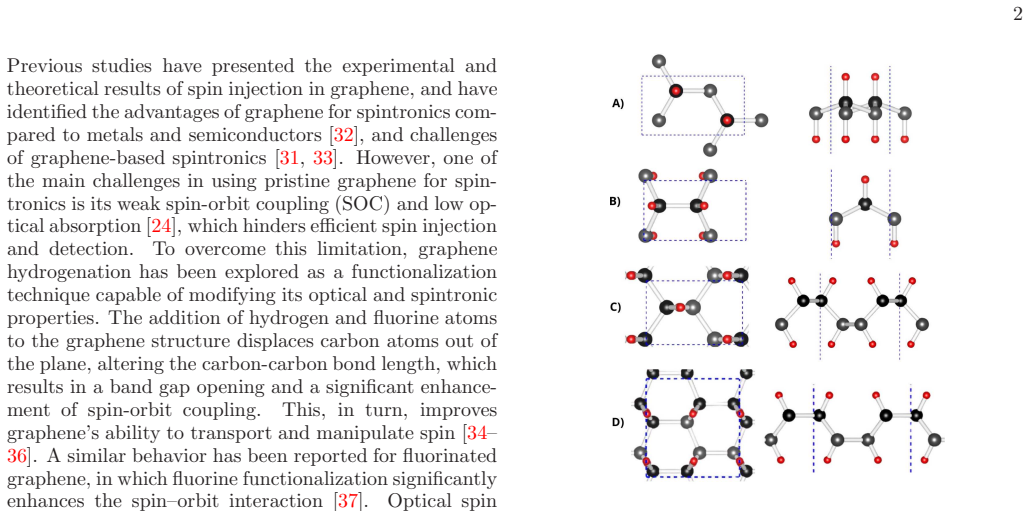
These configurations are re- ferred to as the chair, boat, zigzag, and armchair con- formations. For the chair graphane structure, the opti- mized lattice parameters are b=2.540 ˚ A and a=4.399 ˚ A, in good agreement with previous theoretical results for graphane, where b=2.534 ˚ A and a=4.3769 were re- ported. We note a lattice expansion from 2.46 ˚ A for...
-
[2]
Table II presents the distance between neighboring C atoms, dCC, and the angles, θ CCX
For each con- figuration we report the bond distance C–C, C–H in ˚ A, the out-of-plane buckling height ∆ Z in ˚ A, and the angle θ[CCC] and the bond angles θ[CCH] and θ[CCF]. Table II presents the distance between neighboring C atoms, dCC, and the angles, θ CCX. In general, C–C bond lengths in graphane are estimated to range between 1.52–1.56 ˚ A [ 70], wh...
-
[3]
The values EGGA gap and EGW gap for graphane are taken from Leenaerts et al. [45]. The experimental band gap (E gap (Exp.)) of pure fluorographene [ 76] and the com- puted SOC band splitting (∆ SO, reported in units of µ eV) are included in the last two rows, respectively. The electronic band structure determines the optical properties of materials, such a...
-
[4]
The absorption of fluorine atom on graphene induces some- what smaller SOC value as shown in Table III
Hydrogen adsorption induces a large en- hancement of SOC in graphene due to the formation of sp3 hybridization, which increases the SOC by one to two orders of magnitude compared to pristine graphene. The absorption of fluorine atom on graphene induces some- what smaller SOC value as shown in Table III. According to Table II, the average buckling, ∆ Z , fo...
-
[5]
For circularly polarized light propagating along the ˆz direc- tion, the spin polarization of the injected electrons is aligned to the ˆz-axis. To facilitate comparison among all the DSP z spectra shown in Figure 3 and Figure 4, they are presented on the same scale for both the ver- tical DSP z axis and the horizontal energy axis. More- over, in each of t...
-
[6]
Inspection of Figure 4(A) re- veals a narrow and intense DSP z peak located at 2.74 eV, where the spin polarization sharply increases to 100%
In Figure 4(A), we display the DSP z spectrum for fluoro- graphene configuration (A). Inspection of Figure 4(A) re- veals a narrow and intense DSP z peak located at 2.74 eV, where the spin polarization sharply increases to 100%. When the photon energy increases by just 0.08 eV, the DSP z value drops sharply and becomes zero at 2.82 eV. At this energy, the D...
2024
-
[7]
S. A. Wolf, D. D. Awschalom, R. A. Buhrman, J. M. Daughton, S. von Moln´ ar, M. L. Roukes, A. Y. Chtchelkanova, and D. M. Treger. Spintronics: A spin-based electronics vision for the future. Science, 294(5546):1488–1495, 2001
2001
-
[8]
Valenzuela, J
Jairo Sinova, Sergio O. Valenzuela, J. Wunderlich, C. H. Back, and T. Jungwirth. Spin hall effects. Rev. Mod. Phys., 87:1213–1260, Oct 2015
2015
-
[9]
Costache, St´ ephane Auffret, S´ ebastien Bandiera, Bernard Rodmacq, Alain Schuhl, and Pietro Gambardella
Ioan Mihai Miron, Kevin Garello, Gilles Gaudin, Pierre- Jean Zermatten, Marius V. Costache, St´ ephane Auffret, S´ ebastien Bandiera, Bernard Rodmacq, Alain Schuhl, and Pietro Gambardella. Perpendicular switching of a single ferromagnetic layer induced by in-plane current in- jection. Nature, 476(7359):189–193, Aug 2011
2011
-
[10]
Review on spintronics: Principles and device applications
Atsufumi Hirohata, Keisuke Yamada, Yoshinobu Nakatani, Ioan-Lucian Prejbeanu, Bernard Di´ eny, Philipp Pirro, and Burkard Hillebrands. Review on spintronics: Principles and device applications. Journal of Magnetism and Magnetic Materials , 509:166711, 2020
2020
-
[11]
Das Sarma
Igor ˇZuti´ c, Jaroslav Fabian, and S. Das Sarma. Spintron- ics: Fundamentals and applications. Rev. Mod. Phys. , 76:323–410, Apr 2004
2004
-
[12]
Quantum materials for spintronic applications
Yaqin Guo, Xu Zhang, Zhi Huang, Jinyan Chen, Zijun Luo, Jing Zhang, Jingfeng Li, Zhaowei Zhang, Jinkui Zhao, Xiufeng Han, and Hao Wu. Quantum materials for spintronic applications. npj Spintronics , 2(1):36, Jul 2024
2024
-
[13]
Mendoza and J
Bernardo S. Mendoza and J. L. Cabellos. Optical spin injection at semiconductor surfaces. Phys. Rev. B , 85:165324, Apr 2012
2012
-
[14]
Nastos, J
F. Nastos, J. Rioux, M. Strimas-Mackey, Bernardo S. Mendoza, and J. E. Sipe. Full band structure LDA and k ·p calculations of optical spin-injection. Phys. Rev. B , 76:205113, Nov 2007
2007
-
[15]
Electronic analog of the electro-optic modulator
Supriyo Datta and Biswajit Das. Electronic analog of the electro-optic modulator. Applied Physics Letters , 56(7):665–667, 02 1990
1990
-
[16]
Spin injection in metals: The bipolar spin transistor
Mark Johnson. Spin injection in metals: The bipolar spin transistor. Journal of Magnetism and Magnetic Ma- terials, 156(1):321–324, 1996. Proceedings of the Second International Symposium on Metallic Multilayers
1996
-
[17]
Magnonic memory and logic de- vices: From proposal to device
Alexander Khitun. Magnonic memory and logic de- vices: From proposal to device. Applied Physics Letters , 127(2):020501, 07 2025
2025
-
[18]
Electrical and optical spin in- jection in ferromagnet/semiconductor heterostructures
Tomoyasu Taniyama, Eiji Wada, Mitsuru Itoh, and Masahito Yamaguchi. Electrical and optical spin in- jection in ferromagnet/semiconductor heterostructures. NPG Asia Materials , 3(7):65–73, Jul 2011
2011
-
[19]
Two- dimensional magnetic materials for spintronic devices
Mengjuan Mi, Han Xiao, Lixuan Yu, Yingxu Zhang, Yuanshuo Wang, Qiang Cao, and Yilin Wang. Two- dimensional magnetic materials for spintronic devices. Materials Today Nano , 24:100408, 2023
2023
-
[20]
Principles and advances in spin light-emitting diodes
Kin Ting Chang, Wenfei Liang, Yuan Lu, and Haipeng Lu. Principles and advances in spin light-emitting diodes. npj Spintronics , 3(1):44, Nov 2025
2025
-
[21]
Fiederling, M
R. Fiederling, M. Keim, G. Reuscher, W. Ossau, G. Schmidt, A. Waag, and L. W. Molenkamp. Injec- tion and detection of a spin-polarized current in a light- emitting diode. Nature, 402(6763):787–790, Dec 1999
1999
-
[22]
Katine and Eric E
J.A. Katine and Eric E. Fullerton. Device implications of spin-transfer torques. Journal of Magnetism and Mag- netic Materials , 320(7):1217–1226, 2008
2008
-
[23]
Spin and spin current– From fundamentals to recent progress
Sadamichi Maekawa, Takashi Kikkawa, Hiroyuki Chudo, Jun’ichi Ieda, and Eiji Saitoh. Spin and spin current– From fundamentals to recent progress. Journal of Ap- plied Physics , 133(2):020902, 01 2023
2023
-
[24]
The Stern–Gerlach experiment at
Davide Castelvecchi. The Stern–Gerlach experiment at
-
[25]
Nature Reviews Physics , 4(3):140–142, Mar 2022
2022
-
[26]
Nuclear dynamic polarization by op- tical electronic saturation and optical pumping in semi- conductors
Georges Lampel. Nuclear dynamic polarization by op- tical electronic saturation and optical pumping in semi- conductors. Phys. Rev. Lett. , 20:491–493, Mar 1968
1968
-
[27]
Pierce and Felix Meier
Daniel T. Pierce and Felix Meier. Photoemission of spin - polarized electrons from GaAs. Phys. Rev. B , 13:5484– 5500, Jun 1976. 11
1976
-
[28]
Idrish Miah
M. Idrish Miah. Optical spin generation/detection and spin transport lifetimes. Materials Science and Engineer- ing: B , 176(3):252–255, 2011
2011
-
[29]
Photoinduced pure spin-current injection in graphene with rashba spin-orbit interaction
Julien Rioux and Guido Burkard. Photoinduced pure spin-current injection in graphene with rashba spin-orbit interaction. Phys. Rev. B , 90:035210, Jul 2014
2014
-
[30]
J. W. McIver, D. Hsieh, H. Steinberg, P. Jarillo-Herrer o, and N. Gedik. Control over topological insulator pho- tocurrents with light polarization. Nature Nanotechnol- ogy, 7(2):96–100, Feb 2012
2012
-
[31]
Optospintronics in graphene via proximity coupling
Ahmet Avsar, Dmitrii Unuchek, Jiawei Liu, Oriol Lopez Sanchez, Kenji Watanabe, Takashi Taniguchi, Barbaros ¨Ozyilmaz, and Andras Kis. Optospintronics in graphene via proximity coupling. ACS Nano , 11(11):11678–11686,
-
[32]
Anderson, Bernardo S
Reinaldo Zapata-Pe˜ na, Sean M. Anderson, Bernardo S. Mendoza, and Anatoli I. Shkrebtii. Nonlinear optical responses in hydrogenated graphene structures. physica status solidi (b) , 253(2):226–233, 2016
2016
-
[33]
Oestreich, J
M. Oestreich, J. H¨ ubner, D. H¨ agele, P. J. Klar, W. He- imbrodt, W. W. R¨ uhle, D. E. Ashenford, and B. Lunn. Spin injection into semiconductors. Applied Physics Let- ters, 74(9):1251–1253, 03 1999
1999
-
[34]
Kin Fai Mak, Keliang He, Jie Shan, and Tony F. Heinz. Control of valley polarization in monolayer MoS 2 by op- tical helicity. Nature Nanotechnology, 7(8):494–498, Aug 2012
2012
-
[35]
Valley polarization in MoS 2 monolayers by optical pumping
Hualing Zeng, Junfeng Dai, Wang Yao, Di Xiao, and Xiaodong Cui. Valley polarization in MoS 2 monolayers by optical pumping. Nature Nanotechnology, 7(8):490– 493, Aug 2012
2012
-
[36]
Glazov, Tony F
Gang Wang, Alexey Chernikov, Mikhail M. Glazov, Tony F. Heinz, Xavier Marie, Thierry Amand, and Bern- hard Urbaszek. Colloquium: Excitons in atomically thin transition metal dichalcogenides. Rev. Mod. Phys. , 90:021001, Apr 2018
2018
-
[37]
Graphene on transition-metal dichalcogenides: A platform for prox- imity spin-orbit physics and optospintronics
Martin Gmitra and Jaroslav Fabian. Graphene on transition-metal dichalcogenides: A platform for prox- imity spin-orbit physics and optospintronics. Phys. Rev. B, 92:155403, Oct 2015
2015
-
[38]
Avsar, H
A. Avsar, H. Ochoa, F. Guinea, B. ¨Ozyilmaz, B. J. van Wees, and I. J. Vera-Marun. Colloquium: Spintronics in graphene and other two-dimensional materials. Rev. Mod. Phys. , 92:021003, Jun 2020
2020
-
[39]
Kawakami, Martin Gmitra, and Jaroslav Fabian
Wei Han, Roland K. Kawakami, Martin Gmitra, and Jaroslav Fabian. Graphene spintronics. Nature Nanotech- nology, 9(10):794–807, Oct 2014
2014
-
[40]
Graphene-based spintronics
Gaojie Zhang, Hao Wu, Li Yang, Wen Jin, Wenfeng Zhang, and Haixin Chang. Graphene-based spintronics. Applied Physics Reviews , 11(2):021308, 04 2024
2024
-
[41]
Cazalilla, Antonio H
Jayakumar Balakrishnan, Gavin Kok Wai Koon, Ahmet Avsar, Yuda Ho, Jong Hak Lee, Manu Jaiswal, Seung- Jae Baeck, Jong-Hyun Ahn, Aires Ferreira, Miguel A. Cazalilla, Antonio H. Castro Neto, and Barbaros ¨Ozyilmaz. Giant spin Hall effect in graphene grown by chemical vapour deposition. Nature Communications , 5(1):4748, Sep 2014
2014
-
[42]
Robertson, Thomas T
Mark Kester, Yasser Heakal, Todd Fox, Arati Sharma, Gavin P. Robertson, Thomas T. Morgan, Erhan ˙I. Al- tino˘ glu, Amra Tabakovi´ c, Mylisa R. Parette, Sarah M. Rouse, Victor Ruiz-Velasco, and James H. Adair. Cal- cium phosphate nanocomposite particles for in vitro imaging and encapsulated chemotherapeutic drug deliv- ery to cancer cells. Nano Letters, 8(...
2008
-
[43]
D. C. Elias, R. R. Nair, T. M. G. Mohiuddin, S. V. Morozov, P. Blake, M. P. Halsall, A. C. Ferrari, D. W. Boukhvalov, M. I. Katsnelson, A. K. Geim, and K. S. Novoselov. Control of graphene’s properties by re- versible hydrogenation: Evidence for graphane. Science, 323(5914):610–613, 2009
2009
-
[44]
X. Hong, K. Zou, B. Wang, S.-H. Cheng, and J. Zhu. Evidence for spin-flip scattering and local moments in dilute fluorinated graphene. Phys. Rev. Lett., 108:226602, Jun 2012
2012
-
[45]
Spin transport in hydro- genated graphene
David Soriano, Dinh Van Tuan, Simon M-M Dubois, Martin Gmitra, Aron W Cummings, Denis Kochan, Frank Ortmann, Jean-Christophe Charlier, Jaroslav Fabian, and Stephan Roche. Spin transport in hydro- genated graphene. 2D Materials , 2(2):022002, may 2015
2015
-
[46]
All-optical spin injection in silicon investigated by element-specific time-resolved Kerr effect
Simone Laterza, Antonio Caretta, Richa Bhardwaj, Roberto Flammini, Paolo Moras, Matteo Jugovac, Piu Rajak, Mahabul Islam, Regina Ciancio, Valentina Bo- nanni, Barbara Casarin, Alberto Simoncig, Marco Zan- grando, Primoˇ z Rebernik Ribiˇ c, Giuseppe Penco, Gio- vanni De Ninno, Luca Giannessi, Alexander Demidovich, Miltcho Danailov, Fulvio Parmigiani, and M...
2022
-
[47]
Khamari, P
Shailesh K. Khamari, P. Mudi, S. Porwal, and T.K. Sharma. Detection of optically injected spin polarized electrons in the L-valley of AlGaAs through polariza- tion resolved photoluminescence excitation spectroscopy . Journal of Luminescence , 213:204–209, 2019
2019
-
[48]
Spin-orbit coupling in graphene induced by adatoms with outer-shell p orbitals
Luis Brey. Spin-orbit coupling in graphene induced by adatoms with outer-shell p orbitals. Phys. Rev. B , 92:235444, Dec 2015
2015
-
[49]
Spin-orbit coupling in hydrogenated graphene
Martin Gmitra, Denis Kochan, and Jaroslav Fabian. Spin-orbit coupling in hydrogenated graphene. Phys. Rev. Lett., 110:246602, Jun 2013
2013
-
[50]
Yazyev and Lothar Helm
Oleg V. Yazyev and Lothar Helm. Defect-induced mag- netism in graphene. Phys. Rev. B , 75:125408, Mar 2007
2007
-
[51]
D. W. Boukhvalov and M. I. Katsnelson. Chemical func- tionalization of graphene with defects. Nano Letters , 8(12):4373–4379, 2008. PMID: 18956916
2008
-
[52]
Leenaerts, H
O. Leenaerts, H. Peelaers, A. D. Hern´ andez-Nieves, B. Partoens, and F. M. Peeters. First-principles inves- tigation of graphene fluoride and graphane. Phys. Rev. B, 82:195436, Nov 2010
2010
-
[53]
Nastos, B
F. Nastos, B. Olejnik, K. Schwarz, and J. E. Sipe. Scis- sors implementation within length-gauge formulations of the frequency-dependent nonlinear optical response of semiconductors. Phys. Rev. B , 72:045223, Jul 2005
2005
-
[54]
J. E. Sipe and A. I. Shkrebtii. Second-order optical re- sponse in semiconductors. Phys. Rev. B , 61:5337–5352, Feb 2000
2000
-
[55]
J. L. Cabellos, Cuauht´ emoc Salazar, and Bernardo S. Mendoza. Stress-modulated optical spin injection in bulk Si and GaAs semiconductors. Phys. Rev. B , 80:245204, Dec 2009
2009
-
[56]
Fettu, J
G. Fettu, J. E. Sipe, and O. Moutanabbir. Mid-infrared optical spin injection and coherent control. Phys. Rev. B, 107:165202, Apr 2023
2023
-
[57]
Gonze, F
X. Gonze, F. Jollet, F. Abreu Araujo, D. Adams, B. Amadon, T. Applencourt, C. Audouze, J.-M. Beuken, J. Bieder, A. Bokhanchuk, E. Bousquet, F. Bruneval, 12 D. Caliste, M. Cˆ ot´ e, F. Dahm, F. Da Pieve, M. Delaveau, M. Di Gennaro, B. Dorado, C. Espejo, G. Geneste, L. Genovese, A. Gerossier, M. Giantomassi, Y. Gillet, D.R. Hamann, L. He, G. Jomard, J. Lafla...
2016
-
[58]
Gonze, J.-M
X. Gonze, J.-M. Beuken, R. Caracas, F. Detraux, M. Fuchs, G.-M. Rignanese, L. Sindic, M. Verstraete, G. Zerah, F. Jollet, M. Torrent, A. Roy, M. Mikami, Ph. Ghosez, J.-Y. Raty, and D.C. Allan. First-principles com- putation of material properties: the ABINIT software project. Computational Materials Science , 25(3):478– 492, 2002
2002
-
[59]
Gonze, B
X. Gonze, B. Amadon, P.-M. Anglade, J.-M. Beuken, F. Bottin, P. Boulanger, F. Bruneval, D. Caliste, R. Cara- cas, M. Cˆ ot´ e, T. Deutsch, L. Genovese, Ph. Ghosez, M. Giantomassi, S. Goedecker, D.R. Hamann, P. Hermet, F. Jollet, G. Jomard, S. Leroux, M. Mancini, S. Mazevet, M.J.T. Oliveira, G. Onida, Y. Pouillon, T. Rangel, G.-M. Rignanese, D. Sangalli, R...
2009
-
[60]
A brief introduction to the ABINIT soft- ware package
Xavier Gonze. A brief introduction to the ABINIT soft- ware package. Zeitschrift f¨ ur Kristallographie - Crys- talline Materials , 220(5-6):558–562, 2005
2005
-
[61]
Sudeep Puri, Sneha Patel, Jose Luis Cabellos, Luis En- rique Rosas-Hernandez, Katlin Reynolds, Hugh O. H. Churchill, Salvador Barraza-Lopez, Bernardo S. Men- doza, and Hiroyuki Nakamura. Substrate interfer- ence and strain in the second-harmonic generation from MoSe2 monolayers. Nano Letters , 24(41):13061–13067,
-
[62]
Insulating moir´ e homobilayers lack a three- fold symmetric second-harmonic generation
Luis Enrique Rosas-Hernandez, Jose Luis Cabellos, Ang i- olo Huam´ an, Bernardo Mendoza, and Salvador Barraza- Lopez. Insulating moir´ e homobilayers lack a three- fold symmetric second-harmonic generation. Phys. Rev. Mater., 8:116203, Nov 2024
2024
-
[63]
Perdew, Kieron Burke, and Matthias Ernzerhof
John P. Perdew, Kieron Burke, and Matthias Ernzerhof. Generalized gradient approximation made simple. Phys. Rev. Lett., 77:3865–3868, Oct 1996
1996
-
[64]
A consistent and accurate ab initio parametriza- tion of density functional dispersion correction (DFT- D) for the 94 elements H-Pu
Stefan Grimme, Jens Antony, Stephan Ehrlich, and Helge Krieg. A consistent and accurate ab initio parametriza- tion of density functional dispersion correction (DFT- D) for the 94 elements H-Pu. The Journal of Chemical Physics, 132(15):154104, 04 2010
2010
-
[65]
Aqueous proton-selective conduction across two-dimensional gra- phyne
Le Shi, Ao Xu, Ding Pan, and Tianshou Zhao. Aqueous proton-selective conduction across two-dimensional gra- phyne. Nature Communications, 10(1):1165, Mar 2019
2019
-
[66]
Xe adsorption on noble metal clusters: A density func- tional theory investigation
Arnaud Monpezat, Jean Aupiais, and Bruno Siberchicot. Xe adsorption on noble metal clusters: A density func- tional theory investigation. ACS Omega , 6(47):31513– 31519, 2021
2021
-
[67]
Adsorption of water on graphene: A van der Waals density functional study
Ikutaro Hamada. Adsorption of water on graphene: A van der Waals density functional study. Phys. Rev. B , 86:195436, Nov 2012
2012
-
[68]
R. E. Mapasha, A. M. Ukpong, and N. Chetty. Ab initio studies of hydrogen adatoms on bilayer graphene. Phys. Rev. B , 85:205402, May 2012
2012
-
[69]
Hartwigsen, S
C. Hartwigsen, S. Goedecker, and J. Hutter. Relativist ic separable dual-space Gaussian pseudopotentials from H to Rn. Phys. Rev. B , 58:3641–3662, Aug 1998
1998
-
[70]
Berry, Nicholas C
Dominic W. Berry, Nicholas C. Rubin, Ahmed O. Elnabawy, Gabriele Ahlers, A. Eugene DePrince, Joonho Lee, Christian Gogolin, and Ryan Babbush. Quantum simulation of realistic materials in first quantization us- ing non-local pseudopotentials. npj Quantum Informa- tion, 10(1):130, Dec 2024
2024
-
[71]
Castelli, Stewart J
Kurt Lejaeghere, Gustav Bihlmayer, Torbj¨ orn Bj¨ orkman, Peter Blaha, Stefan Bl¨ ugel, Volker Blum, Damien Cal- iste, Ivano E. Castelli, Stewart J. Clark, Andrea Dal Corso, Stefano de Gironcoli, Thierry Deutsch, John Kay Dewhurst, Igor Di Marco, Claudia Draxl, Marcin Du/suppress lak, Olle Eriksson, Jos´ e A. Flores-Livas, Kevin F. Garrity, Luigi Genovese...
2016
-
[72]
Monkhorst and James D
Hendrik J. Monkhorst and James D. Pack. Special points for Brillouin-zone integrations. Phys. Rev. B , 13:5188– 5192, Jun 1976
1976
-
[73]
A. J. Read and R. J. Needs. Calculation of optical matrix elements with nonlocal pseudopotentials. Phys. Rev. B , 44:13071–13073, Dec 1991
1991
-
[74]
Elec- tronic excitations: density-functional versus many-body Green’s-function approaches
Giovanni Onida, Lucia Reining, and Angel Rubio. Elec- tronic excitations: density-functional versus many-body Green’s-function approaches. Rev. Mod. Phys. , 74:601– 659, Jun 2002
2002
-
[75]
Meyer, A
Jannik C. Meyer, A. K. Geim, M. I. Katsnelson, K. S. Novoselov, T. J. Booth, and S. Roth. The structure of suspended graphene sheets. Nature, 446(7131):60–63, Mar 2007
2007
-
[76]
Sofo, Ajay S
Jorge O. Sofo, Ajay S. Chaudhari, and Greg D. Barber. Graphane: A two-dimensional hydrocarbon. Phys. Rev. B, 75:153401, Apr 2007
2007
-
[77]
Graphane and hydrogenated graphene
Martin Pumera and Colin Hong An Wong. Graphane and hydrogenated graphene. Chem. Soc. Rev. , 42:5987–5995, 2013
2013
-
[78]
A. H. Castro Neto, F. Guinea, N. M. R. Peres, K. S. Novoselov, and A. K. Geim. The electronic properties of graphene. Rev. Mod. Phys. , 81:109–162, Jan 2009. 13
2009
-
[79]
Nair, Wencai Ren, Rashid Jalil, Ibt- sam Riaz, Vasyl G
Rahul R. Nair, Wencai Ren, Rashid Jalil, Ibt- sam Riaz, Vasyl G. Kravets, Liam Britnell, Pe- ter Blake, Fredrik Schedin, Alexander S. Mayorov, Shengjun Yuan, Mikhail I. Katsnelson, Hui-Ming Cheng, Wlodek Strupinski, Lyubov G. Bulusheva, Alexander V. Okotrub, Irina V. Grigorieva, Alexander N. Grigorenko, Kostya S. Novoselov, and Andre K. Geim. Fluo- rograp...
2010
-
[80]
The essential role of bond energetics in C–H activation/functionalization
Xiao-Song Xue, Pengju Ji, Biying Zhou, and Jin- Pei Cheng. The essential role of bond energetics in C–H activation/functionalization. Chemical Reviews , 117(13):8622–8648, 2017. PMID: 28281752
2017
discussion (0)
Sign in with ORCID, Apple, or X to comment. Anyone can read and Pith papers without signing in.