String dynamics of a (2+1)D U(1) quantum link model on a digital quantum computer
Pith reviewed 2026-06-26 20:10 UTC · model grok-4.3
The pith
Digital quantum simulations of a (2+1)D U(1) quantum link model on up to 112 qubits reproduce string fluctuations and match tensor-network results at short times.
A machine-rendered reading of the paper's core claim, the machinery that carries it, and where it could break.
Core claim
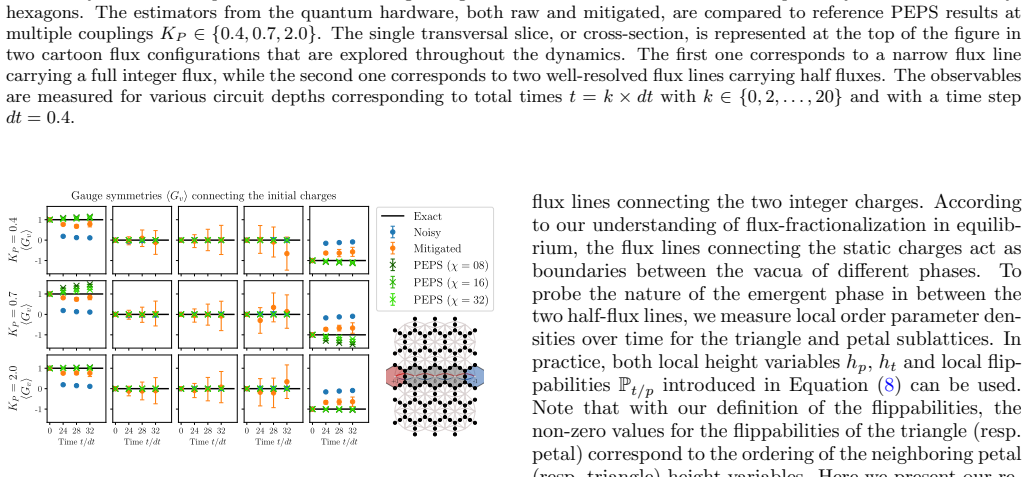
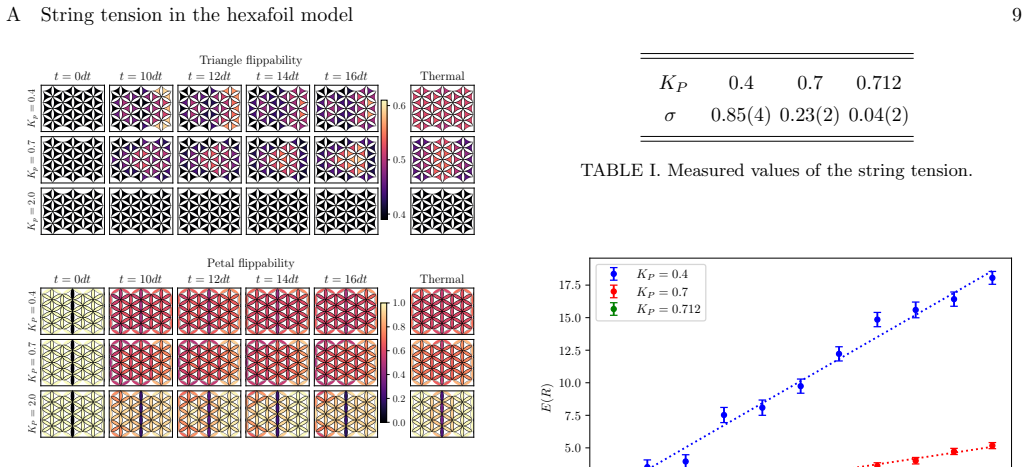
A (2+1)D U(1) pure gauge theory in its confining phase is realized as a quantum link model on qubits, with tailored lattice geometry enabling digital simulation of string quenches; results up to 112 qubits agree with tensor networks at short times and thermal averages at long times, even near the phase transition where fluctuations span both dimensions.
What carries the argument
Qubit encoding of dual height variables on a lattice geometry matched to heavy-hexagonal IBM hardware, which realizes plaquette interactions and supports quench protocols from a simple initial string state.
If this is right
- Real-time dynamics of confining strings become accessible on quantum hardware where Monte Carlo methods cannot reach them.
- Error-mitigated estimators remain accurate near the phase transition despite large spatial fluctuations.
- Noise-induced local gauge violations stay at levels comparable to finite-bond-dimension tensor networks.
- The same qubit mapping and geometry tailoring can be reused for other confining models.
Where Pith is reading between the lines
- The same encoding may extend to study string breaking or multi-string interactions once coherence times increase.
- Hardware-native geometries could reduce overhead when simulating higher-dimensional or non-Abelian gauge theories.
- Longer quench times on future devices might directly test predictions for string tension renormalization.
Load-bearing premise
The tailored lattice geometry and error mitigation produce results faithful to the continuum model without dominant hardware artifacts.
What would settle it
Significant mismatch between the quantum-hardware string observables and independent tensor-network calculations at short times, or failure to approach thermal averages at long times, would falsify the claim of faithful simulation.
Figures
read the original abstract
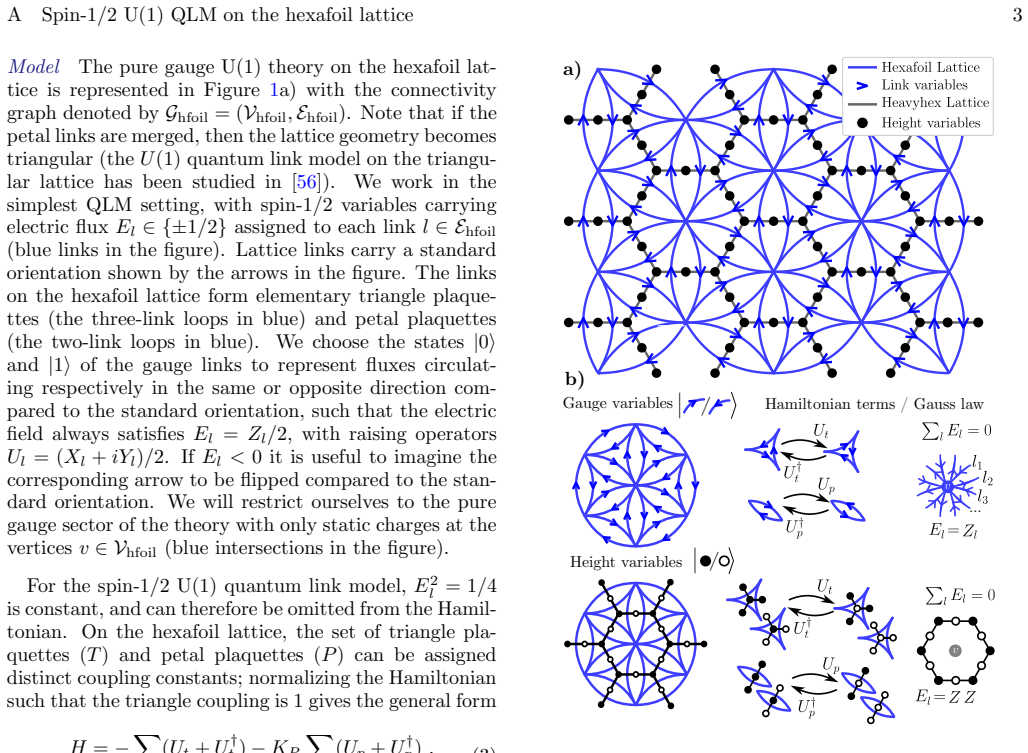
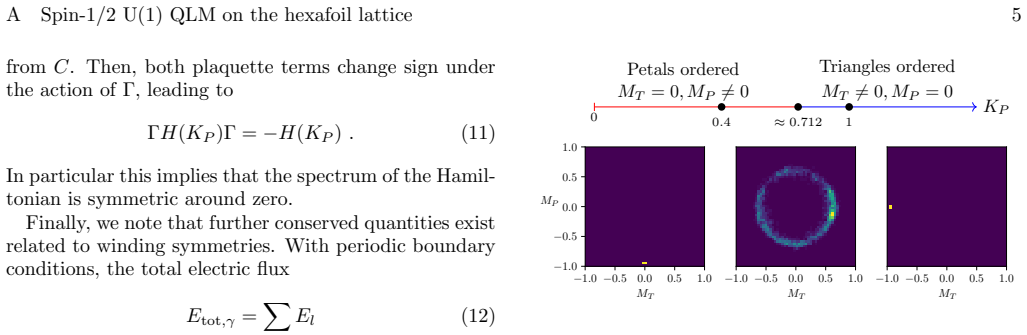
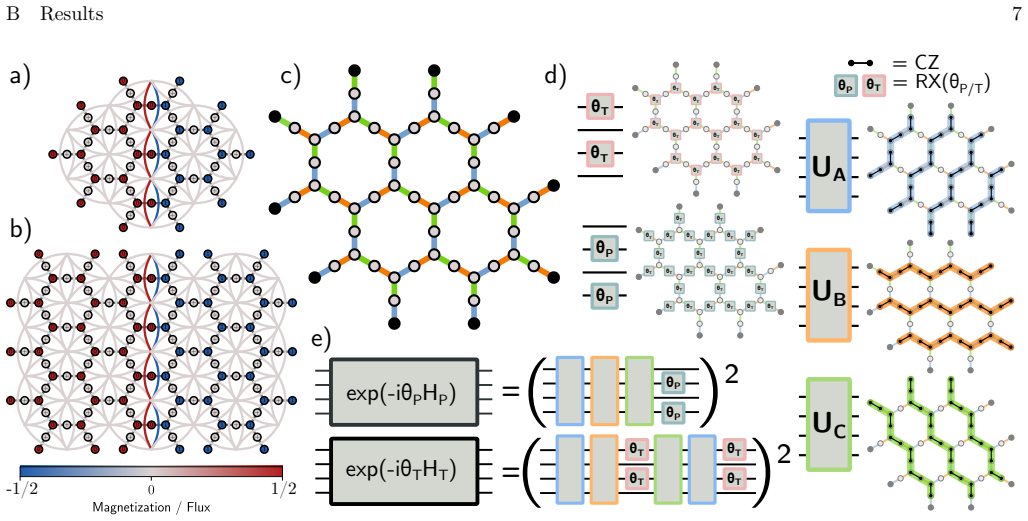
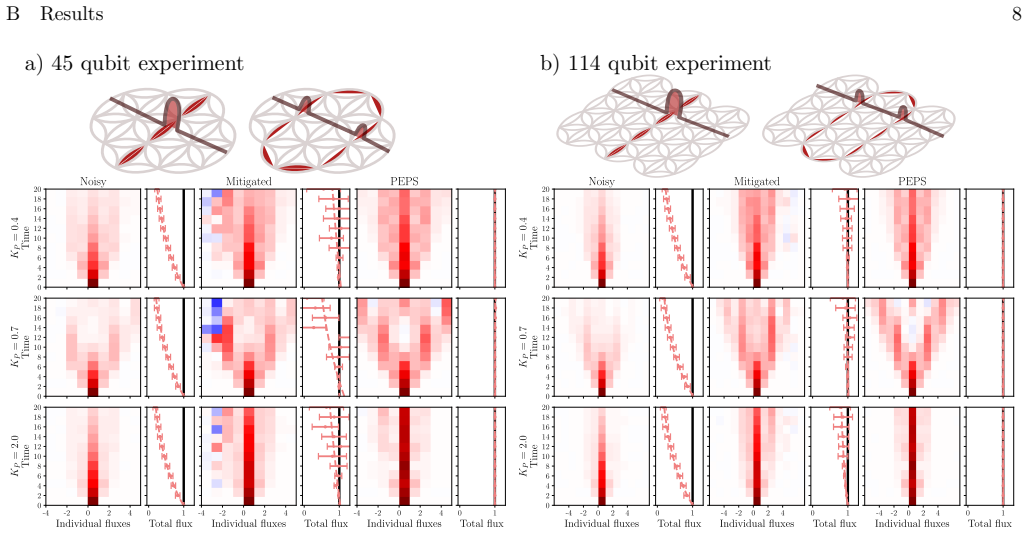
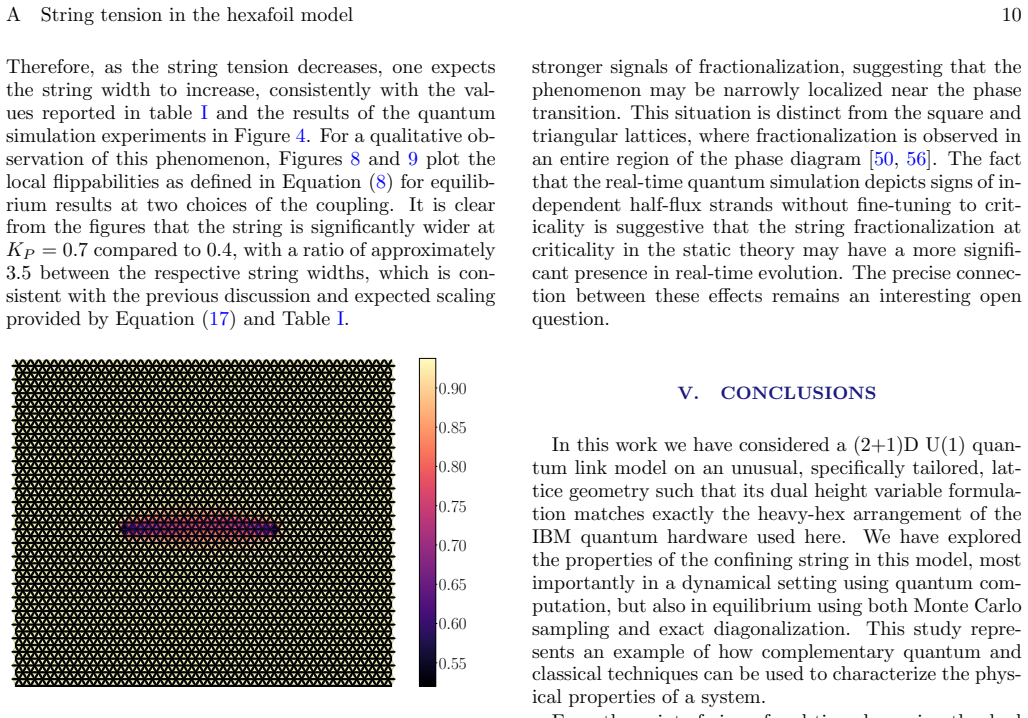
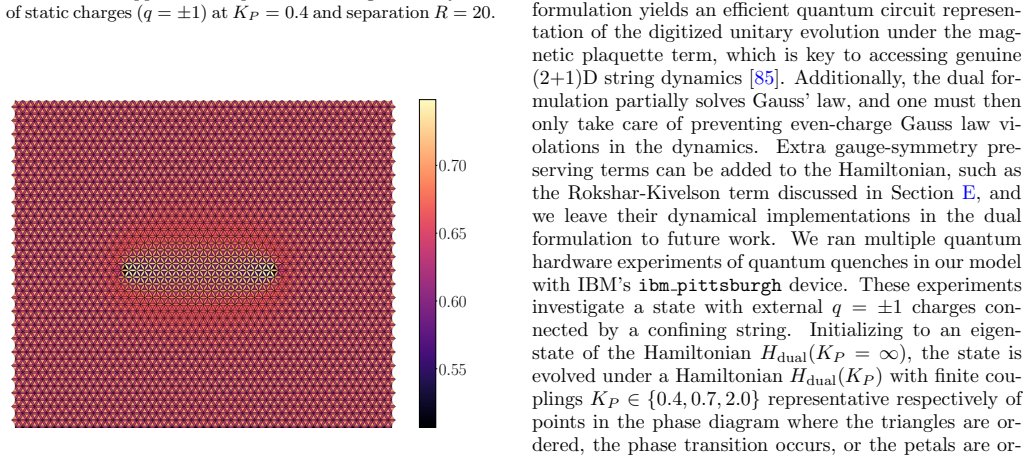
The (2+1)D U(1) pure gauge theory always exists in the confining phase, with strings of non-zero string tension giving a characteristic linear potential between static charges. This makes it a useful testing ground for quantum computing methods designed to study string dynamics of confining gauge theories. Here we implement a minimal U(1) quantum link model on a quantum computer with qubit degrees of freedom representing the dual height variables of the model. This facilitates an efficient realization of plaquette interactions and enables effective calculations of real-time dynamics that are inaccessible to traditional quantum Monte Carlo. A specifically tailored lattice geometry is chosen to match the heavy-hexagonal geometry of the IBM quantum hardware used here, minimizing non-adjacent qubit interactions. By performing quantum quenches from a simple initial string state, we probe the transverse quantum fluctuations of the string before it thermalizes. Our experimental results from digital quantum simulations, with up to 112 qubits, show good agreement with reference tensor-network calculations at short times and with thermal averages at long times. Near the phase transition, the quench dynamics exhibit large fluctuations of the initial string that extend across both spatial dimensions of the lattice. Nonetheless, our error-mitigated estimators from the quantum hardware also give accurate predictions in that regime, with noise-induced violations of local gauge symmetries comparable to finite-bond-dimension tensor-network results.
Editorial analysis
A structured set of objections, weighed in public.
Referee Report
Summary. The manuscript implements a minimal (2+1)D U(1) quantum link model on IBM quantum hardware (up to 112 qubits) by representing dual height variables on a heavy-hexagonal lattice geometry chosen to minimize non-adjacent interactions. It performs quantum quenches from an initial string configuration to probe transverse fluctuations before thermalization, reporting good agreement between error-mitigated hardware results and independent tensor-network calculations at short times, as well as with thermal averages at long times, including near the phase transition where fluctuations span both spatial dimensions.
Significance. If the hardware results are shown to faithfully reproduce the ideal model dynamics, this work would be significant for demonstrating scalable digital quantum simulation of real-time non-equilibrium phenomena in confining gauge theories at a scale (112 qubits) inaccessible to many classical methods. The mapping via height variables for efficient plaquette terms and the direct comparison to tensor networks are technical strengths that provide a concrete benchmark; the ability to access string dynamics beyond quantum Monte Carlo limitations adds value to the quantum computing approach for lattice gauge theory.
major comments (3)
- [Abstract] Abstract and the section on error mitigation: the central claim of agreement with tensor-network results at short times rests on the assumption that noise-induced gauge violations do not systematically bias the transverse string fluctuations, yet the manuscript provides no explicit quantification of mitigation protocols, error bars on the reported observables, or data exclusion criteria; this is load-bearing because the abstract itself states that these violations remain comparable to finite-bond-dimension TN results.
- [Lattice geometry and mapping] The section describing the lattice mapping and quench protocol: the tailored heavy-hexagonal geometry is presented as enabling the simulation, but there is no demonstration or reference calculation showing that the resulting discrete model reproduces the same string tension or confining phase structure as the standard square-lattice U(1) quantum link model; this assumption is central to interpreting the observed fluctuations as representative of the continuum (2+1)D theory.
- [Long-time dynamics] The long-time thermalization comparison: agreement with thermal averages is claimed, but the manuscript does not specify how the effective temperature is extracted from the quench energy or provide a quantitative metric (e.g., fidelity or distance to the thermal ensemble) that accounts for the noted gauge violations; without this, the long-time agreement cannot be distinguished from possible residual hardware artifacts.
minor comments (2)
- [Figures] Figure captions for the string fluctuation plots should explicitly state the number of shots, the precise definition of the transverse fluctuation observable, and any post-selection applied.
- [Model definition] Notation for the dual height variables and plaquette operators should be introduced with an equation in the model definition section to avoid ambiguity when comparing to standard QLM literature.
Simulated Author's Rebuttal
We thank the referee for their careful reading of the manuscript and for the constructive comments. We address each major comment below and indicate the planned revisions.
read point-by-point responses
-
Referee: [Abstract] Abstract and the section on error mitigation: the central claim of agreement with tensor-network results at short times rests on the assumption that noise-induced gauge violations do not systematically bias the transverse string fluctuations, yet the manuscript provides no explicit quantification of mitigation protocols, error bars on the reported observables, or data exclusion criteria; this is load-bearing because the abstract itself states that these violations remain comparable to finite-bond-dimension TN results.
Authors: We agree that the manuscript would benefit from more explicit details. In the revised version we will expand the error-mitigation section with quantitative measures of the mitigation protocols, add error bars to the key observables, and clarify the data-inclusion criteria. The existing comparison of gauge violations to finite-bond-dimension TN results will be retained and augmented with additional analysis addressing possible systematic bias in the fluctuation observables. revision: yes
-
Referee: [Lattice geometry and mapping] The section describing the lattice mapping and quench protocol: the tailored heavy-hexagonal geometry is presented as enabling the simulation, but there is no demonstration or reference calculation showing that the resulting discrete model reproduces the same string tension or confining phase structure as the standard square-lattice U(1) quantum link model; this assumption is central to interpreting the observed fluctuations as representative of the continuum (2+1)D theory.
Authors: The implemented model is a minimal U(1) quantum link model defined on the heavy-hexagonal lattice via the dual height variables; local gauge invariance and the confining character are preserved by construction. While the numerical value of the string tension will differ from the isotropic square lattice because of geometric anisotropy, the qualitative confining dynamics and transverse fluctuations remain representative. We will add a clarifying paragraph in the revised manuscript that states this equivalence of the phase structure and notes the lattice-specific quantitative differences. revision: partial
-
Referee: [Long-time dynamics] The long-time thermalization comparison: agreement with thermal averages is claimed, but the manuscript does not specify how the effective temperature is extracted from the quench energy or provide a quantitative metric (e.g., fidelity or distance to the thermal ensemble) that accounts for the noted gauge violations; without this, the long-time agreement cannot be distinguished from possible residual hardware artifacts.
Authors: We will revise the long-time section to state explicitly how the effective temperature is obtained from the quench energy and to include a quantitative distance metric (e.g., a suitably defined fidelity or Kullback-Leibler divergence) between the observed distribution and the thermal ensemble, with the gauge-violation level incorporated into the comparison. This will make the distinction between physical thermalization and residual artifacts clearer. revision: yes
Circularity Check
No significant circularity; results validated against independent tensor-network calculations and thermal averages
full rationale
The paper implements a U(1) quantum link model on quantum hardware and reports quench dynamics up to 112 qubits. Its central claims rest on direct comparisons of error-mitigated hardware data to separate tensor-network calculations at short times and to thermal averages at long times. These benchmarks are external to the present work and are not obtained by fitting parameters from the same dataset or by self-citation chains. The tailored lattice geometry and mitigation techniques are described as practical choices to enable the simulation, but the reported agreement is presented as an empirical validation rather than a derived identity. No equations or steps in the provided text reduce a prediction to an input by construction, and no uniqueness theorems or ansatzes are smuggled via self-citation. The derivation chain is therefore self-contained against external references.
Axiom & Free-Parameter Ledger
axioms (2)
- standard math Standard principles of quantum mechanics and digital quantum computing hold for the gate operations and measurements performed.
- domain assumption The minimal U(1) quantum link model with dual height variables faithfully represents the confining phase of (2+1)D U(1) pure gauge theory.
Reference graph
Works this paper leans on
-
[1]
DeGrand and C
T. DeGrand and C. DeTar,Lattice Methods for Quantum Chromodynamics(WORLD SCIENTIFIC, 2006)
2006
-
[2]
Y. Aoki, T. Blum, S. Collins, L. Del Debbio, M. Della Morte, P. Dimopoulos, X. Feng, M. Golter- man, S. Gottlieb, R. Gupta, G. Herdo´ ıza, P. Hernan- dez, A. J¨ uttner, T. Kaneko, E. Lunghi, S. Meinel, C. Monahan, A. Nicholson, T. Onogi, P. Petreczky, A. Portelli, A. Ramos, S. R. Sharpe, J. N. Simone, S. Sint, R. Sommer, N. Tantalo, R. Van de Water, A. Va...
2024
-
[3]
Bors´ anyi, Z
S. Bors´ anyi, Z. Fodor, M. Giordano, J. N. Guenther, S. D. Katz, A. P´ asztor, and C. H. Wong, Equation of state of a hot-and-dense quark gluon plasma: Lattice simulations at realµ B vs extrapolations, Physical Review D: Particles and Fields107, L091503 (2023)
2023
-
[4]
G. Aartset al., Phase Transitions in Particle Physics: Results and Perspectives from Lattice Quantum Chromo- Dynamics, Progress in Particle and Nuclear Physics, Vol 63, No 1133, 104070 (2023), arXiv:2301.04382
arXiv 2023
-
[5]
M. C. Ba˜ nulset al., Simulating lattice gauge theo- ries within quantum technologies, The European Phys- ical Journal D: Atomic, Molecular, Optical and Plasma Physics74, 165 (2020), arXiv:1911.00003
arXiv 2020
-
[6]
A. Di Meglioet al., Quantum computing for high-energy physics: State of the art and challenges, PRX Quantum 5, 037001 (2024), arXiv:2307.03236
arXiv 2024
-
[7]
J. C. Halimeh, N. Mueller, J. Knolle, Z. Papi´ c, and Z. Davoudi, Quantum simulation of out-of-equilibrium dynamics in gauge theories (2025), arXiv:2509.03586
Pith/arXiv arXiv 2025
-
[8]
M. Troyer and U.-J. Wiese, Computational complex- ity and fundamental limitations to fermionic quantum Monte Carlo simulations, Physical Review Letters94, 170201 (2005), arXiv:cond-mat/0408370
Pith/arXiv arXiv 2005
-
[9]
E. A. Martinezet al., Real-time dynamics of lattice gauge theories with a few-qubit quantum computer, Nature 534, 516 (2016), arXiv:1605.04570
Pith/arXiv arXiv 2016
-
[10]
Bernien, S
H. Bernien, S. Schwartz, A. Keesling, H. Levine, A. Om- ran, H. Pichler, S. Choi, A. S. Zibrov, M. Endres, M. Greiner, and e. al., Probing many-body dynamics on a 51-atom quantum simulator, Nature551, 579 (2017)
2017
-
[11]
E. Ercolessi, P. Facchi, G. Magnifico, S. Pascazio, and F. V. Pepe, Phase transitions in Z n gauge models: To- wards quantum simulations of the Schwinger-Weyl QED, Physical Review D: Particles and Fields98, 074503 (2018), arXiv:1705.11047
Pith/arXiv arXiv 2018
-
[12]
S. Ebadiet al., Quantum phases of matter on a 256- atom programmable quantum simulator, Nature595, 227 (2021), arXiv:2012.12281. 12
arXiv 2021
-
[13]
F. M. Surace, P. P. Mazza, G. Giudici, A. Lerose, A. Gambassi, and M. Dalmonte, Lattice gauge theories and string dynamics in Rydberg atom quantum simula- tors, Physical Review X10, 021041 (2020)
2020
-
[14]
B. Yang, H. Sun, R. Ott, H.-Y. Wang, T. V. Zache, J. C. Halimeh, Z.-S. Yuan, P. Hauke, and J.-W. Pan, Observation of gauge invariance in a 71-site Bose– Hubbard quantum simulator, Nature587, 392 (2020), arXiv:2003.08945
arXiv 2020
-
[15]
Z.-Y. Zhou, G.-X. Su, J. C. Halimeh, R. Ott, H. Sun, P. Hauke, B. Yang, Z.-S. Yuan, J. Berges, and J.- W. Pan, Thermalization dynamics of a gauge theory on a quantum simulator, Science377, abl6277 (2022), arXiv:2107.13563
arXiv 2022
-
[16]
G. Semeghiniet al., Probing topological spin liquids on a programmable quantum simulator, Science374, abi8794 (2021), arXiv:2104.04119
arXiv 2021
-
[17]
M. S. Moss, S. Ebadi, T. T. Wang, G. Semegh- ini, A. Bohrdt, M. D. Lukin, and R. G. Melko, En- hancing variational Monte Carlo simulations using a programmable quantum simulator, Physical Review A: Atomic, Molecular, and Optical Physics109, 032410 (2024), arXiv:2308.02647
arXiv 2024
-
[18]
J. Schuhmacher, G.-X. Su, J. J. Osborne, A. Gandon, J. C. Halimeh, and I. Tavernelli, Observation of hadron scattering in a lattice gauge theory on a quantum com- puter (2025), arXiv:2505.20387
arXiv 2025
- [19]
-
[20]
D. Gonzalez-Cuadraet al., Observation of string breaking on a (2 + 1)D Rydberg quantum simulator, Nature642, 321 (2025), arXiv:2410.16558
arXiv 2025
-
[21]
A. Mariani, S. Pradhan, and E. Ercolessi, Hamiltoni- ans and gauge-invariant Hilbert space for lattice Yang- Mills-like theories with finite gauge group, Physical Review D: Particles and Fields107, 114513 (2023), arXiv:2301.12224
arXiv 2023
-
[22]
D. Luo, F. M. Surace, A. De, A. Lerose, E. R. Bennewitz, B. Ware, A. Schuckert, Z. Davoudi, A. V. Gorshkov, O. Katz, and C. Monroe, Quantum simulation of bub- ble nucleation across a quantum phase transition (2025), arXiv:2505.09607
arXiv 2025
-
[23]
Z. Davoudi, C.-C. Hsieh, and S. V. Kadam, Quantum computation of hadron scattering in a lattice gauge the- ory (2025), arXiv:2505.20408
arXiv 2025
-
[24]
N. Klco, J. R. Stryker, and M. J. Savage, SU(2) non- Abelian gauge field theory in one dimension on digital quantum computers, Physical Review D: Particles and Fields101, 074512 (2020), arXiv:1908.06935
arXiv 2020
-
[25]
Maiti, D
S. Maiti, D. Banerjee, B. Chakraborty, and E. Huffman, Spontaneous symmetry breaking in a SO(3) non-Abelian lattice gauge theory in 2+1D with quantum algorithms, Physical Review Research7, 013283 (2025)
2025
-
[26]
R. C. Farrell, M. Illa, A. N. Ciavarella, and M. J. Savage, Quantum simulations of hadron dynamics in the Schwinger model using 112 qubits, Physical Re- view D: Particles and Fields109, 114510 (2024), arXiv:2401.08044
arXiv 2024
-
[27]
E. Huffman, M. Garc´ ıa Vera, and D. Banerjee, To- ward the real-time evolution of gauge-invariant Z 2 and U(1) quantum link models on noisy intermediate- scale quantum hardware with error mitigation, Physi- cal Review D: Particles and Fields106, 094502 (2022), arXiv:2109.15065
arXiv 2022
-
[28]
F. Ilˇ ci´ c, R. Majumdar, E. Mathew, M. O. Ali, N. Earnest- Noble, and I. Raychowdhury, Observation of Robust and Coherent Non-Abelian Hadron Dynamics on Noisy Quantum Processors (2026), arXiv:2602.18080
Pith/arXiv arXiv 2026
- [29]
-
[30]
Wiese, Ultracold quantum gases and lattice sys- tems: Quantum simulation of lattice gauge theories, An- nalen der Physik525, 777 (2013)
U.-J. Wiese, Ultracold quantum gases and lattice sys- tems: Quantum simulation of lattice gauge theories, An- nalen der Physik525, 777 (2013)
2013
-
[31]
S. Chandrasekharan and U.-J. Wiese, Quantum Link Models: A Discrete Approach to Gauge Theories, Nu- clear Physics B492, 455 (1997), arXiv:hep-lat/9609042
Pith/arXiv arXiv 1997
-
[32]
R. Brower, S. Chandrasekharan, and U. J. Wiese, QCD as a quantum link model, Physical Review D: Particles and Fields60, 094502 (1999), arXiv:hep-th/9704106
Pith/arXiv arXiv 1999
-
[33]
Zohar, J
E. Zohar, J. I. Cirac, and B. Reznik, Quantum simula- tions of lattice gauge theories using ultracold atoms in op- tical lattices, Reports on Progress in Physics79, 014401 (2015)
2015
-
[34]
T. V. Zache, M. Van Damme, J. C. Halimeh, P. Hauke, and D. Banerjee, Toward the continuum limit of a (1+1)d quantum link Schwinger model, Physical Review D106, L091502 (2022)
2022
-
[35]
A. N. Ciavarella and C. W. Bauer, Quantum simulation of SU(3) lattice yang-mills theory at leading order in large-nc expansion, Physical Review Letters133, 111901 (2024), arXiv:2402.10265
arXiv 2024
-
[36]
I. Raychowdhury and J. R. Stryker, Loop, string, and hadron dynamics in SU(2) Hamiltonian lattice gauge theories, Physical Review D: Particles and Fields101, 114502 (2020), arXiv:1912.06133
arXiv 2020
-
[37]
S. V. Kadam, I. Raychowdhury, and J. R. Stryker, Loop- string-hadron formulation of an SU(3) gauge theory with dynamical quarks, Physical Review D: Particles and Fields107, 094513 (2023), arXiv:2212.04490
arXiv 2023
-
[38]
D. Banerjee, M. B¨ ogli, M. Dalmonte, E. Rico, P. Ste- bler, U. J. Wiese, and P. Zoller, Atomic quantum sim- ulation of U(N) and SU(N) non-abelian lattice gauge theories, Physical Review Letters110, 125303 (2013), arXiv:1211.2242
Pith/arXiv arXiv 2013
-
[39]
P. Fontana, M. M. Riaza, and A. Celi, Efficient finite- resource formulation of non-abelian lattice gauge theories beyond one dimension, Physical Review X15, 031065 (2025), arXiv:2409.04441
arXiv 2025
-
[40]
T. Jakobs, M. Garofalo, T. Hartung, K. Jansen, J. Ost- meyer, S. Romiti, and C. Urbach, Dynamics in hamilto- nian lattice gauge theory: Approaching the continuum limit with partitionings of SU(2), The European Phys- ical Journal C: Particles and Fields85, 1418 (2025), arXiv:2503.03397
arXiv 2025
-
[41]
T. V. Zache, D. Gonz´ alez-Cuadra, and P. Zoller, Quantum and classical spin-network algorithms for q- Deformed Kogut-Susskind gauge theories, Physical Re- view Letters131, 171902 (2023), arXiv:2304.02527
arXiv 2023
-
[42]
A. Alexandru, P. F. Bedaque, A. Carosso, M. J. Cervia, E. M. Murairi, and A. Sheng, Fuzzy gauge theory for quantum computers, Physical Review D: Particles and 13 Fields109, 094502 (2024), arXiv:2308.05253
arXiv 2024
-
[43]
E. J. Gustafson, H. Lamm, and F. Lovelace, Primitive quantum gates for an SU(2) discrete subgroup: Binary octahedral, Physical Review D: Particles and Fields109, 054503 (2024), arXiv:2312.10285
arXiv 2024
- [44]
-
[45]
G. Bergner, M. Hanada, E. Rinaldi, and A. Schafer, Toward QCD on quantum computer: Orbifold lattice approach, JHEP05(RIKEN-iTHEMS-Report-24), 234, arXiv:2401.12045
-
[46]
A. N. Ciavarella, S. Hariprakash, J. C. Halimeh, and C. W. Bauer, Truncation uncertainties for accurate quantum simulations of lattice gauge theories (2026), arXiv:2508.00061
Pith/arXiv arXiv 2026
-
[47]
U.-J. Wiese, From Quantum Link Models to D-Theory: A Resource Efficient Framework for the Quantum Simu- lation and Computation of Gauge Theories, Philosophi- cal Transactions of the Royal Society A: Mathematical, Physical and Engineering Sciences380, 20210068 (2022), arXiv:2107.09335
arXiv 2022
-
[48]
K. G. Wilson, Confinement of Quarks, Phys. Rev. D10, 2445 (1974)
1974
-
[49]
J. B. Kogut and L. Susskind, Hamiltonian formulation of wilson’s lattice gauge theories, Physical Review D: Par- ticles and Fields11, 395 (1975)
1975
-
[50]
D. Banerjee, F. J. Jiang, P. Widmer, and U. J. Wiese, The (2 + 1)-d U(1) quantum link model masquerad- ing as deconfined criticality, Journal of Statistical Me- chanics: Theory and Experiment1312, P12010 (2013), arXiv:1303.6858
Pith/arXiv arXiv 2013
-
[51]
A. Celi, B. Vermersch, O. Viyuela, H. Pichler, M. D. Lukin, and P. Zoller, Emerging Two-Dimensional Gauge Theories in Rydberg Configurable Arrays, Physical Re- view X10, 021057 (2020)
2020
-
[52]
H. Weimer, M. M¨ uller, I. Lesanovsky, P. Zoller, and H. P. B¨ uchler, A Rydberg quantum simulator, Nature Phys.6, 382 (2010), arXiv:0907.1657
Pith/arXiv arXiv 2010
-
[53]
E. Zohar, J. I. Cirac, and B. Reznik, Simulating Com- pact Quantum Electrodynamics with ultracold atoms: Probing confinement and nonperturbative effects, Physi- cal Review Letters109, 125302 (2012), arXiv:1204.6574
Pith/arXiv arXiv 2012
-
[54]
A. Mezzacapo, E. Rico, C. Sab´ ın, I. L. Egusquiza, L. Lamata, and E. Solano, Non-abelian SU(2) lattice gauge theories in superconducting circuits, Physical Re- view Letters115, 240502 (2015), arXiv:1505.04720
Pith/arXiv arXiv 2015
-
[55]
H.-N. Dai, B. Yang, A. Reingruber, H. Sun, X.-F. Xu, Y.-A. Chen, Z.-S. Yuan, and J.-W. Pan, Four-body ring- exchange interactions and anyonic statistics within a minimal toric-code Hamiltonian, Nature Phys.13, 1195 (2017), arXiv:1602.05709
Pith/arXiv arXiv 2017
-
[56]
Banerjee, S
D. Banerjee, S. Caspar, F.-J. Jiang, J.-H. Peng, and U.- J. Wiese, Nematic confined phases in the U(1) quantum link model on a triangular lattice: Near-term quantum computations of string dynamics on a chip, Physical Re- view Research4, 023176 (2022)
2022
-
[57]
Shannon, G
N. Shannon, G. Misguich, and K. Penc, Cyclic exchange, isolated states, and spinon deconfinement in an XXZ Heisenberg model on the checkerboard lattice, Physical Review B69, 220403 (2004)
2004
-
[58]
F. Tschirsich, S. Montangero, and M. Dalmonte, Phase diagram and conformal string excitations of square ice using gauge invariant matrix product states, SciPost Physics6, 028 (2019), arXiv:1807.00826
Pith/arXiv arXiv 2019
-
[59]
P. Stornati, P. Krah, K. Jansen, and D. Banerjee, Crys- talline phases at finite winding densities in a quantum link ladder, Physical Review D: Particles and Fields107, L031504 (2023), arXiv:2208.01964
arXiv 2023
-
[60]
Y. Kim, A. Eddins, S. Anand, K. X. Wei, E. Van Den Berg, S. Rosenblatt, H. Nayfeh, Y. Wu, M. Zaletel, K. Temme, and A. Kandala, Evidence for the utility of quantum computing before fault tolerance, Nature618, 500 (2023)
2023
-
[61]
D. S. Rokhsar and S. A. Kivelson, Superconductivity and the Quantum Hard-Core Dimer Gas, Physical Review Letters61, 2376 (1988)
1988
-
[62]
A. A. Michailidis, C. J. Turner, Z. Papi´ c, D. A. Abanin, and M. Serbyn, Slow Quantum Thermalization and Many-Body Revivals from Mixed Phase Space, Physical Review X10, 011055 (2020)
2020
-
[63]
A. A. Michailidis, C. J. Turner, Z. Papi´ c, D. A. Abanin, and M. Serbyn, Stabilizing two-dimensional quantum scars by deformation and synchronization, Physical Re- view Research2, 022065 (2020)
2020
-
[64]
M. Yue, Z. Wang, B. Mukherjee, and Z. Cai, Order by dis- order in frustration-free systems: Quantum monte carlo study of a two-dimensional pxp model, Phys. Rev. B103, L201113 (2021)
2021
-
[65]
D. Banerjee, Recent progress on cluster and meron al- gorithms for strongly correlated systems, Indian Jour- nal of Physics and Proceedings of The Indian Associ- ation for The Cultivation of Science95, 1669 (2021), arXiv:2101.03161
arXiv 2021
-
[66]
D. Banerjee, F. J. Jiang, T. Z. Olesen, P. Orland, and U. J. Wiese, From the SU(2) quantum link model on the honeycomb lattice to the quantum dimer model on the kagom´ e lattice: Phase transition and fractional- ized flux strings, Physical Review B97, 205108 (2018), arXiv:1712.08300
Pith/arXiv arXiv 2018
-
[67]
B. Zhao, P. Weinberg, and A. W. Sandvik, Symmetry- enhanced discontinuous phase transition in a two- dimensional quantum magnet, Nature Physics15, 678 (2019)
2019
-
[68]
T. Senthil, A. Vishwanath, L. Balents, S. Sachdev, and M. P. A. Fisher, Deconfined quantum critical points, Sci- ence303, 1490 (2004), arXiv:cond-mat/0311326
Pith/arXiv arXiv 2004
-
[69]
Senthil, L
T. Senthil, L. Balents, S. Sachdev, A. Vishwanath, and M. P. A. Fisher, Quantum criticality beyond the Landau-Ginzburg-Wilson paradigm, Physical Review B 70, 144407 (2004)
2004
-
[70]
A. Gonzales, Quantum Error Correction Without Encod- ing via the Circulant Structure of Pauli Noise and the Fast Fourier Transform (2025), arXiv:2501.01953
arXiv 2025
-
[71]
Takagi, S
R. Takagi, S. Endo, S. Minagawa, and M. Gu, Funda- mental limits of quantum error mitigation, npj Quantum Information8, 114 (2022)
2022
-
[72]
S. T. Flammia and J. J. Wallman, Efficient estimation of Pauli channels, ACM Transactions on Quantum Com- puting1, 1 (2020), arXiv:1907.12976
arXiv 2020
-
[73]
van den Berg, Z
E. van den Berg, Z. K. Minev, A. Kandala, and K. Temme, Probabilistic error cancellation with sparse Pauli–Lindblad models on noisy quantum processors, Na- ture Physics19, 1116 (2023)
2023
-
[74]
Verstraete and J
F. Verstraete and J. I. Cirac, Valence-bond states for quantum computation, Physical Review A70, 060302 (2004). 14
2004
-
[75]
A. Banerjee, D. Banerjee, G. Kanwar, A. Mariani, T. Rindlisbacher, and U. J. Wiese, Broken symmetry and fractionalized flux strings in a staggered U(1) pure gauge theory, Physical Review D: Particles and Fields 109, 014506 (2024), arXiv:2309.17109
arXiv 2024
-
[76]
L¨ uscher, K
M. L¨ uscher, K. Symanzik, and P. Weisz, Anomalies of the free loop wave equation in the WKB approximation, Nuclear Physics B173, 365 (1980)
1980
-
[77]
L¨ uscher, Symmetry-breaking aspects of the roughen- ing transition in gauge theories, Nuclear Physics B180, 317 (1981)
M. L¨ uscher, Symmetry-breaking aspects of the roughen- ing transition in gauge theories, Nuclear Physics B180, 317 (1981)
1981
-
[78]
Polchinski and A
J. Polchinski and A. Strominger, Effective string theory, Physical Review Letters67, 1681 (1991)
1991
-
[79]
O. Aharony and Z. Komargodski, The effective theory of long strings, JHEP05(WIS-01-13-FEB-DPPA), 118, arXiv:1302.6257
-
[80]
B. B. Brandt and M. Meineri, Effective string description of confining flux tubes, International Journal of Modern Physics A31, 1643001 (2016), arXiv:1603.06969
Pith/arXiv arXiv 2016
discussion (0)
Sign in with ORCID, Apple, or X to comment. Anyone can read and Pith papers without signing in.