Scalar diquark mass and quark--diquark potential from lattice QCD using the potential method with a static quark
Pith reviewed 2026-06-26 15:23 UTC · model grok-4.3
The pith
Lattice QCD yields scalar diquark mass near (2/3) of nucleon mass with Cornell-type quark-diquark potential.
A machine-rendered reading of the paper's core claim, the machinery that carries it, and where it could break.
Core claim
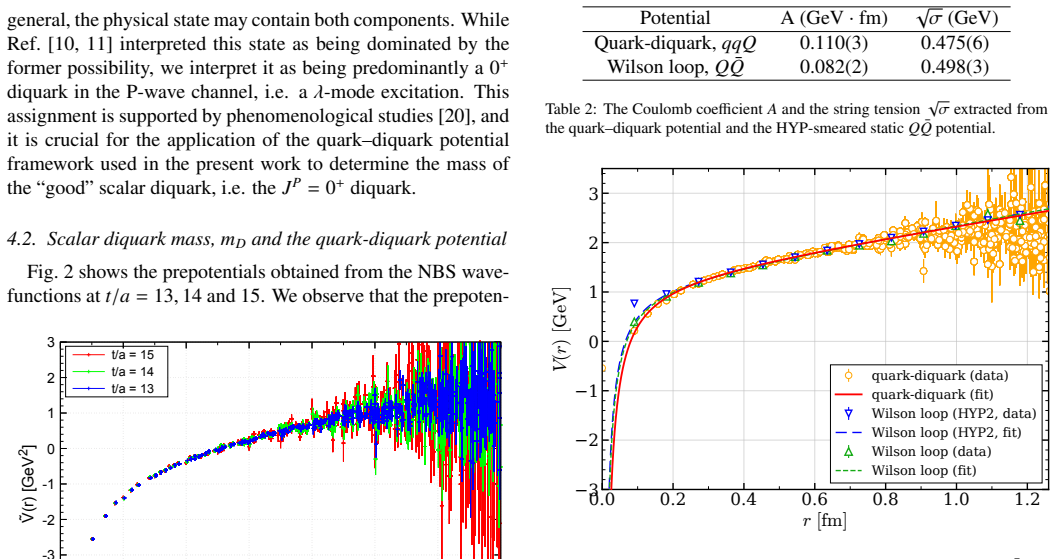
Applying the HAL QCD-inspired potential method to a scalar-diquark plus static-quark system on 2+1 flavor lattices, the diquark mass is fixed self-consistently so that the potential reproduces the p-wave baryonic spectrum; the mass obtained is close to (2/3)m_N and the potential is of Cornell type whose string tension agrees within about 5 percent with the Wilson-loop value.
What carries the argument
HAL QCD-inspired potential extracted from the diquark-static quark correlator, with diquark mass fixed by matching the p-wave baryon spectrum.
If this is right
- The quark-diquark interaction is of the same Cornell form found for quark-antiquark pairs.
- The confinement scale (string tension) is essentially unchanged when one participant is a diquark rather than an antiquark.
- Baryons can be modeled as a static quark bound to a scalar diquark whose mass is set by the constituent estimate.
- The same potential framework can be used to predict higher partial-wave baryon states once the mass and potential are fixed.
Where Pith is reading between the lines
- The method could be applied to other diquark spin-flavor channels to extract their masses and potentials without full three-body simulations.
- If the 5 percent agreement persists at physical pion mass, quark-diquark potentials might serve as a computationally cheaper route to baryon spectroscopy.
- The close match to the naive mass estimate suggests that the diquark behaves as a compact object whose internal dynamics can be absorbed into a single effective mass parameter.
Load-bearing premise
The diquark mass can be chosen so that the potential model reproduces the p-wave spectrum obtained from two-point functions.
What would settle it
A repeat of the calculation at a lighter pion mass in which the self-consistent diquark mass deviates by more than 20 percent from (2/3)m_N while the spectrum match still holds.
Figures
read the original abstract
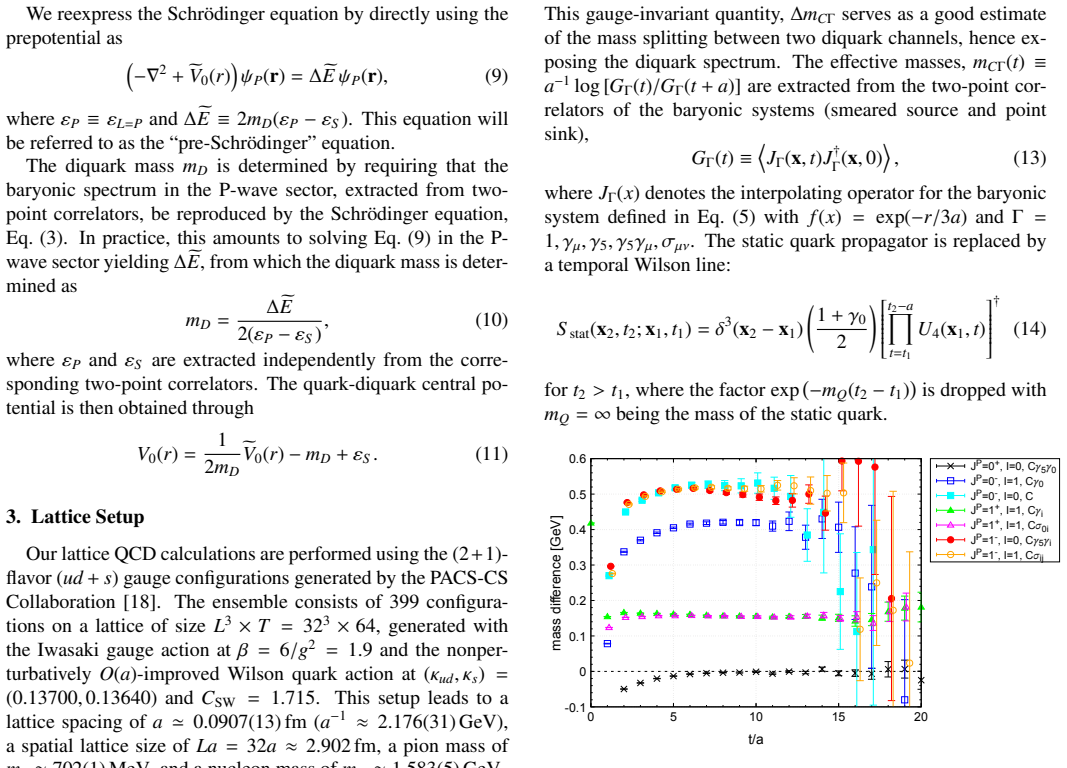
We study the scalar diquark mass and the quark--diquark potential by applying a HAL QCD-inspired potential method to a baryonic system composed of a scalar diquark and a static quark. The diquark mass is determined self-consistently by requiring that the p-wave baryonic spectrum obtained from two-point correlators be reproduced within the potential framework. Numerical calculations are performed using $2+1$ flavor QCD gauge configurations generated by the PACS-CS Collaboration on a $L^{3} \times T = 32^{3} \times 64$ lattice with $a^{-1} \approx 2.176$ GeV and the pion mass, $m_{\pi} \approx 702$ MeV. From the analysis, we obtain a scalar diquark mass which is close to the na\"{\i}ve constituent quark estimate $ (2/3)m_{N}$, together with a quark--diquark potential of the Cornell type (Coulomb + linear). The string tension extracted from the quark--diquark potential agrees within approximately 5% with that obtained from the static quark--antiquark potential (Wilson Loop).
Editorial analysis
A structured set of objections, weighed in public.
Referee Report
Summary. The paper applies a HAL QCD-inspired potential method to a system consisting of a scalar diquark and a static quark on 2+1 flavor PACS-CS configurations (32^3×64, a^{-1}≈2.176 GeV, m_π≈702 MeV). The scalar diquark mass is fixed self-consistently by requiring that the Schrödinger equation with the extracted quark-diquark potential reproduces the p-wave baryon spectrum obtained from two-point correlators. The resulting mass is reported close to the naïve (2/3)m_N estimate, the potential is of Cornell form, and the string tension extracted from it agrees with the Wilson-loop static quark-antiquark value to within ~5%.
Significance. If the self-consistent matching is robust against systematics, the work supplies a lattice QCD determination of both the diquark mass and the quark-diquark interaction in a controlled heavy-light setting. The 5% agreement between the two string tensions constitutes a non-trivial internal consistency check that is not automatic in the potential-method framework.
major comments (2)
- [Numerical analysis / self-consistent mass determination] The self-consistent tuning of the diquark mass (described in the abstract and the numerical-analysis section) is load-bearing for both the reported mass value and the subsequent Cornell parameters. Because the target p-wave energies are taken from two-point correlators on a 32^3 lattice at m_π≈702 MeV, any residual excited-state contamination directly shifts the fitted mass and therefore the extracted string tension; the manuscript does not appear to quantify this systematic via multi-exponential fits or variational methods.
- [Results / string-tension comparison] The claim that the string tension agrees within approximately 5% with the Wilson-loop result rests on the same tuned mass; without an explicit propagation of the uncertainty from the p-wave spectrum fit into the potential parameters, it is unclear whether the 5% figure already incorporates this source of error or only statistical uncertainties.
minor comments (2)
- [Formalism] Notation for the diquark mass (m_D) and the reduced mass in the Schrödinger equation should be defined explicitly in the methods section to avoid ambiguity when the static quark is infinitely heavy.
- [Lattice setup] The manuscript would benefit from a brief statement of the fitting range and functional form used to extract the p-wave energies from the two-point functions.
Simulated Author's Rebuttal
We thank the referee for the careful reading of our manuscript and for highlighting the importance of controlling systematics in the self-consistent mass determination. We address each major comment below and will incorporate the suggested improvements in a revised version.
read point-by-point responses
-
Referee: [Numerical analysis / self-consistent mass determination] The self-consistent tuning of the diquark mass (described in the abstract and the numerical-analysis section) is load-bearing for both the reported mass value and the subsequent Cornell parameters. Because the target p-wave energies are taken from two-point correlators on a 32^3 lattice at m_π≈702 MeV, any residual excited-state contamination directly shifts the fitted mass and therefore the extracted string tension; the manuscript does not appear to quantify this systematic via multi-exponential fits or variational methods.
Authors: We agree that a quantitative assessment of excited-state contamination in the two-point correlators is necessary to support the robustness of the self-consistent diquark mass. Our current analysis relied on identifying a plateau in the effective-mass plot and performing single-exponential fits over a suitable time range. To address the referee's concern, we will add multi-exponential fits (and, where feasible, a variational analysis with multiple operators) to the revised manuscript, extract the associated systematic uncertainty on the p-wave energies, and propagate it through the self-consistent procedure to the diquark mass and the extracted potential parameters. revision: yes
-
Referee: [Results / string-tension comparison] The claim that the string tension agrees within approximately 5% with the Wilson-loop result rests on the same tuned mass; without an explicit propagation of the uncertainty from the p-wave spectrum fit into the potential parameters, it is unclear whether the 5% figure already incorporates this source of error or only statistical uncertainties.
Authors: The quoted 5% agreement refers to the central values of the string tension obtained with the self-consistently tuned diquark mass. We did not propagate the uncertainty arising from the p-wave spectrum fit into the final potential parameters in the submitted version. In the revision we will include this systematic uncertainty (obtained from the multi-exponential analysis mentioned above) and present the string-tension comparison with the combined statistical and systematic errors, thereby clarifying the significance of the agreement. revision: yes
Circularity Check
No significant circularity; derivation relies on independent lattice extractions and explicit fitting
full rationale
The paper explicitly determines the scalar diquark mass via self-consistent tuning to reproduce the p-wave spectrum measured in two-point correlators, while the quark-diquark potential (and its Cornell parameters including string tension) is extracted from the lattice baryonic system using the HAL QCD-inspired method and compared directly to an independent Wilson-loop static potential. This matching step is transparent and does not rename a fitted quantity as an independent prediction; the reported closeness to (2/3)m_N and the ~5% string-tension agreement are outcomes of the lattice data rather than reductions by construction. No load-bearing self-citation chain, ansatz smuggling, or uniqueness theorem is invoked to force the central results. The derivation chain remains self-contained against external benchmarks.
Axiom & Free-Parameter Ledger
free parameters (1)
- diquark mass
axioms (2)
- domain assumption The HAL QCD-inspired potential method accurately extracts the effective potential from the lattice correlators in this system.
- domain assumption The lattice configurations with m_π ≈ 702 MeV adequately represent the physics for this extraction.
Forward citations
Cited by 1 Pith paper
-
Scalar diquarks in the QCD vacuum
A first-principles FRG approach to two-flavor QCD derives low-energy constants for the pion, sigma-meson and scalar diquark without parameters beyond QCD itself, including new diquark properties for color-superconduct...
Reference graph
Works this paper leans on
-
[1]
R. L. Jaffe, Exotica, Nucl. Phys. B Proc. Suppl. 142 (2005) 343
2005
-
[2]
’t Hooft, Physical Review D 14 (12) (1976) 3432–3450
G. ’t Hooft, Physical Review D 14 (12) (1976) 3432–3450. doi:10.1103/physrevd.14.3432
-
[3]
Shuryak, The role of instantons in quantum chromo- dynamics, Nuclear Physics B 203 (1) (1982) 93–115
E. Shuryak, The role of instantons in quantum chromo- dynamics, Nuclear Physics B 203 (1) (1982) 93–115. doi:10.1016/0550-3213(82)90478-3. 5
-
[4]
T. Schäfer, E. V . Shuryak, Instantons in qcd 70 (2) (1998) 323–425. doi:10.1103/revmodphys.70.323
-
[5]
E. Shuryak, I. Zahed, A schematic model for pentaquarks based on diquarks, Physics Letters B 589 (1–2) (2004) 21–27. doi:10.1016/j.physletb.2004.03.019
-
[6]
R. Workman, et al., Review of particle physics, Progress of Theoretical and Experimental Physics 2022 (8) (2022) 083C01. doi:https://doi.org/10.1093/ptep/ptac097
-
[7]
M. Hess, F. Karsch, E. Laermann, I. Wetzorke, Diquark masses from lattice qcd, Phys. Rev. D 58 (1997) 111502. arXiv:hep-lat/9804023
Pith/arXiv arXiv 1997
-
[8]
R. Babich, N. Garron, C. Hoelbling, J. Howard, L. Lel- louch, C. Rebbi, Diquark correlations in baryons on the lattice with overlap quarks, Phys. Rev. D 76 (2007) 074021. arXiv:hep-lat/0701023
Pith/arXiv arXiv 2007
-
[9]
Y . Bi, H. Cai, Y . Chen, M. Gong, Z. Liu, H.-X. Qiao, Y .-B. Yang, Diquark mass differences from unquenched lattice qcd, Chin. Phys. C 40 (2016) 073106. arXiv:1510.07354
Pith/arXiv arXiv 2016
-
[10]
C. Alexandrou, P. de Forcrand, B. Lucini, Evidence for diquarks in lattice qcd, Phys. Rev. Lett. 97 (2006) 222002. arXiv:hep-lat/0609004
Pith/arXiv arXiv 2006
-
[11]
A. Francis, P. de Forcrand, R. Lewis, K. Maltman, Di- quark properties from full qcd lattice simulations, JHEP 05 (2022) 062. arXiv:2106.09080
arXiv 2022
-
[12]
Orginos, Diquark properties from lattice qcd, in: PoS LAT2005, 2006, p
K. Orginos, Diquark properties from lattice qcd, in: PoS LAT2005, 2006, p. 054. arXiv:hep-lat/0510082
Pith/arXiv arXiv 2006
-
[13]
J. Green, J. Negele, M. Engelhardt, P. Varilly, Spatial di- quark correlations in a hadron, in: PoS LATTICE2010, 2010, p. 140. arXiv:1012.2353
Pith/arXiv arXiv 2010
-
[14]
Watanabe, N
K. Watanabe, N. Ishii, Building diquark model from lat- tice qcd, Few Body Syst. 23 (3) (2021) 45
2021
-
[15]
Watanabe, Quark-diquark potential and diquark mass from lattice qcd, Phys
K. Watanabe, Quark-diquark potential and diquark mass from lattice qcd, Phys. Rev. D 105 (2022) 074510. arXiv:2111.15167
arXiv 2022
-
[16]
S. Nishioka, N. Ishii, Axialvector diquark mass and quark- diquark potential inΣ c, PoS (LATTICE2024) 305 (2025). arXiv:2502.06260
arXiv 2025
-
[17]
Nishioka, N
S. Nishioka, N. Ishii, Axialvector diquark Mass and quark-diquark potential inΣ c, PoS HADRON2025 (2026)
2026
-
[18]
doi:10.22323/1.500.0013
-
[19]
Aoki, K.-I
S. Aoki, K.-I. Ishikawa, N. Ishizuka, T. Izubuchi, D. Kadoh, K. Kanaya, Y . Kuramashi, Y . Namekawa, M. Okawa, Y . Taniguchi, A. Ukawa, N. Ukita, T. Yoshie, 2+1 flavor lattice qcd toward the physical point, Phys. Rev. D 79 (2009) 034503
2009
-
[20]
A. Hasenfratz, F. Knechtli, Flavor symmetry and the static potential with hypercubic blocking, Physical Review D 64 (3) (2001). doi:10.1103/physrevd.64.034504
-
[21]
H. Nagahiro, S. Yasui, A. Hosaka, M. Oka, H. Noumi, Structure of charmed baryons studied by pionic decays, Physical Review D 95 (1) (2017). doi:10.1103/physrevd.95.014023
-
[22]
S. Ueda, S. Aoki, T. Aoyama, K. Kanaya, H. Matsu- furu, S. Motoki, Y . Namekawa, H. Nemura, Y . Taniguchi, N. Ukita, Development of an object oriented lattice qcd code ’bridge++’, J. Phys. Conf. Ser. 523 012046. (523) (2014). 6
2014
discussion (0)
Sign in with ORCID, Apple, or X to comment. Anyone can read and Pith papers without signing in.