Factorized Quantum Curves and Voronoi Polytopes in 3D Duality Cascades with FI Parameters
Pith reviewed 2026-06-26 16:20 UTC · model grok-4.3
The pith
Factorized quantum curves extend naturally to include FI parameters for del Pezzo geometries, realizing Voronoi polytope vertices as extremal brane configurations.
A machine-rendered reading of the paper's core claim, the machinery that carries it, and where it could break.
Core claim
In the presence of FI parameters, the vertices of the fundamental domains for del Pezzo geometries with exceptional Weyl-group symmetries are realized as factorized quantum curves constructed from canonical operators interpreted as 5-branes dressed with FI parameters. These vertices are identified with Voronoi polytopes of exceptional root lattices, extending the factorized description known without FI parameters.
What carries the argument
Factorized quantum curves built from canonical operators as 5-branes dressed with FI parameters, realizing the vertices of Voronoi polytopes of exceptional root lattices as extremal brane configurations.
If this is right
- The factorized description of quantum curves extends to include FI parameters.
- The vertices of fundamental domains correspond to factorized quantum curves from FI-dressed 5-branes.
- This provides a physical realization of Voronoi polytope vertices.
- The Fermi gas formalism maps these brane configurations to the factorized curves even with FI parameters.
Where Pith is reading between the lines
- Explicit calculations for specific del Pezzo surfaces could verify the factorization with nonzero FI values.
- The approach might generalize to other root lattices or geometries without exceptional symmetries.
- This could help in understanding how FI parameters affect rank assignments in duality cascades.
Load-bearing premise
The structure of the fundamental domain and its identification with Voronoi polytopes of exceptional root lattices persists when FI parameters are introduced.
What would settle it
A mismatch between the expected factorized form of the quantum curve and the actual curve computed from a 5-brane configuration with specific FI parameters at a Voronoi vertex for a del Pezzo geometry would falsify the claim.
Figures
read the original abstract
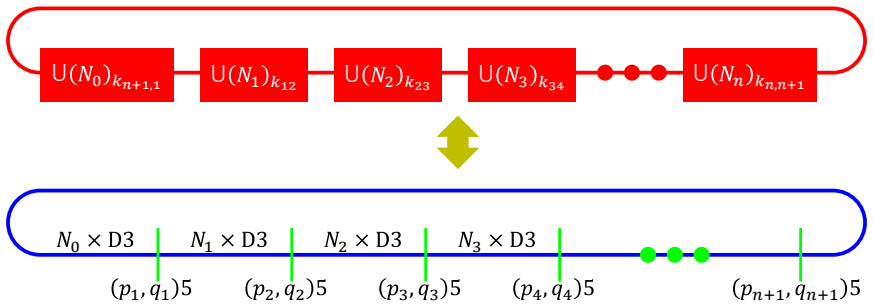
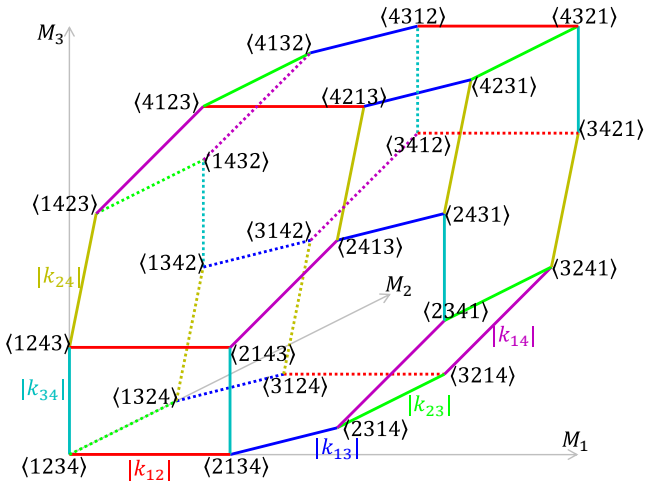
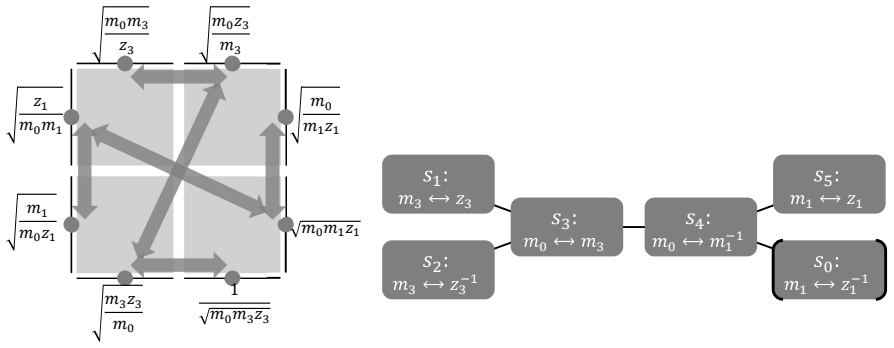
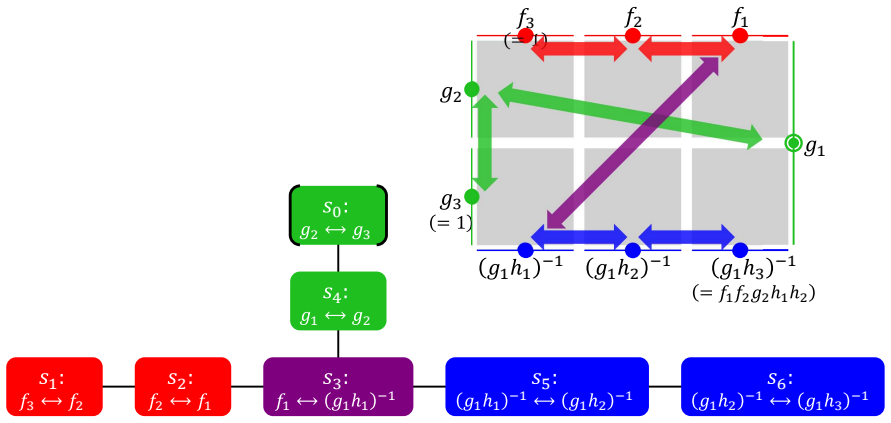
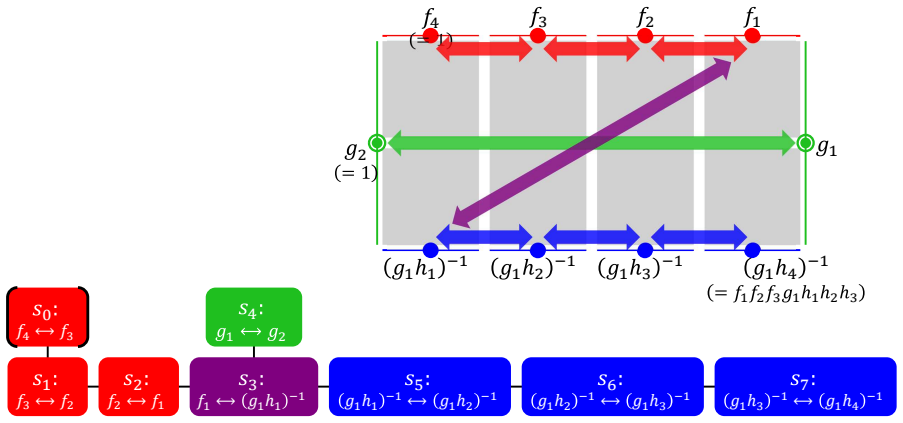
In the study of duality cascades in three-dimensional gauge theories without FI parameters, an important role is played by a fundamental domain whose vertices correspond to brane configurations with vanishing relative ranks. Through the Fermi gas formalism, such brane configurations are known to be represented by factorized quantum curves. In this paper, we show that this factorized description extends naturally to quantum curves associated with del Pezzo geometries possessing exceptional Weyl-group symmetries in the presence of FI parameters. We find that the vertices of the corresponding fundamental domains, identified with Voronoi polytopes of exceptional root lattices, are realized as factorized quantum curves built from canonical operators interpreted as 5-branes dressed with FI parameters. This provides a physical realization of the vertices of the Voronoi polytopes as ``extremal'' brane configurations.
Editorial analysis
A structured set of objections, weighed in public.
Referee Report
Summary. The manuscript claims that the factorized quantum-curve description of brane configurations in 3D duality cascades, previously established for vanishing relative ranks without FI parameters, extends to del Pezzo geometries with exceptional Weyl-group symmetries when FI parameters are included. The vertices of the associated fundamental domains, identified with Voronoi polytopes of exceptional root lattices, are realized as factorized quantum curves constructed from canonical operators interpreted as 5-branes dressed with FI parameters, providing a physical realization of these vertices as extremal brane configurations via the Fermi gas formalism.
Significance. If the central construction holds, the work supplies an explicit physical realization of Voronoi polytope vertices in terms of dressed 5-brane operators, extending the factorized quantum-curve framework to the FI-parameter case for geometries with exceptional Weyl symmetries. This strengthens the link between 3D gauge-theory duality cascades and root-lattice geometry, and the use of the Fermi-gas formalism to map the dressed operators is a concrete strength.
minor comments (3)
- [§3] §3: the commutation relations for the FI-dressed canonical operators are stated but the explicit map from the Fermi-gas partition function to the factorized curve is only sketched; a short derivation or reference to the precise operator ordering would improve readability.
- [Figure 2] Figure 2: the labeling of the Voronoi polytope vertices with the corresponding dressed 5-brane configurations is helpful but the coordinate axes are not labeled with the FI-parameter values used in the example; adding these values would make the identification immediate.
- [Abstract/Introduction] The abstract and introduction use the phrase 'extends naturally' without a one-sentence statement of the key technical step that survives the introduction of FI parameters; a brief clarifying sentence would help readers locate the new content.
Simulated Author's Rebuttal
We thank the referee for their positive assessment of the manuscript, accurate summary of the central results, and recommendation for minor revision. The referee's description correctly identifies the extension of the factorized quantum-curve framework to FI parameters and the realization of Voronoi polytope vertices via dressed 5-brane operators.
Circularity Check
No significant circularity detected
full rationale
The paper extends prior results on factorized quantum curves for duality cascades (without FI parameters) to the case with FI parameters, using the Fermi gas formalism to realize vertices of Voronoi polytopes as dressed 5-brane operators. No step reduces by construction to a self-definition, fitted input renamed as prediction, or unverified self-citation chain; the extension is presented via explicit operator construction on del Pezzo geometries with exceptional Weyl symmetries. The derivation remains independent of its own outputs and is self-contained as a direct continuation.
Axiom & Free-Parameter Ledger
Reference graph
Works this paper leans on
-
[1]
Type IIB superstrings, BPS monopoles, and three- dimensional gauge dynamics,
A. Hanany and E. Witten, “Type IIB superstrings, BPS monopoles, and three- dimensional gauge dynamics,” Nucl. Phys. B492(1997), 152-190 [arXiv:hep-th/9611230 [hep-th]]
Pith/arXiv arXiv 1997
-
[2]
Hanany-Witten effect and SL(2,Z) dualities in matrix models,
B. Assel, “Hanany-Witten effect and SL(2,Z) dualities in matrix models,” JHEP10 (2014), 117 [arXiv:1406.5194 [hep-th]]
Pith/arXiv arXiv 2014
-
[3]
Non-perturbative tests of duality cascades in three dimensional supersymmetric gauge theories,
M. Honda and N. Kubo, “Non-perturbative tests of duality cascades in three dimensional supersymmetric gauge theories,” JHEP07(2021), 012 [arXiv:2010.15656 [hep-th]]
arXiv 2021
-
[4]
I. R. Klebanov and M. J. Strassler, “Supergravity and a confining gauge theory: Duality cascades and chi SB resolution of naked singularities,” JHEP08(2000), 052 [arXiv:hep- th/0007191 [hep-th]]
arXiv 2000
-
[5]
N=6 superconformal Chern- Simons-matter theories, M2-branes and their gravity duals,
O. Aharony, O. Bergman, D. L. Jafferis and J. Maldacena, “N=6 superconformal Chern- Simons-matter theories, M2-branes and their gravity duals,” JHEP10(2008), 091 [arXiv:0806.1218 [hep-th]]
Pith/arXiv arXiv 2008
-
[6]
Entropy of near extremal black p-branes,
I. R. Klebanov and A. A. Tseytlin, “Entropy of near extremal black p-branes,” Nucl. Phys. B475(1996), 164-178 [arXiv:hep-th/9604089 [hep-th]]. 34
Pith/arXiv arXiv 1996
-
[7]
N=5,6 Superconformal Chern- Simons Theories and M2-branes on Orbifolds,
K. Hosomichi, K. M. Lee, S. Lee, S. Lee and J. Park, “N=5,6 Superconformal Chern- Simons Theories and M2-branes on Orbifolds,” JHEP09(2008), 002 [arXiv:0806.4977 [hep-th]]
Pith/arXiv arXiv 2008
-
[8]
O. Aharony, O. Bergman and D. L. Jafferis, “Fractional M2-branes,” JHEP11(2008), 043 [arXiv:0807.4924 [hep-th]]
Pith/arXiv arXiv 2008
-
[9]
Exact Results for Wilson Loops in Superconfor- mal Chern-Simons Theories with Matter,
A. Kapustin, B. Willett and I. Yaakov, “Exact Results for Wilson Loops in Superconfor- mal Chern-Simons Theories with Matter,” JHEP03(2010), 089 [arXiv:0909.4559 [hep- th]]
Pith/arXiv arXiv 2010
-
[10]
From weak to strong coupling in ABJM theory,
N. Drukker, M. Marino and P. Putrov, “From weak to strong coupling in ABJM theory,” Commun. Math. Phys.306(2011), 511-563 [arXiv:1007.3837 [hep-th]]
Pith/arXiv arXiv 2011
-
[11]
Summing Up All Genus Free Energy of ABJM Matrix Model,
H. Fuji, S. Hirano and S. Moriyama, “Summing Up All Genus Free Energy of ABJM Matrix Model,” JHEP08(2011), 001 [arXiv:1106.4631 [hep-th]]
Pith/arXiv arXiv 2011
-
[12]
ABJM at finite N via 4d supergravity,
K. Hristov, “ABJM at finite N via 4d supergravity,” JHEP10(2022), 190 [arXiv:2204.02992 [hep-th]]
arXiv 2022
-
[13]
Large N superconformal indices for 3d holo- graphic SCFTs,
N. Bobev, S. Choi, J. Hong and V. Reys, “Large N superconformal indices for 3d holo- graphic SCFTs,” JHEP02(2023), 027 [arXiv:2210.15326 [hep-th]]
arXiv 2023
-
[14]
M. Beccaria and A. A. Tseytlin, “Large N expansion of superconformal index of k=1 ABJM theory and semiclassical M5 brane partition function,” Nucl. Phys. B1001(2024), 116507 [arXiv:2312.01917 [hep-th]]
arXiv 2024
-
[15]
N. Bobev, P. J. De Smet, J. Hong, V. Reys and X. Zhang, “An Airy tale at large N,” JHEP07(2025), 123 [arXiv:2502.04606 [hep-th]]
arXiv 2025
-
[16]
An M2/M5 Duality from the Giant Graviton Expansion,
H. Y. Chen, N. Dorey, S. Moriyama, R. Mouland and C. Sanli, “An M2/M5 Duality from the Giant Graviton Expansion,” [arXiv:2601.17114 [hep-th]]
-
[17]
Nonperturbative aspects of ABJM theory,
N. Drukker, M. Marino and P. Putrov, “Nonperturbative aspects of ABJM theory,” JHEP 11(2011), 141 [arXiv:1103.4844 [hep-th]]
Pith/arXiv arXiv 2011
-
[18]
M. Marino and P. Putrov, “ABJM theory as a Fermi gas,” J. Stat. Mech.1203(2012), P03001 [arXiv:1110.4066 [hep-th]]
Pith/arXiv arXiv 2012
-
[19]
Instanton Effects in ABJM Theory from Fermi Gas Approach,
Y. Hatsuda, S. Moriyama and K. Okuyama, “Instanton Effects in ABJM Theory from Fermi Gas Approach,” JHEP01(2013), 158 [arXiv:1211.1251 [hep-th]]. 35
Pith/arXiv arXiv 2013
-
[20]
Instanton Bound States in ABJM Theory,
Y. Hatsuda, S. Moriyama and K. Okuyama, “Instanton Bound States in ABJM Theory,” JHEP05(2013), 054 [arXiv:1301.5184 [hep-th]]
Pith/arXiv arXiv 2013
-
[21]
Non-perturbative effects and the refined topological string,
Y. Hatsuda, M. Marino, S. Moriyama and K. Okuyama, “Non-perturbative effects and the refined topological string,” JHEP09(2014), 168 [arXiv:1306.1734 [hep-th]]
Pith/arXiv arXiv 2014
-
[22]
Nekrasov Functions and Exact Bohr-Zommerfeld Inte- grals,
A. Mironov and A. Morozov, “Nekrasov Functions and Exact Bohr-Zommerfeld Inte- grals,” JHEP04(2010), 040 [arXiv:0910.5670 [hep-th]]
Pith/arXiv arXiv 2010
-
[23]
Quantum Geometry of Refined Topological Strings,
M. Aganagic, M. C. Cheng, R. Dijkgraaf, D. Krefl and C. Vafa, “Quantum Geometry of Refined Topological Strings,” JHEP11(2012), 019 [arXiv:1105.0630 [hep-th]]
Pith/arXiv arXiv 2012
-
[24]
Five-brane webs, 3dN= 2 theories and quantum curves,
N. Kubo, “Five-brane webs, 3dN= 2 theories and quantum curves,” JHEP05(2025), 103 [arXiv:2501.04146 [hep-th]]
arXiv 2025
-
[25]
Quantum curves andq-deformed Painlev´ e equa- tions,
G. Bonelli, A. Grassi and A. Tanzini, “Quantum curves andq-deformed Painlev´ e equa- tions,” Lett. Math. Phys.109(2019) no.9, 1961-2001 [arXiv:1710.11603 [hep-th]]
Pith/arXiv arXiv 2019
-
[26]
M2-branes andq-Painlev´ e equations,
G. Bonelli, F. Globlek, N. Kubo, T. Nosaka and A. Tanzini, “M2-branes andq-Painlev´ e equations,” Lett. Math. Phys.112(2022) no.6, 109 [arXiv:2202.10654 [hep-th]]
arXiv 2022
-
[27]
40 bilinear relations of q-Painlev´ e VI fromN= 4 super Chern-Simons theory,
S. Moriyama and T. Nosaka, “40 bilinear relations of q-Painlev´ e VI fromN= 4 super Chern-Simons theory,” JHEP08(2023), 191 [arXiv:2305.03978 [hep-th]]
arXiv 2023
-
[28]
Affine symmetries for ABJM partition function and its generalization,
S. Moriyama and T. Nosaka, “Affine symmetries for ABJM partition function and its generalization,” JHEP05(2024), 153 [arXiv:2312.04206 [hep-th]]
arXiv 2024
-
[29]
Quantization conditions and functional equations in ABJ(M) theories,
A. Grassi, Y. Hatsuda and M. Marino, “Quantization conditions and functional equations in ABJ(M) theories,” J. Phys. A49(2016) no.11, 115401 [arXiv:1410.7658 [hep-th]]
Pith/arXiv arXiv 2016
-
[30]
Large N expansion of mass deformed ABJM matrix model: M2-instanton condensation and beyond,
T. Nosaka, “Large N expansion of mass deformed ABJM matrix model: M2-instanton condensation and beyond,” JHEP03(2024), 087 [arXiv:2401.11484 [hep-th]]
arXiv 2024
-
[31]
Duality cascades and affine Weyl groups,
T. Furukawa, K. Matsumura, S. Moriyama and T. Nakanishi, “Duality cascades and affine Weyl groups,” JHEP05(2022), 132 [arXiv:2112.13616 [hep-th]]
arXiv 2022
-
[32]
Duality cascades and parallelotopes,
T. Furukawa, S. Moriyama and H. Sasaki, “Duality cascades and parallelotopes,” J. Phys. A56(2023) no.16, 165401 [arXiv:2205.08039 [hep-th]]
arXiv 2023
-
[33]
Finiteness and uniqueness of duality cascades in three dimensions for affine quivers,
S. Moriyama and K. Otozawa, “Finiteness and uniqueness of duality cascades in three dimensions for affine quivers,” J. Phys. A58(2025) no.9, 095401 [arXiv:2411.09141 [hep- th]]. 36
arXiv 2025
-
[34]
Convex polytopes,
B. Gr¨ unbaum, “Convex polytopes,” Interscience, Vol.16, (1967)
1967
-
[35]
Lectures on polytopes,
G. M. Ziegler, “Lectures on polytopes,” Springer Science & Business Media, Vol.152, (2012)
2012
-
[36]
Sphere packings, lattices and groups,
J.H. Conway and N.J.A. Sloane. “Sphere packings, lattices and groups,” Springer Science & Business Media, Vol.290, (2013)
2013
-
[37]
Space-filling zonotopes,
G. C. Shephard, “Space-filling zonotopes,” Mathematika21.2(1974), 261-269
1974
-
[38]
Space tiling zonotopes,
P. McMullen, “Space tiling zonotopes,” Mathematika22.2(1975), 202-211
1975
-
[39]
Quantizing the B ´’acklund transformations of Painlev´ e equations and the quantum discrete Painlev´ e VI equation,
K. Hasegawa, “Quantizing the B ´’acklund transformations of Painlev´ e equations and the quantum discrete Painlev´ e VI equation,” Exploring New Structures and Natural Con- structions in Mathematical Physics, Vol.61, Mathematical Society of Japan (2011), 275- 289 [arXiv:0703036 [math.QA]]
2011
-
[40]
On q-deformations of the Heun equation,
K. Takemura, “On q-deformations of the Heun equation,” SIGMA14(2018), 061 [arXiv:1712.09564 [math.CA]]
Pith/arXiv arXiv 2018
-
[41]
Spectral Theories and Topological Strings on del Pezzo Geometries,
S. Moriyama, “Spectral Theories and Topological Strings on del Pezzo Geometries,” JHEP 10(2020), 154 [arXiv:2007.05148 [hep-th]]
arXiv 2020
-
[42]
Quantum Representation of Affine Weyl Groups and Associated Quantum Curves,
S. Moriyama and Y. Yamada, “Quantum Representation of Affine Weyl Groups and Associated Quantum Curves,” SIGMA17(2021), 076 [arXiv:2104.06661 [math.QA]]
arXiv 2021
-
[43]
Webs of five-branes and N=2 superconformal field theories,
F. Benini, S. Benvenuti and Y. Tachikawa, “Webs of five-branes and N=2 superconformal field theories,” JHEP09(2009), 052 [arXiv:0906.0359 [hep-th]]
Pith/arXiv arXiv 2009
-
[44]
5d E n Seiberg-Witten curve via toric-like diagram,
S. S. Kim and F. Yagi, “5d E n Seiberg-Witten curve via toric-like diagram,” JHEP06 (2015), 082 [arXiv:1411.7903 [hep-th]]
Pith/arXiv arXiv 2015
-
[45]
SU(N) q-Toda equations from mass deformed ABJM theory,
T. Nosaka, “SU(N) q-Toda equations from mass deformed ABJM theory,” JHEP06 (2021), 060 [arXiv:2012.07211 [hep-th]]
arXiv 2021
-
[46]
Geometric aspects of Painlev´ e equations,
K. Kajiwara, M. Noumi and Y. Yamada, “Geometric aspects of Painlev´ e equations,” J. Phys. A50(2017) no.7, 073001 [arXiv:1509.08186v8 [nlin.SI]]
Pith/arXiv arXiv 2017
-
[47]
Matrix Models from Operators and Topological Strings, 2,
R. Kashaev, M. Marino and S. Zakany, “Matrix Models from Operators and Topological Strings, 2,” Annales Henri Poincare17(2016) no.10, 2741-2781 [arXiv:1505.02243 [hep- th]]. 37
Pith/arXiv arXiv 2016
-
[48]
Exact Instanton Expansion of Superconformal Chern- Simons Theories from Topological Strings,
S. Moriyama and T. Nosaka, “Exact Instanton Expansion of Superconformal Chern- Simons Theories from Topological Strings,” JHEP05(2015), 022 [arXiv:1412.6243 [hep- th]]
Pith/arXiv arXiv 2015
-
[49]
Instanton Effects in Rank Deformed Su- perconformal Chern-Simons Theories from Topological Strings,
S. Moriyama, S. Nakayama and T. Nosaka, “Instanton Effects in Rank Deformed Su- perconformal Chern-Simons Theories from Topological Strings,” JHEP08(2017), 003 [arXiv:1704.04358 [hep-th]]
Pith/arXiv arXiv 2017
-
[50]
Superconformal Chern-Simons Theories from del Pezzo Geometries,
S. Moriyama, T. Nosaka and K. Yano, “Superconformal Chern-Simons Theories from del Pezzo Geometries,” JHEP11(2017), 089 [arXiv:1707.02420 [hep-th]]
Pith/arXiv arXiv 2017
-
[51]
Hanany-Witten Transition in Quantum Curves,
N. Kubo and S. Moriyama, “Hanany-Witten Transition in Quantum Curves,” JHEP12 (2019), 101 [arXiv:1907.04971 [hep-th]]
arXiv 2019
-
[52]
Conformal field theory,
P. Di Francesco, P. Mathieu and D. S´ en´ echal, “Conformal field theory,” Springer Science & Business Media, (2012)
2012
-
[53]
Introduction to Lie algebras and representation theory,
J.E. Humphreys, “Introduction to Lie algebras and representation theory,” Springer Sci- ence & Business Media, (2012)
2012
-
[54]
A generalization of theµ-function and its relation to integrable systems,
S. Tsuchimi, “A generalization of theµ-function and its relation to integrable systems,” doctoral thesis
-
[55]
Five-dimensional SUSY field theories, nontrivial fixed points and string dynamics,
N. Seiberg, “Five-dimensional SUSY field theories, nontrivial fixed points and string dynamics,” Phys. Lett. B388(1996), 753-760 [arXiv:hep-th/9608111 [hep-th]]
Pith/arXiv arXiv 1996
-
[56]
Classical and quantum curves of 5d Seiberg’s theories and their 4d limit,
O. Chalykh and Y. L¨ u, “Classical and quantum curves of 5d Seiberg’s theories and their 4d limit,” [arXiv:2411.01802 [hep-th]]
-
[57]
Stability structures, motivic Donaldson-Thomas in- variants and cluster transformations,
M. Kontsevich and Y. Soibelman, “Stability structures, motivic Donaldson-Thomas in- variants and cluster transformations,” [arXiv:0811.2435 [math.AG]]. 38
discussion (0)
Sign in with ORCID, Apple, or X to comment. Anyone can read and Pith papers without signing in.