Multi-Agent Transactive Memory
Pith reviewed 2026-06-26 17:37 UTC · model grok-4.3
The pith
A shared repository lets agents retrieve and reuse trajectories produced by other agents to improve task performance and reduce steps.
A machine-rendered reading of the paper's core claim, the machinery that carries it, and where it could break.
Core claim
Multi-Agent Transactive Memory stores trajectories contributed by producer agents in a shared repository so that consumer agents can retrieve relevant ones, producing higher downstream task success and fewer interaction steps in interactive environments without coordination or joint training.
What carries the argument
The Multi-Agent Transactive Memory framework for population-level storage and retrieval of agent-generated trajectories.
If this is right
- Producer agents contribute trajectories that later agents can apply to the same or similar tasks.
- Task success rates rise in long-horizon interactive settings such as ALFWorld and WebArena.
- Interaction length decreases without any requirement for agents to coordinate or train together.
- The benefit holds across heterogeneous agent populations drawn from separate model families.
Where Pith is reading between the lines
- Over time the repository could function as an accumulating library of solutions that grows with each new agent deployment.
- Retrieval quality may depend on how well trajectory embeddings capture procedural similarity rather than surface features.
- The same storage pattern could be tested on tasks outside simulated environments once suitable trajectory abstraction methods exist.
Load-bearing premise
Agent-generated trajectories contain reusable procedural knowledge that matches and transfers directly to consumer agents from different instances or models without extra adaptation or filtering.
What would settle it
A controlled test in which agents given retrieved trajectories show equal or lower success rates and equal or more steps than identical agents given no retrieval would falsify the performance claim.
Figures


read the original abstract
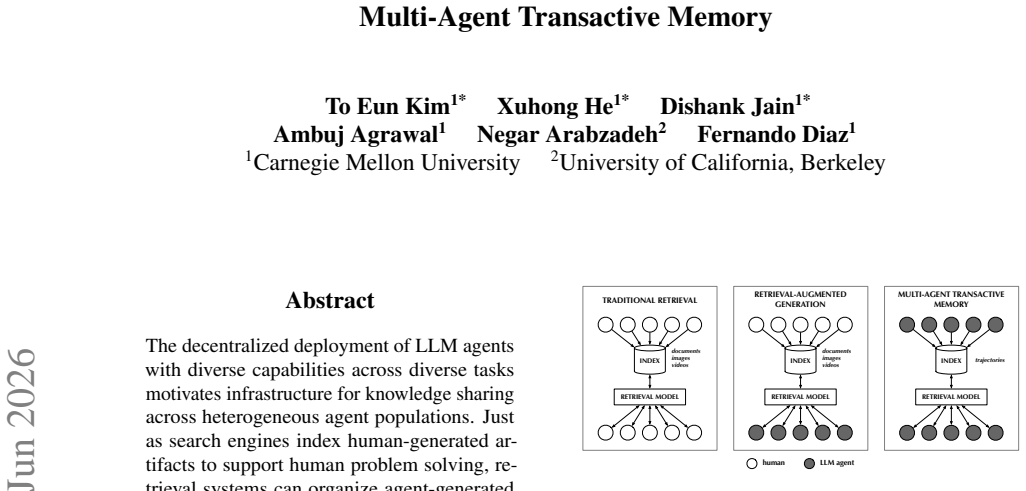
The decentralized deployment of LLM agents with diverse capabilities across diverse tasks motivates infrastructure for knowledge sharing across heterogeneous agent populations. Just as search engines index human-generated artifacts to support human problem solving, retrieval systems can organize agent-generated artifacts for reuse across agent populations. We extend retrieval-augmented generation - which demonstrates the value of human-authored artifacts to individual agents - to retrieval of agent-generated artifacts supporting a population of agents. In particular, agent trajectories encode reusable procedural knowledge, yet these artifacts are typically discarded after a single use or retained only by the producing agent, forcing newly instantiated agents to repeatedly rediscover existing solutions. We propose Multi-Agent Transactive Memory (MATM), a framework for population-level storage and retrieval of agent-generated trajectories, where producer agents contribute trajectories to a shared repository and consumer agents retrieve them to improve task execution. We focus on interactive environments (ALFWorld and WebArena), where trajectories are long and encode especially rich procedural structure. Our experiments demonstrate that retrieving trajectories from MATM improves downstream task performance and reduces interaction steps without coordination or joint training. These results position MATM as a design pattern for population-level experience sharing in open agent ecosystems.
Editorial analysis
A structured set of objections, weighed in public.
Referee Report
Summary. The manuscript proposes Multi-Agent Transactive Memory (MATM), a framework extending retrieval-augmented generation to agent-generated trajectories. Producer agents store trajectories encoding procedural knowledge in a shared repository; consumer agents retrieve them to improve execution in interactive environments (ALFWorld, WebArena). The central empirical claim is that retrieval improves downstream task performance and reduces interaction steps without coordination or joint training across heterogeneous agents.
Significance. If the empirical results hold with proper controls, MATM offers a practical, coordination-free design pattern for experience reuse across agent populations and model families. This extends RAG concepts to multi-agent settings and could support scalable open ecosystems where newly instantiated agents avoid rediscovering solutions.
major comments (2)
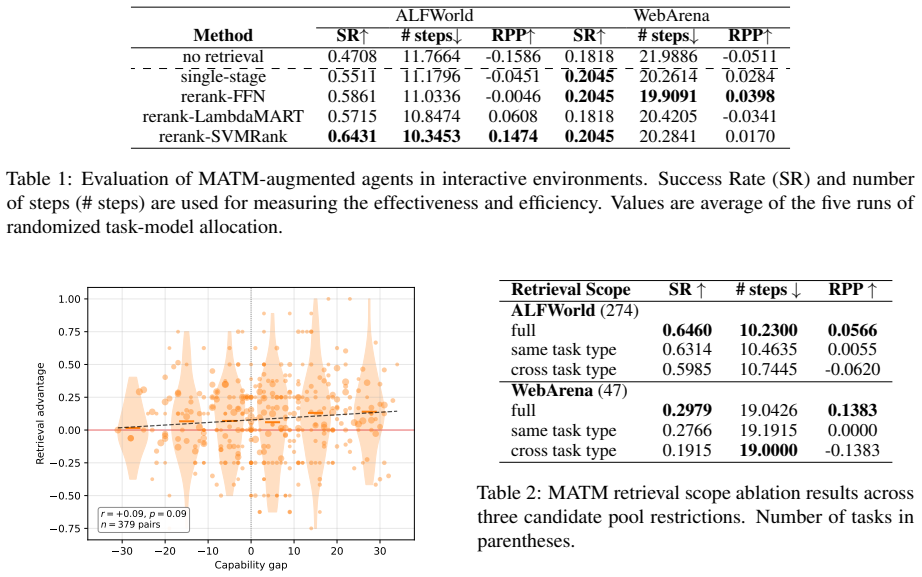
- [Abstract, Experiments] Abstract and Experiments section: the manuscript states that retrieving trajectories improves performance and reduces steps on ALFWorld and WebArena, yet provides no quantitative metrics, error bars, baseline comparisons, retrieval implementation details, or statistical tests. Without these, the magnitude and reliability of the claimed gains cannot be assessed and post-hoc selection of trajectories remains possible.
- [Methods] Methods/Implementation: the weakest assumption—that agent trajectories encode reusable procedural knowledge transferable across different agent instances or model families without adaptation or filtering—is not tested via ablation on cross-model transfer or negative examples; this is load-bearing for the population-level claim but lacks supporting controls.
minor comments (2)
- [Framework] Notation for the shared repository and retrieval process is introduced informally; a formal definition or pseudocode would improve clarity.
- [Abstract] The abstract claims 'without coordination or joint training' but does not explicitly contrast against coordinated or jointly trained baselines in the reported experiments.
Simulated Author's Rebuttal
We thank the referee for the constructive feedback, which identifies key areas where the empirical claims can be presented more rigorously. We address each major comment below.
read point-by-point responses
-
Referee: [Abstract, Experiments] Abstract and Experiments section: the manuscript states that retrieving trajectories improves performance and reduces steps on ALFWorld and WebArena, yet provides no quantitative metrics, error bars, baseline comparisons, retrieval implementation details, or statistical tests. Without these, the magnitude and reliability of the claimed gains cannot be assessed and post-hoc selection of trajectories remains possible.
Authors: We agree that the abstract summarizes results qualitatively and that the Experiments section requires more explicit reporting to substantiate the claims. In the revised manuscript we will update the abstract with specific quantitative metrics (success rates, step reductions), include error bars, baseline comparisons, retrieval implementation details, and statistical tests. This will also clarify how trajectories were selected to mitigate concerns about post-hoc selection. revision: yes
-
Referee: [Methods] Methods/Implementation: the weakest assumption—that agent trajectories encode reusable procedural knowledge transferable across different agent instances or model families without adaptation or filtering—is not tested via ablation on cross-model transfer or negative examples; this is load-bearing for the population-level claim but lacks supporting controls.
Authors: We acknowledge that the current experiments do not include explicit ablations for cross-model transfer or negative examples, which would strengthen support for the transferability assumption. We will add these controls (e.g., cross-model trajectory reuse and negative-example filtering) to the Methods and Experiments sections in the revision. revision: yes
Circularity Check
No significant circularity
full rationale
The paper proposes an empirical retrieval framework (MATM) for agent trajectories and validates it via experiments on ALFWorld and WebArena. No derivation chain, equations, or first-principles predictions exist that could reduce to inputs by construction. Claims rest on reported performance gains from retrieval, which are externally falsifiable via the described benchmarks. No self-citation load-bearing steps or ansatz smuggling are present in the provided text.
Axiom & Free-Parameter Ledger
axioms (1)
- domain assumption Agent trajectories encode reusable procedural knowledge that transfers across agents and task instances.
invented entities (1)
-
Multi-Agent Transactive Memory shared repository
no independent evidence
Reference graph
Works this paper leans on
-
[1]
InThe Eleventh International Confer- ence on Learning Representations
Quantifying memorization across neural lan- guage models. InThe Eleventh International Confer- ence on Learning Representations. Kai-Wei Chang, Akshay Krishnamurthy, Alekh Agar- wal, Hal Daumé III, and John Langford. 2015. Learn- ing to search better than your teacher. InInterna- tional Conference on Machine Learning, pages 2058–
2015
-
[2]
Zijian Chen, Xueguang Ma, Shengyao Zhuang, Jimmy Lin, Akari Asai, and Victor Zhong
PMLR. Zijian Chen, Xueguang Ma, Shengyao Zhuang, Jimmy Lin, Akari Asai, and Victor Zhong. 2026. Agentir: Reasoning-aware retrival for deep research agents. arXiv preprint arXiv:2603.04384. Marc-Alexandre Côté, Ákos Kádár, Xingdi Yuan, Ben Kybartas, Tavian Barnes, Emery Fine, James Moore, Ruo Yu Tao, Matthew Hausknecht, Layla El Asri, Mahmoud Adada, Wendy ...
-
[3]
Textworld: A learning environment for text- based games.CoRR, abs/1806.11532. 9 T. Cover and P. Hart. 1967. Nearest neighbor pattern classification.IEEE Transactions on Information Theory, 13(1):21–27. Yufan Dang, Chen Qian, Xueheng Luo, Jingru Fan, Zihao Xie, Ruijie Shi, Weize Chen, Cheng Yang, Xiaoyin Che, Ye Tian, Xuantang Xiong, Lei Han, Zhiyuan Liu, ...
-
[4]
Artificial Intelligence, 33(1):1–64
Soar: An architecture for general intelligence. Artificial Intelligence, 33(1):1–64. Patrick Lewis, Ethan Perez, Aleksandra Piktus, Fabio Petroni, Vladimir Karpukhin, Naman Goyal, Hein- rich Küttler, Mike Lewis, Wen-tau Yih, Tim Rock- täschel, and 1 others. 2020. Retrieval-augmented gen- eration for knowledge-intensive nlp tasks.Advances in neural informa...
-
[5]
Multi-Agent Collaboration Mechanisms: A Survey of LLMs
CLIN: A continually learning language agent for rapid task adaptation and generalization. InFirst Conference on Language Modeling. Model Context Protocol. 2026. Model context pro- tocol. https://modelcontextprotocol.io. Ac- cessed: 2026-05-26. Niklas Muennighoff, Zitong Yang, Weijia Shi, Xi- ang Lisa Li, Li Fei-Fei, Hannaneh Hajishirzi, Luke Zettlemoyer, ...
work page internal anchor Pith review Pith/arXiv arXiv 2026
-
[6]
goal": "<goal_text>
Supercorrect: Advancing small LLM rea- soning with thought template distillation and self- correction. InThe Thirteenth International Confer- ence on Learning Representations. Shunyu Yao, Dian Yu, Jeffrey Zhao, Izhak Shafran, Thomas L. Griffiths, Yuan Cao, and Karthik R Narasimhan. 2023. Tree of thoughts: Deliberate problem solving with large language mod...
2023
-
[7]
Your action MUST be character-for-character identical to one item in admissible_actions
-
[8]
Do NOT modify, abbreviate, or paraphrase actions
-
[9]
Do NOT use actions from retrieved trajectories unless they appear in current admissible_actions
-
[10]
look" or navigation ONE-SHOT EXAMPLE: Task: clean some apple and put it in sidetable. Turn 1: Observation: The fridge 1 is closed. Response: {
If confused, pick a safe exploratory action like "look" or navigation ONE-SHOT EXAMPLE: Task: clean some apple and put it in sidetable. Turn 1: Observation: The fridge 1 is closed. Response: {"reasoning": "Let’s think step by step. I should open fridge 1 to see what’s inside.", "action": "open fridge 1"} 18 Turn 2: Observation: You open the fridge 1. The ...
-
[11]
reasoning
<action_2> ... RESPONSE FORMAT: You MUST respond with valid JSON in this exact format: {"reasoning": "Let’s think step by step. [your detailed reasoning]", "action": "exact action from admissible_actions"} Where: - reasoning: MUST start with ‘Let’s think step by step.’ Then explain your thought process, what you observe, and why this action is best - acti...
-
[13]
Do not include any text before or after the JSON object. M.3 ALFWorld Trajectory-Augmented Prompt SYSTEM Same as ALFWorld Baseline (no-retrieval) System Prompt USER GOAL: <goal_text> CURRENT STEP: <current_step> / <max_steps> — RECENT HISTORY (Previous Steps - For Reference Only) — <recent_history_str> — End of Recent History — — RETRIEVED TRAJECTORY GUID...
-
[14]
The sequence of actions that led to success
-
[15]
The observations and their progression
-
[16]
How to adapt this strategy to the current situation and your goal
-
[17]
What steps might be different or similar in your current context — End of Trajectory Guidance — >>> CURRENT OBSERVATION (Focus on This - Current State): <observation> <<< End of Current Observation ADMISSIBLE ACTIONS (<N> total):
-
[18]
reasoning
<action_2> ... RESPONSE FORMAT: You MUST respond with valid JSON in this exact format: {"reasoning": "Let’s think step by step. [your detailed reasoning]", "action": "exact action from admissible_actions"} Where: - reasoning: MUST start with ‘Let’s think step by step.’ Then explain your thought process, what you observe, and why this action is best - acti...
-
[20]
M.4 WebArena Baseline (no-retrieval) Prompt SYSTEM You are an autonomous intelligent agent tasked with navigating a web browser
Do not include any text before or after the JSON object. M.4 WebArena Baseline (no-retrieval) Prompt SYSTEM You are an autonomous intelligent agent tasked with navigating a web browser. You will be given web-based tasks. These tasks will be accomplished through the use of specific actions you can issue. Here’s the information you’ll have: The user’s objec...
-
[21]
You should only issue an action that is valid given the current observation
-
[22]
You should only issue one action at a time
-
[23]
For each observation, think step by step about what you see and what action to take next
-
[24]
Example 1: OBSERVATION:
Your action MUST be one of the valid action formats listed above Few-shot examples and closing sentence. Example 1: OBSERVATION:
-
[25]
link ’HP CB782A#ABA 640 Inkjet Fax Machine (Renewed)’
-
[26]
StaticText ’$279.49’
-
[27]
button ’Add to Cart’
-
[28]
button ’Add to Wish List’
-
[29]
reasoning
button ’Add to Compare’ URL: http://onestopmarket.com/office-products/office-electronics.html OBJECTIVE: What is the price of HP CB782A#ABA 640 Inkjet Fax Machine (Renewed)? PREVIOUS ACTION: None Response: {"reasoning": "Let’s think step by step. I can see the product HP CB782A#ABA 640 Inkjet Fax Machine (Renewed) is displayed on the page. The price is cl...
-
[30]
textbox ’Search’ focused: True required: False
-
[31]
reasoning
button ’Search’ URL: http://onestopmarket.com OBJECTIVE: Search for USB-C to USB-B cable on the site. PREVIOUS ACTION: None Response: {"reasoning": "Let’s think step by step. I need to search for USB-C to USB-B cable on this site. I can see a search textbox with id [164] that is already focused. I should type my search query into this textbox and press en...
-
[32]
heading ’Certified Refurbished Kindle Paperwhite’
-
[33]
StaticText ’by Amazon’
-
[34]
StaticText ’Price: $79.99’
-
[35]
reasoning
button ’Add to Cart’ URL: http://onestopmarket.com/dp/B00ZV 9RDKK OBJECTIVE: Show me the details of the Kindle Paperwhite. PREVIOUS ACTION: click [582] Response: {"reasoning": "Let’s think step by step. I can see the Kindle Paperwhite product page with the heading, price ($79.99), and an Add to Cart button. The objective is to show details of the product....
-
[37]
Do not include any text before or after the JSON object. M.5 WebArena Trajectory-Augmented Prompt SYSTEM Same as WebArena Baseline (no-retrieval) System Prompt USER GOAL: <goal_text> CURRENT STEP: <current_step> / <max_steps> — RECENT HISTORY (Previous Steps - For Reference Only) — <recent_history_str> — End of Recent History — — RETRIEVED TRAJECTORY GUID...
-
[38]
The sequence of actions taken 23
-
[39]
How the agent navigated through the website
-
[40]
What elements were clicked and in what order
-
[41]
reasoning
When the task was completed — End of Trajectory Guidance — >>> CURRENT OBSERVATION (Focus on This - Current State): <observation> <<< End of Current Observation CURRENT URL: <url> RESPONSE FORMAT: You MUST respond with valid JSON in this exact format: {"reasoning": "Let’s think step by step. [your detailed reasoning]", "action": "action to be taken"} Wher...
-
[42]
Your reasoning MUST begin with ‘Let’s think step by step.’
-
[43]
N Dataset License • ALFWorld: MIT License • WebArena: Apache License 2.0 O Computational Budget For retrieval from the MATM index, we use one NVIDIA L40S GPU
Do not include any text before or after the JSON object. N Dataset License • ALFWorld: MIT License • WebArena: Apache License 2.0 O Computational Budget For retrieval from the MATM index, we use one NVIDIA L40S GPU. For LLM inference in experiments, the OpenRouter API was used. The total cost was approximately 2,000 USD. P Use of AI Assistants AI assistan...
discussion (0)
Sign in with ORCID, Apple, or X to comment. Anyone can read and Pith papers without signing in.