Optimizing resource allocation for accuracy in noisy variational quantum algorithms
Pith reviewed 2026-06-26 17:09 UTC · model grok-4.3
The pith
Simulations of noisy VQE yield a model that finds the circuit size and iteration count minimizing total gate operations for a target accuracy.
A machine-rendered reading of the paper's core claim, the machinery that carries it, and where it could break.
Core claim
Using simulations of a Variational Quantum Eigensolver, the authors propose a phenomenological model that captures the relationship between algorithmic accuracy, total gate operations, and noise. The model identifies the sweet spot of circuit size versus iterations that minimizes the algorithmic resource costs for a desired accuracy. It also gives the circuit size that maximizes algorithm accuracy for a fixed resource cost. This provides a practical guideline for deployment of variational algorithms on realistic noisy hardware.
What carries the argument
The phenomenological model of accuracy-resource-noise trade-offs derived from VQE simulations, which balances circuit size against iteration count to minimize total gate operations.
If this is right
- Minimizing total gate operations leads to faster and more energy-efficient algorithms.
- There is an identifiable optimal point in the circuit size versus iterations trade-off.
- The model applies to algorithms using error mitigation on noisy hardware.
- For fixed resources, accuracy can be maximized by choosing the right circuit size.
Where Pith is reading between the lines
- The model might extend to other variational quantum algorithms like QAOA.
- Validation on real hardware could allow calibration of the model parameters for specific devices.
- If accurate, it could guide the design of future quantum processors by highlighting resource bottlenecks.
Load-bearing premise
That the phenomenological model fitted to simulations under modeled noise will accurately predict the accuracy and resource trade-off on real quantum hardware with different noise characteristics.
What would settle it
Running VQE experiments on actual NISQ hardware with different circuit depths and iteration counts, then comparing the measured accuracy and total gate counts against the model's predictions for the optimal sweet spot.
Figures
read the original abstract
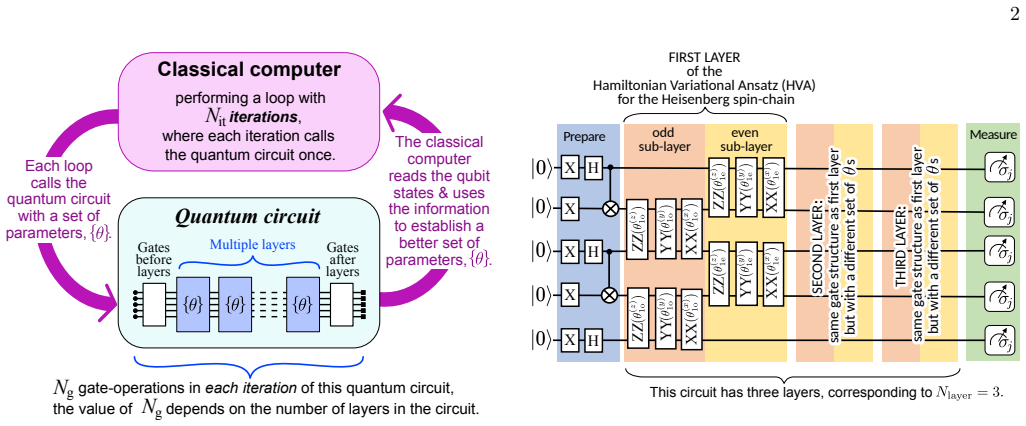
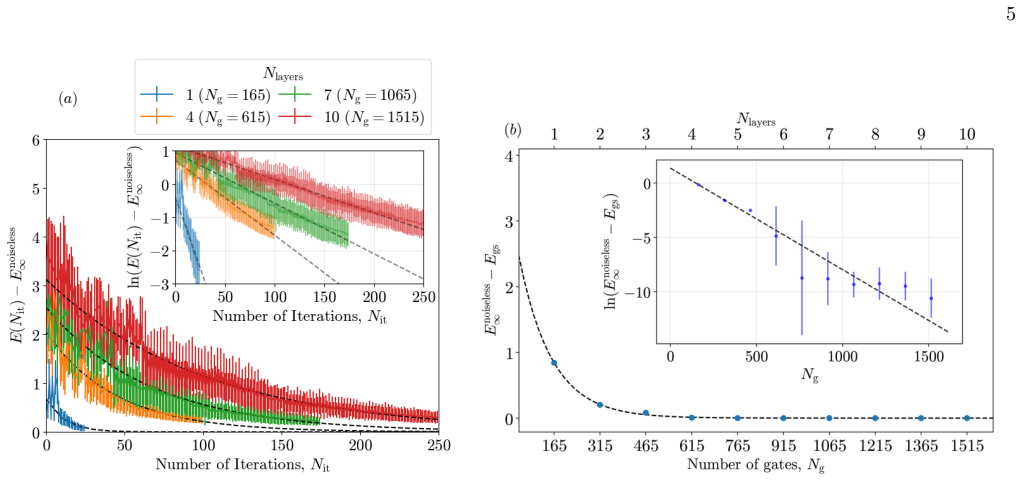
For quantum algorithms to achieve their full potential, we need methodologies to optimize them, such as reaching a given output accuracy with minimal resource costs. Here, we develop such a methodology for a class of Noisy Intermediate-Scale Quantum (NISQ) algorithms. We leverage simulations of a Variational Quantum Eigensolver (VQE) to propose a phenomenological model of such algorithms that captures the complex relationship between algorithmic accuracy, algorithmic resource costs, and the noise that exists in realistic quantum hardware. For this, we take the algorithmic resource cost to be the total number of quantum gate-operations in the algorithm; minimizing this cost typically makes the algorithm faster and more energy-efficient. We consider the subtle trade-off between quantum circuit size (small circuits are too imprecise, but large ones are too noisy), and the number of iterations of that quantum circuit for the full algorithm to sufficiently converge. Using a noise-metric-resource methodology, we identify the sweet spot (of circuit size versus iterations) that minimizes the algorithmic resource costs for a desired algorithm accuracy. It also gives the circuit size that maximizes algorithm accuracy for a fixed resource cost. Our methodology provides a practical guideline for near-term deployment of variational algorithms on realistic noisy hardware, including hardware that uses error mitigation.
Editorial analysis
A structured set of objections, weighed in public.
Referee Report
Summary. The paper develops a phenomenological model from VQE simulations under modeled noise to relate output accuracy to total gate operations and noise strength. It identifies an optimal balance between circuit size and iteration count that minimizes total gate operations for a target accuracy (or maximizes accuracy for fixed resources) and claims this supplies practical guidelines for deploying variational algorithms on realistic NISQ hardware, including with error mitigation.
Significance. If the fitted functional form transfers beyond the simulated noise channels, the work would supply a concrete, simulation-derived heuristic for resource allocation in noisy variational algorithms, directly addressing the circuit-depth versus iteration trade-off that is central to NISQ deployment. The explicit focus on total gate count as the cost metric is a strength, as is the attempt to produce falsifiable operating-point predictions rather than purely abstract bounds.
major comments (2)
- [Abstract] Abstract and methodology: the central claim that the model 'provides a practical guideline for near-term deployment ... on realistic noisy hardware' rests on transferability from simulated noise channels to physical devices. No experimental data, calibration-drift measurements, or crosstalk benchmarks are reported to test whether the fitted accuracy-versus-gate-count surface remains predictive once hardware-specific correlations are present; the predicted sweet-spot circuit size can therefore shift arbitrarily under realistic noise.
- [Methodology] The phenomenological model is constructed by fitting to the authors' own VQE simulation ensemble. Without an independent validation set (either from a different simulator with distinct noise assumptions or from hardware runs), the optimization procedure risks circularity: the reported minimum-resource operating point is guaranteed to be optimal only inside the same simulation loop used to derive the functional form.
minor comments (1)
- [Abstract] The abstract states that the model 'captures the complex relationship' but supplies no explicit functional form, parameter count, or goodness-of-fit metric; these should be stated quantitatively in the main text.
Simulated Author's Rebuttal
We thank the referee for their constructive comments. We address each major comment below, agreeing where revisions are needed to better reflect the simulation-based nature of the work.
read point-by-point responses
-
Referee: [Abstract] Abstract and methodology: the central claim that the model 'provides a practical guideline for near-term deployment ... on realistic noisy hardware' rests on transferability from simulated noise channels to physical devices. No experimental data, calibration-drift measurements, or crosstalk benchmarks are reported to test whether the fitted accuracy-versus-gate-count surface remains predictive once hardware-specific correlations are present; the predicted sweet-spot circuit size can therefore shift arbitrarily under realistic noise.
Authors: We agree that the manuscript is based exclusively on simulations with modeled noise channels and contains no experimental data from physical devices. The central claim regarding practical guidelines for deployment therefore rests on an assumption of transferability that is not directly tested. We will revise the abstract and relevant discussion sections to explicitly state that the model and operating-point predictions are derived from simulations and that further experimental validation on NISQ hardware (including checks for crosstalk and calibration effects) is required before the guidelines can be considered directly applicable to real devices. revision: yes
-
Referee: [Methodology] The phenomenological model is constructed by fitting to the authors' own VQE simulation ensemble. Without an independent validation set (either from a different simulator with distinct noise assumptions or from hardware runs), the optimization procedure risks circularity: the reported minimum-resource operating point is guaranteed to be optimal only inside the same simulation loop used to derive the functional form.
Authors: The referee is correct that the functional form is fitted to the same simulation ensemble used for the subsequent optimization. This is inherent to phenomenological modeling, but we acknowledge the risk of circularity in claiming optimality. In revision we will add an explicit discussion of model validation (e.g., cross-validation on held-out simulation runs) and will note the limitation that an independent simulator or hardware dataset was not used. We maintain that the derived trade-off surface remains a useful heuristic within the modeled noise regime, but we will not claim broader optimality without additional validation. revision: partial
- We cannot supply experimental data, calibration-drift measurements, or crosstalk benchmarks from physical hardware, as the present study is limited to classical simulations of noisy VQE circuits.
Circularity Check
Phenomenological model fitted to own VQE simulations makes sweet-spot identification a direct output of the fit
specific steps
-
fitted input called prediction
[Abstract]
"we leverage simulations of a Variational Quantum Eigensolver (VQE) to propose a phenomenological model of such algorithms that captures the complex relationship between algorithmic accuracy, algorithmic resource costs, and the noise that exists in realistic quantum hardware. ... Using a noise-metric-resource methodology, we identify the sweet spot (of circuit size versus iterations) that minimizes the algorithmic resource costs for a desired algorithm accuracy."
The model parameters and functional form are determined by fitting to the VQE simulation outputs; the subsequent identification of the resource-minimizing sweet spot is performed by optimizing within that fitted model. Therefore the reported minimum is a direct algebraic consequence of the same simulation data used to construct the model, rather than an independent prediction.
full rationale
The paper explicitly builds its central result—a phenomenological model relating accuracy, gate count, and noise—directly from VQE simulations performed under the authors' modeled noise. The claimed sweet spot (circuit size vs. iterations minimizing total gates for target accuracy) is then located by optimizing inside that same fitted model. This matches the fitted-input-called-prediction pattern: the optimization result is statistically forced by the functional form and parameters chosen to match the simulation data, with no independent external benchmark or first-principles derivation separating the input data from the output recommendation.
Axiom & Free-Parameter Ledger
Reference graph
Works this paper leans on
-
[1]
11), a hardware-efficient ansatz with a dif- ferent structure, for the same 5-qubit Heisenberg Hamil- tonian in Eq
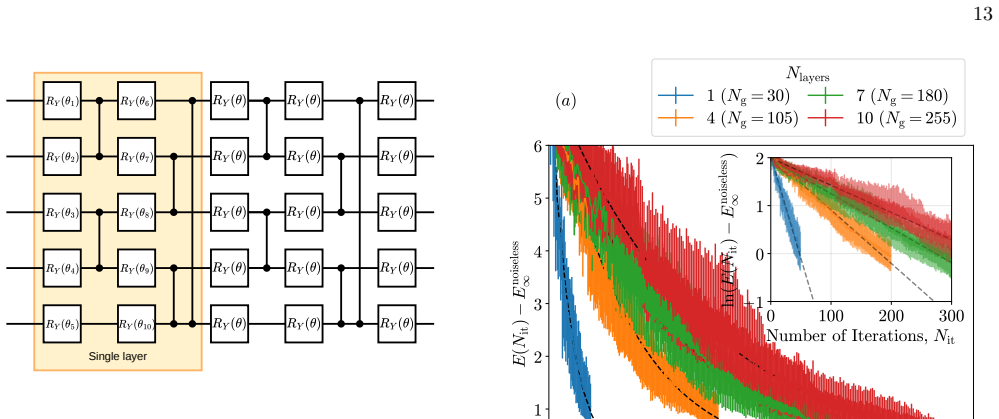
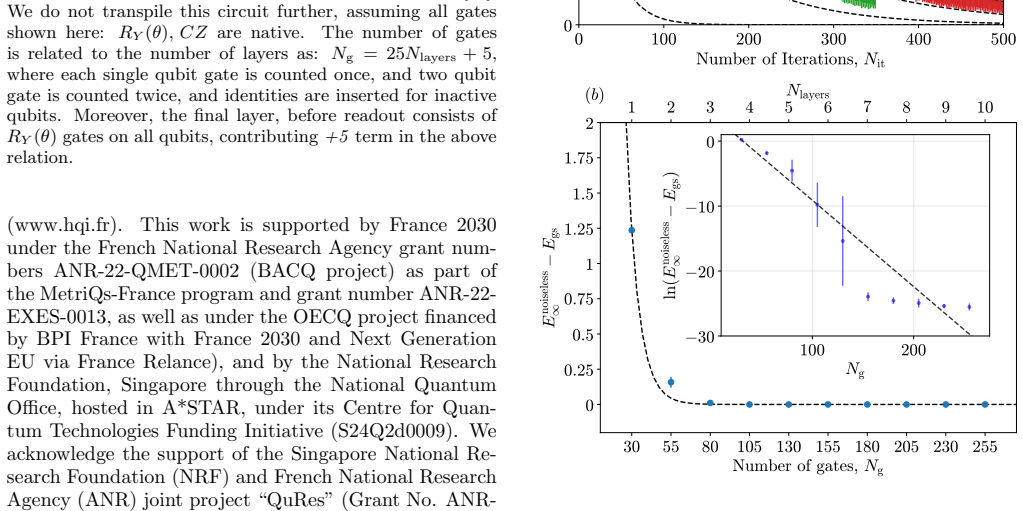
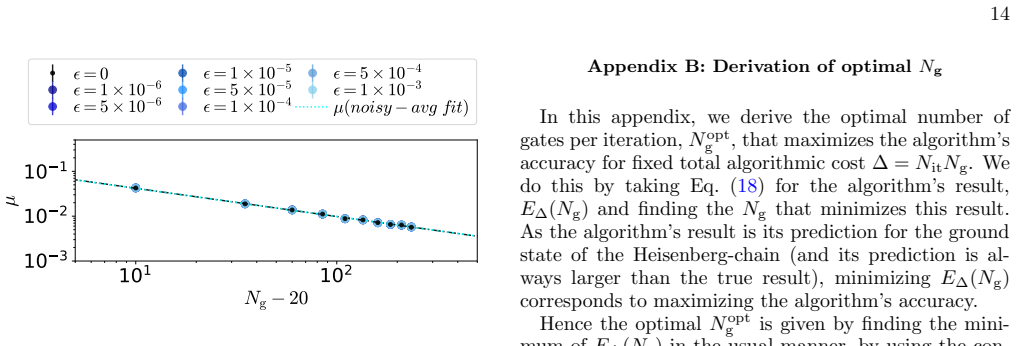
(see Fig. 11), a hardware-efficient ansatz with a dif- ferent structure, for the same 5-qubit Heisenberg Hamil- tonian in Eq. (3). The RYA consists of layers of single- qubitR Y (θ) rotations followed by a fixed entangling pat- 0 100 200 300 400 500 Number of Iterations, Nit 0 1 2 3 4 5 6E(Nit) − E noiseless ∞ (a) Nlayers 1 (Ng = 30) 4 (Ng = 105) 7 (Ng = ...
-
[2]
(B2), simplifies in this regime
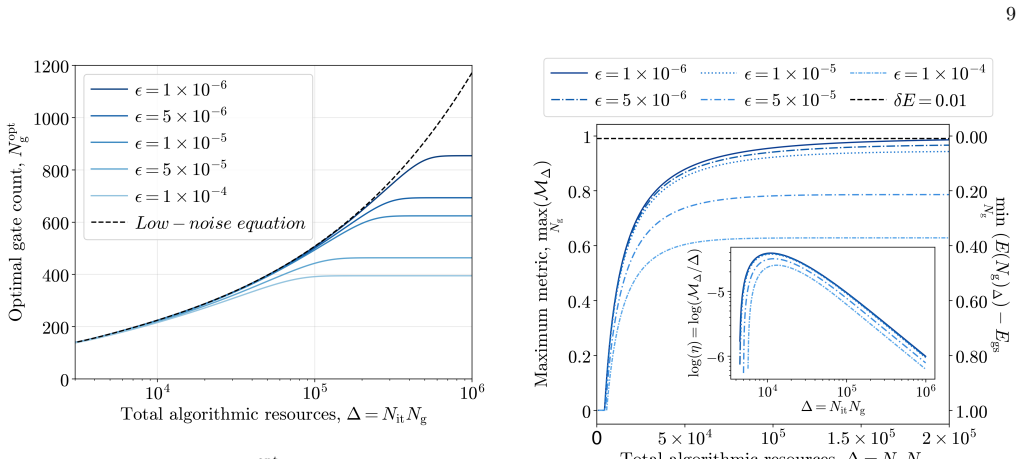
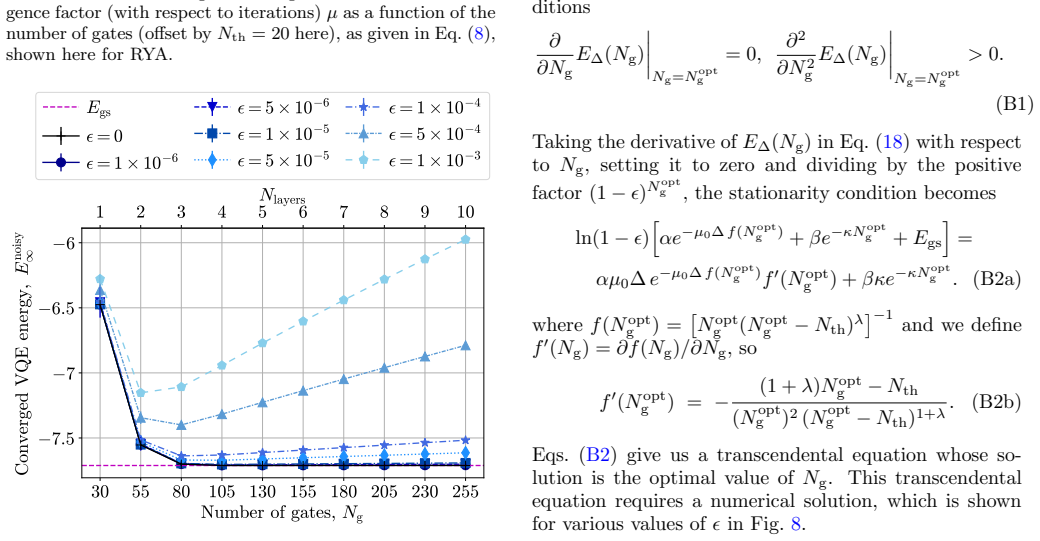
Low-noise limit All simulations in this work employ low noise rates ϵ∈[10 −6,10 −3], so it is natural to ask how the tran- scendental equation for optimalN g, given in Eqs. (B2), simplifies in this regime. Settingϵ= 0 in Eq. (B2a), the left-hand side vanishes since ln(1) = 0, yielding the following condition: αµ0∆e −µ0∆f(N g) f ′(Ng) +βκ e −κNg = 0.(B3) W...
-
[3]
Then we simply want to get the highest algorithm accuracy in the limit of very large ∆
The limit of large algorithmic resources (∆→ ∞) Suppose that we have no limit on the algorithmic re- sources, so ∆ can be as large as we like (∆→ ∞). Then we simply want to get the highest algorithm accuracy in the limit of very large ∆. In this limit, it is always good to have infinitely many iterations of the quantum circuit to ensure complete con- verg...
-
[4]
fold factor
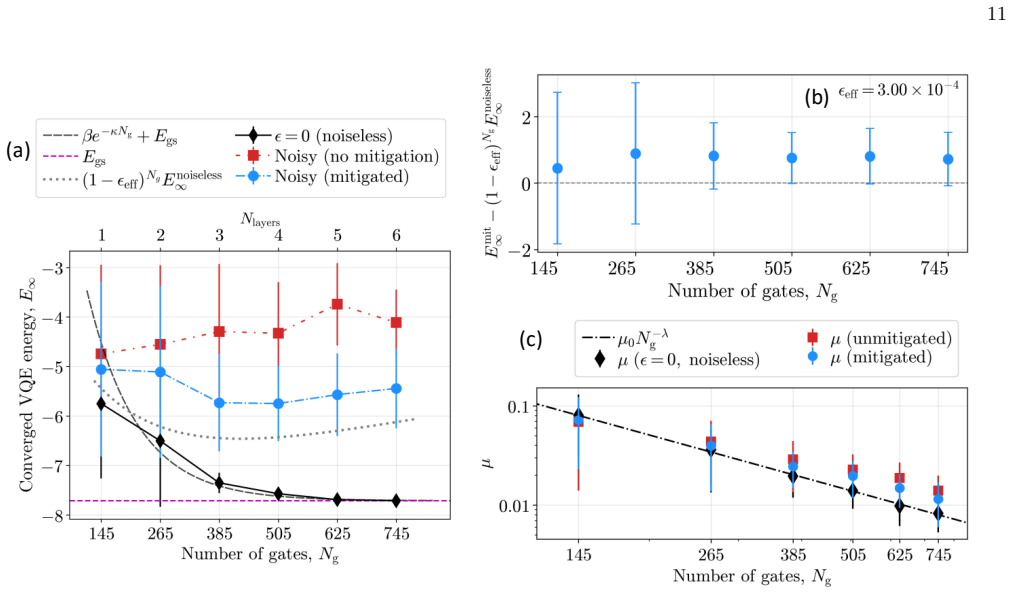
Error mitigation pipeline To escape the noise-dominated regime, we apply a three-stage mitigation pipeline at every optimization step — that is, for every evaluation ofE(N it, Ng). The pipeline is implemented using the Mitiq library [58] on top of Qiskit and combines noise tailoring with zero- noise extrapolation, applied in sequence from innermost (circu...
-
[5]
Tilly, H
J. Tilly, H. Chen, S. Cao, D. Picozzi, K. Setia, Y. Li, E. Grant, L. Wossnig, I. Rungger, G. H. Booth, and J. Tennyson, The variational quantum eigensolver: A re- view of methods and best practices, Physics Reports986, 1 (2022)
2022
-
[6]
Preskill, Quantum computing in the NISQ era and beyond, Quantum2, 79 (2018)
J. Preskill, Quantum computing in the NISQ era and beyond, Quantum2, 79 (2018)
2018
-
[7]
Bharti, A
K. Bharti, A. Cervera-Lierta, T. H. Kyaw, T. Haug, S. Alperin-Lea, A. Anand, M. Degroote, H. Heimonen, J. S. Kottmann, T. Menke, W.-K. Mok, S. Sim, L.-C. Kwek, and A. Aspuru-Guzik, Noisy intermediate-scale quantum algorithms, Reviews of Modern Physics94, 015004 (2022)
2022
-
[8]
Kurita, H
T. Kurita, H. Qassim, M. Ishii, H. Oshima, S. Sato, and J. Emerson, Synergetic quantum error mitigation by randomized compiling and zero-noise extrapolation for the variational quantum eigensolver, Quantum7, 1184 (2023)
2023
-
[9]
Fontana, N
E. Fontana, N. Fitzpatrick, D. M. Ramo, R. Duncan, and I. Rungger, Evaluating the noise resilience of variational quantum algorithms, Phys. Rev. A104, 022403 (2021)
2021
-
[10]
De Palma, M
G. De Palma, M. Marvian, C. Rouz´ e, and D. S. Fran¸ ca, Limitations of variational quantum algorithms: A quan- tum optimal transport approach, Phys. Rev. X Quantum 4, 010309 (2023)
2023
-
[11]
S. Wang, E. Fontana, M. Cerezo, K. Sharma, A. Sone, L. Cincio, and P. J. Coles, Noise-induced barren plateaus in variational quantum algorithms, Nature Communica- tions12, 6961 (2021)
2021
-
[12]
Auff` eves, Quantum technologies need a quantum en- ergy initiative, Phys
A. Auff` eves, Quantum technologies need a quantum en- ergy initiative, Phys. Rev. X Quantum3, 020101 (2022)
2022
-
[13]
Fellous-Asiani, J
M. Fellous-Asiani, J. H. Chai, Y. Thonnart, H. K. Ng, R. S. Whitney, and A. Auff` eves, Optimizing resource effi- ciencies for scalable full-stack quantum computers, Phys. Rev. X Quantum4, 040319 (2023)
2023
-
[14]
J. Kaplan, S. McCandlish, T. Henighan, T. B. Brown, B. Chess, R. Child, S. Gray, A. Radford, J. Wu, and D. Amodei, Scaling laws for neural language models (2020), arXiv:2001.08361
Pith/arXiv arXiv 2020
-
[15]
J. Hoffmann, S. Borgeaud, A. Mensch, E. Buchatskaya, T. Cai, E. Rutherford, D. de Las Casas, L. A. Hendricks, J. Welbl, A. Clark, T. Hennigan, E. Noland, K. Milli- can, G. van den Driessche, B. Damoc, A. Guy, S. Osin- dero, K. Simonyan, E. Elsen, J. W. Rae, O. Vinyals, and L. Sifre, Training compute-optimal large language mod- els (2022), arXiv:2203.15556
Pith/arXiv arXiv 2022
-
[16]
Verteletskyi, T.-C
V. Verteletskyi, T.-C. Yen, and A. F. Izmaylov, Mea- surement optimization in the variational quantum eigen- solver using a minimum clique cover, J. Chem. Phys.152, 124114 (2020)
2020
-
[17]
T.-C. Yen, A. Ganeshram, and A. F. Izmaylov, Deter- ministic improvements of quantum measurements with grouping of compatible operators, non-local transforma- tions, and covariance estimates, npj Quantum Informa- tion9, 14 (2023)
2023
-
[18]
Nakaji, S
K. Nakaji, S. Endo, Y. Matsuzaki, and H. Hakoshima, Measurement optimization of variational quantum simu- lation by classical shadow and derandomization, Quan- tum7, 995 (2023)
2023
-
[19]
Cattelan, S
M. Cattelan, S. Yarkoni, and W. Lechner, Parallel circuit 17 implementation of variational quantum algorithms, npj Quantum Information11, 27 (2025)
2025
-
[20]
Bisicchia, A
G. Bisicchia, A. Bocci, J. Garc´ ıa-Alonso, J. M. Murillo, and A. Brogi, Cut & shoot: cutting & distributing quan- tum circuits across multiple NISQ computers, in2024 IEEE International Conference on Quantum Computing and Engineering (QCE), Vol. 02 (2024) pp. 187–192
2024
-
[21]
K. Endo, Y. Sato, R. Raymond, K. Wada, N. Yamamoto, and H. C. Watanabe, Optimal parameter configurations for sequential optimization of the variational quantum eigensolver, Phys. Rev. Res.5, 043136 (2023)
2023
-
[22]
Ostaszewski, E
M. Ostaszewski, E. Grant, and M. Benedetti, Structure optimization for parameterized quantum circuits, Quan- tum5, 391 (2021)
2021
-
[23]
S. B. Bravyi and A. Y. Kitaev, Fermionic quantum com- putation, Annals of Physics298, 210–226 (2002)
2002
-
[24]
H. R. Grimsley, S. E. Economou, E. Barnes, and N. J. Mayhall, An adaptive variational algorithm for exact molecular simulations on a quantum computer, Nature Communications10, 3007 (2019)
2019
-
[25]
I. G. Ryabinkin, T.-C. Yen, S. N. Genin, and A. F. Iz- maylov, Qubit coupled cluster method: A systematic ap- proach to quantum chemistry on a quantum computer, Journal of Chemical Theory and Computation14, 6317 (2018)
2018
-
[26]
X. You, S. Chakrabarti, and X. Wu, A convergence the- ory for over-parameterized variational quantum eigen- solvers (2022), arXiv:2205.12481
arXiv 2022
-
[27]
T. Haug, K. Bharti, and M. Kim, Capacity and quantum geometry of parametrized quantum circuits, Phys. Rev. X Quantum2, 040309 (2021)
2021
-
[28]
Y. Du, T. Huang, S. You, M.-H. Hsieh, and D. Tao, Quantum circuit architecture search for variational quan- tum algorithms, npj Quantum Information8, 62 (2022)
2022
-
[29]
Gidney and M
C. Gidney and M. Eker˚ a, How to factor 2048 bit rsa in- tegers in 8 hours using 20 million noisy qubits, Quantum 5, 433 (2021)
2048
-
[30]
Astrakhantsev, G
N. Astrakhantsev, G. Mazzola, I. Tavernelli, and G. Car- leo, Phenomenological theory of variational quantum ground-state preparation, Physical Review Research5, 033225 (2023)
2023
-
[31]
Y. Tao, M. Guta, and G. Adesso, Trade-off between com- plexity and energy in quantum phase estimation (2025), arXiv:2511.05458
Pith/arXiv arXiv 2025
-
[32]
M. Fellous-Asiani, H. K. Ng, and R. S. Whitney, Magic states are rarely the most important resource to optimize (2024), arXiv:2411.01880
Pith/arXiv arXiv 2024
-
[33]
C. Gidney, How to factor 2048 bit rsa integers with less than a million noisy qubits (2025), arXiv:2505.15917
Pith/arXiv arXiv 2048
-
[34]
Suchan,Hyperparameter Tuning for Quantum Ma- chine Learning, Master’s thesis, TU Wien (2024)
D. Suchan,Hyperparameter Tuning for Quantum Ma- chine Learning, Master’s thesis, TU Wien (2024)
2024
-
[35]
Moussa, J
C. Moussa, J. N. van Rijn, T. B¨ ack, and V. Dunjko, Hy- perparameter importance of quantum neural networks across small datasets, inDiscovery Science, edited by P. Pascal and D. Ienco (Springer Nature Switzerland, Cham, 2022) p. 32
2022
-
[36]
S. S. Cranganore, V. De Maio, I. Brandic, T. M. A. Do, and E. Deelman, Molecular Dynamics Workflow De- composition for Hybrid Classic/Quantum Systems , in 2022 IEEE 18th International Conference on e-Science (e-Science)(IEEE Computer Society, Los Alamitos, CA, USA, 2022) pp. 346–356
2022
-
[37]
Bonet-Monroig, H
X. Bonet-Monroig, H. Wang, D. Vermetten, B. Senjean, C. Moussa, T. B¨ ack, V. Dunjko, and T. E. O’Brien, Per- formance comparison of optimization methods on vari- ational quantum algorithms, Phys. Rev. A107, 032407 (2023)
2023
-
[38]
Herbst, V
S. Herbst, V. De Maio, and I. Brandic, On optimizing hyperparameters for quantum neural networks, in2024 IEEE International Conference on Quantum Computing and Engineering (QCE)(IEEE, 2024) p. 1478–1489
2024
-
[39]
Watanabe, K
R. Watanabe, K. Fujii, and H. Ueda, Variational quan- tum eigensolver with embedded entanglement using a tensor-network ansatz, Phys. Rev. Res.6, 023009 (2024)
2024
-
[40]
Mih´ alikov´ a, M
I. Mih´ alikov´ a, M. Krejˇ c´ ı, and M. Fri´ ak, The impact of quantum circuit architecture and hyperparameters on variational quantum algorithms exemplified in the elec- tronic structure of the gaas crystal, Scientific Reports15, 15746 (2025)
2025
-
[41]
Wiersema, C
R. Wiersema, C. Zhou, Y. de Sereville, J. F. Carrasquilla, Y. B. Kim, and H. Yuen, Exploring entanglement and optimization within the hamiltonian variational ansatz, Phys. Rev. X Quantum1, 020319 (2020)
2020
-
[42]
The Green500 at top500.org/lists/green500, quantifies supercomputer’s energy efficiency in GFLOPS per Watt. Since FLOPS is the number of floating point operations per second, the units of seconds cancel, making this equivalent to a measure of the number of floating point operations per Joule of energy
-
[43]
F. G´ ois, M. Pezzutto, and Y. Omar, Towards energetic quantum advantage in trapped-ion quantum computa- tion (2024), arXiv:2404.11572
Pith/arXiv arXiv 2024
- [44]
-
[45]
Larocca, S
M. Larocca, S. Thanasilp, S. Wang, K. Sharma, J. Bia- monte, P. J. Coles, L. Cincio, J. R. McClean, Z. Holmes, and M. Cerezo, Barren plateaus in variational quantum computing, Nature Reviews Physics7, 174 (2025)
2025
-
[46]
Cerezo, M
M. Cerezo, M. Larocca, D. Garc´ ıa-Mart´ ın, N. L. Diaz, P. Braccia, E. Fontana, M. S. Rudolph, P. Bermejo, A. Ijaz, S. Thanasilp, E. R. Anschuetz, and Z. Holmes, Does provable absence of barren plateaus imply classical simulability?, Nature Communications16, 7907 (2025)
2025
- [47]
-
[48]
Holmes, K
Z. Holmes, K. Sharma, M. Cerezo, and P. J. Coles, Connecting ansatz expressibility to gradient magnitudes and barren plateaus, Phys. Rev. X Quantum3, 010313 (2022)
2022
-
[49]
R. Puig, M. Drudis, S. Thanasilp, Z. Holmes, R. Puig, M. Drudis, S. Thanasilp, and Z. Holmes, Variational quantum simulation: A case study for understanding warm starts, Phys. Rev. X Quantum10, 1 (2024)
2024
- [50]
-
[51]
B. Anselme-Martin and T. Ayral, Pre-optimization of quantum circuits, barren plateaus and classical simulabil- ity: Tensor networks to unlock the variational quantum eigensolver (2026), arXiv:2602.04676
arXiv 2026
-
[52]
This would have no significant 18 effect on our results
If we had included a pre-measurement subroutine con- sisting of one gate operation per qubit, it would have changed the 15 into 20. This would have no significant 18 effect on our results
-
[53]
Ding, X.-Y
C. Ding, X.-Y. Xu, S. Zhang, H.-L. Huang, and W.-S. Bao, Evaluating the resilience of variational quantum algorithms to leakage noise, Phys. Rev. A106, 042421 (2022)
2022
-
[54]
M. Oliv, A. Matic, T. Messerer, and J. M. Lorenz, Evalu- ating the impact of noise on the performance of the vari- ational quantum eigensolver (2022), arXiv:2209.12803
arXiv 2022
-
[55]
J. Zeng, Z. Wu, C. Cao, C. Zhang, S. Hou, P. Xu, and B. Zeng, Simulating noisy variational quantum eigen- solver with local noise models, Quantum Engineering3, e77 (2021)
2021
-
[56]
Quantum Noise
M. A. Nielsen and I. L. Chuang,Quantum Computation and Quantum Information: 10th Anniversary Edition (Cambridge University Press, Cambridge, UK, 2010) see Chap. 8 “Quantum Noise”’
2010
-
[57]
Garc´ ıa-Mart´ ın, M
D. Garc´ ıa-Mart´ ın, M. Larocca, and M. Cerezo, Effects of noise on the overparametrization of quantum neural networks, Phys. Rev. Res.6, 013295 (2024)
2024
-
[58]
A. M. Dalzell, N. Hunter-Jones, and F. G. S. L. Brand˜ ao, Random quantum circuits transform local noise into global white noise, Commun. Math. Phys.405, 78 (2024)
2024
-
[59]
Vovrosh, K
J. Vovrosh, K. E. Khosla, S. Greenaway, C. Self, M. S. Kim, and J. Knolle, Simple mitigation of global depolar- izing errors in quantum simulations, Phys. Rev. E104, 035309 (2021)
2021
-
[60]
Bravo-Prieto, J
C. Bravo-Prieto, J. Lumbreras-Zarapico, L. Tagliacozzo, and J. I. Latorre, Scaling of variational quantum circuit depth for condensed matter systems, Quantum4, 272 (2020)
2020
-
[61]
A. Javadi-Abhari, M. Treinish, K. Krsulich, C. J. Wood, J. Lishman, J. Gacon, S. Martiel, P. D. Na- tion, L. S. Bishop, A. W. Cross, B. R. Johnson, and J. M. Gambetta, Quantum computing with qiskit (2024), arXiv:2405.08810 [quant-ph]
Pith/arXiv arXiv 2024
-
[62]
LaRose, A
R. LaRose, A. Mari, S. Kaiser, P. J. Karalekas, A. A. Alves, P. Czarnik, M. El Mandouh, M. H. Gordon, Y. Hindy, A. Robertson, P. Thakre, M. Wahl, D. Samuel, R. Mistri, M. Tremblay, N. Gardner, N. T. Stemen, N. Shammah, and W. J. Zeng, Mitiq: A software pack- age for error mitigation on noisy quantum computers, Quantum6, 774 (2022)
2022
-
[63]
J. J. Wallman and J. Emerson, Noise tailoring for scalable quantum computation via randomized compiling, Physi- cal Review A94, 10.1103/physreva.94.052325 (2016)
-
[64]
E. Knill, Fault-tolerant postselected quantum computa- tion: Schemes (2004), arXiv:quant-ph/0402171 [quant- ph]
Pith/arXiv arXiv 2004
-
[65]
Giurgica-Tiron, Y
T. Giurgica-Tiron, Y. Hindy, R. LaRose, A. Mari, and W. J. Zeng, Digital zero noise extrapolation for quantum error mitigation, in2020 IEEE International Conference on Quantum Computing and Engineering (QCE)(IEEE,
-
[66]
Error mitigation for short-depth quantum circuits
K. Temme, S. Bravyi, and J. M. Gambetta, Error mitiga- tion for short-depth quantum circuits, Physical Review Letters119, 10.1103/physrevlett.119.180509 (2017)
work page internal anchor Pith review doi:10.1103/physrevlett.119.180509 2017
-
[67]
Y. Li and S. C. Benjamin, Efficient variational quantum simulator incorporating active error minimization, Phys- ical Review X7, 10.1103/physrevx.7.021050 (2017)
-
[68]
van den Berg, Z
E. van den Berg, Z. K. Minev, A. Kandala, and K. Temme, Probabilistic error cancellation with sparse pauli–lindblad models on noisy quantum processors, Na- ture Physics19, 1116–1121 (2023)
2023
-
[69]
Czarnik, A
P. Czarnik, A. Arrasmith, P. J. Coles, and L. Cincio, Er- ror mitigation with clifford quantum-circuit data, Quan- tum5, 592 (2021)
2021
-
[71]
E. Knill, D. Leibfried, R. Reichle, J. Britton, R. B. Blakestad, J. D. Jost, C. Langer, R. Ozeri, S. Sei- delin, and D. J. Wineland, Randomized benchmarking of quantum gates, Physical Review A77, 10.1103/phys- reva.77.012307 (2008)
-
[72]
Perrin, T
H. Perrin, T. Scoquart, A. Shnirman, J. Schmalian, and K. Snizhko, Mitigating crosstalk errors by randomized compiling: Simulation of the bcs model on a supercon- ducting quantum computer, Phys. Rev. Res.6, 013142 (2024)
2024
discussion (0)
Sign in with ORCID, Apple, or X to comment. Anyone can read and Pith papers without signing in.