Implicit Semantic-Aware Communication Based on Hypergraph Reasoning
Pith reviewed 2026-06-26 17:34 UTC · model grok-4.3
The pith
Hypergraph reasoning models multi-entity semantic relations in subspaces to improve inference under information loss.
A machine-rendered reading of the paper's core claim, the machinery that carries it, and where it could break.
Core claim
The HISR framework leverages hypergraphs to represent complex multi-entity relationships among semantic knowledge entities. In HISR, entities and their associated higher-order relations are mapped into dedicated semantic subspaces tailored to distinct relational contexts. This design disentangles diverse semantic interactions to mitigate the over-smoothing effects commonly found in traditional graph embedding methods and enables robust semantic inference even when partial information loss occurs during transmission.
What carries the argument
Hypergraph encoding of higher-order semantic relations, followed by projection into context-specific semantic subspaces that separate interactions.
If this is right
- Semantic communication systems gain the ability to handle group interactions and multi-entity associations without rapid performance drop under noise.
- Inference remains functional when some transmitted semantic elements are corrupted or erased.
- Over-smoothing that collapses distinct meanings in graph embeddings is reduced by the subspace separation step.
- The shift from bit-level to meaning-level transmission becomes more practical for real-world relational data.
Where Pith is reading between the lines
- The subspace-mapping idea could be tested on temporal hypergraphs to track how semantic relations evolve across successive messages.
- Combining the hypergraph layer with existing message-passing neural networks might produce a hybrid encoder that inherits both higher-order expressivity and efficient training.
- The same disentanglement technique may transfer to other partial-observation settings such as sensor networks or multi-agent coordination where only subsets of relations are observed.
Load-bearing premise
Hypergraphs can represent higher-order implicit correlations among semantic entities and subspace mapping will separate those interactions enough to support inference despite missing data.
What would settle it
An experiment that applies HISR and standard graph methods to the same semantic messages under identical partial-information-loss conditions and finds no accuracy gain, or a loss, for HISR would falsify the claim.
Figures


read the original abstract
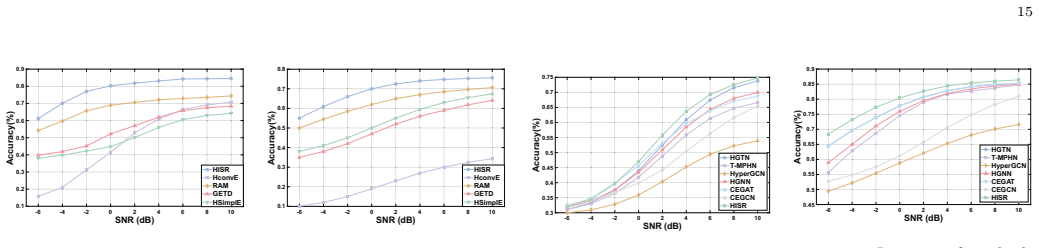
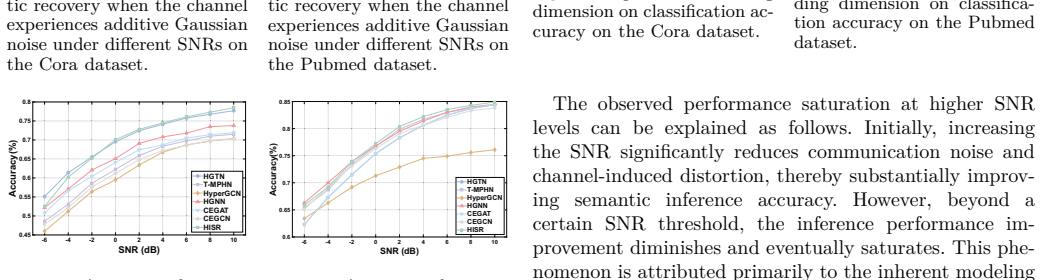
Semantic-aware communication has emerged as a transformative paradigm for next-generation communication systems, shifting the fundamental goal from transmitting bit-level symbols to reliably recovering and understanding the semantic meaning of information. Previous studies have demonstrated that representing the semantic content of source messages as graph-based structures can significantly improve communication efficiency and the accuracy of semantic inference at the receiver. However, existing solutions typically employ graphs that capture only pairwise relationships, thereby neglecting higher-order implicit correlations commonly observed in real-world scenarios, such as group interactions, multi-entity associations, and complex relational contexts. This limitation reduces semantic expressiveness and makes semantic inference susceptible to ambiguity and performance degradation, particularly under noisy or corrupted channel conditions. To address these issues, this paper proposes a novel hypergraph-based implicit semantic reasoning framework, HISR, which leverages hypergraphs to represent complex multi-entity relationships among semantic knowledge entities. In HISR, entities and their associated higher-order relations are mapped into dedicated semantic subspaces tailored to distinct relational contexts. This design not only disentangles diverse semantic interactions to mitigate the over-smoothing effects commonly found in traditional graph embedding methods but also enables robust semantic inference even when partial information loss occurs during transmission. Numerical results show that the proposed HISR achieves up to a 36.6% improvement in implicit semantic interpretation accuracy over the state-of-the-art benchmarks.
Editorial analysis
A structured set of objections, weighed in public.
Referee Report
Summary. The paper proposes the HISR framework, a hypergraph-based approach to implicit semantic reasoning for semantic-aware communication. It claims that standard graphs capture only pairwise relations and thus miss higher-order implicit correlations; HISR maps semantic entities and their higher-order relations into dedicated subspaces to reduce over-smoothing and support inference under partial information loss, reporting up to a 36.6% gain in implicit semantic interpretation accuracy over existing benchmarks.
Significance. If the performance claim is substantiated, the work would address a recognized limitation of pairwise graph models in semantic communication and could improve robustness under noisy channels. No machine-checked proofs, reproducible code, or parameter-free derivations are described, so the significance rests entirely on the empirical result.
major comments (1)
- [Abstract] Abstract: the central numerical claim of a 36.6% accuracy improvement is stated without any description of the datasets, baseline methods, experimental protocol, number of trials, error bars, or statistical tests. This absence prevents verification that the data and methods support the stated result and is load-bearing for the paper's primary contribution.
Simulated Author's Rebuttal
We thank the referee for the constructive comment on the abstract. We agree that the central numerical claim requires supporting context to allow verification.
read point-by-point responses
-
Referee: [Abstract] Abstract: the central numerical claim of a 36.6% accuracy improvement is stated without any description of the datasets, baseline methods, experimental protocol, number of trials, error bars, or statistical tests. This absence prevents verification that the data and methods support the stated result and is load-bearing for the paper's primary contribution.
Authors: We agree that the abstract as currently written does not provide sufficient context for the 36.6% claim. The revised abstract will include a concise statement identifying the datasets, the main baseline methods, the experimental protocol (including number of trials), and the reporting of error bars. This change will be made without altering the length or focus of the abstract. revision: yes
Circularity Check
No significant circularity
full rationale
The abstract and context provide no equations, derivations, or load-bearing steps that reduce any claim to a fitted input, self-definition, or self-citation chain. The framework is introduced as a distinct proposal using hypergraphs for higher-order relations, with the 36.6% improvement stated as a numerical result rather than a constructed prediction. No self-citations, ansatzes, or uniqueness theorems are referenced in a way that would create circularity. This is the expected self-contained case.
Axiom & Free-Parameter Ledger
axioms (1)
- domain assumption Hypergraphs can represent higher-order implicit correlations in semantic knowledge entities better than pairwise graphs
invented entities (1)
-
HISR framework
no independent evidence
Reference graph
Works this paper leans on
-
[1]
Hypergraph reason- ing for implicit semantic-aware communication,
S. Tu, Y. Liao, Y. Xiao, Y. Li, and G. Shi, “Hypergraph reason- ing for implicit semantic-aware communication,” in Proc. IEEE Global Commun. Conf. (GLOBECOM) Workshops, Taipei, China, Dec. 2025
2025
-
[2]
From semantic communi- cation to Semantic-Aware networking: Model, architecture, and open problems,
G. Shi, Y. Xiao, Y. Li, and X. Xie, “From semantic communi- cation to Semantic-Aware networking: Model, architecture, and open problems,” IEEE Commun. Mag., vol. 59, no. 8, pp. 44–50, Aug. 2021
2021
-
[3]
SANet: A semantic-aware agentic AI networking framework for cross-layer optimization in 6G,
Y. Xiao, X. Li, H. Zhou, Y. Gao, G. Shi, P. Zhang, and M. Krunz, “SANet: A semantic-aware agentic AI networking framework for cross-layer optimization in 6G,” IEEE Trans. Mobile Comput., 2026
2026
-
[4]
An introduction to semantic communica- tion and Semantic-Aware networking standardization for 6G,
G. Shi and Y. Xiao, “An introduction to semantic communica- tion and Semantic-Aware networking standardization for 6G,” GetMobile: Mobile Comput. and Commun., vol. 28, no. 3, pp. 14–19, Oct. 2024
2024
-
[5]
SANSee: A physical-layer semantic-aware networking framework for distributed wireless sensing,
H. Zhu, Y. Xiao, Y. Li, G. Shi, and M. Krunz, “SANSee: A physical-layer semantic-aware networking framework for distributed wireless sensing,” IEEE Trans. Mobile Comput., vol. 24, no. 3, pp. 1636–1653, Mar. 2025
2025
-
[6]
Reasoning over the air: A Reasoning-Based Implicit Semantic-Aware Communication framework,
Y. Xiao, Y. Liao, Y. Li, G. Shi, H. V. Poor, W. Saad, M. Debbah, and M. Bennis, “Reasoning over the air: A Reasoning-Based Implicit Semantic-Aware Communication framework,” IEEE Trans. Wireless Commun., vol. 23, no. 4, pp. 3839–3855, Apr. 2024
2024
-
[7]
Imitation Learning-based Implicit Semantic-aware Communication Net- works: Multi-layer Representation and Collaborative Reason- ing,
Y. Xiao, Z. Sun, G. Shi, and D. Niyato, “Imitation Learning-based Implicit Semantic-aware Communication Net- works: Multi-layer Representation and Collaborative Reason- ing,” IEEE J. Sel. Areas Commun., vol. 41, no. 3, pp. 639–658, Mar. 2023
2023
-
[8]
Joint Source–Channel Coding: Fundamentals and recent progress in practical designs,
D. Gunduz et al., “Joint Source–Channel Coding: Fundamentals and recent progress in practical designs,” Proc. IEEE, pp. 1–32, 2024
2024
-
[9]
Implicit semantic communication based on Bayesian reconstruction framework,
Y. Liao, S. Tu, Y. Zhou, D. Jin, Y. Xiao, and Y. Li, “Implicit semantic communication based on Bayesian reconstruction framework,” IEEE Wireless Commun. Lett., vol. 15, pp. 430– 434, 2026
2026
-
[10]
On the rep- resentation and embedding of knowledge bases beyond binary relations,
J. Wen, J. Li, Y. Mao, S. Chen, and R. Zhang, “On the rep- resentation and embedding of knowledge bases beyond binary relations,” in Proc. Int. Joint Conf. Artif. Intell. (IJCAI), New York, NY, USA, Jul. 2016, pp. 1300–1307
2016
-
[11]
Role-aware modeling for N-ary relational knowledge bases,
Y. Liu, Q. Yao, and Y. Li, “Role-aware modeling for N-ary relational knowledge bases,” in Proc. Web Conf. 2021, New York, NY, USA, Jun. 2021, pp. 2660–2671
2021
-
[12]
Inference of Hyperedges and overlapping communities in Hypergraphs,
M. Contisciani, F. Battiston, and C. De Bacco, “Inference of Hyperedges and overlapping communities in Hypergraphs,” Nature Commun., vol. 13, no. 1, p. 7229, Nov. 2022
2022
-
[13]
Community detection in Hypergraphs: Optimal statistical limit and efficient algorithms,
I. Chien, C.-Y. Lin, and I.-H. Wang, “Community detection in Hypergraphs: Optimal statistical limit and efficient algorithms,” in Proc. Int. Conf. Artif. Intell. Statist. (AISTATS), vol. 84, Playa Blanca, Spain, Apr. 2018, pp. 871–879
2018
-
[14]
A survey on Hypergraph Representation Learn- ing,
A. Antelmi, G. Cordasco, M. Polato, V. Scarano, C. Spagnuolo, and D. Yang, “A survey on Hypergraph Representation Learn- ing,” ACM Comput. Surv., vol. 56, no. 1, p. Art. no. 24, Aug. 2023
2023
-
[15]
Hypergraph Learning: Methods and practices,
Y. Gao, Z. Zhang, H. Lin, X. Zhao, S. Du, and C. Zou, “Hypergraph Learning: Methods and practices,” IEEE Trans. Pattern Anal. Mach. Intell., vol. 44, no. 5, pp. 2548–2566, May 2022
2022
-
[16]
Deeper insights into Graph Con- volutional Networks for Semi-Supervised Learning,
Q. Li, Z. Han, and X.-m. Wu, “Deeper insights into Graph Con- volutional Networks for Semi-Supervised Learning,” in Proc. AAAI Conf. Artif. Intell., vol. 32, no. 1, New Orleans, LA, USA, Apr. 2018, pp. 3538–3545
2018
-
[17]
Not too little, not too much: A theoretical analysis of Graph (over) smoothing,
N. Keriven, “Not too little, not too much: A theoretical analysis of Graph (over) smoothing,” in Proc. Adv. Neural Inf. Process. Syst. (NeurIPS), New Orleans, LA, USA, Dec. 2022
2022
-
[18]
Preventing Over- Smoothing for Hypergraph Neural Networks,
G. Chen, J. Zhang, X. Xiao, and Y. Li, “Preventing Over- Smoothing for Hypergraph Neural Networks,” arXiv preprint, 2022, arXiv:2203.17159
-
[19]
Hypergraph Neural Networks,
Y. Feng, H. You, Z. Zhang, R. Ji, and Y. Gao, “Hypergraph Neural Networks,” in Proc. AAAI Conf. Artif. Intell., Honolulu, HI, USA, Jul. 2019, pp. 3558–3565
2019
-
[20]
HGNN+: General hypergraph neural networks,
Y. Gao, Y. Feng, S. Ji, and R. Ji, “HGNN+: General hypergraph neural networks,” IEEE Trans. Pattern Anal. Mach. Intell., vol. 45, no. 3, pp. 3181–3199, Mar. 2023
2023
-
[21]
Generalizing tensor decomposition for N-ary relational knowledge bases,
Y. Liu, Q. Yao, and Y. Li, “Generalizing tensor decomposition for N-ary relational knowledge bases,” in Proc. Web Conf. 2020, Taipei, China, Apr. 2020, pp. 1104–1114
2020
-
[22]
Hyperbolic Graph Convolutional Neural Networks,
I. Chami, Z. Ying, C. Ré, and J. Leskovec, “Hyperbolic Graph Convolutional Neural Networks,” in Proc. Adv. Neural Inf. Process. Syst. (NeurIPS), vol. 32, Vancouver, BC, Canada, Dec. 2019
2019
-
[23]
Knowledge Graph Embedding for Link Prediction: A compar- ative analysis,
A. Rossi, D. Barbosa, D. Firmani, A. Matinata, and P. Merialdo, “Knowledge Graph Embedding for Link Prediction: A compar- ative analysis,” ACM Trans. Knowl. Discov. Data, vol. 15, no. 2, p. Art. no. 14, Jan. 2021
2021
-
[24]
Knowledge Graph Embedding by translating on hyperplanes,
Z. Wang, J. Zhang, J. Feng, and Z. Chen, “Knowledge Graph Embedding by translating on hyperplanes,” in Proc. AAAI Conf. Artif. Intell., Quebec City, QC, Canada, Jun. 2014, pp. 1112–1119
2014
-
[25]
A theory of semantic communication,
Y. Shao, Q. Cao, and D. Gündüz, “A theory of semantic communication,” IEEE Transactions on Mobile Computing, vol. 23, no. 12, pp. 12 211–12 228, Dec 2024
2024
-
[26]
Modeling relational data with Graph Convolutional Networks,
M. Schlichtkrull, T. N. Kipf, P. Bloem, R. van den Berg, I. Titov, and M. Welling, “Modeling relational data with Graph Convolutional Networks,” in Proc. Extended Semantic Web Conf. (ESWC), Heraklion, Greece, Jun. 2018, pp. 593–607
2018
-
[27]
Hypergraph Information Bottleneck-based Implicit Semantic Communica- tion,
Y. Liao, S. Tu, Y. Zhou, Y. Xiao, Y. Li, and G. Shi, “Hypergraph Information Bottleneck-based Implicit Semantic Communica- tion,” IEEE Internet Things J., vol. 13, no. 8, pp. 15 895–15 910, 2026. 17 Yiwei Liao received his B.S. degree from the School of Electrical and Electronic engineer- ing from Huazhong University of Science and Technology, Wuhan, Chin...
2026
discussion (0)
Sign in with ORCID, Apple, or X to comment. Anyone can read and Pith papers without signing in.