Large spin splitting at ferromagnetic surfaces of bulk antiferromagnets
Pith reviewed 2026-06-26 16:25 UTC · model grok-4.3
The pith
Certain ferromagnetic surfaces of bulk antiferromagnets exhibit large spin splitting via lifted sublattice degeneracies
A machine-rendered reading of the paper's core claim, the machinery that carries it, and where it could break.
Core claim
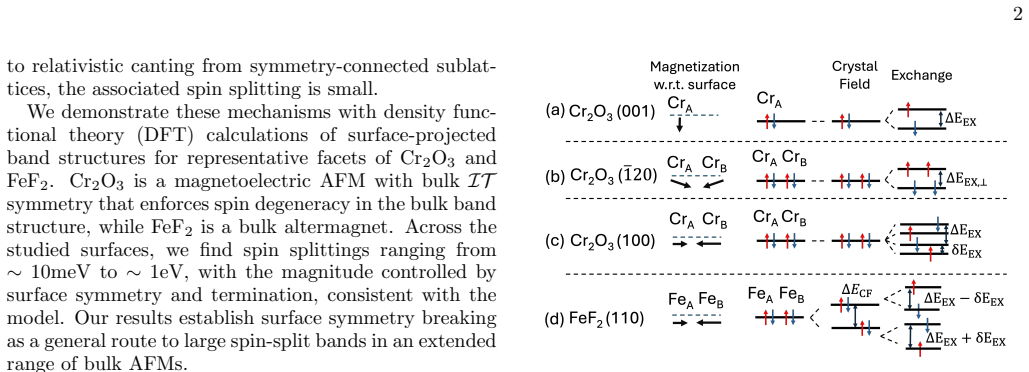
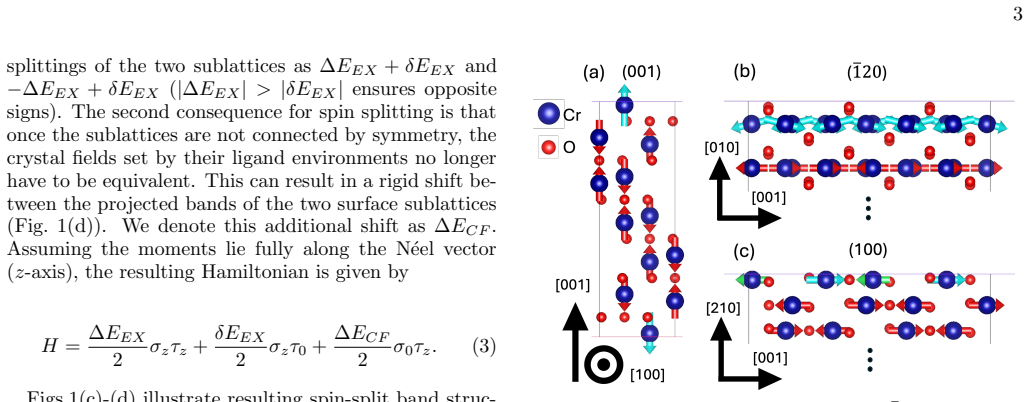
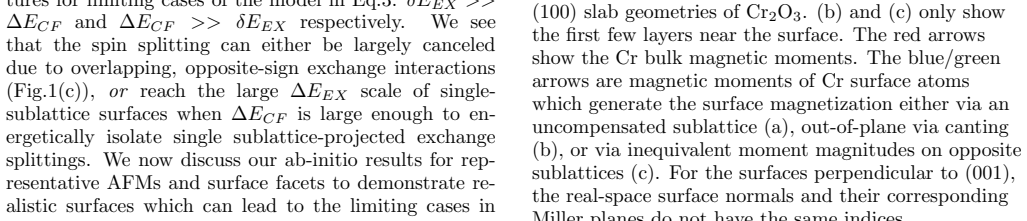
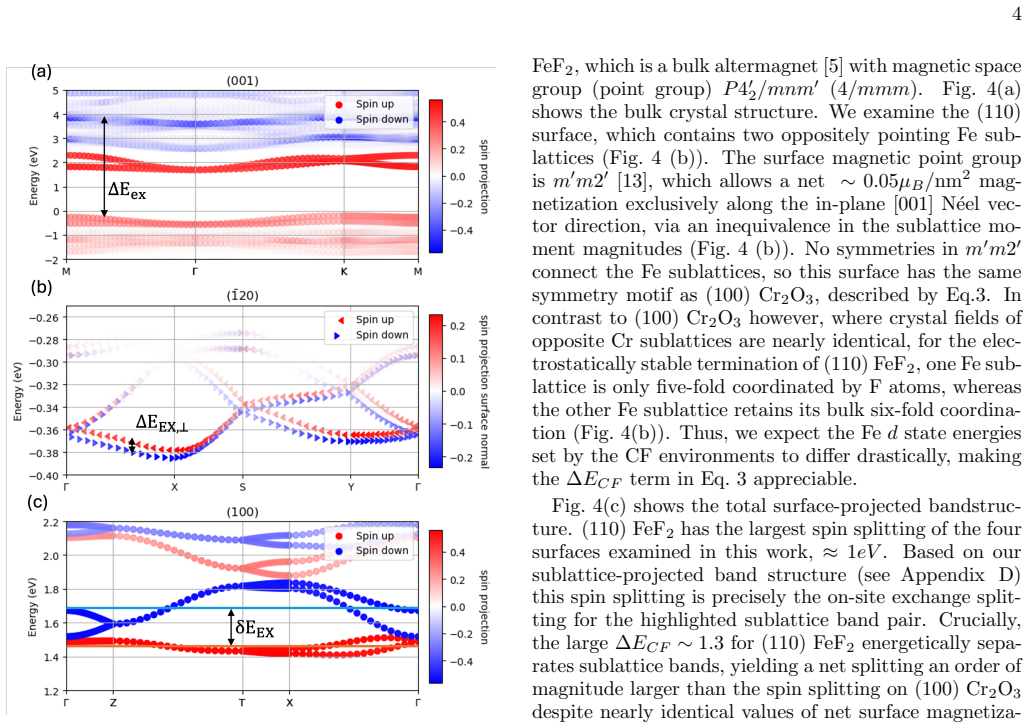
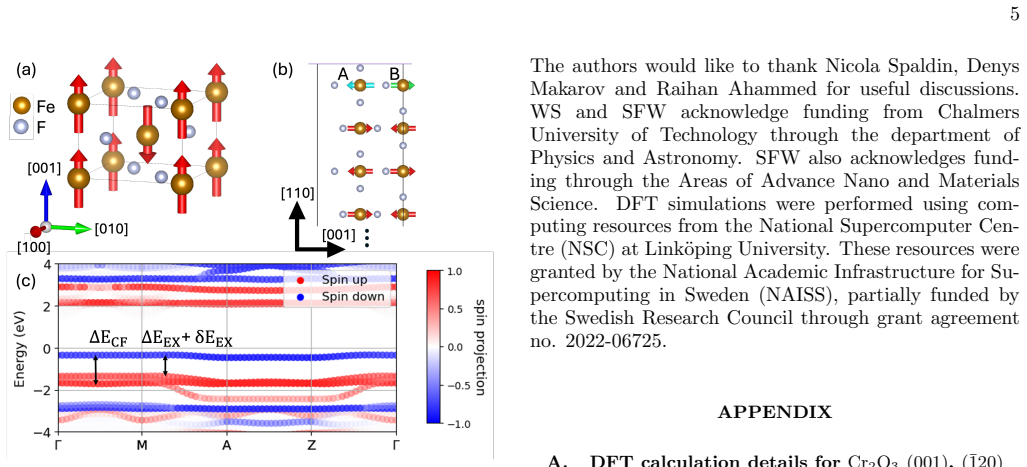
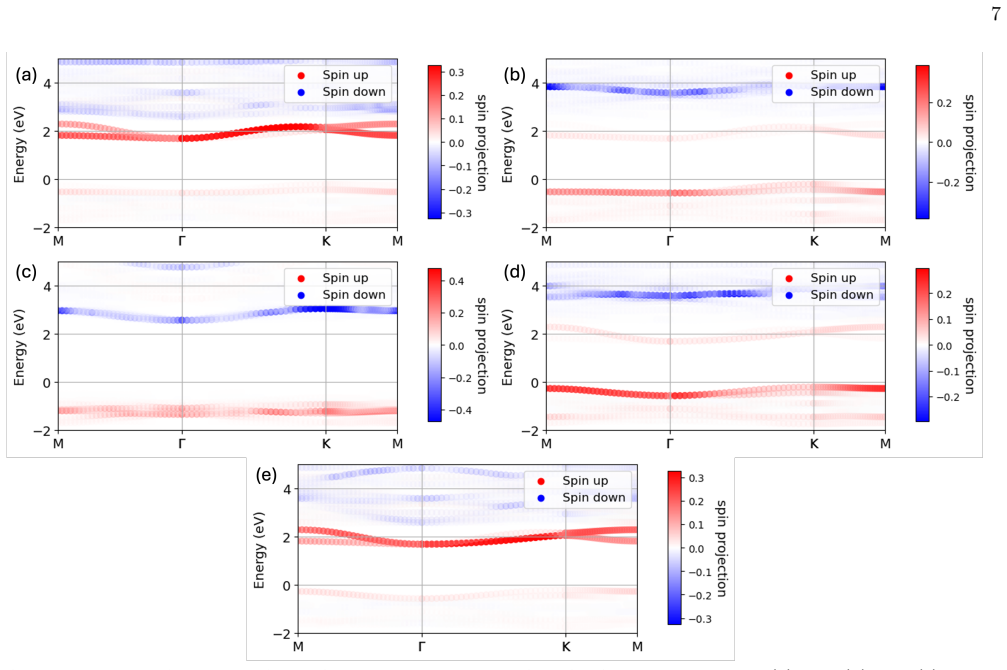
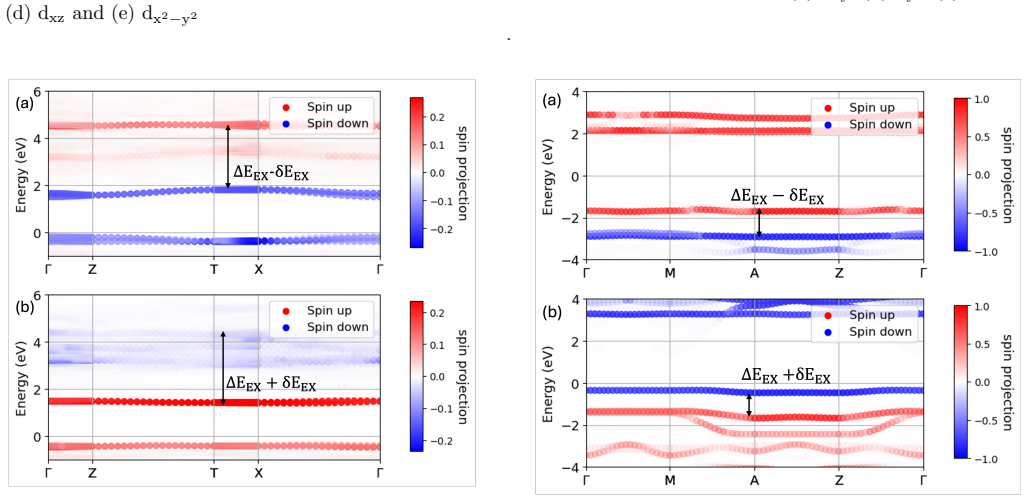
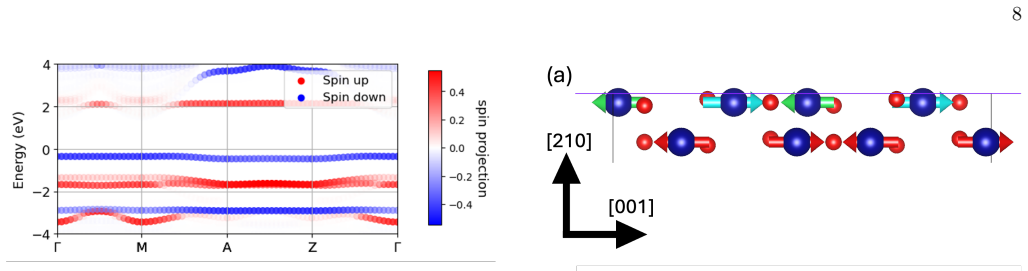
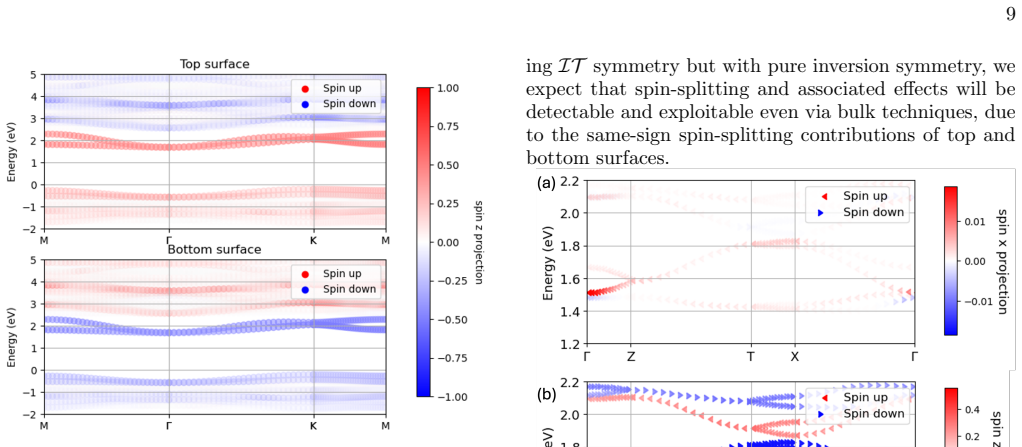
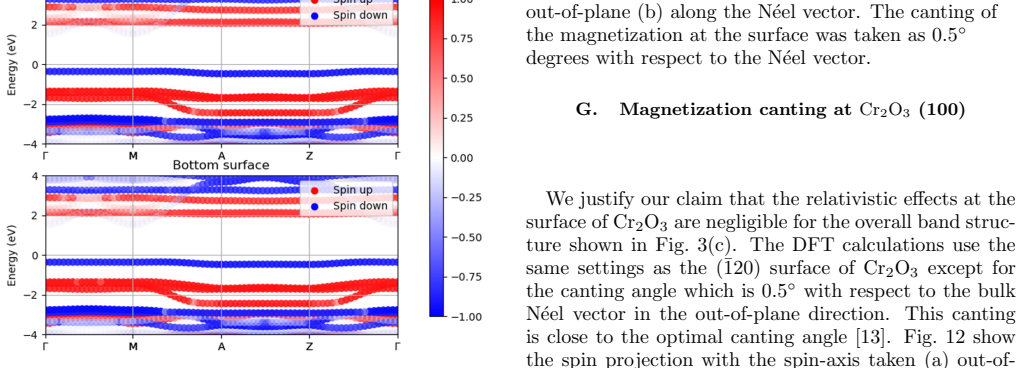
Bulk antiferromagnets host large spin splitting at their ferromagnetic surfaces because surface truncation lifts the degeneracy between sublattice-resolved exchange splittings that remain compensated inside the crystal. The splitting reaches its largest values for terminations with a single uncompensated magnetic sublattice and for two-sublattice terminations whose sublattices experience different crystal fields at the surface. Surfaces whose magnetization arises instead from relativistic canting on symmetry-connected sublattices produce only small splitting. Calculations for Cr2O3 and FeF2 surfaces illustrate the range of splittings from 10 meV to 1 eV.
What carries the argument
surface truncation lifting bulk degeneracy of sublattice-resolved exchange splittings at symmetry-allowed ferromagnetic terminations
Load-bearing premise
Ideal surface terminations exposing a single uncompensated sublattice or distinct crystal-field environments remain stable without reconstruction or contamination that would restore bulk compensation.
What would settle it
Spin-resolved angle-resolved photoemission spectra on atomically clean, predicted terminations of Cr2O3 or FeF2 that show splitting magnitudes matching the DFT results; absence of the predicted large splitting on those surfaces would falsify the mechanism.
Figures
read the original abstract
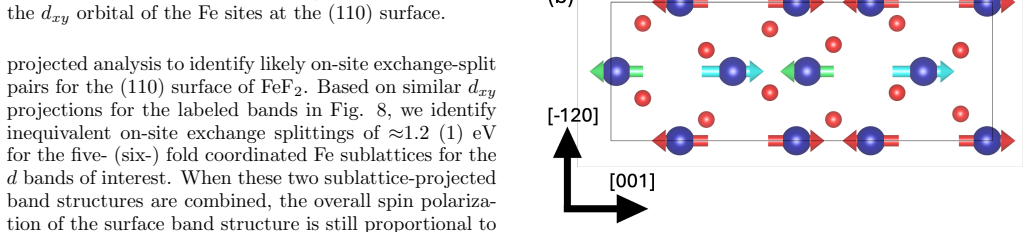
We use density functional theory and model Hamiltonians to reveal large spin splitting of bands localized at low-symmetry, ferromagnetic surfaces of bulk antiferromagnets (AFMs). There is great interest in finding new material platforms combining the robustness and ultrafast dynamics of AFMs with large, functional spin splitting which is often restricted to ferromagnets. Here, we show that a subset of AFM surfaces which have symmetry-allowed magnetization can host large spin splitting via bulk degeneracy lifting of sublattice-resolved exchange splittings. Using model Hamiltonians, we show that the spin splitting is maximized for two ferromagnetic surface motifs: terminations with single uncompensated magnetic sublattices, and two-sublattice surfaces whose sublattices are magnetically and electronically compensated in the bulk, but acquire distinct crystal field environments via surface truncation. The latter case can yield FM-like spin splitting magnitudes while also having vanishingly small uncompensated magnetization. In contrast, when surface magnetization arises from relativistic canting on symmetry-connected sublattices, the spin splitting is expected to be small. We confirm these predictions with first-principles calculations of $\mathrm{Cr_2O_3}$ and $\mathrm{FeF_2}$, finding splittings from $\sim10\mathrm{meV}$-$\sim1\mathrm{eV}$ depending on the surface in question. Our findings point to intrinsic surface symmetry breaking as a route to large, functional spin splitting in an expanded range of AFM materials.
Editorial analysis
A structured set of objections, weighed in public.
Referee Report
Summary. The manuscript claims that a subset of antiferromagnetic surfaces with symmetry-allowed magnetization can host large spin splitting (∼10 meV to ∼1 eV) via bulk degeneracy lifting of sublattice-resolved exchange splittings. This is shown using model Hamiltonians for two motifs (single uncompensated sublattice terminations and two-sublattice terminations with distinct crystal-field environments) and confirmed via DFT on Cr₂O₃ and FeF₂ surfaces, proposing intrinsic surface symmetry breaking as a route to functional spin splitting in AFMs.
Significance. If the central predictions hold, the work is significant because it identifies a mechanism to achieve large, functional spin splitting in antiferromagnets, which offer robustness and ultrafast dynamics not typical of ferromagnets. The dual use of model Hamiltonians (to identify maximizing motifs, including those with vanishing net magnetization) and first-principles DFT provides a clear theoretical foundation and falsifiable predictions for specific materials.
major comments (2)
- [DFT results on Cr₂O₃ and FeF₂] The DFT results for Cr₂O₃ and FeF₂ (reported in the results section) rely on ideal truncated-bulk terminations without any surface-energy minimization, reconstruction search, or stability analysis. This assumption is load-bearing for the quantitative splittings, as reconstruction or contamination could restore compensation and eliminate the large splitting while leaving bulk AFM order intact.
- [Computational methods and DFT results] The reported spin-splitting values (∼10 meV–∼1 eV) lack accompanying error bars, k-point convergence tests, or slab-thickness convergence checks. This weakens in the precise magnitudes and their dependence on the two surface motifs.
minor comments (1)
- [Abstract] The abstract states 'first-principles calculations' but does not summarize key parameters (functional, cutoff, etc.); adding a brief methods sentence would improve clarity without altering the claims.
Simulated Author's Rebuttal
We thank the referee for their careful reading of our manuscript and for the constructive comments. We address each major comment below and outline the revisions we will make.
read point-by-point responses
-
Referee: [DFT results on Cr₂O₃ and FeF₂] The DFT results for Cr₂O₃ and FeF₂ (reported in the results section) rely on ideal truncated-bulk terminations without any surface-energy minimization, reconstruction search, or stability analysis. This assumption is load-bearing for the quantitative splittings, as reconstruction or contamination could restore compensation and eliminate the large splitting while leaving bulk AFM order intact.
Authors: We agree that our DFT calculations use ideal truncated-bulk terminations, which is a standard starting point for identifying the proposed mechanism but does not address surface stability. The model Hamiltonians, however, identify the two maximizing motifs in a manner independent of any particular surface reconstruction. In the revised manuscript we will add a paragraph in the discussion section explicitly acknowledging this limitation, stating that the quantitative splittings are for ideal terminations, and recommending that future work include surface-energy minimization and reconstruction searches to assess robustness against contamination or relaxation. revision: partial
-
Referee: [Computational methods and DFT results] The reported spin-splitting values (∼10 meV–∼1 eV) lack accompanying error bars, k-point convergence tests, or slab-thickness convergence checks. This weakens in the precise magnitudes and their dependence on the two surface motifs.
Authors: We accept that the absence of reported convergence tests and error estimates reduces in the precise numerical values. In the revised manuscript we will add an appendix (or expanded methods section) that documents the k-point meshes, slab thicknesses tested, and the resulting convergence of the spin-splitting energies. We will also attach estimated uncertainties to the reported ∼10 meV–∼1 eV range based on these tests. revision: yes
Circularity Check
No circularity; derivation uses independent DFT and model Hamiltonians
full rationale
The paper constructs model Hamiltonians from symmetry arguments for two surface motifs and applies them to predict spin splitting, then verifies the predictions via standard first-principles DFT on truncated bulk structures of Cr2O3 and FeF2. No equation reduces a claimed prediction to a fitted parameter defined by the target result, no self-citation chain carries the central claim, and no ansatz is smuggled in. The calculations are self-contained against external material examples and do not rely on any input that is definitionally equivalent to the output splitting values.
Axiom & Free-Parameter Ledger
axioms (1)
- domain assumption Density functional theory provides a sufficiently accurate description of surface electronic structure and exchange splittings in the chosen materials.
Reference graph
Works this paper leans on
-
[1]
H. Chen, L. Liu, X. Zhou, Z. Meng, X. Wang, Z. Duan, G. Zhao, H. Yan, P. Qin, and Z. Liu, Emerging Antiferro- magnets for Spintronics, Advanced Materials36, 2310379 (2024)
2024
-
[2]
A. V. Khvalkovskiy, D. Apalkov, S. Watts, R. Chepulskii, R. S. Beach, A. Ong, X. Tang, A. Driskill-Smith, W. H. Butler, P. B. Visscher, D. Lottis, E. Chen, V. Nikitin, and M. Krounbi, Basic principles of STT-MRAM cell oper- ation in memory arrays, Journal of Physics D: Applied 10 Physics46, 074001 (2013)
2013
-
[3]
Ralph and M
D. Ralph and M. Stiles, Spin transfer torques, Journal of Magnetism and Magnetic Materials320, 1190 (2008)
2008
-
[4]
C. Song, H. Bai, Z. Zhou, L. Han, H. Reichlova, J. H. Dil, J. Liu, X. Chen, and F. Pan, Altermagnets as a new class of functional materials, Nature Reviews Materials 10, 473 (2025)
2025
-
[5]
ˇSmejkal, J
L. ˇSmejkal, J. Sinova, and T. Jungwirth, Emerging Re- search Landscape of Altermagnetism, Physical Review X 12, 040501 (2022)
2022
-
[6]
L. L. Tao, Q. Zhang, H. Li, H. J. Zhao, X. Wang, B. Song, E. Y. Tsymbal, and L. Bellaiche, Layer Hall Detection of the N´ eel Vector in Centrosymmetric Magnetoelectric Antiferromagnets, Physical Review Letters133, 096803 (2024)
2024
-
[7]
Guo, X.-S
S.-D. Guo, X.-S. Guo, D.-C. Liang, and G. Wang, Symmetry-breaking induced transition among net-zero- magnetization magnets, Journal of Materials Chemistry C13, 11997 (2025)
2025
-
[8]
Y. Zhu, T. Chen, Y. Li, L. Qiao, X. Ma, C. Liu, T. Hu, H. Gao, and W. Ren, Multipiezo Effect in Altermagnetic V2SeTeO Monolayer, Nano Letters24, 472 (2023)
2023
-
[9]
D. E. Eastman, F. J. Himpsel, and J. A. Knapp, Exper- imental Exchange-Split Energy-Band Dispersions for Fe, Co, and Ni, Physical Review Letters44, 95 (1980)
1980
-
[10]
H. Lu, S. Bao, B. Lei, S. Sun, L. Wu, J. Zhou, and L. Zhang, Spin-splitting above room-temperature in Janus Mn2ClSeH antiferromagnetic semiconductor with a large out-of-plane piezoelectricity, npj Computational Materials11, 71 (2025)
2025
-
[11]
G. Yang, Z. Li, S. Yang, J. Li, H. Zheng, W. Zhu, Z. Pan, Y. Xu, S. Cao, W. Zhao, A. Jana, J. Zhang, M. Ye, Y. Song, L.-H. Hu, L. Yang, J. Fujii, I. Vobornik, M. Shi, H. Yuan, Y. Zhang, Y. Xu, and Y. Liu, Three- dimensional mapping of the altermagnetic spin splitting in CrSb, Nature Communications16, 1442 (2025)
2025
-
[12]
K. D. Belashchenko, Equilibrium Magnetization at the Boundary of a Magnetoelectric Antiferromagnet, Physi- cal Review Letters105, 147204 (2010)
2010
-
[13]
S. F. Weber, A. Urru, S. Bhowal, C. Ederer, and N. A. Spaldin, Surface Magnetization in Antiferromag- nets: Classification, Example Materials, and Relation to Magnetoelectric Responses, Physical Review X14, 021033 (2024)
2024
-
[14]
Appel, B
P. Appel, B. J. Shields, T. Kosub, N. Hedrich, R. H¨ ubner, J. Faßbender, D. Makarov, and P. Maletinsky, Nanomag- netism of Magnetoelectric Granular Thin-Film Antiferro- magnets, Nano Letters19, 1682 (2019)
2019
-
[15]
Kosub, M
T. Kosub, M. Kopte, F. Radu, O. G. Schmidt, and D. Makarov, All-Electric Access to the Magnetic-Field- Invariant Magnetization of Antiferromagnets, Physical Review Letters115, 097201 (2015)
2015
-
[16]
O. V. Pylypovskyi, S. F. Weber, P. Makushko, I. Verem- chuk, N. A. Spaldin, and D. Makarov, Surface-Symmetry- Driven Dzyaloshinskii-Moriya Interaction and Canted Ferrimagnetism in Collinear Magnetoelectric Antiferro- magnet Cr2O3, Physical Review Letters132, 226702 (2024)
2024
-
[17]
Tao and E
L. Tao and E. Y. Tsymbal, Insulator-to-conductor tran- sition driven by the Rashba–Zeeman effect, npj Compu- tational Materials6, 172 (2020)
2020
-
[18]
Takenaka, S
H. Takenaka, S. Sandhoefner, A. A. Kovalev, and E. Y. Tsymbal, Magnetoelectric control of topological phases in graphene, Physical Review B100, 125156 (2019)
2019
-
[19]
Astrov, The magnetoelectric effect in antiferromag- netics, Sov
D. Astrov, The magnetoelectric effect in antiferromag- netics, Sov. Phys. JETP11, 708 (1960)
1960
-
[20]
I. E. Dzyaloshinskiˇi, On the magneto-electrical effects in antiferromagnets, Soviet physics, JETP10, 628 (1960)
1960
-
[21]
R. Schlitz, T. Kosub, A. Thomas, S. Fabretti, K. Nielsch, D. Makarov, and S. T. B. Goennenwein, Evolution of the Spin Hall Magnetoresistance in Cr2O3/Pt bilayers close to the N´ eel temperature, Applied Physics Letters112, 132401 (2018), arXiv:1712.08563 [cond-mat]
Pith/arXiv arXiv 2018
-
[22]
N. Wu, X. He, A. L. Wysocki, U. Lanke, T. Komesu, K. D. Belashchenko, C. Binek, and P. A. Dowben, Imag- ing and Control of Surface Magnetization Domains in a Magnetoelectric Antiferromagnet, Physical Review Let- ters106, 087202 (2011)
2011
-
[23]
M. S. W¨ ornle, P. Welter, M. Giraldo, T. Lottermoser, M. Fiebig, P. Gambardella, and C. L. Degen, Coexistence of Bloch and N´ eel walls in a collinear antiferromagnet, Physical Review B103, 094426 (2021)
2021
-
[24]
X. He, Y. Wang, N. Wu, A. N. Caruso, E. Vescovo, K. D. Belashchenko, P. A. Dowben, and C. Binek, Ro- bust isothermal electric control of exchange bias at room temperature, Nature Materials9, 579 (2010)
2010
-
[25]
Borisov, A
P. Borisov, A. Hochstrat, X. Chen, W. Kleemann, and C. Binek, Magnetoelectric Switching of Exchange Bias, Physical Review Letters94, 117203 (2005)
2005
-
[26]
F. Zou, L. Zhang, J. Han, and G. Gao, Giant tun- neling magnetoresistance in altermagnetic heterostruc- tures via multi-stage spin-filtering, Frontiers of Physics 10.15302/frontphys.2026.115205 (2026)
-
[27]
Y. Zhao, S. Mandal, C.-X. Liu, and B. Yan, Emergent Anomalous Hall Effect from Surface States in the Alter- magnet MnTe Thin Films (2026)
2026
-
[28]
C. Lange, R. Jaeschke-Ubiergo, A. Chakraborty, X. H. Verbeek, L. ˇSmejkal, J. Sinova, and A. Mook, Emer- gent altermagnetism at surfaces of antiferromagnets: Full symmetry classification and material identification (2026), arXiv:2602.08773 [cond-mat]
Pith/arXiv arXiv 2026
-
[29]
Kresse and J
G. Kresse and J. Furthm¨ uller, Efficient iterative schemes forab initiototal-energy calculations using a plane-wave basis set, Physical Review B54, 11169 (1996)
1996
-
[30]
P. E. Bl¨ ochl, Projector augmented-wave method, Physi- cal Review B50, 17953 (1994)
1994
-
[31]
S. F. Weber and N. A. Spaldin, Characterizing and Overcoming Surface Paramagnetism in Magnetoelectric Antiferromagnets, Physical Review Letters130, 146701 (2023)
2023
-
[32]
V. I. Anisimov, F. Aryasetiawan, and A. I. Licht- enstein, First-principles calculations of the electronic structure and spectra of strongly correlated systems: theLDA+Umethod, Journal of Physics: Condensed Matter9, 767 (1997)
1997
-
[33]
Ma and S
P.-W. Ma and S. L. Dudarev, Constrained density func- tional for noncollinear magnetism, Physical Review B91, 054420 (2015)
2015
-
[34]
J. P. Perdew, K. Burke, and M. Ernzerhof, Generalized Gradient Approximation Made Simple, Physical Review Letters77, 3865 (1996)
1996
-
[35]
L´ opez-Moreno, A
S. L´ opez-Moreno, A. H. Romero, J. Mej´ ıa-L´ opez, A. Mu˜ noz, and I. V. Roshchin, First-principles study of electronic, vibrational, elastic, and magnetic properties of FeF 2 as a function of pressure, Physical Review B85, 134110 (2012)
2012
-
[36]
Munoz, A
F. Munoz, A. Romero, J. Mej´ ıa-L´ opez, I. V. Roshchin, R. Gonz´ alez, and M. Kiwi, Surface states of FeF2 (110) 11 and its uncompensated magnetization, Journal of Mag- netism and Magnetic Materials393, 226 (2015)
2015
discussion (0)
Sign in with ORCID, Apple, or X to comment. Anyone can read and Pith papers without signing in.