REVIEW 2 major objections 1 minor 41 references
A diffusion model acting as low-pass filter creates an auxiliary low-frequency stream that anchors cross-modal alignment for 1-shot anomaly detection.
Reviewed by Pith at T0; open to challenge. T0 means a machine referee read the full paper against a public rubric. the ladder, T0–T4 →
T0 review · grok-4.3
2026-06-26 17:41 UTC pith:6Z4MLVLX
load-bearing objection The unverified claim that diffusion acts as a low-pass filter is the load-bearing assumption here and lacks any supporting analysis. the 2 major comments →
CMDS-AD: Cross-Modal Dual-Stream Decoupling for Few-Shot Anomaly Detection
The pith
A machine-rendered reading of the paper's core claim, the machinery that carries it, and where it could break.
Core claim
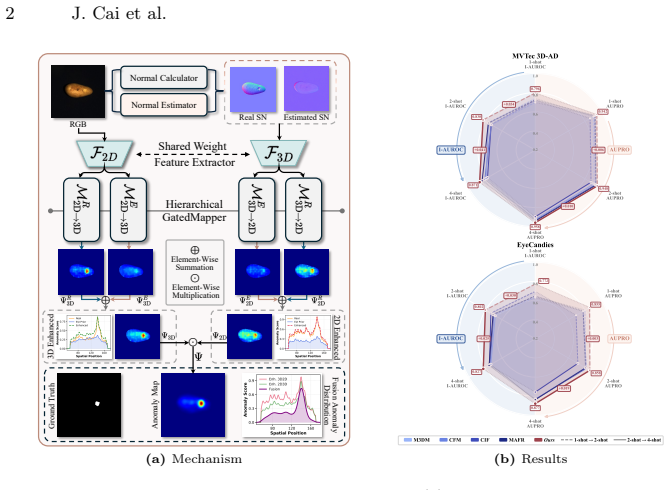
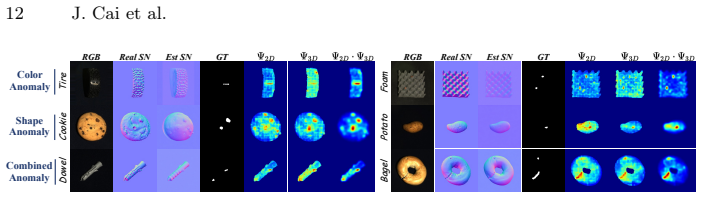
CMDS-AD shows that a pre-trained diffusion model inherently functions as a non-linear low-pass filter, generating an auxiliary estimated stream of purely low-frequency normal representations from RGB inputs that anchors robust structural templates and assists the uncompressed real stream in isolating micro-defects through adaptive cross-modal alignment and multiplicative scoring.
What carries the argument
The pre-trained diffusion model used as a non-linear low-pass filter to extract low-frequency normal representations from RGB inputs, creating the auxiliary estimated stream that decouples frequencies for cross-modal alignment.
Load-bearing premise
The pre-trained diffusion model inherently acts as a non-linear low-pass filter that directly extracts purely low-frequency normal representations from RGB inputs without losing critical defect signals or introducing artifacts that affect downstream alignment.
What would settle it
Direct inspection of the diffusion model's output on defective RGB images that reveals retention of high-frequency defect signals rather than purely low-frequency normals would falsify the claimed filtering behavior.
If this is right
- The auxiliary low-frequency stream reduces cross-modal misalignment and lowers false-positive rates by providing stable structural anchors.
- The Coordinate-Aware Hierarchical Feature Mapper enables adaptive alignment of semantics between the estimated and real streams.
- The multiplicative scoring mechanism filters modality-specific noise after alignment.
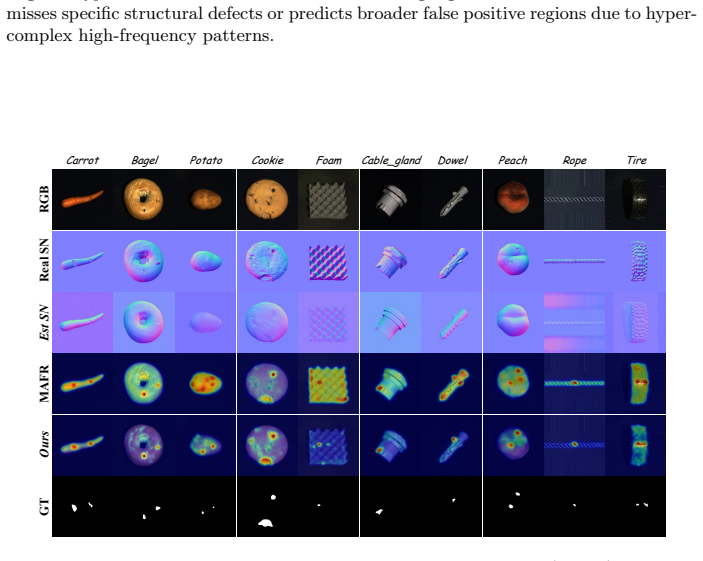
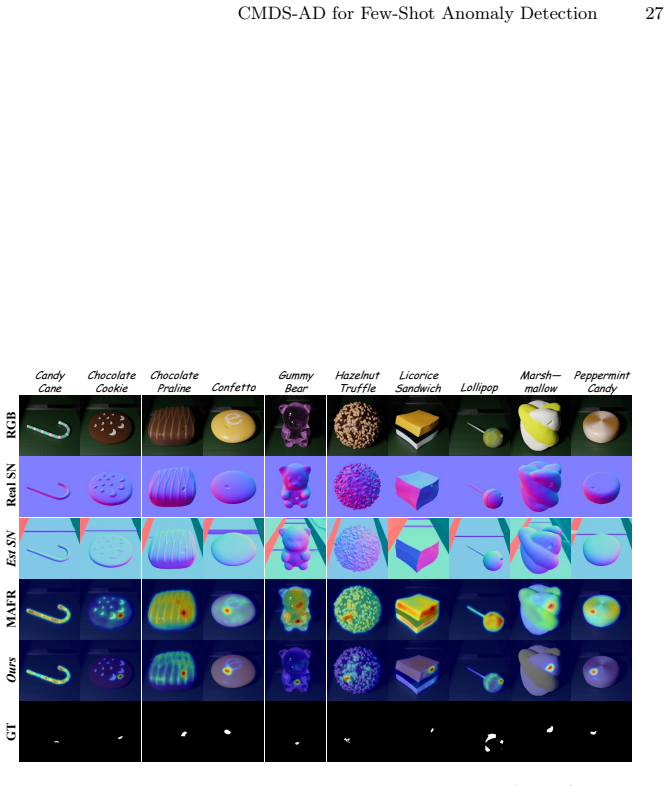
- These mechanisms together produce absolute gains of several percent in I-AUROC and AUPRO under the 1-shot setting on MVTec 3D-AD and EyeCandies.
Where Pith is reading between the lines
- The same low-pass anchoring idea could be tested on other paired modalities such as RGB-infrared where frequency content also differs.
- If the diffusion filter proves reliable, replacing it with lighter non-diffusion low-pass operators might preserve the gains at lower compute cost.
- Extending the dual-stream logic to temporal sequences would require checking whether the same frequency separation holds across video frames.
Editorial analysis
A structured set of objections, weighed in public.
Referee Report
Summary. The paper introduces CMDS-AD, a Cross-Modal Dual-Stream Anomaly Detection framework for few-shot multi-modal anomaly detection. It uses a LoRA-guided diffusion model to augment scarce RGB data and a pre-trained diffusion model as a normal estimator claimed to inherently function as a non-linear low-pass filter extracting purely low-frequency normal representations from RGB inputs. This creates an 'estimated stream' for stable structural templates and a 'real stream' for isolating micro-defects, aided by a Coordinate-Aware Hierarchical Feature Mapper for cross-modal alignment and multiplicative scoring to filter noise. The method reports new SOTA results under 1-shot settings: absolute gains of 5.7% I-AUROC and 2.0% AUPRO on MVTec 3D-AD, and 7.7% and 5.6% on EyeCandies.
Significance. If the diffusion-based decoupling mechanism holds, the approach could meaningfully advance few-shot MAD by addressing frequency conflation and cross-modal misalignment without heavy parameter fitting. The code release supports reproducibility. However, the significance is limited by the absence of verification for the core low-pass filter assumption, which underpins attribution of the reported gains to the dual-stream design rather than other factors.
major comments (2)
- [Abstract/Method] Abstract and method description: the claim that the pre-trained diffusion model 'inherently acts as a non-linear low-pass filter, directly extracting low-frequency normal representations from RGB inputs' without losing defect signals or introducing artifacts is load-bearing for the dual-stream decoupling and cross-modal alignment. No frequency-domain analysis, ablation removing the estimator, or pre/post-estimation defect visibility comparisons are supplied to substantiate points (a)–(c) in the stress-test note.
- [Experiments] Experiments section: performance gains (5.7% I-AUROC, 2.0% AUPRO on MVTec 3D-AD) are reported as absolute improvements establishing SOTA, yet no error bars, multiple random seeds, or statistical tests are mentioned, weakening confidence that the gains arise specifically from the claimed frequency separation rather than post-hoc choices or variance.
minor comments (1)
- [Abstract] The abstract notes code availability at the GitHub link; confirm that the released repository includes scripts and configurations to exactly reproduce the 1-shot MVTec 3D-AD and EyeCandies results.
Simulated Author's Rebuttal
We thank the referee for the constructive feedback on our manuscript. We address the major comments point by point below and will incorporate revisions to strengthen the empirical support for our claims and the statistical reporting of results.
read point-by-point responses
-
Referee: [Abstract/Method] Abstract and method description: the claim that the pre-trained diffusion model 'inherently acts as a non-linear low-pass filter, directly extracting low-frequency normal representations from RGB inputs' without losing defect signals or introducing artifacts is load-bearing for the dual-stream decoupling and cross-modal alignment. No frequency-domain analysis, ablation removing the estimator, or pre/post-estimation defect visibility comparisons are supplied to substantiate points (a)–(c) in the stress-test note.
Authors: We acknowledge that the low-pass filter property is central to the dual-stream design and that the current manuscript does not include direct empirical verification such as frequency-domain analysis or targeted ablations. In the revised version, we will add Fourier spectrum comparisons between the estimated and real streams, an ablation that removes the diffusion estimator, and qualitative pre/post-estimation visualizations of defect signals to substantiate the decoupling behavior. revision: yes
-
Referee: [Experiments] Experiments section: performance gains (5.7% I-AUROC, 2.0% AUPRO on MVTec 3D-AD) are reported as absolute improvements establishing SOTA, yet no error bars, multiple random seeds, or statistical tests are mentioned, weakening confidence that the gains arise specifically from the claimed frequency separation rather than post-hoc choices or variance.
Authors: We agree that the absence of variability measures and statistical tests limits confidence in attributing the gains specifically to the proposed mechanism. We will rerun the 1-shot experiments over multiple random seeds, report means with standard deviations, and include paired statistical significance tests in the updated experiments section. revision: yes
Circularity Check
No significant circularity; method relies on external pre-trained models with independent empirical claims
full rationale
The provided abstract and description contain no equations, fitted parameters, or self-citations that reduce the reported performance gains or the dual-stream decoupling to quantities defined by construction from the same inputs. The core claim invokes a pre-trained diffusion model as an external normal estimator whose low-pass property is asserted but not derived internally; this is an assumption rather than a self-referential reduction. No load-bearing step equates a prediction to a fit on the target data, renames a known result, or chains to prior author work as the sole justification. The 1-shot results on MVTec 3D-AD and EyeCandies are presented as empirical outcomes on external benchmarks, leaving the derivation self-contained against those benchmarks.
Axiom & Free-Parameter Ledger
axioms (1)
- domain assumption Pre-trained diffusion model acts as non-linear low-pass filter extracting purely low-frequency normal representations from RGB inputs
read the original abstract
Few-shot anomaly detection remains challenging due to limited training data. Multi-modal anomaly detection (MAD) offers a viable solution, leveraging 3D geometric cues to enrich 2D RGB representations and compensate for this scarcity. However, existing MAD methods apply spatially uniform feature processing, conflating stable macroscopic structures with high-frequency localized defect signals, exacerbating cross-modal misalignment and inflating false-positive rates. To overcome this, we present CMDS-AD, a Cross-Modal Dual-Stream Anomaly Detection framework. A LoRA-guided diffusion model generates diverse RGB samples to mitigate extreme data scarcity. For 3D normal augmentation, we employ a pre-trained diffusion model as a normal estimator. Crucially, this estimator inherently acts as a non-linear low-pass filter, directly extracting low-frequency normal representations from RGB inputs. This establishes an auxiliary estimated stream of purely low-frequency information, anchoring robust structural templates and assisting the uncompressed real stream, containing coupled high- and low-frequency components, to precisely isolate micro-defects. A Coordinate-Aware Hierarchical Feature Mapper adaptively aligns cross-modal semantics, while a multiplicative scoring mechanism filters modality-specific noise. Under the extreme 1-shot setting, CMDS-AD achieves absolute performance gains of 5.7% (I-AUROC) and 2.0% (AUPRO) on MVTec 3D-AD, alongside 7.7% and 5.6% improvements on EyeCandies, establishing a new state-of-the-art. Code is available at https://github.com/Junhaocai27/CMDS-AD
Figures





Reference graph
Works this paper leans on
-
[1]
In: 2025 International Conference on Digital Image Computing: Techniques and Applications (DICTA)
Ali, U., Zia, A., Rehman, A., Ramzan, U., Hassan, Z., Sattar, T., Wang, J., Xiang, W.: 2d-3d feature fusion via cross-modal latent synthesis and attention-guided restoration for industrial anomaly detection. In: 2025 International Conference on Digital Image Computing: Techniques and Applications (DICTA). pp. 1–8. IEEE (2025)
2025
-
[2]
arXiv preprint arXiv:2112.09045 , year=
Bergmann, P., Jin, X., Sattlegger, D., Steger, C.: The mvtec 3d-ad dataset for un- supervised 3d anomaly detection and localization. arXiv preprint arXiv:2112.09045 (2021)
-
[3]
In: Proceedings of the Asian Conference on Computer Vision
Bonfiglioli, L., Toschi, M., Silvestri, D., Fioraio, N., De Gregorio, D.: The eyecan- dies dataset for unsupervised multimodal anomaly detection and localization. In: Proceedings of the Asian Conference on Computer Vision. pp. 3586–3602 (2022)
2022
-
[4]
In: Proceedings of the 31st ACM International Conference on Multimedia
Chen, R., Xie, G., Liu, J., Wang, J., Luo, Z., Wang, J., Zheng, F.: Easynet: An easy network for 3d industrial anomaly detection. In: Proceedings of the 31st ACM International Conference on Multimedia. pp. 7038–7046 (2023)
2023
-
[5]
In: Proceedings of the IEEE/CVF conference on computer vision and pattern recognition
Choi, J., Lee, J., Shin, C., Kim, S., Kim, H., Yoon, S.: Perception prioritized train- ing of diffusion models. In: Proceedings of the IEEE/CVF conference on computer vision and pattern recognition. pp. 11472–11481 (2022)
2022
-
[6]
Chu, Y.M., Chieh, L., Hsieh, T.I., Chen, H.T., Liu, T.L.: Shape-guided dual- memory learning for 3d anomaly detection (2023)
2023
-
[7]
In: Proceedings of the IEEE/CVF Conference on Computer Vision and Pattern Recognition
Costanzino, A., Ramirez, P.Z., Lisanti, G., Di Stefano, L.: Multimodal indus- trial anomaly detection by crossmodal feature mapping. In: Proceedings of the IEEE/CVF Conference on Computer Vision and Pattern Recognition. pp. 17234– 17243 (2024)
2024
-
[8]
In: Proceedings of the IEEE/CVF conference on computer vision and pattern recognition
Deng, H., Li, X.: Anomaly detection via reverse distillation from one-class embed- ding. In: Proceedings of the IEEE/CVF conference on computer vision and pattern recognition. pp. 9737–9746 (2022)
2022
-
[9]
In: Proceedings of the IEEE/CVF International Conference on Computer Vision
Fang, Z., Wang, X., Li, H., Liu, J., Hu, Q., Xiao, J.: Fastrecon: Few-shot in- dustrial anomaly detection via fast feature reconstruction. In: Proceedings of the IEEE/CVF International Conference on Computer Vision. pp. 17481–17490 (2023)
2023
-
[10]
In: Proceedings of the AAAI Conference on Artificial Intelligence
Gu, Z., Zhang, J., Liu, L., Chen, X., Peng, J., Gan, Z., Jiang, G., Shu, A., Wang, Y., Ma, L.: Rethinking reverse distillation for multi-modal anomaly detection. In: Proceedings of the AAAI Conference on Artificial Intelligence. vol. 38, pp. 8445– 8453 (2024)
2024
-
[11]
In: Proceedings of the IEEE/CVF Conference on Computer Vision and Pattern Recognition
Horwitz, E., Hoshen, Y.: Back to the feature: classical 3d features are (almost) all you need for 3d anomaly detection. In: Proceedings of the IEEE/CVF Conference on Computer Vision and Pattern Recognition. pp. 2968–2977 (2023) 16 J. Cai et al
2023
-
[12]
Iclr1(2), 3 (2022)
Hu, E.J., Shen, Y., Wallis, P., Allen-Zhu, Z., Li, Y., Wang, S., Wang, L., Chen, W., et al.: Lora: Low-rank adaptation of large language models. Iclr1(2), 3 (2022)
2022
-
[13]
In: European conference on computer vision
Huang, C., Guan, H., Jiang, A., Zhang, Y., Spratling, M., Wang, Y.F.: Registration based few-shot anomaly detection. In: European conference on computer vision. pp. 303–319. Springer (2022)
2022
-
[14]
In: Proceedings of the IEEE/CVF conference on computer vision and pattern recognition
Jeong, J., Zou, Y., Kim, T., Zhang, D., Ravichandran, A., Dabeer, O.: Winclip: Zero-/few-shot anomaly classification and segmentation. In: Proceedings of the IEEE/CVF conference on computer vision and pattern recognition. pp. 19606– 19616 (2023)
2023
-
[15]
IEEE Transactions on Pattern Analysis and Machine Intelligence (2025)
Ke, B., Qu, K., Wang, T., Metzger, N., Huang, S., Li, B., Obukhov, A., Schindler, K.: Marigold: Affordable adaptation of diffusion-based image generators for image analysis. IEEE Transactions on Pattern Analysis and Machine Intelligence (2025)
2025
-
[16]
arXiv e-prints pp
Lee, Y., Jang, S., Yoon, H.: Anople: Few-shot anomaly detection via bi-directional prompt learning with only normal samples. arXiv e-prints pp. arXiv–2408 (2024)
2024
-
[17]
In: Proceedings of the IEEE/CVF conference on com- puter vision and pattern recognition
Li, W., Xu, X., Gu, Y., Zheng, B., Gao, S., Wu, Y.: Towards scalable 3d anomaly detection and localization: A benchmark via 3d anomaly synthesis and a self- supervised learning network. In: Proceedings of the IEEE/CVF conference on com- puter vision and pattern recognition. pp. 22207–22216 (2024)
2024
-
[18]
In: Proceedings of the IEEE/CVF International Conference on Computer Vision
Li, Y., Liu, F., Liao, J., Tian, S., Foo, C.S., Yang, X.: Find: Few-shot anomaly inspection with normal-only multi-modal data. In: Proceedings of the IEEE/CVF International Conference on Computer Vision. pp. 23290–23299 (2025)
2025
-
[19]
In: Proceedings of the AAAI Conference on Artificial Intelligence
Liang, H., Xie, G., Hou, C., Wang, B., Gao, C., Wang, J.: Look inside for more: Internal spatial modality perception for 3d anomaly detection. In: Proceedings of the AAAI Conference on Artificial Intelligence. vol. 39, pp. 5146–5154 (2025)
2025
-
[20]
In: Proceedings of the AAAI Conference on Ar- tificial Intelligence
Lin, Y., Yan, H., Tong, X., Chang, Y., Wang, H., Zhou, Z., Gao, S., Wang, Y., Zhang, W.: Commonality in few: Few-shot multimodal anomaly detection via hypergraph-enhanced memory. In: Proceedings of the AAAI Conference on Ar- tificial Intelligence. vol. 40, pp. 7015–7023 (2026)
2026
-
[21]
In: European Conference on Computer Vision
Liu, C., Chu, Y.M., Hsieh, T.I., Chen, H.T., Liu, T.L.: Learning diffusion models for multi-view anomaly detection. In: European Conference on Computer Vision. pp. 328–345. Springer (2024)
2024
-
[22]
In: Proceedings of the AAAI Conference on Artificial Intelligence
Long, K., Xie, G., Ma, L., Liu, J., Lu, Z.: Revisiting multimodal fusion for 3d anomaly detection from an architectural perspective. In: Proceedings of the AAAI Conference on Artificial Intelligence. vol. 39, pp. 12273–12281 (2025)
2025
-
[23]
In: Proceedings of the AAAI Conference on Artificial Intelligence
Luo, X., Xie, Y., Qu, Y., Fu, Y.: Skipdiff: Adaptive skip diffusion model for high- fidelity perceptual image super-resolution. In: Proceedings of the AAAI Conference on Artificial Intelligence. vol. 38, pp. 4017–4025 (2024)
2024
-
[24]
Knowledge-Based Systems290, 111563 (2024)
Lyu, S., Mo, D., keung Wong, W.: Reb: Reducing biases in representation for industrial anomaly detection. Knowledge-Based Systems290, 111563 (2024)
2024
-
[25]
In: Proceedings of the IEEE/CVF conference on computer vi- sion and pattern recognition
Ristea, N.C., Madan, N., Ionescu, R.T., Nasrollahi, K., Khan, F.S., Moes- lund, T.B., Shah, M.: Self-supervised predictive convolutional attentive block for anomaly detection. In: Proceedings of the IEEE/CVF conference on computer vi- sion and pattern recognition. pp. 13576–13586 (2022)
2022
-
[26]
In: Proceedings of the IEEE/CVF winter conference on applications of computer vision
Rudolph, M., Wehrbein, T., Rosenhahn, B., Wandt, B.: Asymmetric student- teacher networks for industrial anomaly detection. In: Proceedings of the IEEE/CVF winter conference on applications of computer vision. pp. 2592–2602 (2023)
2023
-
[27]
In: Pro- ceedings of the IEEE/CVF conference on computer vision and pattern recognition
Si, C., Huang, Z., Jiang, Y., Liu, Z.: Freeu: Free lunch in diffusion u-net. In: Pro- ceedings of the IEEE/CVF conference on computer vision and pattern recognition. pp. 4733–4743 (2024) CMDS-AD for Few-Shot Anomaly Detection 17
2024
-
[28]
Information Fusion p
Sui, W., Lichau, D., Lefèvre, J., Phelippeau, H.: Incomplete multimodal indus- trial anomaly detection via cross-modal distillation. Information Fusion p. 103572 (2025)
2025
-
[29]
In: Proceedings of the AAAI Conference on Artificial Intelligence
Tang, N., Luo, X., Cheng, Z., Zhou, L., Zhang, D., Qu, Y.: Diffusion once and done: Degradation-aware lora for all-in-one image restoration. In: Proceedings of the AAAI Conference on Artificial Intelligence. vol. 40, pp. 9448–9456 (2026)
2026
-
[30]
In: Proceedings of the 32nd ACM International Conference on Multi- media
Tian, L., Zhao, H., Lu, R., Wang, R., Wu, Y., Wang, L., He, X., Liu, X.: Foct: Few-shot industrial anomaly detection with foreground-aware online conditional transport. In: Proceedings of the 32nd ACM International Conference on Multi- media. pp. 6241–6249 (2024)
2024
-
[31]
In: Proceedings of the IEEE/CVF conference on computer vision and pattern recognition
Tien, T.D., Nguyen, A.T., Tran, N.H., Huy, T.D., Duong, S., Nguyen, C.D.T., Truong, S.Q.: Revisiting reverse distillation for anomaly detection. In: Proceedings of the IEEE/CVF conference on computer vision and pattern recognition. pp. 24511–24520 (2023)
2023
-
[32]
In: International Conference on Learning Represen- tations
Trabucco, B., Doherty, K., Gurinas, M., Salakhutdinov, R.: Effective data augmen- tation with diffusion models. In: International Conference on Learning Represen- tations. vol. 2024, pp. 14590–14612 (2024)
2024
-
[33]
In: European conference on computer vision
Tu, Y., Zhang, B., Liu, L., Li, Y., Zhang, J., Wang, Y., Wang, C., Zhao, C.: Self- supervised feature adaptation for 3d industrial anomaly detection. In: European conference on computer vision. pp. 75–91. Springer (2024)
2024
-
[34]
In: Proceedings of the IEEE/CVF conference on computer vision and pattern recognition
Wang, Y., Peng, J., Zhang, J., Yi, R., Wang, Y., Wang, C.: Multimodal industrial anomaly detection via hybrid fusion. In: Proceedings of the IEEE/CVF conference on computer vision and pattern recognition. pp. 8032–8041 (2023)
2023
-
[35]
In: Proceed- ings of the IEEE/CVF conference on computer vision and pattern recognition
Wyatt, J., Leach, A., Schmon, S.M., Willcocks, C.G.: Anoddpm: Anomaly detec- tion with denoising diffusion probabilistic models using simplex noise. In: Proceed- ings of the IEEE/CVF conference on computer vision and pattern recognition. pp. 650–656 (2022)
2022
-
[36]
Advances in Neural Information Processing Systems35, 32398–32411 (2022)
Yan, X., Zhan, H., Zheng, C., Gao, J., Zhang, R., Cui, S., Li, Z.: Let images give you more: Point cloud cross-modal training for shape analysis. Advances in Neural Information Processing Systems35, 32398–32411 (2022)
2022
-
[37]
In: Proceedings of the IEEE/CVF Conference on computer vision and pattern recognition
Yang, X., Zhou, D., Feng, J., Wang, X.: Diffusion probabilistic model made slim. In: Proceedings of the IEEE/CVF Conference on computer vision and pattern recognition. pp. 22552–22562 (2023)
2023
-
[38]
In: Proceedings of the IEEE/CVF Winter Conference on Applications of Computer Vision
Zavrtanik, V., Kristan, M., Skočaj, D.: Cheating depth: Enhancing 3d surface anomaly detection via depth simulation. In: Proceedings of the IEEE/CVF Winter Conference on Applications of Computer Vision. pp. 2164–2172 (2024)
2024
-
[39]
IEEE transactions on pattern analysis and machine intelligence (2025)
Zhang, H., Wang, Z., Zeng, D., Wu, Z., Jiang, Y.G.: Diffusionad: Norm-guided one-step denoising diffusion for anomaly detection. IEEE transactions on pattern analysis and machine intelligence (2025)
2025
-
[40]
In: Proceedings of the IEEE/CVF conference on computer vision and pattern recognition
Zhang, X., Li, S., Li, X., Huang, P., Shan, J., Chen, T.: Destseg: Segmentation guided denoising student-teacher for anomaly detection. In: Proceedings of the IEEE/CVF conference on computer vision and pattern recognition. pp. 3914–3923 (2023)
2023
-
[41]
Zhou, Z., Wang, L., Fang, N., Wang, Z., Qiu, L., Zhang, S.: R3d-ad: Reconstruction viadiffusionfor3danomalydetection.In:Europeanconferenceoncomputervision. pp. 91–107. Springer (2024) 18 J. Cai et al. Supplementary Material for CMDS-AD: Cross-Modal Dual-Stream Decoupling for Few-Shot Anomaly Detection A Extended Analysis on Strict FPR Thresholds A.1 Evalu...
discussion (0)
Sign in with ORCID, Apple, or X to comment. Anyone can read and Pith papers without signing in.