Towards Modality-imbalanced Federated Graph Learning: A Data Synthesis-based Approach
Pith reviewed 2026-06-26 18:15 UTC · model grok-4.3
The pith
Recovering missing modal semantics directly in representation space addresses modality imbalance in multi-modal federated graph learning.
A machine-rendered reading of the paper's core claim, the machinery that carries it, and where it could break.
Core claim
Modality-imbalanced MM-FGL reduces to an implicit graph-aware latent semantic representation synthesis problem; recovering missing modal semantics directly within the representation space maximizes alignment with the original data's semantic distribution and mitigates the high variance induced by missing modalities.
What carries the argument
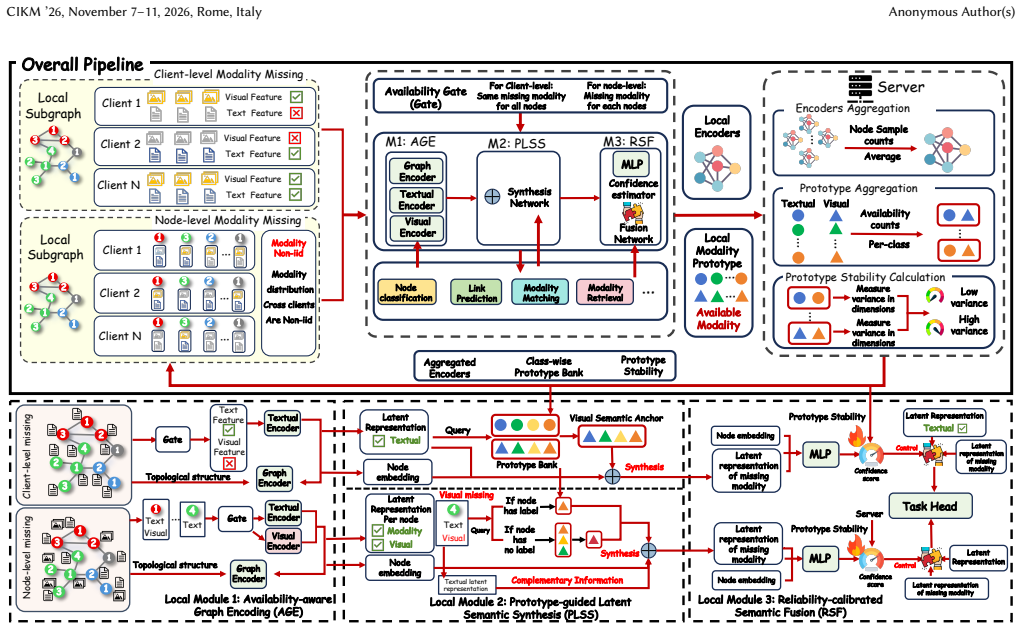
FedMGS, which integrates an availability-aware graph encoder to block contamination of structural propagation, a prototype-guided latent semantic synthesizer to create cross-client semantic anchors, and a reliability-calibrated semantic fusion mechanism to regulate recovered representations before readout.
If this is right
- The availability-aware graph encoder stops missing modalities from affecting local structural message passing.
- The prototype-guided synthesizer creates cross-client anchors that stand in for unavailable modalities.
- The reliability-calibrated fusion limits the influence of recovered representations on final predictions.
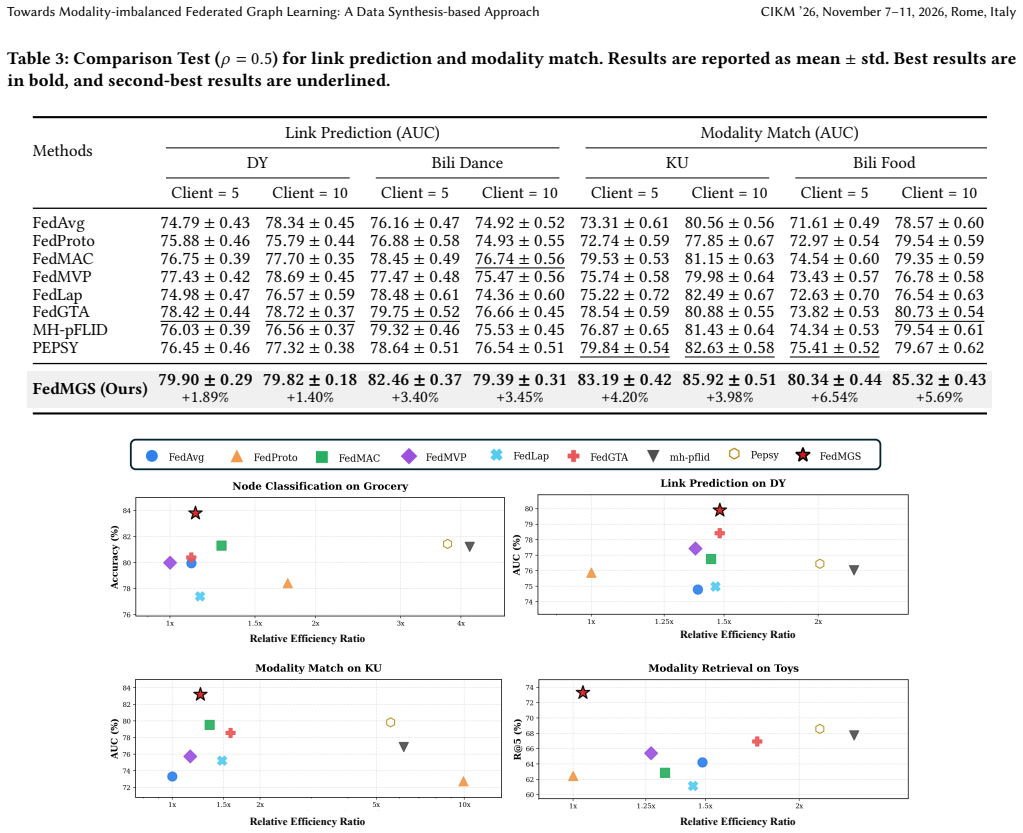
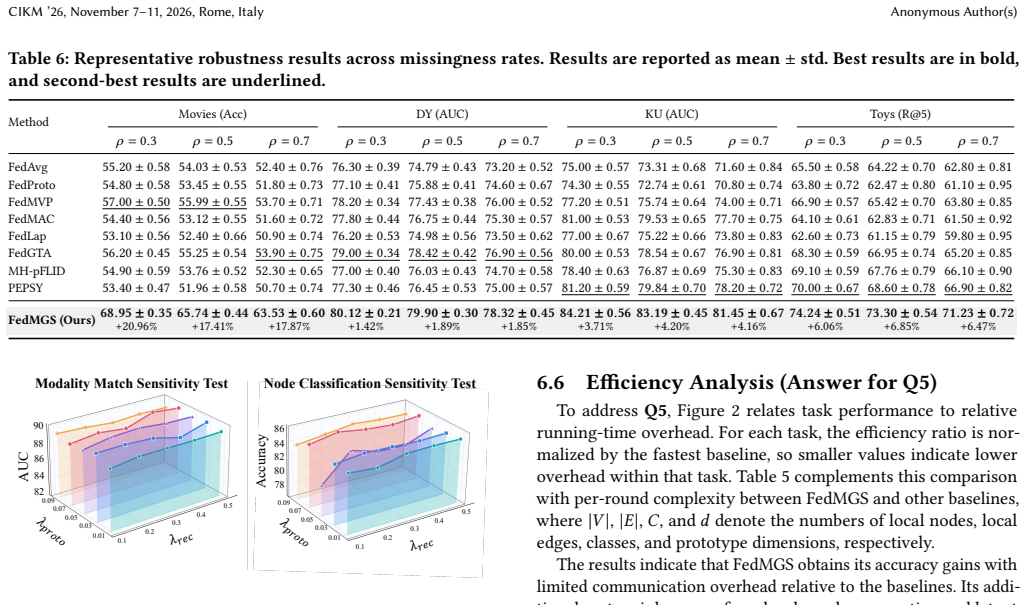
- The overall approach yields up to 17.41 percent gains over competitive baselines on four tasks while preserving the best efficiency-performance tradeoff.
Where Pith is reading between the lines
- If representation-space synthesis succeeds, it may reduce reliance on raw-data imputation techniques that raise privacy concerns in federated settings.
- The same three-component structure could be tested on federated tasks outside graphs, such as tabular or sequential data with modality dropout.
- Node-level and client-level imbalance handled jointly suggests the method might scale to settings where modality availability changes over time.
Load-bearing premise
Recovering missing modal semantics directly in the representation space via the three components will maximize alignment with the original semantic distribution and reduce variance from missing modalities.
What would settle it
A controlled test in which the synthesized representations are measured against held-out complete-modality data and found to increase rather than decrease prediction variance or distributional mismatch.
Figures
read the original abstract
MultiModal Federated Graph Learning (MM-FGL) offers a natural collaborative training paradigm, but its practical deployment is challenged by two granularities of modality imbalance. Client-level imbalance occurs when certain clients lack entire modalities, while node-level imbalance occurs when individual nodes exhibit missing visual or textual attributes. While several relevant studies exist, our investigation reveals that they predominantly target graph-agnostic or centralized scenarios, rendering them difficult to adapt directly. To address these challenges, we formalize modality-imbalanced MM-FGL as an implicit graph-aware latent semantic representation synthesis problem. This paradigm recovers missing modal semantics directly within the representation space, thereby maximizing alignment with the original data's semantic distribution and mitigating the high variance induced by missing modalities. To this end, we propose FedMGS (Federated Modality-aware Graph Synthesis), which integrates three core components. The availability-aware graph encoder prevents missing modalities from contaminating local structural propagation. The prototype-guided latent semantic synthesizer establishes cross-client semantic anchors for unavailable modalities. The reliability-calibrated semantic fusion mechanism regulates the impact of recovered latent representations prior to predictive readout. Extensive experiments on four tasks show that FedMGS consistently outperforms competitive baselines with gains up to 17.41% with best efficiency-performance tradeoff.
Editorial analysis
A structured set of objections, weighed in public.
Referee Report
Summary. The paper formalizes modality-imbalanced MultiModal Federated Graph Learning (MM-FGL) as an implicit graph-aware latent semantic representation synthesis problem. It proposes FedMGS, which integrates an availability-aware graph encoder, a prototype-guided latent semantic synthesizer, and a reliability-calibrated semantic fusion mechanism to recover missing modal semantics in representation space. The manuscript claims this mitigates high variance from missing modalities and yields consistent outperformance over baselines with gains up to 17.41% on four tasks, along with a favorable efficiency-performance tradeoff.
Significance. If the experimental claims and the alignment assumption hold under client heterogeneity, the work could meaningfully advance handling of modality imbalance in federated multimodal graph settings by shifting recovery to representation space rather than data space.
major comments (2)
- [Abstract] Abstract: the load-bearing claim that the synthesis paradigm 'recovers missing modal semantics directly within the representation space, thereby maximizing alignment with the original data's semantic distribution and mitigating the high variance induced by missing modalities' lacks any described direct metric, held-out complete-modality evaluation, or variance-reduction measurement to substantiate the alignment or variance mitigation; this underpins all three components and the reported gains.
- [Abstract] Abstract: the assertion of 'extensive experiments on four tasks' and 'gains up to 17.41%' supplies no datasets, baselines, ablation results, or per-component contribution analysis, so the central outperformance claim cannot be assessed from the provided text.
Simulated Author's Rebuttal
We thank the referee for the constructive comments on the abstract. We address each major comment below and will revise the manuscript accordingly.
read point-by-point responses
-
Referee: [Abstract] Abstract: the load-bearing claim that the synthesis paradigm 'recovers missing modal semantics directly within the representation space, thereby maximizing alignment with the original data's semantic distribution and mitigating the high variance induced by missing modalities' lacks any described direct metric, held-out complete-modality evaluation, or variance-reduction measurement to substantiate the alignment or variance mitigation; this underpins all three components and the reported gains.
Authors: The abstract summarizes the proposed paradigm at a high level. The full manuscript provides the requested substantiation through held-out complete-modality evaluations and variance analyses in Sections 4 and 5. To strengthen the abstract, we will add a concise reference to the evaluation metrics and protocols used. revision: yes
-
Referee: [Abstract] Abstract: the assertion of 'extensive experiments on four tasks' and 'gains up to 17.41%' supplies no datasets, baselines, ablation results, or per-component contribution analysis, so the central outperformance claim cannot be assessed from the provided text.
Authors: We agree the abstract is concise and omits these specifics. The manuscript details the four tasks, datasets, baselines, and ablation studies in the experimental section. We will revise the abstract to name the tasks and note the inclusion of ablation results while preserving brevity. revision: yes
Circularity Check
No significant circularity detected; derivation is self-contained proposal.
full rationale
The paper formalizes modality-imbalanced MM-FGL as an implicit graph-aware latent semantic representation synthesis problem and introduces FedMGS with three components (availability-aware graph encoder, prototype-guided latent semantic synthesizer, reliability-calibrated semantic fusion). No equations, derivations, or self-citations are shown that reduce the claimed alignment maximization, variance mitigation, or performance gains to fitted inputs by construction or to prior self-referential results. The central claims rest on the proposed method without visible reduction to its own inputs.
Axiom & Free-Parameter Ledger
Reference graph
Works this paper leans on
-
[1]
Javad Aliakbari, Johan Östman, Ashkan Panahi, and Alexandre Graell i Amat
-
[2]
InAdvances in Neural Information Processing Systems, Vol
Subgraph Federated Learning via Spectral Methods. InAdvances in Neural Information Processing Systems, Vol. 38. https://arxiv.org/abs/2510.25657
-
[3]
Jinheon Baek, Wonyong Jeong, Jiongdao Jin, Jaehong Yoon, and Sung Ju Hwang
-
[4]
InProceedings of the 40th International Conference on Machine Learning
Personalized Subgraph Federated Learning. InProceedings of the 40th International Conference on Machine Learning
-
[5]
Dongmin Bang, Sangsoo Lim, Sangseon Lee, and Sun Kim. 2023. Biomedical knowledge graph learning for drug repurposing by extending guilt-by-association to multiple layers.Nature Communications14, 1 (2023), 3570
2023
-
[6]
Blondel, Jean-Loup Guillaume, Renaud Lambiotte, and Etienne Lefeb- vre
Vincent D. Blondel, Jean-Loup Guillaume, Renaud Lambiotte, and Etienne Lefeb- vre. 2008. Fast unfolding of communities in large networks.Journal of Statistical Mechanics: Theory and Experiment2008, 10 (2008), P10008
2008
-
[7]
Lei Cai, Jundong Li, Jie Wang, and Shuiwang Ji. 2021. Line Graph Neural Networks for Link Prediction.IEEE Transactions on Pattern Analysis and Machine Intelligence (2021)
2021
-
[8]
Xuheng Cai, Chao Huang, Lianghao Xia, and Xubin Ren. 2023. LightGCL: Simple Yet Effective Graph Contrastive Learning for Recommendation. InInternational Conference on Learning Representations
2023
-
[9]
Liwei Che, Jiaqi Wang, Xinyue Liu, and Fenglong Ma. 2024. Leveraging Foun- dation Models for Multi-modal Federated Learning with Incomplete Modality. arXiv preprint arXiv:2406.11048. doi:10.48550/arXiv.2406.11048
-
[10]
Chuan Chen, Weibo Hu, Ziyue Xu, and Zibin Zheng. 2021. FedGL: Feder- ated Graph Learning Framework with Global Self-Supervision.arXiv preprint arXiv:2105.03170(2021)
arXiv 2021
-
[11]
Zekai Chen, Xun Wu, Xunkai Li, Yihan Sun, Rong-Hua Li, and Guoren Wang
-
[12]
STAGE: Tackling Semantic Drift in Multimodal Federated Graph Learning
STAGE: Tackling Semantic Drift in Multimodal Federated Graph Learning. arXiv preprint arXiv:2605.11919. doi:10.48550/arXiv.2605.11919
work page internal anchor Pith review Pith/arXiv arXiv doi:10.48550/arxiv.2605.11919
-
[13]
Tiantian Feng, Digbalay Bose, Tuo Zhang, Rajat Hebbar, Anil Ramakrishna, Rahul Gupta, Mi Zhang, Salman Avestimehr, and Shrikanth Narayanan. 2023. FedMultimodal: A Benchmark for Multimodal Federated Learning. InProceedings of the 29th ACM SIGKDD Conference on Knowledge Discovery and Data Mining. Association for Computing Machinery, New York, NY, USA, 4035–...
arXiv 2023
-
[14]
Xingbo Fu, Binchi Zhang, Yushun Dong, Chen Chen, and Jundong Li. 2022. Feder- ated graph machine learning: A survey of concepts, techniques, and applications. ACM SIGKDD Explorations Newsletter24, 2 (2022), 32–47
2022
-
[15]
Will Hamilton, Zhitao Ying, and Jure Leskovec. 2017. Inductive Representation Learning on Large Graphs.Advances in Neural Information Processing Systems (2017)
2017
-
[16]
Yu, Yu Rong, et al
Chaoyang He, Keshav Balasubramanian, Emir Ceyani, Carl Yang, Han Xie, Lichao Sun, Lifang He, Liangwei Yang, Philip S. Yu, Yu Rong, et al. 2021. FedGraphNN: A Federated Learning Benchmark System for Graph Neural Networks. InInter- national Conference on Learning Representations Workshop on Distributed and Private Machine Learning
2021
-
[17]
Yufei He, Yuan Sui, Xiaoxin He, Yue Liu, Yifei Sun, and Bryan Hooi. 2025. Uni- Graph2: Learning a Unified Embedding Space to Bind Multimodal Graphs. arXiv preprint arXiv:2502.00806. doi:10.48550/arXiv.2502.00806
-
[18]
Woochang Hyun, Jaehong Lee, and Bongwon Suh. 2023. Anti-Money Laundering in Cryptocurrency via Multi-Relational Graph Neural Network. InPacific-Asia Conference on Knowledge Discovery and Data Mining. Springer, 118–130
2023
-
[19]
Kipf and Max Welling
Thomas N. Kipf and Max Welling. 2017. Semi-Supervised Classification with Graph Convolutional Networks. International Conference on Learning Repre- sentations (ICLR). https://openreview.net/forum?id=SJU4ayYgl
2017
-
[20]
Le, Chu Myaet Thwal, Yu Qiao, Ye Lin Tun, Minh N
Huy Q. Le, Chu Myaet Thwal, Yu Qiao, Ye Lin Tun, Minh N. H. Nguyen, and Choong Seon Hong. 2024. Cross-Modal Prototype based Multimodal Federated Learning under Severely Missing Modality. arXiv preprint arXiv:2401.13898. doi:10.48550/arXiv.2401.13898
-
[21]
Xunkai Li, Yuming Ai, Yinlin Zhu, Haodong Lu, Yi Zhang, Guohao Fu, Bowen Fan, Qiangqiang Dai, Rong-Hua Li, and Guoren Wang. 2026. MM-OpenFGL: A Comprehensive Benchmark for Multimodal Federated Graph Learning. arXiv preprint arXiv:2601.22416. doi:10.48550/arXiv.2601.22416
-
[22]
Xunkai Li, Zhengyu Wu, Wentao Zhang, Henan Sun, Rong-Hua Li, and Guoren Wang. 2024. AdaFGL: A New Paradigm for Federated Node Classification with Topology Heterogeneity. arXiv preprint arXiv:2401.11750. doi:10.48550/arXiv. 2401.11750
work page internal anchor Pith review doi:10.48550/arxiv 2024
-
[23]
Xunkai Li, Zhengyu Wu, Wentao Zhang, Yinlin Zhu, Rong-Hua Li, and Guoren Wang. 2024. FedGTA: Topology-Aware Averaging for Federated Graph Learning. Proceedings of the VLDB Endowment17, 1 (2024), 41–50
2024
-
[24]
Brendan McMahan, Eider Moore, Daniel Ramage, Seth Hampson, and Blaise Agüera y Arcas
H. Brendan McMahan, Eider Moore, Daniel Ramage, Seth Hampson, and Blaise Agüera y Arcas. 2017. Communication-Efficient Learning of Deep Net- works from Decentralized Data. InProceedings of the 20th International Con- ference on Artificial Intelligence and Statistics (Proceedings of Machine Learn- ing Research, Vol. 54). PMLR, Fort Lauderdale, FL, USA, 127...
2017
-
[25]
Manh Duong Nguyen, Trung Thanh Nguyen, Huy Hieu Pham, Trong Nghia Hoang, Phi Le Nguyen, and Thanh Trung Huynh. 2024. FedMAC: Tackling Partial-Modality Missing in Federated Learning with Cross-Modal Aggregation and Contrastive Regularization. arXiv preprint arXiv:2410.03070. doi:10.48550/ arXiv.2410.03070
arXiv 2024
-
[26]
Tan Nguyen et al. 2025. PEPSY: Privacy-Preserving Embedding Controls for Heterogeneous Missing Modalities. Preprint
2025
-
[27]
Jianmo Ni, Jiacheng Li, and Julian J. McAuley. 2019. Justifying Recommendations using Distantly-Labeled Reviews and Fine-Grained Aspects. InEMNLP/IJCNLP (1). Association for Computational Linguistics, 188–197
2019
-
[28]
Zhirui Pan, Guangzhong Wang, Zhaoning Li, Lifeng Chen, Yang Bian, and Zhongyuan Lai. 2022. 2SFGL: A Simple And Robust Protocol For Graph-Based Fraud Detection. In2022 IEEE International Conference on Cloud Computing Tech- nology and Science. IEEE, 194–201
2022
-
[29]
Yuanzhe Peng, Jieming Bian, and Jie Xu. 2024. FedMM: Federated Multi-Modal Learning with Modality Heterogeneity in Computational Pathology. arXiv preprint arXiv:2402.15858. doi:10.48550/arXiv.2402.15858
-
[30]
Plummer, Liwei Wang, Chris M
Bryan A. Plummer, Liwei Wang, Chris M. Cervantes, Juan C. Caicedo, Julia Hockenmaier, and Svetlana Lazebnik. 2015. Flickr30k Entities: Collecting Region- to-Phrase Correspondences for Richer Image-to-Sentence Models. InICCV. IEEE Computer Society, 2641–2649
2015
-
[31]
Yue Tan, Yixin Liu, Guodong Long, Jing Jiang, Qinghua Lu, and Chengqi Zhang
-
[32]
Proceedings of the AAAI Conference on Artificial Intelligence37, 8 (2023), 9953–9961
Federated Learning on Non-IID Graphs via Structural Knowledge Sharing. Proceedings of the AAAI Conference on Artificial Intelligence37, 8 (2023), 9953–9961. doi:10.1609/AAAI.V37I8.26187
-
[33]
Yue Tan, Guodong Long, Lu Liu, Tianyi Zhou, Qinghua Lu, Jing Jiang, and Chengqi Zhang. 2022. FedProto: Federated Prototype Learning across Heteroge- neous Clients.Proceedings of the AAAI Conference on Artificial Intelligence36, 8 (2022), 8432–8440. doi:10.1609/aaai.v36i8.20819
-
[34]
Mingwei Tang, Meng Liu, Hong Li, Junjie Yang, Chenglin Wei, Boyang Li, Dai Li, Rengan Xu, Yifan Xu, Zehua Zhang, Xiangyu Wang, Linfeng Liu, Yuelei Xie, Chengye Liu, Labib Fawaz, Li Li, Hongnan Wang, Bill Zhu, and Sri Reddy. 2024. Async Learned User Embeddings for Ads Delivery Optimization. arXiv:2406.05898 [cs.IR] https://arxiv.org/abs/2406.05898
arXiv 2024
-
[35]
Zhulin Tao, Yinwei Wei, Xiang Wang, Xiangnan He, Xianglin Huang, and Tat-Seng Chua. 2020. MGAT: Multimodal Graph Attention Network for Rec- ommendation.Information Processing & Management57, 5 (2020), 102277. doi:10.1016/j.ipm.2020.102277
-
[36]
Petar Veličković, Guillem Cucurull, Arantxa Casanova, Adriana Romero, Pietro Liò, and Yoshua Bengio. 2018. Graph Attention Networks. InICLR
2018
-
[37]
Guancheng Wan, Wenke Huang, and Mang Ye. 2024. Federated Graph Learning under Domain Shift with Generalizable Prototypes. InProceedings of the AAAI Conference on Artificial Intelligence, Vol. 38. 15429–15437
2024
-
[38]
Zhen Wang, Weirui Kuang, Yuexiang Xie, Liuyi Yao, Yaliang Li, Bolin Ding, and Jingren Zhou. 2022. FederatedScope-GNN: Towards a Unified, Comprehensive and Efficient Package for Federated Graph Learning. InProceedings of the 28th ACM SIGKDD Conference on Knowledge Discovery and Data Mining. 4110–4120
2022
-
[39]
Yinwei Wei, Xiang Wang, Liqiang Nie, Xiangnan He, Richang Hong, and Tat-Seng Chua. 2019. MMGCN: Multi-modal Graph Convolution Network for Personalized Recommendation of Micro-video. InProceedings of the 27th ACM International Conference on Multimedia. Association for Computing Machinery, New York, NY, USA, 1437–1445. doi:10.1145/3343031.3351034
-
[40]
Xiaotong Wu, Jiaquan Gao, Muhammad Bilal, Fei Dai, Xiaolong Xu, Lianyong Qi, and Wanchun Dou. 2023. Federated learning-based private medical knowledge graph for epidemic surveillance in internet of things.Expert Systems(2023), e13372
2023
-
[41]
Zonghan Wu, Shirui Pan, Fengwen Chen, Guodong Long, Chengqi Zhang, and Philip S. Yu. 2020. A Comprehensive Survey on Graph Neural Networks.IEEE Transactions on Neural Networks and Learning Systems32, 1 (2020), 4–24
2020
-
[42]
Han Xie, Jing Ma, Li Xiong, and Carl Yang. 2021. Federated Graph Classification over Non-IID Graphs. arXiv preprint arXiv:2106.13423. doi:10.48550/arXiv.2106. 13423
-
[43]
Liang Xie, Ming Lin, Tuan Luan, Chao Li, Yixuan Fang, Qitao Shen, and Zongwei Wu. 2024. MH-pFLID: Model Heterogeneous Personalized Federated Learn- ing via Injection and Distillation for Medical Data Analysis.arXiv preprint CIKM ’26, November 7–11, 2026, Rome, Italy Anonymous Author(s) arXiv:2405.06822(2024)
arXiv 2024
-
[44]
Keyulu Xu, Weihua Hu, Jure Leskovec, and Stefanie Jegelka. 2019. How Powerful are Graph Neural Networks?International Conference on Learning Representations (2019)
2019
-
[45]
Yuhang Yao, Weizhao Jin, Srivatsan Ravi, and Carlee Joe-Wong. 2024. FedGCN: Convergence-Communication Tradeoffs in Federated Training of Graph Con- volutional Networks.Advances in Neural Information Processing Systems36 (2024)
2024
-
[46]
Huanding Zhang, Tao Shen, Fei Wu, Mingyang Yin, Hongxia Yang, and Chao Wu
-
[47]
Federated Graph Learning–A Position Paper.arXiv preprint arXiv:2105.11099 (2021)
arXiv 2021
-
[48]
Jiaqi Zhang, Yu Cheng, Yongxin Ni, Yunzhu Pan, Zheng Yuan, Junchen Fu, Youhua Li, Jie Wang, and Fajie Yuan. 2025. NineRec: A Benchmark Dataset Suite for Evaluating Transferable Recommendation.IEEE Trans. Pattern Anal. Mach. Intell. 47, 7 (2025), 5256–5267
2025
-
[49]
Ke Zhang, Carl Yang, Xiaoxiao Li, Lichao Sun, and Siu-Ming Yiu. 2021. Sub- graph Federated Learning with Missing Neighbor Generation. InAdvances in Neural Information Processing Systems, Vol. 34. Curran Associates, Inc., Red Hook, NY, USA, 6671–6682. https://proceedings.neurips.cc/paper/2021/hash/ 34adeb8e3242824038aa65460a47c29e-Abstract.html
2021
-
[50]
Muhan Zhang and Yixin Chen. 2018. Link Prediction Based on Graph Neural Networks.Advances in Neural Information Processing Systems(2018)
2018
-
[51]
Yu Zhou, Haixia Zheng, Xin Huang, Shufeng Hao, Dengao Li, and Jumin Zhao
-
[52]
Graph Neural Networks: Taxonomy, Advances, and Trends.ACM Transac- tions on Intelligent Systems and Technology13, 1 (2022), 1–54
2022
-
[53]
Jing Zhu, Yuhang Zhou, Shengyi Qian, Zhongmou He, Tong Zhao, Neil Shah, and Danai Koutra. 2025. Mosaic of Modalities: A Comprehensive Benchmark for Multimodal Graph Learning. InProceedings of the IEEE/CVF Conference on Computer Vision and Pattern Recognition. IEEE, Piscataway, NJ, USA, 14215–14224. doi:10.1109/CVPR52734.2025.01326
-
[54]
Yinlin Zhu, Xunkai Li, Zhengyu Wu, Di Wu, Miao Hu, and Rong-Hua Li. 2024. FedTAD: Topology-aware Data-free Knowledge Distillation for Subgraph Feder- ated Learning.arXiv preprint arXiv:2404.14061(2024)
arXiv 2024
discussion (0)
Sign in with ORCID, Apple, or X to comment. Anyone can read and Pith papers without signing in.