Interaction geometry and ground-state properties of sparse quantum lattice models
Pith reviewed 2026-06-26 17:03 UTC · model grok-4.3
The pith
Phase structure and criticality in sparse long-range quantum models are governed by one effective-geometry principle.
A machine-rendered reading of the paper's core claim, the machinery that carries it, and where it could break.
Core claim
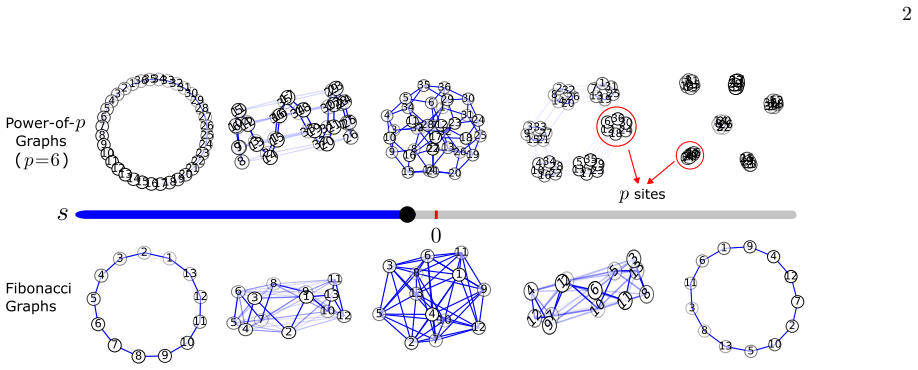
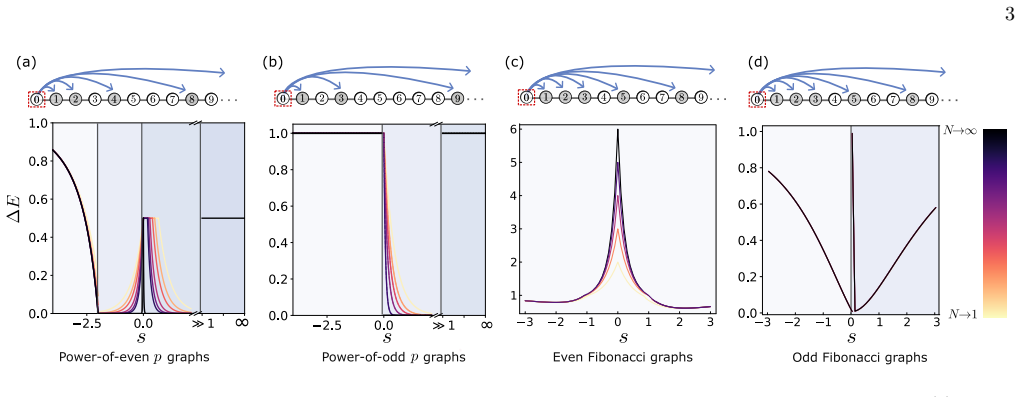
Across power-of-p and Fibonacci graphs, phase structure and criticality are governed by the same effective-geometry principle. Even values of p produce rich phase diagrams inherited from the power-of-two model, while odd values are dominated by geometric frustration; Fibonacci graphs lack discrete self-similarity yet map short-range to long-range limits directly through their connectivity.
What carries the argument
The effective-geometry principle that organises phase structure and criticality according to symmetry and frustration in the interaction graph.
If this is right
- Even-p graphs retain the rich phase structure of the power-of-two model.
- Odd-p graphs are governed by geometric frustration that suppresses or reshapes transitions.
- Fibonacci graphs exhibit a direct geometric mapping between short- and long-range limits without discrete self-similarity.
- The same effective-geometry principle organises both phase structure and criticality across the models studied.
Where Pith is reading between the lines
- The principle could be tested by constructing quantum simulators whose interaction graphs are tuned to match the even-p, odd-p, or Fibonacci families.
- If the principle holds more generally, it may allow prediction of ground-state properties for other logarithmically sparse graphs not yet simulated.
- Experimental platforms with tunable long-range couplings could directly map measured critical exponents onto the geometric features identified here.
Load-bearing premise
The specific graphs examined are representative of the broader class of sparse models whose degree grows logarithmically with system size.
What would settle it
Observation of qualitatively different phase behaviour or criticality in another sparse graph with logarithmic degree growth that cannot be accounted for by the same symmetry, frustration, or geometric-mapping rules would falsify the unifying claim.
Figures
read the original abstract
We investigate how interaction geometry shapes the low-energy phases of sparse tunable long-range quantum models. We focus on a class of graphs whose degree grows logarithmically with system size, and show how symmetry and frustration in graph connectivity can drive, suppress, and reshape ground-state phase transitions. The central examples are power-of-$p$ graphs, where even and odd values of $p$ exhibit qualitatively distinct behaviour: even-$p$ graphs inherit the rich phase structure of the power-of-two model, while odd-$p$ graphs are governed by geometric frustration. Fibonacci graphs provide a contrasting case, lacking the discrete self-similarity of the power-of-$p$ family but exhibiting a direct geometric mapping between the short- and long-range limits. Across our models, we find that phase structure and criticality are governed by the same effective-geometry principle, unifying our framework for experimentally motivated long-range quantum systems.
Editorial analysis
A structured set of objections, weighed in public.
Referee Report
Summary. The manuscript investigates how interaction geometry shapes low-energy phases in sparse tunable long-range quantum models on graphs whose degree grows logarithmically with system size. Central examples are power-of-p graphs (even p inherits rich phase structure from the power-of-two case; odd p is governed by geometric frustration) and Fibonacci graphs (lacking discrete self-similarity but possessing a direct short-to-long-range geometric mapping). The paper concludes that phase structure and criticality are controlled by a single effective-geometry principle that unifies the framework for experimentally motivated long-range systems.
Significance. If the effective-geometry principle is shown to control criticality and the examined graphs are representative, the work would supply a unifying lens for classifying ground states in sparse long-range quantum models, with direct relevance to experimental platforms that realize tunable long-range interactions.
major comments (1)
- [Abstract] Abstract (final sentence): the claim that 'phase structure and criticality are governed by the same effective-geometry principle, unifying our framework' is load-bearing on the assumption that the specific graphs (power-of-p even/odd p, Fibonacci) are representative of the broader class of logarithmically sparse graphs. No argument, additional examples, or mapping to other members of the class is supplied to justify the extrapolation from the reported cases.
Simulated Author's Rebuttal
We thank the referee for the detailed report and the opportunity to clarify the scope of our claims. The single major comment concerns the generality of the effective-geometry principle. We address it directly below and will revise the manuscript accordingly.
read point-by-point responses
-
Referee: [Abstract] Abstract (final sentence): the claim that 'phase structure and criticality are governed by the same effective-geometry principle, unifying our framework' is load-bearing on the assumption that the specific graphs (power-of-p even/odd p, Fibonacci) are representative of the broader class of logarithmically sparse graphs. No argument, additional examples, or mapping to other members of the class is supplied to justify the extrapolation from the reported cases.
Authors: We agree that the abstract statement would benefit from explicit support for generality. The power-of-p (even/odd) and Fibonacci graphs were deliberately chosen as representative archetypes within the logarithmically sparse class: even-p cases preserve the hierarchical symmetry of the p=2 model, odd-p cases introduce geometric frustration, and Fibonacci graphs remove discrete self-similarity while retaining a direct short-to-long-range geometric correspondence. The effective-geometry principle itself is formulated in terms of the shared logarithmic degree growth and the resulting distribution of interaction ranges, which is the defining property of the class. Nevertheless, the manuscript does not contain an explicit mapping to additional members (e.g., random recursive graphs or other non-deterministic constructions). We will therefore add a short subsection in the Discussion that (i) states the minimal conditions on the degree sequence required for the principle to apply and (ii) sketches how the same geometric classification extends to two further logarithmically sparse families. The abstract sentence will be softened to reflect that the principle unifies the examined cases and is expected to apply more broadly under those conditions. These changes constitute a targeted major revision. revision: yes
Circularity Check
No circularity in derivation chain
full rationale
The paper reports numerical and analytical results on phase structure for explicitly enumerated graph families (power-of-p with even/odd p, Fibonacci). No equations are presented that define a quantity in terms of itself, no fitted parameters are relabeled as predictions, and the central effective-geometry principle is stated as an observed pattern across the studied cases rather than derived by reducing to prior self-citations or ansatzes. The representativeness concern raised in the skeptic note is an external-validity issue, not a circularity reduction. The derivation chain is therefore self-contained against the reported models.
Axiom & Free-Parameter Ledger
Reference graph
Works this paper leans on
-
[1]
Classical limitB=0 We start by exploring the transverse-field Ising model on the power-of-pgraph in the limitB=0 and antiferro- magnetic couplingsJ>0 in Eq.(3). As in [23], the classi- cal phase diagrams are determined numerically using ex- act diagonalization for small system sizes, Monte Carlo methods for larger systems, and analytical proofs that acces...
-
[2]
(3) to determine how a transverse field will modify the phases established above
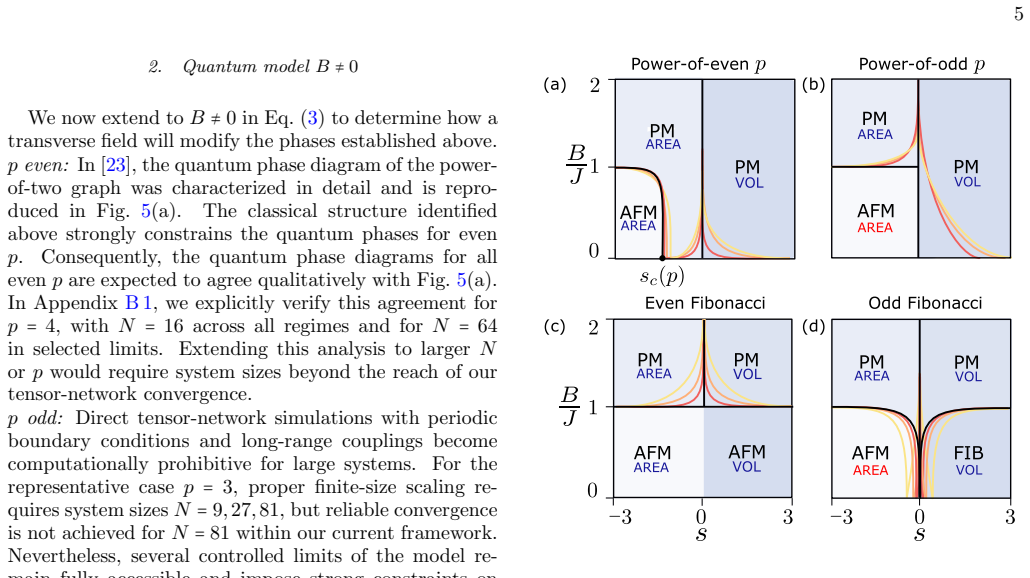
Quantum modelB≠0 We now extend toB≠0 in Eq. (3) to determine how a transverse field will modify the phases established above. peven:In [23], the quantum phase diagram of the power- of-two graph was characterized in detail and is repro- duced in Fig. 5(a). The classical structure identified above strongly constrains the quantum phases for even p. Consequen...
-
[3]
Fibonacci AFM
Classical limitB=0 Fors≪0, the exact ground state is the N´ eel antifer- romagnetic configurationS j =(−1)j,which identically satisfies the nearest-neighbour conditionS j+1 =−Sj. We must establish whether this state remains energetically optimal once other bondsd∈D fib are introduced. If the antiferromagnetic pattern is preserved across bonds of distanced...
-
[4]
As in the classical analysis, understanding the structure of the ground-state manifold and the ef- fective interaction geometry is essential for interpreting the quantum behaviour
Quantum modelB≠0 We now introduce quantum fluctuations into the Fi- bonacci model for system sizesNthat are Fibonacci numbers. As in the classical analysis, understanding the structure of the ground-state manifold and the ef- fective interaction geometry is essential for interpreting the quantum behaviour. To this end, we employ the three techniques intro...
-
[5]
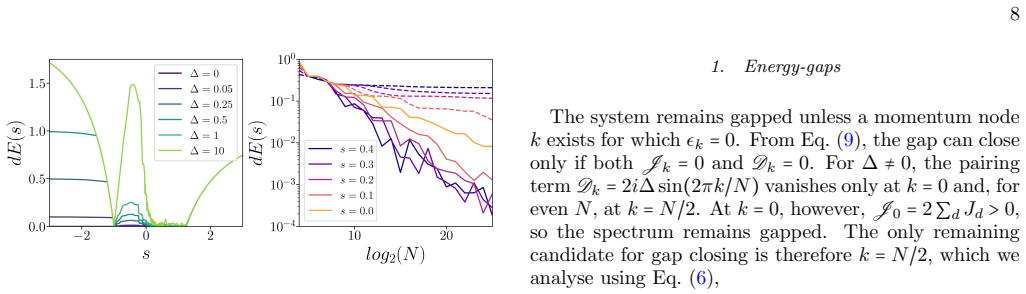
Energy-gaps The system remains gapped unless a momentum node kexists for whichϵ k =0. From Eq. (9), the gap can close only if bothJ k =0 andD k =0. For ∆≠0, the pairing termD k =2i∆ sin(2πk/N)vanishes only atk=0 and, for evenN, atk=N/2. Atk=0, however,J 0 =2 ∑d Jd >0, so the spectrum remains gapped. The only remaining candidate for gap closing is therefor...
-
[6]
For negatives, the density-density correlations exhibit the fa- miliar short-range behaviour, decaying rapidly with dis- tance around the ring geometry
Ground-state correlations To probe the robustness of the fermionic ground state to deviations from the special system sizesN=2 l, we examine density-density correlations, which provide a di- rect measure of how changes in the underlying graph ge- ometry are reflected in the ground-state structure. For negatives, the density-density correlations exhibit th...
-
[7]
Importantly, the furthest-neighbour bonds form closed loops of lengthp
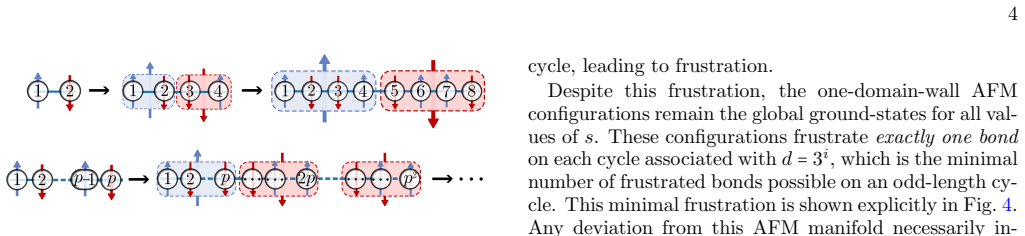
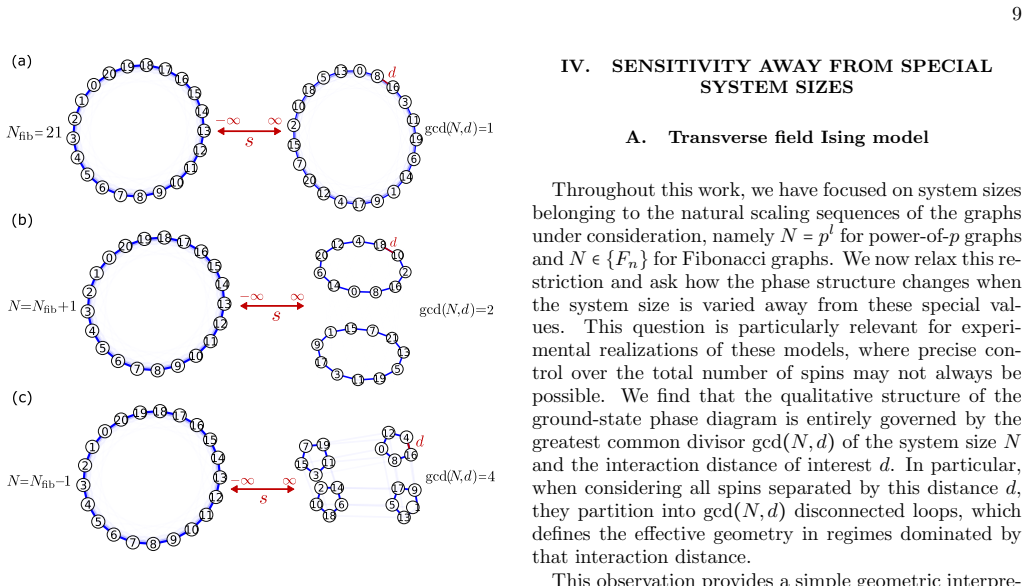
Evenp All of the scaling and criticality arguments presented in [23] for the power-of-two classical phase diagram carry over verbatim to the power-of-pfamily upon the replacement 2→p. Importantly, the furthest-neighbour bonds form closed loops of lengthp. In the main text we clarified that the ground-state fors→0 −ands≥0 will be the recursive ground-state...
-
[8]
We consider our classical Ising Hamiltonian Eq
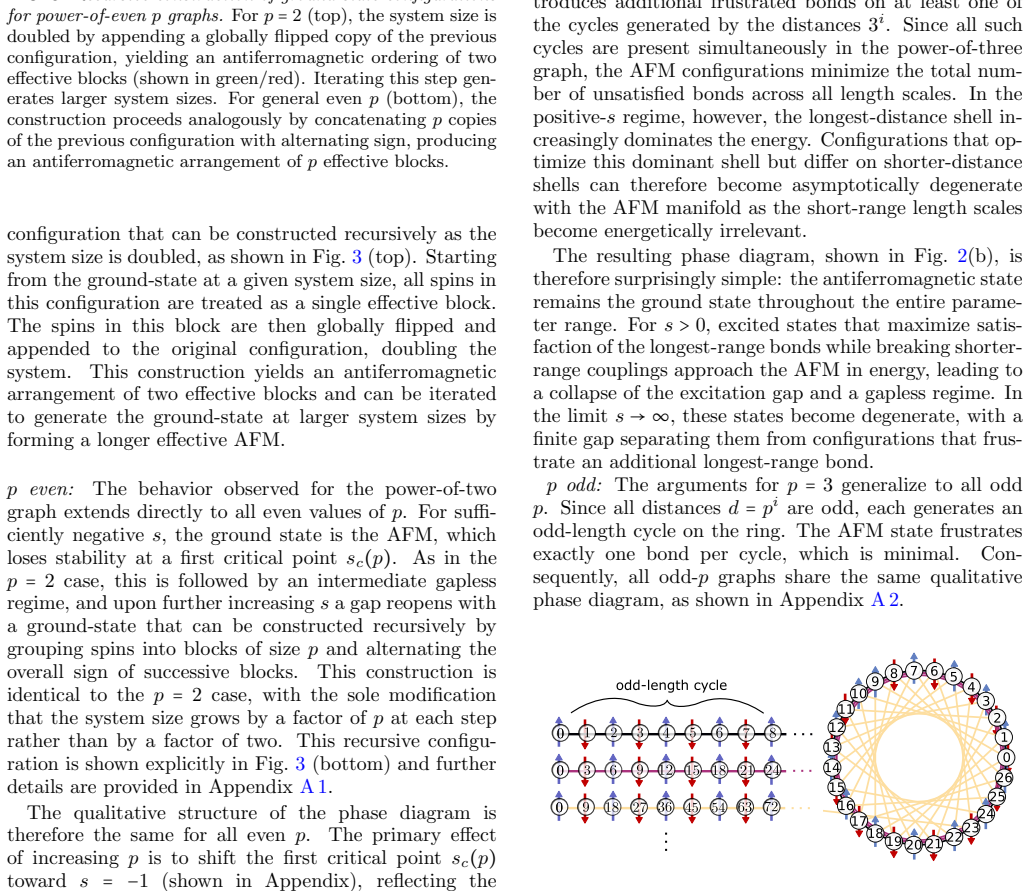
Oddp Here we show that all odd-ppower-of-pgraphs share the same qualitative classical phase diagram as thep=3 case. We consider our classical Ising Hamiltonian Eq. (3) forB=0. For any allowed distanced=p m, the bonds(i, i+d)decompose the ring into gcd(N, d)=d(S12) disconnected cycles, each of length ℓd = N d =p L−m,(S13) which is odd sincepis odd. On an o...
-
[9]
Monte Carlo Results for Fibonacci Phase Diagrams As the model is classical, we can simulate much larger system sizes than are accessible to exact diagonalization by using Markov-chain Monte Carlo [68, 69]. a. Metropolis Algorithm.The algorithm works by setting an initial random configuration of up and down spins. An attempt is made to flip each spin in th...
-
[10]
Forp=4, system sizes scale asN=16,64,
Evenp Numerical corroboration for thep=2 graph can be found in the Supplemental Material of [23]. Forp=4, system sizes scale asN=16,64, . . ., such that only one system size is accessible in all regimes to both exact diagonalization (ED) and density matrix renormalization group (DMRG) methods. ForN=64 we only find convergence in the solvable limits. In Fi...
-
[11]
Results are corroborated with our SKQD method for the regimeB≪1
Oddp We use density matrix renormalization group (DMRG) and matrix product states (MPS) to access ground-state properties for system sizes beyond the reach of exact diagonalization (e.g.N=27,81). Results are corroborated with our SKQD method for the regimeB≪1. A schematic of the quantum phase diagram forp=3 is shown in Fig. 5(b) and corroborated in Fig. S...
-
[12]
OddN Numerical corroboration for the Fibonacci graphs is shown in Fig
Fibonacci graphs a. OddN Numerical corroboration for the Fibonacci graphs is shown in Fig. S5 for odd system sizesN fib =13,21,55. Panel (a) shows the regime of weak quantum fluctuations, where SKQD methods allow access to system sizes up toN=55, beyond the reach of reliable MPS convergence. In this regime, a single phase transition is observed ats=0, fro...
-
[13]
PWR3 Energy gap Fors<0, the spectral gap remains finite and well converged with increasing system size, consistent with the analytic prediction that the quasiparticle spectrum remains gapped. By contrast, fors>0 the minimum gap decreases systematically with system size over an extended range of positives, indicating a gapless thermodynamic regime 7 despit...
-
[14]
Sensitivity away from special system sizes for fermionic hopping model a. Ground-state correlations To assess the robustness of the fermionic ground state to variations in system size away from the special values N=2 q, we analyse the density-density correlation function. As a ground-state observable, it provides a direct probe of the effective geometry i...
-
[15]
J. W. Britton, B. C. Sawyer, A. C. Keith, C.-C. J. Wang, J. K. Freericks, H. Uys, M. J. Biercuk, and J. J. Bollinger, Nature484, 489 (2012)
2012
-
[16]
Islamet al., Science340, 583 (2013)
R. Islamet al., Science340, 583 (2013)
2013
-
[17]
Zeiher, J.-y
J. Zeiher, J.-y. Choi, A. Rubio-Abadal, T. Pohl, R. van Bijnen, I. Bloch, and C. Gross, Phys. Rev. X7, 041063 (2017). 9
2017
-
[18]
V. D. Vaidya, Y. Guo, R. M. Kroeze, K. E. Ballantine, A. J. Koll´ ar, J. Keeling, and B. L. Lev, Phys. Rev. X8, 011002 (2018)
2018
-
[19]
Hollerith, K
S. Hollerith, K. Srakaew, D. Wei, A. Rubio-Abadal, D. Adler, P. Weckesser, A. Kruckenhauser, V. Walther, R. van Bijnen, J. Rui, C. Gross, I. Bloch, and J. Zeiher, Phys. Rev. Lett.128, 113602 (2022)
2022
-
[20]
Dutta and J
A. Dutta and J. K. Bhattacharjee, Phys. Rev. B64, 184106 (2001)
2001
-
[21]
Koffel, M
T. Koffel, M. Lewenstein, and L. Tagliacozzo, Phys. Rev. Lett.109, 267203 (2012)
2012
-
[22]
Schachenmayer, B
J. Schachenmayer, B. P. Lanyon, C. F. Roos, and A. J. Daley, Phys. Rev. X3, 031015 (2013)
2013
-
[23]
Vodola, L
D. Vodola, L. Lepori, E. Ercolessi, A. V. Gorshkov, and G. Pupillo, Phys. Rev. Lett.113, 156402 (2014)
2014
-
[24]
Defenu, A
N. Defenu, A. Trombettoni, and S. Ruffo, Phys. Rev. B96, 104432 (2017)
2017
-
[25]
Bentsen, T
G. Bentsen, T. Hashizume, A. S. Buyskikh, E. J. Davis, A. J. Daley, S. S. Gubser, and M. Schleier-Smith, Phys. Rev. Lett. 123, 130601 (2019)
2019
-
[26]
C.-L. Hung, A. Gonz´ alez-Tudela, J. I. Cirac, and H. J. Kimble, Proceedings of the National Academy of Sciences113, 10.1073/pnas.1603777113 (2016)
-
[27]
Bentsen, Y
G. Bentsen, Y. Gu, and A. Lucas, Proceedings of the National Academy of Sciences116, 6689–6694 (2019)
2019
-
[28]
Z. Qin, M. Gessner, Z. Ren, X. Deng, D. Han, W. Li, X. Su, A. Smerzi, and K. Peng, npj Quantum Information5, 3 (2019)
2019
-
[29]
Periwal, E
A. Periwal, E. S. Cooper, P. Kunkel, M. Lawrence, S. Giovanazzi, and J. Schmiedmayer, Nature600, 630 (2021)
2021
-
[30]
Mivehvar, F
F. Mivehvar, F. Piazza, T. Donner, and H. Ritsch, Advances in Physics70, 1–153 (2021)
2021
-
[31]
Bluvstein, H
D. Bluvstein, H. Levine, G. Semeghini, T. T. Wang, S. Ebadi, M. Kalinowski, A. Keesling, N. Maskara, H. Pichler, M. Greiner, V. Vuleti´ c, and M. D. Lukin, Nature604, 451–456 (2022)
2022
-
[32]
T. M. Graham, M. Kwon, B. Grinkemeyer, A. Marra, X. Jiang, M. Lichtman, Y. Sun, M. Ebert, S. Gilbert, D. Bowman, M. O. Brown, L. Anderegg, D. DeMille, I. B. Spielman, J. V. Porto, M. S. Safronova, and C. Monroe, Physical Review Letters128, 113602 (2022)
2022
-
[33]
Bluvstein, S
D. Bluvstein, S. J. Evered, A. A. Geim, S. H. Li, H. Zhou, T. Manovitz, S. Ebadi, M. Cain, M. Kalinowski, D. Hangleiter, J. P. Bonilla Ataides, N. Maskara, I. Cong, X. Gao, P. Sales Rodriguez, T. Karolyshyn, G. Semeghini, M. J. Gullans, M. Greiner, V. Vuleti´ c, and M. D. Lukin, Nature626, 58–65 (2023)
2023
-
[34]
Evered, D
S. Evered, D. Bluvstein, M. Kalinowski,et al., Nature622, 268 (2023)
2023
-
[35]
Q. X. et al., Nature Physics20, 1084 (2024)
2024
-
[36]
Bernien, S
H. Bernien, S. Schwartz, A. Keesling, H. Levine, A. Omran, H. Pichler, S. Choi, A. S. Zibrov, M. Endres, M. Greiner, V. Vuleti´ c, and M. D. Lukin, Nature551, 579 (2017)
2017
-
[37]
A. Gunning, A. Deger, S. Kuriyattil, and A. J. Daley, Geometry-driven transitions in sparse long-range spin models with cold atoms (2025), arXiv:2512.08709 [quant-ph]
arXiv 2025
-
[38]
Hashizume, S
T. Hashizume, S. Kuriyattil, A. J. Daley, and G. Bentsen, Symmetry14, 666 (2022)
2022
-
[39]
Kuriyattil, T
S. Kuriyattil, T. Hashizume, G. Bentsen, and A. J. Daley, PRX Quantum4, 030325 (2023)
2023
-
[40]
Kuriyattil, P
S. Kuriyattil, P. M. Poggi, J. D. Pritchard, J. Kombe, and A. J. Daley, Phys. Rev. Lett.134, 240801 (2025)
2025
-
[41]
Hashizume, G
T. Hashizume, G. S. Bentsen, S. Weber, and A. J. Daley, Phys. Rev. Lett.126, 200603 (2021)
2021
-
[42]
K. Singh and S. Choudhury, Non-equilibrium dynamics of the disordered power of two model (2026), arXiv:2603.04220 [cond-mat.dis-nn]
arXiv 2026
-
[43]
S. R. White and A. E. Feiguin, Phys. Rev. Lett.93, 076401 (2004)
2004
-
[44]
A. J. Daley, C. Kollath, U. Schollw¨ ock, and G. Vidal, Journal of Statistical Mechanics: Theory and Experiment2004, P04005 (2004)
2004
-
[45]
Schollw¨ ock, Annals of Physics326, 96–192 (2011)
U. Schollw¨ ock, Annals of Physics326, 96–192 (2011)
2011
-
[47]
Fishman, S
M. Fishman, S. R. White, and E. M. Stoudenmire, SciPost Phys. Codebases , 4 (2022)
2022
-
[48]
K. Kanno, M. Kohda, R. Imai, S. Koh, K. Mitarai, W. Mizukami, and Y. O. Nakagawa, Quantum-selected configuration interaction: classical diagonalization of hamiltonians in subspaces selected by quantum computers (2023), arXiv:2302.11320 [quant-ph]
Pith/arXiv arXiv 2023
-
[49]
J. Robledo-Moreno, M. Motta, H. Haas, A. Javadi-Abhari, P. Jurcevic, W. Kirby, S. Martiel, K. Sharma, S. Sharma, T. Shirakawa, I. Sitdikov, R.-Y. Sun, K. J. Sung, M. Takita, M. C. Tran, S. Yunoki, and A. Mezzacapo, Science Advances 11, 10.1126/sciadv.adu9991 (2025)
-
[50]
D. Kaliakin, A. Shajan, J. R. Moreno, Z. Li, A. Mitra, M. Motta, C. Johnson, A. A. Saki, S. Das, I. Sitdikov, A. Mezzacapo, and K. M. M. Jr, Accurate quantum-centric simulations of supramolecular interactions (2024), arXiv:2410.09209 [quant-ph]
arXiv 2024
-
[51]
Barison, J
S. Barison, J. Robledo Moreno, and M. Motta, Quantum Science and Technology10, 025034 (2025)
2025
-
[52]
I. Liepuoniute, K. D. Doney, J. Robledo-Moreno, J. A. Job, W. S. Friend, and G. O. Jones, Quantum-centric study of methylene singlet and triplet states (2024), arXiv:2411.04827 [quant-ph]
arXiv 2024
-
[53]
A. Shajan, D. Kaliakin, A. Mitra, J. R. Moreno, Z. Li, M. Motta, C. Johnson, A. A. Saki, S. Das, I. Sitdikov, A. Mezzacapo, and K. M. M. Jr, Towards quantum-centric simulations of extended molecules: sample-based quantum diagonalization enhanced with density matrix embedding theory (2024), arXiv:2411.09861 [quant-ph]
arXiv 2024
-
[54]
R. M. Parrish and P. L. McMahon, Quantum filter diagonalization: Quantum eigendecomposition without full quantum phase estimation (2019), arXiv:1909.08925 [quant-ph]
arXiv 2019
-
[55]
Motta, C
M. Motta, C. Sun, A. T. K. Tan, M. J. O’Rourke, E. Ye, A. J. Minnich, F. G. S. L. Brand˜ ao, and G. K.-L. Chan, Nature Physics16, 205–210 (2019)
2019
-
[56]
N. H. Stair, R. Huang, and F. A. Evangelista, Journal of Chemical Theory and Computation16, 2236 (2020)
2020
-
[57]
Urbanek, D
M. Urbanek, D. Camps, R. Van Beeumen, and W. A. de Jong, Journal of Chemical Theory and Computation16, 5425 10 (2020)
2020
-
[58]
J. Cohn, M. Motta, and R. M. Parrish, PRX Quantum2, 040352 (2021)
2021
-
[59]
Seki and S
K. Seki and S. Yunoki, PRX Quantum2, 010333 (2021)
2021
-
[60]
T. E. Baker, Physical Review A110, 012420 (2024)
2024
-
[61]
T. E. Baker, Physical Review A103, 032404 (2021)
2021
-
[62]
Klymko, C
K. Klymko, C. Mejuto-Zaera, S. J. Cotton, F. Wudarski, M. Urbanek, D. Hait, M. Head-Gordon, K. B. Whaley, J. Moussa, N. Wiebe, W. A. de Jong, and N. M. Tubman, PRX Quantum3, 020323 (2022)
2022
- [63]
-
[64]
G. Lee, D. Lee, and J. Huh, Quantum8, 1477 (2024)
2024
-
[65]
Kirby, Quantum8, 1457 (2024)
W. Kirby, Quantum8, 1457 (2024)
2024
-
[66]
Kirby, M
W. Kirby, M. Motta, and A. Mezzacapo, Quantum7, 1018 (2023)
2023
-
[67]
Y. Shen, K. Klymko, J. Sud, D. B. Williams-Young, W. A. de Jong, and N. M. Tubman, Quantum7, 1066 (2023)
2023
-
[68]
N. V. Tkachenko, L. Cincio, A. I. Boldyrev, S. Tretiak, P. A. Dub, and Y. Zhang, Quantum Science and Technology9, 035012 (2024)
2024
-
[69]
E. N. Epperly, L. Lin, and Y. Nakatsukasa, SIAM Journal on Matrix Analysis and Applications43, 1263 (2022)
2022
-
[70]
N. Yoshioka, M. Amico, W. Kirby, P. Jurcevic, A. Dutt, B. Fuller, S. Garion, H. Haas, I. Hamamura, A. Ivrii, R. Majumdar, Z. Minev, M. Motta, B. Pokharel, P. Rivero, K. Sharma, C. J. Wood, A. Javadi-Abhari, and A. Mezzacapo, Nature Communications16, 10.1038/s41467-025-59716-z (2025)
-
[71]
J. Yu, J. R. Moreno, J. T. Iosue, L. Bertels, D. Claudino, B. Fuller, P. Groszkowski, T. S. Humble, P. Jurcevic, W. Kirby, T. A. Maier, M. Motta, B. Pokharel, A. Seif, A. Shehata, K. J. Sung, M. C. Tran, V. Tripathi, A. Mezzacapo, and K. Sharma, Quantum-centric algorithm for sample-based krylov diagonalization (2025), arXiv:2501.09702 [quant-ph]
arXiv 2025
-
[73]
M. Asaduzzaman, S. Catterall, J. Hubisz, R. Nelson, and J. Unmuth-Yockey, Physical Review D106, 10.1103/phys- revd.106.054506 (2022)
-
[74]
N. P. Breuckmann, B. Placke, and A. Roy, Physical Review E101, 10.1103/physreve.101.022124 (2020)
-
[75]
Okunishi and T
K. Okunishi and T. Nishino, Progress of Theoretical and Experimental Physics2024, 093A02 (2024), https://academic.oup.com/ptep/article-pdf/2024/9/093A02/59180748/ptae137.pdf
2024
-
[76]
A. Jahn, Z. Zimbor´ as, and J. Eisert, Quantum6, 643 (2022)
2022
-
[77]
A. Jahn, M. Gluza, F. Pastawski, and J. Eisert, Holography and criticality in matchgate tensor networks (2018), arXiv:1711.03109 [quant-ph]
arXiv 2018
-
[78]
Sahay, M
R. Sahay, M. D. Lukin, and J. Cotler, Phys. Rev. X15, 021078 (2025)
2025
-
[79]
S. S. Gubser, J. Knaute, S. Parikh, A. Samberg, and P. Witaszczyk, Communications in Mathematical Physics352, 1019–1059 (2017)
2017
-
[80]
M. Heydeman, M. Marcolli, I. Saberi, and B. Stoica, Tensor networks,p-adic fields, and algebraic curves: arithmetic and the ads3/cft2 correspondence (2017), arXiv:1605.07639 [hep-th]
Pith/arXiv arXiv 2017
-
[81]
http://dx.doi.org/xxx/xxx. (2026)
2026
-
[82]
Krauth,Statistical mechanics: algorithms and computations, Vol
W. Krauth,Statistical mechanics: algorithms and computations, Vol. 13 (OUP Oxford, 2006)
2006
discussion (0)
Sign in with ORCID, Apple, or X to comment. Anyone can read and Pith papers without signing in.