On the Redundancy of Timestep Embeddings in Diffusion Models
Pith reviewed 2026-06-26 18:07 UTC · model grok-4.3
The pith
Diffusion models can reach the global minimum of their training objective without explicit timestep conditioning.
A machine-rendered reading of the paper's core claim, the machinery that carries it, and where it could break.
Core claim
The global minimizer of the diffusion training objective can be achieved without explicit timestep conditioning. Time-agnostic models maintain high structural fidelity and can surpass their conditioned counterparts in FID, precision, and recall. The architectures can implicitly infer noise scales from the corrupted input under specific assumptions, rendering explicit temporal conditioning redundant.
What carries the argument
Implicit inference of noise scales from the corrupted input inside U-Net and Diffusion Transformer architectures
If this is right
- Time-agnostic models reach the global minimizer of the diffusion objective
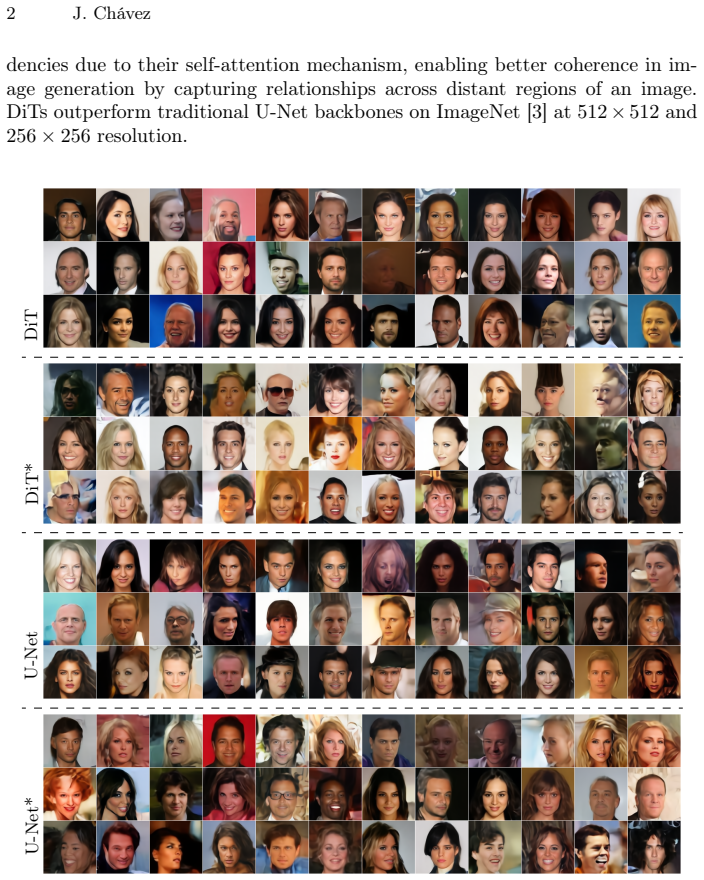
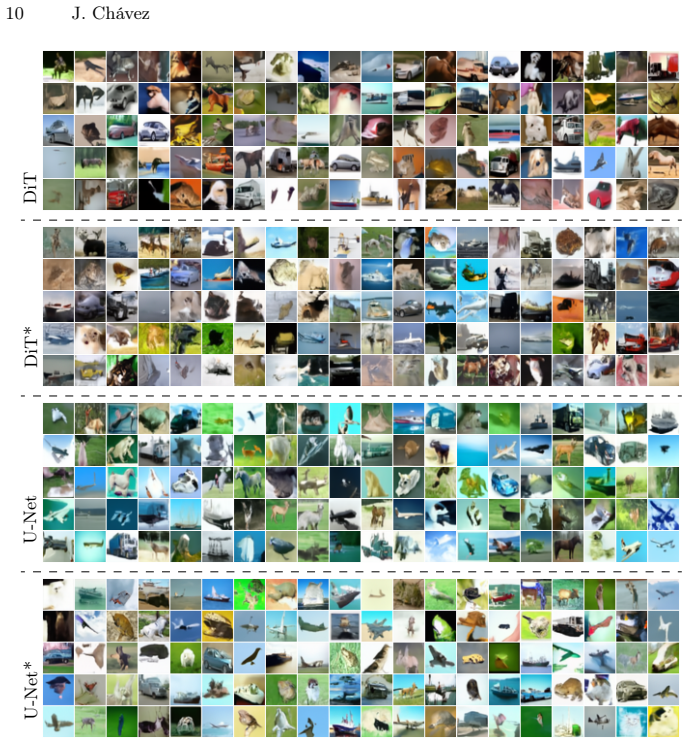
- These models preserve high structural fidelity on CelebA and CIFAR-10
- They match or exceed conditioned models on FID, precision, and recall
- Explicit timestep embeddings are redundant under the paper's stated conditions
Where Pith is reading between the lines
- Architectures could be simplified by dropping the timestep embedding layers and their associated parameters
- The same implicit-inference mechanism might apply to other conditional signals used in generative models
- Testing on higher-resolution or more diverse datasets would reveal whether the redundancy persists outside the two small benchmarks examined
Load-bearing premise
The architectures can implicitly infer noise scales from the corrupted input under specific assumptions.
What would settle it
A controlled experiment in which all noise scales produce statistically identical corrupted inputs, so that no information about the scale remains in the data; if the time-agnostic model then fails to reach the same objective value as the conditioned model, the claim is falsified.
Figures
read the original abstract
Diffusion models rely heavily on explicit timestep embeddings to modulate the denoising process across various noise scales. In this work, we challenge the necessity of these temporal signals by analyzing their impact on U-Net and Diffusion Transformer architectures. Beyond empirical evidence, we provide a theoretical framework demonstrating that, under certain conditions, the global minimizer of the diffusion training objective can be achieved without explicit timestep conditioning. Our findings reveal a surprising robustness when timestep embeddings are completely removed. Extensive ablation studies on the CelebA and CIFAR-10 datasets show that these time-agnostic models can maintain high structural fidelity and even surpass their conditioned counterparts in competitive metrics, including FID, precision, and recall. Our analysis suggests these architectures can implicitly infer noise scales from the corrupted input under specific assumptions, rendering explicit temporal conditioning redundant. This study challenges long-standing temporal conditioning paradigms and paves the way for more efficient and structurally focused generative architectures.
Editorial analysis
A structured set of objections, weighed in public.
Referee Report
Summary. The paper claims that timestep embeddings are redundant in diffusion models. Under certain (unstated) conditions, U-Net and Diffusion Transformer architectures can implicitly recover noise scales from the corrupted input x_t alone, allowing the global minimizer of the diffusion training objective to be reached without explicit timestep conditioning. Extensive ablations on CelebA and CIFAR-10 are said to show that time-agnostic models maintain structural fidelity and can exceed conditioned baselines on FID, precision, and recall.
Significance. If the conditions can be made explicit and the empirical results hold under standard diffusion objectives and architectures, the result would be significant: it would demonstrate that a core design choice in modern diffusion models is unnecessary, potentially enabling simpler, more efficient generative networks focused on spatial structure rather than temporal modulation.
major comments (2)
- [Abstract / theoretical framework] Abstract (theoretical framework paragraph): the central claim that 'the global minimizer of the diffusion training objective can be achieved without explicit timestep conditioning' rests on 'specific assumptions' that are never stated. Without an explicit list of those assumptions (e.g., conditions on the forward-process variance schedule being uniquely recoverable from marginal moments of x_t, or the function class being closed under the required modulation), it is impossible to determine whether the mathematical statement applies to the standard simplified loss or only to a specially constructed objective.
- [Abstract / ablation studies] Abstract (empirical results paragraph): the claim that time-agnostic models 'can surpass their conditioned counterparts' is presented without any quantitative numbers, architecture details, training hyperparameters, or statistical significance tests. This prevents verification of whether the reported improvements reflect a true global-minimizer property or merely competitive local minima on the two small datasets.
minor comments (1)
- The abstract would be clearer if it briefly enumerated the key assumptions in one sentence rather than deferring entirely to an unelaborated 'theoretical framework.'
Simulated Author's Rebuttal
We thank the referee for the constructive feedback. We agree that the assumptions should be made explicit and that the abstract would benefit from quantitative results. We respond to each major comment below.
read point-by-point responses
-
Referee: [Abstract / theoretical framework] Abstract (theoretical framework paragraph): the central claim that 'the global minimizer of the diffusion training objective can be achieved without explicit timestep conditioning' rests on 'specific assumptions' that are never stated. Without an explicit list of those assumptions (e.g., conditions on the forward-process variance schedule being uniquely recoverable from marginal moments of x_t, or the function class being closed under the required modulation), it is impossible to determine whether the mathematical statement applies to the standard simplified loss or only to a specially constructed objective.
Authors: The referee correctly identifies that the assumptions are not listed explicitly. Our theoretical analysis assumes that the variance schedule allows unique recovery of the noise scale from the moments of x_t and that the network architecture can learn the implicit time-dependent modulation. We will revise the abstract and add a new section detailing these assumptions, confirming that the result holds for the standard simplified objective under these conditions. revision: yes
-
Referee: [Abstract / ablation studies] Abstract (empirical results paragraph): the claim that time-agnostic models 'can surpass their conditioned counterparts' is presented without any quantitative numbers, architecture details, training hyperparameters, or statistical significance tests. This prevents verification of whether the reported improvements reflect a true global-minimizer property or merely competitive local minima on the two small datasets.
Authors: We agree that the abstract lacks specific numbers. The main text provides detailed ablations with FID, precision, and recall values demonstrating that time-agnostic models match or exceed conditioned baselines on CelebA and CIFAR-10. In the revision, we will incorporate key quantitative results into the abstract (e.g., FID improvements) and note that results were obtained with standard architectures and hyperparameters detailed in the paper. While we did not conduct formal statistical significance tests, the trends were consistent across runs. revision: partial
Circularity Check
No circularity; theoretical claim and empirical results presented as independent of fitted inputs or self-citations
full rationale
The provided abstract and description outline a theoretical framework showing that under certain conditions the global minimizer of the diffusion objective can be reached without timestep conditioning, with architectures implicitly inferring noise scales. No equations, self-citations, or derivations are quoted that reduce a prediction to a fitted parameter by construction, nor any uniqueness theorem imported from the authors' prior work. The central claim is framed as an analysis of U-Net/DiT behavior under stated assumptions, with ablations on CelebA/CIFAR-10 serving as external validation rather than a renaming or self-referential fit. This is the normal case of a self-contained paper against external benchmarks.
Axiom & Free-Parameter Ledger
axioms (1)
- domain assumption Architectures can implicitly infer noise scales from corrupted inputs under specific (unstated) assumptions
Reference graph
Works this paper leans on
-
[1]
In: Proceedings of the 27th International Conference on Neural Information Processing Systems - Volume 1
Bengio, Y., Yao, L., Alain, G., Vincent, P.: Generalized denoising auto-encoders as generative models. In: Proceedings of the 27th International Conference on Neural Information Processing Systems - Volume 1. p. 899–907. NIPS’13, Curran Associates Inc., Red Hook, NY, USA (2013) On the Redundancy of Timestep Embeddings in Diffusion Models 15
2013
-
[2]
In: Proceedings of the IEEE/CVF Conference on Computer Vision and Pattern Recognition (CVPR)
Blattmann, A., Rombach, R., Ling, H., Dockhorn, T., Kim, S.W., Fidler, S., Kreis, K.: Align your latents: High-resolution video synthesis with latent diffusion models. In: Proceedings of the IEEE/CVF Conference on Computer Vision and Pattern Recognition (CVPR). pp. 22563–22575 (June 2023)
2023
-
[3]
In: 2009 IEEE Conference on Computer Vision and Show Me Examples 17 Pattern Recognition
Deng, J., Dong, W., Socher, R., Li, L.J., Li, K., Fei-Fei, L.: Imagenet: A large-scale hierarchical image database. In: 2009 IEEE Conference on Computer Vision and Pattern Recognition. pp. 248–255 (2009).https://doi.org/10.1109/CVPR.2009. 5206848
-
[4]
In: In- ternational Conference on Learning Representations (2021),https://openreview
Dosovitskiy, A., Beyer, L., Kolesnikov, A., Weissenborn, D., Zhai, X., Unterthiner, T., Dehghani, M., Minderer, M., Heigold, G., Gelly, S., Uszkoreit, J., Houlsby, N.: An image is worth 16x16 words: Transformers for image recognition at scale. In: In- ternational Conference on Learning Representations (2021),https://openreview. net/forum?id=YicbFdNTTy
2021
-
[5]
In: Proceed- ings of the 31st International Conference on Neural Information Processing Sys- tems
Heusel,M.,Ramsauer,H.,Unterthiner,T.,Nessler,B.,Hochreiter,S.:Ganstrained by a two time-scale update rule converge to a local nash equilibrium. In: Proceed- ings of the 31st International Conference on Neural Information Processing Sys- tems. p. 6629–6640. NIPS’17, Curran Associates Inc., Red Hook, NY, USA (2017)
2017
-
[6]
(eds.) Advances in Neu- ral Information Processing Systems
Ho,J.,Jain,A.,Abbeel,P.:Denoisingdiffusionprobabilisticmodels.In:Larochelle, H., Ranzato, M., Hadsell, R., Balcan, M., Lin, H. (eds.) Advances in Neu- ral Information Processing Systems. vol. 33, pp. 6840–6851. Curran Associates, Inc. (2020),https://proceedings.neurips.cc/paper_files/paper/2020/file/ 4c5bcfec8584af0d967f1ab10179ca4b-Paper.pdf
2020
-
[7]
In: 2017 IEEE International Conference on Computer Vision (ICCV)
Huang, X., Belongie, S.: Arbitrary style transfer in real-time with adaptive in- stance normalization. In: 2017 IEEE International Conference on Computer Vision (ICCV). pp. 1510–1519 (2017).https://doi.org/10.1109/ICCV.2017.167
-
[8]
Journal of Machine Learning Research6(24), 695–709 (2005),http://jmlr.org/ papers/v6/hyvarinen05a.html
Hyvärinen, A.: Estimation of non-normalized statistical models by score matching. Journal of Machine Learning Research6(24), 695–709 (2005),http://jmlr.org/ papers/v6/hyvarinen05a.html
2005
-
[9]
arXiv preprint arXiv:2602.09639 (2026)
Kadkhodaie, Z., Pooladian, A.A., Chewi, S., Simoncelli, E.: Blind denoising diffu- sion models and the blessings of dimensionality. arXiv preprint arXiv:2602.09639 (2026)
Pith/arXiv arXiv 2026
-
[10]
In: Proceedings of the 36th International Conference on Neural Information Processing Systems
Karras,T.,Aittala,M.,Laine,S.,Aila,T.:Elucidatingthedesignspaceofdiffusion- based generative models. In: Proceedings of the 36th International Conference on Neural Information Processing Systems. NIPS ’22, Curran Associates Inc., Red Hook, NY, USA (2022)
2022
-
[11]
In: 2019 IEEE/CVF Conference on Computer Vision and Pattern Recognition (CVPR)
Karras, T., Laine, S., Aila, T.: A style-based generator architecture for generative adversarial networks. In: 2019 IEEE/CVF Conference on Computer Vision and Pattern Recognition (CVPR). pp. 4396–4405 (2019).https://doi.org/10.1109/ CVPR.2019.00453
arXiv 2019
-
[12]
arXiv preprint arXiv:1312.6114 (2013)
Kingma, D.P., Welling, M.: Auto-encoding variational bayes. arXiv preprint arXiv:1312.6114 (2013)
Pith/arXiv arXiv 2013
-
[13]
In: Wallach, H., Larochelle, H., Beygelzimer, A., d'Alché-Buc, F., Fox, E., Garnett, R
Kynkäänniemi, T., Karras, T., Laine, S., Lehtinen, J., Aila, T.: Improved precision and recall metric for assessing generative models. In: Wallach, H., Larochelle, H., Beygelzimer, A., d'Alché-Buc, F., Fox, E., Garnett, R. (eds.) Ad- vances in Neural Information Processing Systems. vol. 32. Curran Associates, Inc. (2019),https://proceedings.neurips.cc/pap...
2019
-
[14]
In: Proceedings of the IEEE International Conference on Computer Vision (ICCV) (December 2015) 16 J
Liu, Z., Luo, P., Wang, X., Tang, X.: Deep learning face attributes in the wild. In: Proceedings of the IEEE International Conference on Computer Vision (ICCV) (December 2015) 16 J. Chávez
2015
-
[15]
arXiv preprint arXiv:2208.11970 (2022)
Luo, C.: Understanding diffusion models: A unified perspective. arXiv preprint arXiv:2208.11970 (2022)
arXiv 2022
-
[16]
In: International conference on machine learning
Nichol, A.Q., Dhariwal, P.: Improved denoising diffusion probabilistic models. In: International conference on machine learning. pp. 8162–8171. PMLR (2021)
2021
-
[17]
Peebles,W.,Xie,S.:Scalablediffusionmodelswithtransformers.In:Proceedingsof the IEEE/CVF International Conference on Computer Vision (ICCV). pp. 4195– 4205 (October 2023)
2023
-
[18]
12204,doi:10.1609/AAAI.V32I1.12204
Perez, E., Strub, F., de Vries, H., Dumoulin, V., Courville, A.: Film: Visual rea- soning with a general conditioning layer. Proceedings of the AAAI Conference on Artificial Intelligence32(1) (Apr 2018).https://doi.org/10.1609/aaai.v32i1. 11671,https://ojs.aaai.org/index.php/AAAI/article/view/11671
-
[19]
In: Proceedings of the IEEE/CVF Conference on Computer Vision and Pattern Recognition (CVPR)
Rombach, R., Blattmann, A., Lorenz, D., Esser, P., Ommer, B.: High-resolution image synthesis with latent diffusion models. In: Proceedings of the IEEE/CVF Conference on Computer Vision and Pattern Recognition (CVPR). pp. 10684– 10695 (June 2022)
2022
-
[20]
arXiv preprint arXiv:2602.18428 (2026)
Sahraee-Ardakan, M., Delbracio, M., Milanfar, P.: The geometry of noise: Why diffusion models don’t need noise conditioning. arXiv preprint arXiv:2602.18428 (2026)
arXiv 2026
-
[21]
Sauer, A., Lorenz, D., Blattmann, A., Rombach, R.: Adversarial diffusion distilla- tion (2023),https://arxiv.org/abs/2311.17042
arXiv 2023
-
[22]
Sauer, A., Lorenz, D., Blattmann, A., Rombach, R.: Adversarial diffusion distilla- tion. In: Computer Vision – ECCV 2024: 18th European Conference, Milan, Italy, September 29–October 4, 2024, Proceedings, Part LXXXVI. p. 87–103. Springer- Verlag, Berlin, Heidelberg (2024).https://doi.org/10.1007/978-3-031-73016- 0_6,https://doi.org/10.1007/978-3-031-73016-0_6
-
[23]
In: Bach, F., Blei, D
Sohl-Dickstein, J., Weiss, E., Maheswaranathan, N., Ganguli, S.: Deep unsuper- vised learning using nonequilibrium thermodynamics. In: Bach, F., Blei, D. (eds.) Proceedings of the 32nd International Conference on Machine Learning. Proceed- ings of Machine Learning Research, vol. 37, pp. 2256–2265. PMLR, Lille, France (07–09 Jul 2015),https://proceedings.m...
2015
-
[24]
arXiv preprint arXiv:2010.02502 (2020)
Song, J., Meng, C., Ermon, S.: Denoising diffusion implicit models. arXiv preprint arXiv:2010.02502 (2020)
Pith/arXiv arXiv 2010
-
[25]
In: Wallach, H., Larochelle, H., Beygelzimer, A., d'Alché-Buc, F., Fox, E., Garnett, R
Song, Y., Ermon, S.: Generative modeling by estimating gradients of the data distribution. In: Wallach, H., Larochelle, H., Beygelzimer, A., d'Alché-Buc, F., Fox, E., Garnett, R. (eds.) Advances in Neural Information Processing Systems. vol. 32. Curran Associates, Inc. (2019),https://proceedings.neurips.cc/paper_files/ paper/2019/file/3001ef257407d5a371a9...
2019
-
[26]
Sun, Q., Jiang, Z., Zhao, H., He, K.: Is noise conditioning necessary for denoising generative models? arXiv preprint arXiv:2502.13129 (2025)
arXiv 2025
-
[27]
In: The Thirty-eighth Annual Conference on Neural Information Processing Systems (2024),https: //openreview.net/forum?id=gojL67CfS8
Tian, K., Jiang, Y., Yuan, Z., PENG, B., Wang, L.: Visual autoregressive model- ing: Scalable image generation via next-scale prediction. In: The Thirty-eighth Annual Conference on Neural Information Processing Systems (2024),https: //openreview.net/forum?id=gojL67CfS8
2024
-
[28]
Neural Computation23(7), 1661–1674 (2011).https://doi.org/10.1162/NECO_ a_00142
Vincent, P.: A connection between score matching and denoising autoencoders. Neural Computation23(7), 1661–1674 (2011).https://doi.org/10.1162/NECO_ a_00142
-
[29]
Vincent, P., Larochelle, H., Bengio, Y., Manzagol, P.A.: Extracting and composing robust features with denoising autoencoders. In: Proceedings of the 25th Interna- tional Conference on Machine Learning. p. 1096–1103. ICML ’08, Association for On the Redundancy of Timestep Embeddings in Diffusion Models 17 Computing Machinery, New York, NY, USA (2008).http...
-
[30]
In: Proceedings of the IEEE/CVF Conference on Computer Vision and Pattern Recognition (CVPR)
Xiao, S., Wang, Y., Zhou, J., Yuan, H., Xing, X., Yan, R., Li, C., Wang, S., Huang, T., Liu, Z.: Omnigen: Unified image generation. In: Proceedings of the IEEE/CVF Conference on Computer Vision and Pattern Recognition (CVPR). pp. 13294– 13304 (June 2025)
2025
discussion (0)
Sign in with ORCID, Apple, or X to comment. Anyone can read and Pith papers without signing in.