REVIEW 3 major objections 2 minor 45 references
Distributed Quantum Learning over Near-term Devices: Convergence Analysis and Security Design
T0 review · 3 major / 2 minor · reviewed 2026-06-30 · grok-4.3
Pith's one-line read Distributed quantum learning converges under partial participation with an adaptive security layer that reduces execution time by nearly half.
desk verdict The convergence analysis under partial participation and heterogeneous data is the clearer part; the QNN-driven adaptive security claims rest on missing details about the network's own cost and reliability. read the letter →
The pith
A machine-rendered reading of the paper's core claim, the machinery that carries it, and where it could break.
The reading
What carries the argument
The convergence bound for distributed quantum learning under partial participation, non-convex objectives, and heterogeneous data, together with the quantum neural network-driven adaptive mechanism that switches among three post-quantum cryptographic levels.
What would settle it
A physical testbed experiment in which increasing the number of participating devices fails to improve convergence rate in line with the derived bound, or in which the adaptive security mechanism does not reduce execution time by approximately 49 percent while maintaining over 91 percent threat detection accuracy.
Extended reading notes
Core claim
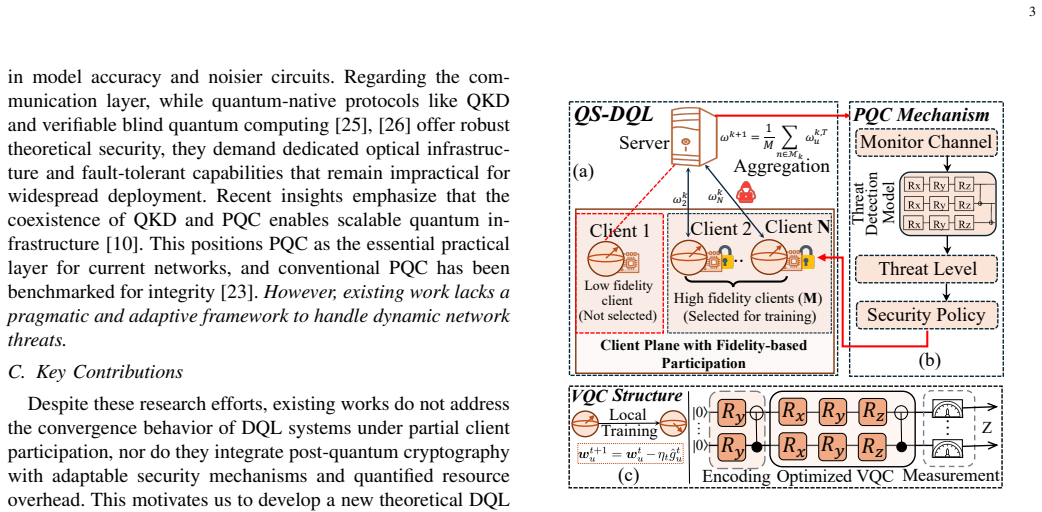
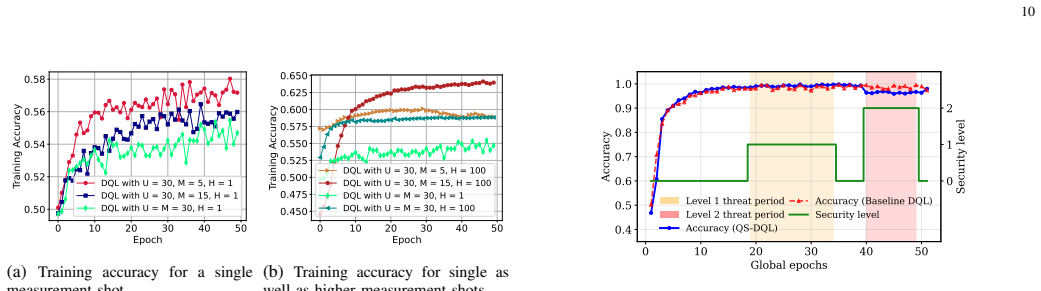
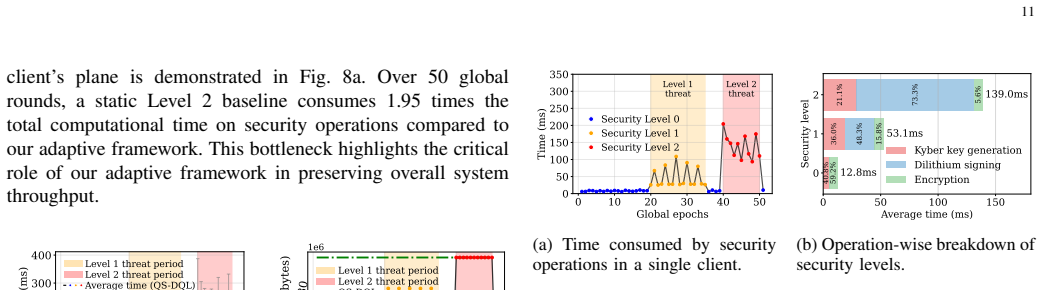
The paper claims that under partial device participation, non-convex loss functions, and heterogeneous data, the convergence bound for distributed quantum learning reveals a fundamental trade-off between convergence rate, measurement shots, and the size of the participating device subset. It further claims that a quantum neural network-powered adaptive post-quantum security architecture monitors conditions, evaluates threats, and adjusts parameters across three NIST-compliant levels, with physical testbed evaluations demonstrating a 49 percent reduction in total security execution time relative to static high-security baselines while maintaining over 91 percent threat detection accuracy.
Load-bearing premise
A quantum neural network can reliably monitor conditions, evaluate threats, and adjust cryptographic parameters across security levels without introducing unacceptable overhead or new vulnerabilities.
Editorial extensions
If this is right
- Convergence speed can be tuned by selecting appropriate levels of device participation and measurement shots.
- The adaptive security framework maintains overall system efficiency when facing varying threat levels.
- Hardware results indicate the adaptive approach outperforms static high-security configurations on execution time.
- Simulations align with the theoretical convergence predictions under the stated practical conditions.
Reading between the lines
- The identified trade-off could inform resource scheduling decisions in larger multi-device quantum networks.
- The adaptive monitoring technique might extend to securing other distributed quantum tasks such as optimization routines.
- Evaluating the quantum neural network component itself for potential new attack surfaces would be a direct follow-on test.
Editorial analysis
A structured set of objections, weighed in public.
Referee Report
Summary. The manuscript presents a convergence analysis for distributed quantum learning (DQL) under partial device participation, non-convex loss functions, and heterogeneous data distributions, deriving a bound that identifies a trade-off among convergence rate, measurement shots, and participating device subset size. It further proposes a multi-layered post-quantum cryptographic architecture that employs a quantum neural network (QNN) to monitor conditions, evaluate threats, and dynamically adjust parameters across three NIST-compliant security levels. Hardware experiments on a physical testbed modeling quantum control architectures are reported to show that the adaptive mechanism reduces total security execution time by approximately 49% relative to static high-security baselines while achieving over 91% threat detection accuracy; simulations are said to validate the theoretical analysis.
Significance. If the convergence bound is derived from first principles without circular fitting and the hardware results demonstrate a genuine net efficiency gain after accounting for all QNN resources, the work would usefully connect theoretical DQL analysis with practical security considerations on near-term hardware. The use of a physical testbed and explicit NIST-level comparisons are strengths that could inform deployment of secure distributed quantum systems.
major comments (3)
- [Hardware Experiments] The central empirical claim of a 49% reduction in security execution time (abstract and hardware experiments section) rests on the QNN successfully performing threat monitoring and level switching without introducing additional measurement shots or decoherence overheads; however, the manuscript supplies no circuit description, training protocol, shot count, or resource accounting for the QNN component, leaving the net gain unsupported.
- [Convergence Analysis] The convergence bound is asserted to reveal a fundamental trade-off between rate, shots, and subset size, yet the explicit functional form of the bound, the precise assumptions on gradient heterogeneity or participation probability, and any dependence on the QNN's own shot requirements are not stated, preventing verification that the bound is non-circular with respect to the data used for validation.
- [Security Architecture] The security architecture's claim of maintaining >91% detection accuracy while switching among three NIST levels assumes the QNN introduces no new vulnerability surfaces; the manuscript contains no error analysis, robustness evaluation under realistic noise, or comparison of the QNN's quantum resources against the reported time savings, which is load-bearing for the adaptive-framework conclusion.
minor comments (2)
- [Figures] Figure captions for the testbed results do not explicitly state the number of independent runs or error bars used to support the 49% and 91% figures.
- [Notation] The notation distinguishing static versus adaptive security overheads is introduced without a dedicated table comparing the three NIST levels across all reported metrics.
Simulated Author's Rebuttal
We thank the referee for the constructive and detailed comments, which help clarify key aspects of our work. We provide point-by-point responses to the major comments below, indicating where revisions will be made to improve transparency and completeness.
read point-by-point responses
-
Referee: [Hardware Experiments] The central empirical claim of a 49% reduction in security execution time (abstract and hardware experiments section) rests on the QNN successfully performing threat monitoring and level switching without introducing additional measurement shots or decoherence overheads; however, the manuscript supplies no circuit description, training protocol, shot count, or resource accounting for the QNN component, leaving the net gain unsupported.
Authors: We agree that the manuscript would benefit from explicit details on the QNN to substantiate the net efficiency claim. The reported execution times on the physical testbed already incorporate all operations, but to enable verification we will add an appendix with the QNN circuit description, training protocol, shot counts, and a resource overhead breakdown showing that the adaptive switching yields the stated reduction after accounting for QNN costs. revision: yes
-
Referee: [Convergence Analysis] The convergence bound is asserted to reveal a fundamental trade-off between rate, shots, and subset size, yet the explicit functional form of the bound, the precise assumptions on gradient heterogeneity or participation probability, and any dependence on the QNN's own shot requirements are not stated, preventing verification that the bound is non-circular with respect to the data used for validation.
Authors: The explicit bound appears in Theorem 1 (Section III), with Assumptions 1–4 specifying non-convex losses, gradient heterogeneity bounded by σ, and participation probability p; the bound depends on these quantities and the number of shots but is independent of the QNN, which operates as a separate security layer. To improve accessibility we will restate the bound equation in the introduction and explicitly note its independence from QNN resources; the simulation validation uses held-out data distinct from bound derivation. revision: partial
-
Referee: [Security Architecture] The security architecture's claim of maintaining >91% detection accuracy while switching among three NIST levels assumes the QNN introduces no new vulnerability surfaces; the manuscript contains no error analysis, robustness evaluation under realistic noise, or comparison of the QNN's quantum resources against the reported time savings, which is load-bearing for the adaptive-framework conclusion.
Authors: We acknowledge that a dedicated robustness analysis is needed to support the claim that the QNN does not introduce new vulnerabilities. The >91% accuracy was obtained under the testbed's modeled noise, but we will add a subsection providing error analysis, noise robustness results, and a direct comparison of QNN quantum resources versus the observed time savings to confirm the net benefit of the adaptive framework. revision: yes
Circularity Check
No circularity in derivation chain
full rationale
The abstract and description present a convergence analysis for DQL under partial participation, non-convex losses, and heterogeneous data, along with an adaptive post-quantum security mechanism. No equations, fitted parameters, or self-citations are exhibited that would reduce the claimed bound or trade-off to inputs by construction. The hardware experiments and simulations are described as validation steps separate from the derivation. The central claims therefore remain self-contained against external benchmarks with no load-bearing circular steps identified.
Assumptions & free parameters
Cite this review
Pith. "Pith review of Distributed Quantum Learning over Near-term Devices: Convergence Analysis and Security Design." pith.science (2026). https://pith.science/paper/AFE5QND6
@misc{pith2026260620606,
  author       = {Pith},
  title        = {Pith review of: Distributed Quantum Learning over Near-term Devices: Convergence Analysis and Security Design},
  year         = {2026},
  howpublished = {\url{https://pith.science/paper/AFE5QND6}},
  note         = {Machine review of arXiv:2606.20606}
}
read the original abstract
Distributed quantum learning (DQL) has emerged as a promising paradigm to scale quantum-enhanced machine learning by interconnecting multiple quantum devices. However, for efficient real-world deployment, it is essential to characterize how DQL converges under practical scenarios while simultaneously safeguarding multi-device quantum infrastructures from evolving security threats. Addressing these aspects in an integrated manner is key to ensuring both performance and resilience in large-scale DQL systems. Therefore, this paper presents a new DQL study where our innovation lies in: (i) conducting a holistic convergence analysis for DQL under practical settings, i.e., partial device participation, non-convex loss functions, and heterogeneous data distributions, (ii) developing a novel multi-layered post-quantum cryptographic architecture with a quantum neural network-powered adaptive mechanism that monitors conditions, evaluates threats, and adjusts parameters across three National Institute of Standards and Technology (NIST)-compliant levels. Our theoretical framework and empirical validation reveal two key insights: (i) the derived convergence bound uncovers a fundamental trade-off between convergence rate, measurement shots, and the size of the participating device subset; and (ii) findings from our evaluations on a physical testbed modeling quantum control architectures expose the performance limitations of static post-quantum security, while confirming that our adaptive framework effectively mitigates these overheads to preserve overall system efficiency. Specifically, the hardware experiments demonstrate that our dynamic security mechanism reduces total security execution time by approximately 49% relative to static high-security baselines, while maintaining a threat detection accuracy of over 91%. Furthermore, extensive simulations validate our theoretical analysis.....
Figures


Figures from the paper (4 more)


Reference graph
Works this paper leans on
-
[1]
Distributed quantum computing across an optical network link,
D. Main, P. Drmota, D. Nadlinger, E. Ainley, A. Agrawal, B. Nichol, R. Srinivas, G. Araneda, and D. Lucas, “Distributed quantum computing across an optical network link,”Nature, pp. 1–6, 2025
work page 2025
-
[2]
Distributed quantum computing for chemical applications,
G. M. Jones and H.-A. Jacobsen, “Distributed quantum computing for chemical applications,” in2024 IEEE International Conference on Quantum Computing and Engineering (QCE), vol. 2. IEEE, 2024, pp. 155–160
work page 2024
-
[3]
Z. Qu, X. Zhao, L. Sun, and G. Muhammad, “Daqfl: Dynamic aggre- gation quantum federated learning algorithm for intelligent diagnosis in internet of medical things,”IEEE Internet of Things Journal, 2025
work page 2025
-
[4]
Qucomm: Optimizing collective com- munication for distributed quantum computing,
A. Wu, Y . Ding, and A. Li, “Qucomm: Optimizing collective com- munication for distributed quantum computing,” inProceedings of the 56th Annual IEEE/ACM International Symposium on Microarchitecture, 2023, pp. 479–493
work page 2023
-
[5]
A modular quantum compila- tion framework for distributed quantum computing,
D. Ferrari, S. Carretta, and M. Amoretti, “A modular quantum compila- tion framework for distributed quantum computing,”IEEE Transactions on Quantum Engineering, vol. 4, pp. 1–13, 2023
work page 2023
-
[6]
Communication-efficient quantum federated learning optimization for multi-center healthcare data,
A. S. Bhatia, M. K. Saggi, and S. Kais, “Communication-efficient quantum federated learning optimization for multi-center healthcare data,” in2024 IEEE EMBS International Conference on Biomedical and Health Informatics (BHI). IEEE, 2024, pp. 1–8
work page 2024
-
[7]
Y . Xu, G. Huang, J. Balewski, R. Naik, A. Morvan, B. Mitchell, K. Nowrouzi, D. I. Santiago, and I. Siddiqi, “Qubic: An open-source fpga-based control and measurement system for superconducting quan- tum information processors,”IEEE Transactions on Quantum Engineer- ing, vol. 2, pp. 1–11, 2021
work page 2021
-
[8]
Distributed processor for fpga-based superconducting qubit control,
N. Fruitwala, Y . Xu, R. Naik, K. Nowrouzi, and G. Huang, “Distributed processor for fpga-based superconducting qubit control,” in2022 IEEE International Conference on Quantum Computing and Engineering (QCE). IEEE, 2022, pp. 763–764
work page 2022
Show all 45 references
-
[9]
Spinq triangulum: A commercial three-qubit desktop quantum computer,
G. Feng, S.-Y . Hou, H. Zou, W. Shi, S. Yu, Z. Sheng, X. Rao, K. Ma, C. Chen, B. Renet al., “Spinq triangulum: A commercial three-qubit desktop quantum computer,”IEEE Nanotechnology Magazine, vol. 16, no. 4, pp. 20–29, 2022
2022
-
[10]
Deploying hybrid quantum-secured infrastructure for applications: When quantum and post-quantum can work together,
A. K. Fedorov, “Deploying hybrid quantum-secured infrastructure for applications: When quantum and post-quantum can work together,” Frontiers in Quantum Science and Technology, vol. 2, p. 1164428, 2023
2023
-
[11]
Compiler design for distributed quantum computing,
D. Ferrari, A. S. Cacciapuoti, M. Amoretti, and M. Caleffi, “Compiler design for distributed quantum computing,”IEEE Transactions on Quantum Engineering, vol. 2, pp. 1–20, 2021
2021
-
[12]
Distributed quantum com- puting and network control for accelerated vqe,
S. DiAdamo, M. Ghibaudi, and J. Cruise, “Distributed quantum com- puting and network control for accelerated vqe,”IEEE Transactions on Quantum Engineering, vol. 2, pp. 1–21, 2021
2021
-
[13]
Qubit allocation for distributed quantum computing,
Y . Mao, Y . Liu, and Y . Yang, “Qubit allocation for distributed quantum computing,” inIEEE INFOCOM 2023-IEEE Conference on Computer Communications. IEEE, 2023, pp. 1–10
2023
-
[14]
Noise- aware detectable byzantine agreement for consensus-based distributed quantum computing,
K.-C. Chen, M. Prest, F. Burt, S. Yu, and K. K. Leung, “Noise- aware detectable byzantine agreement for consensus-based distributed quantum computing,” in2025 International Conference on Quantum Communications, Networking, and Computing (QCNC). IEEE, 2025, pp. 210–215
2025
-
[15]
Quantum federated learning with quantum data,
M. Chehimi and W. Saad, “Quantum federated learning with quantum data,” inIEEE Int. Conf. Acoust., Speech, Signal Process. (ICASSP). IEEE, 2022, pp. 8617–8621
2022
-
[16]
Federated quantum machine learning,
S. Y .-C. Chen and S. Yoo, “Federated quantum machine learning,” Entropy, vol. 23, no. 4, p. 460, 2021
2021
-
[17]
Quantum-train- based distributed multi-agent reinforcement learning,
K.-C. Chen, S. Y .-C. Chen, C.-Y . Liu, and K. K. Leung, “Quantum-train- based distributed multi-agent reinforcement learning,” in2025 IEEE Symposium for Multidisciplinary Computational Intelligence Incubators (MCII Companion). IEEE, 2025, pp. 1–5
2025
-
[18]
Auction-based trustwor- thy and resilient quantum distributed learning,
H. Lee, S. B. Son, S. Y .-C. Chen, and S. Park, “Auction-based trustwor- thy and resilient quantum distributed learning,”IEEE Internet of Things Journal, 2025
2025
-
[19]
Consensus-based distributed quantum kernel learning for speech recognition,
K.-C. Chen, W. Ma, and X. Xu, “Consensus-based distributed quantum kernel learning for speech recognition,” in2025 IEEE International Conference on Acoustics, Speech, and Signal Processing Workshops (ICASSPW). IEEE, 2025, pp. 1–5
2025
-
[20]
Dynamic quantum federated learning for satellite-ground integrated systems using slimmable quantum neural networks,
S. Park, S. Jung, and J. Kim, “Dynamic quantum federated learning for satellite-ground integrated systems using slimmable quantum neural networks,”IEEE Access, vol. 12, pp. 58 239–58 247, 2024
2024
-
[21]
Toward large-scale distributed quantum long short-term memory with modular quantum computers,
K.-C. Chen, S. Y .-C. Chen, C.-Y . Liu, and K. K. Leung, “Toward large-scale distributed quantum long short-term memory with modular quantum computers,” in2025 International Wireless Communications and Mobile Computing (IWCMC). IEEE, 2025, pp. 337–342
2025
-
[22]
Entanglement- controlled quantum federated learning,
S. Park, H. Lee, S. Jung, J. Park, M. Bennis, and J. Kim, “Entanglement- controlled quantum federated learning,”IEEE Internet of Things Journal, 2025
2025
-
[23]
Enhancing quantum adver- sarial robustness by randomized encodings,
W. Gong, D. Yuan, W. Li, and D.-L. Deng, “Enhancing quantum adver- sarial robustness by randomized encodings,”Physical Review Research, vol. 6, no. 2, p. 023020, 2024
2024
-
[24]
Federated quantum machine learning with differential privacy,
R. Rofougaran, S. Yoo, H.-H. Tseng, and S. Y .-C. Chen, “Federated quantum machine learning with differential privacy,” inICASSP 2024- 2024 IEEE International Conference on Acoustics, Speech and Signal Processing (ICASSP). IEEE, 2024, pp. 9811–9815
2024
-
[25]
Distributed secure quantum machine learn- ing,
Y .-B. Sheng and L. Zhou, “Distributed secure quantum machine learn- ing,”Science Bulletin, vol. 62, no. 14, pp. 1025–1029, 2017
2017
-
[26]
Quantum federated learning through blind quantum computing,
W. Li, S. Lu, and D.-L. Deng, “Quantum federated learning through blind quantum computing,”Science China Physics, Mechanics & As- tronomy, vol. 64, no. 10, p. 100312, 2021
2021
-
[27]
General parameter- shift rules for quantum gradients,
D. Wierichs, J. Izaac, C. Wang, and C. Y .-Y . Lin, “General parameter- shift rules for quantum gradients,”Quantum, vol. 6, p. 677, 2022
2022
-
[28]
Barren plateaus in quantum neural network training landscapes,
J. R. McClean, S. Boixo, V . N. Smelyanskiy, R. Babbush, and H. Neven, “Barren plateaus in quantum neural network training landscapes,”Nature communications, vol. 9, no. 1, p. 4812, 2018
2018
-
[29]
On the convergence of SGD with biased gradients,
A. Ajalloeian and S. U. Stich, “On the convergence of SGD with biased gradients,”arXiv preprint arXiv:2008.00051, 2020
2008
-
[30]
Error-mitigation-aided optimization of pa- rameterized quantum circuits: Convergence analysis,
S. T. Jose and O. Simeone, “Error-mitigation-aided optimization of pa- rameterized quantum circuits: Convergence analysis,”IEEE Transactions on Quantum Engineering, vol. 3, pp. 1–19, 2022
2022
-
[31]
Threats and defenses in the federated learning life cycle: a comprehensive survey and challenges,
Y . Li, Z. Guo, N. Yang, H. Chen, D. Yuan, and W. Ding, “Threats and defenses in the federated learning life cycle: a comprehensive survey and challenges,”IEEE Transactions on Neural Networks and Learning Systems, 2025
2025
-
[32]
Managing the quantum cybersecurity threat: Harvest now, decrypt later,
H. Singh, “Managing the quantum cybersecurity threat: Harvest now, decrypt later,” inQuantum Computing. CRC Press, 2024, pp. 142– 158
2024
-
[33]
Salsa verde: a machine learning attack on lwe with sparse small secrets,
C. Li, E. Wenger, Z. Allen-Zhu, F. Charton, and K. E. Lauter, “Salsa verde: a machine learning attack on lwe with sparse small secrets,”Ad- vances in Neural Information Processing Systems, vol. 36, pp. 53 343– 53 361, 2023
2023
-
[34]
Unsw-nb15: a comprehensive data set for network intrusion detection systems (unsw-nb15 network data set),
N. Moustafa and J. Slay, “Unsw-nb15: a comprehensive data set for network intrusion detection systems (unsw-nb15 network data set),” in2015 military communications and information systems conference (MilCIS). IEEE, 2015, pp. 1–6
2015
-
[35]
Hybrid quantum enhanced fed- erated learning for cyber attack detection,
G. Subramanian and M. Chinnadurai, “Hybrid quantum enhanced fed- erated learning for cyber attack detection,”Scientific Reports, vol. 14, no. 1, p. 32038, 2024
2024
-
[36]
Network anomaly detection using quantum neural networks on noisy quantum computers,
A. Kukliansky, M. Orescanin, C. Bollmann, and T. Huffmire, “Network anomaly detection using quantum neural networks on noisy quantum computers,”IEEE Transactions on Quantum Engineering, vol. 5, pp. 1–11, 2024
2024
-
[37]
The power of quantum neural networks,
A. Abbas, D. Sutter, C. Zoufal, A. Lucchi, A. Figalli, and S. Woerner, “The power of quantum neural networks,”Nature Computational Sci- ence, vol. 1, no. 6, pp. 403–409, 2021
2021
-
[38]
Kali: A crystal for post-quantum security using kyber and dilithium,
A. Aikata, A. C. Mert, M. Imran, S. Pagliarini, and S. S. Roy, “Kali: A crystal for post-quantum security using kyber and dilithium,”IEEE Transactions on Circuits and Systems I: Regular Papers, vol. 70, no. 2, pp. 747–758, 2022
2022
-
[39]
Quantumnas: Noise-adaptive search for robust quantum circuits,
H. Wang, Y . Ding, J. Gu, Y . Lin, D. Z. Pan, F. T. Chong, and S. Han, “Quantumnas: Noise-adaptive search for robust quantum circuits,” in 2022 IEEE International Symposium on High-Performance Computer Architecture (HPCA). IEEE, 2022, pp. 692–708
2022
-
[40]
Learning multiple layers of features from tiny images,
A. Krizhevsky, G. Hintonet al., “Learning multiple layers of features from tiny images,” 2009
2009
-
[41]
The mnist database of handwritten digit images for machine learning research [best of the web],
L. Deng, “The mnist database of handwritten digit images for machine learning research [best of the web],”IEEE signal processing magazine, vol. 29, no. 6, pp. 141–142, 2012
2012
-
[42]
Medmnist v2-a large-scale lightweight benchmark for 2d and 3d 13 biomedical image classification,
J. Yang, R. Shi, D. Wei, Z. Liu, L. Zhao, B. Ke, H. Pfister, and B. Ni, “Medmnist v2-a large-scale lightweight benchmark for 2d and 3d 13 biomedical image classification,”Scientific Data, vol. 10, no. 1, p. 41, 2023
2023
-
[43]
Stochastic gradient descent for hybrid quantum- classical optimization,
R. Sweke, F. Wilde, J. Meyer, M. Schuld, P. K. F ¨ahrmann, B. Meynard- Piganeau, and J. Eisert, “Stochastic gradient descent for hybrid quantum- classical optimization,”Quantum, vol. 4, p. 314, 2020
2020
-
[44]
Communication-efficient learning of deep networks from decentralized data,
B. McMahan, E. Moore, D. Ramage, S. Hampson, and B. A. y Arcas, “Communication-efficient learning of deep networks from decentralized data,” inArtificial intelligence and statistics. PMLR, 2017, pp. 1273– 1282
2017
-
[45]
Communication-efficient federated learning with adaptive aggregation for heterogeneous client-edge-cloud network,
L. Luo, C. Zhang, H. Yu, G. Sun, S. Luo, and S. Dustdar, “Communication-efficient federated learning with adaptive aggregation for heterogeneous client-edge-cloud network,”IEEE Transactions on Services Computing, vol. 17, no. 6, pp. 3241–3255, 2024. APPENDIX Detailed Derivatio...
2024
Reviewed June 30, 2026 · model on record in the stance chip above.
Discussion (0). Sign in to comment.