UniSLAD: A Unified Framework for Structural and Logical Industrial Visual Anomaly Detection
Pith reviewed 2026-06-26 17:59 UTC · model grok-4.3
The pith
One framework detects both structural defects and logical errors in industrial images without extra training.
A machine-rendered reading of the paper's core claim, the machinery that carries it, and where it could break.
Core claim
UniSLAD jointly addresses logical and structural anomalies without additional training by using a dual-feature extractor that pairs a CNN backbone for local texture with a Transformer backbone for global context, then applies dual-granularity modules: Mahalanobis Transform memory banks at patch level for discriminative scoring and Lower-Upper Mean plus Power Mean Pooling at image level for robust global representation.
What carries the argument
Dual-feature extractor that pairs CNN local texture perception with Transformer global contextual reasoning, supported by Mahalanobis-enhanced memory banks and Lower-Upper Mean with Power Mean Pooling.
If this is right
- A single trained model can handle both anomaly categories in dynamic factory settings.
- Patch-level memory banks with Mahalanobis distance improve local anomaly scoring.
- Image-level distribution maps aggregated by LUM and PMP yield stronger global scores than standard average pooling.
- The same pipeline reaches 99.4 percent and 93.1 percent on the two main industrial benchmarks.
Where Pith is reading between the lines
- Hybrid local-global backbones may reduce the total number of models needed for quality inspection pipelines.
- The memory-bank and pooling choices could transfer to other tasks that require both fine detail and scene-level consistency checks.
- Removing the retraining requirement suggests potential cost savings when production lines introduce new product variants.
Load-bearing premise
That the CNN-Transformer combination plus the memory banks and pooling steps will produce representations that remain effective across changing industrial conditions without any retraining.
What would settle it
Performance on a new mixed-anomaly industrial dataset drops below the reported levels unless the model is retrained on that data.
Figures


read the original abstract
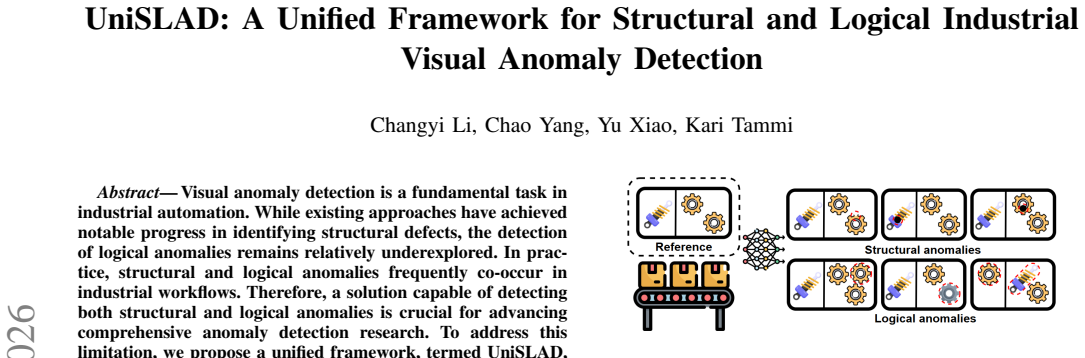
Visual anomaly detection is a fundamental task in industrial automation. While existing approaches have achieved notable progress in identifying structural defects, the detection of logical anomalies remains relatively underexplored. In practice, structural and logical anomalies frequently co-occur in industrial workflows. Therefore, a solution capable of detecting both structural and logical anomalies is crucial for advancing comprehensive anomaly detection research. To address this limitation, we propose a unified framework, termed UniSLAD, which jointly addresses logical and structural anomalies without additional training, enabling a practical solution for dynamic industrial environments. First, we introduce a dual-feature extractor that synergistically integrates a Convolutional Neural Network (CNN) backbone for local texture perception with a Transformer backbone for global contextual reasoning, yielding richer and more comprehensive representations. Building on this foundation, we design dual-granularity feature representation modules. At the patch level, memory banks enhanced by the Mahalanobis Transform (MT) preserve representative features and support more discriminative anomaly scoring. At the image level, distribution maps are aggregated using Lower-Upper Mean (LUM) and Power Mean Pooling (PMP), yielding a more robust global representation than conventional average pooling. Extensive experiments on the two industrial benchmarks demonstrate that UniSLAD achieves competitive performance in comprehensive anomaly detection, achieving 99.4% and 93.1%, respectively. Furthermore, ablation studies verify the individual contributions and effectiveness of each proposed component.
Editorial analysis
A structured set of objections, weighed in public.
Referee Report
Summary. The paper proposes UniSLAD, a unified framework for joint detection of structural and logical anomalies in industrial images without additional training. It combines a dual-feature extractor (CNN backbone for local texture + Transformer for global context), patch-level memory banks enhanced by the Mahalanobis Transform for discriminative scoring, and image-level aggregation via Lower-Upper Mean (LUM) and Power Mean Pooling (PMP) instead of average pooling. Experiments on two industrial benchmarks are reported to achieve 99.4% and 93.1%, with ablations verifying each component.
Significance. If the performance numbers hold under proper controls and the zero-retraining claim is validated, the work would offer a practical advance in comprehensive industrial anomaly detection by handling co-occurring anomaly types in one model. The dual-backbone design and specific pooling choices are positive elements, and the ablation studies provide direct verification of component contributions.
major comments (1)
- [Abstract] Abstract: the central claim that the framework 'enables a practical solution for dynamic industrial environments' without additional training lacks supporting evidence. The reported experiments consist only of results on two standard benchmarks; no tests under distribution shifts (lighting, pose, or product variants) that would require memory-bank adaptation are described. This directly undercuts the generalization argument that motivates the dual-granularity modules.
minor comments (1)
- [Abstract] Abstract: the reported figures (99.4% and 93.1%) are given without naming the metric, the exact datasets, or whether they are image-level or pixel-level scores, reducing immediate interpretability.
Simulated Author's Rebuttal
We thank the referee for highlighting the need to align abstract claims with experimental evidence. We address the point directly below.
read point-by-point responses
-
Referee: [Abstract] Abstract: the central claim that the framework 'enables a practical solution for dynamic industrial environments' without additional training lacks supporting evidence. The reported experiments consist only of results on two standard benchmarks; no tests under distribution shifts (lighting, pose, or product variants) that would require memory-bank adaptation are described. This directly undercuts the generalization argument that motivates the dual-granularity modules.
Authors: We agree that the experiments are confined to the two standard benchmarks (MVTec AD and MVTec LOCO) and provide no direct evaluation under distribution shifts such as lighting, pose, or product variants that would necessitate memory-bank updates. The phrase 'without additional training' in the manuscript refers specifically to the unified handling of structural and logical anomalies within a single model, without requiring separate training pipelines or fine-tuning for each anomaly category. However, this does not constitute evidence for robustness to environmental shifts. We will revise the abstract to remove the unsubstantiated claim about 'dynamic industrial environments' and replace it with a statement limited to the demonstrated performance on the benchmarks. A corresponding limitation paragraph will be added to the discussion section. revision: yes
Circularity Check
No circularity: empirical framework with benchmark results, no derivations or self-referential predictions
full rationale
The paper presents a descriptive framework (dual CNN-Transformer extractor, MT-enhanced memory banks, LUM/PMP pooling) and reports experimental outcomes on two standard benchmarks (99.4% and 93.1%). No equations, parameter-fitting steps, or derivation chains appear in the provided text. Performance figures are framed as direct experimental measurements rather than predictions derived from inputs by construction. No self-citations are invoked as load-bearing uniqueness theorems. The central claim therefore rests on empirical evaluation and does not reduce to its own definitions or fitted values.
Axiom & Free-Parameter Ledger
axioms (2)
- domain assumption A dual-feature extractor integrating CNN for local texture perception with Transformer for global contextual reasoning yields richer and more comprehensive representations
- domain assumption Patch-level memory banks enhanced by Mahalanobis Transform and image-level aggregation via Lower-Upper Mean and Power Mean Pooling yield more discriminative and robust anomaly scoring than standard approaches
Reference graph
Works this paper leans on
-
[1]
Zavrtanik, M
V . Zavrtanik, M. Kristan, D. Sko ˇcaj, Draem-a discriminatively trained reconstruction embedding for surface anomaly detection, in: Proc. IEEE/CVF Int. Conf. Comput. Vis., 2021, pp. 8330–8339
2021
-
[2]
H. Deng, X. Li, Anomaly detection via reverse distillation from one- class embedding, in: Proc. IEEE/CVF Conf. Comput. Vis. Pattern Recognit., 2022, pp. 9737–9746
2022
-
[3]
K. Roth, L. Pemula, J. Zepeda, B. Sch ¨olkopf, T. Brox, P. Gehler, To- wards total recall in industrial anomaly detection, in: Proc. IEEE/CVF Conf. Comput. Vis. Pattern Recognit., 2022, pp. 14298–14308
2022
-
[4]
C. Li, C. Yang, Y . Xiao, S2tkd: Dual-student knowledge distillation for industrial visual anomaly detection and localization, in: Proc. IEEE Int. Conf. Big Data, IEEE, 2025, pp. 2386–2395
2025
-
[5]
Zhang, M
J. Zhang, M. Suganuma, T. Okatani, Contextual affinity distillation for image anomaly detection, in: Proc. IEEE/CVF Winter Conf. Appl. Comput. Vis., 2024, pp. 149–158
2024
-
[6]
Batzner, L
K. Batzner, L. Heckler, R. K ¨onig, Efficientad: Accurate visual anomaly detection at millisecond-level latencies, in: Proc. IEEE/CVF Winter Conf. Appl. Comput. Vis., 2024, pp. 128–138
2024
-
[7]
H. Yao, W. Yu, W. Luo, Z. Qiang, D. Luo, X. Zhang, Learning global- local correspondence with semantic bottleneck for logical anomaly detection, IEEE Transactions on Circuits and Systems for Video Technology 34 (5) (2023) 3589–3605
2023
-
[8]
K. He, X. Zhang, S. Ren, J. Sun, Deep residual learning for image recognition, in: Proc. IEEE/CVF Conf. Comput. Vis. Pattern Recognit., 2016, pp. 770–778
2016
-
[9]
An Image is Worth 16x16 Words: Transformers for Image Recognition at Scale
A. Dosovitskiy, L. Beyer, A. Kolesnikov, D. Weissenborn, X. Zhai, T. Unterthiner, M. Dehghani, M. Minderer, G. Heigold, S. Gelly, et al., An image is worth 16x16 words: Transformers for image recognition at scale, arXiv preprint arXiv:2010.11929 (2020)
work page internal anchor Pith review Pith/arXiv arXiv 2010
- [10]
- [11]
-
[12]
H. Guo, L. Ren, J. Fu, Y . Wang, Z. Zhang, C. Lan, H. Wang, X. Hou, Template-guided hierarchical feature restoration for anomaly detection, in: Proc. IEEE/CVF Int. Conf. Comput. Vis., 2023, pp. 6447–6458
2023
-
[13]
J. Deng, W. Dong, R. Socher, L.-J. Li, K. Li, L. Fei-Fei, Imagenet: A large-scale hierarchical image database, in: Proc. IEEE Conf. Comput. Vis. Pattern Recognit., 2009, pp. 248–255
2009
-
[14]
P. K. Agarwal, S. Har-Peled, K. R. Varadarajan, et al., Geometric ap- proximation via coresets, Combinatorial and computational geometry 52 (1) (2005) 1–30
2005
-
[15]
Sugawara, R
S. Sugawara, R. Imamura, Puad: Frustratingly simple method for robust anomaly detection, in: Proc. IEEE Int. Conf. Image Process., 2024, pp. 842–848
2024
-
[16]
Y . Liu, L. Ma, H. Jiang, Image alignment-based patch distribution framework for anomaly detection, in: Proc. 4th Int. Conf. Comput. Vis. Data Mining, V ol. 13063, SPIE, 2024, pp. 163–172
2024
-
[17]
P. C. Mahalanobis, On the generalized distance in statistics, Sankhy ¯a: The Indian Journal of Statistics, Series A (2008-) 80 (2018) S1–S7
2008
-
[18]
Bergmann, M
P. Bergmann, M. Fauser, D. Sattlegger, C. Steger, Mvtec ad — a comprehensive real-world dataset for unsupervised anomaly detection, in: Proc. IEEE/CVF Conf. Comput. Vis. Pattern Recognit., 2019, pp. 9584–9592
2019
-
[19]
Bergmann, K
P. Bergmann, K. Batzner, M. Fauser, D. Sattlegger, C. Steger, Beyond dents and scratches: Logical constraints in unsupervised anomaly detection and localization, Int. J. Comput. Vision 130 (4) (2022) 947–969
2022
-
[20]
T. Liu, B. Li, X. Du, B. Jiang, X. Jin, L. Jin, Z. Zhao, Component- aware anomaly detection framework for adjustable and logical indus- trial visual inspection, Advanced Engineering Informatics 58 (2023) 102161
2023
-
[21]
E. Jin, Q. Feng, Y . Mou, G. Lakemeyer, S. Decker, O. Simons, J. Stegmaier, Logicad: Explainable anomaly detection via vlm-based text feature extraction, in: Proc. AAAI Conf. Artif. Intell., V ol. 39, 2025, pp. 4129–4137
2025
- [22]
-
[23]
S. Dai, Y . Wu, X. Li, X. Xue, Generating and reweighting dense contrastive patterns for unsupervised anomaly detection, in: Proc. AAAI Conf. Artif. Intell., V ol. 38, 2024, pp. 1454–1462
2024
-
[24]
Zhang, G
J. Zhang, G. Wang, Y . Jin, D. Huang, Towards training-free anomaly detection with vision and language foundation models, in: Proceed- ings of the IEEE/CVF Conference on Computer Vision and Pattern Recognition, 2025, pp. 15204–15213
2025
-
[25]
Y . Peng, X. Lin, N. Ma, J. Du, C. Liu, C. Liu, Q. Chen, Sam-lad: Segment anything model meets zero-shot logic anomaly detection, Knowledge-Based Systems 314 (2025) 113176
2025
-
[26]
S. Kim, S. An, P. Chikontwe, M. Kang, E. Adeli, K. M. Pohl, S. H. Park, Few shot part segmentation reveals compositional logic for industrial anomaly detection, in: Proc. AAAI Conf. Artif. Intell., V ol. 38, 2024, pp. 8591–8599
2024
-
[27]
Y .-H. Hsieh, S.-H. Lai, Csad: Unsupervised component segmenta- tion for logical anomaly detection, arXiv preprint arXiv:2408.15628 (2024)
discussion (0)
Sign in with ORCID, Apple, or X to comment. Anyone can read and Pith papers without signing in.