Distribution Complexity of Electronic Structure Simulations on Quantum Supercomputers
Pith reviewed 2026-06-26 16:51 UTC · model grok-4.3
The pith
An algorithm estimates distribution complexity for electronic structure simulations on quantum supercomputers with O(N^3) scaling and reduced communication costs.
A machine-rendered reading of the paper's core claim, the machinery that carries it, and where it could break.
Core claim
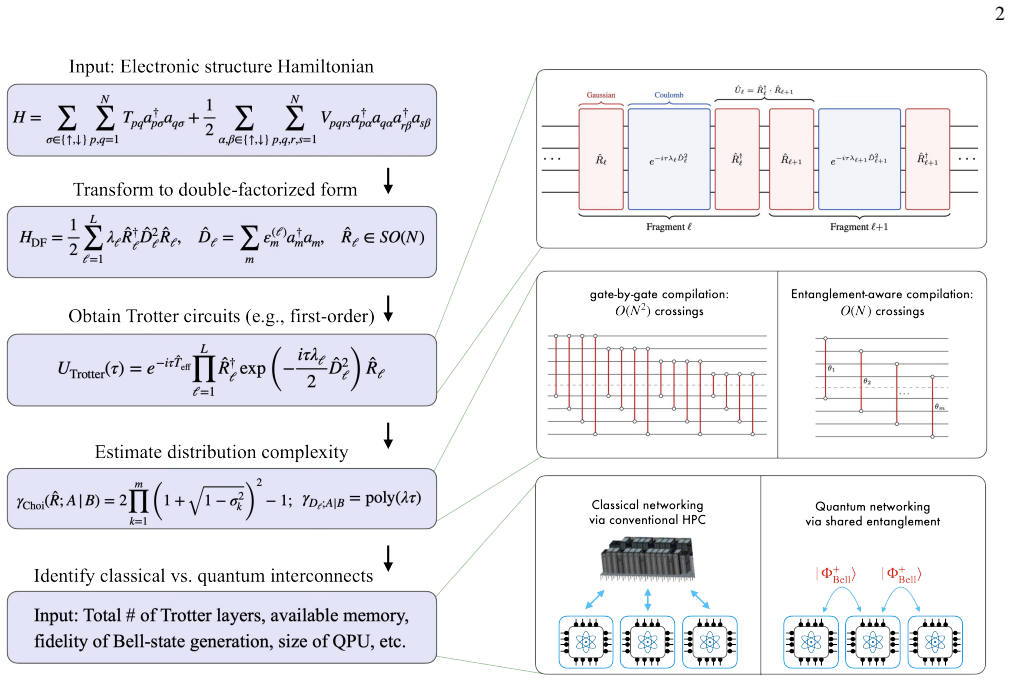
The central claim is that the distribution complexity of hybrid quantum-classical electronic structure simulations can be estimated analytically with O(N^3) cost by evaluating low entanglement boundaries for orbital rotations and dephasing-induced localization in tensor fragments using a double-factorized representation. This leads to quadratic reductions in distribution costs when QPUs communicate over quantum networks and exponential reductions for hybrid approaches using conventional HPC links. Emergent entanglement is governed by coherent Gaussian orbital rotations interacting with disordered Coulomb terms, allowing characterization of three hardness regimes and tunable model systems.
What carries the argument
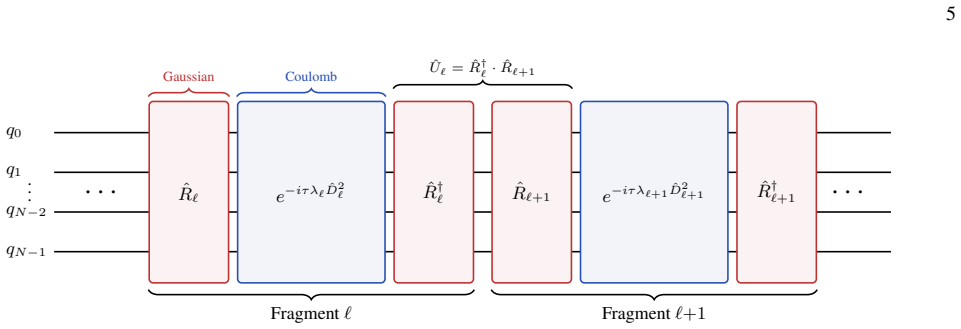
The algorithm for efficient analytical evaluation of low entanglement boundaries for orbital rotations and dephasing-induced localization within tensor fragments in a double-factorized representation.
If this is right
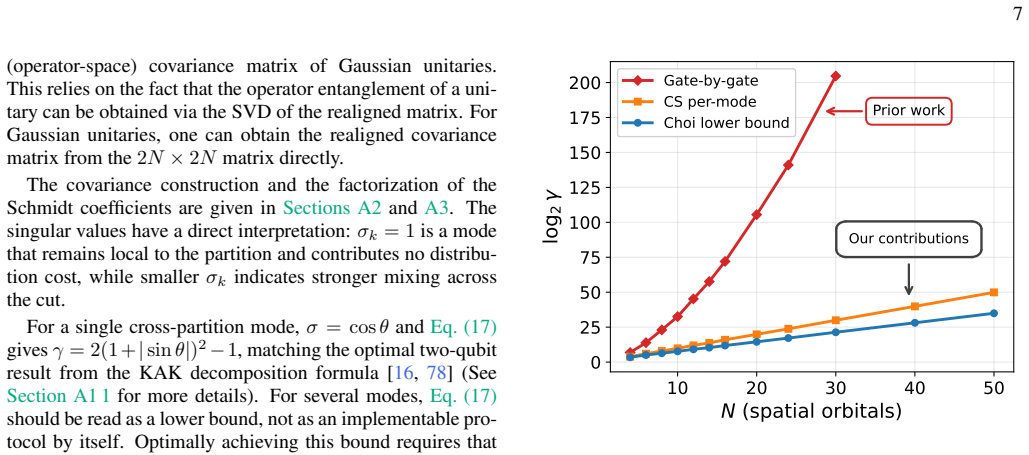
- Distribution costs per fragment scale linearly with N over quantum networks instead of quadratically.
- Hybrid quantum-classical simulations see worst-case costs drop from exp(N^2) to exp(N) with conventional interconnects.
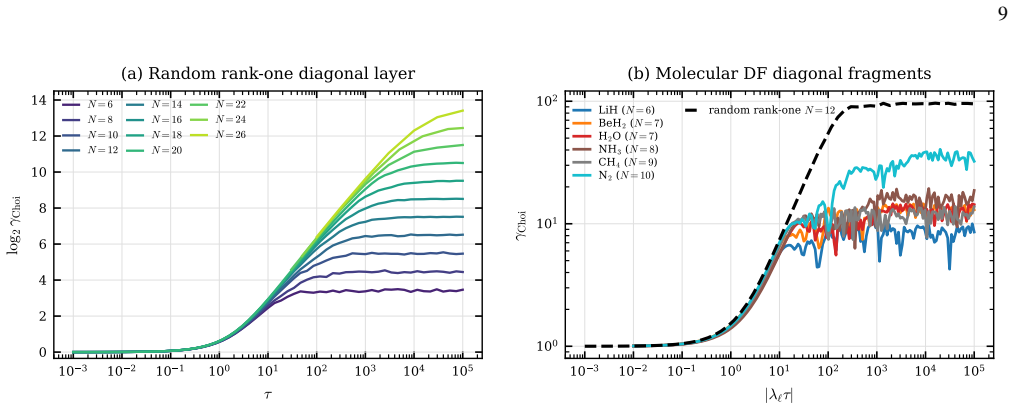
- Three distinct regimes of distribution hardness and classical simulability can be identified based on fragment localizability and rotation overlap.
- Tunable model systems can be constructed to study the interplay between orbital rotations and Coulomb interactions.
Where Pith is reading between the lines
- This framework could be used to dynamically choose fragmentations that minimize distribution overhead in real quantum chemistry applications.
- Similar entanglement estimation techniques might apply to other fermionic simulations or quantum many-body problems on distributed quantum hardware.
- If the analytical method generalizes, it suggests that distribution complexity is more tractable than previously assumed for utility-scale quantum computing.
Load-bearing premise
Low entanglement boundaries for orbital rotations and dephasing-induced localization can be efficiently and accurately evaluated analytically in a double-factorized representation.
What would settle it
Direct numerical computation of exact entanglement measures for a molecular Hamiltonian with 20 orbitals showing that the analytical O(N^3) estimates differ by more than a constant factor from the true distribution complexity.
Figures
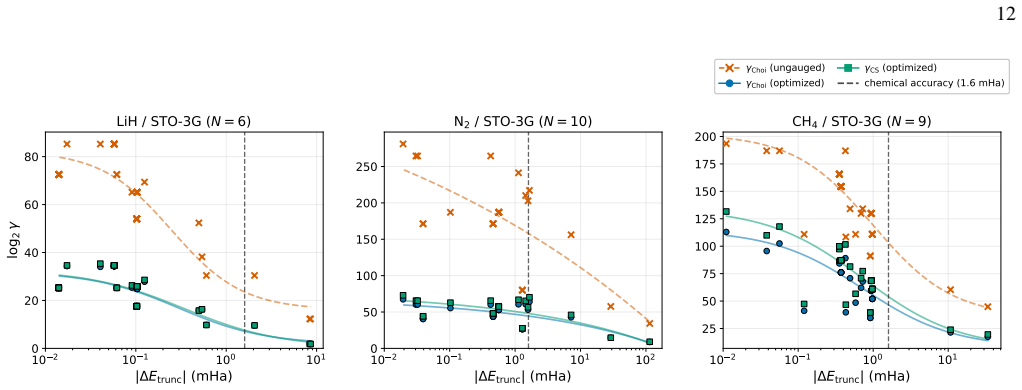
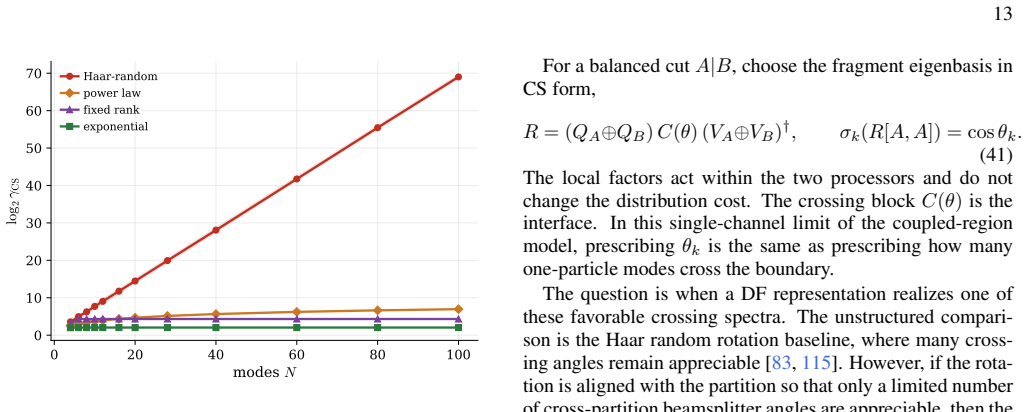
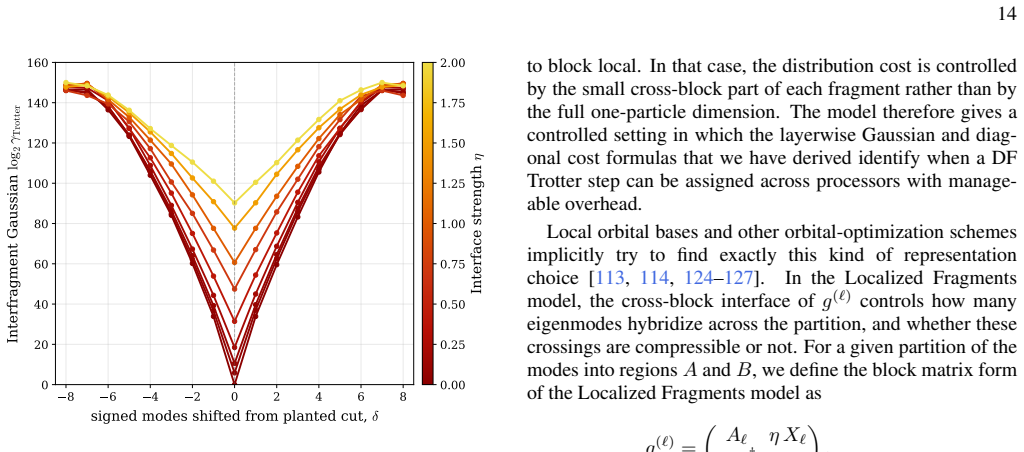
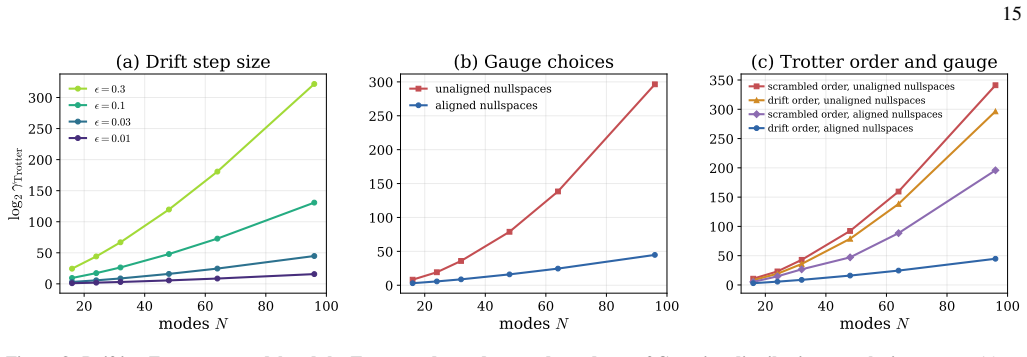
read the original abstract
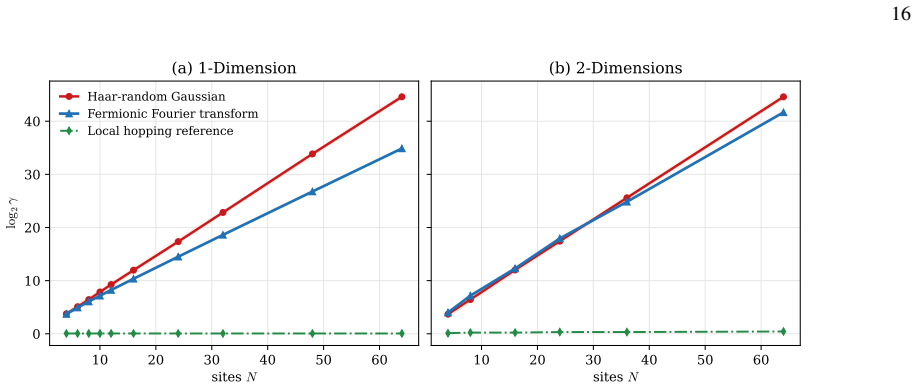
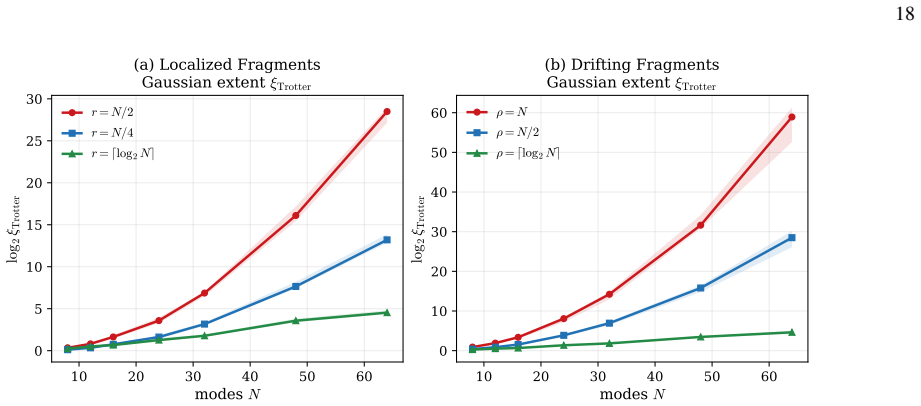
Efficient simulation of strongly-interacting fermionic systems on quantum processing units (QPUs) is a challenging task due to nonlocal mode entanglement generation. However, it is not yet well understood how the structure of entanglement governs the hardness of large-scale quantum chemistry simulations or the scaling of distributing such workloads. Here, we introduce an algorithm for estimating the distribution complexity of hybrid quantum-classical simulation for electronic structure Hamiltonians over heterogeneous high-performance architectures. Our algorithm relies on efficient analytical evaluation of the low entanglement boundaries for the orbital rotations and dephasing-induced localization within tensor fragments, in a double-factorized representation. Our entanglement estimation scales as $O(N^3)$ for each fragment, where $N$ is the number of orbitals. When QPUs are communicating via a quantum network, the cost of distribution per fragment is reduced quadratically from $O(N^2)$ to $O(N)$. Similarly, for hybrid quantum-classical approaches, with access to only conventional HPC interconnects, the worst-case cost is reduced from $O(\exp(N^2))$ to $O(\exp(N))$. We show that emergent entanglement patterns are induced by the interplay between coherent Gaussian orbital rotations and disordered Coulomb interactions. We discuss the underlying physical mechanisms that govern distribution complexity and introduce model systems that are tunable based on the localizability of fragments and the overlap of interfragment rotations. We characterize three different regimes of hardness for distribution complexity and classical simulability. The framework introduced here enables novel and more efficient quantum-classical application workflows towards utility-scale quantum computing.
Editorial analysis
A structured set of objections, weighed in public.
Referee Report
Summary. The manuscript introduces an algorithm to estimate the distribution complexity of hybrid quantum-classical electronic structure simulations over heterogeneous HPC architectures. It relies on analytical evaluation of low-entanglement boundaries for orbital rotations and dephasing-induced localization within tensor fragments in a double-factorized representation, achieving O(N^3) scaling per fragment (N = number of orbitals). This is claimed to reduce per-fragment distribution cost quadratically from O(N^2) to O(N) when QPUs communicate over a quantum network, and exponentially from O(exp(N^2)) to O(exp(N)) for hybrid approaches using only classical HPC interconnects. The work identifies entanglement patterns arising from coherent Gaussian orbital rotations and disordered Coulomb interactions, introduces tunable model systems based on fragment localizability and interfragment rotation overlap, and characterizes three regimes of hardness for distribution complexity and classical simulability.
Significance. If the central analytical evaluation of entanglement boundaries can be rigorously established with explicit expressions and complexity guarantees, the framework would offer a concrete tool for quantifying and minimizing communication overheads in distributed quantum chemistry workloads. The identification of tunable model systems and hardness regimes could help guide architecture choices for utility-scale quantum simulations, particularly in distinguishing regimes where quantum networks provide substantial advantage over classical interconnects.
major comments (2)
- [abstract and distribution complexity section] The quadratic and exponential cost reductions (abstract and § on distribution complexity) are load-bearing claims that presuppose an efficient, exact analytical computation of low-entanglement boundaries in the double-factorized representation. No explicit closed-form expressions, derivation, or formal complexity proof for this O(N^3) boundary extraction is supplied, nor is it shown that the procedure remains exact and non-iterative for arbitrary Hamiltonians rather than requiring numerical search or fragment-specific fitting whose cost or error would invalidate the scaling.
- [regimes of hardness and physical mechanisms] The characterization of three hardness regimes and the physical mechanisms (Gaussian rotations + disordered Coulomb interactions) rests on the same boundary-evaluation step. Without a concrete demonstration that the localization assumptions hold with controllable error for the claimed O(N^3) procedure, the regime classification and the claimed reductions in distribution complexity cannot be assessed.
minor comments (1)
- [algorithm description] Notation for the double-factorized Coulomb integrals and the precise definition of 'dephasing-induced localization' should be introduced with explicit equations before the scaling claims are stated.
Simulated Author's Rebuttal
We thank the referee for the careful reading and constructive comments. The points raised correctly identify areas where the manuscript would benefit from greater explicitness in the derivations and demonstrations. We address each major comment below and will revise accordingly.
read point-by-point responses
-
Referee: [abstract and distribution complexity section] The quadratic and exponential cost reductions (abstract and § on distribution complexity) are load-bearing claims that presuppose an efficient, exact analytical computation of low-entanglement boundaries in the double-factorized representation. No explicit closed-form expressions, derivation, or formal complexity proof for this O(N^3) boundary extraction is supplied, nor is it shown that the procedure remains exact and non-iterative for arbitrary Hamiltonians rather than requiring numerical search or fragment-specific fitting whose cost or error would invalidate the scaling.
Authors: We agree that the current manuscript does not supply the requested closed-form expressions or formal derivation. The O(N^3) procedure follows directly from the analytic structure of Gaussian orbital rotations applied to the double-factorized tensor and the dephasing localization criterion; no iterative search or fitting is involved. In the revised version we will insert a dedicated subsection containing the explicit boundary formulas, the derivation from the rotation and Coulomb terms, and the complexity argument establishing exact O(N^3) evaluation for arbitrary Hamiltonians in this representation. revision: yes
-
Referee: [regimes of hardness and physical mechanisms] The characterization of three hardness regimes and the physical mechanisms (Gaussian rotations + disordered Coulomb interactions) rests on the same boundary-evaluation step. Without a concrete demonstration that the localization assumptions hold with controllable error for the claimed O(N^3) procedure, the regime classification and the claimed reductions in distribution complexity cannot be assessed.
Authors: We acknowledge the need for explicit verification. The revised manuscript will add a section that applies the O(N^3) boundary procedure to the tunable model systems, reports the resulting localization errors with explicit bounds, and shows how these errors remain controllable across the three hardness regimes without altering the claimed quadratic or exponential distribution-cost reductions. revision: yes
Circularity Check
No circularity: derivation chain self-contained against external benchmarks
full rationale
The provided abstract and text introduce an algorithm whose central step is an analytical O(N^3) entanglement-boundary evaluation in double-factorized form. No equations, self-citations, fitted parameters, or uniqueness theorems are quoted that reduce the claimed cost reductions (O(N^2)→O(N) or exp(N^2)→exp(N)) to inputs by construction. The derivation therefore does not exhibit any of the enumerated circular patterns; the scaling claims rest on the (unverified here) analytical step rather than on a self-referential loop. This is the normal honest outcome when no load-bearing reduction is exhibited.
Axiom & Free-Parameter Ledger
Reference graph
Works this paper leans on
-
[1]
M. Mohseni, A. Scherer, K. G. Johnson, O. Wertheim, M. Ot- ten, N. Anand, N. A. Aadit, Y . Alexeev, G. Ben-Shach, K. M. Bresniker, K. Y . Camsari, B. Chapman, S. Chatter- jee, S. Chowdhury, G. A. Dagnew, T. Dvir, A. Esposito, F. Fahim, M. Ferguson, M. Fiorentino, A. Gajjar, K. Gratsea, G. Gyawali, C. Heiter, A. H. Z. Kavaki, A. Khalid, X. Kong, B. Kulchyt...
Pith/arXiv arXiv 2026
-
[2]
M.-Z. Chung, A. H. Z. Kavaki, A. Scherer, A. Khalid, X. Kong, T. Kawakubo, N. Anand, G. A. Dagnew, Z. Webb, A. Silva, G. Gyawali, T. Yan, K. Fujii, A. Ho, M. Mohseni, P. Ronagh, and J. Martinis, Partially fault- tolerant quantum computation for megaquop applications (2026), arXiv:2603.13093 [quant-ph]
arXiv 2026
-
[3]
R. Babbush, A. Zalcman, C. Gidney, M. Broughton, T. Khat- tar, H. Neven, T. Bergamaschi, J. Drake, and D. Boneh, Securing elliptic curve cryptocurrencies against quantum vulnerabilities: Resource estimates and mitigations (2026), arXiv:2603.28846 [quant-ph]
Pith/arXiv arXiv 2026
-
[4]
P. Webster, L. Berent, O. Chandra, E. T. Hockings, N. Baspin, F. Thomsen, S. C. Smith, and L. Z. Cohen, The pinna- cle architecture: Reducing the cost of breaking rsa-2048 to 100 000 physical qubits using quantum ldpc codes (2026), arXiv:2602.11457 [quant-ph]
Pith/arXiv arXiv 2048
-
[5]
M. Cain, Q. Xu, R. King, L. R. B. Picard, H. Levine, M. En- dres, J. Preskill, H.-Y . Huang, and D. Bluvstein, Shor’s algo- rithm is possible with as few as 10,000 reconfigurable atomic qubits (2026), arXiv:2603.28627 [quant-ph]
Pith/arXiv arXiv 2026
-
[6]
Barral, F
D. Barral, F. J. Cardama, G. Díaz-Camacho, D. Faílde, I. F. Llovo, M. Mussa-Juane, J. Vázquez-Pérez, J. Villasuso, C. Piñeiro, N. Costas, J. C. Pichel, T. F. Pena, and A. Gómez, Computer Science Review57, 100747 (2025)
2025
-
[7]
Y . Cao, J. Romero, J. P. Olson, M. Degroote, P. D. John- son, M. Kieferová, I. D. Kivlichan, T. Menke, B. Peropadre, N. P. D. Sawaya, S. Sim, L. Veis, and A. Aspuru-Guzik, Chem- ical Reviews119, 10856–10915 (2019)
2019
- [8]
-
[9]
J. Lee, D. W. Berry, C. Gidney, W. J. Huggins, J. R. McClean, N. Wiebe, and R. Babbush, PRX Quantum2, 030305 (2021), arXiv:2011.03494 [quant-ph]. 21
arXiv 2021
-
[10]
T. Peng, A. W. Harrow, M. Ozols, and X. Wu, Physical Review Letters125, 150504 (2020), arXiv:1904.00102
arXiv 2020
-
[11]
W. Tang, T. Tomesh, M. Suchara, J. Larson, and M. Martonosi, inProceedings of the 26th ACM International Conference on Architectural Support for Programming Languages and Oper- ating Systems, ASPLOS ’21 (ACM, 2021) p. 473–486
2021
-
[12]
S. Bravyi, O. Dial, J. M. Gambetta, D. Gil, and Z. Nazario, Journal of Applied Physics132, 10.1063/5.0082975 (2022)
-
[13]
A. Lowe, M. Medvidovi ´c, A. Hayes, L. J. O’Riordan, T. R. Bromley, J. M. Arrazola, and N. Killoran, Quantum7, 934 (2023)
2023
-
[14]
Carrera Vazquez, C
A. Carrera Vazquez, C. Tornow, D. Ristè, S. Woerner, M. Takita, and D. J. Egger, Nature636, 75–79 (2024)
2024
-
[15]
Piveteau and D
C. Piveteau and D. Sutter, IEEE Transactions on Information Theory70, 2734–2745 (2024)
2024
- [16]
-
[17]
A. W. Harrow and A. Lowe, PRX Quantum6, 010316 (2025)
2025
-
[18]
M. Jing, C. Zhu, and X. Wang, Physical Review A111, 012433 (2025), arXiv:2404.03619 [quant-ph]
arXiv 2025
-
[19]
Zanardi, Phys
P. Zanardi, Phys. Rev. A63, 040304 (2001)
2001
-
[20]
G. Styliaris, N. Anand, and P. Zanardi, Physical Review Let- ters126, 030601 (2021), arXiv:2007.08570 [quant-ph]
arXiv 2021
-
[21]
G. M. Jones and H.-A. Jacobsen, Analyzing common elec- tronic structure theory algorithms for distributed quantum computing (2025), arXiv:2507.01902 [quant-ph]
arXiv 2025
-
[22]
Motta, K
M. Motta, K. J. Sung, K. B. Whaley, M. Head-Gordon, and J. Shee, Chemical Science14, 11213–11227 (2023)
2023
-
[23]
Shirakawa, J
T. Shirakawa, J. Robledo-Moreno, T. Itoko, V . Tripathi, K. Ueda, Y . Kawashima, L. Broers, W. Kirby, H. Pathak, H. Paik, M. Tsuji, Y . Kodama, M. Sato, C. Evangelinos, S. Seelam, R. Walkup, S. Yunoki, M. Motta, P. Jurcevic, H. Horii, and A. Mezzacapo, Closed-loop calculations of elec- tronic structure on a quantum processor and a classical super- compute...
2025
-
[24]
Günther, T
J. Günther, T. Weymuth, M. Bensberg, F. Witteveen, M. S. Teynor, F. E. Thomasen, V . Sora, W. Bro-Jørgensen, R. T. Hu- sistein, M. Erakovic, M. Miller, L. Weisburn, M. Cho, M. Eck- hoff, A. W. Harrow, A. Krogh, T. Van V oorhis, K. Lindorff- Larsen, G. Solomon, M. Reiher, and M. Christandl, Journal of Chemical Theory and Computation22, 4329 (2026)
2026
-
[25]
Kirby, B
W. Kirby, B. Pokharel, J. R. Moreno, K. C. Smith, S. Bravyi, A. Deshpande, C. Evangelinos, B. Fuller, J. R. Garrison, B. Jaderberg, C. Johnson, P. Jurcevic, S.-u. Lee, S. Martiel, M. Motta, S. Seelam, O. Shtanko, K. J. Sung, M. Tran, V . Tri- pathi, K. Seki, K. Shinjo, H. Xu, L. Broers, T. Shirakawa, S. Yunoki, K. Sharma, and A. Mezzacapo, Observation of ...
2026
-
[26]
Q. Yue and E. Chitambar, Journal of Mathematical Physics60, 10.1063/1.5087815 (2019), 1808.10516
-
[27]
J.-Y . Wu, K. Matsui, T. Forrer, A. Soeda, P. Andrés-Martínez, D. Mills, L. Henaut, and M. Murao, Quantum7, 1196 (2023)
2023
- [28]
-
[29]
K. G. Johnson, A. Esposito, G. Gyawali, X. Zhan, R. Ganti, N. Anand, R. G. Beausoleil, and M. Mohseni, Distributed quantum computing via adaptive circuit knitting (2026), arXiv:2603.12411 [quant-ph]
arXiv 2026
-
[30]
Piveteau, L
C. Piveteau, L. Schmitt, and D. Sutter, Phys. Rev. Res.7, 033063 (2025)
2025
-
[31]
A. W. Harrow and M. A. Nielsen, Physical Review A68, 10.1103/physreva.68.012308 (2003)
-
[32]
T. Theurer, K. Fang, and G. Gour, Single-shot entangle- ment manipulation of states and channels revisited (2023), arXiv:2312.17088 [quant-ph]
arXiv 2023
-
[33]
G. Vidal and R. Tarrach, Physical Review A59, 141 (1999), arXiv:quant-ph/9806094
Pith/arXiv arXiv 1999
-
[34]
Szabo and N
A. Szabo and N. S. Ostlund,Modern Quantum Chemistry: In- troduction to Advanced Electronic Structure Theory(Dover Publications, Mineola, NY , 1996)
1996
-
[35]
Helgaker, P
T. Helgaker, P. Jørgensen, and J. Olsen,Molecular Electronic- Structure Theory(John Wiley & Sons, 2000)
2000
-
[36]
R. W. Chien, M. Chiew, B. Harrison, J. Necaise, W. Wang, M. Mudassar, C. McLauchlan, T. M. Henderson, G. E. Scuse- ria, S. Strelchuk, and J. D. Whitfield, Nature Reviews Physics 8, 131 (2026)
2026
-
[37]
S. B. Bravyi and A. Y . Kitaev, Annals of Physics298, 210 (2002), arXiv:quant-ph/0003137 [quant-ph]
Pith/arXiv arXiv 2002
-
[38]
J. T. Seeley, M. J. Richard, and P. J. Love, The Journal of Chemical Physics137, 224109 (2012)
2012
-
[39]
X. Gao, W. Li, J. Li, Z. Li, Y . Huang, C. Iancu, and E. Z. Zhang, Linear complexity fermionic simulation on quan- tum devices with hardware connectivity constraints (2026), arXiv:2606.00982 [cs.AR]
Pith/arXiv arXiv 2026
-
[40]
Setia and J
K. Setia and J. D. Whitfield, The Journal of Chemical Physics 148, 164104 (2018)
2018
- [41]
-
[42]
Miller, Z
A. Miller, Z. Zimboras, S. Knecht, S. Maniscalco, and G. Garcia-Perez, PRX Quantum4, 030314 (2023)
2023
- [43]
-
[44]
B. Harrison, M. Chiew, J. Necaise, A. M. Projansky, S. Strelchuk, and J. D. Whitfield, A Sierpinski triangle fermion-to-qubit transform (2024), arXiv:2409.04348 [quant- ph]
arXiv 2024
- [45]
-
[46]
W. M. Kirby, S. Hadi, M. Kreshchuk, and P. J. Love, Physical Review A104, 042607 (2021), arXiv:2105.10941 [quant-ph]
arXiv 2021
- [47]
-
[48]
J. Carolan and L. Schaeffer, in16th Innovations in Theoretical Computer Science Conference (ITCS 2025), Leibniz Interna- tional Proceedings in Informatics (LIPIcs), V ol. 325 (Schloss Dagstuhl – Leibniz-Zentrum für Informatik, 2025) pp. 32:1– 32:21, arXiv:2410.04015 [quant-ph]
arXiv 2025
-
[49]
D. W. Berry, C. Gidney, M. Motta, J. R. McClean, and R. Bab- bush, Quantum3, 208 (2019), arXiv:1902.02134
arXiv 2019
-
[50]
For a single balanced bipartition for each sector, this would result in four QPUs of sizeN/2qubits each to sim- ulate the evolution of2Nspin-orbitals
We could think of partitioning the spin sectors onto two QPUs, after which we would have to partition spatial orbitals within each sector. For a single balanced bipartition for each sector, this would result in four QPUs of sizeN/2qubits each to sim- ulate the evolution of2Nspin-orbitals
-
[51]
J. L. Whitten, The Journal of Chemical Physics58, 4496 (1973)
1973
-
[52]
Aquilante, L
F. Aquilante, L. Boman, J. Boström, H. Koch, R. Lindh, A. Sánchez de Merás, and T. B. Pedersen, inLinear- Scaling Techniques in Computational Chemistry and Physics (Springer, 2011) pp. 301–343
2011
-
[53]
Peng and K
B. Peng and K. Kowalski, Journal of Chemical Theory and Computation13, 4179 (2017)
2017
-
[54]
N. Bellonzi, J. T. Cantin, M. R. Jangrouei, A. Kunitsa, J. Necaise, N. Nguyen, J. Penuel, M. D. Radin, J. R. Fontalvo, R. Sundareswara, L. Wang, T. Watts, Y . Zhou, M. C. Garrett, A. Holmes, A. F. Izmaylov, and M. Otten, QB ground state en- 22 ergy estimation benchmark (2025), arXiv:2508.10873 [quant- ph]
arXiv 2025
-
[55]
B. O. Roos, P. R. Taylor, and P. E. M. Siegbahn, Chemical Physics48, 157 (1980)
1980
-
[56]
G. Knizia and G. K.-L. Chan, Physical Review Letters109, 186404 (2012), arXiv:1204.5783 [cond-mat.str-el]
Pith/arXiv arXiv 2012
-
[57]
Kitaura, E
K. Kitaura, E. Ikeo, T. Asada, T. Nakano, and M. Uebayasi, Chemical Physics Letters313, 701 (1999)
1999
-
[58]
Mochizuki, S
Y . Mochizuki, S. Tanaka, and K. Fukuzawa, eds.,Recent Ad- vances of the Fragment Molecular Orbital Method: Enhanced Performance and Applicability(Springer Singapore, 2021)
2021
-
[59]
fermionic fragments
The semantics vary across the literature, for e.g., “fermionic fragments”[85], “leafs” [85], “pairwise operators” for ˆGℓ[8], “Cholesky vectors” for|g (ℓ)⟩[68]. Our exact fragment termi- nology is from [54]
-
[60]
Bravyi, Quantum Information and Computation5, 216 (2005), arXiv:quant-ph/0404180 [quant-ph]
S. Bravyi, Quantum Information and Computation5, 216 (2005), arXiv:quant-ph/0404180 [quant-ph]
Pith/arXiv arXiv 2005
-
[61]
I. D. Kivlichan, J. McClean, N. Wiebe, C. Gidney, A. Aspuru- Guzik, G. K.-L. Chan, and R. Babbush, Physical Review Let- ters120, 110501 (2018), arXiv:1711.04789 [quant-ph]
Pith/arXiv arXiv 2018
-
[62]
B. I. Dunlap, J. W. D. Connolly, and J. R. Sabin, The Journal of Chemical Physics71, 3396 (1979)
1979
-
[63]
Vahtras, J
O. Vahtras, J. Almlöf, and M. W. Feyereisen, Chemical Physics Letters213, 514 (1993)
1993
-
[64]
N. H. F. Beebe and J. Linderberg, International Journal of Quantum Chemistry12, 683 (1977)
1977
-
[65]
H. Koch, A. Sánchez de Merás, and T. B. Pedersen, The Jour- nal of Chemical Physics118, 9481 (2003)
2003
-
[66]
S. D. Folkestad, E. F. Kjønstad, and H. Koch, The Journal of Chemical Physics150, 194112 (2019), arXiv:1811.12890
Pith/arXiv arXiv 2019
-
[67]
Aquilante, M
F. Aquilante, M. G. Delcey, T. B. Pedersen, I. Fdez. Galván, and R. Lindh, Molecular Physics115, 2052 (2017)
2052
-
[68]
M. Motta, J. Shee, S. Zhang, and G. K.-L. Chan, Jour- nal of Chemical Theory and Computation15, 3510 (2019), arXiv:1810.01549
Pith/arXiv arXiv 2019
-
[69]
A. M. Childs, Y . Su, M. C. Tran, N. Wiebe, and S. Zhu, Phys- ical Review X11, 011020 (2021), arXiv:1912.08854 [quant- ph]
arXiv 2021
-
[70]
E. T. Campbell, Quantum Science and Technology7, 015007 (2021), 2012.09238
arXiv 2021
-
[71]
S. G. Mehendale, L. A. Martínez-Martínez, P. D. Kamath, and A. F. Izmaylov, Digital Discovery4, 3540 (2025), arXiv:2312.13282 [quant-ph]
arXiv 2025
-
[72]
G. H. Low and I. L. Chuang, Quantum3, 163 (2019), arXiv:1610.06546 [quant-ph]
Pith/arXiv arXiv 2019
-
[73]
R. Babbush, C. Gidney, D. W. Berry, N. Wiebe, J. McClean, A. Paler, A. Fowler, and H. Neven, Physical Review X8, 041015 (2018), arXiv:1805.03662 [quant-ph]
Pith/arXiv arXiv 2018
-
[74]
O. Leimkuhler and K. B. Whaley, Exponential quantum speedups for near-term molecular electronic structure meth- ods (2026), arXiv:2503.21041 [quant-ph]
arXiv 2026
-
[75]
Peschel, Journal of Physics A: Mathematical and General 36, L205 (2003)
I. Peschel, Journal of Physics A: Mathematical and General 36, L205 (2003)
2003
-
[77]
WhereR[A, A]is defined as theN A ×N A submatrix whose elements are defined asR[A, A] ij =R A[i],A[j]
-
[78]
R. R. Tucci, An introduction to cartan’s kak decomposition for qc programmers (2005), arXiv:quant-ph/0507171 [quant-ph]
Pith/arXiv arXiv 2005
-
[79]
Hoffman, R
K. Hoffman, R. C. Raffenetti, and K. Ruedenberg, Journal of Mathematical Physics13, 528 (1972)
1972
-
[80]
C. C. Paige and M. Wei, Linear Algebra and its Applications 208–209, 303 (1994)
1994
-
[81]
G. H. Golub and C. F. Van Loan,Matrix Computations, 4th ed. (Johns Hopkins University Press, 2013)
2013
discussion (0)
Sign in with ORCID, Apple, or X to comment. Anyone can read and Pith papers without signing in.