Exact solutions using power law scalar potential in the Saez-Ballester-K-essence like theory
Pith reviewed 2026-06-26 16:07 UTC · model grok-4.3
The pith
A field redefinition maps a K-essence model with power-law potential to an exactly solvable FLRW cosmology, producing classical and quantum solutions with late-time de Sitter expansion.
A machine-rendered reading of the paper's core claim, the machinery that carries it, and where it could break.
Core claim
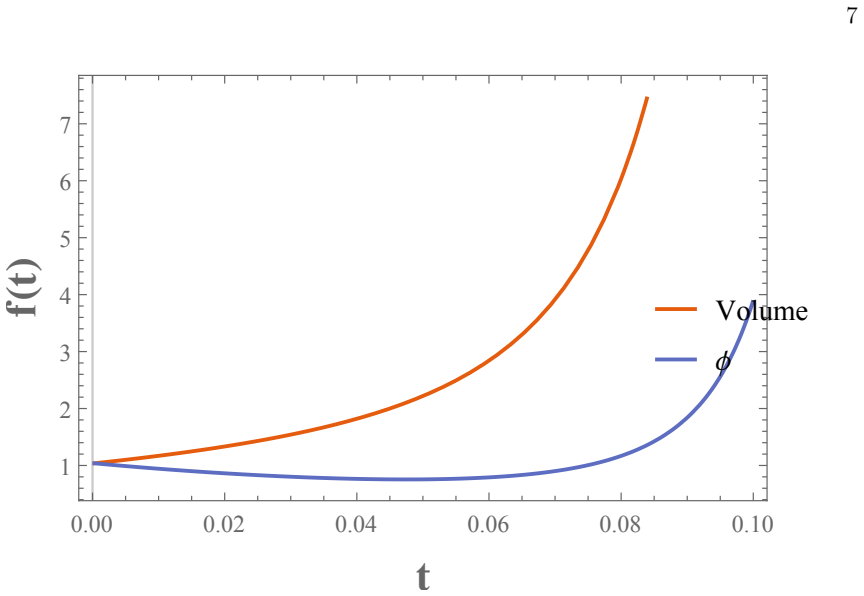
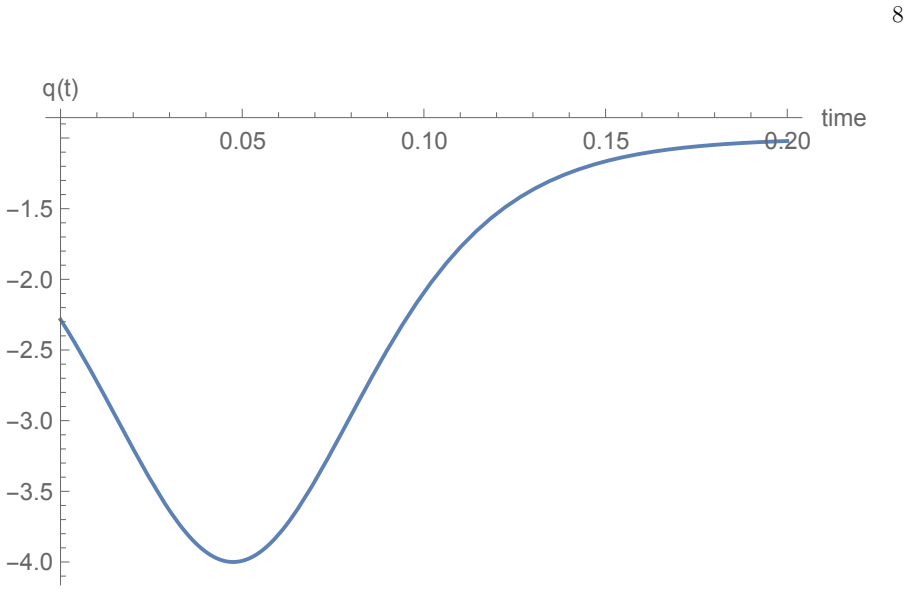
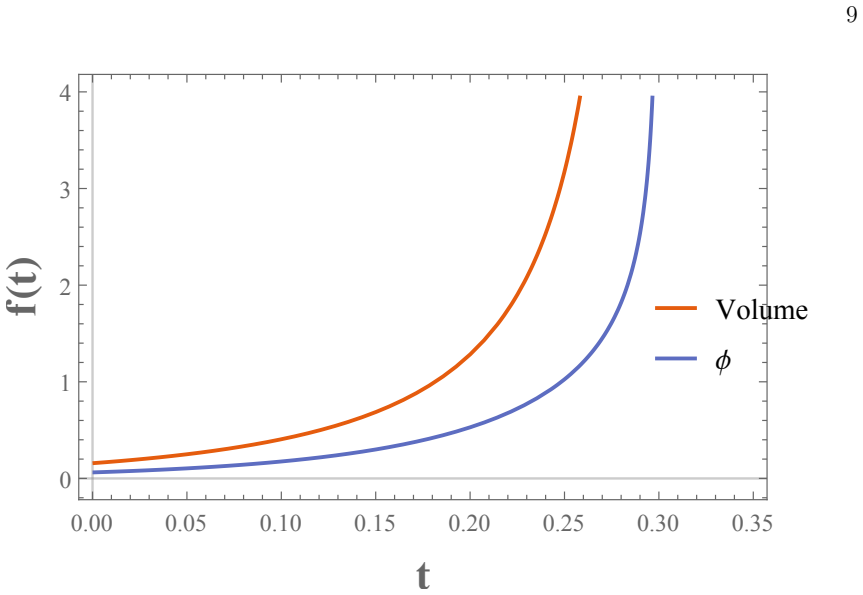
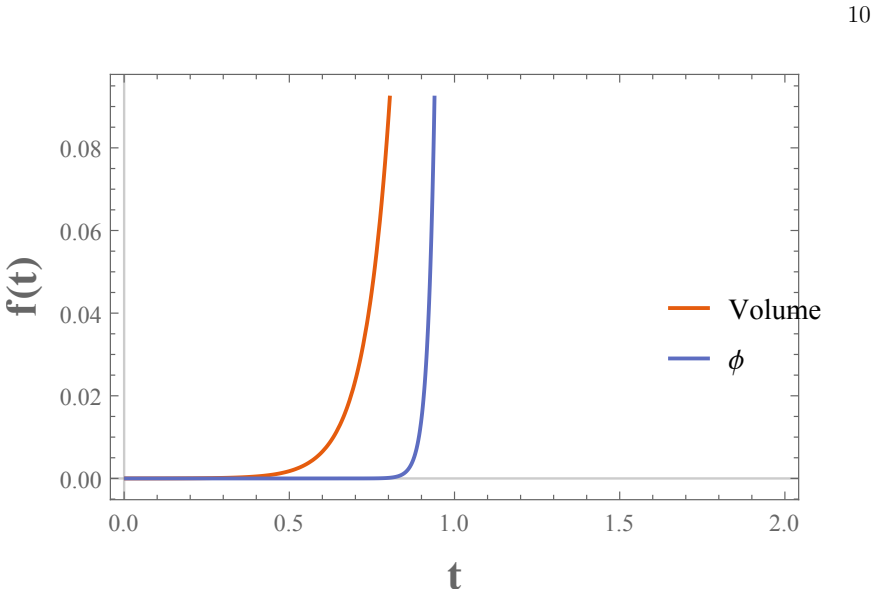
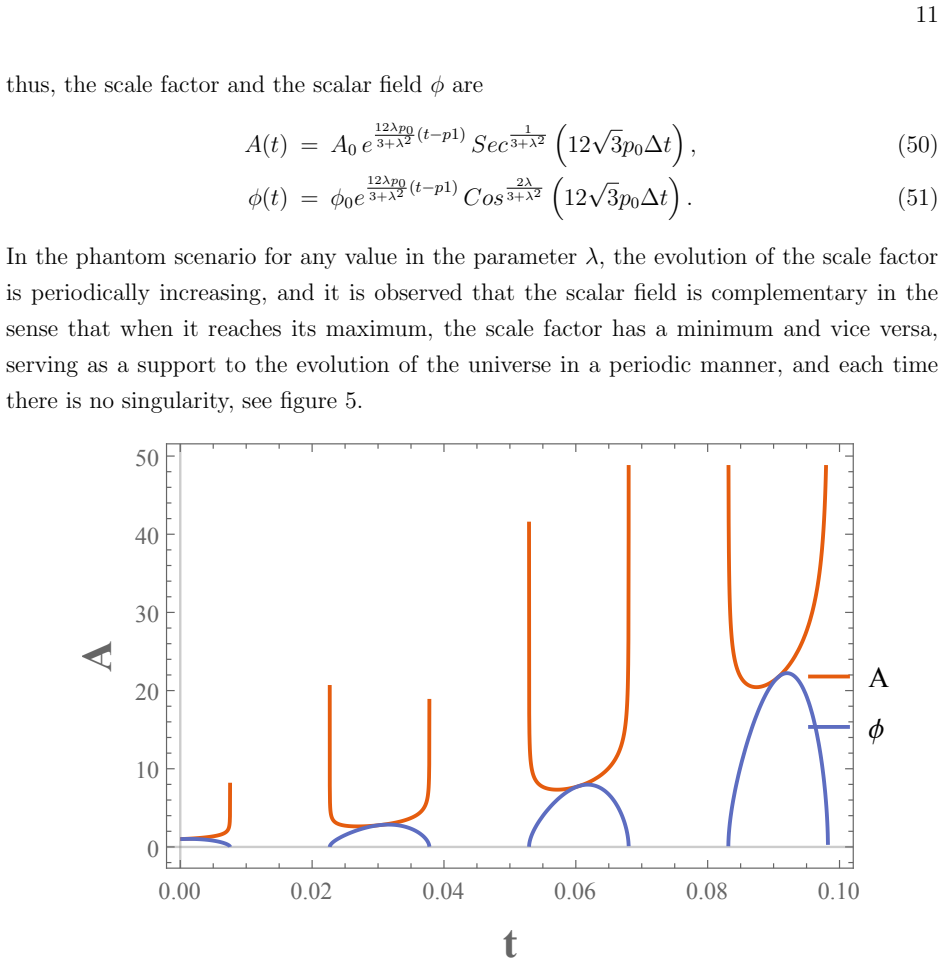
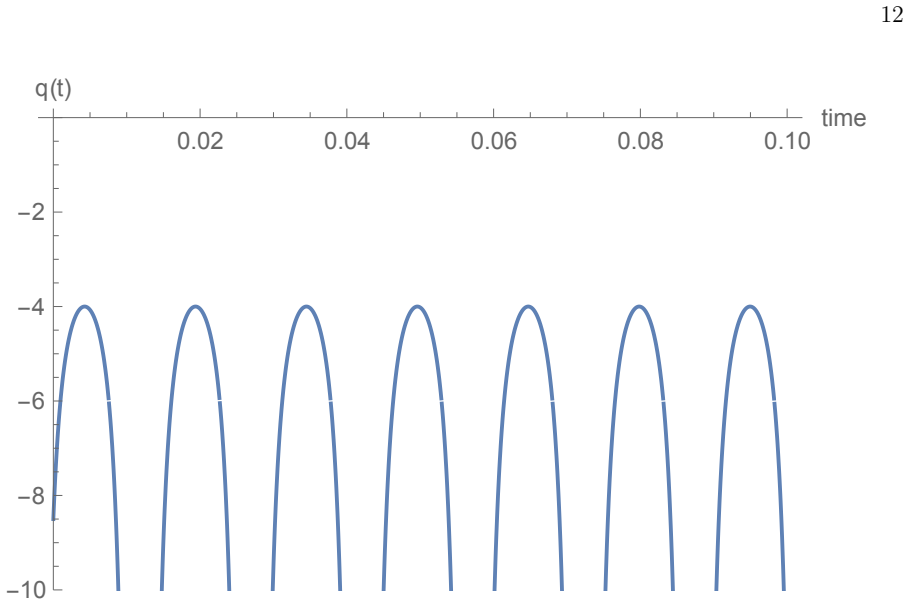
By means of a suitable field redefinition from ϕ to varphi, the resulting field equations acquire a mathematical structure analogous to that of a previously solved FLRW cosmological model. This correspondence allows us to obtain exact classical solutions for both the scale factor and the scalar field within the Hamiltonian formalism. The resulting cosmological dynamics exhibits a late-time accelerated expansion, with the deceleration parameter approaching the asymptotic value q→ -1, characteristic of a de Sitter phase. At the quantum level, the corresponding Wheeler-DeWitt equation is derived and exact quantum solutions are obtained.
What carries the argument
The field redefinition from ϕ to varphi that maps the K-essence equations onto the structure of a previously solved FLRW model, enabling exact solvability in the Hamiltonian formalism.
If this is right
- Exact classical expressions exist for both the scale factor and the scalar field.
- The deceleration parameter q approaches -1 asymptotically, producing de Sitter-like expansion at late times.
- Exact solutions to the Wheeler-DeWitt equation exist and describe the quantum evolution of the model.
- The scalar field functions as a cosmic background in the quantum description.
Where Pith is reading between the lines
- The same redefinition technique could be tested on other K-essence potentials to check whether exact solvability appears more generally.
- The classical solutions could be matched to observational Hubble data to constrain the power-law index in the potential.
- The quantum solutions might be used to extract expectation values for the scale factor at early times.
Load-bearing premise
The field redefinition from ϕ to varphi maps the K-essence equations to an analogous structure of a previously solved FLRW model while preserving physical equivalence and allowing exact solvability in the Hamiltonian formalism without introducing inconsistencies.
What would settle it
Substituting the derived exact solutions back into the original unredefined field equations and checking whether they satisfy the equations identically would falsify the claimed correspondence if they do not.
Figures
read the original abstract
We investigate a K-essence like cosmological model whose scalar-field potential is constructed from a negative power-law S\'aez--Ballester potential. By means of a suitable field redefinition from $\phi$ to $\varphi$, we show that the resulting field equations acquire a mathematical structure analogous to that of a previously solved Friedmann-Lema\^itre-Robertson-Walker (FLRW) cosmological model. This correspondence allows us to obtain exact classical solutions for both the scale factor and the scalar field within the Hamiltonian formalism. The resulting cosmological dynamics exhibits a late-time accelerated expansion, with the deceleration parameter approaching the asymptotic value $q\rightarrow -1$, characteristic of a de Sitter phase. At the quantum level, the corresponding Wheeler-DeWitt (WDW) equation is derived and exact quantum solutions are obtained. These results provide a consistent classical and quantum description of the cosmological evolution generated by this class of K-essence models. In this formalism, the scalar field remains as a cosmic background where the universe unfolds, which is glimpsed from the quantum solution perspective.
Editorial analysis
A structured set of objections, weighed in public.
Referee Report
Summary. The manuscript investigates a K-essence cosmological model whose scalar potential derives from a negative power-law Saez-Ballester term. A field redefinition ϕ → varphi is used to map the field equations onto the structure of a previously solved FLRW model, permitting exact classical solutions for the scale factor and scalar field within the Hamiltonian formalism. The resulting dynamics shows late-time acceleration with q → −1 (de Sitter asymptote). The corresponding Wheeler-DeWitt equation is derived and solved exactly at the quantum level.
Significance. If the redefinition preserves the Hamiltonian structure, the work supplies rare exact classical and quantum solutions for this class of models. Such explicit solutions can serve as benchmarks and the mapping technique may extend to related scalar-tensor or K-essence systems.
major comments (1)
- [Field redefinition and Hamiltonian formalism] Field redefinition (abstract and Hamiltonian section): the mapping ϕ → varphi must be shown to be a canonical transformation in minisuperspace, i.e., the symplectic form p_ϕ dϕ equals p_ϕ dϕ plus a total derivative so that the Hamiltonian constraint and its quantization remain equivalent. The manuscript provides no explicit verification of Poisson brackets or the symplectic structure; without it the claimed exact solutions and WDW wave functions are not guaranteed to describe the original theory.
minor comments (2)
- Add the specific reference for the 'previously solved FLRW cosmological model' to which the equations are mapped.
- Clarify the explicit form of the redefinition and the resulting Hamiltonian constraint with numbered equations so that the correspondence can be checked directly.
Simulated Author's Rebuttal
We thank the referee for the careful reading of the manuscript and for the constructive comment regarding the field redefinition. We address the major point below and will revise the manuscript accordingly to strengthen the presentation.
read point-by-point responses
-
Referee: [Field redefinition and Hamiltonian formalism] Field redefinition (abstract and Hamiltonian section): the mapping ϕ → varphi must be shown to be a canonical transformation in minisuperspace, i.e., the symplectic form p_ϕ dϕ equals p_ϕ dϕ plus a total derivative so that the Hamiltonian constraint and its quantization remain equivalent. The manuscript provides no explicit verification of Poisson brackets or the symplectic structure; without it the claimed exact solutions and WDW wave functions are not guaranteed to describe the original theory.
Authors: We agree that an explicit verification of the canonical character of the transformation is required for rigor. The redefinition ϕ → varphi is a point transformation in the configuration space of the minisuperspace variables. Because the original Lagrangian density is rewritten in terms of the new field varphi while preserving the form of the kinetic term (up to a redefinition of the potential), the transformation induces a corresponding redefinition of the conjugate momentum such that the symplectic form is preserved up to an exact differential. Consequently the Hamiltonian constraint remains equivalent. Nevertheless, the manuscript does not contain the explicit computation of the Poisson brackets or the pull-back of the symplectic two-form. We will add a short subsection (or appendix) in the Hamiltonian formalism section that (i) computes the new momenta, (ii) verifies {varphi, p_varphi} = 1, and (iii) shows that the transformed constraint is identical to the original one. With this addition the subsequent classical solutions and the Wheeler-DeWitt quantization are guaranteed to apply to the original theory. revision: yes
Circularity Check
No significant circularity; derivation relies on explicit field redefinition to an independent prior model
full rationale
The central step is a field redefinition ϕ → varphi that maps the K-essence + Saez-Ballester equations onto the structure of a previously solved FLRW model, after which exact solutions are imported. This is a standard reduction technique rather than a self-definitional loop or fitted-input prediction. The abstract and description present the prior FLRW model as external; no load-bearing self-citation chain, uniqueness theorem, or ansatz smuggling is quoted. The Hamiltonian and WDW steps follow from the mapped equations, not by renaming the input. The result is therefore self-contained against external benchmarks.
Axiom & Free-Parameter Ledger
axioms (1)
- domain assumption The field redefinition from ϕ to varphi maps the K-essence equations to those of a standard FLRW model without loss of physical content.
Reference graph
Works this paper leans on
-
[1]
In the following we will assume such factor ordering for the Wheeler-DeWitt equation, which becomes 13 A
have suggested what might be called a semi-general factor ordering, which in this case would order e −3Ω ˆΠ2 Ω as −e−(3−Q)Ω ∂Ωe−QΩ∂Ω =−e −3Ω ∂2 Ω + Q e−3Ω∂Ω,(52) where Q is any real constant that measure the ambiguity in the factor ordering for the variable Ω. In the following we will assume such factor ordering for the Wheeler-DeWitt equation, which beco...
-
[2]
At Q=0 it becomes indeterminate, but forQ >0 it reverts 14 FIG
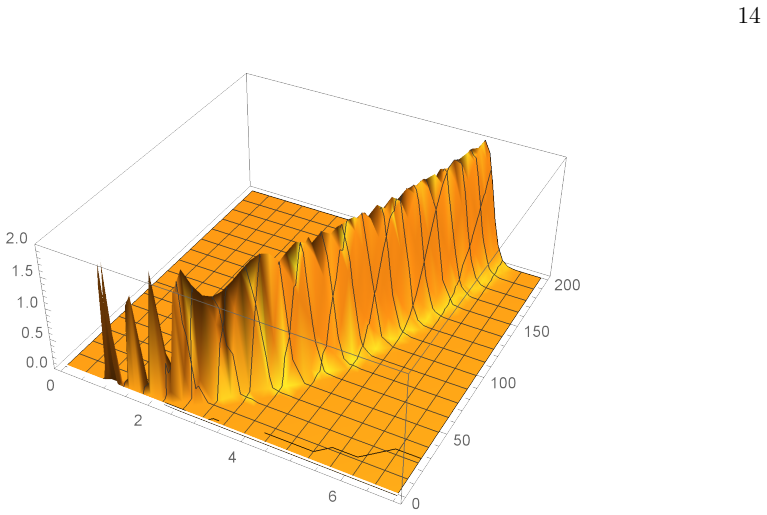
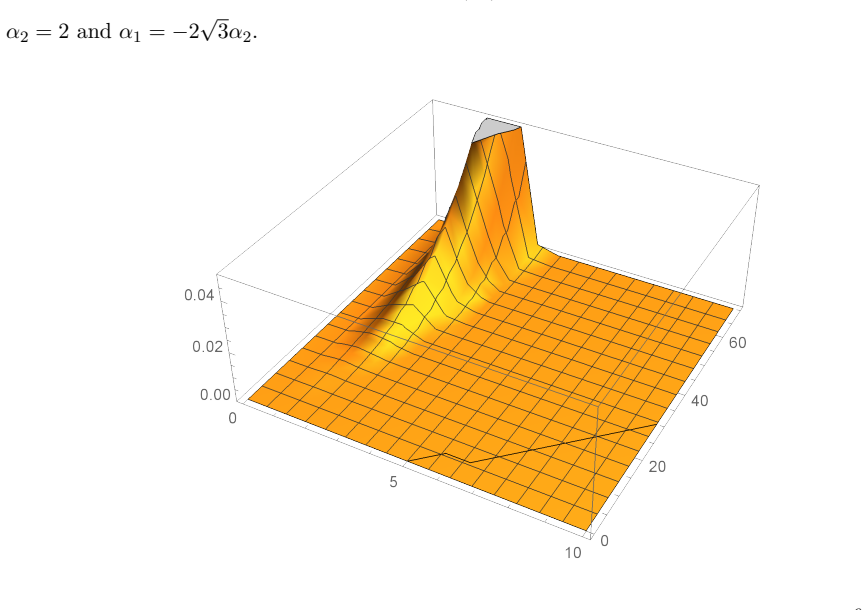
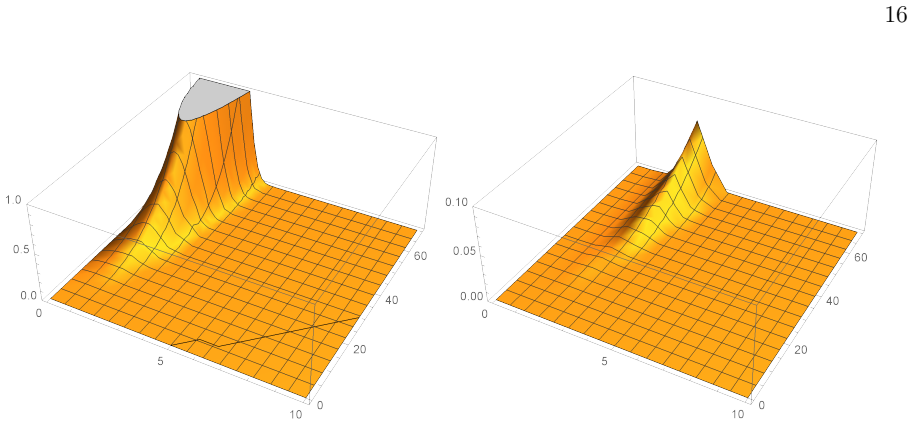
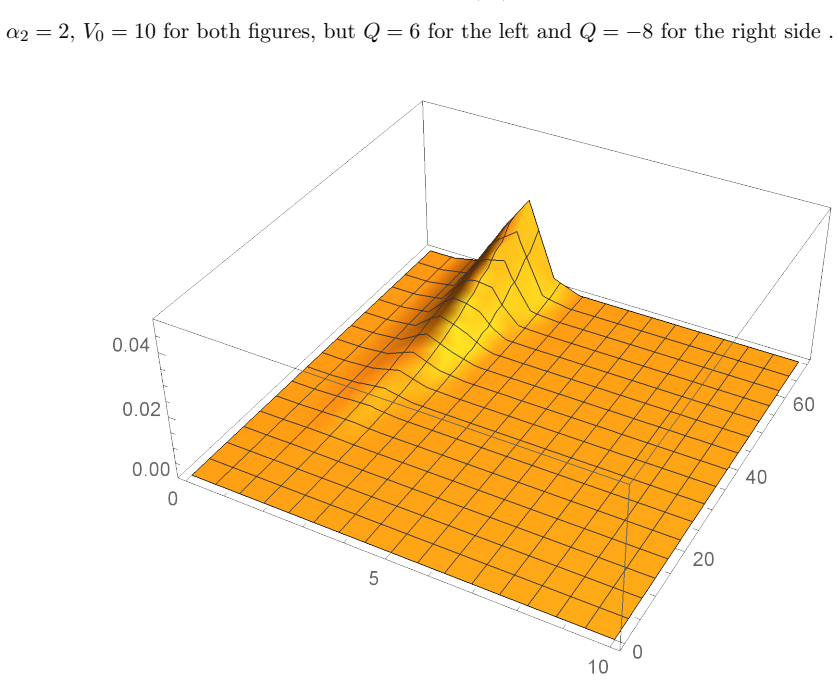
Whenλ= √ 3, the wave function is Ψ(x,y) = Ψ 0eyExp β1 β3 x− β2 β3 ex , that written in the original variables (A, ϕ) is Ψ(A, ϕ) = Ψ0Aν1ϕν2 Exp − β2 β3 A6ϕ− √ 3 ,(57) with the constantsβ 1 andβ 2 are the same, butβ 3 = 6(2α 1 + 4 √ 3α2 −Q) and the constantsν 1 =α 1 + 6 β1 β3 andν 2 =α 2 − √ 3 β1 β3 , and chosing the values to constants α1 =−2 √ 3α2,α 2 = 2...
-
[3]
Forλ > √ 3, the differential equation for the functionu(x) become d2u(x) dx2 −η 1 du(x) dx + (η2 −η 3ex)u(x) = 0 (58) where the constantsη 1 = 2α1+4λα2−Q 2(λ2−3) ,η 2 = 12α2 2−α2 1+6Qα1 12(λ2−3) andη 3 = 2V0 ℏ2(λ2−3), following at Polyanin [23], the solution become u(x) =u 0 e η1 2 xKν 2√η3e x 2 ,(59) where the orderν= p η2 1 −4η 2 andK ν is the modified ...
-
[4]
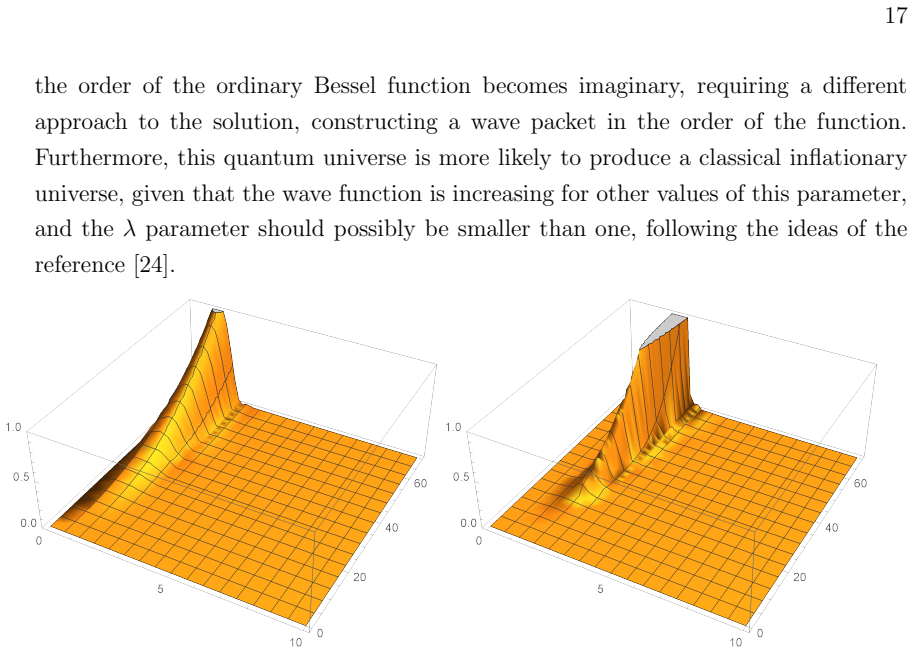
Then the complete solution for this case become Ψ(x, y) =u 0e− η1 2 x+y Jν 2√η3e x 2 = Ψ 0Aα1−3η1 ϕα2+ λη1 2 Jν 2√η3A3 ϕ− λ 2 .(63) 16 FIG
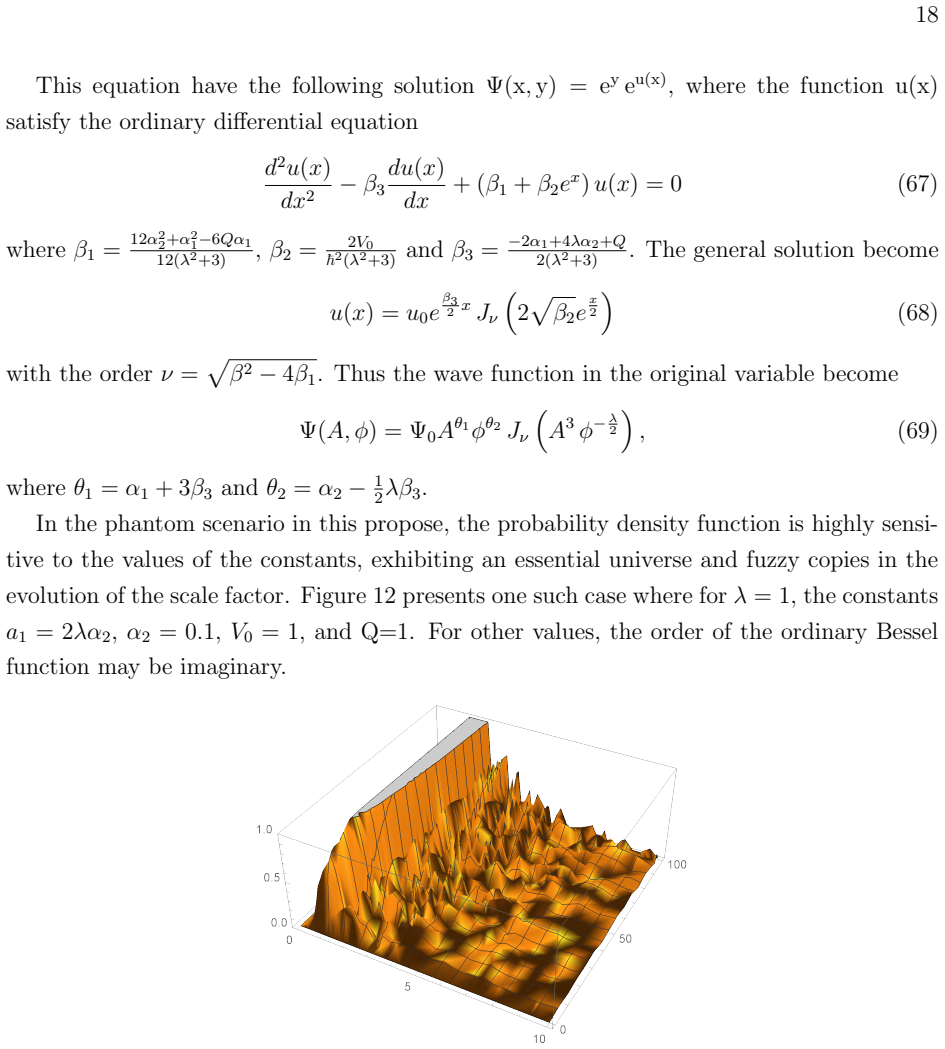
Forλ < √ 3, the differential equation for the functionu(x) become d2u(x) dx2 +η 1 du(x) dx + (−η2 +η 3ex)u(x) = 0 (61) where the constantsη 1 = 2α1+4λα2−Q 2(3−λ2) ,η 2 = 12α2 2−α2 1+6Qα1 12(3−λ2) andη 3 = 2V0 ℏ2(3−λ2), following at Polyanin [23], the solution become u(x) =u 0 e− η1 2 xKν 2√η3e x 2 ,(62) where the orderν= p η2 1 + 4η2 andJ ν is the ordinar...
-
[5]
Jean-Philippe Uzan, Phys. Rev. D59, 123510 (1999),Cosmological scaling solutions of non- minimally coupled scalar fields. 20
1999
-
[6]
Lobo, M.K
Tiberiu Harko, Francisco S.N. Lobo, M.K. Mak, Eur. Phys. J. C74, 2784 (2014),Arbitrary scalar-field and quintessence cosmological models
2014
-
[7]
Leon and Emmanuel N Saridakis, Classical and Quantum Grav31, 075018 (2014),Dynamical analysis of anisotropic scalar-field cosmologies for a wide range of potentials
C.R Fadragas, G. Leon and Emmanuel N Saridakis, Classical and Quantum Grav31, 075018 (2014),Dynamical analysis of anisotropic scalar-field cosmologies for a wide range of potentials
2014
-
[8]
J. Dutta, W. Khyllep and N. Tamanini, Phys. Rev. D95, 023515 (2017),Scalar-Fluid interact- ing dark energy: cosmological dynamics beyond the exponential potential, [arXiv:1701.00744]
Pith/arXiv arXiv 2017
-
[9]
Genly Leon, Alan Coley, Andronikos Paliathanasis, Jonathan Tot and Balkar Yildirim, Physics of the Dark Universe45, 101503 (2024),Global dynamics of two models for Quintom Friedman- Lemaitre-Robertson-Walker universes
2024
-
[10]
Abraham Espinoza Garc´ ıa, J. Socorro and Luis O. Pimentel, Int. J. of Theor. Phys.53 (9), 3066-3077 (2014),Quantum Bianchi type IX cosmology in K-essence theory.DOI: 10.1007/s10773-014-2102-0
-
[11]
Roland de Putter and Eric V. Linder,Astropart. Phys.28, 263 (2007).Kinetic k-essence and Quintessence. [arXiv:0705.0400]
Pith/arXiv arXiv 2007
-
[12]
T. Chiba, S. Dutta and R.J. Scherrer,Phys. Rev. D80, 043517 (2009).Slow-roll k-essence, [arXiv:0906.0628]
Pith/arXiv arXiv 2009
-
[13]
N. Bose and A.S. Majumdar,Phys. Rev. D79, 103517 (2009).A k-essence model of inflation, dark matter and dark energy, [arXiv:0812.4131]
Pith/arXiv arXiv 2009
-
[14]
F. Arroja and M. Sasaki,Phys. Rev. D81, 107301 (2010).A note on the equivalence of a barotropic perfect fluid with a k-essence scalar field, [arXiv:1002.1376]
Pith/arXiv arXiv 2010
-
[15]
L.A. Garc´ ıa, J.M. Tejeiro and L. Casta˜ neda,K-essence scalar field as dynamical dark energy, [arXiv:1210.5259]
-
[16]
Saez, and V.J
D. Saez, and V.J. Ballester, Physics Letters A113, 467 (1986),A Simple Coupling with Cosmological Implications
1986
-
[17]
M. Sabido, J. Socorro and L. Arturo Ure˜ na-L´ opez, Fizika B,19(4), 177-186 (2010),Classical and quantum Cosmology of the S´ aez-Ballester theory, [arXiv:0904.0422]
Pith/arXiv arXiv 2010
-
[18]
J. Socorro, M. Sabido, M.A. S´ anchez G. and M.G. Fr´ ıas Palos, Rev. Mex. F´ ıs.56(2), 166- 171 (2010),Anisotropic cosmology in S´ aez-Ballester theory: classical and quantum solutions, [arxiv:1007.3306]
Pith/arXiv arXiv 2010
-
[19]
J. Socorro, S. P´ erez-Pay´ an, Rafael Hern´ andez-Jim´ enez, Abraham Espinoza-Garc´ ıa and Luis Rey D´ ıaz-Barr´ on, Class. Quantum Grav.38, 135027 (2021),Classical and quantum exact 21 solutions for a FRW in chiral like cosmology.[arXiv:2012.11108, (gr-qc)]
arXiv 2021
-
[20]
Dimakis and A
N. Dimakis and A. Paliathanasis, Class. Quant. Grav.38, (2021),Crossing the phantom divide line as a effect of quantum transistions
2021
-
[21]
Chimento, Phys
Luis P. Chimento, Phys. Rev. D69, 123517 (2004), Extended tachyon field, Chaplygin gas, and solvable k-essence cosmologies
2004
-
[22]
Socorro and Marco D’oleire, Phys
J. Socorro and Marco D’oleire, Phys. Rev. D82(4), 044008 (2010),Inflation from supersym- metric quantum cosmology
2010
-
[23]
J. Socorro and Omar E. Nu˜ nez, Eur. Phys. Journal Plus132: 168 (2017),Scalar poten- tials with multi-scalar fields from quantum cosmology and supersymetric quantum mechanics, [arXiv:1702.00478]
Pith/arXiv arXiv 2017
-
[24]
Gibbons and L.P
G.W. Gibbons and L.P. Grishchuk, Nucl. Phys. B313, 736 (1989),What is a typical wave function for the universe?
1989
-
[25]
Hartle and S.W
J. Hartle and S.W. Hawking, Phys. Rev. D28, 2960 (1983),Wave function of the Universe
1983
-
[26]
Hawking, Nucl
S.W. Hawking, Nucl. Phys. B239, 257 (1983),The Quantum State of the Universe
1983
-
[27]
Zaitsev, V.F., & Polyanin, A.D., inHandbook of Exact Solutions for Ordinary Differential Equations(Taylor & Francis Editorial, 2002)
2002
-
[28]
Omar E. N´ u˜ nez, J. Socorro and Rafael Hern´ andez-Jim´ enez, Astrophys. Space Sci.364, 69. (2019),Hamilton’s approach in cosmological inflation with an exponential potential and its observational constraints., [arXiv:1806.01190]
Pith/arXiv arXiv 2019
-
[29]
J. Socorro, Juan Luis P´ erez, Luis Rey D´ ıaz-Barr´ on, Abraham Espinoza Garc´ ıa, Sinuh´ e P´ erez Pay´ an,F(R,..) theories from the point of view of the Hamiltonian approach: non-vacuum Anisotropic Bianchi type I cosmological model, [arXiv:2512.10850 [gr-qc]]
discussion (0)
Sign in with ORCID, Apple, or X to comment. Anyone can read and Pith papers without signing in.