Learning-Based List Sequential Belief Propagation Decoding of Quantum LDPC Codes
Pith reviewed 2026-06-26 15:03 UTC · model grok-4.3
The pith
A reinforcement learning list-sequential BP decoder improves decoding performance for quantum LDPC codes over the depolarizing channel.
A machine-rendered reading of the paper's core claim, the machinery that carries it, and where it could break.
Core claim
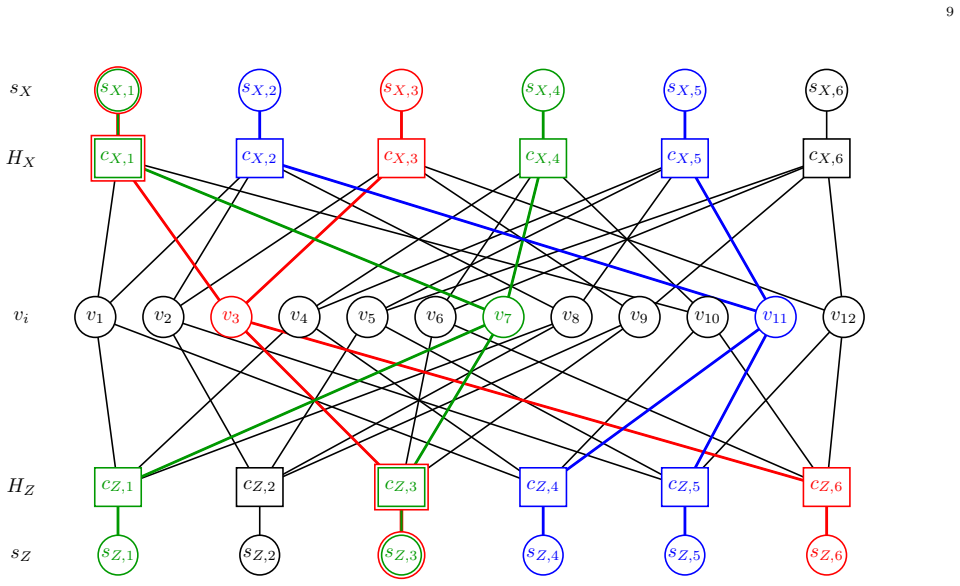
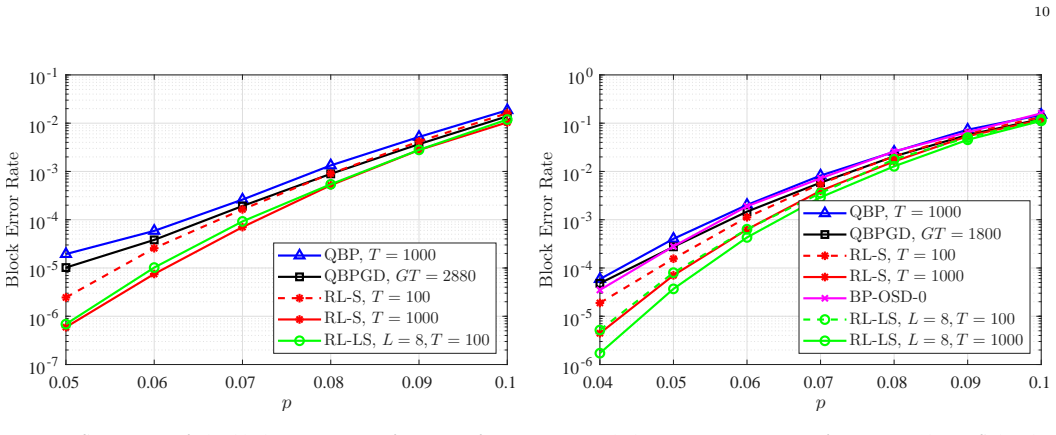
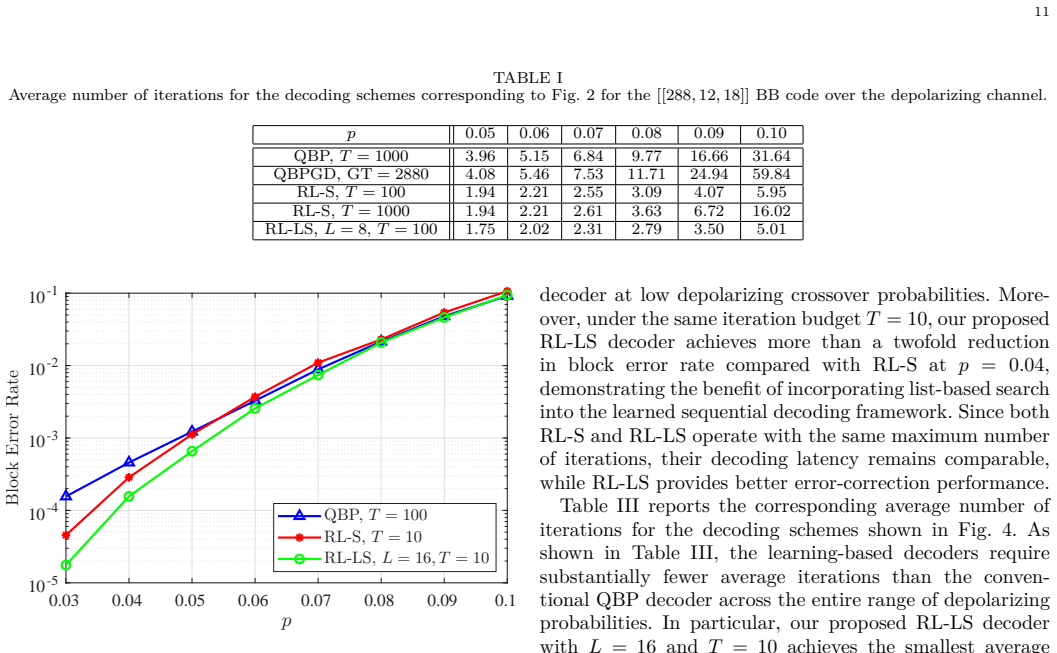
The authors introduce the RL-LS BP decoder by extending the RL-S framework with list-based search. At each step a learned policy chooses the next variable node to update; the decoder retains the main trajectory while also creating a competing branch by softly biasing the post-update LLR pair toward the second-most-likely Pauli symbol, recomputing incident local BP messages, and assigning that symbol to the visited node. Candidate trajectories are ranked and pruned using a proposed cumulative path metric. Numerical results on representative QLDPC benchmark codes over the depolarizing channel show that the method improves the decoding performance of the underlying decoder and compares favorabl
What carries the argument
The RL-LS BP decoder, which pairs a learned policy for sequential variable-node scheduling with list exploration of a softly biased second-best symbol branch that is ranked by cumulative path metric.
If this is right
- The decoder raises the success rate of belief-propagation decoding on the tested QLDPC codes over the depolarizing channel.
- List exploration of a second-best symbol branch yields better trajectories than the single learned scheduling path alone.
- The combined method outperforms or matches several existing BP-based decoders on the same benchmark instances.
- Learned sequential scheduling plus list search together mitigate the convergence problems caused by short cycles and degeneracy.
Where Pith is reading between the lines
- The same list-augmented scheduling idea could be tested on non-QLDPC quantum codes that also exhibit poor BP convergence.
- Combining the RL-LS trajectories with a post-processing step such as ordered-statistics decoding might produce still lower error rates.
- The cumulative path metric itself could be studied in isolation to see how much of the gain comes from ranking rather than from the learned policy.
- Scaling the approach to larger code lengths would test whether the learned policy continues to generalize when the Tanner graph grows.
Load-bearing premise
The learned policy for variable-node scheduling generalizes across codes and noise levels and the list exploration with soft biasing toward the second-most-likely symbol reliably produces better trajectories than the single learned path.
What would settle it
Executing the RL-LS decoder on the same representative QLDPC benchmark codes over the depolarizing channel and measuring a frame error rate or bit error rate no lower than that achieved by the base RL-S decoder or other BP methods would disprove the claimed performance gain.
Figures
read the original abstract
Quantum low-density parity-check (QLDPC) codes are strong candidates for fault-tolerant quantum computation, but efficient decoding remains a major challenge due to short cycles, degeneracy, and the poor convergence of standard belief-propagation (BP) decoders. We propose a reinforcement learning-based list sequential (RL-LS) BP decoder for QLDPC codes by extending the reinforcement-learning-based sequential variable-node scheduling (RL-S) framework with list-based search. At each step, the learned policy selects the next variable node to update; the decoder then retains the ordinary RL-S trajectory while also exploring a competing branch obtained by softly biasing the post-update LLR pair toward the second-most likely Pauli symbol, recomputing the incident local BP messages, and setting the visited variable node to that second-best symbol. Candidate trajectories are ranked and pruned using our proposed cumulative path metric. The resulting decoder extends the learned decoder by combining the improved convergence of learned sequential scheduling with list exploration. Numerical results on representative QLDPC benchmark codes over the depolarizing channel show that our proposed method improves the decoding performance of the underlying decoder and compares favorably with existing BP-based decoding methods.
Editorial analysis
A structured set of objections, weighed in public.
Referee Report
Summary. The paper proposes a reinforcement learning-based list sequential belief propagation (RL-LS BP) decoder for quantum LDPC codes. It extends the prior RL-S framework by incorporating list-based search: a learned policy selects the next variable node to update, the decoder retains the RL-S trajectory while exploring a competing branch via soft biasing of the post-update LLR pair toward the second-most likely Pauli symbol, and trajectories are ranked and pruned using a proposed cumulative path metric. Numerical results on representative QLDPC benchmark codes over the depolarizing channel are reported to show improved decoding performance relative to the underlying decoder and favorable comparisons with existing BP-based methods.
Significance. If the reported empirical gains are reproducible, the work offers a practical contribution to decoding QLDPC codes by combining learned variable-node scheduling with targeted list exploration, addressing convergence difficulties arising from short cycles and degeneracy. The explicit extension of the RL-S framework and the provision of numerical comparisons on standard benchmarks constitute strengths that allow readers to assess the incremental benefit.
minor comments (2)
- [Method] The description of the cumulative path metric and the soft-biasing rule for the second branch would benefit from an explicit equation or pseudocode block in the method section to clarify implementation details.
- [Numerical Results] The numerical results section should include a table or explicit listing of the exact code parameters (length, rate, girth), training hyperparameters, and number of Monte Carlo trials for each reported curve to support reproducibility.
Simulated Author's Rebuttal
We thank the referee for the positive summary of our work on the RL-LS BP decoder and for recommending minor revision. The referee's description accurately reflects the extension of the RL-S framework with list-based search and the reported numerical results on benchmark QLDPC codes.
Circularity Check
No significant circularity
full rationale
The paper proposes RL-LS as an explicit extension of the authors' prior RL-S framework and supports its performance claims solely through numerical simulations on representative QLDPC codes under depolarizing noise. No equations, fitted parameters, or uniqueness theorems are presented that reduce the claimed gains to quantities defined by the authors' own prior results; the central empirical improvement is independently verifiable on the stated benchmarks and does not rely on self-citation chains for its validity.
Axiom & Free-Parameter Ledger
Reference graph
Works this paper leans on
-
[1]
Scheme for reducing decoherence in quantum computer memory,
P. W. Shor, “Scheme for reducing decoherence in quantum computer memory,” Physical Review A, vol. 52, no. 4, pp. R2493– R2496, 1995
1995
-
[2]
Quantum error correction for quantum memo- ries,
B. M. Terhal, “Quantum error correction for quantum memo- ries,” Reviews of Modern Physics, vol. 87, no. 2, pp. 307–346, 2015
2015
-
[3]
Quantum low-density parity-check codes,
N. P. Breuckmann and J. N. Eberhardt, “Quantum low-density parity-check codes,” PRX Quantum, vol. 2, no. 4, p. 040101, 2021
2021
-
[4]
Quantum LDPC codes with positive rate and minimum distance proportional to the square root of the blocklength,
J.-P. Tillich and G. Zémor, “Quantum LDPC codes with positive rate and minimum distance proportional to the square root of the blocklength,” IEEE Transactions on Information Theory, vol. 60, no. 2, pp. 1193–1202, 2014
2014
-
[5]
Balanced product quantum codes,
N. P. Breuckmann and J. N. Eberhardt, “Balanced product quantum codes,” IEEE Transactions on Information Theory, vol. 67, no. 10, pp. 6653–6674, 2021
2021
-
[6]
Asymptotically good quantum and locally testable classical LDPC codes,
P. Panteleev and G. Kalachev, “Asymptotically good quantum and locally testable classical LDPC codes,” in Proceedings of the 54th Annual ACM SIGACT Symposium on Theory of Computing, 2022, pp. 375–388
2022
-
[7]
Quantum Tanner codes,
A. Leverrier and G. Zémor, “Quantum Tanner codes,” in 2022 IEEE 63rd Annual Symposium on Foundations of Computer Science (FOCS), 2022, pp. 872–883
2022
-
[8]
High-threshold and low-overhead fault-tolerant quantum memory,
S. Bravyi, A. W. Cross, J. M. Gambetta, D. Maslov, P. Rall, and T. J. Yoder, “High-threshold and low-overhead fault-tolerant quantum memory,” Nature, vol. 627, pp. 778–782, 2024
2024
-
[9]
K. Kasai, “Breaking the orthogonality barrier in quantum LDPC codes,” arXiv preprint arXiv:2601.08824, 2026
-
[10]
Towards Ultra-High-Rate Quantum Error Correction with Reconfigurable Atom Arrays
C. Zhao, C. Duckering, A. Gu, N. Maskara, and H. Zhou, “Towards ultra-high-rate quantum error correction with recon- figurable atom arrays,” arXiv preprint arXiv:2604.16209, 2026
work page internal anchor Pith review Pith/arXiv arXiv 2026
-
[11]
Decoding across the quantum LDPC code landscape,
J. Roffe, D. R. White, S. Burton, and E. T. Campbell, “Decoding across the quantum LDPC code landscape,” Physical Review Research, vol. 2, no. 4, p. 043423, 2020
2020
-
[12]
Low-density parity-check codes,
R. Gallager, “Low-density parity-check codes,” IRE Transactions on Information Theory, vol. 8, no. 1, pp. 21–28, 1962
1962
-
[13]
Near Shannon limit perfor- mance of low density parity check codes,
D. J. C. MacKay and R. M. Neal, “Near Shannon limit perfor- mance of low density parity check codes,” Electronics Letters, vol. 32, no. 18, pp. 1645–1646, 1996
1996
-
[14]
Factor graphs and the sum-product algorithm,
F. R. Kschischang, B. J. Frey, and H.-A. Loeliger, “Factor graphs and the sum-product algorithm,” IEEE Transactions on Information Theory, vol. 47, no. 2, pp. 498–519, 2001
2001
-
[15]
The capacity of low- density parity-check codes under message-passing decoding,
T. J. Richardson and R. L. Urbanke, “The capacity of low- density parity-check codes under message-passing decoding,” IEEE Transactions on Information Theory, vol. 47, no. 2, pp. 599–618, 2001
2001
-
[16]
On the iterative decoding of sparse quantum codes,
D. Poulin and Y. Chung, “On the iterative decoding of sparse quantum codes,” Quantum Information & Computation, vol. 8, no. 10, pp. 987–1000, 2008
2008
-
[17]
Exploiting degeneracy in belief prop- agation decoding of quantum codes,
K.-Y. Kuo and C.-Y. Lai, “Exploiting degeneracy in belief prop- agation decoding of quantum codes,” npj Quantum Information, vol. 8, no. 1, p. 111, 2022
2022
-
[18]
Trapping sets of quantum LDPC codes,
N. Raveendran and B. Vasić, “Trapping sets of quantum LDPC codes,” Quantum, vol. 5, p. 562, 2021
2021
-
[19]
Stabilizer inactivation for message-passing decoding of quantum LDPC codes,
J. du Crest, M. Mhalla, and V. Savin, “Stabilizer inactivation for message-passing decoding of quantum LDPC codes,” in 2022 IEEE Information Theory Workshop (ITW), 2022, pp. 488–493
2022
-
[20]
Localized statistics decoding for quantum low- density parity-check codes,
T. Hillmann, L. Berent, A. O. Quintavalle, J. Eisert, R. Wille, and J. Roffe, “Localized statistics decoding for quantum low- density parity-check codes,” Nature Communications, vol. 16, p. 8214, 2025
2025
-
[21]
Neural belief propagation decoding of quantum LDPC codes using overcomplete check matrices,
S. Miao, A. Schnerring, H. Li, and L. Schmalen, “Neural belief propagation decoding of quantum LDPC codes using overcomplete check matrices,” in 2023 IEEE Information Theory Workshop (ITW), 2023, pp. 215–220
2023
-
[22]
Quaternary neural belief propagation decoding of quan- tum LDPC codes with overcomplete check matrices,
——, “Quaternary neural belief propagation decoding of quan- tum LDPC codes with overcomplete check matrices,” IEEE Access, vol. 13, pp. 25 637–25 649, 2025
2025
-
[23]
Graph neural networks for enhanced decoding of quantum LDPC codes,
A. Gong, S. Cammerer, and J. M. Renes, “Graph neural networks for enhanced decoding of quantum LDPC codes,” in 2024 IEEE International Symposium on Information Theory (ISIT), 2024, pp. 2700–2705
2024
-
[24]
Enhanced message-passing decoding of degenerate quantum codes utilizing trapping set dynamics,
D. Chytas, M. Pacenti, N. Raveendran, M. F. Flanagan, and B. Vasić, “Enhanced message-passing decoding of degenerate quantum codes utilizing trapping set dynamics,” IEEE Com- munications Letters, vol. 28, no. 3, pp. 444–448, 2024
2024
-
[25]
Belief propagation decoding of quantum LDPC codes with guided decimation,
H. Yao, W. A. Laban, C. Häger, A. G. i Amat, and H. D. Pfister, “Belief propagation decoding of quantum LDPC codes with guided decimation,” in 2024 IEEE International Symposium on Information Theory (ISIT), 2024, pp. 2478–2483
2024
-
[26]
Layered decoding of quantum LDPC codes,
J. du Crest, F. Garcia-Herrero, M. Mhalla, V. Savin, and J. Valls, “Layered decoding of quantum LDPC codes,” in 2023 12th International Symposium on Topics in Coding (ISTC), 2023, pp. 1–5
2023
-
[27]
Sequential BP-based decoding of QLDPC codes,
M. Moradi, S. Habib, V. Nourozi, and D. G. M. Mitchell, “Sequential BP-based decoding of QLDPC codes,” CoRR, vol. abs/2602.13420, 2026
-
[28]
Informed dynamic scheduling for QLDPC codes,
T.-H. Huang and Y.-L. Ueng, “Informed dynamic scheduling for QLDPC codes,” Quantum, vol. 10, p. 1967, 2026
1967
-
[29]
Fully parallelized BP decoding for quantum LDPC codes can outperform BP-OSD,
M. Wang, A. Li, and F. Mueller, “Fully parallelized BP decoding for quantum LDPC codes can outperform BP-OSD,” CoRR, vol. abs/2507.00254, 2025. 13
-
[30]
List decoding and new bicycle code constructions for quantum LDPC codes,
S. Rabeti and H. Mahdavifar, “List decoding and new bicycle code constructions for quantum LDPC codes,” CoRR, vol. abs/2511.02951, 2025
-
[31]
Learned parallel bit- flipping sequential belief propagation decoding of quantum LDPC codes,
M. Moradi, T. Kim, and R. A. Chou, “Learned parallel bit- flipping sequential belief propagation decoding of quantum LDPC codes,” 2026, manuscript
2026
-
[32]
Replica shuffled iterative decoding,
J. Zhang, Y. Wang, M. P. C. Fossorier, and J. S. Yedidia, “Replica shuffled iterative decoding,” in Proceedings of the 2005 IEEE International Symposium on Information Theory (ISIT), 2005, pp. 454–458
2005
-
[33]
Learn- ing to decode quantum LDPC codes via belief propagation,
M. Moradi, V. Nourozi, S. Habib, and D. G. M. Mitchell, “Learn- ing to decode quantum LDPC codes via belief propagation,” CoRR, vol. abs/2603.10192, 2026
-
[34]
RELDEC: Reinforce- ment learning-based decoding of moderate length LDPC codes,
S. Habib, A. Beemer, and J. Kliewer, “RELDEC: Reinforce- ment learning-based decoding of moderate length LDPC codes,” CoRR, vol. abs/2112.13934, 2021
-
[35]
Enhancing belief propagation decoding of polar codes: A reinforcement learning approach,
M. Moradi, S. Habib, and D. G. M. Mitchell, “Enhancing belief propagation decoding of polar codes: A reinforcement learning approach,” IEEE Communications Letters, vol. 29, no. 6, pp. 1285–1289, 2025
2025
-
[36]
A heuristic discussion of probabilistic decoding,
R. M. Fano, “A heuristic discussion of probabilistic decoding,” IEEE Transactions on Information Theory, vol. 9, no. 2, pp. 64– 74, Apr. 1963
1963
-
[37]
Some sequential decoding procedures,
K. S. Zigangirov, “Some sequential decoding procedures,” Prob- lems of Information Transmission, vol. 2, no. 4, pp. 1–10, 1966
1966
-
[38]
Fast sequential decoding algorithm using a stack,
F. Jelinek, “Fast sequential decoding algorithm using a stack,” IBM Journal of Research and Development, vol. 13, no. 6, pp. 675–685, Nov. 1969
1969
-
[39]
List decoding of polar codes,
I. Tal and A. Vardy, “List decoding of polar codes,” IEEE Transactions on Information Theory, vol. 61, no. 5, pp. 2213– 2226, May 2015
2015
-
[40]
On sequential decoding metric function of polarization-adjusted convolutional (PAC) codes,
M. Moradi, “On sequential decoding metric function of polarization-adjusted convolutional (PAC) codes,” IEEE Trans- actions on Communications, vol. 69, no. 12, pp. 7913–7922, Dec. 2021
2021
-
[41]
Stabilizer codes and quantum error correction,
D. Gottesman, “Stabilizer codes and quantum error correction,” Ph.D. dissertation, California Institute of Technology, 1997
1997
-
[42]
Good quantum error- correcting codes exist,
A. R. Calderbank and P. W. Shor, “Good quantum error- correcting codes exist,” Physical Review A, vol. 54, no. 2, pp. 1098–1105, 1996
1996
-
[43]
Multiple-particle interference and quantum error correction,
A. M. Steane, “Multiple-particle interference and quantum error correction,” Proceedings of the Royal Society of London. Series A: Mathematical, Physical and Engineering Sciences, vol. 452, no. 1954, pp. 2551–2577, 1996
1954
-
[44]
Good error-correcting codes based on very sparse matrices,
D. J. C. MacKay, “Good error-correcting codes based on very sparse matrices,” IEEE Transactions on Information Theory, vol. 45, no. 2, pp. 399–431, 1999
1999
-
[45]
Degenerate quantum LDPC codes with good finite length performance,
P. Panteleev and G. Kalachev, “Degenerate quantum LDPC codes with good finite length performance,” Quantum, vol. 5, p. 585, 2021
2021
discussion (0)
Sign in with ORCID, Apple, or X to comment. Anyone can read and Pith papers without signing in.