Generative Responsible AI Data Evaluation Schema (GRAIDES) for AI Assurance in Local Government
Pith reviewed 2026-06-26 16:53 UTC · model grok-4.3
The pith
GRAIDES treats generative AI evaluations as a data modelling problem to centralize observability and improve consistency across vendors.
A machine-rendered reading of the paper's core claim, the machinery that carries it, and where it could break.
Core claim
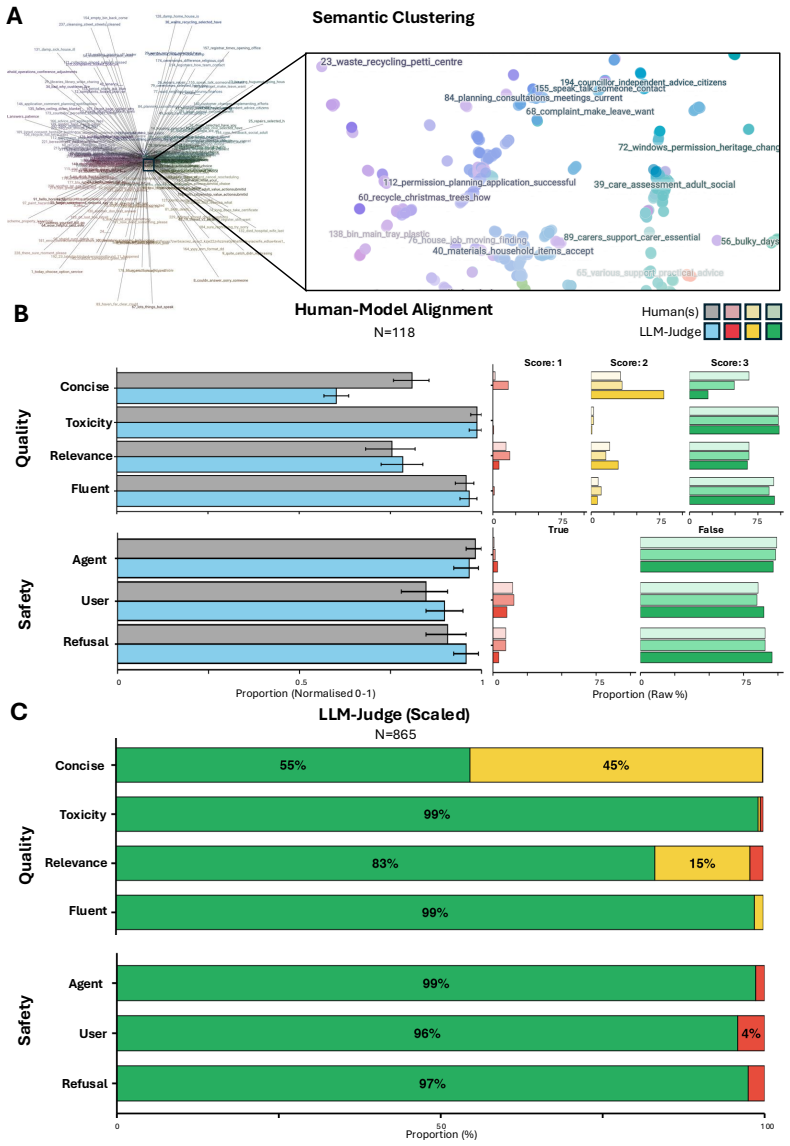
GRAIDES is a lightweight open-source data model for centralising AI observability across popular vendors, accompanied by blueprints for code, architecture and statistical evaluation, and illustrated through a case study of Westminster City Council's AI catalogue that measures human-model alignment and detects systematic evaluator disagreement.
What carries the argument
The GRAIDES schema, a data model that structures evaluation records to support observability, benchmarking and assurance for generative AI.
If this is right
- Enables consistent and comparable benchmarking of generative AI systems across different vendors.
- Supports detection of systematic disagreements between human evaluators and model outputs.
- Provides reusable code and architecture patterns for organizational-level AI assurance.
- Frames evaluation activities as data modelling to make them more reproducible over time.
Where Pith is reading between the lines
- The schema could be extended to track evaluation data over multiple time periods to monitor drift in model performance.
- Integration with existing municipal data platforms might reduce the effort required for initial adoption.
- Wider use could surface common patterns of misalignment that apply beyond the local government context.
Load-bearing premise
Organizations will adopt and maintain the GRAIDES schema in a way that produces measurable improvements in AI governance and safety evidence.
What would settle it
An empirical comparison in which organizations using GRAIDES show no measurable gain in evaluation consistency or reproducibility over their prior fragmented approaches.
Figures



read the original abstract
Trust in the application of generative Artificial Intelligence (AI) relies on well-governed measurable evidence of performance and safety. In practice, however, evaluation data is often fragmented across systems, inconsistently structured and difficult to compare. We introduce the Generative Responsible AI Data Evaluation Schema (GRAIDES) as a lightweight open-source data model for centralising AI observability across popular vendors. Practical blueprints for code, architecture and statistical evaluation are shared as guidance about how to approach generative system assurance at the organisational level. Illustrative case study results are reported from Westminster City Council's AI catalogue with a focus on measuring human-model alignment including detecting systematic disagreement between evaluators. By framing evaluations as a data modelling problem, GRAIDES provides a practical pathway toward more consistent and reproducible benchmarking, tuning and assurance activities for generative AI systems.
Editorial analysis
A structured set of objections, weighed in public.
Referee Report
Summary. The paper introduces the Generative Responsible AI Data Evaluation Schema (GRAIDES), a lightweight open-source data model for centralizing AI observability across vendors. It provides practical blueprints for code, architecture, and statistical evaluation, and reports illustrative case study results from Westminster City Council's AI catalogue focusing on human-model alignment and systematic disagreement detection. The authors claim that framing evaluations as a data modelling problem offers a practical pathway to more consistent and reproducible benchmarking, tuning, and assurance for generative AI systems.
Significance. If adopted, GRAIDES could help address fragmented evaluation data in local government generative AI deployments by providing a shared schema. The open-source release of the schema and code blueprints is a concrete strength that supports reproducibility of the proposed model itself. The case study illustrates application to human-model alignment tasks. However, the claimed pathway to measurable gains in consistency and reproducibility remains untested.
major comments (1)
- [Abstract and case study] Abstract and case study section: the claim that GRAIDES 'provides a practical pathway toward more consistent and reproducible benchmarking' is not supported by any comparative metrics, inter-rater reliability deltas, cross-organization variance reductions, or controlled before/after measurements. The Westminster City Council results are described as illustrative only, leaving the central assurance claim without empirical grounding.
Simulated Author's Rebuttal
We thank the referee for their review and agree that the manuscript's central claim about providing a pathway to measurable gains in consistency and reproducibility lacks empirical support. We will revise the abstract and relevant sections to qualify this language and accurately describe the Westminster results as illustrative only.
read point-by-point responses
-
Referee: [Abstract and case study] Abstract and case study section: the claim that GRAIDES 'provides a practical pathway toward more consistent and reproducible benchmarking' is not supported by any comparative metrics, inter-rater reliability deltas, cross-organization variance reductions, or controlled before/after measurements. The Westminster City Council results are described as illustrative only, leaving the central assurance claim without empirical grounding.
Authors: We agree with the referee's assessment. The paper presents the Westminster City Council results explicitly as illustrative and does not include comparative metrics, reliability deltas, or controlled measurements to substantiate gains in consistency or reproducibility. In the revised manuscript we will remove the unsubstantiated claim from the abstract and case study section, replacing it with language that positions GRAIDES as a data modelling framework intended to enable such evaluations in future work, without asserting that it has already delivered measurable improvements. revision: yes
Circularity Check
No circularity: proposed schema without derivations, fits, or self-referential claims
full rationale
The paper presents GRAIDES as a lightweight open-source data model for centralizing AI observability, along with code blueprints and one illustrative case study from Westminster City Council. No equations, fitted parameters, predictions of derived quantities, or load-bearing self-citations appear in the provided text. The central claim that framing evaluations as a data modelling problem supplies a pathway to consistency is an assertion about the schema's intended utility rather than a result that reduces to its own inputs by construction. The contribution is therefore self-contained as a framework proposal.
Axiom & Free-Parameter Ledger
Reference graph
Works this paper leans on
-
[1]
Ada Lovelace Institute. (2024, September). Buying AI: Is the public sector equipped to procure technology in the public interest? [Discussion paper]. https://www.adalovelaceinstitute.org/report/buying- ai-procurement/ Bowyer, S., Aitchison, L., & Ivanova, D. R. (2025). Position: Don't Use the CLT in LLM Evals With Fewer Than a Few Hundred Datapoints. arXi...
-
[2]
Pahune, S., & Akhtar, Z. (2025). Transitioning from MLOps to LLMOps: Navigating the unique challenges of large language models. Information, 16(2),
2025
-
[3]
Palumbo, G., Carneiro, D., & Alves, V. (2024). Objective metrics for ethical AI: a systematic literature review. International Journal of Data Science and Analytics , 20(2), 247-267. Palumbo, G., Guimarães, M., & Carneiro, D. (2025). Observability-driven AI governance: A framework for compliance and audit. In D. H. de la Iglesia, J. F. de Paz Santana, & A...
-
[4]
Siro, C., Aliannejadi, P., & Aliannejadi, M. (2026). Learning to Judge: LLMs Designing and Applying Evaluation Rubrics. arXiv preprint arXiv:2602.08672 . Thakur, A. S., Choudhary, K., Ramayapally, V. S., Vaidyanathan, S., & Hupkes, D. (2025, July). Judging the judges: Evaluating alignment and vulnerabilities in llms-as-judges. In Proceedings of the Fourth...
discussion (0)
Sign in with ORCID, Apple, or X to comment. Anyone can read and Pith papers without signing in.