Generalized Mpemba effect in diffusion-controlled spin-dependent delayed fluorescence
Pith reviewed 2026-06-26 13:09 UTC · model grok-4.3
The pith
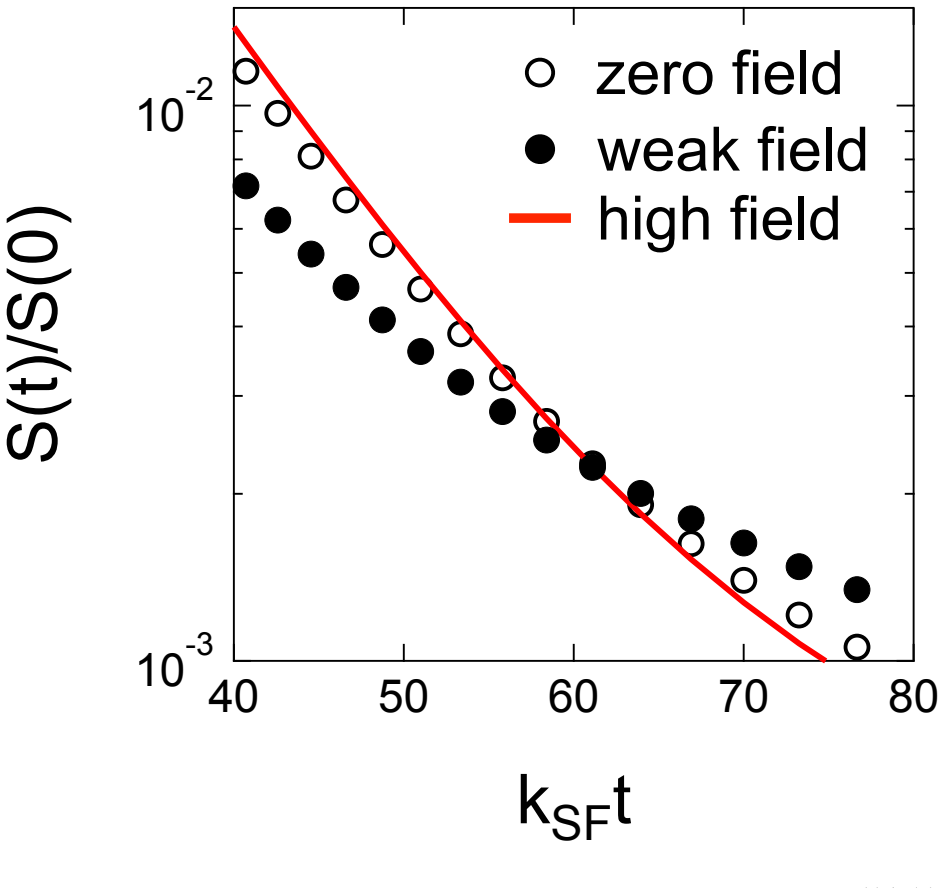
Delayed-fluorescence trajectories at different magnetic fields cross in triplet-fusion systems, realizing a generalized Mpemba effect.
A machine-rendered reading of the paper's core claim, the machinery that carries it, and where it could break.
Core claim
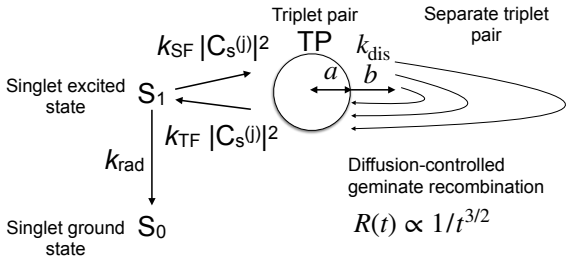
Using a diffusion-controlled geminate-recombination extension of the Johnson-Merrifield model, delayed-fluorescence trajectories obtained at different magnetic fields cross when geminate fusion is effective. This crossing constitutes a generalized Mpemba effect driven by external control of spin-selective kinetics. The effect stems from redistribution of transient relaxation pathways associated with geminate recombination, while bulk diffusion-controlled processes contribute only to the final relaxation. The final state is independent of the external control parameter and is defined as the fully relaxed state in which no separated triplet population remains.
What carries the argument
Diffusion-controlled geminate-recombination extension of the Johnson-Merrifield model, which enables external magnetic-field control of spin-selective kinetics to produce trajectory crossing.
If this is right
- The generalized Mpemba effect in this setting is captured by a kinetic criterion comparing intermediate-time decay rates against long-time power-law amplitudes.
- Trajectory crossing emerges only when geminate recombination is effective and does not require changes to the final equilibrium state.
- Bulk diffusion contributes solely to the long-time relaxation while geminate processes control the anomalous crossing behavior.
- The final relaxed state with no separated triplet population is reached independently of the applied magnetic field.
Where Pith is reading between the lines
- The same kinetic criterion might identify generalized Mpemba behavior in other externally tunable non-Markovian reaction systems.
- Experimental checks could vary the strength of geminate fusion by changing concentration or viscosity while holding magnetic field fixed.
- The framework may extend to related spin-dependent processes such as radical-pair recombination under magnetic fields.
Load-bearing premise
The diffusion-controlled geminate-recombination extension of the Johnson-Merrifield model is valid for the system and geminate fusion is effective.
What would settle it
Measuring delayed-fluorescence intensity versus time at two different magnetic fields in a triplet-fusion system known to have effective geminate fusion and finding that the curves do not cross would falsify the central claim.
Figures
read the original abstract
The Mpemba effect is commonly associated with anomalous thermal relaxation, in which a system prepared at a higher temperature reaches equilibrium faster than one prepared at a lower temperature. In modern formulations, however, its defining feature is broader: a state initially farther from equilibrium can relax faster than a closer one, or, equivalently, relaxation trajectories can cross. Here, we show that magnetic-field-dependent delayed fluorescence in triplet-fusion systems realizes a generalized Mpemba effect driven by external control of spin-selective kinetics. Using a diffusion-controlled geminate-recombination extension of the Johnson--Merrifield model, we demonstrate that delayed-fluorescence trajectories obtained at different magnetic fields cross when geminate fusion is effective. We further derive a compact kinetic criterion for such crossing in terms of the competition between intermediate-time decay rates and long-time power-law amplitudes. This criterion captures the interplay between effective fast and slow relaxation contributions. Within this kinetic framework, the final state is independent of the external control parameter and is defined as the fully relaxed state in which no separated triplet population remains. The generalized Mpemba effect therefore arises from the redistribution of transient relaxation pathways associated with geminate recombination, whereas bulk diffusion-controlled processes contribute only to the final relaxation. These results link anomalous relaxation in spin-dependent photokinetics to modern formulations of the generalized Mpemba effect and show how trajectory crossing can emerge in systems governed by diffusion-controlled geminate recombination and non-Markovian kinetics.
Editorial analysis
A structured set of objections, weighed in public.
Referee Report
Summary. The manuscript claims that magnetic-field-dependent delayed fluorescence in triplet-fusion systems realizes a generalized Mpemba effect driven by external control of spin-selective kinetics. Using a diffusion-controlled geminate-recombination extension of the Johnson-Merrifield model, it demonstrates that delayed-fluorescence trajectories obtained at different magnetic fields cross when geminate fusion is effective. A compact kinetic criterion is derived for such crossing in terms of the competition between intermediate-time decay rates and long-time power-law amplitudes, with the final state defined as the fully relaxed state independent of the control parameter.
Significance. If the model demonstration holds, the work provides a concrete physical realization linking anomalous relaxation in spin-dependent photokinetics to modern formulations of the generalized Mpemba effect. It shows how trajectory crossing can emerge from redistribution of transient relaxation pathways associated with geminate recombination in diffusion-controlled, non-Markovian systems, while bulk processes contribute only to final relaxation.
major comments (1)
- Abstract: the central claim rests on a model demonstration whose details (explicit derivation of the kinetic criterion, validation of the diffusion-controlled extension, and confirmation that geminate fusion produces crossing) are not provided, leaving major gaps in assessing whether the math supports the stated result.
minor comments (1)
- The interplay between effective fast and slow relaxation contributions in the kinetic criterion would benefit from an explicit equation or numerical example in the main text to illustrate the competition between rates and amplitudes.
Simulated Author's Rebuttal
We thank the referee for their positive evaluation and constructive feedback. Below we respond point-by-point to the single major comment. We believe the manuscript already contains the requested details in the main text and appendices; no changes to the abstract are required, as abstracts are not the appropriate venue for explicit derivations.
read point-by-point responses
-
Referee: Abstract: the central claim rests on a model demonstration whose details (explicit derivation of the kinetic criterion, validation of the diffusion-controlled extension, and confirmation that geminate fusion produces crossing) are not provided, leaving major gaps in assessing whether the math supports the stated result.
Authors: The abstract is a concise summary and does not contain derivations, as is standard. The explicit derivation of the kinetic criterion (competition between intermediate-time decay rates and long-time power-law amplitudes) appears in Section III, with the full analytic steps in Appendix A. Validation of the diffusion-controlled geminate-recombination extension of the Johnson-Merrifield model, including the non-Markovian treatment and boundary conditions, is given in Section II and Appendix B. Numerical confirmation that geminate fusion produces trajectory crossing (while bulk processes do not) is shown in Figures 2–4 and the associated discussion in Section IV. These elements directly support the stated result. The final state is defined as the fully relaxed state with no separated triplet population, independent of magnetic field, as stated in the abstract and derived in Eq. (12). revision: no
Circularity Check
No significant circularity in derivation chain
full rationale
The paper extends the Johnson-Merrifield model with diffusion-controlled geminate recombination and derives a kinetic criterion for trajectory crossing directly from the competition between intermediate-time decay rates and long-time power-law amplitudes. The final relaxed state is defined independently of the magnetic-field control parameter. No load-bearing step reduces by construction to a fitted input, self-citation, or ansatz smuggled from prior work; the crossing result follows from the stated model equations under the geminate-fusion-effective condition. The derivation is therefore self-contained against external benchmarks.
Axiom & Free-Parameter Ledger
axioms (1)
- domain assumption The diffusion-controlled geminate-recombination extension of the Johnson-Merrifield model accurately describes the spin-dependent delayed fluorescence kinetics in the systems considered.
Reference graph
Works this paper leans on
-
[1]
E. B. Mpemba and D. G. Osborne, Cool?, Phys. Educ.4, 172 (1969)
1969
-
[2]
Lu and O
Z. Lu and O. Raz, Nonequilibrium thermodynamics of the markovian mpemba effect and its inverse, Proc. Natl. Acad. Sci. U. S. A.114, 5083 (2017)
2017
-
[3]
A. K. Chatterjee, S. Takada, and H. Hayakawa, Quantum mpemba effect in a quantum dot with reservoirs, Phys. Rev. Lett.131, 080402 (2023)
2023
-
[4]
A. K. Chatterjee, S. Takada, and H. Hayakawa, Multiple quantum mpemba effect: Exceptional points and oscillations, Phys. Rev. A110, 022213 (2024)
2024
-
[5]
H. Hayakawa and S. Takada, Mpemba effect in a two-dimensional bistable potential (2026), arXiv:2603.24148 [cond-mat.stat-mech]. 20
arXiv 2026
-
[6]
J. J. Burdett, G. B. Piland, and C. J. Bardeen, Magnetic field effects and the role of spin states in singlet fission, Chem. Phys. Lett.585, 1 (2013)
2013
-
[7]
G. B. Piland, J. J. Burdett, D. Kurunthu, and C. J. Bardeen, Magnetic field effects on singlet fission and fluorescence decay dynamics in amorphous rubrene, J. Phys. Chem. C117, 1224 (2013)
2013
-
[8]
K. Seki, Y. Sonoda, and R. Katoh, Diffusion-mediated delayed fluorescence by singlet fission and geminate fusion of correlated triplets, J. Phys. Chem. C122, 11659 (2018)
2018
-
[9]
Shushin, Kinetic curves crossing effect
A. Shushin, Kinetic curves crossing effect. manifestation of the effect in singlet fission in organic semiconductors, Chem. Phys. Lett.712, 165 (2018)
2018
-
[10]
K. Seki, T. Yoshida, T. Yago, M. Wakasa, and R. Katoh, Geminate delayed fluorescence by anisotropic diffusion-mediated reversible singlet fission and triplet fusion, J. Phys. Chem. C 125, 3295 (2021)
2021
-
[11]
Bechhoefer, A
J. Bechhoefer, A. Kumar, and R. Ch´ etrite, A fresh understanding of the mpemba effect, Nat. Rev. Phys.3, 534 (2021)
2021
-
[12]
F. Ares, P. Calabrese, and S. Murciano, The quantum mpemba effects, Nat. Rev. Phys.7, 451 (2025)
2025
-
[13]
Redner,A Guide to First-Passage Processes(Cambridge University Press, 2001)
S. Redner,A Guide to First-Passage Processes(Cambridge University Press, 2001)
2001
-
[14]
Abramowitz and I
M. Abramowitz and I. A. Stegun,Handbook of Mathematical Functions(Dover, New York, 1972)
1972
-
[15]
Feller,An Introduction to Probability Theory and Its Applications, Vol
W. Feller,An Introduction to Probability Theory and Its Applications, Vol. 2, 2nd ed. (Wiley, New York, NY, 1971)
1971
-
[16]
R. E. Merrifield, Theory of magnetic field effects on the mutual annihilation of triplet excitons, J. Chem. Phys.48, 4318 (1968)
1968
-
[17]
R. C. Johnson and R. E. Merrifield, Effects of magnetic fields on the mutual annihilation of triplet excitons in anthracene crystals, Phys. Rev. B1, 896 (1970)
1970
-
[18]
R. E. Merrifield, Magnetic effects on triplet exciton interactions, Pure Appl. Chem.27, 481 (1971)
1971
-
[19]
U. E. Steiner and T. Ulrich, Magnetic field effects in chemical kinetics and related phenomena, Chem. Rev.89, 51 (1989)
1989
-
[20]
Stehfest, Algorithm 368: Numerical inversion of laplace transforms [d5], Commun
H. Stehfest, Algorithm 368: Numerical inversion of laplace transforms [d5], Commun. ACM 13, 47 (1970). 21
1970
-
[21]
Stehfest, Remark on algorithm 368: Numerical inversion of laplace transforms, Commun
H. Stehfest, Remark on algorithm 368: Numerical inversion of laplace transforms, Commun. ACM13, 624 (1970)
1970
-
[22]
T. Yago, K. Ishikawa, R. Katoh, and M. Wakasa, Magnetic field effects on triplet pair generated by singlet fission in an organic crystal: Application of radical pair model to triplet pair, J. Phys. Chem. C120, 27858 (2016). 22
2016
discussion (0)
Sign in with ORCID, Apple, or X to comment. Anyone can read and Pith papers without signing in.