Propagating edge and interfacial states in corrugated graphene: Robustness and configurability
Pith reviewed 2026-06-26 13:39 UTC · model grok-4.3
The pith
Strain superlattices in graphene produce propagating edge states in gaps despite vanishing total Chern number.
A machine-rendered reading of the paper's core claim, the machinery that carries it, and where it could break.
Core claim
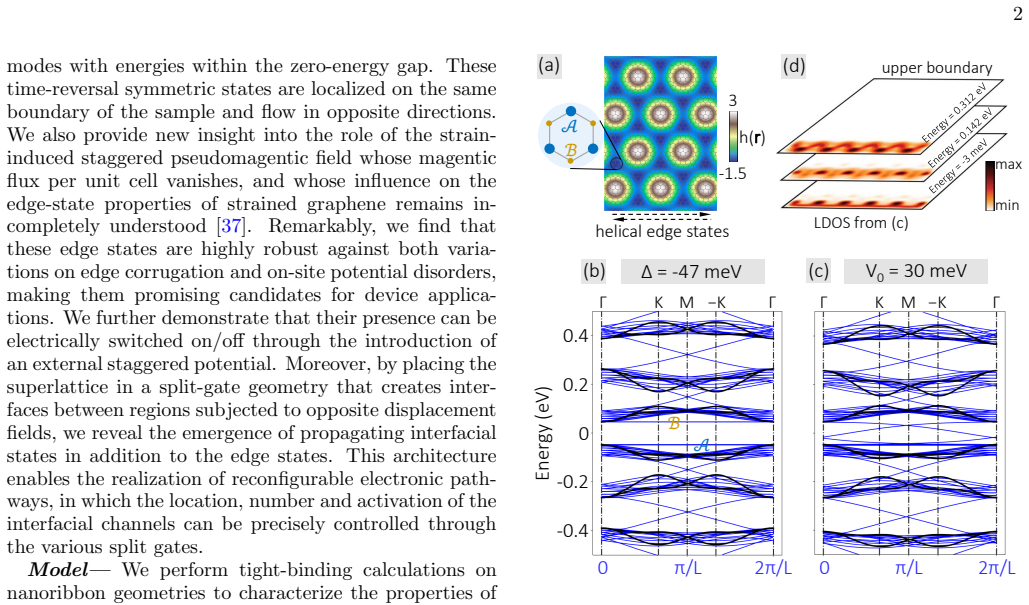
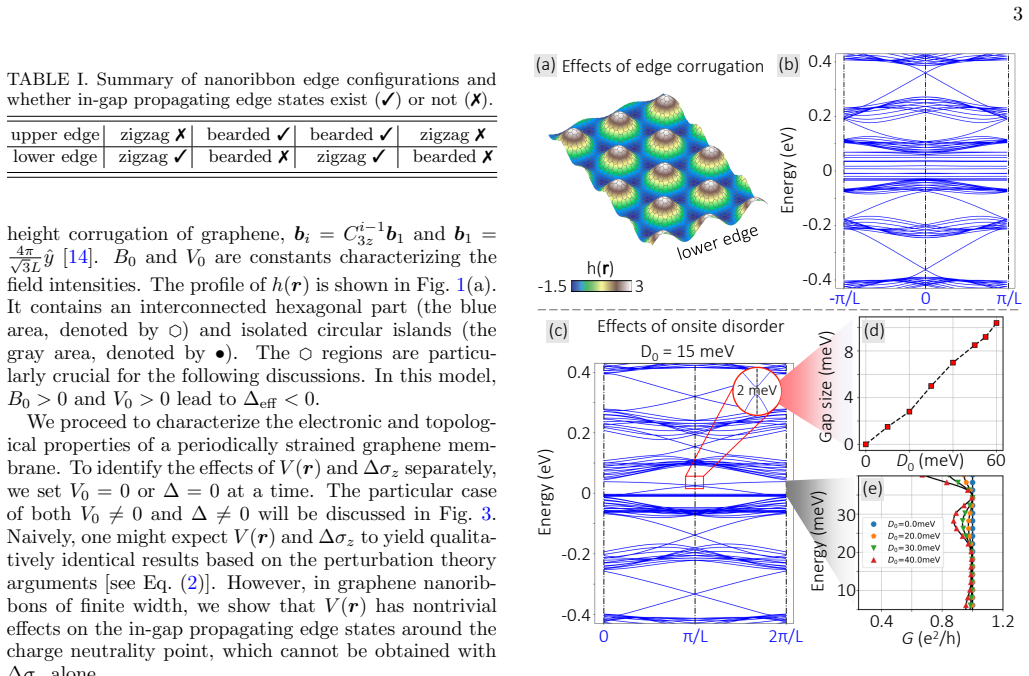
In nanoribbon geometries that preserve valley symmetry, the interplay of a strain-induced pseudomagnetic field and a displacement-field-controlled scalar potential produces isolated narrow bands and energy gaps; propagating in-gap edge states appear in both the zero-energy gap and higher-energy gaps despite a vanishing total Chern number, and these states remain robust against termination variations and moderate disorder without relying on conventional topological protection.
What carries the argument
The strain-induced pseudomagnetic field combined with a displacement-field-controlled scalar potential, which together isolate narrow bands and open multiple gaps while valley symmetry enables the emergence of robust edge states.
If this is right
- Edge states appear across a wide range of nanoribbon geometries that preserve valley symmetry.
- The states remain robust against variations in superlattice termination and moderate disorder.
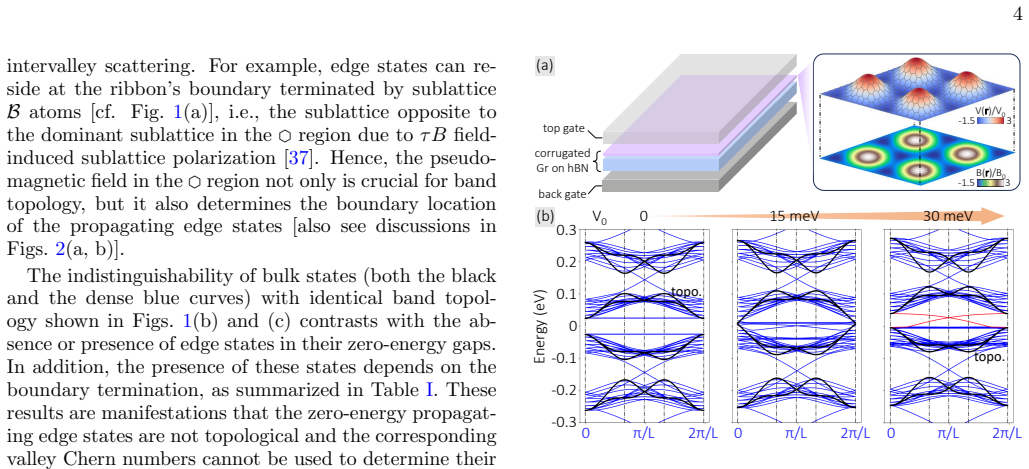
- An externally applied staggered potential electrically switches the zero-energy gap and its associated edge channels on and off.
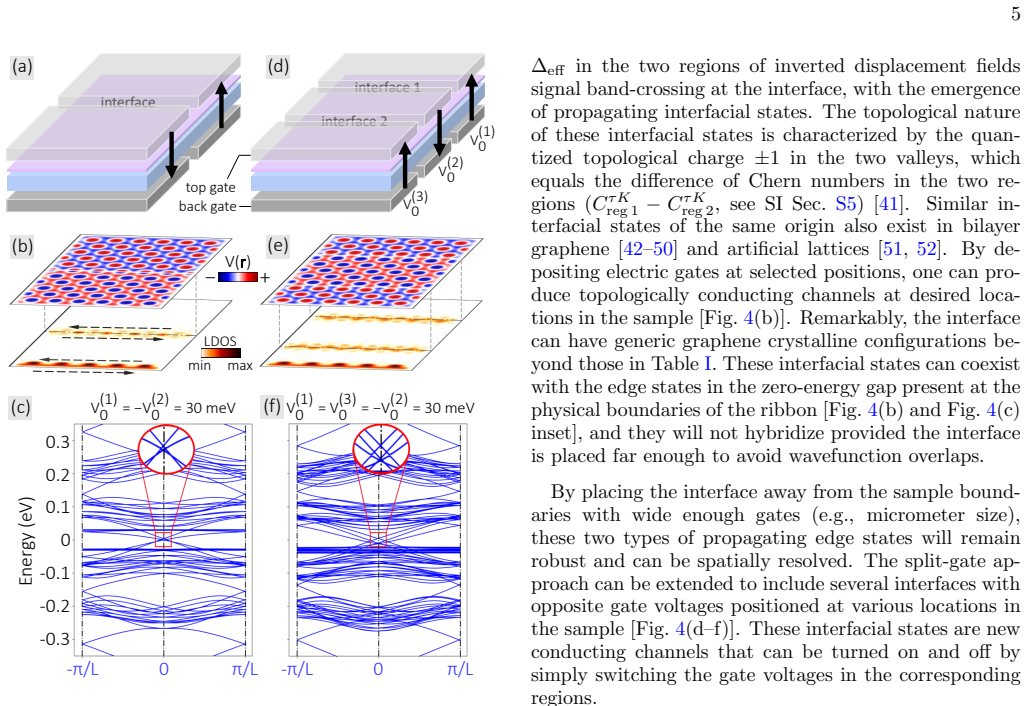
- Split-gate geometries generate topologically protected interfacial states that coexist with edge modes and can be spatially reconfigured by gate voltages.
Where Pith is reading between the lines
- The gate-switchable character suggests a route to dynamically reconfigurable interconnects in graphene-based circuits.
- The separation of mechanisms for zero-energy versus higher-energy gaps may allow selective control of channels at different energies in multi-band devices.
- Similar strain-plus-potential engineering could be tested in other Dirac materials to check whether valley symmetry alone suffices for such states.
Load-bearing premise
Nanoribbon geometries preserve valley symmetry and the low-energy Dirac model with the pseudomagnetic field plus scalar potential is enough to describe the physics without higher-order substrate or lattice effects.
What would settle it
A nanoribbon calculation or transport measurement that breaks valley symmetry while retaining the same strain pattern and scalar potential shows no propagating in-gap edge states.
Figures
read the original abstract
Periodically strained graphene on patterned substrates provides a versatile route to realizing moir\'e-like electronic structures through strain engineering. Here, we show that the interplay between a strain-induced pseudomagnetic field and a displacement-field-controlled scalar potential enables the formation of isolated narrow bands and multiple energy gaps near charge neutrality and at higher energies. Some of the low-energy bands exhibit nontrivial topology, carrying valley-opposite Chern numbers. Remarkably, despite a vanishing total Chern number, propagating in-gap edge states emerge in a wide range of nanoribbon geometries that preserve valley symmetry. We elucidate the distinct mechanisms responsible for edge states in the zero-energy and higher-energy gaps and demonstrate that they remain robust against variations in superlattice termination and moderate disorder, despite lacking conventional topological protection. Leveraging these properties, we propose device architectures in which an externally applied staggered potential electrically switches the zero-energy gap and its associated edge channels on and off. Furthermore, split-gate geometries generate topologically protected interfacial states that coexist with the edge modes and can be spatially reconfigured by gate voltages. These results establish strain superlattices as a powerful platform for engineering topological electronic states and electronic transport in graphene.
Editorial analysis
A structured set of objections, weighed in public.
Referee Report
Summary. The manuscript studies periodically strained graphene nanoribbons on patterned substrates using a low-energy Dirac model that incorporates a strain-induced pseudomagnetic field and a displacement-field-controlled scalar potential. It claims that this setup produces isolated narrow bands and multiple gaps near charge neutrality and at higher energies, with some low-energy bands carrying valley-opposite Chern numbers. Despite a vanishing total Chern number, propagating in-gap edge states appear in nanoribbon geometries that preserve valley symmetry; these states arise from distinct mechanisms in the zero-energy and higher-energy gaps, remain robust to superlattice termination variations and moderate disorder (without conventional topological protection), and can be electrically switched or reconfigured via staggered potentials and split-gate geometries to produce coexisting interfacial states.
Significance. If the low-energy modeling is quantitatively faithful, the work identifies a route to robust, non-topologically-protected yet propagating edge and interfacial states that are electrically configurable, offering a platform for strain-engineered graphene devices beyond conventional moiré or topological-insulator approaches.
major comments (1)
- [Abstract / Model description] The headline claims of propagating edge states and their robustness to termination and moderate disorder rest on the low-energy Dirac Hamiltonian with pseudomagnetic field plus scalar potential being sufficient. No validation is supplied against intervalley scattering, higher-order lattice corrections, or substrate-induced terms that could open gaps or localize the states, directly undermining the robustness assertion given the explicit absence of conventional topological protection.
minor comments (1)
- [Abstract] The abstract states the main results but supplies no equations, numerical methods, error analysis, or validation steps, making it impossible to judge whether the modeling supports the claims.
Simulated Author's Rebuttal
We thank the referee for their careful reading of the manuscript and for the constructive feedback. We address the single major comment below.
read point-by-point responses
-
Referee: [Abstract / Model description] The headline claims of propagating edge states and their robustness to termination and moderate disorder rest on the low-energy Dirac Hamiltonian with pseudomagnetic field plus scalar potential being sufficient. No validation is supplied against intervalley scattering, higher-order lattice corrections, or substrate-induced terms that could open gaps or localize the states, directly undermining the robustness assertion given the explicit absence of conventional topological protection.
Authors: We appreciate the referee raising this point on model validity. The continuum Dirac Hamiltonian with strain-induced pseudomagnetic field is the standard framework used throughout the literature on pseudomagnetic fields in graphene (e.g., for bubble and ripple geometries). Our periodic strain profile is smooth on the atomic scale, which inherently suppresses intervalley scattering; the model preserves valley symmetry by construction, consistent with the nanoribbon geometries studied. Higher-order lattice corrections remain small for the strain amplitudes employed (few percent), as benchmarked against tight-binding calculations in related strain-superlattice works. Substrate-induced terms beyond the scalar potential are not included because the displacement-field control is the dominant tunable parameter in the proposed setup. We will add a concise paragraph in the revised manuscript (likely in the Model section) explicitly discussing these approximations, their regime of validity, and supporting references. This addresses the concern without requiring new calculations. revision: yes
Circularity Check
No significant circularity in the derivation chain
full rationale
The paper derives its claims about propagating in-gap edge states (despite vanishing total Chern number) from explicit solutions of the low-energy Dirac model with strain-induced pseudomagnetic field plus scalar potential, applied to nanoribbon geometries that preserve valley symmetry. These outcomes are obtained by direct computation within the model rather than by fitting parameters to data and relabeling them as predictions, or by self-citations that bear the central load. The abstract and description state the model assumptions explicitly and demonstrate robustness within those assumptions; no self-definitional steps, uniqueness theorems imported from prior author work, or ansatzes smuggled via citation are indicated. The derivation chain remains self-contained against external benchmarks.
Axiom & Free-Parameter Ledger
free parameters (3)
- strain amplitude
- displacement field magnitude
- superlattice period
axioms (2)
- domain assumption Strain generates a pseudomagnetic field that enters the Dirac Hamiltonian as a vector potential.
- domain assumption Valley symmetry remains intact in the chosen nanoribbon terminations.
Reference graph
Works this paper leans on
-
[1]
Y. Cao, V. Fatemi, S. Fang, K. Watanabe, T. Taniguchi, E. Kaxiras, and P. Jarillo-Herrero, Unconventional super- conductivity in magic-angle graphene superlattices, Na- ture 556, 43 (2018)
2018
-
[2]
J. Cai, E. Anderson, C. Wang, X. Zhang, X. Liu, W. Holtzmann, Y. Zhang, F. Fan, T. Taniguchi, K. Watanabe, Y. Ran, T. Cao, L. Fu, D. Xiao, W. Yao, and X. Xu, Signatures of fractional quantum anomalous hall states in twisted mote2, Nature 622, 63 (2023)
2023
-
[3]
Y. Zeng, Z. Xia, K. Kang, J. Zhu, P. Kn¨ uppel, C. Vaswani, K. Watanabe, T. Taniguchi, K. F. Mak, and J. Shan, Thermodynamic evidence of fractional chern in- sulator in moir´ e mote2, Nature622, 69 (2023)
2023
-
[4]
H. Park, J. Cai, E. Anderson, Y. Zhang, J. Zhu, X. Liu, C. Wang, W. Holtzmann, C. Hu, Z. Liu, T. Taniguchi, K. Watanabe, J.-H. Chu, T. Cao, L. Fu, W. Yao, C.-Z. Chang, D. Cobden, D. Xiao, and X. Xu, Observation of fractionally quantized anomalous hall effect, Nature 622, 74 (2023)
2023
-
[5]
F. Xu, Z. Sun, T. Jia, C. Liu, C. Xu, C. Li, Y. Gu, K. Watanabe, T. Taniguchi, B. Tong, J. Jia, Z. Shi, S. Jiang, Y. Zhang, X. Liu, and T. Li, Observation of integer and fractional quantum anomalous hall effects in twisted bilayer mote2, Phys. Rev. X 13, 031037 (2023)
2023
-
[6]
C. N. Lau, M. W. Bockrath, K. F. Mak, and F. Zhang, Reproducibility in the fabrication and physics of moir´ e materials, Nature 602, 41 (2022)
2022
-
[7]
Cai and G
L. Cai and G. Yu, Fabrication strategies of twisted bilayer graphenes and their unique properties, Adv. Mater. 33, 2004974 (2021)
2021
-
[8]
S. Wang, X. Cui, C. Jian, H. Cheng, M. Niu, J. Yu, J. Yan, and W. Huang, Stacking-engineered heterostruc- tures in transition metal dichalcogenides, Adv. Mater. 33, 2005735 (2021)
2021
-
[9]
F. He, Y. Zhou, Z. Ye, S.-H. Cho, J. Jeong, X. Meng, and Y. Wang, Moir´ e patterns in 2d materials: A review, ACS Nano 15, 5944 (2021)
2021
-
[10]
Liu and G
S. Liu and G. Yu, Fabrication, energy band engineering, and strong correlations of two-dimensional van der waals moir´ e superlattices, Nano Today50, 101829 (2023)
2023
-
[11]
C. Fox, Y. Mao, X. Zhang, Y. Wang, and J. Xiao, Stack- ing order engineering of two-dimensional materials and device applications, Chem. Rev. 124, 1862 (2024)
2024
-
[12]
X. Sun, M. Suriyage, A. R. Khan, M. Gao, J. Zhao, B. Liu, M. M. Hasan, S. Rahman, R.-s. Chen, P. K. Lam, and Y. Lu, Twisted van der waals quantum materials: Fundamentals, tunability, and applications, Chem. Rev. 124, 1992 (2024)
1992
-
[13]
Zhang, Y
X. Zhang, Y. Long, N. Lu, F. Jian, X. Zhang, Z. Liang, L. He, and H. Tang, Moir´ e superlattice in two- dimensional materials: Fundamentals, applications, and recent developments, ACS Appl. Mater. Interfaces 16, 68724 (2024)
2024
-
[14]
J. Mao, S. P. Milovanovi´ c, M. Andelkovi´ c, X. Lai, Y. Cao, K. Watanabe, T. Taniguchi, L. Covaci, F. M. Peeters, A. K. Geim, Y. Jiang, and E. Y. Andrei, Evidence of flat bands and correlated states in buckled graphene super- lattices, Nature 584, 215 (2020)
2020
-
[15]
Z. Wang, Y. Wang, X. Bai, L. Cao, Y. Xue, Y. Cao, D. Zhai, H.-J. Gao, F. M. Peeters, B. Jorissen, L. Co- vaci, Y. Jiang, and J. Mao, Artificial cooper-pair density modulation in buckled heterostructure, Chin. Phys. Lett. 43, 030707 (2026)
2026
-
[16]
S. P. Milovanovi´ c, M. Andelkovi´ c, L. Covaci, and F. M. Peeters, Band flattening in buckled monolayer graphene, Phys. Rev. B 102, 245427 (2020)
2020
-
[17]
A. L. R. Manesco, J. L. Lado, E. V. S. Ribeiro, G. Weber, and D. R. Jr, Correlations in the elastic landau level of spontaneously buckled graphene, 2D Mater. 8, 015011 (2021)
2021
-
[18]
A. L. R. Manesco and J. L. Lado, Correlation-induced valley topology in buckled graphene superlattices, 2D Mater. 8, 035057 (2021)
2021
-
[19]
V. T. Phong and E. J. Mele, Boundary modes from pe- riodic magnetic and pseudomagnetic fields in graphene, Phys. Rev. Lett. 128, 176406 (2022)
2022
-
[20]
Giambastiani, F
D. Giambastiani, F. Colangelo, A. Tredicucci, S. Rod- daro, and A. Pitanti, Electron localization in periodically strained graphene, J. Appl. Phys. 131, 085103 (2022)
2022
-
[21]
Q. Gao, J. Dong, P. Ledwith, D. Parker, and E. Khalaf, Untwisting moir´ e physics: Almost ideal bands and frac- tional chern insulators in periodically strained monolayer graphene, Phys. Rev. Lett. 131, 096401 (2023)
2023
-
[22]
M. T. Mahmud, D. Zhai, and N. Sandler, Topological flat bands in strained graphene: Substrate engineering and optical control, Nano Lett. 23, 7725 (2023)
2023
-
[23]
X. Wan, S. Sarkar, K. Sun, and S.-Z. Lin, Nearly flat chern band in periodically strained monolayer and bilayer graphene, Phys. Rev. B 108, 125129 (2023)
2023
-
[24]
X. Wan, S. Sarkar, S.-Z. Lin, and K. Sun, Topological exact flat bands in two-dimensional materials under pe- riodic strain, Phys. Rev. Lett. 130, 216401 (2023)
2023
-
[25]
De Beule, V
C. De Beule, V. o. T. Phong, and E. J. Mele, Network model for periodically strained graphene, Phys. Rev. B 107, 045405 (2023)
2023
-
[26]
D. Zhai, Z. Lin, and W. Yao, Supersymmetry dic- tated topology in periodic gauge fields and realization in strained and twisted 2d materials, Rep. Prog. Phys. 87, 108004 (2024)
2024
-
[27]
Yuan and S
X. Yuan and S. Zhu, Flat bands and extreme pseudomag- netic fields in monolayer graphene by topography strain engineering, Phys. Rev. B 109, 245408 (2024)
2024
-
[28]
D.-H. Kang, H. Sun, M. Luo, K. Lu, M. Chen, Y. Kim, Y. Jung, X. Gao, S. J. Parluhutan, J. Ge, S. W. Koh, D. Giovanni, T. C. Sum, Q. J. Wang, H. Li, and D. Nam, Pseudo-magnetic field-induced slow carrier dynamics in periodically strained graphene, Nat. Commun. 12, 5087 (2021)
2021
-
[29]
ˇSrut Raki´ c, M
I. ˇSrut Raki´ c, M. J. Gilbert, P. Sarkar, A. Aishwarya, M. Polini, V. Madhavan, and N. Mason, Interaction ef- fects and non-integer pseudo-landau levels in engineered periodically strained graphene, Nano Lett. 25, 41 (2025)
2025
-
[30]
Liu and Z
Y. Liu and Z. Zhu, Engineering fractional chern insu- lators through periodic strain in monolayer graphene and transition metal dichalcogenides, Phys. Rev. B 112, L041123 (2025)
2025
-
[31]
P. J. Ledwith, A. Vishwanath, and D. E. Parker, Vor- texability: A unifying criterion for ideal fractional chern insulators, Phys. Rev. B 108, 205144 (2023)
2023
-
[32]
Fujimoto, D
M. Fujimoto, D. E. Parker, J. Dong, E. Khalaf, A. Vish- wanath, and P. Ledwith, Higher vortexability: Zero-field realization of higher landau levels, Phys. Rev. Lett. 134, 7 106502 (2025)
2025
-
[33]
De Beule, R
C. De Beule, R. Smeyers, W. N. Luna, E. J. Mele, and L. Covaci, Elastic screening of pseudogauge fields in graphene, Phys. Rev. Lett. 134, 046404 (2025)
2025
-
[34]
C. H. Sørensen, M. V. Nielsen, S. J. Linde, D. H. Nguyen, C. E. Iversen, R. Jensen, S. Raza, P. Bøggild, T. J. Booth, and N. Lassaline, Quantitative mapping of smooth to- pographic landscapes generated using thermal scanning- probe lithography, Nat. Protoc. 21, 1073 (2026)
2026
-
[35]
B. S. Dias, R. Dziobek-Garrett, G. Mentasti, A. Gupta, A. Lambertz, E. Alarcon-Llado, P. Schall, R. Bliem, and J. van de Groep, Large-area deterministic stamp- ing of 2d materials on arbitrarily patterned surfaces, arXiv:2603.04623 (2026)
arXiv 2026
-
[36]
Snyman, Gapped state of a carbon monolayer in peri- odic magnetic and electric fields, Phys
I. Snyman, Gapped state of a carbon monolayer in peri- odic magnetic and electric fields, Phys. Rev. B80, 054303 (2009)
2009
-
[37]
Salerno, T
G. Salerno, T. Ozawa, H. M. Price, and I. Carusotto, Propagating edge states in strained honeycomb lattices, Phys. Rev. B 95, 245418 (2017)
2017
-
[38]
See supporting information for further details
-
[39]
T. Low, F. Guinea, and M. I. Katsnelson, Gaps tunable by electrostatic gates in strained graphene, Phys. Rev. B 83, 195436 (2011)
2011
-
[40]
Georgi, P
A. Georgi, P. Nemes-Incze, R. Carrillo-Bastos, D. Faria, S. Viola Kusminskiy, D. Zhai, M. Schneider, D. Sub- ramaniam, T. Mashoff, N. M. Freitag, M. Liebmann, M. Pratzer, L. Wirtz, C. R. Woods, R. V. Gorbachev, Y. Cao, K. S. Novoselov, N. Sandler, and M. Morgen- stern, Tuning the pseudospin polarization of graphene by a pseudomagnetic field, Nano Lett. 17...
2017
-
[41]
J. Li, A. F. Morpurgo, M. B¨ uttiker, and I. Martin, Marginality of bulk-edge correspondence for single-valley hamiltonians, Phys. Rev. B 82, 245404 (2010)
2010
-
[42]
Martin, Y
I. Martin, Y. M. Blanter, and A. F. Morpurgo, Topo- logical confinement in bilayer graphene, Phys. Rev. Lett. 100, 036804 (2008)
2008
-
[43]
G. W. Semenoff, V. Semenoff, and F. Zhou, Domain walls in gapped graphene, Phys. Rev. Lett.101, 087204 (2008)
2008
-
[44]
J. Jung, F. Zhang, Z. Qiao, and A. H. MacDonald, Valley- hall kink and edge states in multilayer graphene, Phys. Rev. B 84, 075418 (2011)
2011
-
[45]
Zhang, A
F. Zhang, A. H. MacDonald, and E. J. Mele, Val- ley chern numbers and boundary modes in gapped bi- layer graphene, Proc. Natl. Acad. Sci. U.S.A 110, 10546 (2013)
2013
-
[46]
Vaezi, Y
A. Vaezi, Y. Liang, D. H. Ngai, L. Yang, and E.-A. Kim, Topological edge states at a tilt boundary in gated mul- tilayer graphene, Phys. Rev. X 3, 021018 (2013)
2013
-
[47]
L. Ju, Z. Shi, N. Nair, Y. Lv, C. Jin, J. Velasco, C. Ojeda- Aristizabal, H. A. Bechtel, M. C. Martin, A. Zettl, J. An- alytis, and F. Wang, Topological valley transport at bi- layer graphene domain walls, Nature 520, 650 (2015)
2015
-
[48]
J. Li, K. Wang, K. J. McFaul, Z. Zern, Y. Ren, K. Watan- abe, T. Taniguchi, Z. Qiao, and J. Zhu, Gate-controlled topological conducting channels in bilayer graphene, Nat. Nanotechnol. 11, 1060 (2016)
2016
-
[49]
Li, R.-X
J. Li, R.-X. Zhang, Z. Yin, J. Zhang, K. Watanabe, T. Taniguchi, C. Liu, and J. Zhu, A valley valve and electron beam splitter, Science 362, 1149 (2018)
2018
-
[50]
Huang, H
K. Huang, H. Fu, K. Watanabe, T. Taniguchi, and J. Zhu, High-temperature quantum valley hall effect with quan- tized resistance and a topological switch, Science 385, 657 (2024)
2024
-
[51]
Zhang, M
X. Zhang, M. Xiao, Y. Cheng, M.-H. Lu, and J. Chris- tensen, Topological sound, Commun. Phys. 1, 97 (2018)
2018
-
[52]
H. Xue, Y. Yang, and B. Zhang, Topological valley pho- tonics: Physics and device applications, Adv. Photon. Res. 2, 2100013 (2021)
2021
-
[53]
C. W. Groth, M. Wimmer, A. R. Akhmerov, and X. Waintal, Kwant: a software package for quantum transport, New J. Phys. 16, 063065 (2014)
2014
-
[54]
Ando, Theory of electronic states and transport in carbon nanotubes, J
T. Ando, Theory of electronic states and transport in carbon nanotubes, J. Phys. Soc. Jpn. 74, 777 (2005)
2005
-
[55]
Propagating edge and interfacial states in corrugated graphene: Robustness and configurability
W. Yao, S. A. Yang, and Q. Niu, Edge states in graphene: From gapped flat-band to gapless chiral modes, Phys. Rev. Lett. 102, 096801 (2009). Supporting Information for “Propagating edge and interfacial states in corrugated graphene: Robustness and configurability” Adel Belayadi Deparment of Physics, University of Science and Technology Houari Boumediene, ...
2009
discussion (0)
Sign in with ORCID, Apple, or X to comment. Anyone can read and Pith papers without signing in.