REVIEW 1 major objections 2 minor 52 references
GRAG: Generic Response-Augmented Generation Framework for Personalized Conversational Systems
T0 review · 1 major / 2 minor · reviewed 2026-06-26 · grok-4.3
Pith's one-line read Offline generic responses from large models act as scaffolds that let smaller models handle personalization while staying grounded in conversation history.
desk verdict GRAG reports large gains from using generic responses as a scaffold for personalization but lacks the ablation to show that scaffold is what produces the gains. read the letter →
The pith
A machine-rendered reading of the paper's core claim, the machinery that carries it, and where it could break.
The reading
What carries the argument
The GRAG framework, which supplies offline generic responses as semantic and structural scaffolds for smaller-model fine-tuning.
What would settle it
An ablation that trains the identical smaller model on the same personalization data once with the generic-response scaffold and once without it, then checks whether grounding metrics and persona adherence both drop when the scaffold is removed.
Extended reading notes
Core claim
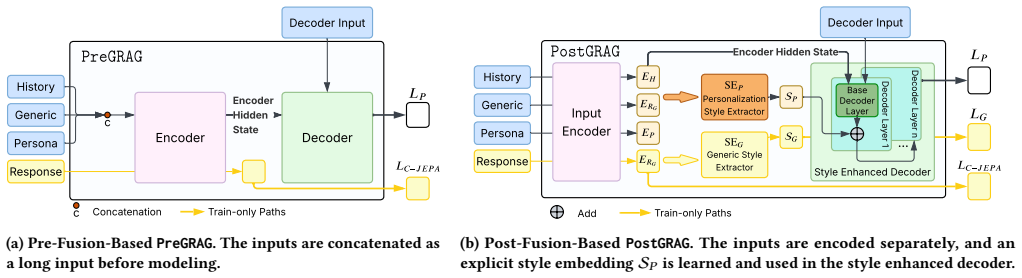
GRAG decouples content grounding from personalization by treating offline generic responses produced by high-capacity LLMs as a fixed semantic and structural scaffold. The smaller task-specialized model is then fine-tuned to adapt only the persona aspects while the scaffold keeps the output anchored to conversational context. The framework is realized in post-fusion and pre-fusion variants and evaluated across benchmark datasets covering varied personalization structures.
Load-bearing premise
That generic responses generated once by a large model supply an effective enough guide that smaller models can add persona without drifting from the original conversational intent.
Editorial analysis
A structured set of objections, weighed in public.
Referee Report
Summary. The manuscript proposes the Generic Response-Augmented Generation (GRAG) framework to decouple content grounding from personalization in conversational agents. It uses offline generic responses generated by high-capacity LLMs as a semantic and structural scaffold, allowing smaller models to specialize in persona injection while remaining anchored to context. Two architectural variants (post- and pre-fusion) are instantiated and evaluated on multiple benchmark conversational datasets, with claims of up to 47% ROUGE-2 and 36% BLEU improvements over state-of-the-art methods that lack auxiliary scaffolding.
Significance. If the results hold after proper controls, the decoupling approach could offer a practical route to grounding-aware personalization in resource-limited or privacy-sensitive settings. The core idea directly targets a recognized tension in current training paradigms. Credit is due for framing a generalizable blueprint rather than a narrow technique.
major comments (1)
- [Abstract / Experimental Evaluation] Abstract and experimental evaluation sections: the headline performance claims rest on the premise that the offline generic-response scaffold drives the gains by enabling decoupling. However, the paper reports comparisons only against external SOTA baselines that lack any scaffolding; no internal ablation is described that removes or masks the generic responses while holding architecture, data, training recipe, and context length fixed. This leaves open the possibility that measured improvements arise from extra context, fusion mechanics, or other factors rather than the claimed mechanism.
minor comments (2)
- [Abstract] Abstract: no dataset names, sizes, or characteristics are supplied despite the claim of evaluation on 'multiple benchmark conversational datasets that cover diverse personalization structures.'
- [Abstract] Abstract: baseline descriptions, statistical tests, variance estimates, and implementation details for the reported metric gains are absent, preventing assessment of the results.
Simulated Author's Rebuttal
We thank the referee for highlighting a key aspect of our experimental design. We address the concern point by point below.
read point-by-point responses
-
Referee: [Abstract / Experimental Evaluation] Abstract and experimental evaluation sections: the headline performance claims rest on the premise that the offline generic-response scaffold drives the gains by enabling decoupling. However, the paper reports comparisons only against external SOTA baselines that lack any scaffolding; no internal ablation is described that removes or masks the generic responses while holding architecture, data, training recipe, and context length fixed. This leaves open the possibility that measured improvements arise from extra context, fusion mechanics, or other factors rather than the claimed mechanism.
Authors: We agree that an internal ablation isolating the generic-response scaffold—while holding architecture, data, training recipe, and context length fixed—would provide stronger evidence that the observed gains stem specifically from the decoupling mechanism rather than auxiliary factors. The current evaluation focuses on end-to-end comparisons against external SOTA methods that lack any scaffolding, which directly addresses the practical utility of GRAG. However, to address the referee's concern, we will add the requested ablation in the revised manuscript, including variants that mask or remove the generic responses under matched conditions, and report the resulting performance deltas. revision: yes
Circularity Check
No circularity: empirical framework with external benchmarks
full rationale
The paper introduces GRAG as an architectural decoupling of grounding and personalization via offline LLM-generated scaffolds, then reports empirical gains on public conversational benchmarks against external SOTA baselines. No equations, fitted parameters, or self-citations appear in the provided text; performance numbers are measured outcomes rather than quantities derived by construction from the inputs. The derivation chain is therefore a standard proposal-plus-evaluation structure with no reduction to self-definition or self-citation load-bearing.
Assumptions & free parameters
Cite this review
Pith. "Pith review of GRAG: Generic Response-Augmented Generation Framework for Personalized Conversational Systems." pith.science (2026). https://pith.science/paper/UIKRWFQC
@misc{pith2026260621097,
  author       = {Pith},
  title        = {Pith review of: GRAG: Generic Response-Augmented Generation Framework for Personalized Conversational Systems},
  year         = {2026},
  howpublished = {\url{https://pith.science/paper/UIKRWFQC}},
  note         = {Machine review of arXiv:2606.21097}
}
read the original abstract
Deploying highly capable personalized conversational agents in resource-constrained or privacy-sensitive environments remains a significant challenge. We identify a fundamental bottleneck in the existing approaches: current training paradigms treat personalization and grounding as a single monolithic learning problem. Under these paradigms, language models are forced to simultaneously address what to say (content grounding) and how to say it in a user-specific way (personalization), which introduces significant computational and optimization challenges. Consequently, contextual grounding is often sacrificed for persona adherence, or vice versa, resulting in responses that are either weakly grounded in the conversational history or insufficiently personalized. In this work, we propose the Generic Response-Augmented Generation (GRAG) framework that decouples these competing objectives by leveraging offline, generic responses from high-capacity, general-purpose LLMs as a semantic and structural scaffold to guide the fine-tuning of smaller, task-specialized models seamlessly in resource-limited environments. By decoupling the content grounding from personalization, GRAG allows the model to focus exclusively on persona injection while remaining firmly anchored to the conversational context. We instantiate the GRAG in two post- and pre-fusion-based architectural variants and evaluate them on multiple benchmark conversational datasets that cover diverse personalization structures. Our results demonstrate that GRAG significantly outperforms state-of-the-art methods that do not use auxiliary scaffolding, yielding up to 47% improvements in ROUGE-2 and 36% in BLEU scores. Ultimately, GRAG offers a generalizable blueprint for building grounding-aware personalized conversational systems in resource-limited environments.
Figures


Figures from the paper (3 more)


Reference graph
Works this paper leans on
-
[1]
Josh Achiam et al. 2023.Gpt-4 technical report. Technical Report. https://arxiv. org/abs/2303.08774
work page Pith review arXiv 2023
-
[2]
2025.System Card: Claude Opus 4 & Claude Sonnet
Anthropic, AI. 2025.System Card: Claude Opus 4 & Claude Sonnet
2025
-
[3]
Anthropic, AI
Technical Report. Anthropic, AI. https://www-cdn.anthropic.com/ 4263b940cabb546aa0e3283f35b686f4f3b2ff47.pdf
-
[4]
Mahmoud Assran, Quentin Duval, Ishan Misra, Piotr Bojanowski, Pascal Vincent, Michael Rabbat, Yann LeCun, and Nicolas Ballas. 2023. Self-supervised learning from images with a joint-embedding predictive architecture. InProceedings of the IEEE/CVF conference on computer vision and pattern recognition. 15619–15629
2023
-
[5]
Amy Bucher. 2023. The patient experience of the future is personalized: using technology to scale an N of 1 approach.Journal of Patient Experience10 (2023), 23743735231167975
2023
- [6]
-
[7]
Ning Dai, Jianze Liang, Xipeng Qiu, and Xuan-Jing Huang. 2019. Style trans- former: Unpaired text style transfer without disentangled latent representation. InProceedings of the 57th annual meeting of the association for computational linguistics. 5997–6007
2019
-
[8]
Tim Dettmers, Artidoro Pagnoni, Ari Holtzman, and Luke Zettlemoyer. 2023. QLoRA: Efficient finetuning of quantized llms.Advances in neural information processing systems36 (2023), 10088–10115
2023
Show all 52 references
-
[9]
Emily Dinan, Varvara Logacheva, Valentin Malykh, Alexander Miller, Kurt Shus- ter, Jack Urbanek, Douwe Kiela, Arthur Szlam, Iulian Serban, Ryan Lowe, et al
-
[10]
InThe NeurIPS’18 Competition
The second conversational intelligence challenge (convai2). InThe NeurIPS’18 Competition. Springer, 187–208
-
[11]
Emily Dinan, Stephen Roller, Kurt Shuster, Angela Fan, Michael Auli, and Jason Weston. 2019. Wizard of Wikipedia: Knowledge-powered Conversational Agents. InProceedings of the International Conference on Learning Representations (ICLR)
2019
-
[12]
Qingxiu Dong, Lei Li, Damai Dai, Ce Zheng, Jingyuan Ma, Rui Li, Heming Xia, Jingjing Xu, Zhiyong Wu, Baobao Chang, et al . 2024. A survey on in-context learning. InProceedings of the 2024 conference on empirical methods in natural language processing. 1107–1128
2024
-
[13]
Geoffrey Hinton, Oriol Vinyals, and Jeff Dean. 2015. Distilling the knowledge in a neural network.arXiv preprint arXiv:1503.02531(2015)
2015 arXiv
-
[14]
Emiel Hoogeboom, Alexey A Gritsenko, Jasmijn Bastings, Ben Poole, Rianne van den Berg, and Tim Salimans. 2021. Autoregressive Diffusion Models. In International Conference on Learning Representations
2021
-
[15]
Edward J Hu, Phillip Wallis, Zeyuan Allen-Zhu, Yuanzhi Li, Shean Wang, Lu Wang, Weizhu Chen, et al. 2022. LoRA: Low-Rank Adaptation of Large Language Models. InProceedings of the International Conference on Learning Representations (ICLR)
2022
-
[16]
Zhiqiang Hu, Roy Ka-Wei Lee, Charu C Aggarwal, and Aston Zhang. 2022. Text style transfer: A review and experimental evaluation.ACM SIGKDD Explorations Newsletter24, 1 (2022), 14–45
2022
-
[17]
Zhiting Hu, Zichao Yang, Xiaodan Liang, Ruslan Salakhutdinov, and Eric P Xing
-
[18]
InInternational conference on machine learning
Toward controlled generation of text. InInternational conference on machine learning. PMLR, 1587–1596
-
[19]
Hai Huang, Yann LeCun, and Randall Balestriero. 2025. LLM-JEPA: Large Lan- guage Models Meet Joint Embedding Predictive Architectures. InNeurIPS 2025 Fourth Workshop on Deep Learning for Code
2025
-
[20]
Samuel Humeau, Kurt Shuster, Marie-Anne Lachaux, and Jason Weston. 2019. Poly-encoders: Architectures and Pre-training Strategies for Fast and Accurate Multi-sentence Scoring. InInternational Conference on Learning Representations
2019
-
[21]
Pegah Jandaghi, XiangHai Sheng, Xinyi Bai, Jay Pujara, and Hakim Sidahmed
-
[22]
InProceedings of the 6th Workshop on NLP for Conversational AI (NLP4ConvAI 2024)
Faithful persona-based conversational dataset generation with large lan- guage models. InProceedings of the 6th Workshop on NLP for Conversational AI (NLP4ConvAI 2024). 114–139
2024
-
[23]
Yoonna Jang, Jungwoo Lim, Yuna Hur, Dongsuk Oh, Suhyune Son, Yeonsoo Lee, Donghoon Shin, Seungryong Kim, and Heuiseok Lim. 2022. Call for Customized Conversation: Customized Conversation Grounding Persona and Knowledge. In Proceedings of the AAAI Conference on Artificial Intel...
2022
-
[24]
Xiyuan Jia, Zongqing Mao, Zhen Zhang, Qiyun Lv, Xin Wang, and Guohua Wu. 2025. Syntax-controlled paraphrases generation with VAE and multi-task learning.Computer Speech & Language89 (2025), 101705
2025
-
[25]
Guillaume Lample, Sandeep Subramanian, Eric Smith, Ludovic Denoyer, Marc’Aurelio Ranzato, and Y-Lan Boureau. 2019. Multiple-attribute text rewriting. InInternational Conference on Learning Representations
2019
-
[26]
Mike Lewis, Yinhan Liu, Naman Goyal, Marjan Ghazvininejad, Abdelrahman Mohamed, Omer Levy, Veselin Stoyanov, and Luke Zettlemoyer. 2020. BART: Denoising sequence-to-sequence pre-training for natural language generation, translation, and comprehension. InProceedings of the 58th...
2020
-
[27]
Patrick Lewis, Ethan Perez, Aleksandra Piktus, Fabio Petroni, Vladimir Karpukhin, Naman Goyal, Heinrich Küttler, Mike Lewis, Wen-tau Yih, Tim Rocktäschel, et al. 2020. Retrieval-augmented generation for knowledge-intensive nlp tasks. Advances in neural information processing s...
2020
-
[28]
Junfeng Liu, Christopher Symons, and Ranga Raju Vatsavai. 2022. Persona-Based Conversational AI: State of the Art and Challenges. In2022 IEEE International Conference on Data Mining Workshops (ICDMW). IEEE, 993–1001
2022
-
[29]
Junfeng Liu, Christopher Symons, and Ranga Raju Vatsavai. 2023. Persona-coded poly-encoder: persona-guided multi-stream conversational sentence scoring. In 2023 IEEE 35th International Conference on Tools with Artificial Intelligence (ICTAI). IEEE, 250–257
2023
-
[30]
Junfeng Liu, Christopher T Symons, and Ranga Raju Vatsavai. 2025. CoMAC: Conversational Agent for Multi-source Auxiliary Context with Sparse and Sym- metric Latent Interactions. InPacific-Asia Conference on Knowledge Discovery and Data Mining. Springer, 196–208
2025
-
[31]
Qian Liu, Yihong Chen, Bei Chen, Jian-Guang Lou, Zixuan Chen, Bin Zhou, and Dongmei Zhang. 2020. You impress me: Dialogue generation via mutual persona perception. InProceedings of the 58th annual meeting of the association for computational linguistics. 1417–1427
2020
-
[32]
Ilya Loshchilov and Frank Hutter. 2019. Decoupled Weight Decay Regularization. InProceedings of the International Conference on Learning Representations (ICLR)
2019
-
[33]
Nasrin Mostafazadeh, Chris Brockett, William B Dolan, Michel Galley, Jianfeng Gao, Georgios Spithourakis, and Lucy Vanderwende. 2017. Image-grounded conversations: Multimodal context for natural question and response generation. InProceedings of the Eighth International Joint ...
2017
-
[34]
Lei Pan, Yunshi Lan, Yang Li, and Weining Qian. 2024. Unsupervised text style transfer via LLMs and attention masking with multi-way interactions.arXiv preprint arXiv:2402.13647(2024)
2024
-
[35]
Alec Radford, Jeffrey Wu, Rewon Child, David Luan, Dario Amodei, Ilya Sutskever, et al. 2019. Language models are unsupervised multitask learners.OpenAI blog 1, 8 (2019), 9
2019
-
[36]
Colin Raffel, Noam Shazeer, Adam Roberts, Katherine Lee, Sharan Narang, Michael Matena, Yanqi Zhou, Wei Li, and Peter J Liu. 2020. Exploring the limits of transfer learning with a unified text-to-text transformer.Journal of machine learning research21, 140 (2020), 1–67
2020
-
[37]
Hannah Rashkin, Eric Michael Smith, Margaret Li, and Y-Lan Boureau. 2019. Towards empathetic open-domain conversation models: A new benchmark and dataset. InProceedings of the 57th Annual Meeting of the Association for Computa- tional Linguistics. 5370–5381
2019
-
[38]
Emily Reif, Daphne Ippolito, Ann Yuan, Andy Coenen, Chris Callison-Burch, and Jason Wei. 2022. A recipe for arbitrary text style transfer with large lan- guage models. InProceedings of the 60th Annual Meeting of the Association for Computational Linguistics (Volume 2: Short Pa...
2022
-
[39]
Stephen Roller, Emily Dinan, Naman Goyal, Da Ju, Mary Williamson, Yinhan Liu, Jing Xu, Myle Ott, Eric Michael Smith, Y-Lan Boureau, et al. 2021. Recipes for building an open-domain chatbot. InProceedings of the 16th Conference of the European Chapter of the Association for Com...
2021
-
[40]
Sascha Rothe, Shashi Narayan, and Aliaksei Severyn. 2020. Leveraging pre-trained checkpoints for sequence generation tasks.Transactions of the Association for Computational Linguistics8 (2020), 264–280. 11
2020
-
[41]
Sougata Saha, Souvik Das, and Rohini K Srihari. 2022. Stylistic response gen- eration by controlling personality traits and intent. InProceedings of the 4th Workshop on NLP for Conversational AI. 197–211
2022
-
[42]
Hugo Touvron, Thibaut Lavril, Gautier Izacard, Xavier Martinet, Marie-Anne Lachaux, Timothée Lacroix, Baptiste Rozière, Naman Goyal, Eric Hambro, Faisal Azhar, et al. 2023. LLaMA: Open and efficient foundation language models.arXiv preprint arXiv:2302.1397110 (2023)
2023 arXiv
-
[43]
Xuewei Wang, Weiyan Shi, Richard Kim, Yoojung Oh, Sijia Yang, Jingwen Zhang, and Zhou Yu. 2019. Persuasion for Good: Towards a Personalized Persuasive Dialogue System for Social Good. InProceedings of the 57th Annual Meeting of the Association for Computational Linguistics. 5635–5649
2019
-
[44]
Xinyi Wang, Wanrong Zhu, Michael Saxon, Mark Steyvers, and William Yang Wang. 2023. Large language models are latent variable models: Explaining and finding good demonstrations for in-context learning.Advances in Neural Information Processing Systems36 (2023), 15614–15638
2023
-
[45]
An Yang, Anfeng Li, Baosong Yang, Beichen Zhang, Binyuan Hui, Bo Zheng, Bowen Yu, Chang Gao, Chengen Huang, Chenxu Lv, et al. 2025. Qwen3 technical report.arXiv preprint arXiv:2505.09388(2025)
2025 arXiv
-
[46]
Jialin Yu, Alexandra I Cristea, Anoushka Harit, Zhongtian Sun, Olanrewaju Tahir Aduragba, Lei Shi, and Noura Al Moubayed. 2023. Language as a latent sequence: Deep latent variable models for semi-supervised paraphrase generation.AI Open 4 (2023), 19–32
2023
-
[47]
Chiyu Zhang, Honglong Cai, Yuezhang Li, Yuexin Wu, Le Hou, and Muhammad Abdul-Mageed. 2024. Distilling text style transfer with self-explanation from LLMs. InProceedings of the 2024 Conference of the North American Chapter of the Association for Computational Linguistics: Huma...
2024
-
[48]
Saizheng Zhang, Emily Dinan, Jack Urbanek, Arthur Szlam, Douwe Kiela, and Jason Weston. 2018. Personalizing dialogue agents: I have a dog, do you have pets too?. InProceedings of the 56th Annual Meeting of the Association for Computational Linguistics (Volume 1: Long Papers). ...
2018
-
[49]
Tianyi Zhang, Varsha Kishore, Felix Wu, Kilian Q Weinberger, and Yoav Artzi
-
[50]
InInternational Con- ference on Learning Representations
BERTScore: Evaluating Text Generation with BERT. InInternational Con- ference on Learning Representations
-
[51]
Wei-Nan Zhang, Qingfu Zhu, Yifa Wang, Yanyan Zhao, and Ting Liu. 2019. Neural personalized response generation as domain adaptation.World Wide Web22, 4 (2019), 1427–1446
2019
-
[52]
Yizhe Zhang, Siqi Sun, Michel Galley, Yen-Chun Chen, Chris Brockett, Xiang Gao, Jianfeng Gao, Jingjing Liu, and William B Dolan. 2020. Dialogpt: Large-scale generative pre-training for conversational response generation. InProceedings of the 58th annual meeting of the associat...
2020
Reviewed June 26, 2026 · model on record in the stance chip above.
Discussion (0). Continue with ORCID to comment.