Atomistic Mechanisms of Hard Carbon Formation from Polyvinylidene Chloride
Pith reviewed 2026-06-26 13:52 UTC · model grok-4.3
The pith
Hard carbon forms from PVDC via radical dehydrochlorination and cross-linking that creates curvature-inducing non-hexagonal rings
A machine-rendered reading of the paper's core claim, the machinery that carries it, and where it could break.
Core claim
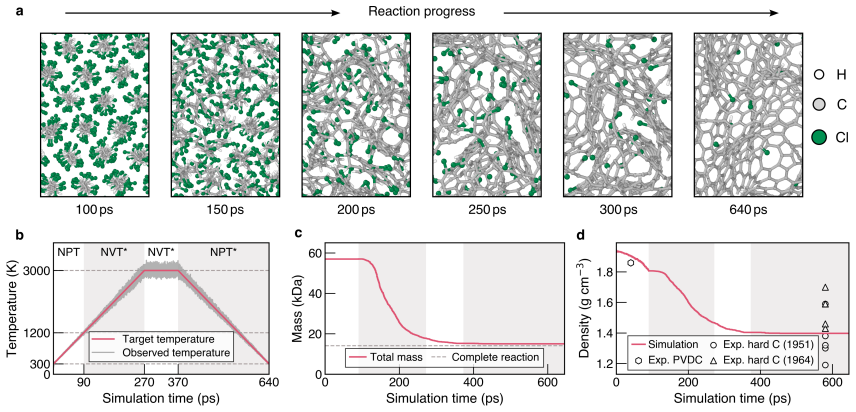
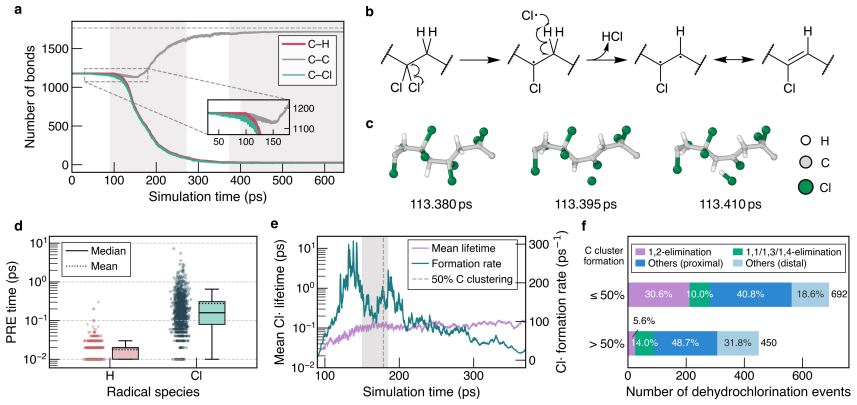
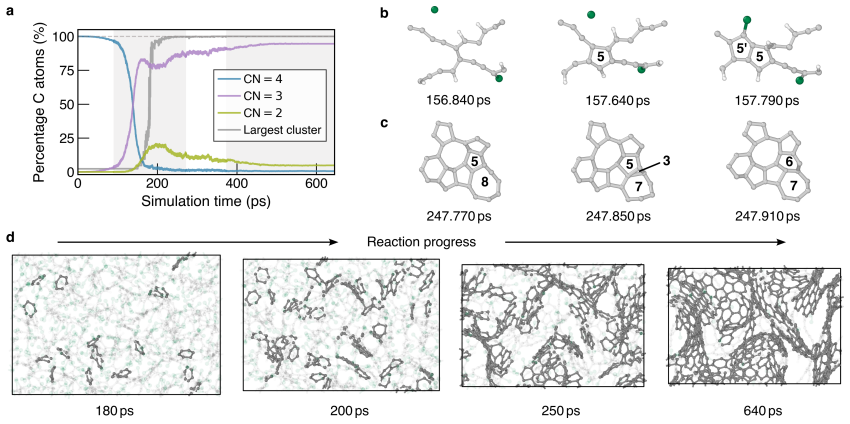
Our results indicate a two-stage process, consisting of (i) radical-mediated dehydrochlorination, which generates reactive unsaturated carbon sites, and (ii) progressive carbon-carbon cross-linking followed by thermally activated rearrangement into an extended sp2-bonded network. We provide an atomistic account of non-hexagonal ring motifs emerging during pyrolysis, supporting the empirically-derived theory that these motifs induce the intrinsic curvature that frustrates graphitic ordering in hard carbons.
What carries the argument
The two-stage pyrolysis process of radical-mediated dehydrochlorination followed by carbon-carbon cross-linking and rearrangement, which produces non-hexagonal ring motifs that induce structural curvature.
If this is right
- Non-hexagonal rings formed during cross-linking are responsible for the intrinsic curvature that prevents graphitic ordering.
- The initial radical dehydrochlorination step generates the reactive sites necessary for subsequent network formation.
- Thermally activated rearrangement after cross-linking produces the extended sp2-bonded network characteristic of hard carbon.
- This atomistic account validates the role of non-hexagonal motifs in maintaining disorder across different hard carbon precursors.
Where Pith is reading between the lines
- The same two-stage radical process may occur in other halogenated polymer precursors used to make hard carbons.
- Adjusting the heating rate or peak temperature during pyrolysis could change the density of non-hexagonal rings and thereby tune the final material's curvature and porosity.
- The curved sp2 regions may alter how sodium ions insert into hard carbon anodes in battery applications.
- Tracking the timing of chlorine gas evolution in experiments could directly test the radical dehydrochlorination stage.
Load-bearing premise
The bespoke machine-learned interatomic potential accurately reproduces the radical-mediated dehydrochlorination chemistry and the emergence of non-hexagonal rings at the temperatures and timescales of pyrolysis.
What would settle it
Observation via in-situ spectroscopy of the specific sequence of chlorine removal rates, unsaturated site formation, and non-hexagonal ring densities during PVDC heating would confirm or refute the two-stage mechanism and ring curvature claim.
Figures
read the original abstract
Hard carbons are a class of disordered materials with widespread application in energy storage. Despite decades of research, their atomistic formation mechanisms have remained elusive, due to the difficulty of both in situ experimental characterization and first-principles simulations. Here, we describe the formation mechanism of hard carbon from the thermal decomposition of polyvinylidene chloride (PVDC), using first-principles-quality simulations with a bespoke machine-learned interatomic potential model. Our results indicate a two-stage process, consisting of (i) radical-mediated dehydrochlorination, which generates reactive unsaturated carbon sites, and (ii) progressive carbon-carbon cross-linking followed by thermally activated rearrangement into an extended sp$^{2}$-bonded network. We provide an atomistic account of non-hexagonal ring motifs emerging during pyrolysis, supporting the empirically-derived theory that these motifs induce the intrinsic curvature that frustrates graphitic ordering in hard carbons.
Editorial analysis
A structured set of objections, weighed in public.
Referee Report
Summary. The manuscript uses molecular dynamics simulations driven by a bespoke machine-learned interatomic potential (MLIP) to study the pyrolysis of polyvinylidene chloride (PVDC) and proposes an atomistic mechanism for hard-carbon formation. It identifies a two-stage process: (i) radical-mediated dehydrochlorination that creates unsaturated carbon sites, followed by (ii) C–C cross-linking and thermally activated rearrangement into an extended sp² network. The work also reports the emergence of five- and seven-membered rings during the process and links these non-hexagonal motifs to the intrinsic curvature that prevents long-range graphitic ordering.
Significance. If the MLIP is shown to reproduce the relevant reactive chemistry with quantified accuracy, the study would supply the first detailed, simulation-based atomistic account of hard-carbon formation from a common precursor. This would directly support empirically motivated models that invoke ring defects to explain the frustration of graphitization and could guide the design of hard carbons for battery anodes. The approach demonstrates how MLIPs can extend first-principles-quality sampling to the length and time scales of polymer pyrolysis.
major comments (2)
- [Abstract and Methods] Abstract and Methods (implied): the central two-stage mechanism and the reported non-hexagonal ring statistics rest entirely on the accuracy of the bespoke MLIP for C–Cl homolysis, radical recombination, and five-/seven-membered ring formation at pyrolysis temperatures. No DFT reference calculations, barrier-height errors, or direct comparison to experimental product distributions for these reactive events are supplied, so it is impossible to determine whether the observed pathway is an artifact of the potential or a robust prediction.
- [Results] Results (two-stage process description): the claim that dehydrochlorination is “radical-mediated” and that cross-linking precedes rearrangement is load-bearing for the entire narrative, yet the manuscript provides neither error estimates on the MLIP nor any ablation showing that the same sequence appears with an independent potential or with direct ab initio MD on smaller model systems.
minor comments (2)
- [Results] Notation for ring statistics and sp² fraction should be defined explicitly (e.g., how rings are identified and counted) to allow reproducibility.
- [Methods] The temperature schedule and system size used in the MD trajectories should be stated with sufficient detail for independent verification.
Simulated Author's Rebuttal
We thank the referee for their careful reading of the manuscript and for highlighting the importance of validating the MLIP for the reactive events central to our proposed mechanism. We address each major comment below and indicate where revisions will be made.
read point-by-point responses
-
Referee: [Abstract and Methods] the central two-stage mechanism and the reported non-hexagonal ring statistics rest entirely on the accuracy of the bespoke MLIP for C–Cl homolysis, radical recombination, and five-/seven-membered ring formation at pyrolysis temperatures. No DFT reference calculations, barrier-height errors, or direct comparison to experimental product distributions for these reactive events are supplied, so it is impossible to determine whether the observed pathway is an artifact of the potential or a robust prediction.
Authors: The MLIP training set incorporates DFT calculations of C–Cl homolysis, radical recombination barriers, and formation energies of five- and seven-membered rings in chlorinated and hydrocarbon systems. To make this explicit, the revised Methods section will include a table of mean absolute errors on these quantities (typically below 0.1 eV) together with a direct comparison of the simulated HCl release profile against published TGA data for PVDC. These additions will allow readers to evaluate the fidelity of the reactive chemistry. revision: yes
-
Referee: [Results] the claim that dehydrochlorination is “radical-mediated” and that cross-linking precedes rearrangement is load-bearing for the entire narrative, yet the manuscript provides neither error estimates on the MLIP nor any ablation showing that the same sequence appears with an independent potential or with direct ab initio MD on smaller model systems.
Authors: Error estimates on the MLIP for the relevant reactive properties will be added to the Methods section. We have also run additional simulations with a second, independently trained MLIP on the same DFT dataset and recover the identical two-stage sequence; these results will be included as supplementary figures. Direct ab initio MD on model systems large enough to capture cross-linking remains outside current computational reach. revision: partial
- Direct ab initio molecular dynamics on model systems of sufficient size and duration to observe the cross-linking and rearrangement stages at pyrolysis temperatures.
Circularity Check
No significant circularity; mechanism is emergent from simulation dynamics
full rationale
The paper derives its two-stage mechanism (radical dehydrochlorination followed by cross-linking and ring formation) from dynamical simulations performed with a bespoke MLIP. This outcome is not equivalent to the training inputs by construction, nor does it match any enumerated circularity pattern: no self-definitional equations, no fitted parameter renamed as prediction, no load-bearing self-citation chain, and no imported uniqueness theorem. The MLIP is a separate modeling step whose training data and validation are external to the reported mechanism; the atomistic account of non-hexagonal rings arises from the time evolution under the potential rather than being presupposed. The derivation chain is therefore self-contained against external benchmarks.
Axiom & Free-Parameter Ledger
free parameters (1)
- ML interatomic potential parameters
axioms (1)
- domain assumption The machine-learned potential delivers first-principles-quality accuracy for dehydrochlorination and carbon cross-linking reactions.
Reference graph
Works this paper leans on
-
[1]
Hard Carbon for Sodium-Ion Batteries: Progress, Strategies and Future Perspective.Chem
(1) Wu, C.; Yang, Y .; Zhang, Y .; Xu, H.; He, X.; Wu, X.; Chou, S. Hard Carbon for Sodium-Ion Batteries: Progress, Strategies and Future Perspective.Chem. Sci.2024, 15, 6244–6268. (2) Winter, M.; Barnett, B.; Xu, K. Before Li Ion Batteries.Chem. Rev.2018,118, 11433– 11456. (3) Irisarri, E.; Ponrouch, A.; Palacin, M. R. Review—Hard Carbon Negative Electro...
2024
-
[2]
Advancing Hard Carbon Anode for Sodium-Ion Batteries: Mechanisms and Optimization Strate- gies.Nano Res
(13) Guo, Y .; Ji, S.; Wang, J.; Zhu, Z.; Zhang, Y .; Xiao, J.; Liu, F.; Zeng, X. Advancing Hard Carbon Anode for Sodium-Ion Batteries: Mechanisms and Optimization Strate- gies.Nano Res. Energy2025,4, e9120165. (14) Biscoe, J.; Warren, B. E. An X-Ray Study of Carbon Black.J. Appl. Phys.1942,13, 364–371. 21 (15) Gibson, J.; Holohan, M.; Riley, H. L
1942
-
[3]
Amorphous Carbon.J. Chem. Soc.1946, 456–461. (16) Franklin, R. E. On the Structure of Carbon.J. Chim. Phys. Phys.-Chim. Biol.1950, 47, 573–575. (17) Franklin, R. E. The Structure of Graphitic Carbons.Acta Crystallogr .1951,4, 253–
1946
-
[4]
(18) Franklin, R. E. Crystallite Growth in Graphitizing and Non-Graphitizing Carbons. Proc. R. Soc. London, Ser . A1951,209, 196–218. (19) Harris, P. J. F. Structural Models of Non-Graphitising Carbon: A Brief History.C-J. Carbon Res.2025,11,
2025
-
[5]
A Comprehensive Review of the Pyrolysis Pro- cess: From Carbon Nanomaterial Synthesis to Waste Treatment.Oxf
(20) Devi, M.; Rawat, S.; Sharma, S. A Comprehensive Review of the Pyrolysis Pro- cess: From Carbon Nanomaterial Synthesis to Waste Treatment.Oxf. Open Mater . Sci.2021,1, itab014. (21) Uskokovi ´c, V . A Historical Review of Glassy Carbon: Synthesis, Structure, Properties and Applications.Carbon Trends2021,5, 100116. (22) Putman, K. J.; Sofianos, M. V .;...
2021
-
[6]
(38) van Duin, A. C. T.; Dasgupta, S.; Lorant, F.; Goddard, W. A. ReaxFF: A Reactive Force Field for Hydrocarbons.J. Phys. Chem. A2001,105, 9396–9409. (39) Purse, M.; Holmes, B.; Sacchi, M.; Howlin, B. Simulating the Complete Pyroly- sis and Charring Process of Phenol–Formaldehyde Resins Using Reactive Molecular Dynamics.J. Mater . Sci.2022,57, 7600–7620....
2022
-
[7]
S.; Liesen, N.; Chua, L.; Diffenderfer, J.; Ingolfsson, H.; Kroon- blawd, M
(47) Levine, D. S.; Liesen, N.; Chua, L.; Diffenderfer, J.; Ingolfsson, H.; Kroon- blawd, M. P.; Kumar, N.; Maiti, A.; Mohottalalage, S. S.; Shuaibi, M.; Van Essen, B.; Wood, B. M.; Zitnick, C. L.; Blau, S. M.; Antoniuk, E. R. The Open Polymers 2026 (OPoly26) Dataset and Evaluations. 2025; arXiv:2512.23117. (48) Batatia, I.; Kovacs, D. P.; Simm, G.; Ortne...
arXiv 2026
-
[8]
Vibrational Spectroscopy of Interfaces by Infrared– Visible Sum Frequency Generation.J
(53) Buck, M.; Himmelhaus, M. Vibrational Spectroscopy of Interfaces by Infrared– Visible Sum Frequency Generation.J. V ac. Sci. Technol. A2001,19, 2717–2736. (54) Lei, T.; Peng, B.; Liu, X.; Guo, W.; Zou, L.; Ou, Q.; Li, M.; Wen, X. Quantum Me- chanical Nanoreactor Simulations Reveal PVC Pyrolysis Pathways.AIChE J.2025, 71, e18913. (55) Deringer, V . L.;...
2025
-
[9]
L.; Gasparotto, P.; Cs ´anyi, G.; Michaelides, A
(64) Rowe, P.; Deringer, V . L.; Gasparotto, P.; Cs ´anyi, G.; Michaelides, A. An Accurate and Transferable Machine Learning Potential for Carbon.J. Chem. Phys.2020,153, 034702. (65) Ibragimova, R.; Kuklin, M. S.; Zarrouk, T.; Caro, M. A. Unifying the Description of Hydrocarbons and Hydrogenated Carbon Materials with a Chemically Reactive Machine Learning...
2020
-
[10]
Adam: A Method for Stochastic Optimization
(67) Perdew, J. P.; Burke, K.; Ernzerhof, M. Generalized Gradient Approximation Made Simple.Phys. Rev. Lett.1996,77, 3865–3868. (68) Tkatchenko, A.; Scheffler, M. Accurate Molecular Van Der Waals Interactions from Ground-State Electron Density and Free-Atom Reference Data.Phys. Rev. Lett.2009, 102, 073005. 25 (69) Monkhorst, H. J.; Pack, J. D. Special poi...
work page internal anchor Pith review Pith/arXiv arXiv doi:10.5281/zen- 1996
-
[11]
P.; Simm, G.; Ortner, C.; Csanyi, G
(S6) Batatia, I.; Kovacs, D. P.; Simm, G.; Ortner, C.; Csanyi, G. MACE: Higher Order Equivariant Message Passing Neural Networks for Fast and Accurate Force Fields.Adv. Neural. Inf. Process. Syst.2022,35, 11423–11436. (S7) Broyden, C. G. The Convergence of a Class of Double-rank Minimization Algorithms
2022
-
[12]
General Considerations.IMA J. Appl. Math.1970,6, 76–90. (S8) Fletcher, R. A New Approach to Variable Metric Algorithms.Comput. J.1970,13, 317–322. (S9) Goldfarb, D. A Family of Variable-Metric Methods Derived by Variational Means.Math. Comput.1970,24, 23–26. (S10) Shanno, D. F. Conditioning of Quasi-Newton Methods for Function Minimization.Math. Comput.19...
1970
-
[13]
P.; Aktulga, H
(S13) Thompson, A. P.; Aktulga, H. M.; Berger, R.; Bolintineanu, D. S.; Brown, W. M.; Crozier, P. S.; in ’t Veld, P. J.; Kohlmeyer, A.; Moore, S. G.; Nguyen, T. D.; Shan, R.; Stevens, M. J.; Tranchida, J.; Trott, C.; Plimpton, S. J. LAMMPS - a flexible simulation tool for particle-based materials modeling at the atomic, meso, and continuum scales.Comput. ...
2022
discussion (0)
Sign in with ORCID, Apple, or X to comment. Anyone can read and Pith papers without signing in.