SCOPE: Sequential Conformal Probing for Reliable OOD Rejection in LLM Services
Pith reviewed 2026-06-26 14:35 UTC · model grok-4.3
The pith
SCOPE selects a readable hidden layer and applies sequential conformal probing with a supermartingale e-process to reject out-of-distribution inputs more reliably than final-layer detectors.
A machine-rendered reading of the paper's core claim, the machinery that carries it, and where it could break.
Core claim
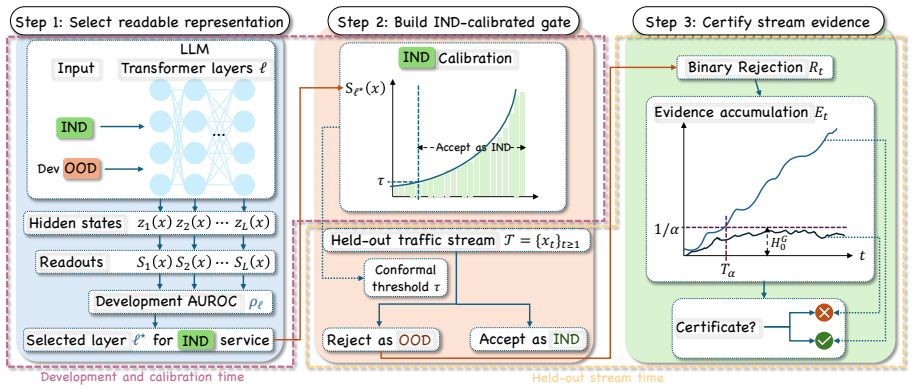
SCOPE is a framework that selects a readable hidden layer, constructs a conformal gate with IND calibration, and uses a supermartingale e-process to certify persistent service-boundary evidence, leading to improved rejection over standard final-layer detectors across multiple LLM backbones and six boundary conditions, while revealing geometric forms of OOD boundaries in hidden space.
What carries the argument
The conformal gate at a selected hidden layer combined with a supermartingale e-process for certifying boundary evidence.
If this is right
- Gate-level rejection improves compared to final-layer detectors.
- Different OOD boundaries manifest as distinct geometric forms in hidden space.
- The supermartingale e-process provides a theoretical guarantee for held-out inputs.
- Service-boundary signals are most clearly encoded at a selectable hidden layer.
Where Pith is reading between the lines
- SCOPE could be adapted to other sequential models beyond LLMs for OOD detection.
- Selecting different layers might allow tuning for specific types of boundary conditions.
- Integrating this into production LLM services might reduce unnecessary computation on invalid inputs.
Load-bearing premise
Service-boundary signals are most clearly encoded at a selectable readable hidden layer and the supermartingale e-process supplies a valid theoretical guarantee for held-out inputs under the chosen calibration.
What would settle it
A new set of OOD boundary conditions where the selected hidden layer does not show clearer signals than the final layer, or where the e-process fails to certify evidence on held-out data.
Figures
read the original abstract
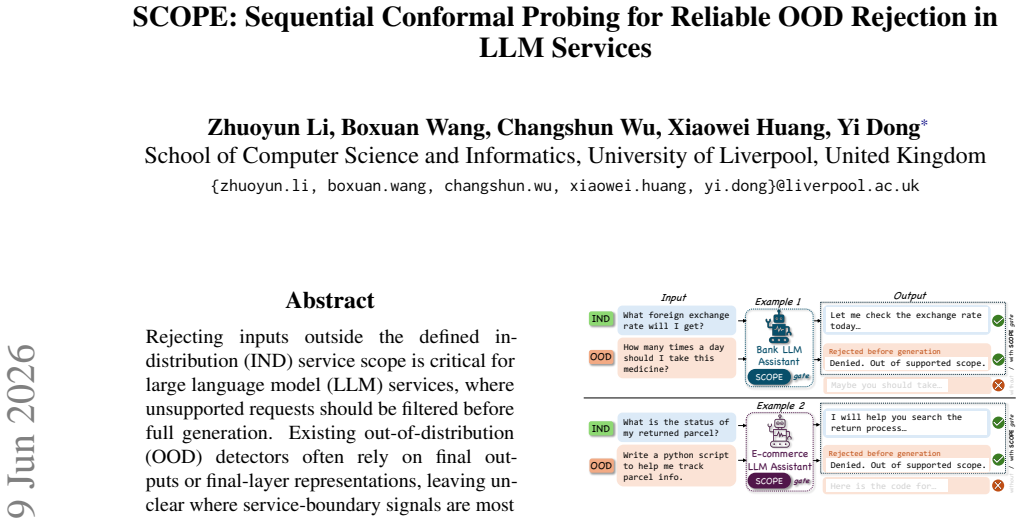
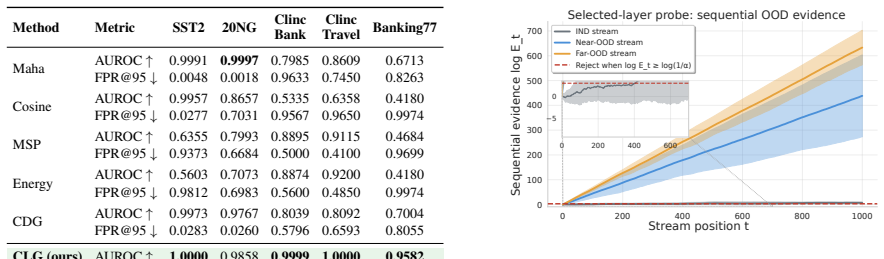
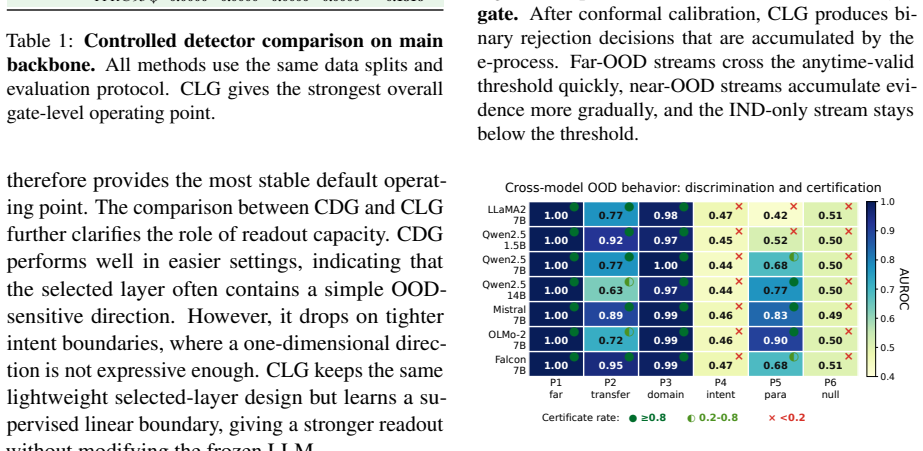
Rejecting inputs outside the defined in-distribution (IND) service scope is critical for large language model (LLM) services, where unsupported requests should be filtered before full generation. Existing out-of-distribution (OOD) detectors often rely on final outputs or final-layer representations, leaving unclear where service-boundary signals are most clearly encoded inside the model; they also lack a theoretical guarantee for held-out inputs. In this paper, we introduce SCOPE (Sequential Conformal OOD Probing and Evaluation), a framework that selects a readable hidden layer, constructs a conformal gate with IND calibration, and uses a supermartingale e-process to certify persistent service-boundary evidence. Experiments across multiple LLM backbones and six carefully designed boundary conditions show that SCOPE improves gate-level rejection over standard final-layer detectors, while revealing how different OOD boundaries take different geometric forms in hidden space.
Editorial analysis
A structured set of objections, weighed in public.
Referee Report
Summary. The paper introduces SCOPE (Sequential Conformal OOD Probing and Evaluation), a framework that selects a readable hidden layer in LLMs, constructs a conformal gate using IND calibration data, and applies a supermartingale e-process to certify persistent service-boundary evidence for OOD rejection. Experiments on multiple LLM backbones under six boundary conditions demonstrate improved gate-level rejection compared to standard final-layer detectors and provide insights into the geometric forms of different OOD boundaries in hidden space.
Significance. If the theoretical guarantees hold, the work could advance reliable OOD rejection for LLM services by moving beyond final-layer heuristics to layer-selected conformal gates with e-process certification. The multi-backbone experiments and six boundary conditions constitute a strength in empirical coverage.
major comments (1)
- [the section describing the supermartingale e-process construction and conformal gate] The central claim that SCOPE certifies persistent service-boundary evidence rests on the supermartingale e-process supplying a valid theoretical guarantee after conformal calibration at a selected hidden layer. No explicit derivation is provided showing that the filtration and the layer-selection step preserve the supermartingale property when hidden-layer scores are high-dimensional and token-sequence dependent (which can violate exchangeability or filtration conditions even under exchangeable calibration data). This is load-bearing for the certification claim for arbitrary held-out inputs.
Simulated Author's Rebuttal
We thank the referee for the constructive feedback and for recognizing the potential impact of the work on reliable OOD rejection in LLM services. We address the major comment below.
read point-by-point responses
-
Referee: [the section describing the supermartingale e-process construction and conformal gate] The central claim that SCOPE certifies persistent service-boundary evidence rests on the supermartingale e-process supplying a valid theoretical guarantee after conformal calibration at a selected hidden layer. No explicit derivation is provided showing that the filtration and the layer-selection step preserve the supermartingale property when hidden-layer scores are high-dimensional and token-sequence dependent (which can violate exchangeability or filtration conditions even under exchangeable calibration data). This is load-bearing for the certification claim for arbitrary held-out inputs.
Authors: We appreciate the referee pointing out the need for a more rigorous justification of the theoretical guarantees. The construction relies on the fact that the calibration data is exchangeable, and the conformal scores at the selected layer are used to form the e-process. The layer selection is performed using a validation set from the IND data, which maintains exchangeability. However, we agree that an explicit derivation showing preservation of the supermartingale property under layer selection and for high-dimensional, sequence-dependent scores is missing from the manuscript. In the revised version, we will add a new subsection or appendix providing this derivation, including how the filtration is defined over the sequence of tokens and why the property holds for held-out inputs under the standard assumptions of conformal prediction. We will also discuss potential limitations when strong dependencies violate exchangeability. revision: yes
Circularity Check
No significant circularity; derivation relies on external conformal and e-process methods
full rationale
The paper introduces SCOPE by selecting a hidden layer, building a conformal gate via IND calibration, and applying a supermartingale e-process for certification. These steps invoke standard techniques from conformal prediction literature rather than reducing any prediction or guarantee to fitted quantities by construction within the paper. No equations are exhibited that equate outputs to inputs via self-definition, renaming, or self-citation chains. The abstract and description present the framework as an application of existing tools to LLM hidden representations, with experimental validation on multiple backbones. This is self-contained against external benchmarks and does not meet the criteria for any enumerated circularity pattern.
Axiom & Free-Parameter Ledger
axioms (2)
- standard math Conformal prediction yields valid coverage under exchangeability of calibration and test points.
- domain assumption Supermartingale e-process can certify persistent service-boundary evidence for held-out inputs.
Reference graph
Works this paper leans on
-
[1]
Potsawee Manakul and Adian Liusie and Mark J. F. Gales , title =. Proceedings of the 2023 Conference on Empirical Methods in Natural Language Processing , year = 2023, pages =
2023
-
[2]
Hallucination Detection for Generative Large Language Models by B ayesian Sequential Estimation
Wang, Xiaohua and Yan, Yuliang and Huang, Longtao and Zheng, Xiaoqing and Huang, Xuanjing. Hallucination Detection for Generative Large Language Models by B ayesian Sequential Estimation. Proceedings of the 2023 Conference on Empirical Methods in Natural Language Processing. 2023. doi:10.18653/v1/2023.emnlp-main.949
-
[3]
Findings of the Association for Computational Linguistics: EMNLP 2023 , year = 2023, pages =
Yi Dai and Hao Lang and Kaisheng Zeng and Fei Huang and Yongbin Li , title =. Findings of the Association for Computational Linguistics: EMNLP 2023 , year = 2023, pages =
2023
-
[4]
Findings of the Association for Computational Linguistics: EMNLP 2024 , year = 2024, pages =
Qing Li and Jiahui Geng and Chenyang Lyu and Derui Zhu and Maxim Panov and Fakhri Karray , title =. Findings of the Association for Computational Linguistics: EMNLP 2024 , year = 2024, pages =
2024
-
[5]
Don't Just Say ``
Yang Deng and Yong Zhao and Moxin Li and See. Don't Just Say ``
-
[6]
Sali, Yusuf and Toraman, S tk Can. Navigating the Unknown: Intent Classification and Out-of-Distribution Detection Using Large Language Models. Findings of the Association for Computational Linguistics: EMNLP 2025. 2025. doi:10.18653/v1/2025.findings-emnlp.791
-
[7]
Edelman , title =
Gustaf Ahdritz and Tian Qin and Nikhil Vyas and Boaz Barak and Benjamin L. Edelman , title =. Proceedings of the 41st International Conference on Machine Learning , volume = 235, pages =
-
[8]
Farima Fatahi Bayat and Xin Liu and H. V. Jagadish and Lu Wang , title =. Findings of the Association for Computational Linguistics: ACL 2024 , year = 2024, pages =
2024
-
[9]
Guillaume Alain and Yoshua Bengio , title =
-
[10]
Findings of the Association for Computational Linguistics: EMNLP 2023 , year = 2023, pages =
Amos Azaria and Tom Mitchell , title =. Findings of the Association for Computational Linguistics: EMNLP 2023 , year = 2023, pages =
2023
-
[11]
First Conference on Language Modeling , year=
The Geometry of Truth: Emergent Linear Structure in Large Language Model Representations of True/False Datasets , author=. First Conference on Language Modeling , year=
-
[12]
The Twelfth International Conference on Learning Representations , year=
Language Models Represent Space and Time , author=. The Twelfth International Conference on Learning Representations , year=
-
[13]
2025 , eprint=
Linear socio-demographic representations emerge in Large Language Models from indirect cues , author=. 2025 , eprint=
2025
-
[14]
No Answer Needed: Predicting
Iv. No Answer Needed: Predicting. ICLR 2026 Workshop on Principled Design for Trustworthy AI - Interpretability, Robustness, and Safety across Modalities , year=
2026
-
[15]
2022 , eprint=
Language Models (Mostly) Know What They Know , author=. 2022 , eprint=
2022
-
[16]
The Eleventh International Conference on Learning Representations , year=
Semantic Uncertainty: Linguistic Invariances for Uncertainty Estimation in Natural Language Generation , author=. The Eleventh International Conference on Learning Representations , year=
-
[17]
Nature , volume = 630, number = 8017, pages =
Detecting hallucinations in large language models using semantic entropy , author =. Nature , volume = 630, number = 8017, pages =
-
[18]
On Large Language Models' Hallucination with Regard to Known Facts , author =. Proceedings of the 2024 Conference of the North American Chapter of the Association for Computational Linguistics: Human Language Technologies (Volume 1: Long Papers) , year = 2024, pages =
2024
-
[19]
Proceedings of the 41st International Conference on Machine Learning , pages =
The Linear Representation Hypothesis and the Geometry of Large Language Models , author =. Proceedings of the 41st International Conference on Machine Learning , pages =
-
[20]
Probing the Geometry of Truth: Consistency and Generalization of Truth Directions in
Bao, Yuntai and Zhang, Xuhong and Du, Tianyu and Zhao, Xinkui and Feng, Zhengwen and Peng, Hao and Yin, Jianwei , booktitle =. Probing the Geometry of Truth: Consistency and Generalization of Truth Directions in
-
[21]
Tibshirani and Larry Wasserman , title =
Jing Lei and Max G’Sell and Alessandro Rinaldo and Ryan J. Tibshirani and Larry Wasserman , title =. Journal of the American Statistical Association , volume = 113, number = 523, pages =
-
[22]
Journal of the Royal Statistical Society Series B: Statistical Methodology , volume = 87, number = 4, pages =
Conformal prediction with conditional guarantees , author =. Journal of the Royal Statistical Society Series B: Statistical Methodology , volume = 87, number = 4, pages =
-
[23]
Proceedings of the Twelfth Symposium on Conformal and Probabilistic Prediction with Applications , pages =
A Review of Nonconformity Measures for Conformal Prediction in Regression , author =. Proceedings of the Twelfth Symposium on Conformal and Probabilistic Prediction with Applications , pages =
-
[24]
Test martingales,
Shafer, Glenn and Shen, Alexander and Vereshchagin, Nikolai and Vovk, Vladimir , journal =. Test martingales,
-
[25]
Time-uniform
Howard, Steven and Ramdas, Aaditya and McAuliffe, Jon and Sekhon, Jagmohan , year = 2020, pages =. Time-uniform
2020
-
[26]
Proceedings of the National Academy of Sciences , volume = 121, number = 39, pages =
Beyond Neyman--Pearson: E-values enable hypothesis testing with a data-driven alpha , author =. Proceedings of the National Academy of Sciences , volume = 121, number = 39, pages =
-
[27]
A Baseline for Detecting Misclassified and Out-of-Distribution Examples in Neural Networks , author =
-
[28]
Lee, Kimin and Lee, Kibok and Lee, Honglak and Shin, Jinwoo , booktitle =
-
[29]
Liu, Weitang and Wang, Xiaoyun and Owens, John and Li, Yixuan , booktitle =
-
[30]
2023 , eprint=
Llama 2: Open Foundation and Fine-Tuned Chat Models , author=. 2023 , eprint=
2023
-
[31]
2025 , eprint=
Qwen2.5 Technical Report , author=. 2025 , eprint=
2025
-
[32]
2024 , eprint=
Out-of-Distribution Detection Should Use Conformal Prediction (and Vice-versa?) , author=. 2024 , eprint=
2024
-
[33]
and Chellappa, Rama and Jha, Susmit , booktitle =
Gupta, Ayush and Kaur, Ramneet and Roy, Anirban and Cobb, Adam D. and Chellappa, Rama and Jha, Susmit , booktitle =. Polysemantic Dropout: Conformal
-
[34]
How Good Are
Liu, Bo and Zhan, Li-Ming and Lu, Zexin and Feng, Yujie and Xue, Lei and Wu, Xiao-Ming , booktitle =. How Good Are
-
[35]
2026 , eprint=
Chain-of-Thought as a Lens: Evaluating Structured Reasoning Alignment between Human Preferences and Large Language Models , author=. 2026 , eprint=
2026
-
[36]
2021 51st Annual IEEE/IFIP International Conference on Dependable Systems and Networks-Supplemental Volume (DSN-S) , pages=
Detecting operational adversarial examples for reliable deep learning , author=. 2021 51st Annual IEEE/IFIP International Conference on Dependable Systems and Networks-Supplemental Volume (DSN-S) , pages=. 2021 , organization=
2021
-
[37]
ACM transactions on embedded computing systems , volume=
Reliability assessment and safety arguments for machine learning components in system assurance , author=. ACM transactions on embedded computing systems , volume=. 2023 , publisher=
2023
-
[38]
, booktitle=
Jiang, Zhihan and Ren, Rui and Yu, Guangba and Wu, Yulun and Gu, Wenwei and Li, Yichen and Huang, Yujie and Feng, Cong and Yang, Zengyin and Yang, Yongqiang and Lyu, Michael R. , booktitle=. LLMPrism: Black-box Performance Diagnosis for Production LLM Training Platforms , year=
-
[39]
2022 52nd Annual IEEE/IFIP International Conference on Dependable Systems and Networks Workshops (DSN-W) , pages=
A robust framework for adaptive selection of filter ensembles to detect adversarial inputs , author=. 2022 52nd Annual IEEE/IFIP International Conference on Dependable Systems and Networks Workshops (DSN-W) , pages=. 2022 , organization=
2022
-
[40]
2025 55th Annual IEEE/IFIP International Conference on Dependable Systems and Networks (DSN) , pages=
Multi-version Machine Learning and Rejuvenation for Resilient Perception in Safety-critical Systems , author=. 2025 55th Annual IEEE/IFIP International Conference on Dependable Systems and Networks (DSN) , pages=. 2025 , organization=
2025
-
[41]
arXiv preprint arXiv:2605.08896 , year=
FragileFlow: Spectral Control of Correct-but-Fragile Predictions for Foundation Model Robustness , author=. arXiv preprint arXiv:2605.08896 , year=
-
[42]
Llama 2: Open Foundation and Fine-Tuned Chat Models
Llama 2: Open Foundation and Fine-Tuned Chat Models , author =. 2023 , eprint =. doi:10.48550/arXiv.2307.09288 , url =
work page internal anchor Pith review Pith/arXiv arXiv doi:10.48550/arxiv.2307.09288 2023
-
[43]
Qwen2.5 Technical Report , author =. 2025 , eprint =. doi:10.48550/arXiv.2412.15115 , url =
work page internal anchor Pith review Pith/arXiv arXiv doi:10.48550/arxiv.2412.15115 2025
-
[44]
Mistral 7B , author =. 2023 , eprint =. doi:10.48550/arXiv.2310.06825 , url =
work page internal anchor Pith review Pith/arXiv arXiv doi:10.48550/arxiv.2310.06825 2023
-
[45]
2 OLMo 2 Furious , author =. 2025 , eprint =. doi:10.48550/arXiv.2501.00656 , url =
work page internal anchor Pith review Pith/arXiv arXiv doi:10.48550/arxiv.2501.00656 2025
-
[46]
The Falcon Series of Open Language Models
The Falcon Series of Open Language Models , author =. 2023 , eprint =. doi:10.48550/arXiv.2311.16867 , url =
work page internal anchor Pith review Pith/arXiv arXiv doi:10.48550/arxiv.2311.16867 2023
-
[47]
Proceedings of the 2013 Conference on Empirical Methods in Natural Language Processing , pages =
Recursive Deep Models for Semantic Compositionality Over a Sentiment Treebank , author =. Proceedings of the 2013 Conference on Empirical Methods in Natural Language Processing , pages =. 2013 , address =
2013
-
[48]
GLUE : A Multi-Task Benchmark and Analysis Platform for Natural Language Understanding
Wang, Alex and Singh, Amanpreet and Michael, Julian and Hill, Felix and Levy, Omer and Bowman, Samuel R. , booktitle =. 2018 , address =. doi:10.18653/v1/W18-5446 , url =
-
[49]
Machine Learning Proceedings 1995 , pages =
NewsWeeder: Learning to Filter Netnews , author =. Machine Learning Proceedings 1995 , pages =. 1995 , publisher =
1995
-
[50]
An Evaluation Dataset for Intent Classification and Out-of-Scope Prediction , author =. Proceedings of the 2019 Conference on Empirical Methods in Natural Language Processing and the 9th International Joint Conference on Natural Language Processing , pages =. 2019 , address =. doi:10.18653/v1/D19-1131 , url =
-
[51]
Proceedings of the 2nd Workshop on Natural Language Processing for Conversational AI , pages =
Efficient Intent Detection with Dual Sentence Encoders , author =. Proceedings of the 2nd Workshop on Natural Language Processing for Conversational AI , pages =. 2020 , address =. doi:10.18653/v1/2020.nlp4convai-1.5 , url =
-
[52]
Dagan, Ido and Glickman, Oren and Magnini, Bernardo , booktitle =. The. 2006 , publisher =
2006
-
[53]
Proceedings of the Ninth Workshop on Statistical Machine Translation , pages =
Findings of the 2014 Workshop on Statistical Machine Translation , author =. Proceedings of the Ninth Workshop on Statistical Machine Translation , pages =. 2014 , address =
2014
-
[54]
2002 , url =
Learning Question Classifiers , author =. 2002 , url =
2002
-
[55]
A broad-coverage challenge corpus for sentence understanding through inference
A Broad-Coverage Challenge Corpus for Sentence Understanding through Inference , author =. Proceedings of the 2018 Conference of the North American Chapter of the Association for Computational Linguistics: Human Language Technologies, Volume 1 , pages =. 2018 , address =. doi:10.18653/v1/N18-1101 , url =
work page internal anchor Pith review doi:10.18653/v1/n18-1101 2018
discussion (0)
Sign in with ORCID, Apple, or X to comment. Anyone can read and Pith papers without signing in.