Evidence of the Excited X(5)-like Critical-Point Symmetry Structures in 152Sm
Pith reviewed 2026-06-26 12:51 UTC · model grok-4.3
The pith
152Sm shows X(5)-like symmetry in excited collective bands.
A machine-rendered reading of the paper's core claim, the machinery that carries it, and where it could break.
Core claim
In addition to the established X(5)-like features of the low-lying spectrum, the observed systematics of the higher-lying bands are found to be consistent with excited collective structures exhibiting X(5)-like characteristics.
What carries the argument
The X(5) critical-point description of the first-order U(5)-SU(3) shape-phase transition, which supplies predicted energy ratios and B(E2) strengths for nuclei at the spherical-to-deformed boundary.
If this is right
- The N=90 region contains multiple realizations of X(5)-like behavior at different excitation energies.
- Critical-point symmetry can appear in excited configurations as well as in the ground-state band.
- Collectivity in 152Sm follows the X(5) pattern across several bands, tightening constraints on shape-phase models.
- Similar excited X(5) sequences may occur in neighboring nuclei near the same phase transition.
Where Pith is reading between the lines
- Comparable excited-band studies in 150Nd or 154Gd could test whether the pattern repeats across the N=90 isotones.
- The results suggest the U(5)-SU(3) transition may support replicated critical points at higher energies, a feature not usually included in standard calculations.
- If the pattern holds, models of nuclear collectivity would need explicit provisions for X(5)-like structures above the lowest bands.
Load-bearing premise
The spin-parity assignments and B(E2) values derived from branching ratios and lifetimes correctly identify pure collective motion without important mixing from other configurations.
What would settle it
A new lifetime or branching-ratio measurement that places the B(E2) values of the higher bands far from X(5) predictions while matching a rigid-rotor or pure-vibrator limit.
Figures
read the original abstract
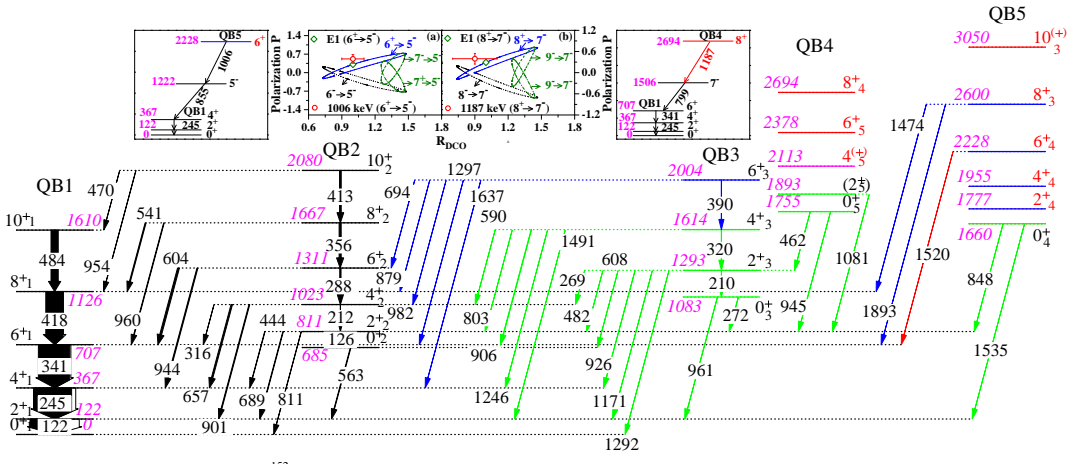
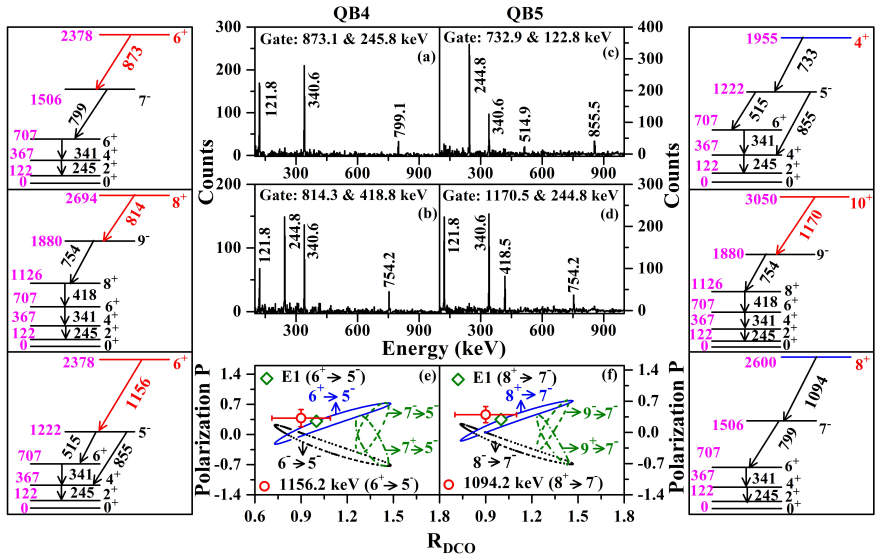
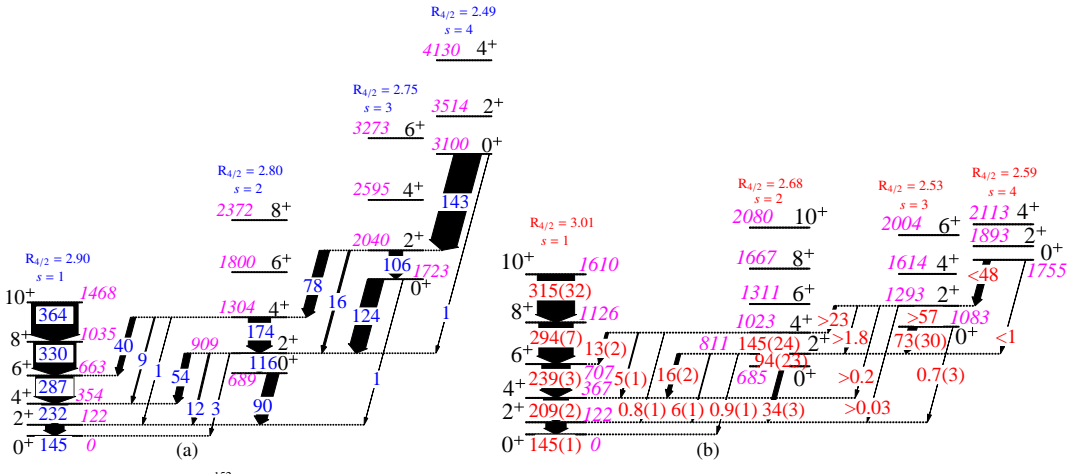
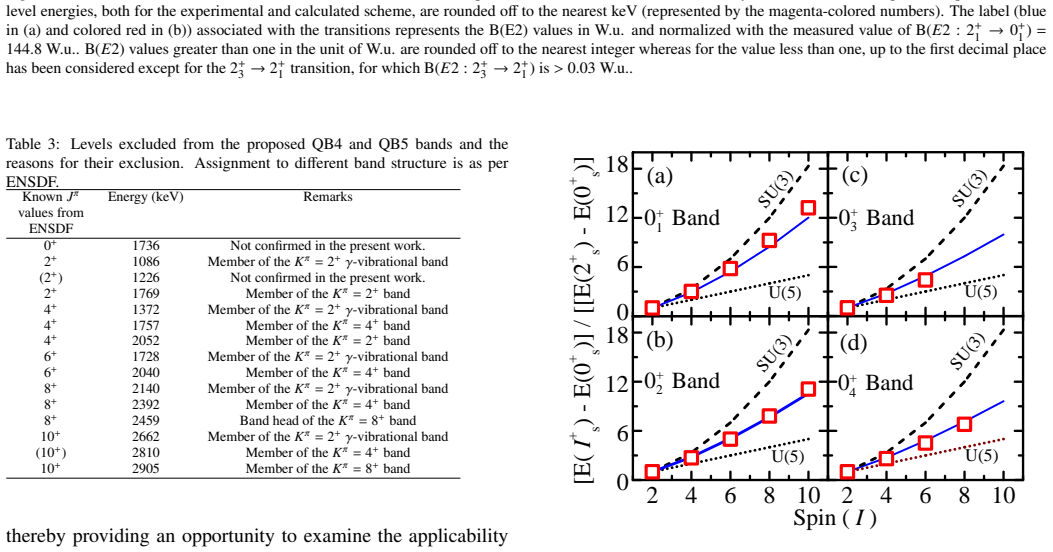
The positive-parity structure of 152Sm has been investigated through high-statistics {\gamma}-ray spectroscopy following the (150Nd({\alpha},2n)152Sm reaction at Elab = 26 MeV. Several collective structures built on excited 0+ states have been extended through the observation of new levels and {\gamma}-ray transitions, and spin-parity assignments have been established using directional-correlation and linear-polarization measurements. Electromagnetic transition strengths (B(E2)), deduced from measured branching ratios and known level lifetimes, reveal pronounced collectivity among the excited configurations. The resulting level scheme provides evidence for a sequence of excited collective bands extending beyond the well-known ground-state and first excited 0+ structures. The excitation energies and transition strengths are examined within the framework of the X(5) critical-point description of the first-order U(5)-SU(3) shape-phase transition. In addition to the established X(5)-like features of the low-lying spectrum, the observed systematics of the higher-lying bands are found to be consistent with excited collective structures exhibiting X(5)-like characteristics. The results provide new constraints on the realization of critical-point behavior in finite nuclei and on the evolution of collectivity in the N=90 region.
Editorial analysis
A structured set of objections, weighed in public.
Referee Report
Summary. The manuscript reports high-statistics γ-ray spectroscopy of 152Sm following the 150Nd(α,2n) reaction at 26 MeV. New levels and transitions in positive-parity collective structures built on excited 0+ states are identified, with J^π assignments from directional-correlation and linear-polarization data. B(E2) values are deduced from branching ratios combined with known lifetimes, revealing collectivity. The level scheme is compared to the X(5) critical-point symmetry of the U(5)-SU(3) transition; in addition to the established low-lying X(5)-like features, the systematics of higher-lying bands are reported as consistent with excited X(5)-like structures, yielding new constraints on critical-point behavior in the N=90 region.
Significance. If the quantitative comparisons hold, the work extends X(5) descriptions beyond the ground-state and first-excited 0+ bands to higher collective configurations, supplying additional experimental constraints on the realization of critical-point symmetries in finite nuclei and on collectivity evolution near N=90. The use of conventional γ-spectroscopy techniques (DCO, polarization, branching ratios + lifetimes) applied to extended bands is a standard approach in the field and, when the data tables are complete, adds to the existing body of N=90 studies without introducing new methodological assumptions.
major comments (2)
- [Results and Discussion sections] The central claim of X(5)-like behavior in the higher-lying bands rests on the comparison of excitation energies and B(E2) values; the manuscript should provide explicit tables or figures showing the numerical experimental values (with uncertainties) alongside the X(5) predictions, including any parameter choices (e.g., the ratio of moments of inertia or effective charges) used for the excited bands, so that the degree of agreement can be assessed independently.
- [Electromagnetic transition strengths subsection] The deduction of B(E2) strengths from branching ratios and known lifetimes assumes negligible mixing or contamination; the paper should quantify possible effects of configuration mixing on the assigned collective character of the higher bands, citing specific levels or transitions where this could affect the X(5) comparison.
minor comments (3)
- [Abstract] The abstract would be strengthened by inclusion of at least one or two representative numerical B(E2) ratios or energy ratios that support the X(5)-like claim for the higher bands.
- [Introduction and Experimental details] Notation for the reaction should follow standard nuclear-reaction format throughout (e.g., consistent use of 150Nd(α,2n)152Sm).
- [Introduction] Ensure all cited previous X(5) studies on 152Sm and neighboring nuclei are referenced in the introduction for context.
Simulated Author's Rebuttal
We thank the referee for the positive assessment and constructive comments on our manuscript. We address each major comment below and will revise the manuscript accordingly to improve clarity and transparency of the comparisons.
read point-by-point responses
-
Referee: [Results and Discussion sections] The central claim of X(5)-like behavior in the higher-lying bands rests on the comparison of excitation energies and B(E2) values; the manuscript should provide explicit tables or figures showing the numerical experimental values (with uncertainties) alongside the X(5) predictions, including any parameter choices (e.g., the ratio of moments of inertia or effective charges) used for the excited bands, so that the degree of agreement can be assessed independently.
Authors: We agree that explicit numerical comparisons will allow independent assessment. In the revised manuscript we will add a dedicated table (and associated figure) in the Results and Discussion sections listing experimental excitation energies and B(E2) values (with uncertainties) for the higher-lying bands next to the X(5) predictions. All model parameters, including the ratio of moments of inertia and effective charges adopted for the excited bands, will be stated explicitly. revision: yes
-
Referee: [Electromagnetic transition strengths subsection] The deduction of B(E2) strengths from branching ratios and known lifetimes assumes negligible mixing or contamination; the paper should quantify possible effects of configuration mixing on the assigned collective character of the higher bands, citing specific levels or transitions where this could affect the X(5) comparison.
Authors: We will expand the Electromagnetic transition strengths subsection to include a quantitative discussion of possible configuration mixing. For the specific levels and transitions where mixing could influence the extracted B(E2) values, we will cite the relevant data and estimate its potential impact on the X(5) comparison. The current analysis is based on the observed systematics supporting dominant collective character, but we will explicitly note the assumptions and limitations. revision: partial
Circularity Check
No significant circularity; comparison to external X(5) model
full rationale
The paper reports experimental gamma-ray spectroscopy results from the (150Nd(α,2n)) reaction, including new level extensions, spin-parity assignments via DCO and polarization, and B(E2) values from branching ratios plus known lifetimes. These data are then compared to the pre-existing X(5) critical-point symmetry (an external theoretical framework from the literature). No derivation chain, equation, or fitted parameter is shown to reduce by construction to the paper's own inputs; the X(5) comparison is not generated from the present dataset via self-definition or self-citation load-bearing steps. The analysis follows standard nuclear-structure methods without internal circularity.
Axiom & Free-Parameter Ledger
axioms (1)
- domain assumption The X(5) critical-point symmetry provides a valid description of the U(5)-SU(3) shape-phase transition in finite nuclei.
Reference graph
Works this paper leans on
-
[1]
F.Nature Physics, 2:811, 2006
Casten and R. F.Nature Physics, 2:811, 2006
2006
-
[2]
Goswami, D
P. Goswami, D. Schwab, and S. Chakravarty.Phys. Rev. Lett., 100:015703, 2008
2008
-
[3]
C. Wang, A. Nahum, M.A. Metlitski, C. Xu, and T. Senthil. Phys. Rev. X, 7:031051, 2017
2017
-
[4]
Casten and E.A
R.F. Casten and E.A. McCutchan.J. Phys. G, 34:R285, 2007
2007
-
[5]
Sharff-Goldhaber and J
G. Sharff-Goldhaber and J. Weneser.Phys. Rev., 98:212, 1955
1955
-
[6]
Bohr and B.R
A. Bohr and B.R. Mottelson.Phys. Rev., 90:717, 1953
1953
-
[7]
Wilets and M
L. Wilets and M. Jean.Phys. Rev., 102:788, 1956
1956
-
[8]
Iachello and A
F. Iachello and A. Arima.Cambridge Univ. Press, Cambridge
-
[9]
Iachello.Phys
F. Iachello.Phys. Rev. Lett., 87:052502, 2001
2001
-
[10]
Iachello.Phys
F. Iachello.Phys. Rev. Lett., 85:3580, 2000. 6
2000
-
[11]
Brookhaven National Laboratory and National Nuclear Data Center.https://www.nndc.bnl.gov/ENSDF
-
[12]
Martin.Nucl
M.J. Martin.Nucl. Data Sheets, 114:1497, 2013
2013
-
[13]
Hirning and D.G
C.R. Hirning and D.G. Burke.Can. J. Phys., 13:13, 1977
1977
-
[14]
Iachello and A
F. Iachello and A. Arima.The Interacting Boson Model. Cam- bridge University Press, Cambridge, 1987
1987
-
[15]
O. Scholten, F. Iachello, and A. Arima. Interacting boson model of collective nuclear states. iii. the transition from su(5) to su(3).Annals of Physics, 115(2):325–366, 1978. doi: 10.1016/0003-4916(78)90060-4
-
[16]
N. V . Zamfir, E. A. McCutchan, and R. F. Casten. The x(5) critical point nuclei and the interacting boson model symmetry triangle.Phys. At. Nucl., 67(10):1829–1833, 2004. doi: 10. 1134/1.1811186
2004
-
[17]
Guo.Phys
J.Y . Guo.Phys. Rev. Lett., 87:052503, 2001
2001
-
[18]
Krückenet al
R. Krückenet al. Phys. Rev. Lett., 88:232501, 2002
2002
-
[19]
E. A. McCutchan, N. V . Zamfir, R. F. Casten, C. W. Beausang, J.- Y . Zhang, M. A. Caprio, R. Krücken, J. R. Novak, J. R. Cooper, G. C. Ball, et al. Lifetime measurements of yrast states in 162yb and 166hf.Physical Review C, 73(3):034303, 2006. doi: 10. 1103/PhysRevC.73.034303
2006
-
[20]
S. Das, S. Samanta, R. Banik, R. Bhattacharjee, K. Basu, R. Raut, S. S. Ghugre, A. K. Sinha, S. Bhattacharya, S. Imran, et al. A compton suppressed detector multiplicity trigger based digital daq for gamma-ray spectroscopy.Nucl. Instrum. Methods Phys. Res. A, 893:138–145, 2018. doi: 10.1016/j.nima.2018.03. 035
-
[21]
R. K. Bhowmik. Ingasort manual. Private communication
-
[22]
D. C. Radford. Escl8r and levit8r: Software for interactive anal- ysis of hpge coincidence data sets.Nucl. Instrum. Methods Phys. Res. A, 361:297–305, 1995
1995
-
[23]
D. C. Radford. Software for the analysis of gamma-ray coinci- dence data.Nucl. Instrum. Methods Phys. Res. A, 361:306–316, 1995
1995
-
[24]
Krämer-Flecken, G
A. Krämer-Flecken, G. Duchêne, B. Haas, O. Kenn, J. C. Lisle, J. Meyer, C. Miehe, and U. Neuneyer. Directional correlation measurements with germanium detector arrays.Nucl. Instrum. Methods Phys. Res. A, 275:333–339, 1989
1989
-
[25]
M. K. Kabadiyski, K. P. Lieb, and D. Rudolph. Directional correlation analysis in in-beam gamma-ray spectroscopy.Nucl. Phys. A, 563:301–316, 1993
1993
-
[26]
Starosta, T
K. Starosta, T. Morek, Ch. Droste, et al. Novel techniques for gamma-ray linear polarization measurements using clover detec- tors.Nucl. Instrum. Methods Phys. Res. A, 423:16–25, 1999
1999
-
[27]
Droste, T
Ch. Droste, T. Morek, S. Klupp, et al. Gamma-ray polarization measurements with segmented detectors.Nucl. Instrum. Meth- ods Phys. Res. A, 378:518–525, 1996
1996
-
[28]
J. K. Deng, H. Hua, C. X. Yang, et al. Linear polarization mea- surements using compton polarimeters.Nucl. Instrum. Methods Phys. Res. A, 317:242–252, 1992
1992
-
[29]
P. M. Jones, R. M. Lieder, H. M. Jäger, et al. Polarization mea- surements with germanium detector arrays.Nucl. Instrum. Meth- ods Phys. Res. A, 362:556–564, 1995
1995
-
[30]
Basaket al
S. Basaket al. Phys. Rev. C, 111:034319, 2025
2025
-
[31]
Hamiltonet al
S.J.H. Hamiltonet al. Phys. Rev. C, 3:960, 1971
1971
-
[32]
Castenet al
R.F. Castenet al. Phys. Rev. C, 57:R1553, 1998
1998
-
[33]
Kulpet al
W.D. Kulpet al. Phys. Rev. C, 71:041303(R), 2005
2005
-
[34]
Kulpet al
W.D. Kulpet al. Phys. Rev. C, 77:061301(R), 2008
2008
-
[35]
Machet al
H. Machet al. Phys. Rev. C, 46:1849, 1992
1992
-
[36]
D. J. Rowe, P. S. Turner, and G. Thiamova. The u(5)-su(3) phase transition in the interacting boson model.Nucl. Phys. A, 760:59– 83, 2005. doi: 10.1016/j.nuclphysa.2005.05.144
-
[37]
J. M. Arias, J. Dukelsky, and J. E. García-Ramos. The u(5)-o(6) transition in the interacting boson model and the e(5) critical point symmetry.Phys. Rev. C, 68:041302(R), 2003. doi: 10. 1103/PhysRevC.68.041302
2003
-
[38]
M. A. Caprio. Consequences of wall stiffness for a beta-soft potential.Phys. Rev. C, 69:044307, 2004
2004
-
[39]
Bonatsos, D
D. Bonatsos, D. Lenis, N. Minkov, D. Petrellis, P. P. Raychev, and P. A. Terziev. E(5) and x(5) critical point symmetries ob- tained from davidson potentials through a variational procedure. Phys. Rev. C, 70:024305, 2004
2004
-
[40]
Bonatsos, D
D. Bonatsos, D. Lenis, E. A. McCutchan, D. Petrellis, and I. Yig- itoglu. Exactly separable version of x(5) and related models. Phys. Lett. B, 649:394–399, 2007. 7
2007
discussion (0)
Sign in with ORCID, Apple, or X to comment. Anyone can read and Pith papers without signing in.