Ramanujan Graph Rewiring with Non Negative Resistance Curvature
Pith reviewed 2026-06-26 14:25 UTC · model grok-4.3
The pith
Ramanujan graphs can be rewired onto input graphs to guarantee non-negative resistance curvature and reduce over-squashing in GNN message passing.
A machine-rendered reading of the paper's core claim, the machinery that carries it, and where it could break.
Core claim
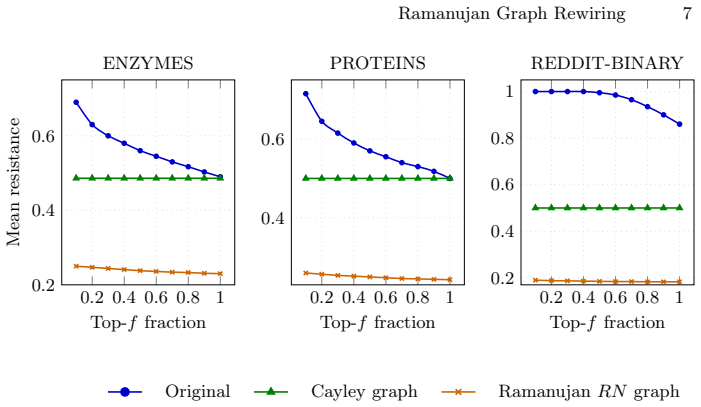
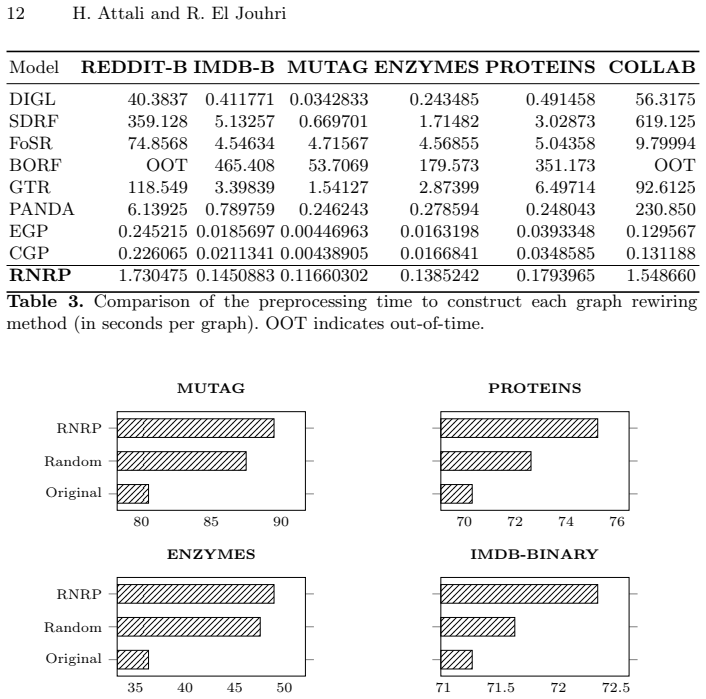
Suitably chosen Ramanujan graphs guarantee non-negative resistance curvature, which mitigates over-squashing and facilitates efficient information flow; an algorithmic framework then constructs a Ramanujan rewired graph that preserves the local connectivity of the original graph, and this construction outperforms nine state-of-the-art rewiring techniques on GNN tasks.
What carries the argument
The Ramanujan rewired graph, formed by adding edges drawn from a Ramanujan graph while preserving the original local connectivity, which carries the non-negative resistance curvature property into the input graph.
If this is right
- Non-negative resistance curvature directly reduces the compression of large neighborhoods into fixed embeddings during message passing.
- The rewired graphs support longer-range dependency capture without changing the original node features or local structure.
- Ramanujan graphs supply a deterministic structural prior that replaces heuristic curvature-based or spectral rewiring rules.
- The same construction yields a topology-aware message-passing scheme that scales with graph size while remaining local.
Where Pith is reading between the lines
- The same rewiring idea could be tested on directed graphs or hypergraphs where resistance curvature has a natural analogue.
- If the non-negative curvature bound holds uniformly, it may imply improved mixing times for random walks on the rewired graph, a property left unmeasured in the experiments.
- The method opens a route to parameter-free topology repair that could be combined with existing attention or positional-encoding layers in GNNs.
Load-bearing premise
An algorithmic framework always exists that can add Ramanujan edges to any input graph while preserving its local connectivity and achieving non-negative resistance curvature.
What would settle it
A concrete input graph on which no such rewiring procedure produces non-negative resistance curvature while keeping local neighborhoods unchanged, or a benchmark where the method fails to match or exceed the nine compared rewiring baselines.
Figures
read the original abstract
Graph Neural Networks (GNNs) have emerged as a powerful paradigm for learning on graph-structured data by iteratively propagating and aggregating information across edges. However, conventional message passing schemes often suffer from over-squashing, whereby exponentially large neighborhoods are compressed into fixed-dimensional embeddings, impeding effective long-range dependency learning. In this work, we introduce Ramanujan Propagation, a graph rewiring strategy that leverages Ramanujan graphs to alleviate topological bottlenecks in GNNs. We first establish that suitably chosen Ramanujan graphs guarantee non-negative resistance curvature, which mitigates over-squashing and facilitates efficient information flow. We then propose an algorithmic framework to construct a Ramanujan rewired graph that preserves the local connectivity of the original graph. Our experiments demonstrate that our method outperforms nine state-of-the-art rewiring techniques. These results establish Ramanujan graphs as a rigorous structural prior for scalable, topology-aware message passing in GNNs.
Editorial analysis
A structured set of objections, weighed in public.
Referee Report
Summary. The manuscript introduces Ramanujan Propagation, a graph rewiring strategy for GNNs that uses Ramanujan graphs to address over-squashing. It asserts that suitably chosen Ramanujan graphs guarantee non-negative resistance curvature to improve information flow, proposes an algorithmic framework for constructing a rewired graph that preserves local connectivity of the input graph, and claims experimental superiority over nine state-of-the-art rewiring methods.
Significance. If the curvature guarantee and the existence of a construction satisfying all three conditions (Ramanujan property, non-negative resistance curvature, and local connectivity preservation) are established with explicit derivations, the work would supply a structural prior with potential theoretical grounding for rewiring, distinguishing it from heuristic approaches. The reported outperformance would then indicate practical relevance for long-range dependency tasks in GNNs.
major comments (2)
- [Abstract] Abstract: the assertion that 'suitably chosen Ramanujan graphs guarantee non-negative resistance curvature, which mitigates over-squashing' is presented without any derivation, theorem statement, or reference to a specific result establishing the curvature property from the Ramanujan spectral condition. This link is load-bearing for the central claim that the rewiring alleviates topological bottlenecks.
- [algorithmic framework] The algorithmic framework paragraph: the manuscript states that an algorithmic framework exists to construct a Ramanujan rewired graph preserving local connectivity while achieving the non-negative resistance curvature property, yet supplies neither pseudocode, an explicit invariant, nor a proof that the output simultaneously satisfies the Ramanujan spectral bound, the curvature guarantee, and retention of original neighborhoods. This is the load-bearing assumption identified in the skeptic note and directly undermines verifiability of the proposed method.
minor comments (2)
- [Abstract] The abstract refers to 'nine state-of-the-art rewiring techniques' without naming them or providing citations; a table or section listing the baselines with references is needed for reproducibility.
- No dataset descriptions, experimental protocol details, or statistical significance tests are mentioned in the provided text, which affects assessment of the experimental claims.
Simulated Author's Rebuttal
We thank the referee for the constructive feedback on our manuscript. We address each major comment below and agree that the theoretical claims and algorithmic details require more explicit presentation to strengthen verifiability.
read point-by-point responses
-
Referee: [Abstract] Abstract: the assertion that 'suitably chosen Ramanujan graphs guarantee non-negative resistance curvature, which mitigates over-squashing' is presented without any derivation, theorem statement, or reference to a specific result establishing the curvature property from the Ramanujan spectral condition. This link is load-bearing for the central claim that the rewiring alleviates topological bottlenecks.
Authors: We agree that the abstract would benefit from greater explicitness. The full manuscript derives the non-negative resistance curvature from the Ramanujan spectral gap in Section 3 using the definition of resistance curvature and expander mixing properties. In revision we will add an explicit theorem statement to the abstract (or a footnote) with a direct reference to this derivation. revision: yes
-
Referee: [algorithmic framework] The algorithmic framework paragraph: the manuscript states that an algorithmic framework exists to construct a Ramanujan rewired graph preserving local connectivity while achieving the non-negative resistance curvature property, yet supplies neither pseudocode, an explicit invariant, nor a proof that the output simultaneously satisfies the Ramanujan spectral bound, the curvature guarantee, and retention of original neighborhoods. This is the load-bearing assumption identified in the skeptic note and directly undermines verifiability of the proposed method.
Authors: We acknowledge the need for greater formality. The manuscript describes the framework at a high level but does not include pseudocode or a formal proof of the joint invariants. We will revise the section to supply pseudocode, state the invariants explicitly (local neighborhood retention, Ramanujan bound, and curvature non-negativity), and include a proof sketch establishing that the output satisfies all three conditions simultaneously. revision: yes
Circularity Check
No significant circularity; derivation is self-contained
full rationale
The abstract and described claims establish a graph-theoretic guarantee for non-negative resistance curvature on suitably chosen Ramanujan graphs, followed by an algorithmic construction that preserves local connectivity. No equations or steps reduce a claimed prediction or result to a fitted parameter, self-definition, or self-citation chain by construction. The framework is presented as a proposed algorithm rather than a statistical fit renamed as prediction, and the curvature-to-over-squashing link is asserted as a consequence of the structural property without evidence of definitional circularity. The paper's central results therefore stand as independent content relative to the inputs.
Axiom & Free-Parameter Ledger
axioms (1)
- domain assumption Suitably chosen Ramanujan graphs guarantee non-negative resistance curvature
Reference graph
Works this paper leans on
-
[1]
In: ICML
Abu-El-Haija, S., Perozzi, B., Kapoor, A., Alipourfard, N., Lerman, K., Harutyun- yan, H., Ver Steeg, G., Galstyan, A.: Mixhop: Higher-order graph convolutional architectures via sparsified neighborhood mixing. In: ICML. pp. 21–29 (2019)
2019
-
[2]
In: 25th Annual Symposium onFoundations of Computer Science, 1984
Alon, N., Milman, V.D.: Eigenvalues, expanders and superconcentrators. In: 25th Annual Symposium onFoundations of Computer Science, 1984. IEEE (1984)
1984
-
[3]
In: International Conference on Learning Representations (2021)
Alon, U., Yahav, E.: On the bottleneck of graph neural networks and its practical implications. In: International Conference on Learning Representations (2021)
2021
-
[4]
Arnaiz-Rodriguez, A., Errica, F.: Oversmoothing," oversquashing", heterophily, long-range, and more: Demystifying common beliefs in graph machine learning. arXiv preprint arXiv:2505.15547 (2025)
-
[5]
In: Forty-first International Conference on Machine Learning (2024),https://openreview.net/forum?id= uyhjKoaIQa
Attali, H., Buscaldi, D., Pernelle, N.: Delaunay graph: Addressing over-squashing and over-smoothing using delaunay triangulation. In: Forty-first International Conference on Machine Learning (2024),https://openreview.net/forum?id= uyhjKoaIQa
2024
-
[6]
In: Proceedings of the 34th ACM International Conference on Information and Knowledge Management
Attali, H., Papastergiou, T., Pernelle, N., Malliaros, F.D.: Dynamic triangulation- based graph rewiring for graph neural networks. In: Proceedings of the 34th ACM International Conference on Information and Knowledge Management. pp. 87–97 (2025)
2025
-
[7]
Graph Rewiring in GNNs to Mitigate Over-Squashing and Over-Smoothing: A Survey
Attali, H., Pernelle, N., Buscaldi, D., Malliaros, F.D.: Graph rewiring in gnns to mitigate over-squashing and over-smoothing: A survey. arXiv preprint arXiv:2605.00951 (2026)
work page internal anchor Pith review Pith/arXiv arXiv 2026
-
[8]
arXiv preprint arXiv:2506.05971 (2025)
Bamberger, J., Gutteridge, B., Roux, S.l., Bronstein, M.M., Dong, X.: On measuring long-range interactions in graph neural networks. arXiv preprint arXiv:2506.05971 (2025)
-
[9]
In: 2022 58th Annual Allerton Conference on Communication, Control, and Computing (Allerton)
Banerjee,P.K.,Karhadkar,K.,Wang,Y.G.,Alon,U.,Montúfar,G.:Oversquashing in gnns through the lens of information contraction and graph expansion. In: 2022 58th Annual Allerton Conference on Communication, Control, and Computing (Allerton). pp. 1–8. IEEE (2022)
2022
-
[10]
In: The Twelfth International Conference on Learn- ing Representations (2024),https://openreview.net/forum?id=4Ua4hKiAJX
Barbero, F., Velingker, A., Saberi, A., Bronstein, M.M., Giovanni, F.D.: Locality- aware graph rewiring in GNNs. In: The Twelfth International Conference on Learn- ing Representations (2024),https://openreview.net/forum?id=4Ua4hKiAJX
2024
-
[11]
In: Forty-first International Conference on Machine Learning (2024),https://openreview.net/forum?id=fSNHK7mu3j
Bechler-Speicher, M., Amos, I., Gilad-Bachrach, R., Globerson, A.: Graph neural networks use graphs when they shouldn’t. In: Forty-first International Conference on Machine Learning (2024),https://openreview.net/forum?id=fSNHK7mu3j
2024
-
[12]
In: International Conference on Machine Learning
Black, M., Wan, Z., Nayyeri, A., Wang, Y.: Understanding oversquashing in gnns through the lens of effective resistance. In: International Conference on Machine Learning. pp. 2528–2547. PMLR (2023)
2023
-
[13]
In: ICLR (2014)
Bruna, J., Zaremba, W., Szlam, A., LeCun, Y.: Spectral networks and locally connected networks on graphs. In: ICLR (2014)
2014
-
[14]
In: Proceedings of the twenty-first annual ACM symposium on Theory of computing
Chandra, A.K., Raghavan, P., Ruzzo, W.L., Smolensky, R.: The electrical resis- tance of a graph captures its commute and cover times. In: Proceedings of the twenty-first annual ACM symposium on Theory of computing. pp. 574–586 (1989) Ramanujan Graph Rewiring 15
1989
-
[15]
Princeton University Press (1970)
Cheeger,J.:Alowerboundforthesmallesteigenvalueofthelaplacian.In:Problems in Analysis: A Symposium in Honor of Salomon Bochner (PMS-31). Princeton University Press (1970)
1970
-
[16]
In: Proceedings of the AAAI Conference
Chen, D., Lin, Y., Li, W., Li, P., Zhou, J., Sun, X.: Measuring and relieving the over-smoothing problem for graph neural networks from the topological view. In: Proceedings of the AAAI Conference. vol. 34, pp. 3438–3445 (2020)
2020
-
[17]
In: Proceedings of the conference on computer vision and pattern recognition
Chen, J., Li, Z., Zhu, Y., Zhang, J., Pu, J.: From node interaction to hop interac- tion: New effective and scalable graph learning paradigm. In: Proceedings of the conference on computer vision and pattern recognition. pp. 7876–7885 (2023)
2023
-
[18]
Choi, J., Park, S., Park, S., Cho, S.B., Park, N.: Fractal-inspired message passing neural networks with fractal nodes (2025),https://openreview.net/forum?id= zPoW8CajCN
2025
-
[19]
arXiv preprint arXiv:2406.03671 (2024)
Choi, J., Park, S., Wi, H., Cho, S.B., Park, N.: Panda: Expanded width-aware message passing beyond rewiring. arXiv preprint arXiv:2406.03671 (2024)
-
[20]
American Mathematical Soc
Chung, F.R., Graham, F.C.: Spectral graph theory. American Mathematical Soc. (1997)
1997
-
[21]
In: Learning on Graphs Conference
Deac, A., Lackenby, M., Veličković, P.: Expander graph propagation. In: Learning on Graphs Conference. pp. 38–1. PMLR (2022)
2022
-
[22]
arXiv preprint arXiv:2410.07756 (2024)
Devriendt, K.: Graphs with nonnegative resistance curvature. arXiv preprint arXiv:2410.07756 (2024)
-
[23]
Discrete Applied Mathematics348, 68–78 (2024)
Devriendt, K., Ottolini, A., Steinerberger, S.: Graph curvature via resistance dis- tance. Discrete Applied Mathematics348, 68–78 (2024)
2024
-
[24]
In: ICML
Di Giovanni, F., Giusti, L., Barbero, F., Luise, G., Lio, P., Bronstein, M.M.: On over-squashing in message passing neural networks: The impact of width, depth, and topology. In: ICML. pp. 7865–7885. PMLR (2023)
2023
- [25]
-
[26]
arXiv preprint arXiv:2110.07875 (2021)
Dwivedi, V.P., Luu, A.T., Laurent, T., Bengio, Y., Bresson, X.: Graph neural networks with learnable structural and positional representations. arXiv preprint arXiv:2110.07875 (2021)
-
[27]
Advances in Neural Information Processing Sys- tems35, 22326–22340 (2022)
Dwivedi, V.P., Rampášek, L., Galkin, M., Parviz, A., Wolf, G., Luu, A.T., Beaini, D.: Long range graph benchmark. Advances in Neural Information Processing Sys- tems35, 22326–22340 (2022)
2022
-
[28]
In: The Second Learning on Graphs Confer- ence (2023)
Fesser, L., Weber, M.: Mitigating over-smoothing and over-squashing using aug- mentations of forman-ricci curvature. In: The Second Learning on Graphs Confer- ence (2023)
2023
-
[29]
Forman, R.: Bochner’s method for cell complexes and combinatorial ricci curvature (2003)
2003
-
[30]
In: Proceedings of the thirty-fifth annual ACM symposium on Theory of computing
Friedman, J.: A proof of alon’s second eigenvalue conjecture. In: Proceedings of the thirty-fifth annual ACM symposium on Theory of computing. pp. 720–724 (2003)
2003
-
[31]
In: International conference on machine learning
Gilmer, J., Schoenholz, S.S., Riley, P.F., Vinyals, O., Dahl, G.E.: Neural message passing for quantum chemistry. In: International conference on machine learning. pp. 1263–1272. PMLR (2017)
2017
-
[32]
In: Proceedings of the 32nd ACM international CIKM
Giraldo,J.H.,Skianis,K.,Bouwmans,T.,Malliaros,F.D.:Onthetrade-offbetween over-smoothing and over-squashing in deep graph neural networks. In: Proceedings of the 32nd ACM international CIKM. pp. 566–576 (2023)
2023
-
[33]
Advances in Mathematics458, 109984 (2024) 16 H
Glock, S., Correia, D.M., Sudakov, B.: Hamilton cycles in pseudorandom graphs. Advances in Mathematics458, 109984 (2024) 16 H. Attali and R. El Jouhri
2024
-
[34]
In: Proceedings of International Conference on Neural Networks (ICNN’96)
Goller, C., Kuchler, A.: Learning task-dependent distributed representations by backpropagation through structure. In: Proceedings of International Conference on Neural Networks (ICNN’96). vol. 1, pp. 347–352. IEEE (1996)
1996
-
[35]
In: Proceedings
Gori, M., Monfardini, G., Scarselli, F.: A new model for learning in graph domains. In: Proceedings. 2005 IEEE International Joint Conference on Neural Networks,
2005
-
[36]
vol. 2, pp. 729–734. IEEE (2005)
2005
-
[37]
In: International Conference on Machine Learning
Gutteridge, B., Dong, X., Bronstein, M.M., Di Giovanni, F.: Drew: Dynamically rewired message passing with delay. In: International Conference on Machine Learning. pp. 12252–12267. PMLR (2023)
2023
-
[38]
In: International Conference on Learning Representations
Karhadkar, K., Banerjee, P.K., Montúfar, G.: Fosr: First-order spectral rewiring for addressing oversquashing in gnns. In: International Conference on Learning Representations. ICLR (2023)
2023
-
[39]
In: Proceedings of the International Conference on Learning Represen- tations
Kipf, T.N., Welling, M.: Semi-Supervised Classification with Graph Convolutional Networks. In: Proceedings of the International Conference on Learning Represen- tations. ICLR (2017)
2017
-
[40]
In: Advances in neural information processing systems
Klicpera, J., Weißenberger, S., Günnemann, S.: Diffusion improves graph learning. In: Advances in neural information processing systems. NeurIPS (2019)
2019
-
[41]
In: International Conference on Machine Learning
Li, X., Zhu, R., Cheng, Y., Shan, C., Luo, S., Li, D., Qian, W.: Finding global homophily in graph neural networks when meeting heterophily. In: International Conference on Machine Learning. pp. 13242–13256. PMLR (2022)
2022
-
[42]
In: The Thirteenth International Conference on Learning Representations (2025),https://openreview.net/forum?id=zBbZ2vdLzH
Linkerhägner, J., Shi, C., Dokmanić, I.: Joint graph rewiring and feature denoising via spectral resonance. In: The Thirteenth International Conference on Learning Representations (2025),https://openreview.net/forum?id=zBbZ2vdLzH
2025
-
[43]
Combinatorica8(3), 261–277 (1988)
Lubotzky, A., Phillips, R., Sarnak, P.: Ramanujan graphs. Combinatorica8(3), 261–277 (1988)
1988
-
[44]
TUDataset: A collection of benchmark datasets for learning with graphs
Morris, C., Kriege, N.M., Bause, F., Kersting, K., Mutzel, P., Neumann, M.: Tudataset: A collection of benchmark datasets for learning with graphs. arXiv preprint arXiv:2007.08663 (2020)
work page internal anchor Pith review Pith/arXiv arXiv 2007
-
[45]
In: International Conference on Machine Learning
Nguyen,K.,Hieu,N.M.,Nguyen,V.D.,Ho,N.,Osher,S.,Nguyen,T.M.:Revisiting over-smoothing and over-squashing using ollivier-ricci curvature. In: International Conference on Machine Learning. pp. 25956–25979. PMLR (2023)
2023
-
[46]
Comptes Rendus Mathematique 345(11), 643–646 (2007)
Ollivier, Y.: Ricci curvature of metric spaces. Comptes Rendus Mathematique 345(11), 643–646 (2007)
2007
-
[47]
Platonov, O., Kuznedelev, D., Diskin, M., Babenko, A., Prokhorenkova, L.: A critical look at the evaluation of gnns under heterophily: are we really making progress? In: International Conference on Learning Representations (2023)
2023
-
[48]
arXiv preprint arXiv:2303.10993 , year=
Rusch, T.K., Bronstein, M.M., Mishra, S.: A survey on oversmoothing in graph neural networks. arXiv preprint arXiv:2303.10993 (2023)
-
[49]
In: transactions on neural networks
Scarselli, F., Gori, M., Tsoi, A.C., Hagenbuchner, M., Monfardini, G.: The graph neural network model. In: transactions on neural networks. IEEE (2008)
2008
-
[50]
In: international conference on learning representation (2023)
Song, Y., Zhou, C., Wang, X., Lin, Z.: Ordered gnn: Ordering message passing to deal with heterophily and over-smoothing. In: international conference on learning representation (2023)
2023
-
[51]
Proceedings of the International Conference on Learning Representations (2022)
Topping, J., Di Giovanni, F., Chamberlain, B.P., Dong, X., Bronstein, M.M.: Un- derstanding over-squashing and bottlenecks on graphs via curvature. Proceedings of the International Conference on Learning Representations (2022)
2022
-
[52]
arXiv preprint arXiv:2410.03424 (2024)
Wilson, J., Bechler-Speicher, M., Veličković, P.: Cayley graph propagation. arXiv preprint arXiv:2410.03424 (2024)
-
[53]
In: IEEE transactions on neural networks and learning systems
Wu, Z., Pan, S., Chen, F., Long, G., Zhang, C., Philip, S.Y.: A comprehensive survey on graph neural networks. In: IEEE transactions on neural networks and learning systems. vol. 32, pp. 4–24. IEEE (2020) Ramanujan Graph Rewiring 17
2020
-
[54]
Xu, K., Hu, W., Leskovec, J., Jegelka, S.: How powerful are graph neural networks? arXiv preprint arXiv:1810.00826 (2018)
work page internal anchor Pith review Pith/arXiv arXiv 2018
-
[55]
Zhou, J., Cui, G., Hu, S., Zhang, Z., Yang, C., Liu, Z., Wang, L., Li, C., Sun, M.: Graph neural networks: A review of methods and applications. AI open (2020) A Appendix: Proofs of Sections 4 and 5 A.1 Proof of Theorem 1: Commute Time Bound via Resistance Curvature Theorem 1 (Commute time bound via resistance curvature).LetG= (V, E)be a finite, connected...
2020
discussion (0)
Sign in with ORCID, Apple, or X to comment. Anyone can read and Pith papers without signing in.