Distance-based subsidy rate design to incentivize ride-hail access to advanced air mobility hubs
Pith reviewed 2026-06-26 12:53 UTC · model grok-4.3
The pith
AAM operators must subsidize ride-hailing access to vertiports when air taxi costs exceed $12 per mile.
A machine-rendered reading of the paper's core claim, the machinery that carries it, and where it could break.
Core claim
By jointly optimizing AAM profitability, ride-hail compensation, and traveler route choice under heterogeneous values of time, the distance-based subsidy rate design shows that AAM operators need to pay ride-hailing operators for vertiport access trips once air-taxi costs exceed twelve dollars per mile; ridership and profit contributions then differ across vertiport locations because of spatial demand heterogeneity in the underlying HVFHV data.
What carries the argument
Distance-based subsidy rate that simultaneously satisfies AAM break-even constraints and traveler route-choice equilibria across VOT groups.
If this is right
- Subsidies become necessary above twelve dollars per mile in air-taxi operating cost.
- Different candidate vertiports in Manhattan generate measurably different ridership and profit shares.
- Under lower air-taxi fares the same framework flags the taxi zones that supply the highest passenger volumes to all three major NYC airports.
- The subsidy schedule can be tuned to achieve target air-taxi ridership while keeping AAM operators at break-even.
Where Pith is reading between the lines
- The same subsidy logic could be tested in other dense cities that already have dense ride-hail networks and planned vertiport sites.
- If the spatial demand patterns prove stable, regulators could publish standardized subsidy tables rather than case-by-case negotiations.
- Extending the model to include congestion pricing on ground access legs would show how the required subsidy rate changes with time of day.
Load-bearing premise
The integrated profitability, route-choice, and spatial-demand model correctly predicts how operators and travelers will respond to the proposed subsidies.
What would settle it
A field trial in which ride-hail dispatch data are collected before and after distance-based subsidies are offered at the modeled rates; the claim is falsified if service levels to the targeted vertiports do not rise.
Figures
read the original abstract
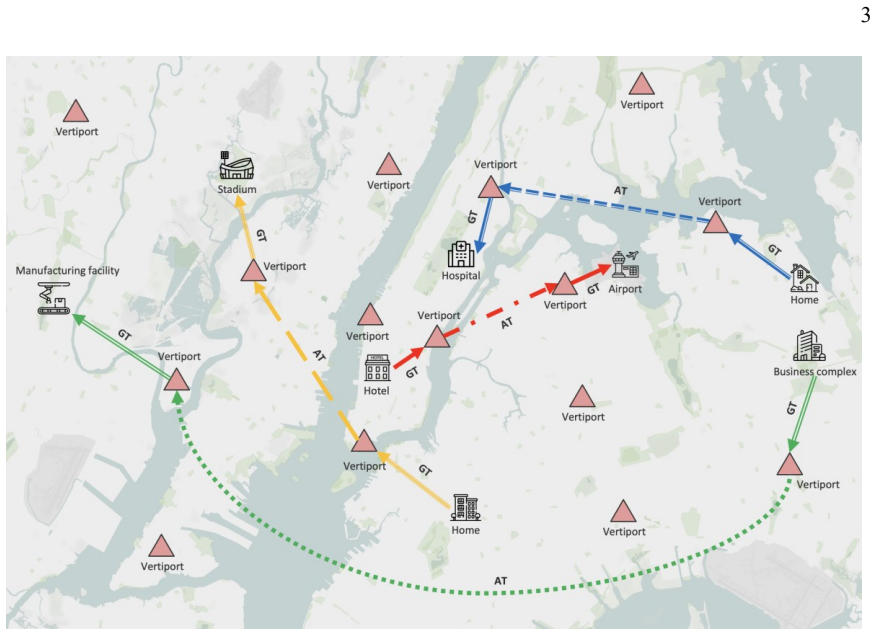
The success of advanced air mobility (AAM) operations is largely contingent on its effective integration with other ground transport modes. Under many use cases, AAM operators have to work with ride-hailing operators to create a seamless air taxi travel experience with adequate first and last-mile access. In investigating this multimodal coalition, this study proposes a distance-based subsidy rate design for AAM operators to incentivize ride-hail access to AAM hubs, incorporating air mobility operators' profitability considerations and travelers' route choices jointly. Using New York City (NYC) airport access as a case study, this study integrates high-volume for-hire vehicle (HVFHV) data from NYC taxi zones to consider real-world spatial demand distributions while considering passenger groups with different values of time (VOT) to derive insights on distinctive customer bases. Overall, the results show that AAM operators would need to subsidize the ride-hailing operators on vertiport access trips when air taxi operating costs exceed $12/mi. The analysis of ridership at AAM hubs indicates that ridership and profit contributions differ across different candidate vertiports in Manhattan, reflecting spatial demand heterogeneity. Additionally, having the airport access system in place, the taxi zones that generate the highest passenger demand to all three major NYC airports are identified under lower air taxi fare scenarios. These findings highlight how a distance-based subsidy rate design is beneficial in facilitating better access to vertiports and to foster high air taxi ridership with optimal AAM fare levels.
Editorial analysis
A structured set of objections, weighed in public.
Referee Report
Summary. The manuscript proposes a distance-based subsidy rate design for advanced air mobility (AAM) operators to incentivize ride-hail access to vertiports. It jointly models AAM operator profitability and traveler route choice under heterogeneous values of time (VOT), using high-volume for-hire vehicle (HVFHV) data from New York City taxi zones as a case study for airport access. The central result is that AAM operators must subsidize ride-hailing operators on vertiport access trips when air taxi operating costs exceed $12/mi. Additional findings address ridership and profit variation across Manhattan vertiport candidates and identify high-demand taxi zones for airport access under varying air taxi fares.
Significance. If the $12/mi threshold and associated spatial insights hold under scrutiny, the work offers a concrete, policy-relevant benchmark for subsidy design in AAM-ground transport integration. The use of real NYC taxi-zone spatial demand data combined with VOT heterogeneity is a constructive step beyond stylized models. The joint treatment of operator profit and traveler choice provides a framework that could be extended to other multimodal AAM scenarios.
major comments (2)
- [Abstract] Abstract: The headline numerical claim that subsidy becomes necessary above $12/mi is stated without any accompanying model equations, parameter table, derivation steps, or sensitivity analysis on VOT distribution, demand elasticity, or operator response functions. This absence makes it impossible to determine whether the threshold is an output of the integrated profitability-choice model or reduces to input assumptions.
- [Results] Results on subsidy rate design: The crossover point at $12/mi is presented as the key policy output, yet no out-of-sample validation, cross-validation on the HVFHV-derived demand, or systematic sensitivity checks on the VOT groups or cost parameters are reported. If any of these components are misspecified, the reported threshold can shift materially, undermining the central claim.
minor comments (2)
- [Abstract] The acronym HVFHV is used without an explicit first-use definition in the abstract and early sections.
- [Model] Notation for the distance-based subsidy rate and the air taxi operating cost threshold should be introduced with symbols and units in the model section for clarity.
Simulated Author's Rebuttal
We thank the referee for their constructive comments on our manuscript. The $12/mi threshold is an output of the integrated model described in the full text, not an input assumption. We address each major comment below, clarifying the manuscript content and agreeing to targeted revisions for improved transparency.
read point-by-point responses
-
Referee: [Abstract] Abstract: The headline numerical claim that subsidy becomes necessary above $12/mi is stated without any accompanying model equations, parameter table, derivation steps, or sensitivity analysis on VOT distribution, demand elasticity, or operator response functions. This absence makes it impossible to determine whether the threshold is an output of the integrated profitability-choice model or reduces to input assumptions.
Authors: Abstracts are concise summaries and conventionally omit equations or derivations; the full model (profitability objective, traveler utility with heterogeneous VOT, and distance-based subsidy formulation) is specified in Sections 3–4 with parameter values and solution procedure. The $12/mi crossover is solved endogenously from the joint optimization, not assumed. To address the concern, we will add a short parenthetical reference to the model framework and key parameters in the revised abstract. revision: yes
-
Referee: [Results] Results on subsidy rate design: The crossover point at $12/mi is presented as the key policy output, yet no out-of-sample validation, cross-validation on the HVFHV-derived demand, or systematic sensitivity checks on the VOT groups or cost parameters are reported. If any of these components are misspecified, the reported threshold can shift materially, undermining the central claim.
Authors: The HVFHV data constitute the complete observed demand surface for the NYC case study rather than a training set for prediction, so out-of-sample or cross-validation splits are not applicable. We agree, however, that systematic sensitivity on VOT group weights and air-taxi cost parameters would strengthen confidence in the threshold. We will insert a new sensitivity subsection that varies these inputs and reports the resulting range for the subsidy crossover point. revision: yes
Circularity Check
No circularity: model output follows from stated inputs without reduction to self-definition or fitted renaming.
full rationale
The provided abstract and context present the $12/mi threshold as an output of an integrated optimization model that incorporates HVFHV spatial data, heterogeneous VOT groups, profitability constraints, and route choice. No equations, self-citations, or parameter-fitting steps are quoted that would make the threshold equivalent to its inputs by construction (e.g., no fitted cost parameter directly renamed as the crossover prediction). The derivation chain relies on external data sources and behavioral assumptions rather than self-referential definitions or load-bearing prior work by the same authors. This is the normal case of a simulation/optimization study whose numerical result is not forced by renaming or tautology.
Axiom & Free-Parameter Ledger
free parameters (1)
- air taxi operating cost threshold =
$12/mi
axioms (1)
- domain assumption Travelers select routes according to value of time and subsidy levels
Reference graph
Works this paper leans on
-
[1]
Mobility as a Service
Alvarez, L. E., Jones, J. C., Bryan, A., & Weinert, A. J. (2021). Demand and capacity modeling for advanced air mobility. AIAA AVIATION 2021 Forum. American Institute of Aeronautics and Astronautics. Antcliff, K., Borer, N., Sartorius, S., Saleh, P., Rose, R., Gariel, M., … & Ouellette, R. (2021). Regional air mobility: Leveraging our national investments...
2021
-
[2]
Hensher, D. A., & Hietanen, S. (2023). Mobility as a feature (MaaF): Rethinking the focus of the second generation of mobility as a service (MaaS). Transport Reviews, 43(3), 325–329. Ji, Z. (2025). Algorithm runtime comparison testing networks [Data set]. Zenodo. https://doi.org/10.5281/zenodo.17253864 Joby Aviation. (2022). Delta, Joby Aviation partner t...
discussion (0)
Sign in with ORCID, Apple, or X to comment. Anyone can read and Pith papers without signing in.