Precision Recall Controllable Radiology Report Generation via Hybrid Natural Language and Clinical Reward Learning
Reviewed by Pith T0 review T1 audit T2 compute T3 formal T4 kernel 2026-07-03 23:15 UTCgrok-4.3pith:XJWCX4X5record.jsonopen to challenge →
The pith
A reinforcement learning framework generates radiology reports with a tunable control parameter that adjusts the clinical precision-recall trade-off while adding a clinical reward to improve efficacy.
A machine-rendered reading of the paper's core claim, the machinery that carries it, and where it could break.
Core claim
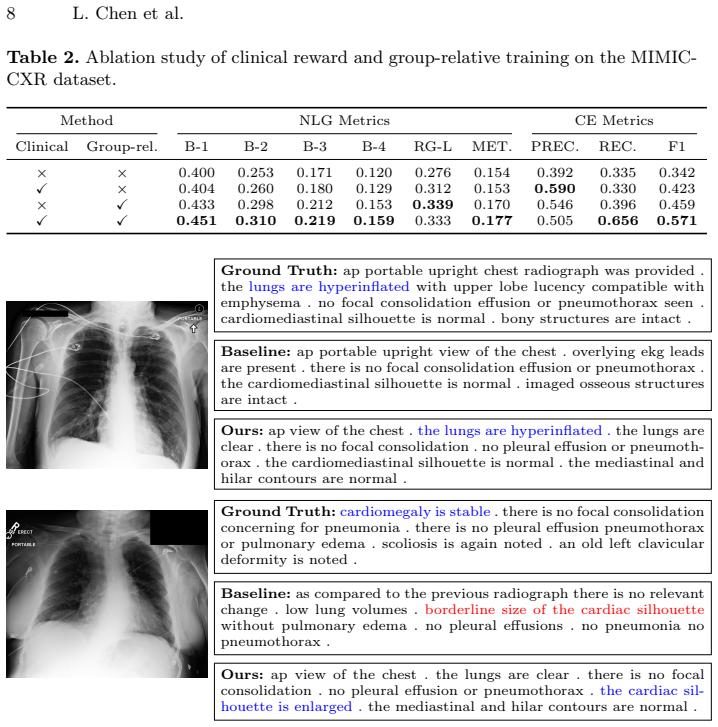
The authors claim that a hybrid reinforcement learning objective combining natural language generation rewards with a clinical reward, modulated by an explicit control parameter, enables reliable adjustment of the precision-recall trade-off in generated radiology reports. This produces outputs that exceed state-of-the-art performance on both NLG and clinical efficacy metrics on the MIMIC-CXR dataset while maintaining training stability through group-relative reward normalization.
What carries the argument
The control parameter that scales the clinical precision-recall trade-off inside the reinforcement learning policy, paired with the clinical reward function.
If this is right
- Reports can be generated on demand with higher emphasis on precision or on recall depending on the clinical scenario.
- Clinical efficacy scores rise in tandem with natural language generation metrics rather than trading one for the other.
- Training stability improves because rewards are normalized within each batch group.
- A single trained model can serve multiple clinical priorities instead of requiring separate models for each precision-recall target.
Where Pith is reading between the lines
- Radiologists could adjust the control parameter in real time to generate an initial high-recall screening report and then a high-precision follow-up version for the same images.
- The approach might extend to other medical text tasks such as discharge summary generation where similar precision-recall tensions exist.
- Integration with hospital workflows could allow the parameter to be set automatically based on patient risk profiles stored in the electronic record.
- If the clinical reward can be further decomposed by disease category, the same framework might offer targeted control over sensitivity for specific conditions.
Load-bearing premise
The clinical reward function, when scaled by the control parameter, produces reports whose clinical efficacy improves or holds steady as precision and recall are traded off without creating new clinical errors.
What would settle it
On the MIMIC-CXR test set, sweeping the control parameter across its range produces no statistically detectable change in measured clinical precision-recall balance while clinical efficacy scores remain at or above baseline levels.
Figures


read the original abstract
Automated radiology report generation (RRG) has gained increasing attention because it can reduce the heavy workload of clinical report writing. However, most existing methods mainly optimize for natural language generation (NLG) metrics that focus on language fluency, while providing little control over clinically important factors such as precision and recall. As consequence, generated reports may be fluent but not well aligned with different clinical needs. To address this challenge, we propose a reinforcement learning framework for precision recall controllable RRG, where a control parameter explicitly adjusts the trade-off between clinical precision and recall during inference. This design allows the model to flexibly generate reports according to different clinical requirements. To ensure clinical correctness, we introduce a clinical reward into the training objective, which helps improve clinical efficacy (CE) beyond standard language-based optimization. In addition, we apply a group-relative training strategy that normalizes rewards within each training group, reducing reward variance and improving training stability. Extensive experiments on the MIMIC-CXR dataset show that our method consistently outperforms state-of-the-art approaches in both NLG and CE evaluation metrics, while providing reliable control over the CE precision recall trade-off.
Editorial analysis
A structured set of objections, weighed in public.
Referee Report
Summary. The manuscript proposes a reinforcement learning framework for radiology report generation that introduces a control parameter to explicitly adjust the clinical precision-recall trade-off at inference time. It augments the training objective with a clinical reward function and applies group-relative training to normalize rewards and stabilize learning. Experiments on the MIMIC-CXR dataset are reported to show consistent outperformance over state-of-the-art methods on both NLG and clinical efficacy (CE) metrics while enabling reliable control over the precision-recall balance.
Significance. If the central claims hold after verification of the reward definition, control mechanism, and statistical results, the work would address a practical gap between fluency-focused NLG optimization and clinically tunable report generation. The hybrid reward and controllable inference design could support deployment scenarios with varying diagnostic priorities.
Simulated Author's Rebuttal
We thank the referee for their summary of our work and for recognizing its potential to address the gap between fluency-focused optimization and clinically tunable report generation. We note that the report lists no specific major comments for us to address point by point.
Circularity Check
No significant circularity detected
full rationale
The abstract and visible description outline a reinforcement learning setup with an explicit control parameter for precision-recall trade-off plus a clinical reward term added to the objective, plus a group-relative normalization step. No equations, definitions, or self-citations are shown that would make any reported prediction or CE metric reduce by construction to a fitted input or prior self-referential result. The central claims rest on external MIMIC-CXR experiments and standard RL training, which remain independent of the method's own definitions. This is the normal self-contained case.
Axiom & Free-Parameter Ledger
free parameters (1)
- control parameter
axioms (1)
- domain assumption A scalar clinical reward can be defined that meaningfully improves clinical efficacy when added to the RL objective.
invented entities (1)
-
clinical reward
no independent evidence
Reference graph
Works this paper leans on
-
[1]
On the automatic generation of medical imaging reports
Baoyu Jing, Pengtao Xie, and Eric Xing. On the automatic generation of medical imaging reports. InProceedings of the 56th annual meeting of the association for computational linguistics (volume 1: long papers), pages 2577–2586, 2018
work page 2018
-
[2]
Generating radiology reports via memory-driven transformer.arXiv preprint arXiv:2010.16056, 2020
Zhihong Chen, Yan Song, Tsung-Hui Chang, and Xiang Wan. Generating radiology reports via memory-driven transformer.arXiv preprint arXiv:2010.16056, 2020
-
[3]
Evaluating progress in automatic chest x-ray radiology report generation.Patterns, 4(9), 2023
Feiyang Yu, Mark Endo, Rayan Krishnan, Ian Pan, Andy Tsai, Eduardo Pontes Reis, Eduardo Kaiser Ururahy Nunes Fonseca, Henrique Min Ho Lee, Zahra Shak- eri Hossein Abad, Andrew Y Ng, et al. Evaluating progress in automatic chest x-ray radiology report generation.Patterns, 4(9), 2023
work page 2023
-
[4]
Phillip Sloan, Philip Clatworthy, Edwin Simpson, and Majid Mirmehdi. Auto- mated radiology report generation: A review of recent advances.IEEE Reviews in Biomedical Engineering, 18:368–387, 2024
work page 2024
-
[5]
Optimizing the factual correctness of a summary: A study of summarizing radiology reports
Yuhao Zhang, Derek Merck, Emily Tsai, Christopher D Manning, and Curtis Lan- glotz. Optimizing the factual correctness of a summary: A study of summarizing radiology reports. InProceedings of the 58th annual meeting of the association for computational linguistics, pages 5108–5120, 2020
work page 2020
-
[6]
Yuan Li, Xiaodan Liang, Zhiting Hu, and Eric P Xing. Hybrid retrieval-generation reinforced agent for medical image report generation.Advances in neural informa- tion processing systems, 31, 2018
work page 2018
-
[7]
Xiulong Yi, You Fu, Jianzhi Yu, Ruiqing Liu, Hao Zhang, and Rong Hua. Lhr- rfl: Linear hybrid-reward-based reinforced focal learning for automatic radiology report generation.IEEE transactions on medical imaging, 44(3):1494–1504, 2025
work page 2025
-
[8]
Reinforced cross-modal alignment for radiology report generation
Han Qin and Yan Song. Reinforced cross-modal alignment for radiology report generation. InFindings of the Association for Computational Linguistics: ACL 2022, pages 448–458, 2022
work page 2022
-
[9]
Deep Communicating Agents for Abstractive Summarization
Asli Celikyilmaz, Antoine Bosselut, Xiaodong He, and Yejin Choi. Deep commu- nicating agents for abstractive summarization.arXiv preprint arXiv:1803.10357, 2018. 10 L. Chen et al
work page internal anchor Pith review Pith/arXiv arXiv 2018
-
[10]
Bleu: a method for automatic evaluation of machine translation
Kishore Papineni, Salim Roukos, Todd Ward, and Wei-Jing Zhu. Bleu: a method for automatic evaluation of machine translation. InProceedings of the 40th annual meeting of the Association for Computational Linguistics, pages 311–318, 2002
work page 2002
-
[11]
Meteor: An automatic metric for mt evalua- tion with improved correlation with human judgments
Satanjeev Banerjee and Alon Lavie. Meteor: An automatic metric for mt evalua- tion with improved correlation with human judgments. InProceedings of the acl workshop on intrinsic and extrinsic evaluation measures for machine translation and/or summarization, pages 65–72, 2005
work page 2005
-
[12]
Rouge: A package for automatic evaluation of summaries
Chin-Yew Lin. Rouge: A package for automatic evaluation of summaries. InText summarization branches out, pages 74–81, 2004
work page 2004
-
[13]
Eric J Topol. High-performance medicine: the convergence of human and artificial intelligence.Nature medicine, 25(1):44–56, 2019
work page 2019
-
[14]
A Deep Reinforced Model for Abstractive Summarization
Romain Paulus, Caiming Xiong, and Richard Socher. A deep reinforced model for abstractive summarization.arXiv preprint arXiv:1705.04304, 2017
work page internal anchor Pith review Pith/arXiv arXiv 2017
-
[15]
DeepSeekMath: Pushing the Limits of Mathematical Reasoning in Open Language Models
Zhihong Shao, Peiyi Wang, Qihao Zhu, Runxin Xu, Junxiao Song, Xiao Bi, Haowei Zhang, Mingchuan Zhang, YK Li, Yang Wu, et al. Deepseekmath: Pushing the limits of mathematical reasoning in open language models.arXiv preprint arXiv:2402.03300, 2024
work page internal anchor Pith review Pith/arXiv arXiv 2024
-
[16]
MIMIC-CXR-JPG, a large publicly available database of labeled chest radiographs
Alistair EW Johnson, Tom J Pollard, Nathaniel R Greenbaum, Matthew P Lun- gren, Chih-ying Deng, Yifan Peng, Zhiyong Lu, Roger G Mark, Seth J Berkowitz, and Steven Horng. Mimic-cxr-jpg, a large publicly available database of labeled chest radiographs.arXiv preprint arXiv:1901.07042, 2019
work page internal anchor Pith review Pith/arXiv arXiv 1901
-
[17]
Film: Visual reasoning with a general conditioning layer
Ethan Perez, Florian Strub, Harm De Vries, Vincent Dumoulin, and Aaron Courville. Film: Visual reasoning with a general conditioning layer. InProceedings of the AAAI conference on artificial intelligence, volume 32, 2018
work page 2018
-
[18]
Ronald J Williams. Simple statistical gradient-following algorithms for connec- tionist reinforcement learning.Machine learning, 8(3):229–256, 1992
work page 1992
-
[19]
Rrg- dpo: Direct preference optimization for clinically accurate radiology report gener- ation
Hong Liu, Dong Wei, Zhe Xu, Xian Wu, Yefeng Zheng, and Liansheng Wang. Rrg- dpo: Direct preference optimization for clinically accurate radiology report gener- ation. InInternational Conference on Medical Image Computing and Computer- Assisted Intervention, pages 552–562. Springer, 2025
work page 2025
-
[20]
Akshay Smit, Saahil Jain, Pranav Rajpurkar, Anuj Pareek, Andrew Y Ng, and Matthew P Lungren. Chexbert: combining automatic labelers and expert an- notations for accurate radiology report labeling using bert.arXiv preprint arXiv:2004.09167, 2020
-
[21]
Ohio supercomputer center, 1987
Ohio Supercomputer Center. Ohio supercomputer center, 1987
work page 1987
-
[22]
Metransformer: Radi- ology report generation by transformer with multiple learnable expert tokens
Zhanyu Wang, Lingqiao Liu, Lei Wang, and Luping Zhou. Metransformer: Radi- ology report generation by transformer with multiple learnable expert tokens. In Proceedings of the IEEE/CVF conference on computer vision and pattern recogni- tion, pages 11558–11567, 2023
work page 2023
-
[23]
R2gengpt: Radiology report generation with frozen llms.Meta-Radiology, 1(3):100033, 2023
Zhanyu Wang, Lingqiao Liu, Lei Wang, and Luping Zhou. R2gengpt: Radiology report generation with frozen llms.Meta-Radiology, 1(3):100033, 2023
work page 2023
-
[24]
Contrastive knowledge- guided large language models for medical report generation
Yuyang Sha, Hongxin Pan, Weiyu Meng, and Kefeng Li. Contrastive knowledge- guided large language models for medical report generation. InInternational Con- ference on Medical Image Computing and Computer-Assisted Intervention, pages 111–120. Springer, 2025
work page 2025
-
[25]
Hannah Yun, Junyeong Maeng, Eunsong Kang, and Heung-Il Suk. Diff-rrg: Lon- gitudinal disease-wise patch difference as guidance for llm-based radiology re- port generation. InInternational Conference on Medical Image Computing and Computer-Assisted Intervention, pages 152–161. Springer, 2025. Precision-Recall Controllable Radiology Report Generation 11
work page 2025
-
[26]
Enhanced contrastive learning with multi-view longitudinal data for chest x-ray report generation
Kang Liu, Zhuoqi Ma, Xiaolu Kang, Yunan Li, Kun Xie, Zhicheng Jiao, and Qiguang Miao. Enhanced contrastive learning with multi-view longitudinal data for chest x-ray report generation. InProceedings of the Computer Vision and Pattern Recognition Conference, pages 10348–10359, 2025
work page 2025
-
[27]
Andrew Sellergren, Sahar Kazemzadeh, Tiam Jaroensri, Atilla Kiraly, Madeleine Traverse, Timo Kohlberger, Shawn Xu, Fayaz Jamil, Cían Hughes, Charles Lau, et al. Medgemma technical report.arXiv preprint arXiv:2507.05201, 2025
work page internal anchor Pith review Pith/arXiv arXiv 2025
-
[28]
GDPO: Group reward-Decoupled Normalization Policy Optimization for Multi-reward RL Optimization
Shih-Yang Liu, Xin Dong, Ximing Lu, Shizhe Diao, Peter Belcak, Mingjie Liu, Min-Hung Chen, Hongxu Yin, Yu-Chiang Frank Wang, Kwang-Ting Cheng, et al. Gdpo:Groupreward-decouplednormalizationpolicyoptimizationformulti-reward rl optimization.arXiv preprint arXiv:2601.05242, 2026
work page internal anchor Pith review Pith/arXiv arXiv 2026
-
[29]
CURE: Curriculum-guided Multi-task Training for Reliable Anatomy Grounded Report Generation
Pablo Messina, Andrés Villa, Juan León Alcázar, Karen Sánchez, Carlos Hinojosa, Denis Parra, Álvaro Soto, and Bernard Ghanem. Cure: Curriculum-guided multi- task training for reliable anatomy grounded report generation.arXiv preprint arXiv:2601.15408, 2026
work page internal anchor Pith review Pith/arXiv arXiv 2026
discussion (0)
Sign in with ORCID, Apple, or X to comment. Anyone can read and Pith papers without signing in.