Controlling the phase behaviour of ultraconfined water via bilayer graphene stacking
Pith reviewed 2026-06-26 12:41 UTC · model grok-4.3
The pith
Bilayer graphene stacking controls phase behaviour of confined water despite a 1.4 angstrom shift.
A machine-rendered reading of the paper's core claim, the machinery that carries it, and where it could break.
Core claim
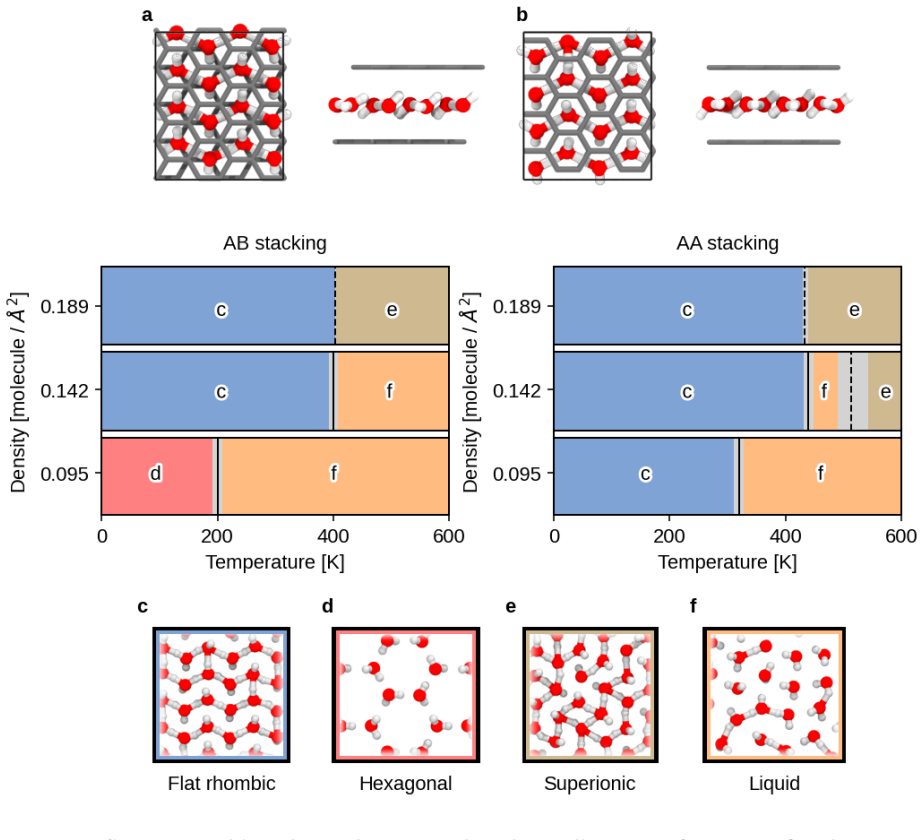
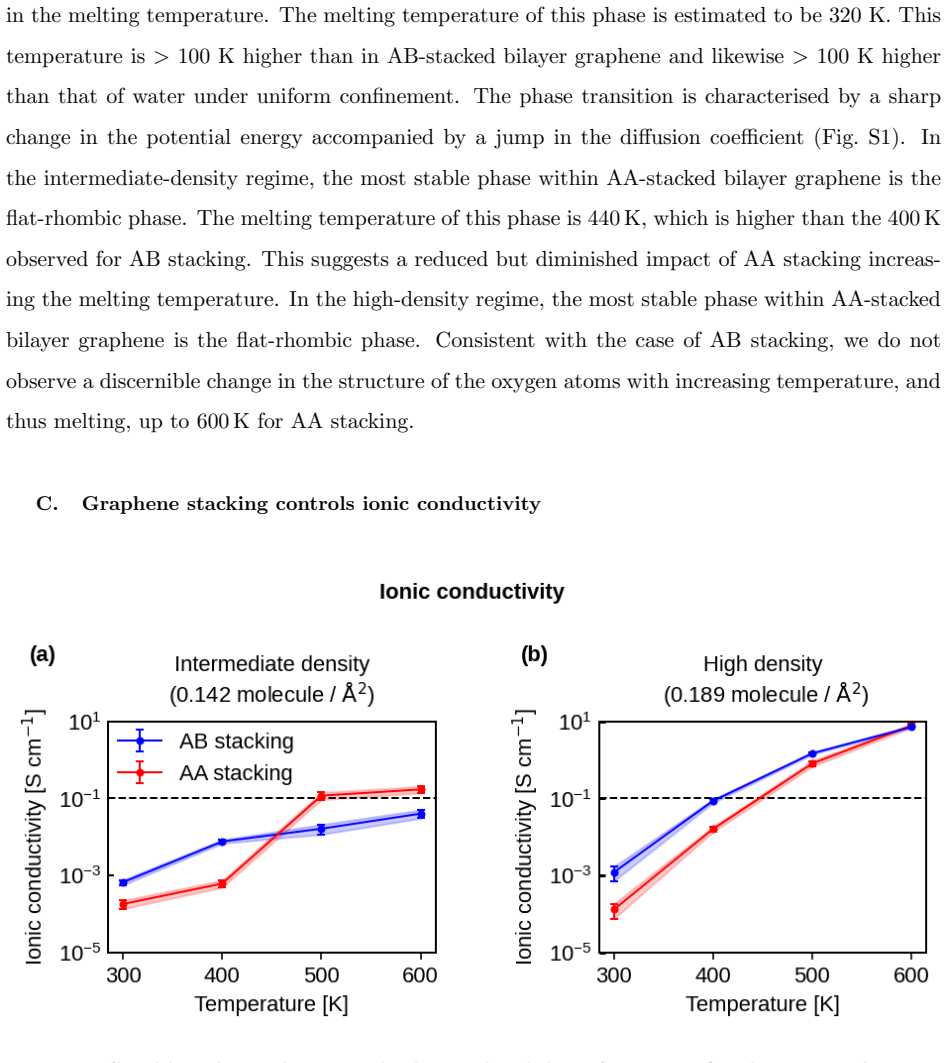
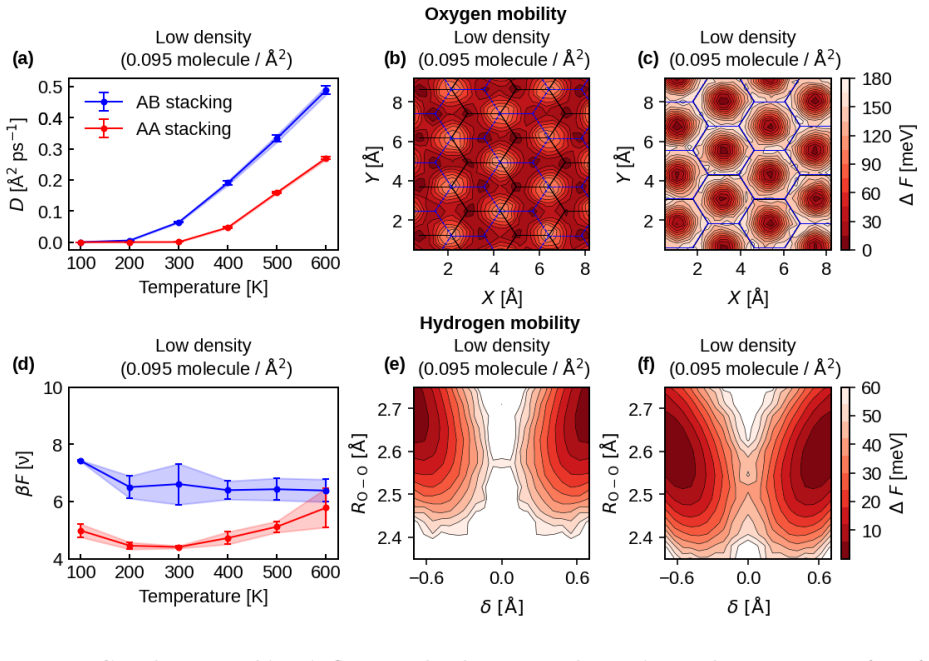
Using machine learning interatomic potentials with first-principles accuracy, the density-temperature phase diagram of water confined within bilayer graphene nanocapillaries is computed and compared for AA and AB stacking arrangements, which differ only by a lateral shift of 1.4 Å. Despite this minimal structural change, AA stacking can stabilise different ice polymorphs, can increase the melting temperature by more than 100 K, can enhance proton transfer, and alters the onset of superionic behaviour relative to AB stacking. These effects are traced to stacking-induced changes in the hydrogen-bond network associated with modifications to the lateral free energy landscape and neighbouring O-O
What carries the argument
The AA versus AB stacking arrangement of the bilayer graphene walls, which alters the lateral free energy landscape and hydrogen-bond network of the confined water.
If this is right
- AA stacking stabilises different ice polymorphs than AB stacking.
- Melting temperature increases by more than 100 K under AA stacking.
- Proton transfer is enhanced under AA stacking.
- The onset of superionic behaviour changes with the choice of stacking.
Where Pith is reading between the lines
- The stacking dependence suggests that precise atomic arrangement of confining walls could be used to tune phase behaviour in other nanoconfined systems.
- Similar lateral shifts in other layered materials may produce comparable changes in confined fluid properties.
- The altered hydrogen-bond network could affect additional transport or reaction properties not computed in the phase diagram.
Load-bearing premise
The machine learning interatomic potentials with first-principles accuracy correctly capture the stacking-dependent differences in the hydrogen-bond network and free energy landscape for water in these nanocapillaries.
What would settle it
Measuring identical melting temperatures, ice polymorphs, and proton transfer rates for water in AA-stacked and AB-stacked bilayer graphene nanocapillaries would falsify the central claim.
Figures
read the original abstract
Water confined within nanoscale capillaries exhibits phase behaviour and transport properties that differ substantially from bulk, and these effects are commonly interpreted as consequences of geometric confinement and reduced dimensionality. Here we show that confinement topology alone is insufficient to predict the behaviour of nanoconfined water. Using machine learning interatomic potentials with first-principles accuracy, we compute the density-temperature phase diagram of water confined within bilayer graphene nanocapillaries and compare AA and AB stacking arrangements, which differ only by a lateral shift of 1.4 {\AA}. Despite this minimal structural change, AA stacking can stabilise different ice polymorphs, can increase the melting temperature by more than 100 K, can enhance proton transfer, and alters the onset of superionic behaviour relative to AB stacking. We trace these effects to stacking-induced changes in the hydrogen-bond network associated with modifications to the lateral free energy landscape and neighbouring O-O separations. Our results demonstrate that even subtle atomistic variations in the confining walls can qualitatively reshape the physical and chemical behaviour of nanoconfined water, with implications for the interpretation and control of fluids under angstrom-scale confinement.
Editorial analysis
A structured set of objections, weighed in public.
Referee Report
Summary. The manuscript uses machine learning interatomic potentials trained to first-principles accuracy to compute the density-temperature phase diagram of water confined in bilayer graphene nanocapillaries. It claims that AA versus AB stacking (differing only by a 1.4 Å lateral registry shift) stabilizes different ice polymorphs, increases the melting temperature by more than 100 K, enhances proton transfer, and shifts the onset of superionic behavior, with these effects traced to stacking-induced changes in the hydrogen-bond network and lateral free-energy landscape.
Significance. If the central results hold, the work would demonstrate that even minimal atomistic variations in confining walls can qualitatively reshape phase behavior and transport in angstrom-scale confinement, with implications for nanofluidics. The approach of deploying ML potentials for extensive sampling of confined phase diagrams provides concrete, falsifiable predictions that could be tested experimentally.
major comments (1)
- [Methods] Methods (and Section 2): No dedicated benchmark set of AA versus AB confined configurations at the relevant densities and temperatures is reported to validate that the MLIP correctly captures stacking-dependent differences in the hydrogen-bond network and O–O separations; any systematic bias here would propagate directly into the reported phase boundaries, Tm shifts, and proton-transfer results.
Simulated Author's Rebuttal
We thank the referee for their constructive feedback and for recognizing the potential significance of the work. We address the single major comment below.
read point-by-point responses
-
Referee: [Methods] Methods (and Section 2): No dedicated benchmark set of AA versus AB confined configurations at the relevant densities and temperatures is reported to validate that the MLIP correctly captures stacking-dependent differences in the hydrogen-bond network and O–O separations; any systematic bias here would propagate directly into the reported phase boundaries, Tm shifts, and proton-transfer results.
Authors: We agree that a dedicated benchmark focused on AA versus AB stacking at the relevant confined densities and temperatures would strengthen the validation. Although the MLIP training set incorporated diverse first-principles configurations of water near graphene (including both stackings), we did not report a targeted comparison of stacking-dependent observables such as hydrogen-bond statistics and O–O separations under confinement. We will add a new subsection to the Methods (cross-referenced in Section 2) that directly compares MLIP and DFT results for these quantities on held-out AA and AB confined snapshots at the densities and temperatures used in the phase-diagram calculations. This addition will explicitly demonstrate that any systematic bias in the stacking-dependent hydrogen-bond network is negligible relative to the reported differences in Tm and proton transfer. revision: yes
Circularity Check
No circularity; phase differences derived from explicit MLIP sampling of stacking-induced landscape changes
full rationale
The paper trains MLIPs on DFT data then directly samples the density-temperature phase diagram, free-energy landscape, and H-bond network for AA vs AB graphene registries (differing by 1.4 Å). Differences in ice polymorphs, Tm, proton transfer, and superionic onset are attributed to computed changes in lateral free energy and O-O separations. No step reduces a claimed prediction to a fitted parameter defined by the target result, no self-citation chain bears the central claim, and no ansatz or uniqueness theorem is smuggled in. The derivation remains self-contained against external DFT benchmarks.
Axiom & Free-Parameter Ledger
Reference graph
Works this paper leans on
-
[1]
We employ an MLIP to represent the potential energy surface of the full system
-
[2]
We perform random structure searches with DFT validation to find the thermodynamically stable ice phases for all densities in both stacking arrangements at 0 K (neglecting quantum nuclear effects)
-
[3]
We perform classical MD simulations at various temperatures to investigate the melting temperature
-
[4]
These simulations are used to understand proton transfer, transport, and the onset of the superionic phase transition
We perform PIMD simulations to investigate structural properties and Te PIGS simulations58 to investigate dynamical properties at various temperatures for all densities and both stack- ings. These simulations are used to understand proton transfer, transport, and the onset of the superionic phase transition
-
[5]
Additional computational details specific to the systems associated with the three different density regimes are provided in tables S5 - S7 of the SI
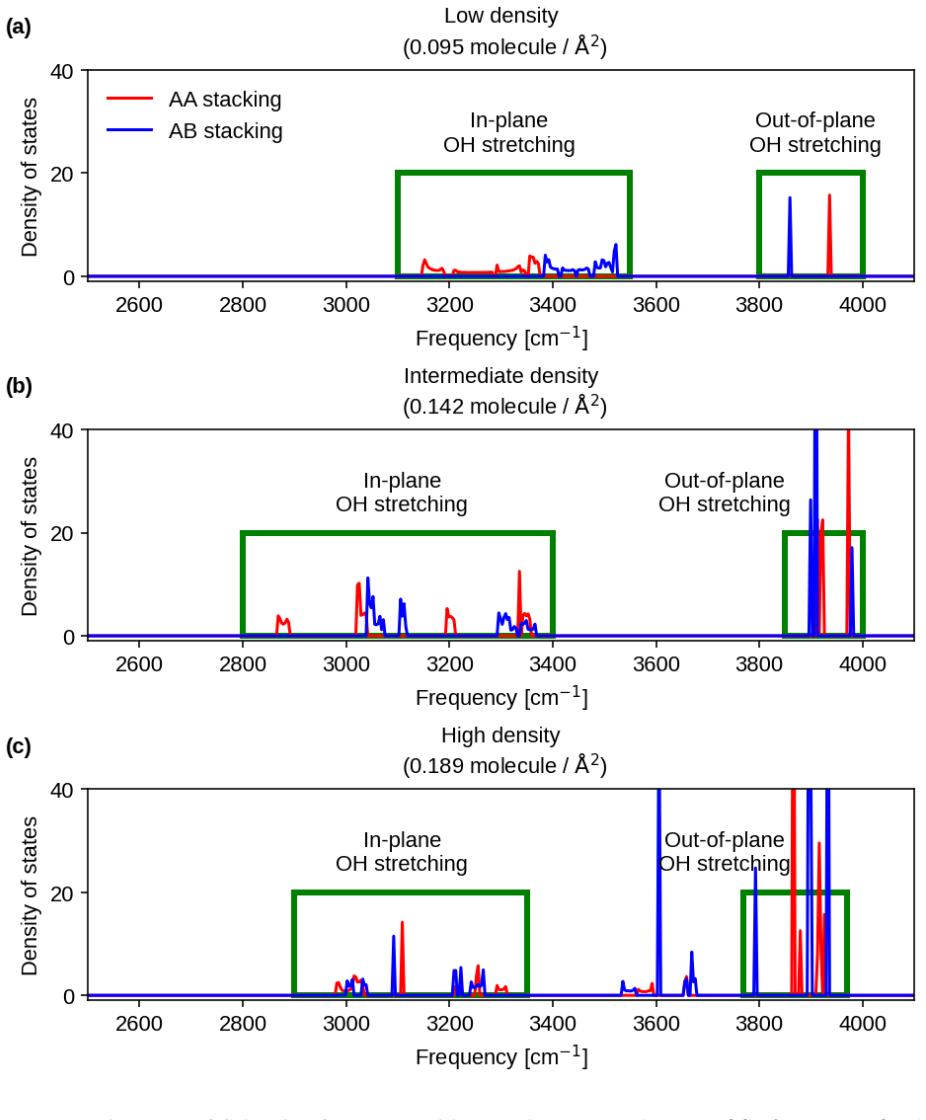
To understand how the observed behaviours are linked to hydrogen bonding, we compute phonon densities of states in the confined ice phases. Additional computational details specific to the systems associated with the three different density regimes are provided in tables S5 - S7 of the SI
-
[6]
65 (reported in its respective SI)
Overview of MLIP We employ a previously developed revPBE0-D3 MLIP62–64 from Ref. 65 (reported in its respective SI). The revPBE0-D3 functional has been previously shown to yield sub-kcal/mol accuracy for water binding to carbon nanostructures 66, provides a good description of structural and dynamical prop- erties of bulk water under ambient conditions in...
-
[7]
sensible
Random structure search with DFT validation We apply the random structure search method pioneered by Pickard and Needs [73] together with DFT validation to obtain the most thermodynamically stable phases at 0 K (neglecting quantum nuclear effects) for each density and stacking. For each system, we generate 1000 random “sensible” structures with water mole...
-
[8]
MD simulations are performed using the i-PI code 75 and the MLIP via the ASE 74 socket client
Molecular dynamics We perform molecular dynamics to determine the melting temperature of the ice phases obtained from random structure search. MD simulations are performed using the i-PI code 75 and the MLIP via the ASE 74 socket client. All MD simulations were carried out in a common super- cell of 34.22×39.52×30 ˚A. This supercell corresponds to a 16×in...
-
[9]
To this extent, we perform PIMD simulations for structural properties and Te PIGS for dynamical properties in theN V Tensemble
Path integral simulations We perform path integral simulations to study proton transfer, the superionic phase transition and transport properties. To this extent, we perform PIMD simulations for structural properties and Te PIGS for dynamical properties in theN V Tensemble. We use the i-PI code together with an ASE socket client to run these simulations. ...
-
[10]
Based on the PIMD trajectory, we calculate the probability distribution associated with the proton transfer coordinate for all the systems
The positions of replicas and the centroid are saved every 200 time steps. Based on the PIMD trajectory, we calculate the probability distribution associated with the proton transfer coordinate for all the systems. The proton transfer coordinateνis defined as the difference of the distances of a proton with two nearest oxygen atomsO 1 andO 2:ν=dO 1H−dO 2H...
-
[11]
We calculate phonon total DOS using the finite displacement method with the implementation in phonopy 78 for the full water carbon systems
Phonon DOS We estimate the phonon DOS using the MLIP for nanoconfined ice phases to investigate how phonon modes that participate in hydrogen bonding are affected by graphene stacking. We calculate phonon total DOS using the finite displacement method with the implementation in phonopy 78 for the full water carbon systems. We use a displacement distance o...
-
[12]
Faucher, N
S. Faucher, N. Aluru, M. Z. Bazant, D. Blankschtein, A. H. Brozena, J. Cumings, J. Pedro de Souza, M. Elimelech, R. Epsztein, J. T. Fourkas, A. G. Rajan, H. J. Kulik, A. Levy, A. Majumdar, C. Martin, M. McEldrew, R. P. Misra, A. Noy, T. A. Pham, M. Reed, E. Schwegler, Z. Siwy, Y. Wang, and M. Strano, Critical Knowledge Gaps in Mass Transport through Singl...
2019
-
[13]
N. R. Aluru, F. Aydin, M. Z. Bazant, D. Blankschtein, A. H. Brozena, J. P. de Souza, M. Elimelech, S. Faucher, J. T. Fourkas, V. B. Koman, M. Kuehne, H. J. Kulik, H.-K. Li, Y. Li, Z. Li, A. Majumdar, J. Martis, R. P. Misra, A. Noy, T. A. Pham, H. Qu, A. Rayabharam, M. A. Reed, C. L. Ritt, E. Schwe- gler, Z. Siwy, M. S. Strano, Y. Wang, Y.-C. Yao, C. Zhan,...
2023
-
[14]
Trushin, D
M. Trushin, D. V. Andreeva, F. M. Peeters, and K. S. Novoselov, Structure and flow of low-dimensional water, Nature Reviews Physics7, 502 (2025)
2025
-
[15]
Bocquet, Nanofluidics coming of age, Nature Materials19, 254 (2020)
L. Bocquet, Nanofluidics coming of age, Nature Materials19, 254 (2020)
2020
-
[16]
Majumder, N
M. Majumder, N. Chopra, R. Andrews, and B. J. Hinds, Enhanced flow in carbon nanotubes, Nature 438, 44 (2005)
2005
-
[17]
Whitby and N
M. Whitby and N. Quirke, Fluid flow in carbon nanotubes and nanopipes, Nature Nanotechnology2, 87 (2007)
2007
-
[18]
J. K. Holt, H. G. Park, Y. Wang, M. Stadermann, A. B. Artyukhin, C. P. Grigoropoulos, A. Noy, and O. Bakajin, Fast Mass Transport Through Sub-2-Nanometer Carbon Nanotubes, Science312, 1034 (2006)
2006
-
[19]
J. Peng, D. Cao, Z. He, J. Guo, P. Hapala, R. Ma, B. Cheng, J. Chen, W. J. Xie, X.-Z. Li, P. Jel´ ınek, L.-M. Xu, Y. Q. Gao, E.-G. Wang, and Y. Jiang, Publisher Correction: The effect of hydration number on the interfacial transport of sodium ions, Nature563, E18 (2018)
2018
-
[20]
K. Falk, F. Sedlmeier, L. Joly, R. R. Netz, and L. Bocquet, Molecular Origin of Fast Water Transport in Carbon Nanotube Membranes: Superlubricity versus Curvature Dependent Friction, Nano Letters 10, 4067 (2010)
2010
-
[21]
Secchi, S
E. Secchi, S. Marbach, A. Nigu` es, D. Stein, A. Siria, and L. Bocquet, Massive radius-dependent flow slippage in carbon nanotubes, Nature537, 210 (2016)
2016
-
[22]
Siria, P
A. Siria, P. Poncharal, A.-L. Biance, R. Fulcrand, X. Blase, S. T. Purcell, and L. Bocquet, Giant osmotic energy conversion measured in a single transmembrane boron nitride nanotube, Nature494, 455 (2013)
2013
-
[23]
Siria, M.-L
A. Siria, M.-L. Bocquet, and L. Bocquet, New avenues for the large-scale harvesting of blue energy, Nature Reviews Chemistry1, 0091 (2017)
2017
-
[24]
Fumagalli, A
L. Fumagalli, A. Esfandiar, R. Fabregas, S. Hu, P. Ares, A. Janardanan, Q. Yang, B. Radha, T. Taniguchi, K. Watanabe, G. Gomila, K. S. Novoselov, and A. K. Geim, Anomalously low dielectric 22 constant of confined water, Science360, 1339 (2018)
2018
-
[25]
R. Wang, M. Souilamas, A. Esfandiar, R. Fabregas, S. Benaglia, H. Nevison-Andrews, Q. Yang, J. Nor- mansell, P. Ares, G. Ferrari, A. Principi, A. K. Geim, and L. Fumagalli, In-plane dielectric constant and conductivity of confined water, Nature646, 606 (2025)
2025
-
[26]
S. P. Surwade, S. N. Smirnov, I. V. Vlassiouk, R. R. Unocic, G. M. Veith, S. Dai, and S. M. Mahurin, Water desalination using nanoporous single-layer graphene, Nature Nanotechnology10, 459 (2015)
2015
-
[27]
Radha, A
B. Radha, A. Esfandiar, F. C. Wang, A. P. Rooney, K. Gopinadhan, A. Keerthi, A. Mishchenko, A. Janardanan, P. Blake, L. Fumagalli, M. Lozada-Hidalgo, S. Garaj, S. J. Haigh, I. V. Grigorieva, H. A. Wu, and A. K. Geim, Molecular transport through capillaries made with atomic-scale precision, Nature538, 222 (2016)
2016
-
[28]
Esfandiar, B
A. Esfandiar, B. Radha, F. C. Wang, Q. Yang, S. Hu, S. Garaj, R. R. Nair, A. K. Geim, and K. Gopinad- han, Size effect in ion transport through angstrom-scale slits, Science358, 511 (2017)
2017
-
[29]
Abraham, K
J. Abraham, K. S. Vasu, C. D. Williams, K. Gopinadhan, Y. Su, C. T. Cherian, J. Dix, E. Prestat, S. J. Haigh, I. V. Grigorieva, P. Carbone, A. K. Geim, and R. R. Nair, Tunable sieving of ions using graphene oxide membranes, Nature Nanotechnology12, 546 (2017)
2017
-
[30]
Chakravarty, W
P. Chakravarty, W. Qian, M. A. El-Sayed, and M. R. Prausnitz, Delivery of molecules into cells using carbon nanoparticles activated by femtosecond laser pulses, Nature Nanotechnology5, 607 (2010)
2010
-
[31]
J. Geng, K. Kim, J. Zhang, A. Escalada, R. Tunuguntla, L. R. Comolli, F. I. Allen, A. V. Shnyrova, K. R. Cho, D. Munoz, Y. M. Wang, C. P. Grigoropoulos, C. M. Ajo-Franklin, V. A. Frolov, and A. Noy, Stochastic transport through carbon nanotubes in lipid bilayers and live cell membranes, Nature514, 612 (2014)
2014
-
[32]
B. Dong, Y. Pei, F. Zhao, T. W. Goh, Z. Qi, C. Xiao, K. Chen, W. Huang, and N. Fang, In situ quantitative single-molecule study of dynamic catalytic processes in nanoconfinement, Nature Catalysis 1, 135 (2018)
2018
-
[33]
P. Zuo, C. Ye, Z. Jiao, J. Luo, J. Fang, U. S. Schubert, N. B. McKeown, T. L. Liu, Z. Yang, and T. Xu, Near-frictionless ion transport within triazine framework membranes, Nature617, 299 (2023)
2023
-
[34]
Algara-Siller, O
G. Algara-Siller, O. Lehtinen, F. C. Wang, R. R. Nair, U. Kaiser, H. A. Wu, A. K. Geim, and I. V. Grigorieva, Square ice in graphene nanocapillaries, Nature519, 443 (2015)
2015
-
[35]
W. Zhou, K. Yin, C. Wang, Y. Zhang, T. Xu, A. Borisevich, L. Sun, J. C. Idrobo, M. F. Chisholm, S. T. Pantelides, R. F. Klie, and A. R. Lupini, The observation of square ice in graphene questioned, Nature528, E1 (2015)
2015
-
[36]
Algara-Siller, O
G. Algara-Siller, O. Lehtinen, and U. Kaiser, Algara-Siller et al . reply, Nature528, E3 (2015)
2015
-
[37]
F. C. Wang, H. A. Wu, and A. K. Geim, Wang et al. reply, Nature528, E3 (2015)
2015
-
[38]
Zheng, S
W. Zheng, S. Zhang, J. Jiang, Y. He, R. St¨ ohr, A. Denisenko, J. Wrachtrup, X. C. Zeng, K. Bian, E.-G. Wang, and Y. Jiang, Experimental observation of liquid–solid transition of nanoconfined water at ambient temperature, Nature Materials , 1 (2026). 23
2026
-
[39]
K. Koga, X. C. Zeng, and H. Tanaka, Freezing of Confined Water: A Bilayer Ice Phase in Hydrophobic Nanopores, Physical Review Letters79, 5262 (1997)
1997
-
[40]
S. Han, M. Y. Choi, P. Kumar, and H. E. Stanley, Phase transitions in confined water nanofilms, Nature Physics6, 685 (2010)
2010
-
[41]
W.-H. Zhao, L. Wang, J. Bai, L.-F. Yuan, J. Yang, and X. C. Zeng, Highly Confined Water: Two- Dimensional Ice, Amorphous Ice, and Clathrate Hydrates, Accounts of Chemical Research47, 2505 (2014)
2014
-
[42]
W.-H. Zhao, J. Bai, L.-F. Yuan, J. Yang, and X. C. Zeng, Ferroelectric hexagonal and rhombic monolayer ice phases, Chemical Science5, 1757 (2014)
2014
-
[43]
Sobrino Fernandez Mario, M
M. Sobrino Fernandez Mario, M. Neek-Amal, and F. M. Peeters, AA-stacked bilayer square ice between graphene layers, Physical Review B92, 245428 (2015)
2015
-
[44]
Y. Zhu, F. Wang, J. Bai, X. C. Zeng, and H. Wu, Compression Limit of Two-Dimensional Water Constrained in Graphene Nanocapillaries, ACS Nano9, 12197 (2015)
2015
-
[45]
Zhu, W.-H
W. Zhu, W.-H. Zhao, L. Wang, D. Yin, M. Jia, J. Yang, X. C. Zeng, and L.-F. Yuan, Two-dimensional interlocked pentagonal bilayer ice: how do water molecules form a hydrogen bonding network?, Physical Chemistry Chemical Physics18, 14216 (2016)
2016
-
[46]
Corsetti, J
F. Corsetti, J. Zubeltzu, and E. Artacho, Enhanced Configurational Entropy in High-Density Nanocon- fined Bilayer Ice, Physical Review Letters116, 085901 (2016)
2016
-
[47]
Zubeltzu, F
J. Zubeltzu, F. Corsetti, M. V. Fern´ andez-Serra, and E. Artacho, Continuous melting through a hexatic phase in confined bilayer water, Physical Review E93, 062137 (2016)
2016
-
[48]
M. Raju, A. van Duin, and M. Ihme, Phase transitions of ordered ice in graphene nanocapillaries and carbon nanotubes, Scientific Reports8, 3851 (2018)
2018
-
[49]
Li and B
S. Li and B. Schmidt, Replica exchange MD simulations of two-dimensional water in graphene nanocap- illaries: rhombic versus square structures, proton ordering, and phase transitions, Physical Chemistry Chemical Physics21, 17640 (2019)
2019
-
[50]
J. Chen, G. Schusteritsch, C. J. Pickard, C. G. Salzmann, and A. Michaelides, Two Dimensional Ice from First Principles: Structures and Phase Transitions, Physical Review Letters116, 025501 (2016)
2016
-
[51]
Corsetti, P
F. Corsetti, P. Matthews, and E. Artacho, Structural and configurational properties of nanoconfined monolayer ice from first principles, Scientific Reports6, 18651 (2016)
2016
-
[52]
J. Chen, A. Zen, J. G. Brandenburg, D. Alf` e, and A. Michaelides, Evidence for stable square ice from quantum Monte Carlo, Physical Review B94, 220102 (2016)
2016
-
[53]
Kapil, C
V. Kapil, C. Schran, A. Zen, J. Chen, C. J. Pickard, and A. Michaelides, The first-principles phase diagram of monolayer nanoconfined water, Nature609, 512 (2022)
2022
-
[54]
B. Lin, J. Jiang, X. C. Zeng, and L. Li, Temperature-pressure phase diagram of confined monolayer water/ice at first-principles accuracy with a machine-learning force field, Nature Communications14, 4110 (2023). 24
2023
-
[55]
Jiang, Y
J. Jiang, Y. Gao, L. Li, Y. Liu, W. Zhu, C. Zhu, J. S. Francisco, and X. C. Zeng, Rich proton dynamics and phase behaviours of nanoconfined ices, Nature Physics , 1 (2024)
2024
-
[56]
Kapil, C
V. Kapil, C. Schran, A. Zen, J. Chen, C. J. Pickard, and A. Michaelides, Author Correction: The first-principles phase diagram of monolayer nanoconfined water, Nature648, E15 (2025)
2025
-
[57]
Ravindra, X
P. Ravindra, X. R. Advincula, C. Schran, A. Michaelides, and V. Kapil, Quasi-one-dimensional hydrogen bonding in nanoconfined ice, Nature Communications15, 7301 (2024)
2024
-
[58]
Dufils, C
T. Dufils, C. Schran, J. Chen, A. K. Geim, L. Fumagalli, and A. Michaelides, Origin of dielectric polarization suppression in confined water from first principles, Chemical Science15, 516 (2024)
2024
-
[59]
X. R. Advincula, Y. Litman, K. D. Fong, W. C. Witt, C. Schran, and A. Michaelides, How reactive is water at the nanoscale and how to control it? (2025), arXiv:2508.13034
arXiv 2025
-
[60]
P. Ravindra, X. R. Advincula, B. X. Shi, S. W. Coles, A. Michaelides, and V. Kapil, Nuclear quantum effects amplify autoionization-driven superionic behaviour in nanoconfined monolayer water, Chemical Science 10.1039/D6SC00138F (2026)
-
[61]
Bj¨ orneholm, M
O. Bj¨ orneholm, M. H. Hansen, A. Hodgson, L.-M. Liu, D. T. Limmer, A. Michaelides, P. Pedevilla, J. Rossmeisl, H. Shen, G. Tocci, E. Tyrode, M.-M. Walz, J. Werner, and H. Bluhm, Water at Interfaces, Chemical Reviews116, 7698 (2016)
2016
-
[62]
Y. Wang, F. Tang, X. Yu, K.-Y. Chiang, C.-C. Yu, T. Ohto, Y. Chen, Y. Nagata, and M. Bonn, Interfaces govern the structure of angstrom-scale confined water solutions, Nature Communications16, 7288 (2025)
2025
-
[63]
Frisenda, E
R. Frisenda, E. Navarro-Moratalla, P. Gant, D. P. D. Lara, P. Jarillo-Herrero, R. V. Gorbachev, and A. Castellanos-Gomez, Recent progress in the assembly of nanodevices and van der Waals heterostruc- tures by deterministic placement of 2D materials, Chemical Society Reviews47, 53 (2018)
2018
-
[64]
Zhang, F
E. Zhang, F. Lin, Z. Lei, S. Qi, S. Ban, A. Vinu, J. Yi, and Y. Liu, Twist the doorknob to open the electronic properties of graphene-based van der Waals structure, Matter4, 3444 (2021)
2021
-
[65]
C. Fox, Y. Mao, X. Zhang, Y. Wang, and J. Xiao, Stacking Order Engineering of Two-Dimensional Materials and Device Applications, Chemical Reviews124, 1862 (2024)
2024
-
[66]
C. J. Pickard and R. J. Needs, Ab initiorandom structure searching, Journal of Physics: Condensed Matter23, 053201 (2011)
2011
-
[67]
Rahman, Correlations in the Motion of Atoms in Liquid Argon, Physical Review136, A405 (1964)
A. Rahman, Correlations in the Motion of Atoms in Liquid Argon, Physical Review136, A405 (1964)
1964
-
[68]
Parrinello and A
M. Parrinello and A. Rahman, Study of an F center in molten KCl, The Journal of Chemical Physics 80, 860 (1984)
1984
-
[69]
F. Musil, I. Zaporozhets, F. No´ e, C. Clementi, and V. Kapil, Quantum dynamics using path inte- gral coarse-graining, The Journal of Chemical Physics 10.1063/5.0120386 (2022), publisher: American Institute of Physics
-
[70]
S. W. Coles, A. Hajibabaei, V. Kapil, X. R. Advincula, C. Schran, S. J. Cox, and A. Michaelides, Nanoconfined superionic water is a molecular superionic, Science Advances12, eadz6392 (2026). 25
2026
-
[71]
Y. Cao, V. Fatemi, S. Fang, K. Watanabe, T. Taniguchi, E. Kaxiras, and P. Jarillo-Herrero, Unconven- tional superconductivity in magic-angle graphene superlattices, Nature556, 43 (2018)
2018
-
[72]
K. Kim, A. DaSilva, S. Huang, B. Fallahazad, S. Larentis, T. Taniguchi, K. Watanabe, B. J. LeRoy, A. H. MacDonald, and E. Tutuc, Tunable moir´ e bands and strong correlations in small-twist-angle bilayer graphene, Proceedings of the National Academy of Sciences114, 3364 (2017)
2017
-
[73]
Generalized Gradient Approximation Made Simple
Y. Zhang and W. Yang, Comment on “Generalized Gradient Approximation Made Simple”, Physical Review Letters80, 890 (1998)
1998
-
[74]
Adamo and V
C. Adamo and V. Barone, Toward reliable density functional methods without adjustable parameters: The PBE0 model, The Journal of Chemical Physics110, 6158 (1999)
1999
-
[75]
Grimme, J
S. Grimme, J. Antony, S. Ehrlich, and H. Krieg, A consistent and accurate ab initio parametrization of density functional dispersion correction (DFT-D) for the 94 elements H-Pu, The Journal of Chemical Physics132, 154104 (2010)
2010
-
[76]
X. R. Advincula, K. D. Fong, A. Michaelides, and C. Schran, Protons Accumulate at the Graphene–Water Interface, ACS Nano19, 17728 (2025)
2025
-
[77]
J. G. Brandenburg, A. Zen, D. Alf` e, and A. Michaelides, Interaction between water and carbon nanos- tructures: How good are current density functional approximations?, The Journal of Chemical Physics 151, 164702 (2019)
2019
-
[78]
Marsalek and T
O. Marsalek and T. E. Markland, Quantum Dynamics and Spectroscopy of Ab Initio Liquid Water: The Interplay of Nuclear and Electronic Quantum Effects, The Journal of Physical Chemistry Letters 8, 1545 (2017)
2017
-
[79]
Cheng, E
B. Cheng, E. A. Engel, J. Behler, C. Dellago, and M. Ceriotti, Ab initio thermodynamics of liquid and solid water, Proceedings of the National Academy of Sciences116, 1110 (2019)
2019
-
[80]
Kapil, D
V. Kapil, D. P. Kov´ acs, G. Cs´ anyi, and A. Michaelides, First-principles spectroscopy of aqueous in- terfaces using machine-learned electronic and quantum nuclear effects, Faraday Discussions249, 50 (2024)
2024
discussion (0)
Sign in with ORCID, Apple, or X to comment. Anyone can read and Pith papers without signing in.