Microscopic mechanism of the Fayans pairing for the enhancement of charge radii
Pith reviewed 2026-06-26 12:44 UTC · model grok-4.3
The pith
Density and density-gradient terms in the Fayans pairing interaction produce the bell-shaped charge radii of calcium isotopes through a repulsive rearrangement potential.
A machine-rendered reading of the paper's core claim, the machinery that carries it, and where it could break.
Core claim
The Fayans energy density functional's pairing sector reproduces the experimental charge radii data, including the bell shape in Ca isotopes. Analysis of multiple equivalent Fayans-like pairing parameterizations reveals that both the density dependence and the density-gradient dependence contribute to the enhancement of charge radii in open-shell nuclei. This enhancement originates from the repulsive nature of the rearrangement potential induced by these dependencies, and it cannot be replicated merely by refitting the pairing strength. The study also identifies some limitations in the standard Fayans EDFs that suggest the need for a more general form.
What carries the argument
The rearrangement potential generated by the density-dependent and density-gradient-dependent terms in the Fayans pairing interaction.
If this is right
- The bell-shaped charge radii in calcium isotopes arise from the repulsive rearrangement potential rather than from the pairing strength alone.
- Both density dependence and density-gradient dependence must be retained in the pairing interaction to capture the radius enhancement in open-shell nuclei.
- Refitting only the overall pairing strength cannot substitute for the density and gradient terms.
- Standard Fayans energy density functionals contain drawbacks that may require a more general functional form.
Where Pith is reading between the lines
- The same pairing mechanism could be tested in other isotopic chains to check whether repulsive rearrangement potentials explain radius anomalies more broadly.
- Nuclear energy density functionals may need explicit gradient terms in the pairing sector to model nuclear sizes accurately across the chart.
- Further comparisons with data on other observables could show whether the identified drawbacks of Fayans functionals affect predictions beyond radii.
Load-bearing premise
The 25 Fayans-like parameterizations are equivalent in reproducing pairing gaps, so that differences in charge radii come only from their density and gradient terms rather than from other parts of the energy density functional or fitting details.
What would settle it
A set of calculations in which the density and gradient dependencies are removed from the pairing force while the pairing gaps remain matched, yet the bell-shaped charge radii pattern in calcium isotopes still appears, would falsify the claim that those terms are required.
Figures

read the original abstract
The Fayans energy density functional (EDF), and in particular its pairing sector, have been claimed to be able to reproduce the experimental data of charge radii in many instances. A particularly intriguing case is that of the $ \mathrm{Ca} $ isotopes between $ A = 40 $ and $ 48 $, where charge radii exhibit a "bell shape". In our work, we examine the microscopic origin of this behaviour. We prepare in total $ 25 $ paramerizations of the Fayans-like pairing interaction, that are equivalent in fulfilling the same criteria for the reproduction of empirical pairing gaps. We find that both the density and the density-gradient dependence of the pairing interaction are important to reproduce the well-known enhancement of charge radii in the open-shell nuclei, leading to the "bell shape" behaviour of $ \mathrm{Ca} $ isotopes. In particular, this originates from the repulsive nature of the rearrangement potential, and cannot simply be mocked up by a refit of the pairing strength. At the same time, we notice some drawbacks of the Fayans standard EDFs, that may call for investigating a more general form of it.
Editorial analysis
A structured set of objections, weighed in public.
Referee Report
Summary. The paper investigates the microscopic origin of the bell-shaped charge radii observed in Ca isotopes (A=40-48) within the Fayans EDF framework. It constructs 25 Fayans-like pairing parameterizations that are stated to be equivalent in reproducing empirical pairing gaps, and concludes that both the density dependence and density-gradient terms in the pairing interaction are essential for the radii enhancement. This effect is traced to the repulsive rearrangement potential and cannot be reproduced by a simple refit of the overall pairing strength. The work also identifies drawbacks in the standard Fayans EDF that may motivate more general forms.
Significance. If the isolation of pairing-sector effects holds, the result would provide a concrete microscopic explanation for the success of Fayans functionals in describing charge radii and would strengthen the case for retaining explicit density and gradient dependence in pairing channels rather than absorbing them into overall strength adjustments. This could inform the development of next-generation EDFs for open-shell nuclei.
major comments (2)
- [Section describing construction of the 25 Fayans-like parameterizations] The central claim rests on the 25 parameterizations being equivalent solely in their pairing-gap reproduction while differing only in the density and density-gradient terms of the pairing interaction (with all other EDF components fixed). The abstract states they 'fulfill the same criteria for the reproduction of empirical pairing gaps,' but the manuscript must explicitly demonstrate (e.g., via a table of fixed parameters or a dedicated methods subsection) that particle-hole EDF terms, fitting protocols, and additional constraints remain identical across the set; otherwise the attribution of the bell shape exclusively to the rearrangement potential cannot be isolated from other variations.
- [Results section on Ca charge radii and rearrangement potential] The assertion that the radii effect 'cannot simply be mocked up by a refit of the pairing strength' requires a direct side-by-side comparison (with quantitative radii differences) between the 25 sets and a control set in which only the overall pairing strength is varied while density/gradient coefficients are held fixed. Without this explicit test, the claim that the density dependence is indispensable remains unverified.
minor comments (2)
- [Abstract] Abstract contains a typo: 'paramerizations' should be 'parameterizations'.
- [Introduction or Methods] Notation for the pairing interaction terms (density vs. gradient coefficients) should be introduced with explicit equations at first use to improve readability for readers unfamiliar with Fayans EDF variants.
Simulated Author's Rebuttal
We thank the referee for the careful reading and constructive comments, which help clarify the isolation of pairing effects in our study. We address both major comments below by adding explicit documentation and a control comparison in the revised manuscript.
read point-by-point responses
-
Referee: The central claim rests on the 25 parameterizations being equivalent solely in their pairing-gap reproduction while differing only in the density and density-gradient terms of the pairing interaction (with all other EDF components fixed). The abstract states they 'fulfill the same criteria for the reproduction of empirical pairing gaps,' but the manuscript must explicitly demonstrate (e.g., via a table of fixed parameters or a dedicated methods subsection) that particle-hole EDF terms, fitting protocols, and additional constraints remain identical across the set.
Authors: We agree that explicit documentation is needed to isolate the effect. The 25 sets were generated with the particle-hole EDF fixed to the standard Fayans form and only the pairing parameters varied while enforcing identical pairing-gap criteria. We have added a dedicated Methods subsection and a table listing all fixed parameters and the common fitting protocol to make this transparent. revision: yes
-
Referee: The assertion that the radii effect 'cannot simply be mocked up by a refit of the pairing strength' requires a direct side-by-side comparison (with quantitative radii differences) between the 25 sets and a control set in which only the overall pairing strength is varied while density/gradient coefficients are held fixed.
Authors: We concur that an explicit control test strengthens the claim. The revised manuscript now includes results from a control parameterization in which only the overall pairing strength is adjusted while density and gradient coefficients remain fixed. The quantitative charge-radii differences confirm that the bell shape is absent in the control case and arises specifically from the repulsive rearrangement potential. revision: yes
Circularity Check
No significant circularity; derivation self-contained via explicit parameterization variations
full rationale
The paper constructs 25 Fayans-like pairing parameterizations constrained only to equivalent reproduction of empirical pairing gaps, then computes charge radii to identify the role of density and density-gradient terms through the repulsive rearrangement potential. This is independent of inputs because charge radii data are not part of the equivalence criteria, and the paper explicitly distinguishes the effect from a simple refit of pairing strength. No self-definitional reductions, fitted quantities renamed as predictions, or load-bearing self-citations appear in the provided text. The central claim retains independent content from the model calculations.
Axiom & Free-Parameter Ledger
free parameters (1)
- pairing interaction parameters
axioms (1)
- domain assumption Fayans energy density functional provides a valid microscopic description of nuclear ground-state properties including pairing.
Reference graph
Works this paper leans on
-
[1]
The “kink” behaviour of the isotope shift [19–24], which is the change in the slope of the charge radii as a function of the mass numberAbelow and above the magic numbers; this is related to the symmetry energy as one goes towards neutron-rich or proton-rich nuclei, as well as to the spin-orbit and pairing interactions that govern the detailed position of...
-
[2]
The isotopic dependence of the charge radii ofCa isotopes, even the stable ones [19, 20, 25, 26] represents a specific and difficult open question. The charge radii of most proton-magic nuclei display a constant increase with respect to the mass numberA. In contrast, the charge radii of the two closed shell nuclei40Caand 48Ca are almost the same, and that...
Pith/arXiv arXiv 2026
-
[3]
The volume term is fitted to a microscopic calculation of the nuclear equation of state
Particle-hole channel The Fayansp-hchannel is divided into the three terms Ep-h (r) =E cent (α(r),∇α(r), β(r),∇β(r)) +E LS (ρ(r), ρ IV (r),J(r),J IV (r)) +E Coul (ρp (r), ρ n (r)).(3) The central partEcent is further divided into two parts: the volume and surface terms. The volume term is fitted to a microscopic calculation of the nuclear equation of stat...
-
[4]
The parameterf <0determines the overall strength of the pairing interaction, while the parameters ˜h0 =−h 0/fand ˜hD =−h D/fdetermine its volume/surface character
Particle-particle channel TheFayansEDFinthep-pchannelisoriginallydefined by Ep-p (α,∇α,˜ρp,˜ρn) = εF 3ρ0 f+h 0αγ +h Dr2 s |∇α|2 X q ˜ρ2 q = εFf 3ρ0 1− ˜h0αγ − ˜hDr2 s |∇α|2 X q ˜ρ2 q,(14) where˜ρp and˜ρn are, respectively, the proton and neu- tron pairing density. The parameterf <0determines the overall strength of the pairing interaction, while the param...
-
[5]
The values of the parameters are listed in Table I, where the parame- ters with the value of0.0are not considered even in the fitting procedure
EDF used in this paper In this paper, we use the original Fayans EDF named FaNDF0 [44] in the particle-hole channel. The values of the parameters are listed in Table I, where the parame- ters with the value of0.0are not considered even in the fitting procedure. In the appendix, we will show results obtained with another parameterization of the Fayans EDF ...
2070
-
[6]
(23)] [83–87]
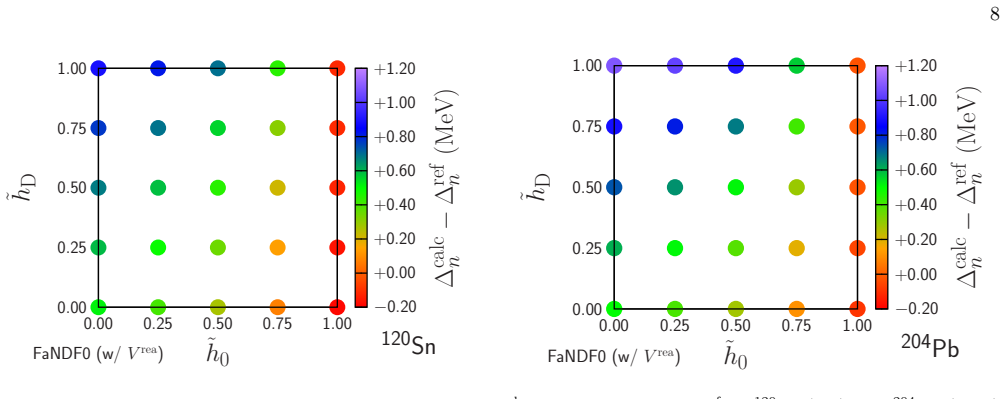
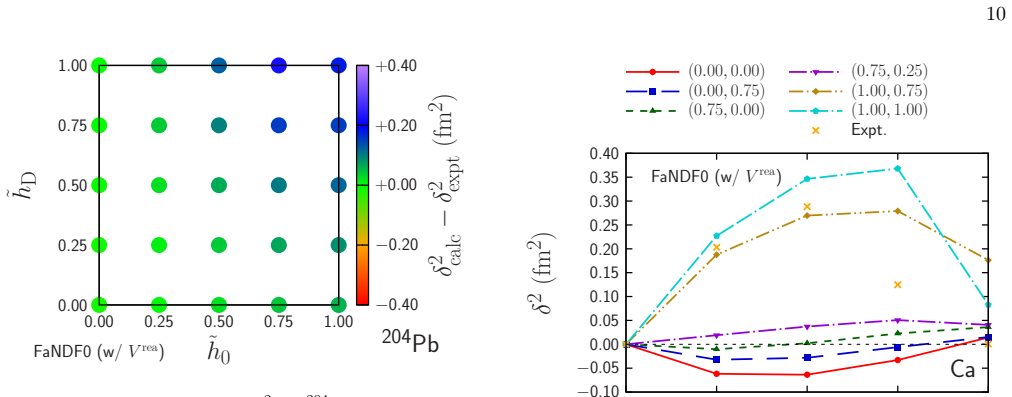
Determination of the overall strength The theoretical values obtained with FaNDF0 and the 25 different pairing parameters will be compared with the odd-even shifted three-point mass formula based on the experimental binding energyB(Z, N)[81, 82] of a nucleus withZprotons andNneutrons ∆n (Z, N) = B(Z, N+ 2)−2B(Z, N+ 1) +B(Z, N) 2 , (24) leading to ∆ref n (...
-
[7]
In the following, we select four pairs of ˜h0 and ˜hD among five interactions shown with⋆in Table III
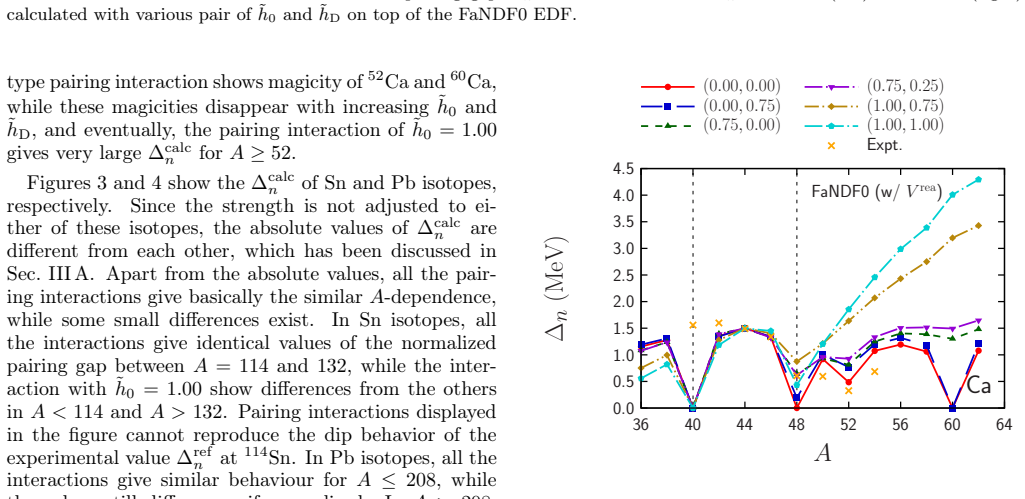
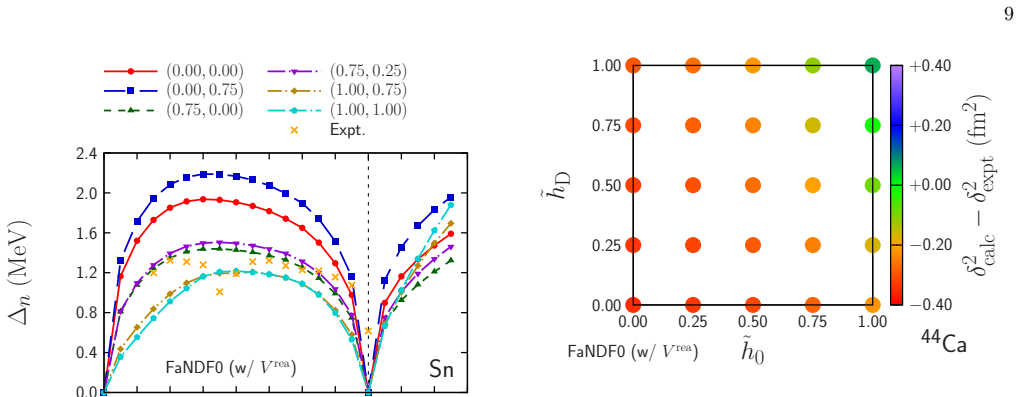
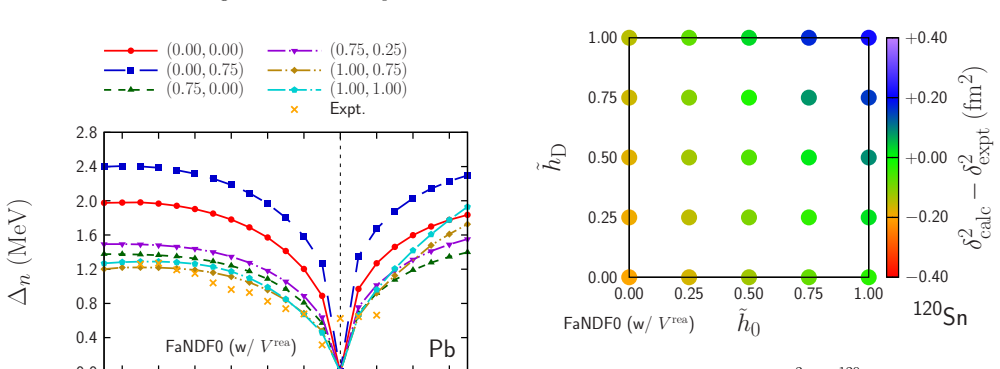
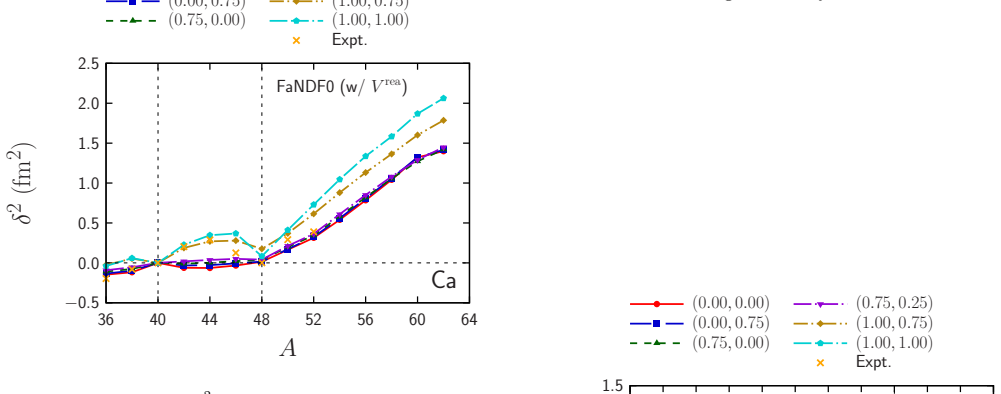
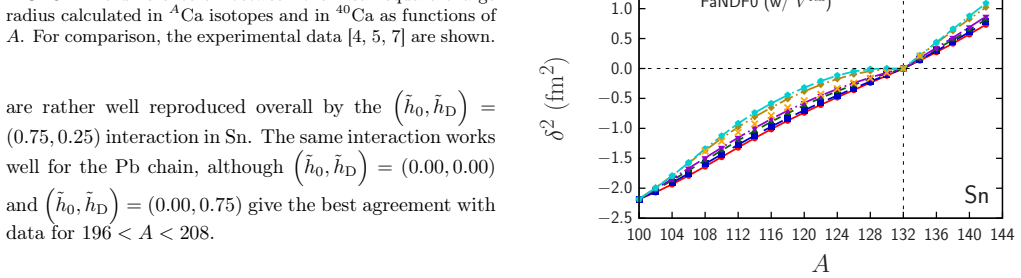
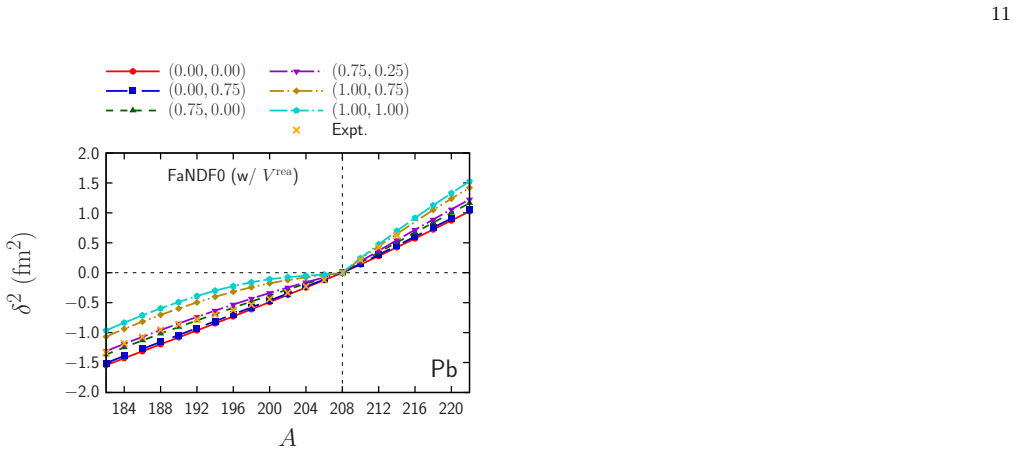
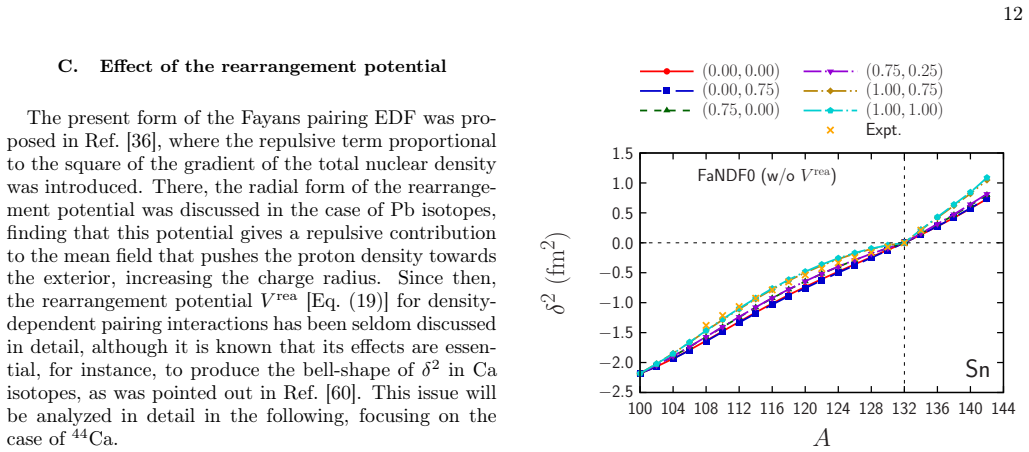
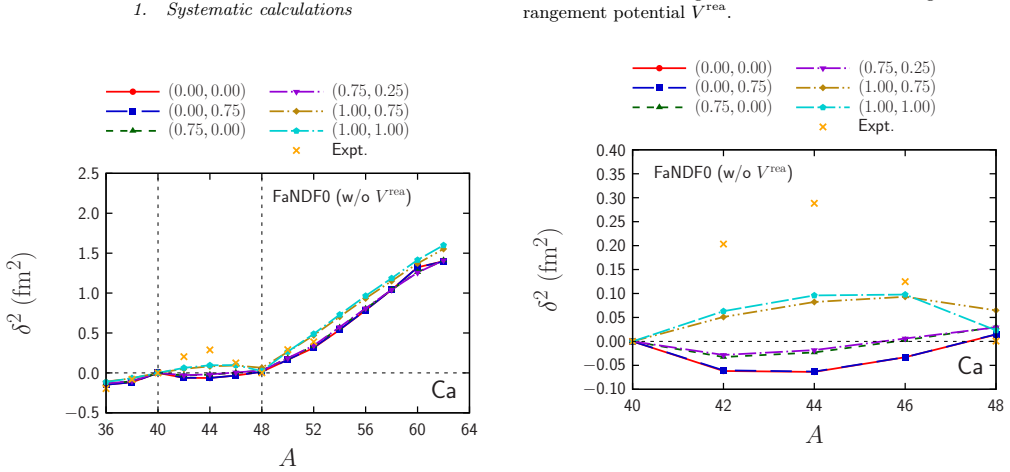
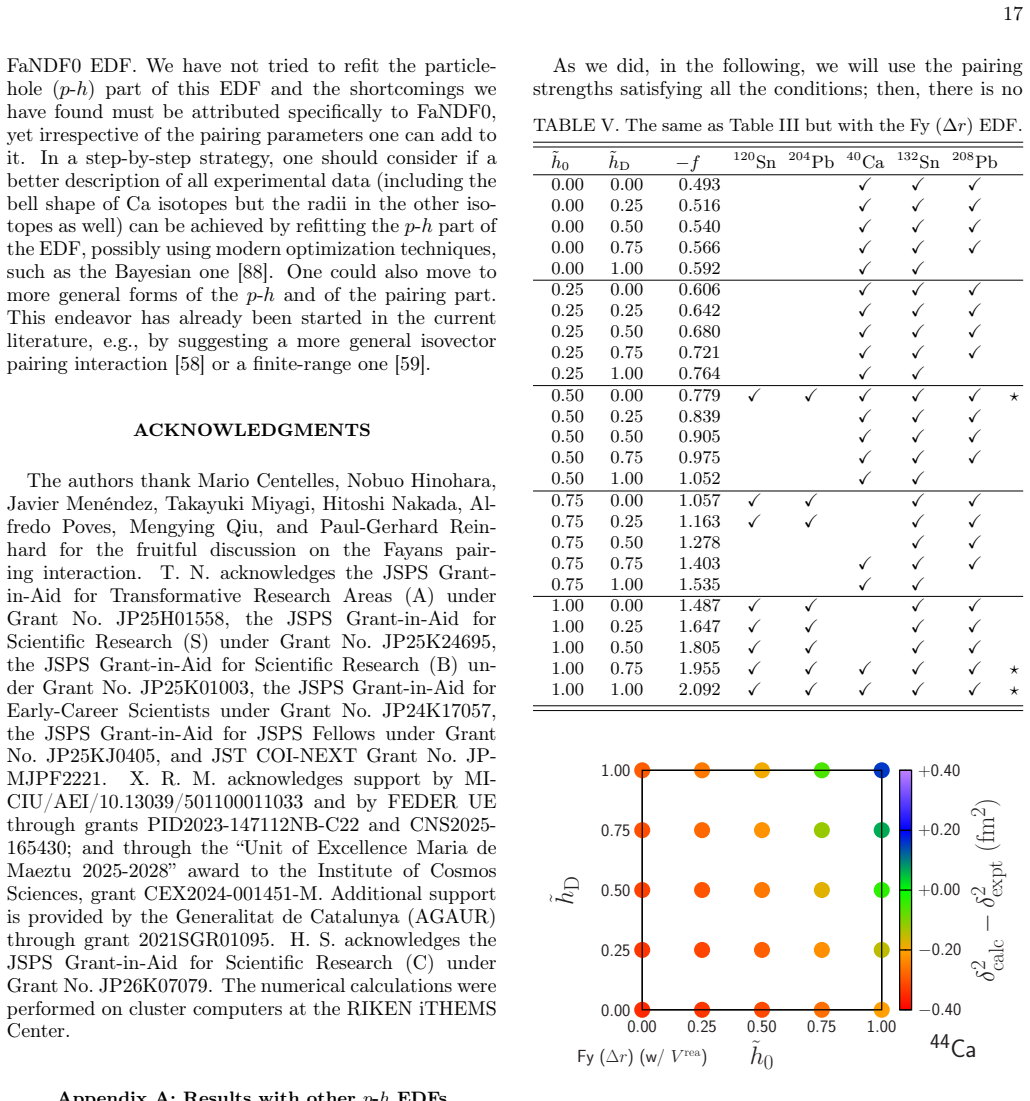
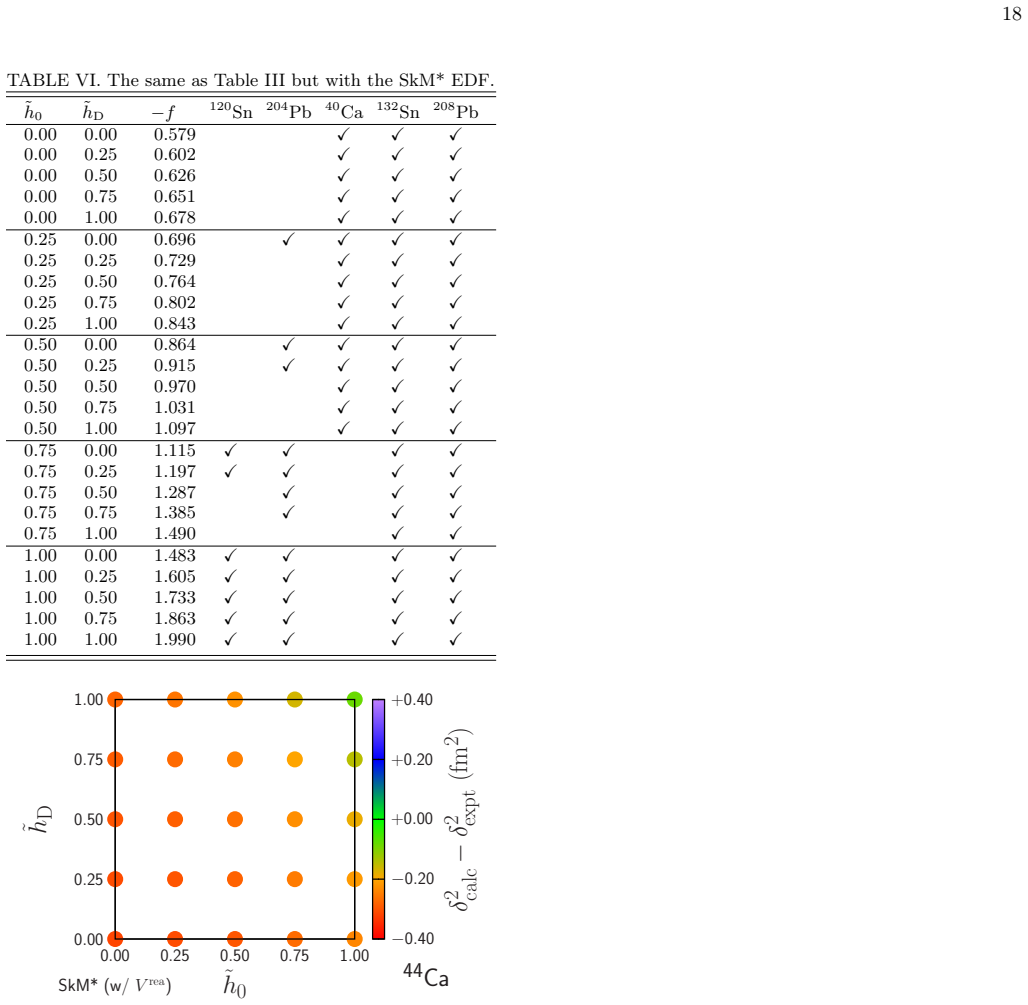
Systematic behaviour Next, we will show the systematic behaviour of the pairing gaps and the charge radii ofCa,Sn, andPbiso- topes. In the following, we select four pairs of ˜h0 and ˜hD among five interactions shown with⋆in Table III. We also use the volume-type pairing (˜h0 = 0.00and ˜hD = 0.00) as the representative of the conventional delta pairing int...
-
[8]
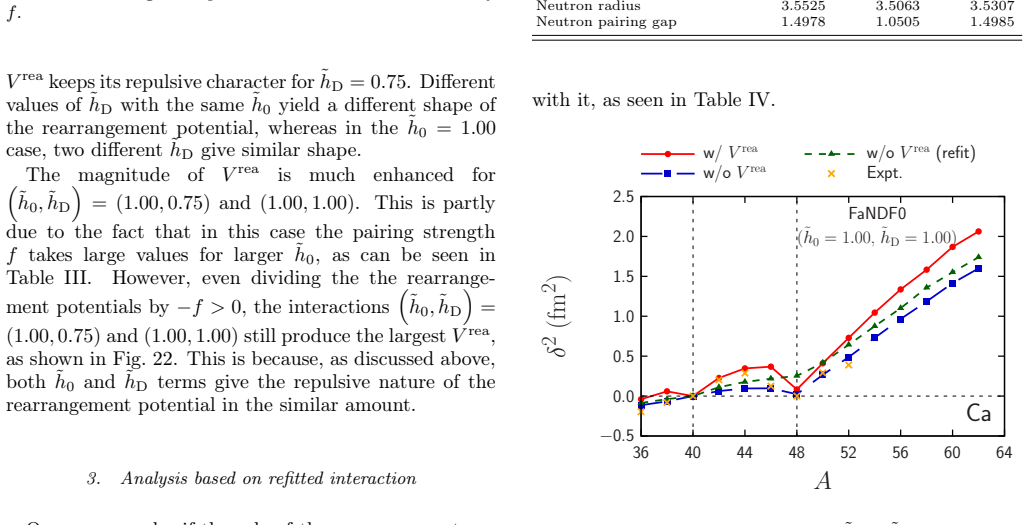
Systematic calculations −0.5 0.0 0.5 1.0 1.5 2.0 2.5 36 40 44 48 52 56 60 64 Ca FaNDF0 (w/o V rea) δ2 (fm2) A (0.00, 0.00) (0.00, 0.75) (0.75, 0.00) (0.75, 0.25) (1.00, 0.75) (1.00, 1.00) Efipt. FIG. 12. Same as Fig. 8 but without considering the rear- rangement potentialV rea. We perform a series of calculations without including V rea. The resultingδ2 of...
-
[9]
Wewill mostly consider the case corresponding to the parameters ˜h0 = ˜hD = 1.00, which enhance the effects ofVrea
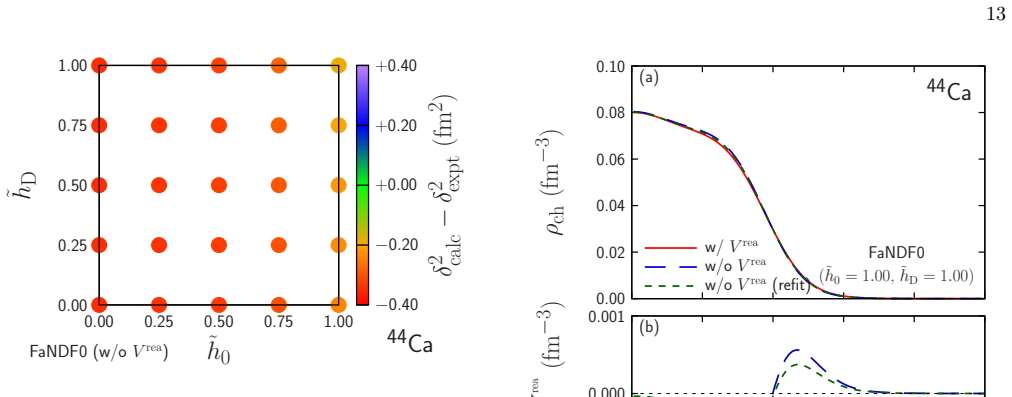
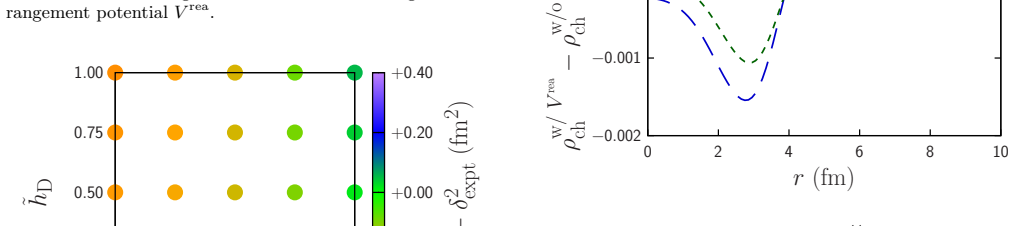
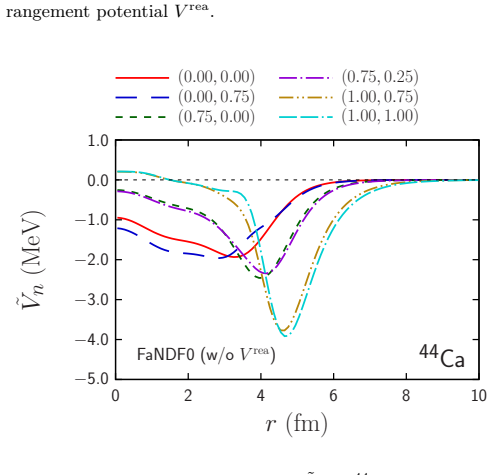
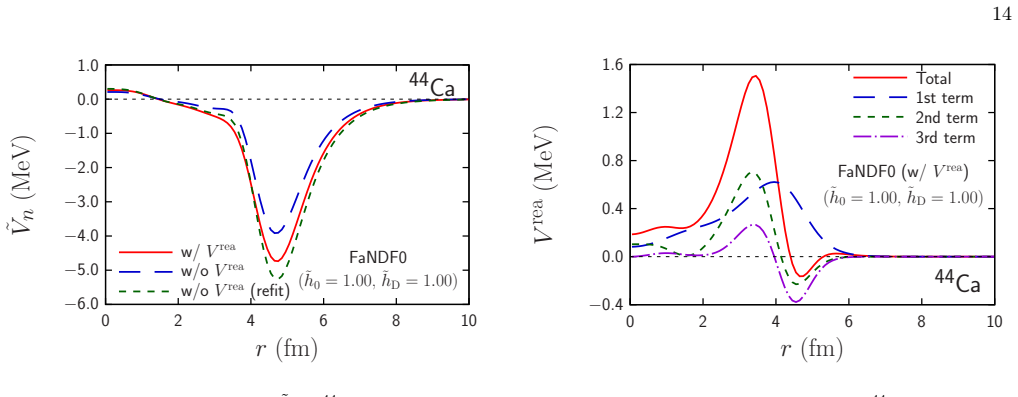
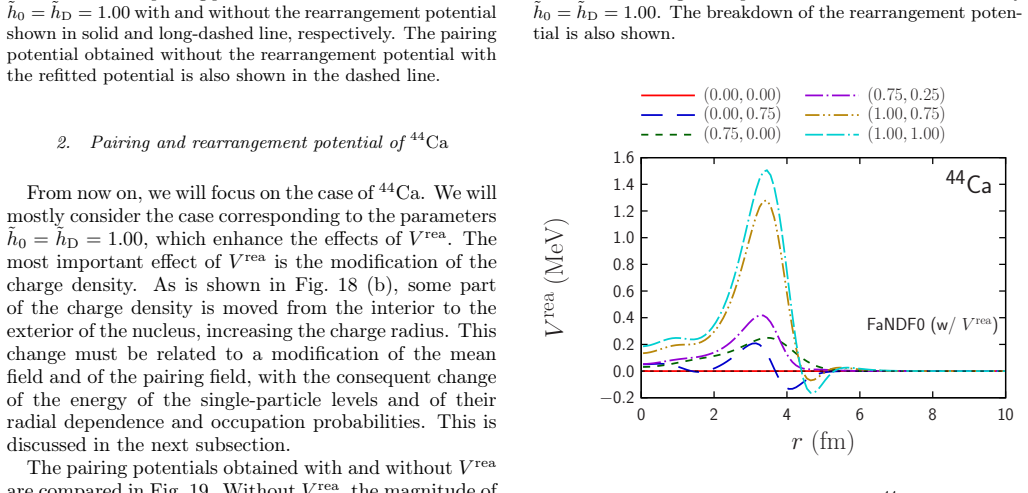
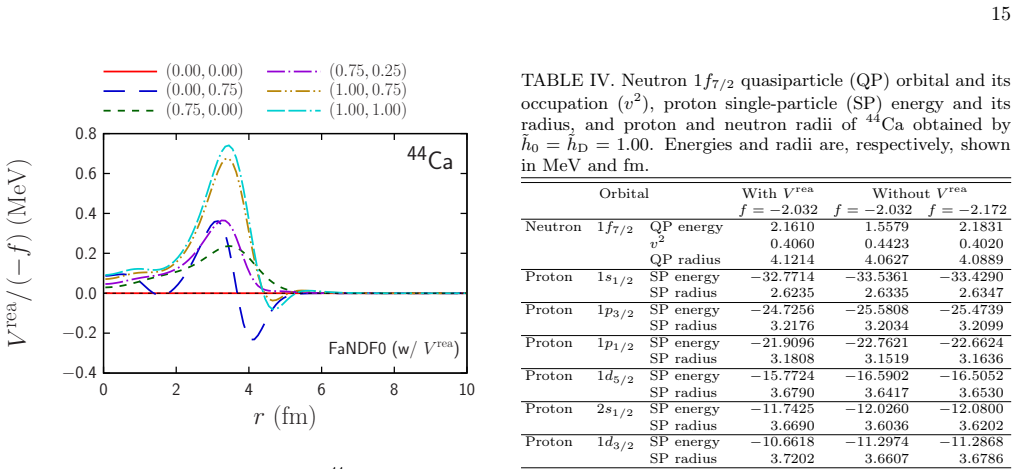
Pairing and rearrangement potential of44Ca Fromnowon, wewillfocusonthecaseof 44Ca. Wewill mostly consider the case corresponding to the parameters ˜h0 = ˜hD = 1.00, which enhance the effects ofVrea. The most important effect ofV rea is the modification of the charge density. As is shown in Fig. 18 (b), some part of the charge density is moved from the int...
-
[10]
In this subsection, we show that the latter does not hold, and a large fraction of the enhancement of the charge radius emerges genuinely by the rearrangement potential only
Analysis based on refitted interaction One may wonder if the role of the rearrangement po- tential is really unique, or instead if its effects can be mocked up by a different choice of the pairing strength. In this subsection, we show that the latter does not hold, and a large fraction of the enhancement of the charge radius emerges genuinely by the rearr...
2034
-
[11]
Brief summary about the rearrangement potential Summarizing, the strongest rearrangement potentials are obtained by adopting large values of˜h0 and ˜hD. Such V rea gives a repulsive contribution to the neutron and proton mean fields in the interior of the nucleus and an attractive contribution of smaller magnitude at its sur- face. This contribution is ac...
-
[12]
De Vries, C
H. De Vries, C. W. De Jager, and C. De Vries, Nu- clear charge-density-distribution parameters from elastic electron scattering, At. Data Nucl. Data Tables36, 495 (1987)
1987
-
[13]
Tsukada, A
K. Tsukada, A. Enokizono, T. Ohnishi, K. Adachi, T. Fu- jita, M. Hara, M. Hori, T. Hori, S. Ichikawa, K. Kurita, K. Matsuda, T. Suda, T. Tamae, M. Togasaki, M. Waka- sugi, M. Watanabe, and K. Yamada, First Elastic Elec- tron Scattering from132Xeat the SCRIT Facility, Phys. Rev. Lett.118, 262501 (2017)
2017
-
[14]
Tsukada, Y
K. Tsukada, Y. Abe, A. Enokizono, T. Goke, M. Hara, Y. Honda, T. Hori, S. Ichikawa, Y. Ito, K. Kurita, C. Legris, Y. Maehara, T. Ohnishi, R. Ogawara, T. Suda, T. Tamae, M. Wakasugi, M. Watanabe, and H. Wauke, First Observation of Electron Scattering from Online- Produced Radioactive Target, Phys. Rev. Lett.131, 092502 (2023)
2023
-
[15]
Angeli and K
I. Angeli and K. P. Marinova, Table of experimental nu- clear ground state charge radii: An update, At. Data Nucl. Data Tables99, 69 (2013)
2013
-
[16]
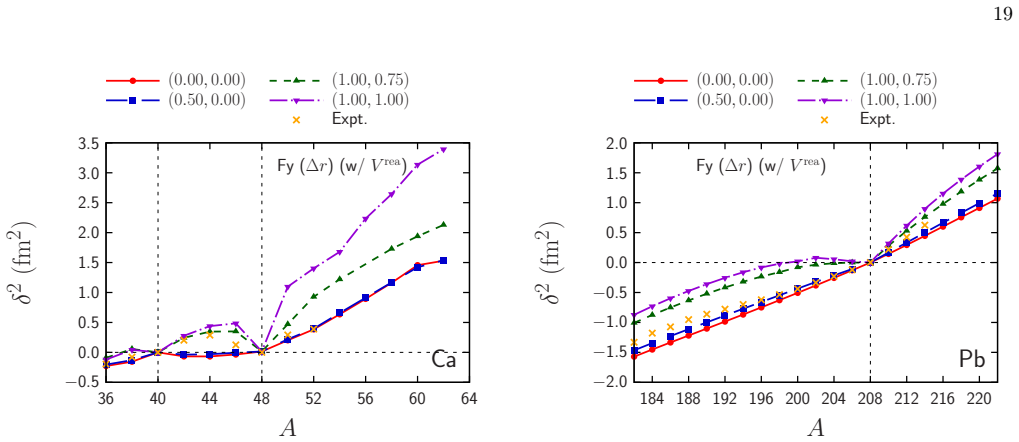
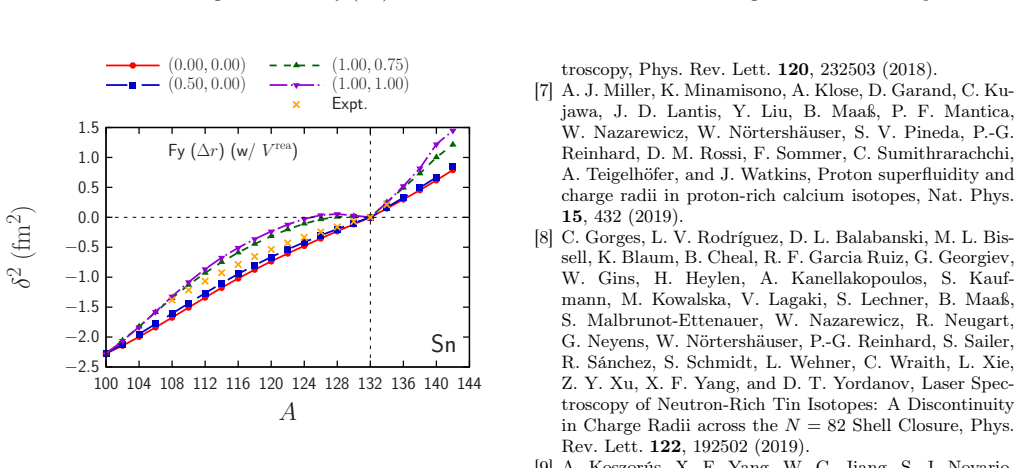
R. F. Garcia Ruiz, M. L. Bissell, K. Blaum, A. Ekström, N. Frömmgen, G. Hagen, M. Hammen, K. Hebeler, 19 −0.5 0.0 0.5 1.0 1.5 2.0 2.5 3.0 3.5 36 40 44 48 52 56 60 64 Ca Fy ( ∆r) (w/ V rea) δ2 (fm2) A (0.00ρ0.00) (0.50ρ0.00) (1.00ρ0.75) (1.00ρ1.00) Expfi. FIG. 26. Same as Fig. 8 but with Fy (∆r) EDF. −2.5 −2.0 −1.5 −1.0 −0.5 0.0 0.5 1.0 1.5 100 104 108 112 ...
2016
-
[17]
Raeder, D
S. Raeder, D. Ackermann, H. Backe, R. Beerwerth, J. C. Berengut, M. Block, A. Borschevsky, B. Cheal, P. Chhetri, C. E. Düllmann, V. A. Dzuba, E. Eliav, J. Even, R. Ferrer, V. V. Flambaum, S. Fritzsche, F. Gi- acoppo, S. Götz, F. P. Heßberger, M. Huyse, U. Kaldor, O. Kaleja, J. Khuyagbaatar, P. Kunz, M. Laatiaoui, F. Lautenschläger, W. Lauth, A. K. Mistry,...
2018
-
[18]
A.J.Miller, K.Minamisono, A.Klose, D.Garand, C.Ku- jawa, J. D. Lantis, Y. Liu, B. Maaß, P. F. Mantica, W. Nazarewicz, W. Nörtershäuser, S. V. Pineda, P.-G. Reinhard, D. M. Rossi, F. Sommer, C. Sumithrarachchi, A. Teigelhöfer, and J. Watkins, Proton superfluidity and charge radii in proton-rich calcium isotopes, Nat. Phys. 15, 432 (2019)
2019
-
[19]
Gorges, L
C. Gorges, L. V. Rodríguez, D. L. Balabanski, M. L. Bis- sell, K. Blaum, B. Cheal, R. F. Garcia Ruiz, G. Georgiev, W. Gins, H. Heylen, A. Kanellakopoulos, S. Kauf- mann, M. Kowalska, V. Lagaki, S. Lechner, B. Maaß, S. Malbrunot-Ettenauer, W. Nazarewicz, R. Neugart, G. Neyens, W. Nörtershäuser, P.-G. Reinhard, S. Sailer, R. Sánchez, S. Schmidt, L. Wehner, ...
2019
-
[20]
Koszorús, X
A. Koszorús, X. F. Yang, W. G. Jiang, S. J. Novario, S. W. Bai, J. Billowes, C. L. Binnersley, M. L. Bissell, T. E. Cocolios, B. S. Cooper, R. P. de Groote, A. Ek- ström, K. T. Flanagan, C. Forssén, S. Franchoo, R. F. Garcia Ruiz, F. P. Gustafsson, G. Hagen, G. R. Jansen, A. Kanellakopoulos, M. Kortelainen, W. Nazarewicz, G. Neyens, T. Papenbrock, P.-G. R...
2021
-
[21]
Day Goodacre, A
T. Day Goodacre, A. V. Afanasjev, A. E. Barzakh, B. A. Marsh, S. Sels, P. Ring, H. Nakada, A. N. Andreyev, P. Van Duppen, N. A. Althubiti, B. Andel, D. Atanasov, J. Billowes, K. Blaum, T. E. Cocolios, J. G. Cubiss, G. J. Farooq-Smith, D. V. Fedorov, V. N. Fedosseev, K. T. Flanagan, L. P. Gaffney, L. Ghys, M. Huyse, S. Kreim, D. Lunney, K. M. Lynch, V. Man...
2021
-
[22]
X. F. Yang, S. J. Wang, S. G. Wilkins, and R. F. Gar- cia Ruiz, Laser spectroscopy for the study of exotic nu- clei, Prog. Part. Nucl. Phys.129, 104005 (2023)
2023
-
[23]
Warbinek, E
J. Warbinek, E. Rickert, S. Raeder, T. Albrecht- Schönzart, B. Andelic, J. Auler, B. Bally, M. Ben- der, S. Berndt, M. Block, A. Brizard, P. Chauveau, B. Cheal, P. Chhetri, A. Claessens, A. de Roubin, C. De- vlin, H. Dorrer, C. E. Düllmann, J. Ezold, R. Fer- rer, V. Gadelshin, A. Gaiser, F. Giacoppo, S. Goriely, M. J. Gutiérrez, A. Harvey, R. Hasse, R. He...
2024
-
[24]
H. H. Xie, T. Naito, J. Li, and H. Liang, Revisiting the extraction of charge radii of40Caand 208Pbwith muonic atom spectroscopy, Phys. Lett. B846, 138232 (2023)
2023
-
[25]
H. H. Xie, J. Li, and H. Liang, Extraction of higher-order radial moments of nuclear charge density from muonic atom spectroscopy, Phys. Rev. C109, 034309 (2024)
2024
-
[26]
T. Y. Saito, M. Niikura, T. Matsuzaki, H. Saku- rai, M. Igashira, H. Imao, K. Ishida, T. Katabuchi, Y. Kawashima, M. K. Kubo, Y. Miyake, Y. Mori, K. Ninomiya, A. Sato, K. Shimomura, P. Strasser, A. Taniguchi, D. Tomono, and Y. Watanabe, Muonic x-ray measurement for the nuclear charge distribution: The case of stable palladium isotopes, Phys. Rev. C111, 03...
2025
-
[27]
Schunck, ed.,Energy Density Functional Methods for Atomic Nuclei(IOP Publishing, 2019)
N. Schunck, ed.,Energy Density Functional Methods for Atomic Nuclei(IOP Publishing, 2019)
2019
-
[28]
Colò, Nuclear density functional theory, Adv
G. Colò, Nuclear density functional theory, Adv. Phys.:X 5, 1740061 (2020)
2020
-
[29]
Roca-Maza and N
X. Roca-Maza and N. Paar, Nuclear equation of state from ground and collective excited state properties of nu- clei, Prog. Part. Nucl. Phys.101, 96 (2018)
2018
-
[30]
U. C. Perera, A. V. Afanasjev, and P. Ring, Charge radii in covariant density functional theory: A global view, Phys. Rev. C104, 064313 (2021)
2021
-
[31]
Naito, T
T. Naito, T. Oishi, H. Sagawa, and Z. Wang, Compara- tive study on charge radii and their kinks at magic num- bers, Phys. Rev. C107, 054307 (2023)
2023
-
[32]
Reinhard and H
P.-G. Reinhard and H. Flocard, Nuclear effective forces and isotope shifts, Nucl. Phys. A584, 467 (1995)
1995
-
[33]
Nakada, Irregularities in nuclear radii at magic num- bers, Phys
H. Nakada, Irregularities in nuclear radii at magic num- bers, Phys. Rev. C100, 044310 (2019)
2019
-
[34]
S.Marcos, R.Niembro,andM.López-Quelle,Relativistic effects on the kink of nuclear charge radii in lead, Eur. Phys. J. A60, 78 (2024)
2024
-
[35]
Marcos, R
S. Marcos, R. Niembro, and M. López-Quelle, Kink of the nuclear charge radius isotope shift and overlaps of the neutron and proton orbitals in lead, Nucl. Phys. A 1047, 122883 (2024)
2024
-
[36]
Miyagi, S
T. Miyagi, S. R. Stroberg, J. D. Holt, and N. Shimizu, Ab initiomultishell valence-space Hamiltonians and the island of inversion, Phys. Rev. C102, 034320 (2020)
2020
-
[37]
Heinz, T
M. Heinz, T. Miyagi, S. R. Stroberg, A. Tichai, K. Hebeler, and A. Schwenk, Improved structure of cal- cium isotopes fromab initiocalculations, Phys. Rev. C 111, 034311 (2025)
2025
-
[38]
Bender, P.-H
M. Bender, P.-H. Heenen, and P.-G. Reinhard, Self- consistent mean-field models for nuclear structure, Rev. Mod. Phys.75, 121 (2003)
2003
-
[39]
V. A. Khodel, A. P. Platonov, and E. E. Saperstein, On the 40Ca–48Caisotope shift, J. Phys.G8, 967 (1982)
1982
-
[40]
V. A. Khodel, E. E. Saperstein, and M. V. Zverev, Ef- fects of mass operator energy dependence in atomic nu- clei: Quasiparticle lagrangian versus quasiparticle hamil- tonian, Nucl. Phys. A465, 397 (1987)
1987
-
[41]
S. A. Fayans, E. L. Trykov, and D. Zawischa, Influence of effective spin-orbit interaction on the collective states of nuclei, Nucl. Phys. A568, 523 (1994)
1994
-
[42]
W. Kim, J. P. Connelly, J. H. Heisenberg, F. W. Hers- man, T. E. Milliman, J. E. Wise, C. N. Papanicolas, S. A. Fayans, and A. P. Platonov, Ground-state charge distri- bution and transition charge densities of the low-lying states in 86Sr, Phys. Rev. C46, 1656 (1992)
1992
-
[43]
I. N. Borzov, S. A. Fayans, E. Krömer, and D. Zawischa, Groundstate properties andβ-decay half-lives near132Sn in a self-consistent theory, Z. Phys. A355, 117 (1996)
1996
-
[44]
I. N. Borzov, Beta-decay of nuclei near the neutron shell N= 126, Phys. At. Nucl.74, 1435 (2011)
2011
-
[45]
G. F. Bertsch and H. Esbensen, Pair correlations near the neutron drip line, Ann. Phys.209, 327 (1991)
1991
-
[46]
S. A. Fayans, S. V. Tolokonnikov, E. L. Trykov, and D. Zawischa, Isotope shifts within the energy-density functional approach with density dependent pairing, Phys. Lett. B338, 1 (1994)
1994
-
[47]
S. A. Fayans and D. Zawischa, Towards a better parametrization of the nuclear pairing force: density dependence with gradient term, Phys. Lett. B383, 19 (1996)
1996
-
[48]
S. A. Fayans, S. V. Tolokonnikov, E. L. Trykov, and D. Zawischa, Nuclear isotope shifts within the local energy-density functional approach, Nucl. Phys. A676, 49 (2000)
2000
-
[49]
E. E. Saperstein and S. V. Tolokonnikov, Self-consistent theory of finite Fermi systems and Skyrme–Hartree–Fock method, Phys. At. Nucl.79, 1030 (2016)
2016
-
[50]
I. N. Borzov and S. V. Tolokonnikov, Self-Consistent Study of Nuclear Charge Radii in Ar–Ti Region, Phys. At. Nucl.85, 222 (2022)
2022
-
[51]
I. N. Borzov and S. V. Tolokonnikov, Self-Consistent Cal- culation of Nuclear Charge Radii inKIsotopes, Phys. Part. Nucl.54, 586 (2023)
2023
-
[52]
I. N. Borzov and S. V. Tolokonnikov, Fayans Functional: Self-Consistent Description of Isospin Excitations, Phys. At. Nucl.83, 24 (2020)
2020
-
[53]
I. N. Borzov, Global Calculations of Beta-Decay Proper- ties Based on the Fayans Functional, Phys. At. Nucl.83, 700 (2020)
2020
-
[54]
I. N. Borzov and S. V. Tolokonnikov, Spin-Dipole Strengths and Neutron Skin Thickness of 90Zr, 132Sn, 208Pb, Phys. At. Nucl.87, 541 (2024). 21
2024
-
[55]
S. A. Fayans, Towards a universal nuclear density func- tional, JETP Lett.68, 169 (1998)
1998
-
[56]
S. V. Tolokonnikov, I. N. Borzov, M. Kortelainen, Y. S. Lutostansky, and E. E. Saperstein, First applications of the Fayans functional to deformed nuclei, J. Phys. G42, 075102 (2015)
2015
-
[57]
E. E. Saperstein, I. N. Borzov, Y. S. Lutostansky, and S. V. Tolokonnikov, Two-neutron drip line for heavy nu- clei calculated with the Fayans functional, JETP Lett. 102, 421 (2015), Pis’ma Zh. Éksp. Teor. Fiz. 102, 475 (2015)
2015
-
[58]
S. V. Tolokonnikov, I. N. Borzov, Y. S. Lutostansky, and E. E. Saperstein, Deformation properties of lead isotopes, Phys. At. Nucl.79, 21 (2016)
2016
-
[59]
Reinhard and W
P.-G. Reinhard and W. Nazarewicz, Toward a global de- scription of nuclear charge radii: Exploring the Fayans energy density functional, Phys. Rev. C95, 064328 (2017)
2017
-
[60]
Hammen, W
M. Hammen, W. Nörtershäuser, D. L. Balabanski, M. L. Bissell, K. Blaum, I. Budinčević, B. Cheal, K. T. Flana- gan, N. Frömmgen, G. Georgiev, C. Geppert, M. Kowal- ska, K. Kreim, A. Krieger, W. Nazarewicz, R. Neugart, G. Neyens, J. Papuga, P.-G. Reinhard, M. M. Rajabali, S. Schmidt, and D. T. Yordanov, From Calcium to Cad- mium: Testing the Pairing Functio...
2018
-
[61]
Geldhof, M
S. Geldhof, M. Kortelainen, O. Beliuskina, P. Campbell, L. Caceres, L. Cañete, B. Cheal, K. Chrysalidis, C. S. De- vlin, R. P. de Groote, A. de Roubin, T. Eronen, Z. Ge, W. Gins, A. Koszorus, S. Kujanpää, D. Nesterenko, A. Ortiz-Cortes, I. Pohjalainen, I. D. Moore, A. Rag- gio, M. Reponen, J. Romero, and F. Sommer, Impact of Nuclear Deformation and Pairin...
2022
-
[62]
Reponen, R
M. Reponen, R. P. de Groote, L. Al Ayoubi, O. Be- liuskina, M. L. Bissell, P. Campbell, L. Cañete, B. Cheal, K. Chrysalidis, C. Delafosse, A. de Roubin, C. S. De- vlin, T. Eronen, R. F. Garcia Ruiz, S. Geldhof, W. Gins, M. Hukkanen, P. Imgram, A. Kankainen, M. Korte- lainen, A. Koszorús, S. Kujanpää, R. Mathieson, D. A. Nesterenko, I. Pohjalainen, M. Vilé...
2021
-
[63]
J. Hur, D. P. L. Aude Craik, I. Counts, E. Knyazev, L. Caldwell, C. Leung, S. Pandey, J. C. Berengut, A. Geddes, W. Nazarewicz, P.-G. Reinhard, A. Kawasaki, H. Jeon, W. Jhe, and V. Vuletić, Evidence of Two-Source King Plot Nonlinearity in Spectroscopic Search for New Boson, Phys. Rev. Lett. 128, 163201 (2022)
2022
-
[64]
Sommer, K
F. Sommer, K. König, D. M. Rossi, N. Everett, D. Garand, R. P. de Groote, J. D. Holt, P. Imgram, A. Incorvati, C. Kalman, A. Klose, J. Lantis, Y. Liu, A. J. Miller, K. Minamisono, T. Miyagi, W. Nazarewicz, W. Nörtershäuser, S. V. Pineda, R. Powel, P.-G. Reinhard, L. Renth, E. Romero-Romero, R. Roth, A. Schwenk, C. Sumithrarachchi, and A. Teigelhöfer, Char...
2022
-
[65]
Malbrunot-Ettenauer, S
S. Malbrunot-Ettenauer, S. Kaufmann, S. Bacca, C. Bar- bieri, J. Billowes, M. L. Bissell, K. Blaum, B. Cheal, T. Duguet, R. F. G. Ruiz, W. Gins, C. Gorges, G. Hagen, H. Heylen, J. D. Holt, G. R. Jansen, A. Kanellakopoulos, M. Kortelainen, T. Miyagi, P. Navrátil, W. Nazarewicz, R. Neugart, G. Neyens, W. Nörtershäuser, S. J. Novario, T. Papenbrock, T. Rataj...
2022
-
[66]
König, S
K. König, S. Fritzsche, G. Hagen, J. D. Holt, A. Klose, J. Lantis, Y. Liu, K. Minamisono, T. Miyagi, W. Nazarewicz, T. Papenbrock, S. V. Pineda, R. Powel, and P.-G. Reinhard, Surprising Charge-Radius Kink in the Sc Isotopes atN= 20, Phys. Rev. Lett.131, 102501 (2023)
2023
-
[67]
Karthein, C
J. Karthein, C. M. Ricketts, R. F. Garcia Ruiz, J. Bil- lowes, C. L. Binnersley, T. E. Cocolios, J. Dobaczewski, G. J. Farooq-Smith, K. T. Flanagan, G. Georgiev, W. Gins, R. P. de Groote, F. P. Gustafsson, J. D. Holt, A. Kanellakopoulos, A. Koszorús, D. Leimbach, K. M. Lynch, T. Miyagi, W. Nazarewicz, G. Neyens, P.-G. Reinhard, B. K. Sahoo, A. R. Vernon, ...
2024
-
[68]
Dobaczewski, W
J. Dobaczewski, W. Nazarewicz, T. R. Werner, J. F. Berger, C. R. Chinn, and J. Dechargé, Mean-field de- scription of ground-state properties of drip-line nuclei: Pairing and continuum effects, Phys. Rev. C53, 2809 (1996)
1996
-
[69]
Reinhard, J
P.-G. Reinhard, J. O’Neal, S. M. Wild, and W. Nazarewicz, Extended Fayans energy density functional: optimization and analysis, J. Phys. G51, 105101 (2024)
2024
-
[70]
Lalit, P.-G
S. Lalit, P.-G. Reinhard, K. Godbey, and W. Nazarewicz, Finite-range pairing in nuclear density functional theory, Phys. Rev. C113, 054310 (2026)
2026
-
[71]
Inakura, N
T. Inakura, N. Hinohara, and H. Nakada, Radial and orbital decomposition of charge radii of Ca nuclei: Com- parative study of Skyrme and Fayans functionals, Phys. Rev. C110, 054315 (2024)
2024
-
[72]
F.BarrancoandR.A.Broglia,Correlationbetweenmean square radii and zero-point motions of the surface in the Caisotopes, Phys. Lett. B151, 90 (1985)
1985
-
[73]
G. Co’, M. Anguiano, and A. M. Lallena, Charge radii of Ca isotopes and correlations, Phys. Rev. C105, 034320 (2022)
2022
-
[74]
B.A.BrownandK.Minamisono,β 2 correctionstospher- ical energy-density functional calculations for root-mean- square charge radii, Phys. Rev. C106, L011304 (2022)
2022
-
[75]
H.H.Xie, J.Li, Y.L.Yang,andP.W.Zhao,Chargeradii of calcium isotopes within relativistic density functional theory: The finite size of the nucleon and quadrupole shape-fluctuation effects, Phys. Rev. C112, L021303 (2025)
2025
-
[76]
Caurier, K
E. Caurier, K. Langanke, G. Martínez-Pinedo, F. Nowacki, and P. Vogel, Shell model description of isotope shifts in calcium, Phys. Lett. B522, 240 (2001)
2001
-
[77]
Poves, Private communications
A. Poves, Private communications
-
[78]
Miyagi, Nuclear radii from first principles, Front
T. Miyagi, Nuclear radii from first principles, Front. Phys.13, 1581854 (2025)
2025
-
[79]
Dobaczewski, H
J. Dobaczewski, H. Flocard, and J. Treiner, Hartree- 22 Fock-Bogolyubov description of nuclei near the neutron- drip line, Nucl. Phys. A422, 103 (1984)
1984
-
[80]
Chabanat, P
E. Chabanat, P. Bonche, P. Haensel, J. Meyer, and R. Schaeffer, A Skyrme parametrization from subnuclear to neutron star densities Part II. Nuclei far from stabili- ties, Nucl. Phys. A635, 231 (1998)
1998
discussion (0)
Sign in with ORCID, Apple, or X to comment. Anyone can read and Pith papers without signing in.